Entity Binding Failures in Tool-Augmented Agents
Pith reviewed 2026-06-30 06:01 UTC · model grok-4.3
The pith
Tool-augmented agents must bind natural-language references to the correct real-world entities before acting, beyond merely selecting the right tool.
A machine-rendered reading of the paper's core claim, the machinery that carries it, and where it could break.
Core claim
Entity binding failures occur when an agent selects the right tool yet contacts the wrong Alex, attaches the wrong launch document, replies in the wrong thread, or updates the wrong customer account. The work formalizes the separation of tool correctness from entity correctness, introduces a taxonomy of wrong-entity failures in enterprise workflows, and shows that entity-aware execution mechanisms eliminate wrong-entity actions and risk-weighted exposure in a controlled evaluation, although they reduce direct task completion by deferring under ambiguity.
What carries the argument
Entity binding mechanisms (entity-resolution preconditions, confidence-gated binding, clarification under ambiguity, and provenance tracking) that enforce correct mapping from natural-language references to real-world entities prior to tool execution.
If this is right
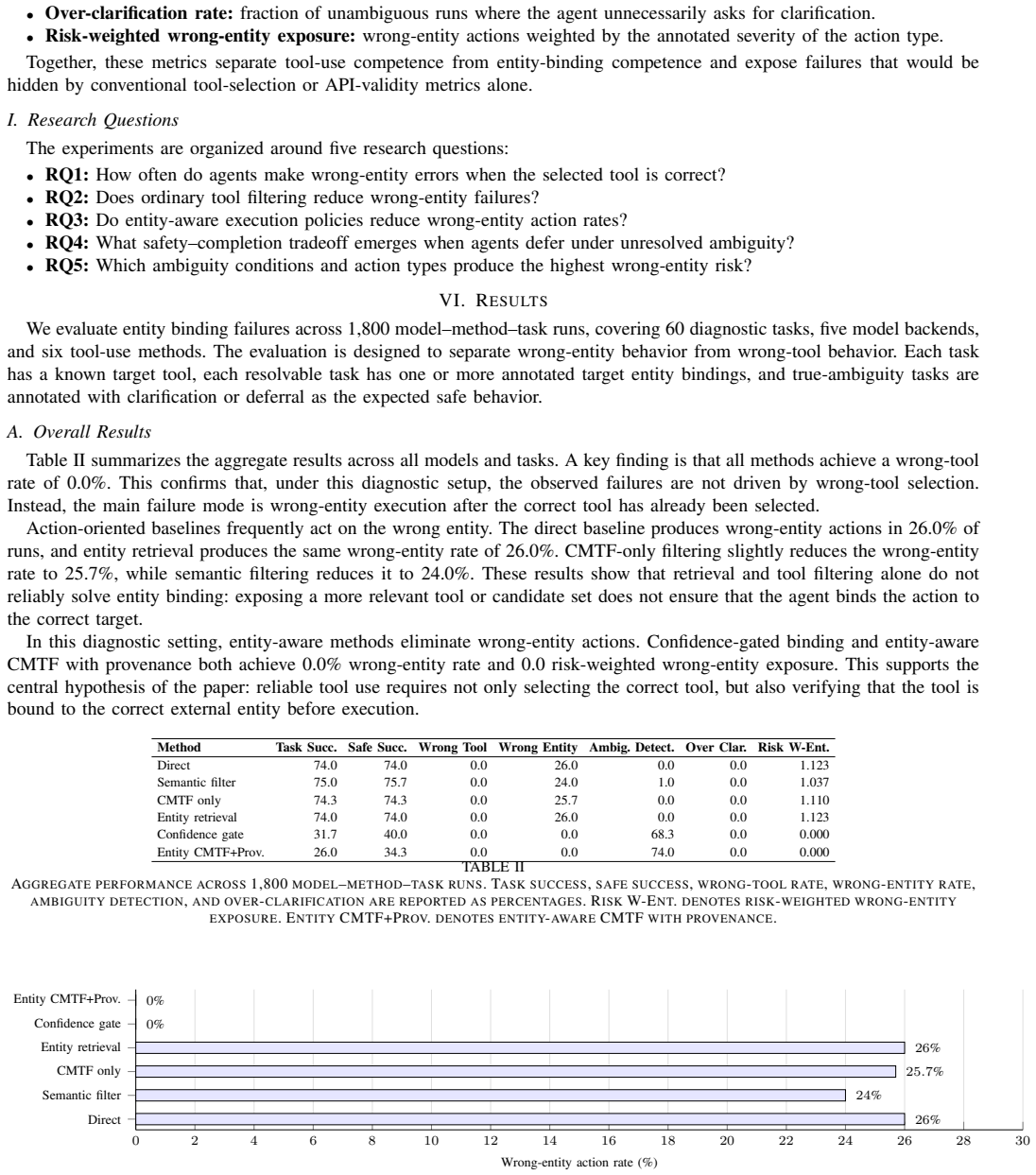
- Wrong-entity actions form a failure mode independent of tool selection errors, persisting at 24-26 percent even when wrong-tool error is zero.
- Entity-aware methods can drive wrong-entity actions and risk-weighted exposure to zero in the tested setting.
- Clarification and deferral under ambiguity trade reduced direct task completion for lower risk exposure.
- A taxonomy of failures covers distinct cases including wrong contact, wrong document, wrong thread, and wrong account.
Where Pith is reading between the lines
- Benchmarks limited to tool selection accuracy or overall task success would miss this class of errors.
- Production systems may require integration with external entity resolution services to support the binding step.
- Frequent clarification requests could raise user interaction costs in ambiguous natural-language instructions.
Load-bearing premise
The controlled diagnostic evaluation across 60 tasks accurately captures the prevalence and impact of entity binding failures in real enterprise workflows.
What would settle it
Measuring wrong-entity action rates and the effect of entity-aware methods on live enterprise tool deployments with actual user queries and external systems would confirm or refute the reported baseline rates and elimination results.
Figures

read the original abstract
Tool-augmented language-model agents are often evaluated by whether they select the correct tool, produce valid API arguments, and complete the requested task. However, an agent may choose the right tool and still act on the wrong external entity. For example, a request to "email Alex about the launch" may lead the agent to contact the wrong Alex, attach the wrong launch document, reply in the wrong thread, or update the wrong customer account. We call these errors entity binding failures. This paper studies entity binding failures as a distinct reliability and safety problem in tool-augmented agents. We formalize the separation between tool correctness and entity correctness, introduce a taxonomy of wrong-entity failures in enterprise workflows, and evaluate entity-aware execution mechanisms including entity-resolution preconditions, confidence-gated binding, clarification under ambiguity, and provenance tracking. In a controlled diagnostic evaluation across 60 tasks, five model backends, and six tool-use methods, all methods achieved 0.0 percent wrong-tool error, yet action-oriented baselines still produced wrong-entity actions in 24.0-26.0 percent of runs. Entity-aware methods eliminated wrong-entity actions and risk-weighted wrong-entity exposure in this setting, but reduced direct task completion by deferring under ambiguity. These findings show that safe tool use requires not only selecting the correct tool, but also reliably binding natural-language references to the correct real-world entity before action.
Editorial analysis
A structured set of objections, weighed in public.
Referee Report
Summary. The paper claims that tool-augmented LM agents can select the correct tool yet still fail by acting on the wrong real-world entity (termed entity binding failures). It formalizes the separation of tool correctness from entity correctness, introduces a taxonomy of such failures in enterprise workflows, and reports a controlled evaluation across 60 tasks, five model backends, and six methods in which all approaches achieve 0% wrong-tool error while baselines produce 24-26% wrong-entity actions; entity-aware mechanisms (resolution preconditions, confidence gating, clarification, provenance) eliminate the latter errors but reduce direct task completion by deferring under ambiguity.
Significance. If the results hold, the work usefully isolates a distinct reliability and safety issue in tool use that is not captured by standard tool-selection metrics. The formal distinction and taxonomy provide a clear conceptual contribution. The multi-backend, multi-method diagnostic evaluation supplies concrete quantitative evidence of the problem and of mitigation trade-offs; this empirical grounding is a strength.
major comments (2)
- [Evaluation setup and results] The controlled diagnostic evaluation (abstract and §4) reports 0% wrong-tool and 24-26% wrong-entity rates yet supplies no information on task construction, sampling procedure, reference ambiguity density, or entity count per workflow. Because the central claim is that entity binding is a distinct and prevalent problem for safe tool use in enterprise settings, the absence of these details makes it impossible to determine whether the observed rates and the reported trade-off (error elimination vs. deferred completion) are artifacts of the diagnostic design rather than inherent properties of tool-augmented agents.
- [Evaluation setup and results] The claim that entity-aware methods 'eliminated wrong-entity actions and risk-weighted wrong-entity exposure in this setting' (abstract) is load-bearing for the recommendation of those mechanisms; without the missing task-construction details, the result cannot be assessed for robustness outside deliberately ambiguous diagnostic tasks.
minor comments (2)
- [Abstract] Clarify in the abstract or introduction whether the 60 tasks were designed with injected ambiguity or drawn from naturalistic logs; this directly affects interpretation of the error rates.
- [Taxonomy section] The taxonomy of wrong-entity failures is introduced but not illustrated with concrete examples tied to the 60-task set; adding one or two such examples would improve readability.
Simulated Author's Rebuttal
We thank the referee for highlighting the need for greater transparency in the evaluation setup. The comments correctly identify that the current manuscript provides insufficient detail on task construction to allow readers to assess whether the reported error rates and mitigation trade-offs are robust or diagnostic artifacts. We address each point below and will revise the manuscript accordingly.
read point-by-point responses
-
Referee: The controlled diagnostic evaluation (abstract and §4) reports 0% wrong-tool and 24-26% wrong-entity rates yet supplies no information on task construction, sampling procedure, reference ambiguity density, or entity count per workflow. Because the central claim is that entity binding is a distinct and prevalent problem for safe tool use in enterprise settings, the absence of these details makes it impossible to determine whether the observed rates and the reported trade-off (error elimination vs. deferred completion) are artifacts of the diagnostic design rather than inherent properties of tool-augmented agents.
Authors: We agree that the absence of these details limits the ability to evaluate the results. In the revised version we will expand the description of the evaluation in §4 (and add a new appendix if needed) to specify: (1) the procedure used to sample the 60 tasks from a library of enterprise workflow templates, (2) how reference ambiguity density was controlled (including the fraction of tasks containing multiple candidate entities for the same role), and (3) the distribution of entity counts per workflow. These additions will make it possible to judge whether the observed 24-26% wrong-entity rate is an artifact of the chosen diagnostic distribution. revision: yes
-
Referee: The claim that entity-aware methods 'eliminated wrong-entity actions and risk-weighted wrong-entity exposure in this setting' (abstract) is load-bearing for the recommendation of those mechanisms; without the missing task-construction details, the result cannot be assessed for robustness outside deliberately ambiguous diagnostic tasks.
Authors: We accept that the load-bearing claim cannot be properly assessed without the missing details. The revision described above will also include quantitative characterization of the ambiguity levels present in the 60 tasks (e.g., average number of distractor entities per reference and the distribution of ambiguity types from the taxonomy). This will allow readers to determine the conditions under which the entity-aware mechanisms achieve elimination of wrong-entity actions. revision: yes
Circularity Check
No circularity: empirical introduction of entity-binding concept with independent evaluation
full rationale
The paper is an empirical diagnostic study that introduces the entity-binding failure concept, formalizes a tool-vs-entity correctness separation, presents a taxonomy, and reports error rates from a 60-task controlled evaluation across models and methods. No equations, fitted parameters, predictions derived from inputs, or self-citations appear in the provided text. The central claims rest on observed experimental outcomes rather than any reduction to prior self-referential results or definitions. The evaluation is presented as a controlled diagnostic rather than a general derivation, making the work self-contained against external benchmarks.
Axiom & Free-Parameter Ledger
axioms (1)
- domain assumption Entity binding can be evaluated independently of tool selection in agent workflows.
invented entities (1)
-
entity binding failures
no independent evidence
Reference graph
Works this paper leans on
-
[1]
Toolformer: Language Models Can Teach Themselves to Use Tools
T. Schick, J. Dwivedi-Yu, R. Dess‘i, R. Raileanu, M. Lomeli, E. Hambro, L. Zettlemoyer, N. Cancedda, and T. Scialom, “Toolformer: Language models can teach themselves to use tools,”arXiv preprint arXiv:2302.04761, 2023
work page internal anchor Pith review Pith/arXiv arXiv 2023
-
[2]
ReAct: Synergizing Reasoning and Acting in Language Models
S. Yao, J. Zhao, D. Yu, N. Du, I. Shafran, K. Narasimhan, and Y . Cao, “React: Synergizing reasoning and acting in language models,”arXiv preprint arXiv:2210.03629, 2023
work page internal anchor Pith review Pith/arXiv arXiv 2023
-
[3]
ToolLLM: Facilitating Large Language Models to Master 16000+ Real-world APIs
Y . Qin, S. Liang, Y . Ye, K. Zhu, L. Yan, Y . Lu, Y . Lin, X. Cong, X. Tang, B. Qian, S. Zhao, R. Tian, R. Xie, J. Zhou, M. Gerstein, D. Li, Z. Liu, and M. Sun, “ToolLLM: Facilitating large language models to master 16000+ real-world apis,”arXiv preprint arXiv:2307.16789, 2023
work page internal anchor Pith review Pith/arXiv arXiv 2023
-
[4]
Api-bank: A comprehensive benchmark for tool-augmented llms,
M. Li, Y . Zhao, B. Yu, F. Song, H. Li, H. Yu, Z. Li, F. Huang, and Y . Li, “Api-bank: A comprehensive benchmark for tool-augmented llms,” in Proceedings of the 2023 Conference on Empirical Methods in Natural Language Processing, 2023
2023
-
[5]
Gorilla: Large Language Model Connected with Massive APIs
S. G. Patil, T. Zhang, X. Wang, and J. E. Gonzalez, “Gorilla: Large language model connected with massive apis,”arXiv preprint arXiv:2305.15334, 2023
work page internal anchor Pith review Pith/arXiv arXiv 2023
-
[6]
$\tau$-bench: A Benchmark for Tool-Agent-User Interaction in Real-World Domains
S. Yao, N. Shinn, P. Razavi, and K. Narasimhan, “τ-bench: A benchmark for tool-agent-user interaction in real-world domains,”arXiv preprint arXiv:2406.12045, 2024
work page internal anchor Pith review Pith/arXiv arXiv 2024
-
[7]
ToolChoiceConfusion: Causal Minimal Tool Filtering for Reliable LLM Agents
R. S. Babu and L. G. Iyer, “ToolChoiceConfusion: Causal minimal tool filtering for reliable llm agents,”arXiv preprint arXiv:2606.06284, 2026
work page internal anchor Pith review Pith/arXiv arXiv 2026
-
[8]
ToolMenuBench: Benchmarking tool-menu filtering strategies for reliable and efficient llm agents,
——, “ToolMenuBench: Benchmarking tool-menu filtering strategies for reliable and efficient llm agents,”arXiv preprint arXiv:2606.15508, 2026
-
[9]
Contract2Tool: Learning Preconditions and Effects for Reliable Tool-Augmented LLM Agents
——, “Contract2Tool: Learning preconditions and effects for reliable tool-augmented llm agents,”arXiv preprint arXiv:2606.07904, 2026
work page internal anchor Pith review Pith/arXiv arXiv 2026
-
[10]
GIST-CMTF: Goal-state inference for causal minimal tool filtering in llm agents,
R. S. Babu and R. Shukla, “GIST-CMTF: Goal-state inference for causal minimal tool filtering in llm agents,”arXiv preprint arXiv:2606.16813, 2026
-
[11]
Neural entity linking: A survey of models based on deep learning,
O. Sevgili, A. Shelmanov, M. Arkhipov, A. Panchenko, and C. Biemann, “Neural entity linking: A survey of models based on deep learning,”Semantic Web, 2022
2022
-
[12]
Entity resolution: Theory, practice and open challenges,
O. Binette and R. C. Steorts, “Entity resolution: Theory, practice and open challenges,”arXiv preprint arXiv:2211.05889, 2022
-
[13]
Semantic parsing on freebase from question-answer pairs,
J. Berant, A. Chou, R. Frostig, and P. Liang, “Semantic parsing on freebase from question-answer pairs,” inProceedings of the 2013 Conference on Empirical Methods in Natural Language Processing, 2013, pp. 1533–1544
2013
discussion (0)
Sign in with ORCID, Apple, or X to comment. Anyone can read and Pith papers without signing in.