MediEncoder: Nonlinear Representation Learning for High-Dimensional Causal Mediation Analysis
Pith reviewed 2026-07-01 07:18 UTC · model grok-4.3
The pith
A coupled encoder-decoder with cross-factor network learns representations for high-dimensional nonlinear mediation analysis.
A machine-rendered reading of the paper's core claim, the machinery that carries it, and where it could break.
Core claim
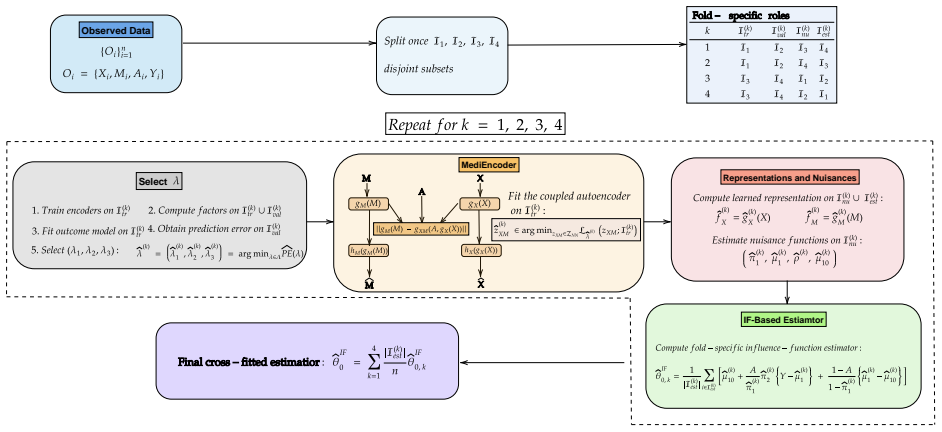
MediEncoder jointly learns low-dimensional covariate and mediator representations using a coupled encoder-decoder architecture with a cross-factor network that links treatment and covariate representations to mediator representations. The learned features are then used in a cross-fitted efficient influence function-based estimator of natural direct and indirect effects. The resulting estimator is multiply robust and asymptotically normal under suitable regularity conditions.
What carries the argument
Coupled encoder-decoder architecture with cross-factor network that links treatment and covariate representations to mediator representations.
If this is right
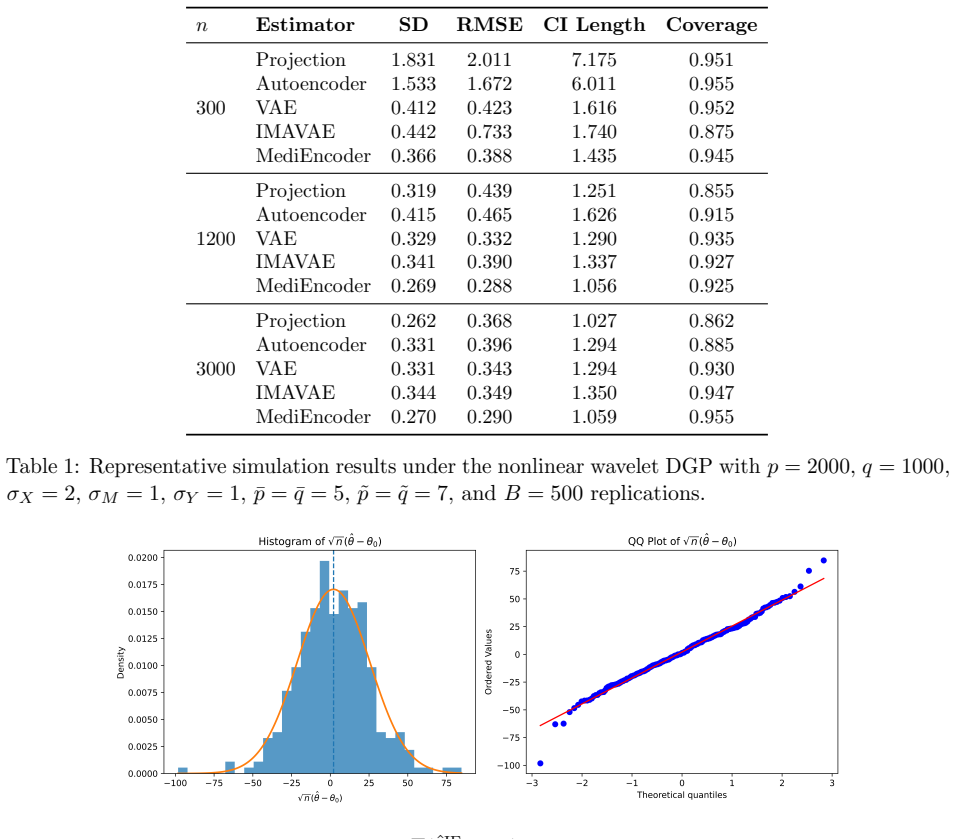
- Simulations show improved estimation accuracy over competing dimension-reduction approaches.
- The method applies to high-dimensional biomedical causal mediation analysis, as illustrated with Alzheimer's Disease Neuroimaging Initiative data.
- The estimator remains multiply robust and asymptotically normal under suitable regularity conditions.
- It handles nonlinear relationships and structural dependencies between covariate and mediator factors.
Where Pith is reading between the lines
- Similar representation-learning architectures could extend to other high-dimensional causal inference tasks that rely on noisy proxies for latent variables.
- Incorporating additional domain-specific constraints into the cross-factor network might improve representation quality in targeted applications.
- Direct tests on synthetic data with verified latent factors could isolate whether the network captures structural dependencies.
Load-bearing premise
The coupled encoder-decoder architecture with cross-factor network successfully learns representations that capture the relevant lower-dimensional latent processes and their structural dependencies.
What would settle it
A simulation in which the true nonlinear latent structure and mediation effects are known but the estimator loses multiple robustness or asymptotic normality would falsify the central claim.
Figures

read the original abstract
Causal mediation analysis decomposes a treatment effect into indirect pathways through mediators and direct pathways not operating through them. Modern biomedical studies often involve high-dimensional covariates and mediators that are noisy proxies for lower-dimensional latent biological processes. Existing methods typically rely on sparsity, linear factor models, or ignore the connection among variables in the learned representations, which can be restrictive when measurements are nonlinear and covariate and mediator factors are structurally dependent. We propose MediEncoder, a representation-learning framework for nonlinear high-dimensional mediation analysis. MediEncoder jointly learns low-dimensional covariate and mediator representations using a coupled encoder-decoder architecture with a cross-factor network that links treatment and covariate representations to mediator representations. The learned features are then used in a cross-fitted efficient influence function-based estimator of natural direct and indirect effects. The resulting estimator is multiply robust and asymptotically normal under suitable regularity conditions. Simulations show that MediEncoder improves estimation accuracy over competing dimension-reduction approaches, and an application to Alzheimer's Disease Neuroimaging Initiative data illustrates its utility in high-dimensional biomedical causal mediation analysis.
Editorial analysis
A structured set of objections, weighed in public.
Referee Report
Summary. The manuscript introduces MediEncoder, a representation-learning framework for nonlinear high-dimensional causal mediation analysis. It employs a coupled encoder-decoder architecture with a cross-factor network to learn low-dimensional covariate and mediator representations that capture structural dependencies. These representations are then used in a cross-fitted efficient influence function (EIF) estimator for natural direct and indirect effects. The paper claims that this estimator is multiply robust and asymptotically normal under suitable regularity conditions. It demonstrates improved performance in simulations compared to competing dimension-reduction methods and applies the method to Alzheimer's Disease Neuroimaging Initiative (ADNI) data.
Significance. Should the theoretical guarantees hold, the work would be significant for advancing causal mediation analysis in high-dimensional biomedical data by handling nonlinearities and inter-factor dependencies, areas where linear or sparsity-based methods fall short. The use of cross-fitting with EIF provides a solid foundation for robustness, and the empirical results suggest practical advantages. This could influence future methodological developments in integrating deep learning with causal inference.
major comments (2)
- [Abstract] Abstract: The claim that the resulting estimator is multiply robust after using the learned representations from the coupled encoder-decoder architecture is load-bearing for the central contribution, yet the dependence between the neural network fitting and the EIF may violate standard multiple robustness unless the cross-fitting and cross-factor network explicitly preserve the necessary orthogonality; this requires explicit verification in the theoretical section.
- [Abstract] Abstract: The asymptotic normality claim under suitable regularity conditions cannot be assessed without the explicit list of those conditions (e.g., rates for the representation learners or boundedness assumptions on the cross-factor network), which are central to whether the result applies to the proposed NN-based method.
minor comments (1)
- [Abstract] The abstract would benefit from a brief statement of the achieved latent dimensions or the specific loss functions used in the encoder-decoder training to aid immediate understanding.
Simulated Author's Rebuttal
We thank the referee for their careful reading and constructive comments. We address the two major comments point by point below. Our responses focus on clarifying the theoretical foundations without overstating the current manuscript content.
read point-by-point responses
-
Referee: [Abstract] Abstract: The claim that the resulting estimator is multiply robust after using the learned representations from the coupled encoder-decoder architecture is load-bearing for the central contribution, yet the dependence between the neural network fitting and the EIF may violate standard multiple robustness unless the cross-fitting and cross-factor network explicitly preserve the necessary orthogonality; this requires explicit verification in the theoretical section.
Authors: We agree that explicit verification is needed to confirm that the cross-fitting and cross-factor network preserve the orthogonality required for multiple robustness when representations are learned via neural networks. The current theoretical section establishes multiple robustness under the EIF framework with cross-fitting, but does not contain a dedicated lemma isolating the effect of the coupled architecture on the influence function. We will revise the manuscript to add this verification. revision: yes
-
Referee: [Abstract] Abstract: The asymptotic normality claim under suitable regularity conditions cannot be assessed without the explicit list of those conditions (e.g., rates for the representation learners or boundedness assumptions on the cross-factor network), which are central to whether the result applies to the proposed NN-based method.
Authors: The manuscript states asymptotic normality under suitable regularity conditions in the abstract and proves it in Theorem 4.1, but the abstract itself does not enumerate the conditions (e.g., the n^{-1/4} rate requirement on the representation learners or boundedness of the cross-factor network). We will revise the abstract to reference the specific assumptions from Section 3 for clarity. revision: yes
Circularity Check
No significant circularity; derivation applies standard EIF theory to learned representations
full rationale
The paper introduces MediEncoder as a coupled encoder-decoder architecture for learning low-dimensional representations from high-dimensional covariates and mediators, then plugs the resulting features into a cross-fitted efficient influence function estimator for natural direct and indirect effects. The multiply-robustness and asymptotic normality claims are stated to hold under suitable regularity conditions, which align with established results for EIF-based estimators in causal mediation analysis rather than being redefined or fitted from the paper's own outputs. No equation or step equates the target estimator to its inputs by construction, renames a fitted quantity as a prediction, or relies on a load-bearing self-citation whose validity reduces to the present work. The representation-learning step is an independent modeling choice whose success is evaluated via simulations and an external data application, keeping the derivation self-contained against external benchmarks.
Axiom & Free-Parameter Ledger
free parameters (1)
- latent representation dimensions
axioms (2)
- domain assumption Standard causal assumptions (consistency, positivity, no unmeasured confounding) hold for identification of natural effects
- ad hoc to paper The learned representations preserve the causal structure needed for valid effect estimation
Reference graph
Works this paper leans on
-
[1]
BMC medicine , volume=
Statistical analysis of high-dimensional biomedical data: a gentle introduction to analytical goals, common approaches and challenges , author=. BMC medicine , volume=. 2023 , publisher=
2023
-
[2]
Analytica chimica acta , volume=
Multi-omics integration in biomedical research--A metabolomics-centric review , author=. Analytica chimica acta , volume=. 2021 , publisher=
2021
-
[3]
Nature neuroscience , volume=
Methylomic profiling implicates cortical deregulation of ANK1 in Alzheimer's disease , author=. Nature neuroscience , volume=. 2014 , publisher=
2014
-
[4]
The Annals of Statistics , volume=
On deep learning as a remedy for the curse of dimensionality in nonparametric regression , author=. The Annals of Statistics , volume=. 2019 , publisher=
2019
-
[5]
arXiv preprint arXiv:2311.07243 , year=
Optimal estimation of large-dimensional nonlinear factor models , author=. arXiv preprint arXiv:2311.07243 , year=
-
[6]
2015 , publisher=
Explanation in causal inference: methods for mediation and interaction , author=. 2015 , publisher=
2015
-
[7]
Nature communications , volume=
Epigenome-wide meta-analysis of DNA methylation differences in prefrontal cortex implicates the immune processes in Alzheimer’s disease , author=. Nature communications , volume=. 2020 , publisher=
2020
-
[8]
Wellcome open research , volume=
The EWAS Catalog: a database of epigenome-wide association studies , author=. Wellcome open research , volume=
-
[9]
Journal of the American statistical association , volume=
Forecasting using principal components from a large number of predictors , author=. Journal of the American statistical association , volume=. 2002 , publisher=
2002
-
[10]
The Annals of Statistics , volume=
On the rate of convergence of fully connected deep neural network regression estimates , author=. The Annals of Statistics , volume=. 2021 , publisher=
2021
-
[11]
2019 , publisher=
High-dimensional statistics: A non-asymptotic viewpoint , author=. 2019 , publisher=
2019
-
[12]
Optimal Learning from the Doob-Dynkin lemma
Optimal learning from the Doob-Dynkin lemma , author=. arXiv preprint arXiv:1801.00974 , year=
work page internal anchor Pith review Pith/arXiv arXiv
-
[13]
The lancet , volume=
Dementia prevention, intervention, and care: 2024 report of the Lancet standing Commission , author=. The lancet , volume=. 2024 , publisher=
2024
-
[14]
Antioxidants , volume=
Role of oxidative damage in Alzheimer’s disease and neurodegeneration: From pathogenic mechanisms to biomarker discovery , author=. Antioxidants , volume=. 2021 , publisher=
2021
-
[15]
Oxidative medicine and cellular longevity , volume=
Approaches and methods to measure oxidative stress in clinical samples: research applications in the cancer field , author=. Oxidative medicine and cellular longevity , volume=. 2019 , publisher=
2019
-
[16]
Progress in Neuro-Psychopharmacology and Biological Psychiatry , volume=
Antioxidants as potential therapeutics for neuropsychiatric disorders , author=. Progress in Neuro-Psychopharmacology and Biological Psychiatry , volume=. 2013 , publisher=
2013
-
[17]
Econometrica , volume=
Determining the number of factors in approximate factor models , author=. Econometrica , volume=. 2002 , publisher=
2002
-
[18]
arXiv preprint arXiv:2601.18128 , year=
Nonlinear multi-study factor analysis , author=. arXiv preprint arXiv:2601.18128 , year=
-
[19]
arXiv preprint arXiv:2306.07918 , year=
Causal mediation analysis with multi-dimensional and indirectly observed mediators , author=. arXiv preprint arXiv:2306.07918 , year=
-
[20]
SIAM Journal on Mathematical Analysis , volume=
Deep network approximation for smooth functions , author=. SIAM Journal on Mathematical Analysis , volume=. 2021 , publisher=
2021
-
[21]
arXiv preprint arXiv:2207.09185 , year=
Multimodal hierarchical variational autoencoders with factor analysis latent space , author=. arXiv preprint arXiv:2207.09185 , year=
-
[22]
International conference on artificial intelligence and statistics , pages=
Variational autoencoders and nonlinear ica: A unifying framework , author=. International conference on artificial intelligence and statistics , pages=. 2020 , organization=
2020
-
[23]
Auto-Encoding Variational Bayes
Auto-encoding variational bayes , author=. arXiv preprint arXiv:1312.6114 , year=
work page internal anchor Pith review Pith/arXiv arXiv
-
[24]
International conference on machine learning , pages=
On deep multi-view representation learning , author=. International conference on machine learning , pages=. 2015 , organization=
2015
-
[25]
nature , volume=
Deep learning , author=. nature , volume=. 2015 , publisher=
2015
-
[26]
Chicago Booth Research Paper , number=
Deep autoencoders for nonlinear factor models: Theory and applications , author=. Chicago Booth Research Paper , number=
-
[27]
Journal of the Royal Statistical Society Series B: Statistical Methodology , volume=
Large covariance estimation by thresholding principal orthogonal complements , author=. Journal of the Royal Statistical Society Series B: Statistical Methodology , volume=. 2013 , publisher=
2013
-
[28]
2016 , publisher=
Deep learning , author=. 2016 , publisher=
2016
-
[29]
Molecular systems biology , volume=
Deep learning for computational biology , author=. Molecular systems biology , volume=. 2016 , publisher=
2016
-
[30]
science , volume=
Reducing the dimensionality of data with neural networks , author=. science , volume=. 2006 , publisher=
2006
-
[31]
Statistics and its Interface , volume=
Pathway lasso: pathway estimation and selection with high-dimensional mediators , author=. Statistics and its Interface , volume=
-
[32]
Statistics in biosciences , volume=
High-dimensional mediation analysis with applications to causal gene identification , author=. Statistics in biosciences , volume=. 2022 , publisher=
2022
-
[33]
Journal of the Royal Statistical Society Series B: Statistical Methodology , volume=
Causal mediation analysis: selection with asymptotically valid inference , author=. Journal of the Royal Statistical Society Series B: Statistical Methodology , volume=. 2025 , publisher=
2025
-
[34]
Psychoneuroendocrinology , volume=
Is depression associated with increased oxidative stress? A systematic review and meta-analysis , author=. Psychoneuroendocrinology , volume=. 2015 , publisher=
2015
-
[35]
Progress in neurobiology , volume=
The role of oxidative stress in the toxicity induced by amyloid -peptide in Alzheimer’s disease , author=. Progress in neurobiology , volume=. 2000 , publisher=
2000
-
[36]
Epigenetics , volume=
Non-linear patterns in age-related DNA methylation may reflect CD4+ T cell differentiation , author=. Epigenetics , volume=. 2017 , publisher=
2017
-
[37]
Scientific reports , volume=
Disentangling age-dependent DNA methylation: deterministic, stochastic, and nonlinear , author=. Scientific reports , volume=. 2021 , publisher=
2021
-
[38]
Journal of the American Statistical Association , volume=
Factor augmented sparse throughput deep relu neural networks for high dimensional regression , author=. Journal of the American Statistical Association , volume=. 2024 , publisher=
2024
-
[39]
Journal of financial economics , volume=
Performance measurement with the arbitrage pricing theory: A new framework for analysis , author=. Journal of financial economics , volume=. 1986 , publisher=
1986
-
[40]
Journal of econometrics , volume=
Factor-adjusted regularized model selection , author=. Journal of econometrics , volume=. 2020 , publisher=
2020
-
[41]
Journal of the American Statistical Association , pages=
Factor augmented sparse throughput deep relu neural networks for high dimensional regression , author=. Journal of the American Statistical Association , pages=. 2023 , publisher=
2023
-
[42]
Journal of statistical software , volume=
mice: Multivariate imputation by chained equations in R , author=. Journal of statistical software , volume=
-
[43]
arXiv preprint arXiv:2508.17136 , year=
Factor informed double deep learning for average treatment effect estimation , author=. arXiv preprint arXiv:2508.17136 , year=
-
[44]
Alzheimer's & Dementia , volume=
The ADAS-Cog revisited: novel composite scales based on ADAS-Cog to improve efficiency in MCI and early AD trials , author=. Alzheimer's & Dementia , volume=. 2013 , publisher=
2013
-
[45]
Journal of Machine Learning Research , volume=
Nearly-tight VC-dimension and pseudodimension bounds for piecewise linear neural networks , author=. Journal of Machine Learning Research , volume=
-
[46]
Journal of Neurology, Neurosurgery & Psychiatry , volume=
The ADAS-cog in Alzheimer's disease clinical trials: psychometric evaluation of the sum and its parts , author=. Journal of Neurology, Neurosurgery & Psychiatry , volume=. 2010 , publisher=
2010
-
[47]
Neuroimaging Clinics , volume=
The Alzheimer's disease neuroimaging initiative , author=. Neuroimaging Clinics , volume=. 2005 , publisher=
2005
-
[48]
Bioinformatics , volume=
Minfi: a flexible and comprehensive Bioconductor package for the analysis of Infinium DNA methylation microarrays , author=. Bioinformatics , volume=. 2014 , publisher=
2014
-
[49]
Advances in Neural Information Processing Systems , volume=
DeepMed: Semiparametric causal mediation analysis with debiased deep learning , author=. Advances in Neural Information Processing Systems , volume=
-
[50]
Best Practices in Nursing Care to Older Adults , volume=
The geriatric depression scale (GDS) , author=. Best Practices in Nursing Care to Older Adults , volume=
-
[51]
BMC bioinformatics , volume=
Comparison of Beta-value and M-value methods for quantifying methylation levels by microarray analysis , author=. BMC bioinformatics , volume=. 2010 , publisher=
2010
-
[52]
arXiv preprint arXiv:2410.20671 , year=
Statistical Inference in High-dimensional Poisson Regression with Applications to Mediation Analysis , author=. arXiv preprint arXiv:2410.20671 , year=
-
[53]
Biometrics , volume=
High dimensional mediation analysis with latent variables , author=. Biometrics , volume=. 2019 , publisher=
2019
-
[54]
Journal of the American Statistical Association , pages=
Factor augmented matrix regression , author=. Journal of the American Statistical Association , pages=. 2026 , publisher=
2026
-
[55]
Statistical Science , number =
Kosuke Imai and Luke Keele and Teppei Yamamoto , title =. Statistical Science , number =. 2010 , pages =
2010
-
[56]
Journal of the American Statistical Association , volume=
Learning latent factors from diversified projections and its applications to over-estimated and weak factors , author=. Journal of the American Statistical Association , volume=. 2022 , publisher=
2022
-
[57]
Journal of the American Statistical Association , volume=
Are latent factor regression and sparse regression adequate? , author=. Journal of the American Statistical Association , volume=. 2024 , publisher=
2024
-
[58]
The Annals of Statistics , volume=
Bridging factor and sparse models , author=. The Annals of Statistics , volume=. 2023 , publisher=
2023
-
[59]
Proceedings of the 30th ACM SIGKDD Conference on Knowledge Discovery and Data Mining , pages=
Causal inference with latent variables: Recent advances and future prospectives , author=. Proceedings of the 30th ACM SIGKDD Conference on Knowledge Discovery and Data Mining , pages=
-
[60]
Frontiers in Psychiatry , volume=
PTSD and DNA methylation in select immune function gene promoter regions: a repeated measures case-control study of US military service members , author=. Frontiers in Psychiatry , volume=. 2013 , publisher=
2013
-
[61]
Cell death & disease , volume=
DNA-methylation-mediated silencing of miR-486-5p promotes colorectal cancer proliferation and migration through activation of PLAGL2/IGF2/ -catenin signal pathways , author=. Cell death & disease , volume=. 2018 , publisher=
2018
-
[62]
Alzheimer's & Dementia , volume=
Blood DNA methylation as a potential biomarker of dementia: a systematic review , author=. Alzheimer's & Dementia , volume=. 2018 , publisher=
2018
-
[63]
Journal of econometrics , volume=
Principal components estimation and identification of static factors , author=. Journal of econometrics , volume=. 2013 , publisher=
2013
-
[64]
Journal of the American Statistical Association , volume=
Statistical inference for high-dimensional matrix-variate factor models , author=. Journal of the American Statistical Association , volume=. 2023 , publisher=
2023
-
[65]
Molecular psychiatry , volume=
Opening up the DNA methylome of dementia , author=. Molecular psychiatry , volume=. 2017 , publisher=
2017
-
[66]
Medical oncology , volume=
DNA methylation and cancer: transcriptional regulation, prognostic, and therapeutic perspective , author=. Medical oncology , volume=. 2023 , publisher=
2023
-
[67]
Journal of the American Statistical Association , number=
Individualized dynamic mediation analysis using latent factor models , author=. Journal of the American Statistical Association , number=. 2026 , publisher=
2026
-
[68]
Computational statistics & data analysis , volume=
Sparse principal component based high-dimensional mediation analysis , author=. Computational statistics & data analysis , volume=. 2020 , publisher=
2020
-
[69]
Personnel psychology , volume=
The application of exploratory factor analysis in applied psychology: A critical review and analysis , author=. Personnel psychology , volume=. 1986 , publisher=
1986
-
[70]
Journal of personality , volume=
An introduction to the five-factor model and its applications , author=. Journal of personality , volume=. 1992 , publisher=
1992
-
[71]
, author=
Five-factor model of personality and employee absence. , author=. Journal of applied psychology , volume=. 1997 , publisher=
1997
-
[72]
, author=
Personality disorders and the five-factor model of personality: Rationale for the third edition. , author=. 2013 , publisher=
2013
-
[73]
, author=
Application of confirmatory factor analysis to the study of self-concept: First-and higher order factor models and their invariance across groups. , author=. Psychological bulletin , volume=. 1985 , publisher=
1985
-
[74]
Journal of Econometrics , volume=
A multi-dynamic-factor model for stock returns , author=. Journal of Econometrics , volume=. 1992 , publisher=
1992
-
[75]
Journal of financial economics , volume=
A five-factor asset pricing model , author=. Journal of financial economics , volume=. 2015 , publisher=
2015
-
[76]
Available at SSRN 1418117 , year=
An alternative three-factor model , author=. Available at SSRN 1418117 , year=
-
[77]
International Journal of Forecasting , volume=
Forecasting the US term structure of interest rates using a macroeconomic smooth dynamic factor model , author=. International Journal of Forecasting , volume=. 2013 , publisher=
2013
-
[78]
Oxford Bulletin of Economics and Statistics , volume=
Assessing the transmission of monetary policy using time-varying parameter dynamic factor models , author=. Oxford Bulletin of Economics and Statistics , volume=. 2013 , publisher=
2013
-
[79]
Journal of the American Statistical Association , volume=
High-dimensional sparse factor modeling: applications in gene expression genomics , author=. Journal of the American Statistical Association , volume=. 2008 , publisher=
2008
-
[80]
Bayesian inference for gene expression and proteomics , volume=
Sparse statistical modelling in gene expression genomics , author=. Bayesian inference for gene expression and proteomics , volume=. 2006 , publisher=
2006
discussion (0)
Sign in with ORCID, Apple, or X to comment. Anyone can read and Pith papers without signing in.