Estimating the Effect of Timing on Coupon Effectiveness
Pith reviewed 2026-07-01 07:35 UTC · model grok-4.3
The pith
Variations in coupon delivery times create natural experiments that causally identify optimal send timing.
A machine-rendered reading of the paper's core claim, the machinery that carries it, and where it could break.
Core claim
The authors claim that natural variations in coupon delivery timing constitute valid experiments allowing causal identification of timing effects on effectiveness, and that applying standard causal methods to such data yields actionable estimates for marketing decisions. They demonstrate the framework first on company onboarding data and then on a public retention dataset to confirm that the same logic produces usable guidance without dedicated testing infrastructure.
What carries the argument
Natural randomized control trial experiments arising from observed variations in coupon send times, which allow causal identification when timing is ignorable conditional on observed covariates.
If this is right
- The framework lets marketers estimate timing effects directly from historical campaign records.
- Business decisions on coupon timing can be made without building real-time event-triggered distribution systems.
- The same logic applies across campaign types, as shown by consistent application to both onboarding and retention settings.
- Results from the natural experiments can replace or reduce the need for new dedicated tests when choosing when to send incentives.
Where Pith is reading between the lines
- This approach could be applied to timing questions for other interventions such as emails or push notifications.
- If unmeasured factors still influence both timing and outcomes, the estimates would require additional robustness checks such as sensitivity analyses.
- The public-dataset replication suggests the framework can be tested for reproducibility on other open marketing or user-behavior datasets.
- Extending the method to continuous time or to multiple simultaneous treatments would require only modest changes to the identification strategy.
Load-bearing premise
Observed differences in coupon delivery timing are as good as randomly assigned once measured covariates are accounted for.
What would settle it
Running a true randomized A/B test that assigns coupon send times independently and finding materially different effect estimates from the natural-experiment analysis would falsify the central claim.
Figures
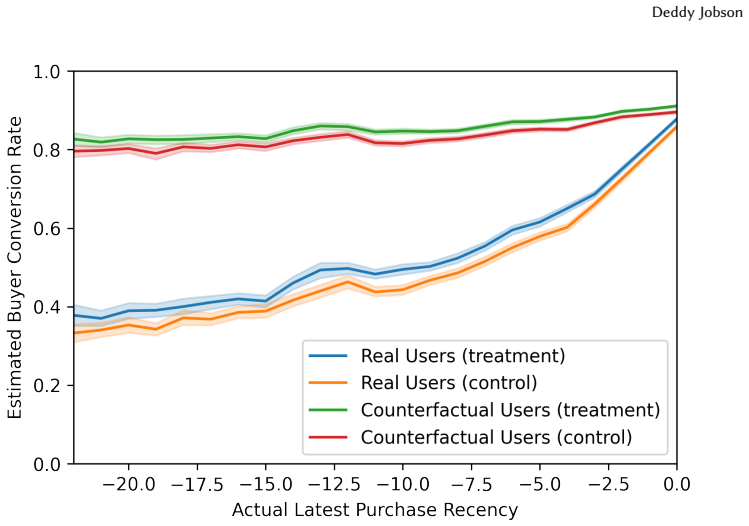
read the original abstract
The coupon incentive is one of the most common tools marketers use to court users to engage with a business at various stages of the customer life cycle. A variety of factors can affect the effectiveness of a coupon incentive on users, timing being one of them. We hypothesize that coupons can be more effective when delivered at critical times in the customer journey, right when a user is engaging with the platform. Verifying such a hypothesis would typically require real time event-triggered coupon distribution software that may be too expensive to implement. In this paper, we propose a framework in which we apply causal inference on "natural randomized control trial experiments" to measure the effectiveness of sending coupons at the right time to users without requiring a dedicated AB test. We demonstrate the usefulness of our framework in the case of a user onboarding coupon campaign held in our company and show how the results can lead to correct data-driven decisions for the business. Furthermore, in order to test the generalizability of our framework, and to make our research more reproducible, we apply our framework on a user retention campaign with a publicly available dataset.
Editorial analysis
A structured set of objections, weighed in public.
Referee Report
Summary. The paper proposes a framework that treats observed variations in coupon delivery timing as natural randomized control trials, applies causal inference methods to estimate the effect of timing on coupon effectiveness, and demonstrates the approach on an internal user onboarding campaign plus a public user retention dataset, claiming this enables data-driven decisions without dedicated A/B tests or real-time event-triggered systems.
Significance. If the ignorability assumption holds and the framework is shown to be robust, the work could offer a practical, low-cost alternative for optimizing coupon timing in observational marketing data settings. The inclusion of a public dataset for reproducibility is a strength that supports broader applicability and verification.
major comments (1)
- [Framework description (abstract and methods)] The central claim rests on the assumption that timing variations constitute valid natural RCTs permitting causal identification (i.e., timing is ignorable conditional on observed covariates). No explicit identification strategy, balance tables, sensitivity analysis, or robustness checks are described to address potential confounding from user behavior that may drive both delivery timing and response outcomes.
Simulated Author's Rebuttal
We thank the referee for the constructive feedback. The major comment concerns the need for greater explicitness around the causal identification strategy, balance checks, and robustness to confounding. We respond below and will revise the manuscript accordingly.
read point-by-point responses
-
Referee: [Framework description (abstract and methods)] The central claim rests on the assumption that timing variations constitute valid natural RCTs permitting causal identification (i.e., timing is ignorable conditional on observed covariates). No explicit identification strategy, balance tables, sensitivity analysis, or robustness checks are described to address potential confounding from user behavior that may drive both delivery timing and response outcomes.
Authors: We agree that the manuscript would be strengthened by a more explicit treatment of the identification strategy. In the revision we will add a dedicated subsection to the Methods that states the core identifying assumptions (conditional ignorability of coupon timing given the observed covariates such as user demographics, prior engagement metrics, and onboarding stage) and the associated potential-outcomes notation. We will also insert balance tables that compare covariate means and distributions across the observed timing groups, together with standardized mean differences. Finally, we will report sensitivity analyses that assess robustness to unobserved confounding, including (i) re-estimation under alternative covariate sets and (ii) application of a bounding approach (e.g., Rosenbaum bounds or similar) that quantifies how large an unobserved confounder would need to be to overturn the main findings. These additions directly address the possibility that user behavior jointly influences both delivery timing and response. revision: yes
Circularity Check
No significant circularity; framework relies on external identification assumption
full rationale
The paper proposes a causal framework treating observed coupon timing variation as natural RCTs for estimating timing effects, without any equations, parameter fitting, or predictions that reduce to inputs by construction. The load-bearing step is the claim that timing is ignorable conditional on covariates, presented as an empirical assumption rather than derived from or equivalent to the framework itself. No self-citations, ansatzes, or renamings appear in the text that would create definitional or fitted circularity. The derivation is self-contained as a methodological proposal whose validity rests on external falsifiability of the ignorability assumption.
Axiom & Free-Parameter Ledger
axioms (1)
- domain assumption Natural experiments in coupon delivery timing act as randomized control trials permitting causal inference on timing effects.
Reference graph
Works this paper leans on
-
[1]
Estimating Conditional Average Treatment Effects.Journal of Business & Economic Statistics33, 4 (Oct. 2015), 485–505. https://doi.org/10.1080/07350015.2014.975555 Publisher: Taylor & Francis _eprint: https://doi.org/10.1080/07350015.2014.975555. Douglas G. Altman, Berthold Lausen, Willi Sauerbrei, and Martin Schumacher
-
[2]
https://doi.org/10.1093/jnci/86.11.829 M
Dangers of Using “Optimal” Cutpoints in the Evaluation of Prognostic Factors.JNCI: Journal of the National Cancer Institute86, 11 (June 1994), 829–835. https://doi.org/10.1093/jnci/86.11.829 M. Bonetti and R. D. Gelber
-
[3]
A graphical method to assess treatment-covariate interactions using the Cox model on subsets of the data.Statistics in Medicine19, 19 (Oct. 2000), 2595–2609. https://doi.org/10.1002/1097-0258(20001015)19: 19<2595::aid-sim562>3.0.co;2-m Milos Brankovic, Isabella Kardys, Ewout W. Steyerberg, Stanley Lemeshow, Maja Markovic, Dimitris Rizopoulos, and Eric Boersma
-
[4]
Understanding of interaction (subgroup) analysis in clinical trials.European Journal of Clinical Investigation49, 8 (Aug. 2019), e13145. https://doi.org/10.1111/eci.13145 Alexander D’Amour
-
[5]
On Multi-Cause Causal Inference with Unobserved Confounding: Counterexamples, Impossibility, and Alternatives.arXiv:1902.10286 [cs, stat](March 2019). http://arxiv.org/abs/1902.10286 arXiv: 1902.10286. Uplift Modeling Dataset
work page internal anchor Pith review Pith/arXiv arXiv 1902
-
[6]
1999), 37–48
Causal Diagrams for Epidemiologic Research.Epidemiology 10, 1 (Jan. 1999), 37–48. https://journals.lww.com/epidem/Abstract/1999/01000/Causal_Diagrams_for_Epidemiologic_ Research.8.aspx Pierre Gutierrez and Jean-Yves Gérardy
1999
-
[7]
2013), 361–373
To Whom, When, and How Much to Discount? A Constrained Optimization of Customized Temporal Discounts.Journal of Retailing89, 4 (Dec. 2013), 361–373. https://doi.org/10. 1016/j.jretai.2013.08.002 David B. Klenosky, Suzeanne B. Benet, and Petr Chadraba
2013
-
[8]
https://doi.org/10.1016/0148- 2963(95)00121-2 Sören R
Assessing Czech consumers’ reactions to western marketing practices: A conjoint approach.Journal of Business Research36, 2 (June 1996), 189–198. https://doi.org/10.1016/0148- 2963(95)00121-2 Sören R. Künzel, Jasjeet S. Sekhon, Peter J. Bickel, and Bin Yu
-
[9]
https://doi.org/10.1073/pnas.1804597116 Publisher: Proceedings of the National Academy of Sciences
Metalearners for estimating heterogeneous treatment effects using machine learning.Proceedings of the National Academy of Sciences116, 10 (March 2019), 4156–4165. https://doi.org/10.1073/pnas.1804597116 Publisher: Proceedings of the National Academy of Sciences. Scott T. Leatherdale
-
[10]
Natural experiment methodology for research: a review of how different methods can support real-world research.International Journal of Social Research Methodology22, 1 (Jan. 2019), 19–35. https://doi.org/10. 1080/13645579.2018.1488449 Publisher: Routledge _eprint: https://doi.org/10.1080/13645579.2018.1488449. Ana Rita Nogueira, Andrea Pugnana, S. Ruggie...
-
[11]
Methods and tools for causal discovery and causal inference.WIREs Data Mining Knowl. Discov.(2022). https://doi.org/10.1002/widm.1449 Judea Pearl
-
[12]
Causal inference in statistics: An overview.Statistics Surveys3, none (Jan. 2009), 96–146. https: //doi.org/10.1214/09-SS057 Publisher: Amer. Statist. Assoc., the Bernoulli Soc., the Inst. Math. Statist., and the Statist. Soc. Canada. Judea Pearl and Elias Bareinboim
-
[13]
In 2011 IEEE 11th International Conference on Data Mining Workshops
Transportability of Causal and Statistical Relations: A Formal Approach. In 2011 IEEE 11th International Conference on Data Mining Workshops. IEEE, Vancouver, BC, Canada, 540–547. https: //doi.org/10.1109/ICDMW.2011.169 Nicholas Radcliffe
-
[14]
https://www.research.ed.ac.uk/en/publications/using-control-groups-to- target-on-predicted-lift-building-and-ass Patrick Royston and Willi Sauerbrei
Using control groups to target on predicted lift: Building and assessing uplift model.Direct Marketing Analytics Journal(2007), 14–21. https://www.research.ed.ac.uk/en/publications/using-control-groups-to- target-on-predicted-lift-building-and-ass Patrick Royston and Willi Sauerbrei
2007
-
[15]
https: //doi.org/10.1002/sim.1815 _eprint: https://onlinelibrary.wiley.com/doi/pdf/10.1002/sim.1815
A new approach to modelling interactions between treatment and continuous covariates in clinical trials by using fractional polynomials.Statistics in Medicine23, 16 (2004), 2509–2525. https: //doi.org/10.1002/sim.1815 _eprint: https://onlinelibrary.wiley.com/doi/pdf/10.1002/sim.1815. Willi Sauerbrei, Patrick Royston, and Karina Zapien
-
[16]
https://doi.org/10.1016/j.csda.2006.12.041 Greg Shaffer and Z
Detecting an interaction between treatment and a continuous covariate: A comparison of two approaches.Computational Statistics & Data Analysis51, 8 (May 2007), 4054–4063. https://doi.org/10.1016/j.csda.2006.12.041 Greg Shaffer and Z. John Zhang
-
[17]
Competitive Coupon Targeting.Marketing Science14, 4 (Nov. 1995), 395–416. https://doi.org/10.1287/mksc.14.4.395 Publisher: INFORMS. Deddy Jobson Yitao Shen, Yue Wang, Xingyu Lu, Feng Qi, Jia Yan, Yixiang Mu, Yao Yang, YiFan Peng, and Jinjie Gu
- [18]
-
[19]
https://econpapers.repec.org/article/inmormksc/v_3a14_3ay_ 3a1995_3ai_3a3_3ap_3a271-299.htm Publisher: INFORMS
Tackling the Retailer Decision Maze: Which Brands to Discount, How Much, When and Why?Marketing Science14, 3 (1995), 271–299. https://econpapers.repec.org/article/inmormksc/v_3a14_3ay_ 3a1995_3ai_3a3_3ap_3a271-299.htm Publisher: INFORMS. Hirotsugu Uchida, Yuko Onozaka, Tamaki Morita, and Shunsuke Managi
1995
-
[20]
Demand for ecolabeled seafood in the Japanese market: A conjoint analysis of the impact of information and interaction with other labels.Food Policy44 (Feb. 2014), 68–76. https://doi.org/10.1016/j.foodpol.2013.10.002 Janet A. Young and Michelle D. Pain
discussion (0)
Sign in with ORCID, Apple, or X to comment. Anyone can read and Pith papers without signing in.