Wrinkles in Time. II. Stellar Age Trends in Kinematic Signatures from Transient Spiral Structure
Pith reviewed 2026-07-01 01:28 UTC · model grok-4.3
The pith
Stellar ages in kinematic wrinkles can constrain the timing of past transient spiral patterns near the Sun.
A machine-rendered reading of the paper's core claim, the machinery that carries it, and where it could break.
Core claim
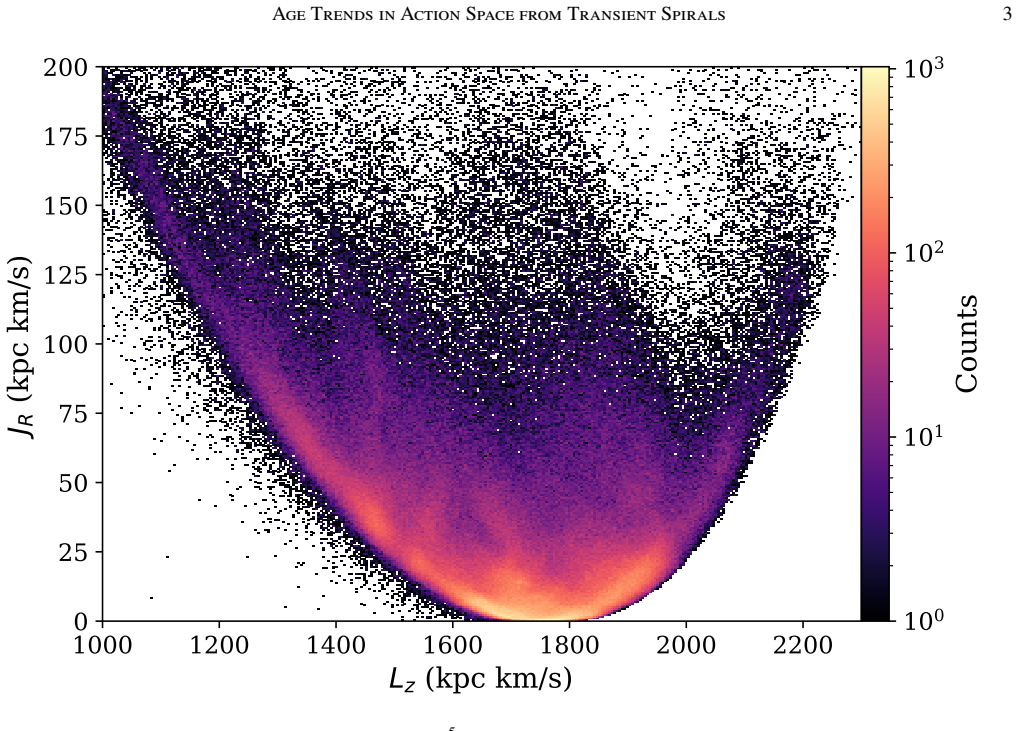
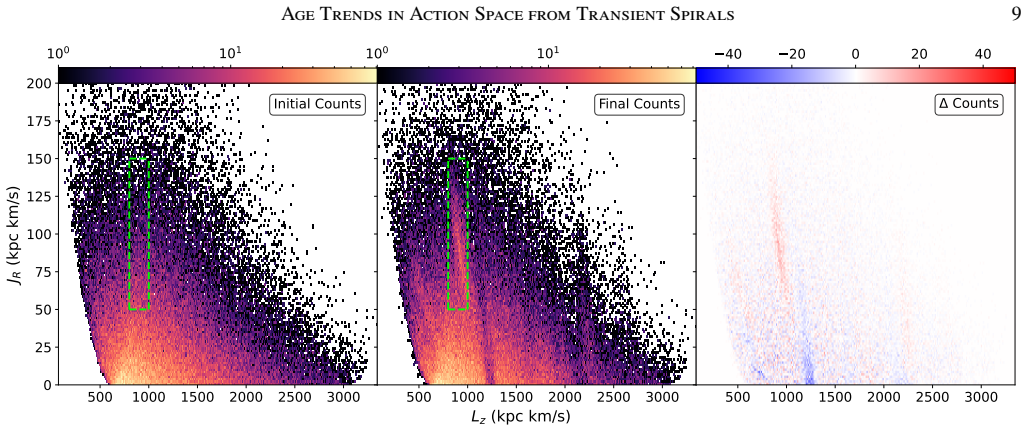
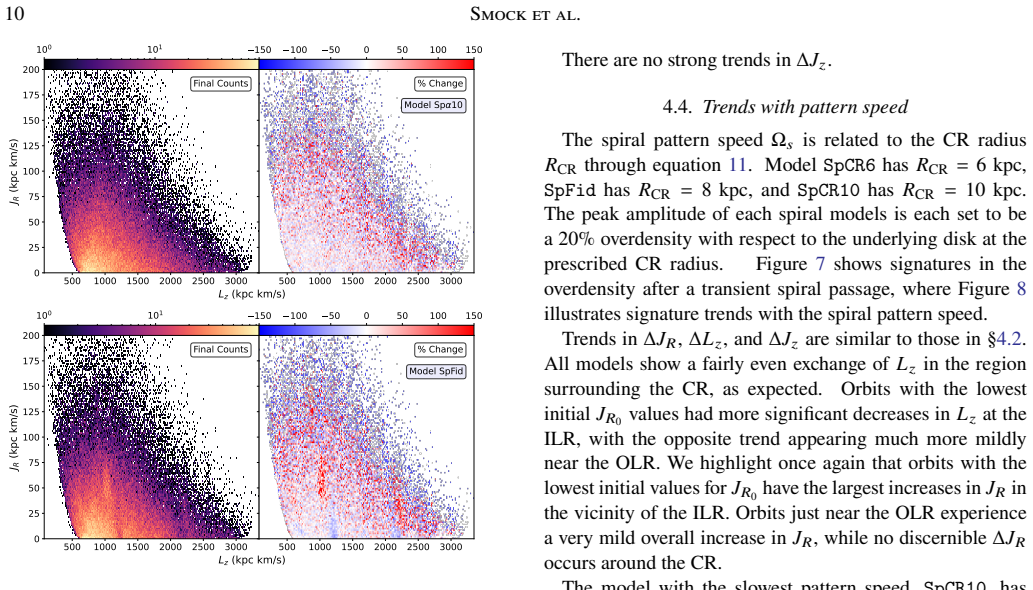
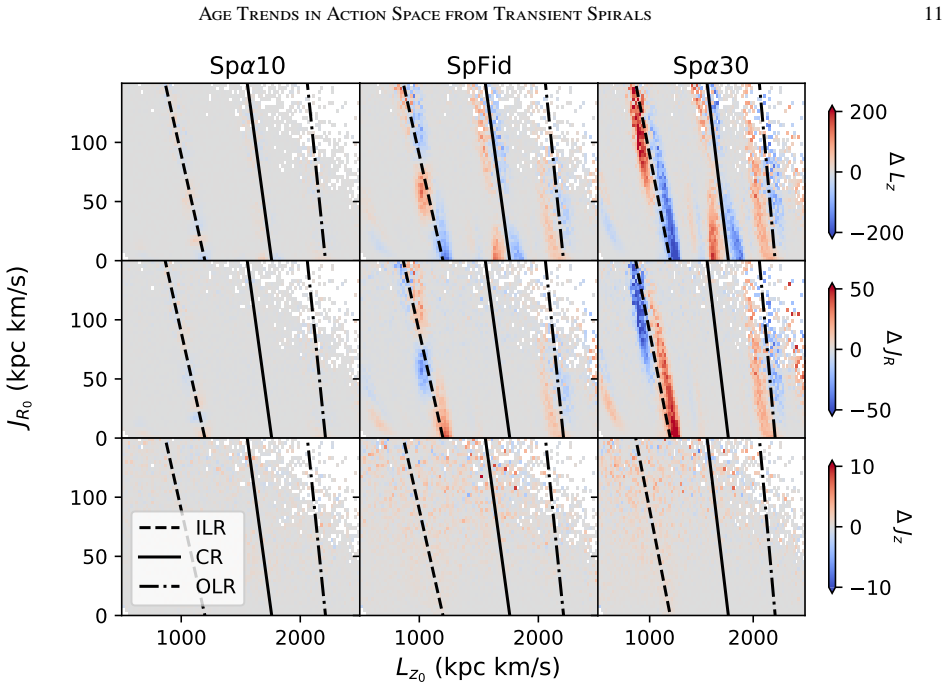
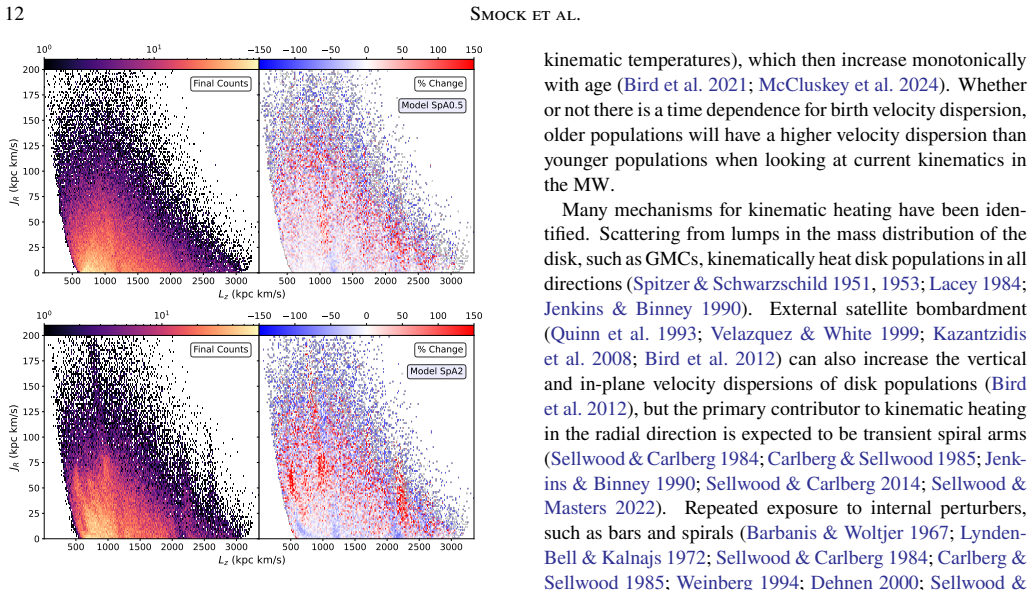
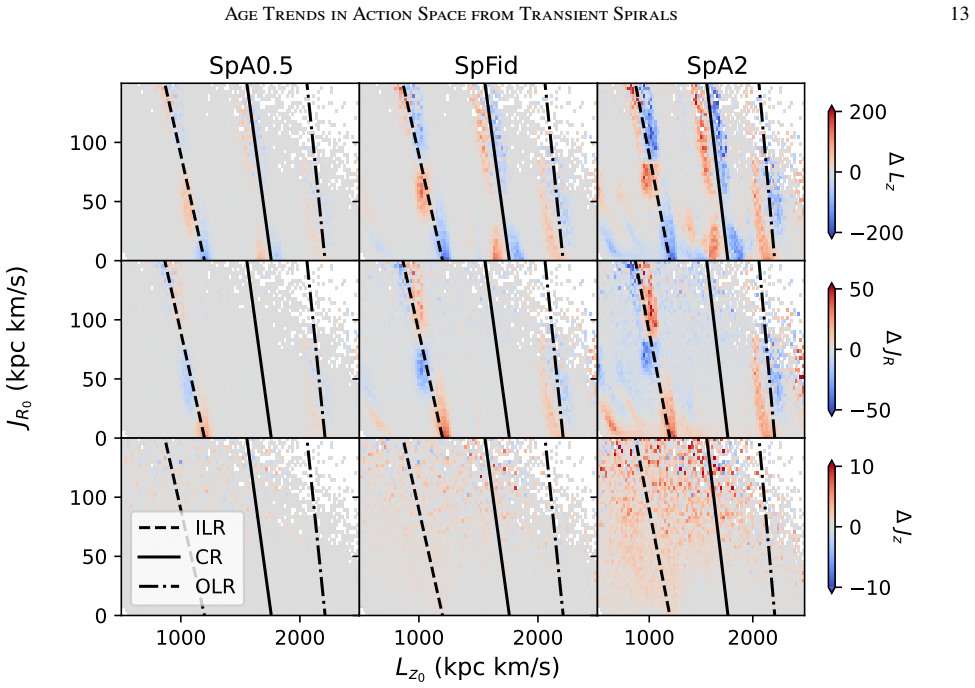
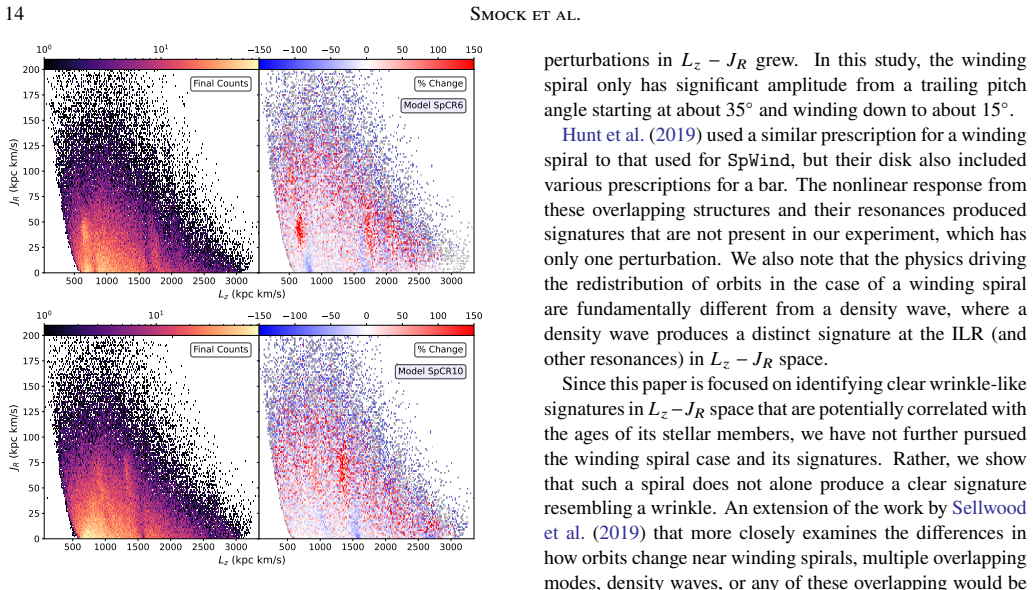
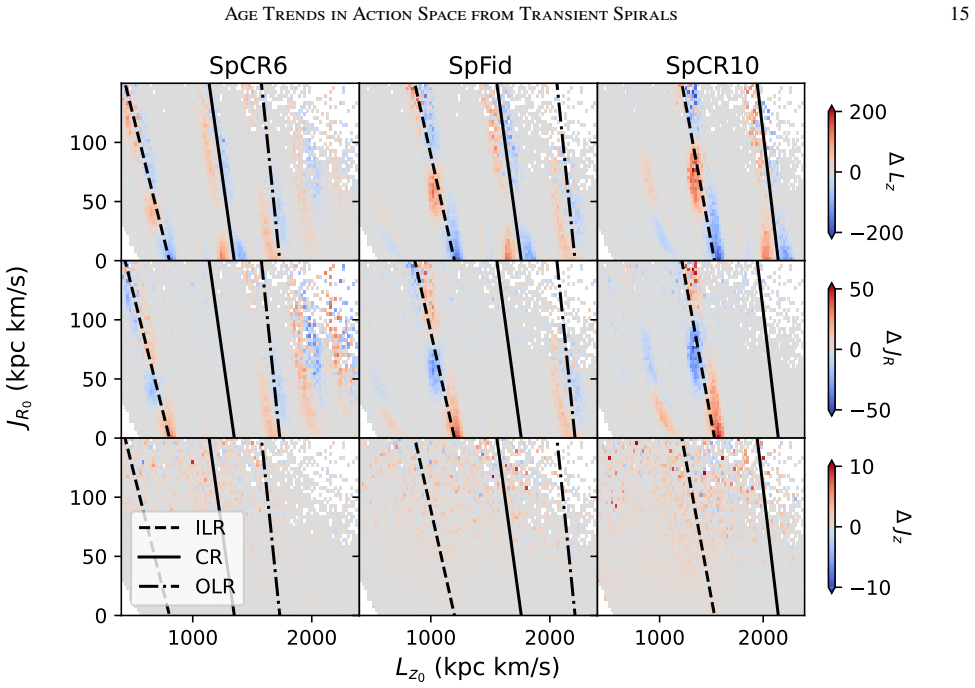
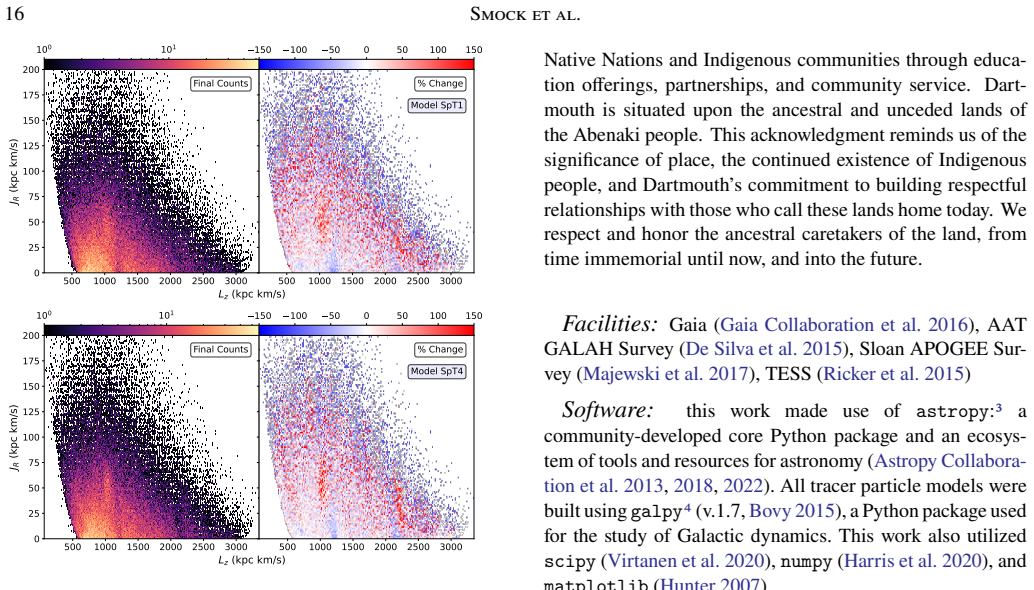
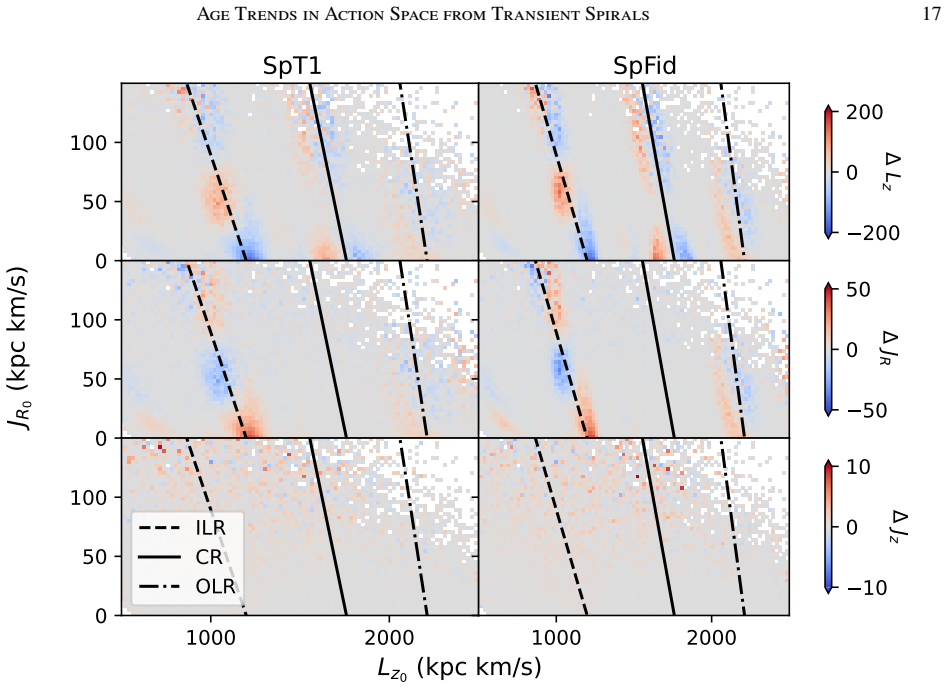
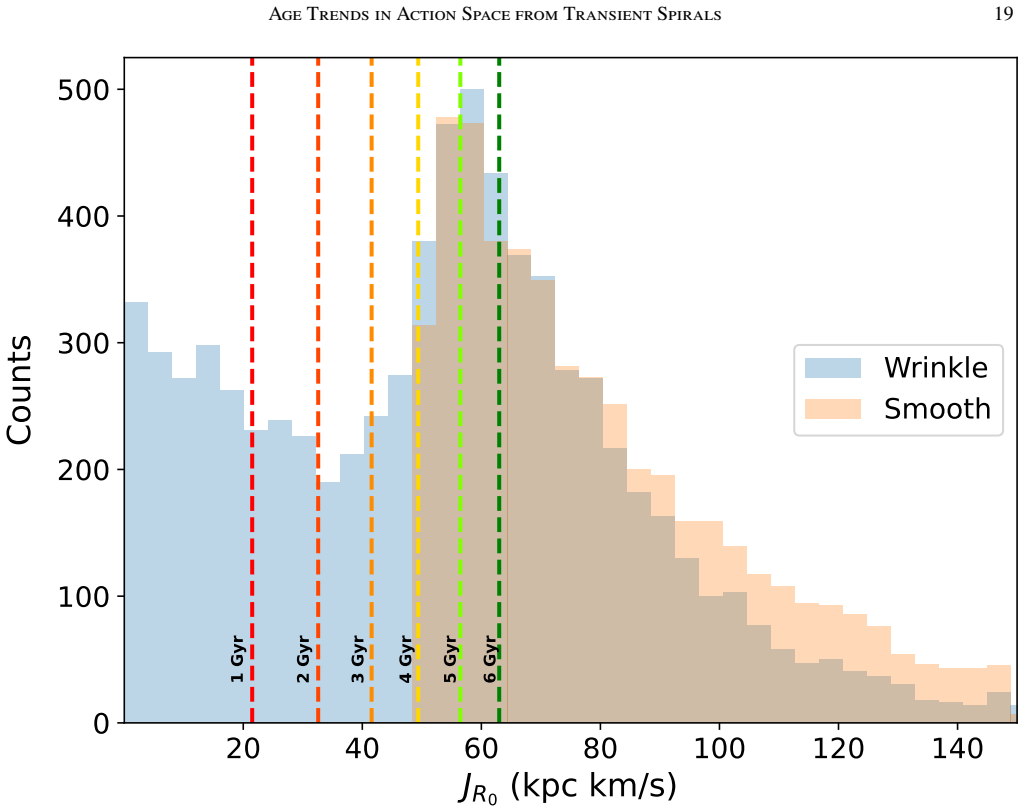
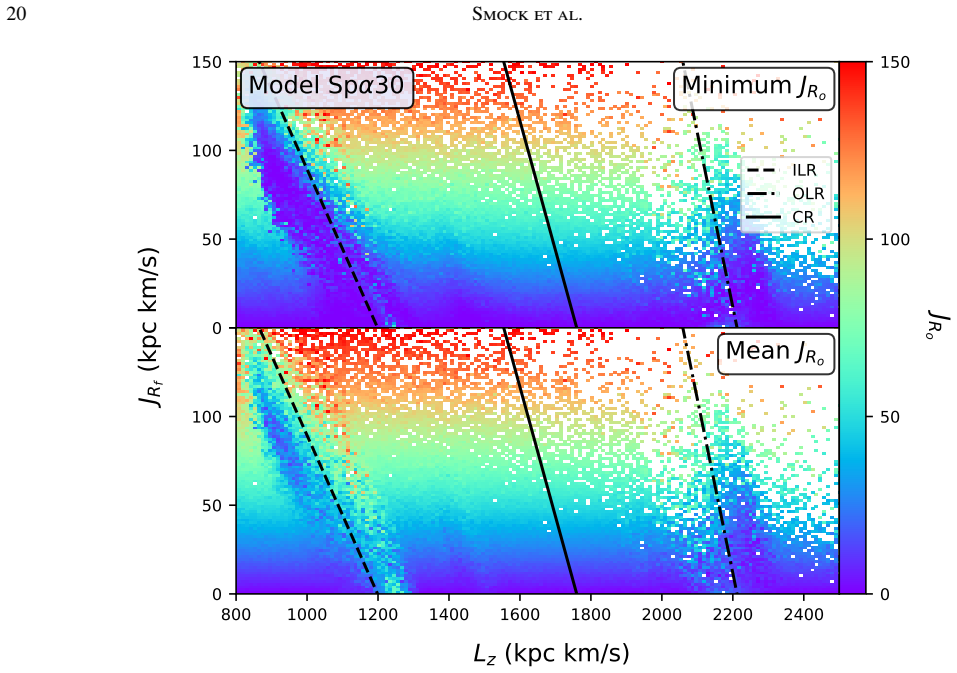
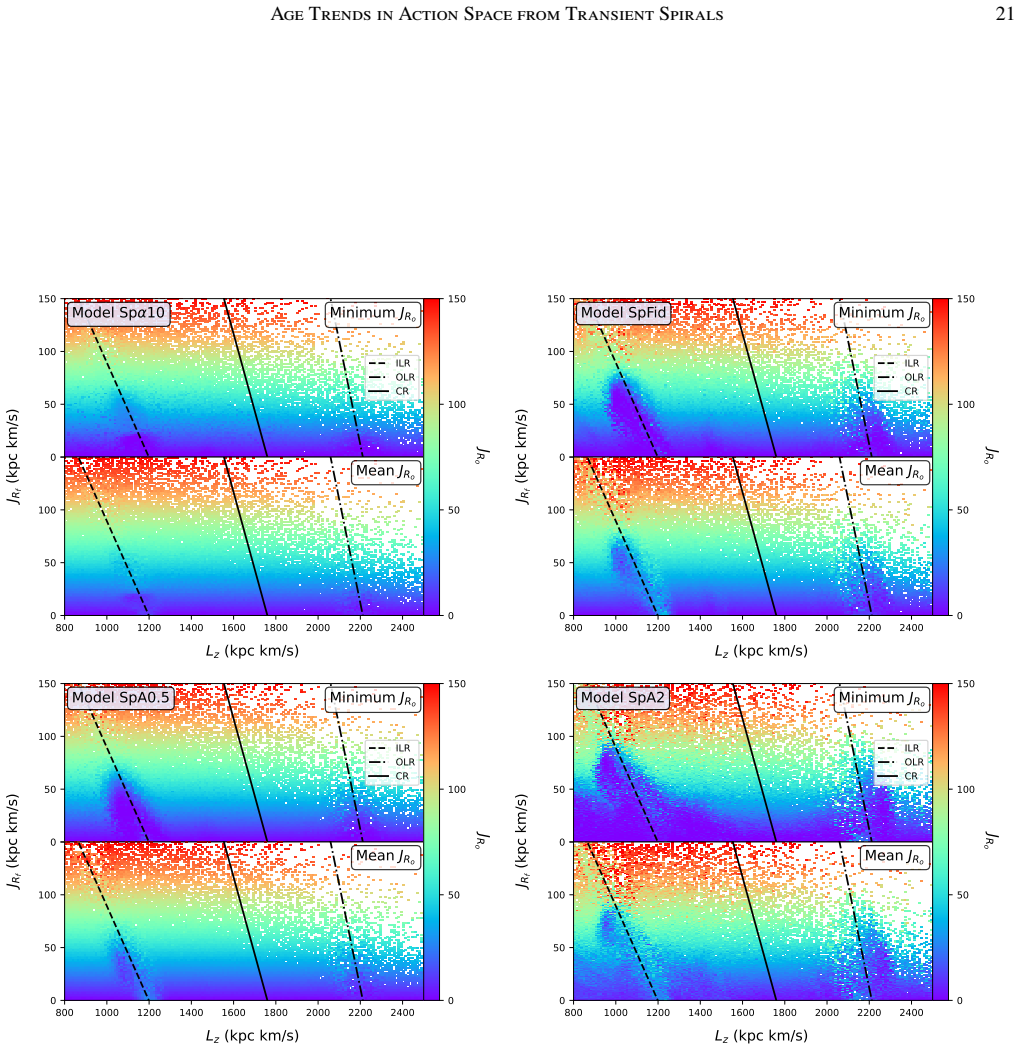
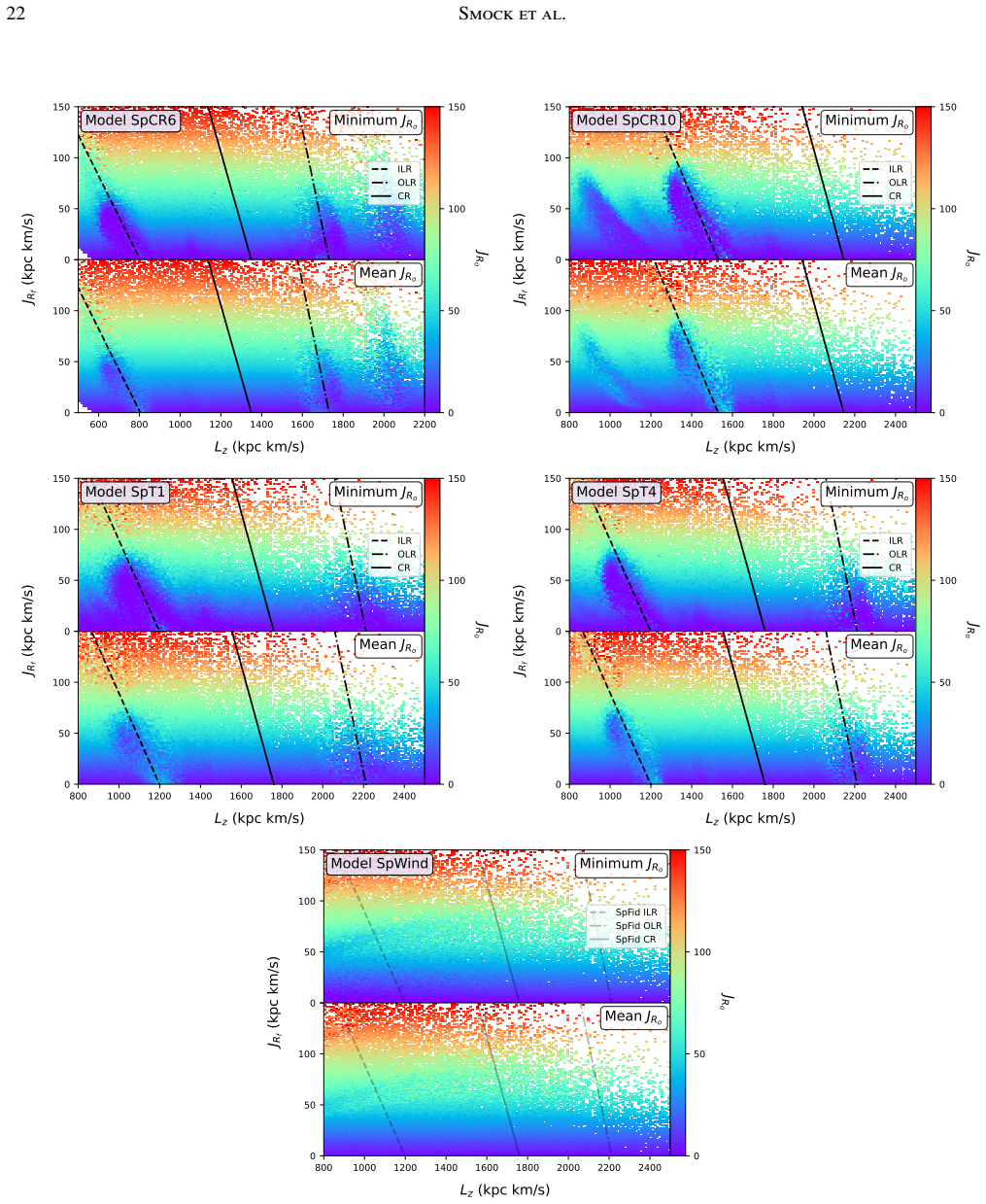
The Lindblad resonances of nonwinding spirals produce signature overdensities, or wrinkles, in a kinematic space that is typically associated with older stellar populations (high radial action). These wrinkles are preferentially populated with stars that were initially in nearly circular orbits, kinematics that is generally correlated with younger stellar ages. It follows that the stellar age distribution of wrinkle populations could serve to place constraints on the past passage of a transient spiral pattern in the solar neighborhood. For example, simulations suggest that a physically motivated spiral pattern could significantly populate a wrinkle with zero-age stars in orbits typically occ
What carries the argument
Tracer-particle simulations of varied spiral-arm prescriptions that track how initial orbital circularity maps onto observable wrinkles in action space and correlates with stellar age.
If this is right
- Wrinkles in high radial action space can contain a significant fraction of young stars.
- Age trends within wrinkles can distinguish among different models of spiral-arm behavior.
- Stellar ages offer an observable that dates the passage of transient spirals through the solar neighborhood.
- A physically motivated spiral can place zero-age stars into orbits normally occupied by much older stars.
Where Pith is reading between the lines
- Matching observed age distributions to the simulated trends would support nonwinding transient spirals as the source of specific wrinkles.
- The same age-kinematic mapping could be tested on other disk features such as moving groups or ridges beyond the solar neighborhood.
- If the mapping holds, surveys that combine precise ages with kinematics could reconstruct a timeline of recent spiral-arm passages.
Load-bearing premise
The simulations correctly capture how real Milky Way stars respond to transient spiral arms in their orbits and how that response links to stellar age.
What would settle it
An observed wrinkle in high radial action space whose stars show an age distribution dominated by old populations with no excess of young stars from circular orbits.
Figures

read the original abstract
Spiral arms in the disks of galaxies like the Milky Way can generate kinematic signatures, which appear as ridges or wrinkles in action space. Such signatures have proven difficult to disentangle using kinematic measures alone. In this study, we investigate how including stellar age as an additional dimension for analysis may provide a novel insight into the physical characteristics, timescales, and nature of the progenitors of such perturbations, where these novel insights could contribute to our understanding of the history of spiral arms in the Milky Way. We used a suite of tracer particle simulations that modeled a variety of prescriptions for spiral arms to characterize observable trends. The Lindblad resonances of nonwinding spirals produce signature overdensities, or wrinkles, in a kinematic space that is typically associated with older stellar populations (high radial action). We find that these wrinkles are preferentially populated with stars that were initially in nearly circular orbits, kinematics that is generally correlated with younger stellar ages. It follows that the stellar age distribution of wrinkle populations could serve to place constraints on the past passage of a transient spiral pattern in the solar neighborhood. For example, our simulations suggest that a physically motivated spiral pattern could significantly populate a wrinkle with zero-age stars in orbits typically occupied by stars much older than the Sun.
Editorial analysis
A structured set of objections, weighed in public.
Referee Report
Summary. The paper claims that stellar age provides an additional dimension to interpret kinematic wrinkles (overdensities in radial action) generated by transient spiral arms. Using a suite of tracer-particle simulations with various imposed spiral potentials, it reports that Lindblad resonances of non-winding spirals preferentially populate high-J_r wrinkles with stars that began on nearly circular orbits; because such orbits correlate with young ages, the age distribution within wrinkles could constrain the past passage of transient spirals, including the possibility of zero-age stars occupying orbits typically associated with much older populations.
Significance. If the reported age trends are robust, the work supplies a concrete, observationally testable link between kinematic substructure and the temporal history of spiral structure in the Milky Way disk, extending beyond purely kinematic diagnostics. The forward-modeling approach that generates falsifiable predictions for age distributions in specific action-space features is a methodological strength.
major comments (2)
- [Abstract / simulation description] Abstract (paragraph describing the simulation suite): the central claim that age distributions in wrinkles can constrain transient spiral passages rests on the fidelity of the tracer-particle response, yet the manuscript supplies no information on numerical resolution, time-stepping criteria, convergence tests, validation against analytic limits (e.g., epicyclic motion or linear resonance theory), or comparison to self-consistent N-body runs. Without these, it is impossible to assess whether the reported zero-age population in high-J_r wrinkles survives in a live disk.
- [Simulation setup and results] The mapping from initial orbital circularity to stellar age is taken as direct (nearly circular orbits = young stars), but the text provides no quantitative test of how birth-velocity scatter, subsequent heating, or the chosen initial-condition distribution affects this mapping. This assumption is load-bearing for the claim that wrinkles can be significantly populated by zero-age stars.
minor comments (1)
- [Abstract] Abstract: 'kinematics that is generally correlated' should read 'kinematics that are generally correlated'.
Simulated Author's Rebuttal
We thank the referee for their thoughtful and constructive comments. We address each major comment below.
read point-by-point responses
-
Referee: [Abstract / simulation description] Abstract (paragraph describing the simulation suite): the central claim that age distributions in wrinkles can constrain transient spiral passages rests on the fidelity of the tracer-particle response, yet the manuscript supplies no information on numerical resolution, time-stepping criteria, convergence tests, validation against analytic limits (e.g., epicyclic motion or linear resonance theory), or comparison to self-consistent N-body runs. Without these, it is impossible to assess whether the reported zero-age population in high-J_r wrinkles survives in a live disk.
Authors: We agree that the manuscript lacks sufficient numerical details. The revised version will add a methods subsection specifying the number of tracer particles, integration time step, and convergence tests performed by varying particle number and time step. Validation against epicyclic motion (no-spiral runs) and linear resonance expectations will also be included. Direct comparison to self-consistent N-body runs is beyond the present scope, which isolates effects via imposed potentials; this limitation will be stated explicitly. revision: partial
-
Referee: [Simulation setup and results] The mapping from initial orbital circularity to stellar age is taken as direct (nearly circular orbits = young stars), but the text provides no quantitative test of how birth-velocity scatter, subsequent heating, or the chosen initial-condition distribution affects this mapping. This assumption is load-bearing for the claim that wrinkles can be significantly populated by zero-age stars.
Authors: We acknowledge that the manuscript does not include explicit quantitative tests of this mapping. The revised manuscript will incorporate an additional analysis that varies the initial velocity dispersion (birth scatter) and tracks its effect on the fraction of low-circularity stars populating the wrinkles, providing a direct test of robustness under different heating assumptions. revision: yes
- Whether the zero-age population in high-J_r wrinkles survives in a live, self-gravitating disk (requires self-consistent N-body simulations not performed here).
Circularity Check
No significant circularity: results from forward tracer simulations
full rationale
The paper's central claims follow from forward simulations of tracer particles in imposed spiral potentials. Age distributions and wrinkle populations are simulation outputs, not quantities defined in terms of themselves or fitted parameters renamed as predictions. No load-bearing step reduces by the paper's own equations or self-citations to its inputs; the mapping from initial circularity to age trends is generated by the chosen prescriptions rather than assumed. This is self-contained against external benchmarks and matches the default non-circular outcome for such studies.
Axiom & Free-Parameter Ledger
axioms (1)
- domain assumption Tracer-particle simulations under imposed spiral potentials faithfully represent the orbital evolution of real stars in a galactic disk
Reference graph
Works this paper leans on
-
[1]
Astropy: A Community Python Package for Astronomy
doi:10.1051/0004-6361/201322068 , Eid =. arXiv , Author =:1307.6212 , Journal =
work page internal anchor Pith review Pith/arXiv arXiv doi:10.1051/0004-6361/201322068
-
[2]
The Astropy Project: Building an inclusive, open-science project and status of the v2.0 core package
The Astropy Project: Building an Open-science Project and Status of the v2.0 Core Package. , keywords =. doi:10.3847/1538-3881/aabc4f , archivePrefix =. 1801.02634 , primaryClass =
work page internal anchor Pith review Pith/arXiv arXiv doi:10.3847/1538-3881/aabc4f
-
[3]
The Astropy Project: Sustaining and Growing a Community-oriented Open-source Project and the Latest Major Release (v5.0) of the Core Package. apj , keywords =. doi:10.3847/1538-4357/ac7c74 , archivePrefix =. 2206.14220 , primaryClass =
work page internal anchor Pith review Pith/arXiv arXiv doi:10.3847/1538-4357/ac7c74
-
[4]
Wrinkles in Time. I. Rapid Rotators Found in High-eccentricity Orbits. , keywords =. doi:10.3847/1538-4357/acff69 , archivePrefix =. 2310.02305 , primaryClass =
-
[5]
Summary of the content and survey properties
Gaia Data Release 3 - Summary of the content and survey properties , DOI= "10.1051/0004-6361/202243940", url= "https://doi.org/10.1051/0004-6361/202243940", journal =
-
[6]
Summary of the contents and survey properties
Gaia Early Data Release 3 - Summary of the contents and survey properties , DOI= "10.1051/0004-6361/202039657", url= "https://doi.org/10.1051/0004-6361/202039657", journal =
-
[8]
Gaia Data Release 3 - Properties and validation of the radial velocities , DOI= "10.1051/0004-6361/202244220", url= "https://doi.org/10.1051/0004-6361/202244220", journal =
-
[9]
The Apache Point Observatory Galactic Evolution Experiment (APOGEE)
The Apache Point Observatory Galactic Evolution Experiment (APOGEE). , keywords =. doi:10.3847/1538-3881/aa784d , archivePrefix =. 1509.05420 , primaryClass =
work page internal anchor Pith review Pith/arXiv arXiv doi:10.3847/1538-3881/aa784d
-
[10]
Radial Distribution of Stellar Motions in Gaia DR2
Radial distribution of stellar motions in Gaia DR2. , keywords =. doi:10.1093/mnrasl/sly107 , archivePrefix =. 1804.10175 , primaryClass =
work page internal anchor Pith review Pith/arXiv arXiv doi:10.1093/mnrasl/sly107
-
[11]
The origin of the Gaia phase-plane spiral
The origin of the Gaia phase-plane spiral. , keywords =. doi:10.1093/mnras/sty2378 , archivePrefix =. 1807.09819 , primaryClass =
work page internal anchor Pith review Pith/arXiv arXiv doi:10.1093/mnras/sty2378
-
[12]
The distribution of H II regions in external galaxies. I. , keywords =
-
[13]
Co-formation of the thin and thick discs revealed by APOGEE-DR16 and Gaia-DR2. , keywords =. doi:10.1093/mnras/staa3966 , archivePrefix =. 2009.03346 , primaryClass =
-
[14]
Kinematics of Molecular Clouds. II. New Data on Nearby Giant Molecular Clouds. , keywords =. doi:10.1086/167334 , adsurl =
-
[15]
Stellar Kinematic Constraints on Galactic Structure Models Revisited: Bar and Spiral Arm Resonances
Stellar Kinematic Constraints on Galactic Structure Models Revisited: Bar and Spiral Arm Resonances. , keywords =. doi:10.1088/0004-637X/700/2/L78 , archivePrefix =. 0906.4682 , primaryClass =
work page internal anchor Pith review Pith/arXiv arXiv doi:10.1088/0004-637x/700/2/l78
-
[16]
Bending waves excited by irregular gas inflow along warps. , keywords =. doi:10.1093/mnras/stac606 , archivePrefix =. 2203.03741 , primaryClass =
-
[17]
Phase spirals induced by the gas warp
Phase spirals induced by the gas warp. arXiv e-prints , keywords =. doi:10.48550/arXiv.2604.06862 , archivePrefix =. 2604.06862 , primaryClass =
work page internal anchor Pith review Pith/arXiv arXiv doi:10.48550/arxiv.2604.06862
-
[18]
Azimuthal metallicity variations, spiral structure, and the failure of radial actions based on assuming axisymmetry. , keywords =. doi:10.1093/mnras/staf035 , archivePrefix =. 2402.08356 , primaryClass =
-
[19]
Kinematics in Young Star Clusters and Associations with Gaia DR2
Kinematics in Young Star Clusters and Associations with Gaia DR2. , keywords =. doi:10.3847/1538-4357/aaef8c , archivePrefix =. 1807.02115 , primaryClass =
work page internal anchor Pith review Pith/arXiv arXiv doi:10.3847/1538-4357/aaef8c
-
[20]
A Galactic-scale gas wave in the solar neighbourhood. , keywords =. doi:10.1038/s41586-019-1874-z , archivePrefix =. 2001.08748 , primaryClass =
-
[21]
A Comprehensive Perturbative Formalism for Phase Mixing in Perturbed Disks. II. Phase Spirals in an Inhomogeneous Disk Galaxy with a Nonresponsive Dark Matter Halo. , keywords =. doi:10.3847/1538-4357/acd641 , archivePrefix =. 2303.00034 , primaryClass =
-
[22]
Structure in phase space associated with spiral and bar density waves in an N-body hybrid galactic disc. , keywords =. doi:10.1111/j.1365-2966.2011.19349.x , archivePrefix =. 1010.5745 , primaryClass =
-
[23]
Spiral arm crossings inferred from ridges in Gaia stellar velocity distributions
Spiral arm crossings inferred from ridges in Gaia stellar velocity distributions. , keywords =. doi:10.1093/mnras/sty2077 , archivePrefix =. 1805.10236 , primaryClass =
work page internal anchor Pith review Pith/arXiv arXiv doi:10.1093/mnras/sty2077
-
[24]
, year = 1967, month = nov, volume =
Orbits in Spiral Galaxies and the Velocity Dispersion of Population i Stars. , year = 1967, month = nov, volume =. doi:10.1086/149349 , adsurl =
-
[25]
Coma Berenices: The First Evidence for Incomplete Vertical Phase-mixing in Local Velocity Space with RAVE Confirmed with Gaia DR2. Research Notes of the American Astronomical Society , keywords =. doi:10.3847/2515-5172/aac38e , archivePrefix =. 1804.07767 , primaryClass =
work page internal anchor Pith review Pith/arXiv arXiv doi:10.3847/2515-5172/aac38e
-
[26]
Warp, Waves, and Wrinkles in the Milky Way
Warp, waves, and wrinkles in the Milky Way. , keywords =. doi:10.1093/mnras/sty1256 , archivePrefix =. 1712.06616 , primaryClass =
work page internal anchor Pith review Pith/arXiv arXiv doi:10.1093/mnras/sty1256
-
[27]
One large blob and many streams frosting the nearby stellar halo in Gaia DR2
One Large Blob and Many Streams Frosting the nearby Stellar Halo in Gaia DR2. , keywords =. doi:10.3847/2041-8213/aac882 , archivePrefix =. 1804.11347 , primaryClass =
work page internal anchor Pith review Pith/arXiv arXiv doi:10.3847/2041-8213/aac882 2041
-
[28]
The GALAH survey and Gaia DR2: dissecting the stellar disc's phase space by age, action, chemistry, and location. , keywords =. doi:10.1093/mnras/stz217 , archivePrefix =. 1809.02658 , primaryClass =
work page internal anchor Pith review Pith/arXiv arXiv doi:10.1093/mnras/stz217
-
[29]
, year = 2003, month = apr, volume =
Kinematic response of the outer stellar disk to a central bar. , year = 2003, month = apr, volume =. doi:10.1051/0004-6361:20030186 , adsurl =
-
[30]
Phase Space Structure in the Solar Neighbourhood
Phase space structure in the solar neighbourhood. , keywords =. doi:10.1051/0004-6361:20066677 , archivePrefix =. astro-ph/0703242 , primaryClass =
work page internal anchor Pith review Pith/arXiv arXiv doi:10.1051/0004-6361:20066677
-
[31]
Evidence for a signature of the galactic bar in the solar neighbourhood
Evidence for a signature of the galactic bar in the solar neighbourhood. , keywords =. doi:10.48550/arXiv.astro-ph/9802266 , archivePrefix =. astro-ph/9802266 , primaryClass =
work page internal anchor Pith review Pith/arXiv arXiv doi:10.48550/arxiv.astro-ph/9802266
-
[32]
On the ridges, undulations, and streams in Gaia DR2: linking the topography of phase space to the orbital structure of an N-body bar. , keywords =. doi:10.1093/mnras/stz1875 , archivePrefix =. 1901.07568 , primaryClass =
work page internal anchor Pith review Pith/arXiv arXiv doi:10.1093/mnras/stz1875 1901
-
[33]
The echo of the bar buckling: phase-space spirals in Gaia DR2
The echo of the bar buckling: Phase-space spirals in Gaia Data Release 2. , keywords =. doi:10.1051/0004-6361/201834707 , archivePrefix =. 1811.09205 , primaryClass =
work page internal anchor Pith review Pith/arXiv arXiv doi:10.1051/0004-6361/201834707
-
[34]
The GALAH survey and Gaia DR2: Linking ridges, arches, and vertical waves in the kinematics of the Milky Way. , keywords =. doi:10.1093/mnras/stz2462 , archivePrefix =. 1902.10113 , primaryClass =
-
[35]
Is the Milky Way ringing? The hunt for high-velocity streams. , keywords =. doi:10.1111/j.1745-3933.2009.00661.x , archivePrefix =. 0902.1531 , primaryClass =
-
[36]
Signatures of minor mergers in Milky Way like disc kinematics: ringing revisited. , keywords =. doi:10.1111/j.1365-2966.2011.19867.x , archivePrefix =. 1105.4231 , primaryClass =
-
[37]
Debris streams in the solar neighbourhood as relicts from the formation of the Milky Way
Debris streams in the solar neighbourhood as relicts from the formation of the Milky Way. , keywords =. doi:10.1038/46980 , archivePrefix =. astro-ph/9911041 , primaryClass =
work page internal anchor Pith review Pith/arXiv arXiv doi:10.1038/46980
-
[38]
Footprints of the Sagittarius dwarf galaxy in the $Gaia$ data set
Footprints of the Sagittarius dwarf galaxy in the Gaia data set. , keywords =. doi:10.1093/mnras/stz583 , archivePrefix =. 1808.00451 , primaryClass =
work page internal anchor Pith review Pith/arXiv arXiv doi:10.1093/mnras/stz583
-
[39]
, year = 1972, month = jan, volume =
On the generating mechanism of spiral structure. , year = 1972, month = jan, volume =. doi:10.1093/mnras/157.1.1 , adsurl =
-
[40]
Spirals in Galaxies. , keywords =. doi:10.1146/annurev-astro-052920-104505 , archivePrefix =. 2110.05615 , primaryClass =
-
[41]
Cold Dark Matter Substructure and Galactic Disks. I. Morphological Signatures of Hierarchical Satellite Accretion. , keywords =. doi:10.1086/591958 , archivePrefix =. 0708.1949 , primaryClass =
work page internal anchor Pith review Pith/arXiv arXiv doi:10.1086/591958 1949
-
[42]
Riding the Spiral Waves: Implications of Stellar Migration for the Properties of Galactic Disks
Riding the Spiral Waves: Implications of Stellar Migration for the Properties of Galactic Disks. , keywords =. doi:10.1086/592231 , archivePrefix =. 0808.0206 , primaryClass =
work page internal anchor Pith review Pith/arXiv arXiv doi:10.1086/592231
-
[43]
On density waves in galaxies. I. Source terms and action conservation. , keywords =. doi:10.1086/153192 , adsurl =
-
[44]
Simulations of Galaxy Formation in a Cold Dark Matter Universe. I. Dynamical and Photometric Properties of a Simulated Disk Galaxy. , keywords =. doi:10.1086/375512 , archivePrefix =. astro-ph/0211331 , primaryClass =
work page internal anchor Pith review Pith/arXiv arXiv doi:10.1086/375512
-
[45]
, keywords =
Spiral heating of galactic discs. , keywords =
-
[47]
Actions are weak stellar age indicators in the Milky Way disk
Actions Are Weak Stellar Age Indicators in the Milky Way Disk. , keywords =. doi:10.3847/1538-4357/aae07f , archivePrefix =. 1807.05986 , primaryClass =
work page internal anchor Pith review Pith/arXiv arXiv doi:10.3847/1538-4357/aae07f
-
[48]
The Effect of the Outer Lindblad Resonance of the Galactic Bar on the Local Stellar Velocity Distribution. , keywords =. doi:10.1086/301226 , archivePrefix =. astro-ph/9911161 , primaryClass =
work page internal anchor Pith review Pith/arXiv arXiv doi:10.1086/301226
-
[49]
Order and chaos in the local disc stellar kinematics induced by the Galactic bar
Order and chaos in the local disc stellar kinematics induced by the Galactic bar. , keywords =. doi:10.1051/0004-6361:20010561 , archivePrefix =. astro-ph/0105398 , primaryClass =
work page internal anchor Pith review Pith/arXiv arXiv doi:10.1051/0004-6361:20010561
-
[50]
Local kinematics and the local standard of rest. , keywords =. doi:10.1111/j.1365-2966.2010.16253.x , archivePrefix =. 0912.3693 , primaryClass =
-
[51]
The Galaxy in Context: Structural, Kinematic, and Integrated Properties. , keywords =. doi:10.1146/annurev-astro-081915-023441 , archivePrefix =. 1602.07702 , primaryClass =
work page internal anchor Pith review Pith/arXiv arXiv doi:10.1146/annurev-astro-081915-023441
-
[52]
The Messenger , year = 2012, month = mar, volume =
The Gaia-ESO Public Spectroscopic Survey. The Messenger , year = 2012, month = mar, volume =
2012
-
[53]
, year = 1946, month = jul, volume =
The Motions of the Stars Within 20 Parsecs of the Sun. , year = 1946, month = jul, volume =. doi:10.1086/144830 , adsurl =
-
[54]
, year = 1950, month = oct, volume =
Some characteristics of the spectra of F-, G-, and K-type stars. , year = 1950, month = oct, volume =. doi:10.1086/106403 , adsurl =
-
[55]
, year = 1950, month = nov, volume =
A Correlation Between the Spectroscopic and Dynamical Characteristics of the Late F - and Early G - Type Stars. , year = 1950, month = nov, volume =. doi:10.1086/145367 , adsurl =
-
[56]
Revisiting the relations: Galactic thin disc age-velocity dispersion relation. , keywords =. doi:10.1111/j.1365-2966.2007.12210.x , archivePrefix =. 0707.1027 , primaryClass =
-
[57]
The GALAH survey: chemodynamics of the solar neighbourhood. , keywords =. doi:10.1093/mnras/staa335 , archivePrefix =. 1901.07565 , primaryClass =
-
[58]
First Gaia dynamical model of the Milky Way disc with six phase space coordinates: a test for galaxy dynamics. , keywords =. doi:10.1093/mnras/staa1128 , archivePrefix =. 1909.05269 , primaryClass =
-
[59]
Kinematic Signature of a Rotating Bar Near a Resonance
Kinematic Signature of a Rotating Bar near a Resonance. , keywords =. doi:10.1086/173589 , archivePrefix =. astro-ph/9304026 , primaryClass =
work page internal anchor Pith review Pith/arXiv arXiv doi:10.1086/173589
-
[60]
Inside out and upside-down: The roles of gas cooling and dynamical heating in shaping the stellar age-velocity relation. , keywords =. doi:10.1093/mnras/stab289 , archivePrefix =. 2005.12948 , primaryClass =
-
[61]
The influence of massive gas clouds on stellar velocity dispersions in galactic discs. , keywords =. doi:10.1093/mnras/208.4.687 , adsurl =
-
[62]
Time-dependent secular evolution in galaxies
Time-dependent secular evolution in galaxies. arXiv e-prints , keywords =. doi:10.48550/arXiv.astro-ph/0404169 , archivePrefix =. astro-ph/0404169 , primaryClass =
work page internal anchor Pith review Pith/arXiv arXiv doi:10.48550/arxiv.astro-ph/0404169
-
[63]
Radial mixing in galactic discs: the effects of disc structure and satellite bombardment. , keywords =. doi:10.1111/j.1365-2966.2011.19728.x , archivePrefix =. 1104.0933 , primaryClass =
-
[64]
Mass models of the Milky Way. , keywords =. doi:10.1111/j.1365-2966.2011.18564.x , archivePrefix =. 1102.4340 , primaryClass =
-
[65]
The age of the solar neighbourhood. , keywords =. doi:10.1046/j.1365-8711.2000.03720.x , archivePrefix =. astro-ph/0003479 , primaryClass =
-
[66]
Laporte, Chervin F P and Famaey, Benoit and Monari, Giacomo and Hill, Vanessa and Wegg, Christopher and Gerhard, Ortwin , title =. ApJ , year =. 2006.13876 , eprinttype =
-
[67]
eleanor: An Open-source Tool for Extracting Light Curves from the TESS Full-frame Images. , keywords =. doi:10.1088/1538-3873/ab291c , archivePrefix =. 1903.09152 , primaryClass =
-
[68]
Spiral instabilities provoked by accretion and star formation. , keywords =. doi:10.1086/162176 , adsurl =
-
[69]
Nature Physics , year = 2009, month = jul, volume =
Galactic archaeology: Overcoming great barriers. Nature Physics , year = 2009, month = jul, volume =. doi:10.1038/nphys1327 , adsurl =
-
[70]
Kinematics and history of the solar neighbourhood revisited. , keywords =. doi:10.1111/j.1365-2966.2009.15053.x , archivePrefix =. 0905.2512 , primaryClass =
-
[71]
The quiescent phase of galactic disc growth
The quiescent phase of galactic disc growth. , keywords =. doi:10.1093/mnras/stw777 , archivePrefix =. 1604.00191 , primaryClass =
work page internal anchor Pith review Pith/arXiv arXiv doi:10.1093/mnras/stw777
-
[72]
The origin of large peculiar motions of star-forming regions and spiral structures of our Galaxy
The Origin of Large Peculiar Motions of Star-Forming Regions and Spiral Structures of Our Galaxy. , keywords =. doi:10.1088/0004-637X/706/1/471 , archivePrefix =. 0904.4305 , primaryClass =
work page internal anchor Pith review Pith/arXiv arXiv doi:10.1088/0004-637x/706/1/471
-
[73]
Isochrone ages for ~3 million stars with the second Gaia data release
Isochrone ages for 3 million stars with the second Gaia data release. , keywords =. doi:10.1093/mnras/sty2490 , archivePrefix =. 1806.02324 , primaryClass =
work page internal anchor Pith review Pith/arXiv arXiv doi:10.1093/mnras/sty2490
-
[74]
Toward Precise Stellar Ages: Combining Isochrone Fitting with Empirical Gyrochronology. , keywords =. doi:10.3847/1538-3881/ab3c53 , archivePrefix =. 1908.07528 , primaryClass =
-
[75]
Astrocut: Tools for creating cutouts of TESS images
-
[76]
Distribution functions for the Milky Way. , keywords =. doi:10.1111/j.1365-2966.2009.15845.x , archivePrefix =. 0910.1512 , primaryClass =
-
[77]
Models of our Galaxy - II. , keywords =. doi:10.1111/j.1365-2966.2011.18268.x , archivePrefix =. 1101.0747 , primaryClass =
-
[78]
The GALAH Survey: Accurate Radial Velocities and Library of Observed Stellar Template Spectra
The GALAH survey: accurate radial velocities and library of observed stellar template spectra. , keywords =. doi:10.1093/mnras/sty2293 , archivePrefix =. 1804.06344 , primaryClass =
work page internal anchor Pith review Pith/arXiv arXiv doi:10.1093/mnras/sty2293
-
[79]
The GALAH Survey: Second Data Release
The GALAH Survey: second data release. , keywords =. doi:10.1093/mnras/sty1281 , archivePrefix =. 1804.06041 , primaryClass =
work page internal anchor Pith review Pith/arXiv arXiv doi:10.1093/mnras/sty1281
-
[80]
The GALAH Survey: Observational Overview and Gaia DR1 companion
The GALAH survey: observational overview and Gaia DR1 companion. , keywords =. doi:10.1093/mnras/stw2835 , archivePrefix =. 1609.02822 , primaryClass =
work page internal anchor Pith review Pith/arXiv arXiv doi:10.1093/mnras/stw2835
-
[81]
The GALAH Survey: Scientific Motivation
The GALAH survey: scientific motivation. , keywords =. doi:10.1093/mnras/stv327 , archivePrefix =. 1502.04767 , primaryClass =
work page internal anchor Pith review Pith/arXiv arXiv doi:10.1093/mnras/stv327
-
[82]
Principles of stellar dynamics
discussion (0)
Sign in with ORCID, Apple, or X to comment. Anyone can read and Pith papers without signing in.