Unveil the nature of JWST-AGN and Little Red Dots with SKAO continuum surveys
Pith reviewed 2026-07-01 01:22 UTC · model grok-4.3
The pith
SKAO continuum surveys can distinguish between three scenarios for the faint multi-wavelength properties of JWST AGN and Little Red Dots.
A machine-rendered reading of the paper's core claim, the machinery that carries it, and where it could break.
Core claim
The central claim is that the three scenarios invoked to explain the peculiar properties of JWST-discovered AGN and Little Red Dots each produce distinct radio signatures, so that SKAO continuum surveys will detect radio emission in every case and use the differences in those signatures to determine which physical mechanism is operating.
What carries the argument
The distinct radio emission properties (luminosity and spectral shape) predicted under each of the three scenarios at SKAO sensitivities and frequencies.
If this is right
- SKAO will detect the radio emission of these AGN under all three scenarios at the stated sensitivities.
- Observations over 0.2-11 GHz will allow spectral characterization from the local universe to high redshift.
- Repeated observations can test for radio variability as an additional discriminant.
- The same data will constrain or rule out alternative black-hole accretion models.
Where Pith is reading between the lines
- If radio data favor the dense-gas cocoon, this would link the objects more closely to models of early galaxy assembly with heavy obscuration.
- Distinguishing the scenarios could tighten estimates of the black-hole mass density at z greater than 4.
- The approach suggests a template for using radio surveys to test physical models of other JWST populations that lack X-ray counterparts.
Load-bearing premise
The three scenarios each produce radio emission that differs enough to be told apart at the sensitivities and frequencies reachable by SKAO.
What would settle it
A set of SKAO detections showing the same radio luminosity and spectrum for all such objects, independent of their X-ray or UV properties, or no detections even after 1000-hour integrations where every scenario predicts measurable flux.
Figures
read the original abstract
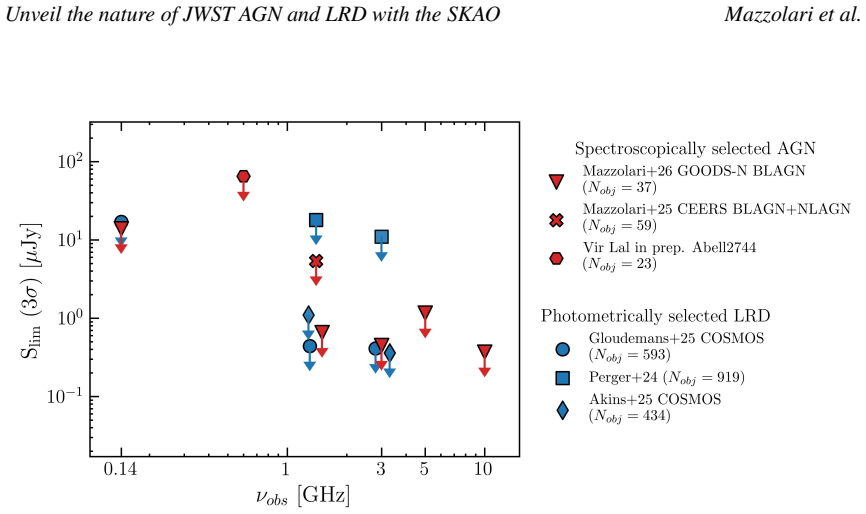
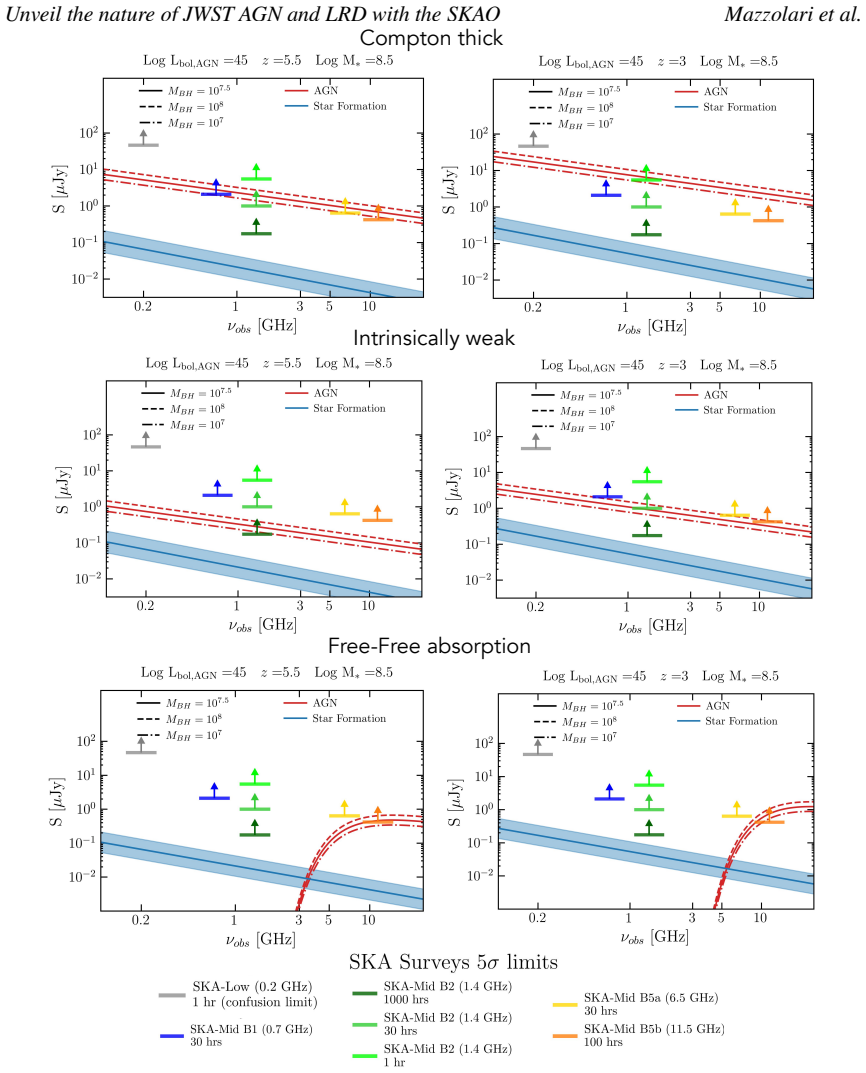
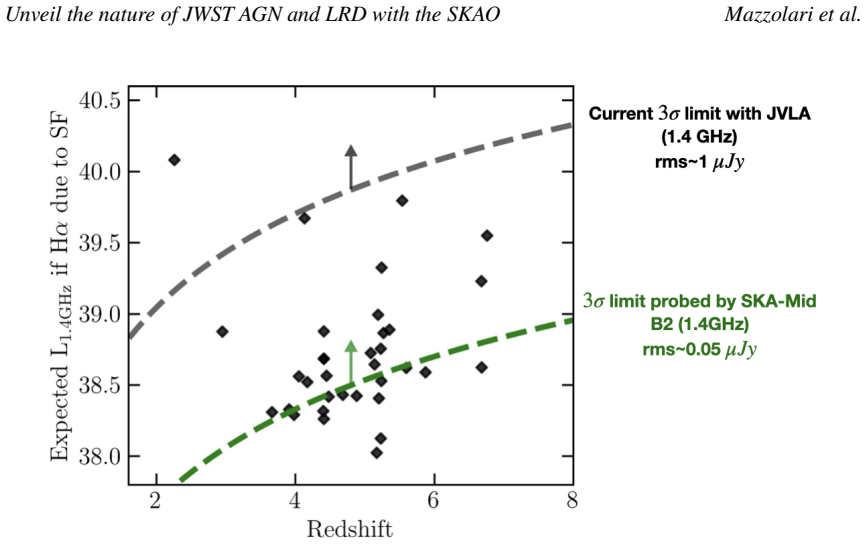
The advent of JWST has revealed a large population of AGN at $z>4$, which are $\sim1$ dex more abundant than previously expected, including also the enigmatic population of Little Red Dots (LRDs). Remarkably, the vast majority of JWST-discovered AGN and LRDs are not detected in X-rays, and most of them also show faint rest-frame UV continua and faint high-ionization emission lines, as well as unusually faint emission in the Mid and Far infrared. Recent studies investigating their radio properties have reported no significant detections, even in deep stacking analyses, reaching sensitivities of 0.5-0.1 $\mu$Jy at $z\sim 5-6$, corresponding to $L_{R}\lesssim 10^{39}\rm \ erg\ s^{-1}$. While these non-detections may be consistent with a standard radio-quiet nature, some results suggest that the radio emission might instead be significantly suppressed by other physical phenomena. Three main scenarios have been proposed in the literature to explain the physical properties of these objects across the electromagnetic spectrum: Compton-thick absorption by a broad-line region with high covering-factor, intrinsically weak emission driven by high accretion rates, or the presence of a cocoon of dense ionized gas that produces strong scattering effects. The unprecedented sensitivity of SKAO will enable the detection of the radio emission of these AGN in all three cases. Because each scenario is expected to produce distinct radio signatures, future SKAO continuum surveys will be able to distinguish between them, uncovering the physical processes responsible for their peculiar properties. Observations spanning a wide range of integration times (1-1000 hours) and frequencies with SKA-Mid and SKA-Low (0.2-11 GHz) will allow us to characterize these objects from the local Universe to high redshift, investigate possible radio variability, and test alternative scenarios to black hole accretion.
Editorial analysis
A structured set of objections, weighed in public.
Referee Report
Summary. The manuscript argues that SKAO continuum surveys (SKA-Mid and SKA-Low, 0.2-11 GHz) will detect radio emission from JWST-discovered AGN and Little Red Dots at z>4, which are currently undetected in X-rays, UV, and IR. It posits that the three scenarios proposed in the literature to explain their properties—Compton-thick absorption by a high-covering-factor broad-line region, intrinsically weak emission at high accretion rates, or a cocoon of dense ionized gas—will each produce distinct radio signatures (in luminosity, spectrum, or variability), allowing future observations with integration times of 1-1000 hours to distinguish between them and characterize the objects across redshifts.
Significance. If the claimed distinguishability holds, the work would identify a practical observational path to test the physical drivers of these high-redshift AGN populations using radio data that can penetrate obscuration, building on existing non-detection limits (L_R ≲ 10^39 erg s^-1 at z~5-6). The manuscript correctly summarizes the multi-wavelength faintness and radio non-detections from recent studies and references published SKAO sensitivity forecasts, but supplies no original quantitative modeling to support separability.
major comments (2)
- [Abstract] Abstract: The central claim that 'each scenario is expected to produce distinct radio signatures' and that SKAO 'will be able to distinguish between them' is not supported by any explicit calculations, luminosity functions, spectral-index predictions, absorption models, or simulated spectra for the three scenarios at the quoted SKAO sensitivities (~0.1 μJy). Without these, it is not possible to verify that differences would exceed noise, avoid overlap after redshift and stacking effects, or remain separable across the 0.2-11 GHz range.
- [Abstract] Abstract: No error budgets, variability predictions, or comparisons of expected radio properties (e.g., for Compton-thick vs. cocoon scenarios) are provided to demonstrate that the signatures would be observationally distinguishable within the stated integration times (1-1000 hours) or after accounting for the reported non-detection limits from stacking analyses.
Simulated Author's Rebuttal
We thank the referee for their constructive comments on our manuscript. The points raised correctly identify that the central claims rest on qualitative expectations rather than new quantitative modeling. We respond to each major comment below and indicate where revisions will be made.
read point-by-point responses
-
Referee: [Abstract] Abstract: The central claim that 'each scenario is expected to produce distinct radio signatures' and that SKAO 'will be able to distinguish between them' is not supported by any explicit calculations, luminosity functions, spectral-index predictions, absorption models, or simulated spectra for the three scenarios at the quoted SKAO sensitivities (~0.1 μJy). Without these, it is not possible to verify that differences would exceed noise, avoid overlap after redshift and stacking effects, or remain separable across the 0.2-11 GHz range.
Authors: We agree that the manuscript provides no original quantitative calculations, luminosity functions, or simulated spectra. The argument synthesizes expectations from the published literature on how Compton-thick absorption, high-accretion-rate weak emission, and dense ionized cocoons would imprint differently on radio luminosity, spectral index, and variability. We will revise the abstract to state that SKAO observations 'have the potential to distinguish between these scenarios' and add a dedicated paragraph citing specific prior works on radio properties under each physical condition. This is a partial revision, as new modeling lies outside the scope of the present work. revision: partial
-
Referee: [Abstract] Abstract: No error budgets, variability predictions, or comparisons of expected radio properties (e.g., for Compton-thick vs. cocoon scenarios) are provided to demonstrate that the signatures would be observationally distinguishable within the stated integration times (1-1000 hours) or after accounting for the reported non-detection limits from stacking analyses.
Authors: The manuscript references existing stacking limits and SKAO sensitivity forecasts but does not supply new error budgets or detailed variability predictions. We will expand the text to include references to studies of radio variability and spectral behavior in obscured AGN, and note how the different scenarios could produce distinguishable outcomes within the quoted integration times. We will also explicitly compare the expected radio properties of the Compton-thick and cocoon cases using published models. This constitutes a partial revision. revision: partial
- Provision of explicit calculations, luminosity functions, spectral-index predictions, absorption models, or simulated spectra for the three scenarios at SKAO sensitivities, as these require new modeling work beyond the current manuscript.
Circularity Check
No significant circularity; claim is qualitative expectation from external literature
full rationale
The paper states that three scenarios from the literature are expected to produce distinct radio signatures, allowing SKAO to distinguish them, but supplies no equations, fitted parameters, self-citations, or derivations that reduce this expectation to the paper's own inputs by construction. The argument rests on external benchmarks (literature scenarios and published SKAO forecasts) without any self-referential reduction or load-bearing self-citation chain. This is the normal case of a self-contained qualitative prediction.
Axiom & Free-Parameter Ledger
Reference graph
Works this paper leans on
-
[1]
2026 ,publisher =
Isabella Prandoni and author2 and author3 and author4 and author5 ,title =. 2026 ,publisher =
2026
-
[2]
The GlimmIr: Spectroscopic Variability in a z -0.5ex 7 LRD Indicates Rapid Changes in Both the Narrow and Broad Line Regions. arXiv e-prints , keywords =. doi:10.48550/arXiv.2604.25991 , archivePrefix =. 2604.25991 , primaryClass =
work page internal anchor Pith review Pith/arXiv arXiv doi:10.48550/arxiv.2604.25991
-
[3]
Ruling Out Compact Jets as the Dominant Source of Radio Emission in Radio-quiet, High-Eddington-ratio Active Galactic Nuclei. , keywords =. doi:10.3847/1538-4357/ae36a6 , archivePrefix =. 2601.06480 , primaryClass =
-
[4]
The Radio Quiescence of Active Galaxies with High Accretion Rates
The Radio Quiescence of Active Galaxies with High Accretion Rates. , keywords =. doi:10.1086/497905 , archivePrefix =. astro-ph/0509198 , primaryClass =
work page internal anchor Pith review Pith/arXiv arXiv doi:10.1086/497905
-
[5]
Analysis of Multi-epoch JWST Images of 300 Little Red Dots: Tentative Detection of Variability in a Minority of Sources. , keywords =. doi:10.3847/1538-4357/adcb3e , archivePrefix =. 2411.02729 , primaryClass =
-
[6]
A black hole in a near-pristine galaxy 700 million years after the Big Bang
A black hole in a near pristine galaxy 700 Myr after the big bang. , keywords =. doi:10.1093/mnras/staf2109 , archivePrefix =. 2505.22567 , primaryClass =
work page internal anchor Pith review Pith/arXiv arXiv doi:10.1093/mnras/staf2109
-
[7]
X-ray Eclipses of Active Galactic Nuclei
X-Ray Eclipses of Active Galactic Nuclei. , keywords =. doi:10.3847/1538-4357/aa7fbd , archivePrefix =. 1707.06734 , primaryClass =
work page internal anchor Pith review Pith/arXiv arXiv doi:10.3847/1538-4357/aa7fbd
-
[8]
The CaFe Project: Optical Fe II and Near-infrared Ca II Triplet Emission in Active Galaxies. I. Photoionization Modeling. , keywords =. doi:10.3847/1538-4357/abb5b8 , archivePrefix =. 2004.05201 , primaryClass =
-
[9]
A comprehensive radio study of narrow-line Seyfert 1 galaxies. , keywords =. doi:10.1051/0004-6361/202450962 , archivePrefix =. 2510.01307 , primaryClass =
-
[10]
Investigating kpc-scale radio emission properties of narrow-line Seyfert 1 galaxies
Investigating kpc-scale radio emission properties of narrow-line Seyfert 1 galaxies. , keywords =. doi:10.1093/mnras/sty1818 , archivePrefix =. 1807.01945 , primaryClass =
work page internal anchor Pith review Pith/arXiv arXiv doi:10.1093/mnras/sty1818
-
[11]
Radio jets and gamma-ray emission in radio-silent narrow-line Seyfert 1 galaxies
Radio jets and gamma-ray emission in radio-silent narrow-line Seyfert 1 galaxies. , keywords =. doi:10.1051/0004-6361/201833378 , archivePrefix =. 1806.02058 , primaryClass =
work page internal anchor Pith review Pith/arXiv arXiv doi:10.1051/0004-6361/201833378
-
[12]
Frontiers in Astronomy and Space Sciences , keywords =
Narrow-line Seyfert 1 galaxies with absorbed jets -insights from radio spectral index maps. Frontiers in Astronomy and Space Sciences , keywords =. doi:10.3389/fspas.2021.735310 , archivePrefix =. 2108.08521 , primaryClass =
-
[13]
BlackTHUNDER: Shedding light on a dormant and extreme little red dot at z = 8.50. , keywords =. doi:10.1093/mnras/stag115 , archivePrefix =. 2509.20455 , primaryClass =
-
[14]
Subarcsecond view on the high-redshift blazar GB 1508+5714 by the International LOFAR Telescope. , keywords =. doi:10.1051/0004-6361/202141720 , archivePrefix =. 2205.11288 , primaryClass =
-
[15]
A Dichotomy in the 1─24 GHz Parsec-scale Radio Spectra of Radio-quiet Quasars. , keywords =. doi:10.3847/1538-4357/ada142 , archivePrefix =. 2410.07889 , primaryClass =
-
[16]
Counting Little Red Dots at z < 4 with Ground-based Surveys and Spectroscopic Follow-up. , keywords =. doi:10.3847/1538-4357/ae4596 , archivePrefix =. 2504.08032 , primaryClass =
-
[17]
A Black Hole Star at Cosmic Noon: Extreme Balmer break, photospheric continuum, and broad absorption by thick winds in a Little Red Dot at z=1.7. arXiv e-prints , keywords =. doi:10.48550/arXiv.2603.28335 , archivePrefix =. 2603.28335 , primaryClass =
work page internal anchor Pith review Pith/arXiv arXiv doi:10.48550/arxiv.2603.28335
-
[18]
The X-ray weakness of little red dots and JWST-selected AGN: Comparison with local AGN in different accretion regimes. , keywords =. doi:10.1051/0004-6361/202557444 , adsurl =
-
[19]
The Radio Properties of Seyfert Galaxies in the 12--Micron and CfA Samples
The Radio Properties of Seyfert Galaxies in the 12 Micron and CfA Samples. , keywords =. doi:10.1086/178132 , archivePrefix =. astro-ph/9606178 , primaryClass =
work page internal anchor Pith review Pith/arXiv arXiv doi:10.1086/178132
-
[20]
The Discovery of Little Red Dots in the Local Universe: Signatures of Cool Gas Envelopes. , keywords =. doi:10.3847/1538-4357/ae2bdf , archivePrefix =. 2507.10659 , primaryClass =
-
[21]
Radio detection of a local little red dot. , keywords =. doi:10.1051/0004-6361/202558326 , archivePrefix =. 2512.03331 , primaryClass =
-
[22]
Little Red Dots or Brown Dwarfs? NIRSpec Discovery of Three Distant Brown Dwarfs Masquerading as NIRCam-selected Highly Reddened Active Galactic Nuclei. , keywords =. doi:10.3847/2041-8213/acfeec , archivePrefix =. 2308.10900 , primaryClass =
-
[23]
Narrow-line AGN selection in CEERS: Spectroscopic selection, physical properties, and X-ray and radio analysis. , keywords =. doi:10.1051/0004-6361/202451860 , archivePrefix =. 2408.15615 , primaryClass =
-
[24]
The radio properties of the JWST-discovered AGN. , keywords =. doi:10.1051/0004-6361/202453317 , archivePrefix =. 2412.04224 , primaryClass =
-
[25]
Radio selection of heavily obscured AGN in the J1030 field: unraveling a missing Compton-thick population. arXiv e-prints , keywords =. doi:10.48550/arXiv.2603.10176 , archivePrefix =. 2603.10176 , primaryClass =
-
[26]
Little Red and Blue Dots: simply stratified Broad Line Regions. arXiv e-prints , keywords =. doi:10.48550/arXiv.2603.22277 , archivePrefix =. 2603.22277 , primaryClass =
-
[27]
Little Red Dots as Late-stage Quasi-stars. , keywords =. doi:10.3847/1538-4357/ae274a , archivePrefix =. 2507.09085 , primaryClass =
-
[28]
Inside the cocoon: a comprehensive explanation of the spectra of Little Red Dots. arXiv e-prints , keywords =. doi:10.48550/arXiv.2601.18864 , archivePrefix =. 2601.18864 , primaryClass =
-
[29]
A population of red candidate massive galaxies 600 Myr after the Big Bang. , keywords =. doi:10.1038/s41586-023-05786-2 , archivePrefix =. 2207.12446 , primaryClass =
-
[30]
The warm outer layer of a Little Red Dot as the source of [Fe II] and collisional Balmer lines with scattering wings. arXiv e-prints , keywords =. doi:10.48550/arXiv.2510.00103 , archivePrefix =. 2510.00103 , primaryClass =
-
[31]
Irony at z=6.68: a bright AGN with forbidden Fe emission and multi-component Balmer absorption. arXiv e-prints , keywords =. doi:10.48550/arXiv.2510.00101 , archivePrefix =. 2510.00101 , primaryClass =
-
[32]
Little Red Dots as the Very First Activity of Black Hole Growth. , keywords =. doi:10.3847/2041-8213/adea66 , archivePrefix =. 2503.05537 , primaryClass =
-
[33]
Little Red Dots are Nurseries of Massive Black Holes. , keywords =. doi:10.3847/1538-4357/ae1619 , archivePrefix =. 2509.02664 , primaryClass =
-
[34]
Little Red Dots as direct-collapse black hole nurseries. , keywords =. doi:10.1093/mnras/staf1362 , archivePrefix =. 2508.14897 , primaryClass =
-
[35]
Connecting the Dots: UV-Bright Companions of Little Red Dots as Lyman-Werner Sources Enabling Direct Collapse Black Hole Formation. arXiv e-prints , keywords =. doi:10.48550/arXiv.2602.02702 , archivePrefix =. 2602.02702 , primaryClass =
work page internal anchor Pith review Pith/arXiv arXiv doi:10.48550/arxiv.2602.02702
-
[36]
Little Red Dots at an Inflection Point: Ubiquitous V-shaped Turnover Consistently Occurs at the Balmer Limit. , keywords =. doi:10.3847/1538-4357/ae1500 , archivePrefix =. 2411.03424 , primaryClass =
-
[37]
Little Red Dots host Black Hole Stars: A unified family of gas-reddened AGN revealed by JWST/NIRSpec spectroscopy. arXiv e-prints , keywords =. doi:10.48550/arXiv.2511.21820 , archivePrefix =. 2511.21820 , primaryClass =
-
[38]
The M_ BH -M_ * Relationship at 3<z<7 : Big Black Holes in Little Red Dots. arXiv e-prints , keywords =. doi:10.48550/arXiv.2510.07376 , archivePrefix =. 2510.07376 , primaryClass =
-
[39]
Constraints on the host galaxy and AGN properties of three z > 6 JWST AGN from NOEMA observations. arXiv e-prints , keywords =. doi:10.48550/arXiv.2603.29652 , archivePrefix =. 2603.29652 , primaryClass =
-
[40]
The Galaxies Missed by Hubble and ALMA: The Contribution of Extremely Red Galaxies to the Cosmic Census at 3 < z < 8. , keywords =. doi:10.3847/1538-4357/ad3f17 , archivePrefix =. 2311.07483 , primaryClass =
-
[41]
UNCOVER: Candidate Red Active Galactic Nuclei at 3 < z < 7 with JWST and ALMA. , keywords =. doi:10.3847/1538-4357/ad3551 , archivePrefix =. 2306.07320 , primaryClass =
-
[42]
Backhaus and Fergus Cullen and Lu Shen and Micaela B
Kaila Ronayne and Casey Papovich and Allison Kirkpatrick and Bren E. Backhaus and Fergus Cullen and Lu Shen and Micaela B. Bagley and Steven L. Finkelstein and Kurt Hamblin and Jeyhan S. Kartaltepe and Dale D. Kocevski and Anton M. Koekemoer and Erini Lambrides and Fabio Pacucci and Guang Yang , title =. Arxiv:2508.20177v1 , year =
-
[43]
Jiyoung Choe and Taysun Kimm and Harley Katz and Maxime Rey and Daniel Han and J. K. Jang and Joki Rosdahl , title =. Arxiv:2510.00400v1 , year =
-
[44]
Saiyang Zhang and Boyuan Liu and Volker Bromm and Florian Kühnel , title =. Arxiv:2512.14066v1 , year =
-
[45]
Sunmyon Chon and Shingo Hirano and Tomoaki Ishiyama and Seok-Jun Chang and Volker Springel , title =. Arxiv:2601.04955v1 , year =
-
[46]
Undermassive Hosts of z = 4-6 AGN from JWST/NIRCam Image Decomposition with CONGRESS, FRESCO, and JADES. arXiv e-prints , keywords =. doi:10.48550/arXiv.2601.15962 , archivePrefix =. 2601.15962 , primaryClass =
-
[47]
BlackTHUNDER strikes twice: rest-frame Balmer-line absorption and high Eddington accretion rate in a Little Red Dot at z=7.04. arXiv e-prints , keywords =. doi:10.48550/arXiv.2503.11752 , archivePrefix =. 2503.11752 , primaryClass =
work page internal anchor Pith review Pith/arXiv arXiv doi:10.48550/arxiv.2503.11752
-
[48]
Ruling out dominant electron scattering in Little Red Dots' Rosetta Stone using multiple hydrogen lines. arXiv e-prints , keywords =. doi:10.48550/arXiv.2507.08929 , archivePrefix =. 2507.08929 , primaryClass =
-
[49]
Impact of Resonance, Raman, and Thomson Scattering on Hydrogen Line Formation in Little Red Dots. arXiv e-prints , keywords =. doi:10.48550/arXiv.2508.08768 , archivePrefix =. 2508.08768 , primaryClass =
-
[50]
A "Black Hole Star" Reveals the Remarkable Gas-Enshrouded Hearts of the Little Red Dots
A ``Black Hole Star'' Reveals the Remarkable Gas-Enshrouded Hearts of the Little Red Dots. arXiv e-prints , keywords =. doi:10.48550/arXiv.2503.16596 , archivePrefix =. 2503.16596 , primaryClass =
work page internal anchor Pith review Pith/arXiv arXiv doi:10.48550/arxiv.2503.16596
-
[51]
Deciphering the JWST spectrum of a 'little red dot' at z 4.53: An obscured AGN and its star-forming host. , keywords =. doi:10.1051/0004-6361/202348857 , archivePrefix =. 2312.03065 , primaryClass =
-
[52]
A Lower Bound of Star Formation Activity in Ultra-high-redshift Galaxies Detected with JWST: Implications for Stellar Populations and Radiation Sources. , keywords =. doi:10.3847/2041-8213/ac9310 , archivePrefix =. 2208.06872 , primaryClass =
-
[53]
AGN luminosity functions and helium reionization at z = 2-7
Semi-analytic forecasts for JWST - V. AGN luminosity functions and helium reionization at z = 2-7. , keywords =. doi:10.1093/mnras/stab2761 , archivePrefix =. 2109.13241 , primaryClass =
-
[54]
Reionization with galaxies and active galactic nuclei. , keywords =. doi:10.1093/mnras/staa1138 , archivePrefix =. 2001.06021 , primaryClass =
-
[55]
The Assembly of Black Hole Mass and Luminosity Functions of High-redshift Quasars via Multiple Accretion Episodes. , keywords =. doi:10.3847/1538-4357/accbbe , archivePrefix =. 2210.02308 , primaryClass =
-
[56]
JWST CEERS and JADES Active Galaxies at z = 4-7 Violate the Local M _ -M _ Relation at >3 : Implications for Low-mass Black Holes and Seeding Models. , keywords =. doi:10.3847/2041-8213/ad0158 , archivePrefix =. 2308.12331 , primaryClass =
-
[57]
RUBIES: A spectroscopic census of little red dots: All point sources with v-shaped continua have broad lines. , keywords =. doi:10.1051/0004-6361/202555816 , archivePrefix =. 2506.05459 , primaryClass =
-
[58]
JADES: comprehensive census of broad-line AGN from Reionization to Cosmic Noon revealed by JWST. arXiv e-prints , keywords =. doi:10.48550/arXiv.2504.03551 , archivePrefix =. 2504.03551 , primaryClass =
-
[59]
What you see is what you get: empirically measured bolometric luminosities of Little Red Dots. arXiv e-prints , keywords =. doi:10.48550/arXiv.2509.05434 , archivePrefix =. 2509.05434 , primaryClass =
-
[60]
AGN-heated dust revealed in ``Little Red Dots''. arXiv e-prints , keywords =. doi:10.48550/arXiv.2509.07100 , archivePrefix =. 2509.07100 , primaryClass =
-
[61]
A Confirmed Deficit of Hot and Cold Dust Emission in the Most Luminous Little Red Dots. , keywords =. doi:10.3847/2041-8213/ade78b , archivePrefix =. 2503.02059 , primaryClass =
-
[62]
No [C II] or dust detection in two Little Red Dots at z _ spec > 7. , keywords =. doi:10.1051/0004-6361/202554361 , archivePrefix =. 2503.01945 , primaryClass =
-
[63]
An Upper Limit of 10 ^ 6 M _ in Dust from ALMA Observations in 60 Little Red Dots. , keywords =. doi:10.3847/2041-8213/adfa91 , archivePrefix =. 2505.18873 , primaryClass =
-
[64]
Dust in Little Red Dots. , keywords =. doi:10.3847/2041-8213/ad7ba7 , archivePrefix =. 2407.05094 , primaryClass =
-
[65]
The 1.28 GHz MeerKAT Galactic Center Mosaic. , keywords =. doi:10.3847/1538-4357/ac449a , archivePrefix =. 2201.10541 , primaryClass =
-
[66]
RUBIES: JWST/NIRSpec Confirmation of an Infrared-luminous, Broad-line Little Red Dot with an Ionized Outflow. , keywords =. doi:10.3847/1538-4357/adc1ca , archivePrefix =. 2403.02304 , primaryClass =
-
[67]
A big red dot at cosmic noon. arXiv e-prints , keywords =. doi:10.48550/arXiv.2506.12141 , archivePrefix =. 2506.12141 , primaryClass =
-
[68]
Another Piece to the Puzzle: Radio Detection of a JWST-detected Active Galactic Nucleus Candidate. , keywords =. doi:10.3847/1538-4357/adddb9 , archivePrefix =. 2501.04912 , primaryClass =
-
[69]
JWST's little red dots: an emerging population of young, low-mass AGN cocooned in dense ionized gas. arXiv e-prints , keywords =. doi:10.48550/arXiv.2503.16595 , archivePrefix =. 2503.16595 , primaryClass =
-
[70]
The radio properties of the JWST-discovered AGN. arXiv e-prints , keywords =. doi:10.48550/arXiv.2412.04224 , archivePrefix =. 2412.04224 , primaryClass =
-
[71]
BlackTHUNDER - A non-stellar Balmer break in a black hole-dominated little red dot at z = 7.04. , keywords =. doi:10.1093/mnras/staf1867 , archivePrefix =. 2501.13082 , primaryClass =
-
[72]
Investigating photometric and spectroscopic variability in the multiply imaged little red dot A2744-QSO1. , keywords =. doi:10.1051/0004-6361/202554110 , archivePrefix =. 2502.07875 , primaryClass =
-
[73]
Lack of Rest-frame Ultraviolet Variability in Little Red Dots Based on HST and JWST Observations. , keywords =. doi:10.3847/2041-8213/adc5e3 , archivePrefix =. 2412.05242 , primaryClass =
-
[75]
How similar are narrow-line Seyfert 1 galaxies and high-z type 1 AGN?. arXiv e-prints , keywords =. doi:10.48550/arXiv.2509.03576 , archivePrefix =. 2509.03576 , primaryClass =
-
[76]
The Role of Fast Magnetic Reconnection on the Radio and Gamma-ray Emission from the Nuclear Regions of Microquasars and Low Luminosity AGNs. , keywords =. doi:10.1088/0004-637X/802/2/113 , archivePrefix =. 1410.3454 , primaryClass =
work page internal anchor Pith review Pith/arXiv arXiv doi:10.1088/0004-637x/802/2/113
-
[77]
Gamma rays from jets interacting with BLR clouds in blazars
Gamma rays from jets interacting with BLR clouds in blazars. , keywords =. doi:10.1051/0004-6361/201834231 , archivePrefix =. 1902.07195 , primaryClass =
work page internal anchor Pith review Pith/arXiv arXiv doi:10.1051/0004-6361/201834231 1902
-
[78]
Unprecedented extreme high-frequency radio variability in early-stage active galactic nuclei. , keywords =. doi:10.1093/mnras/stae1701 , archivePrefix =. 2312.02326 , primaryClass =
-
[79]
A Catalog of Narrow Line Seyfert 1 Galaxies from the Sloan Digital Sky Survey Data Release 12
A Catalog of Narrow Line Seyfert 1 Galaxies from the Sloan Digital Sky Survey Data Release 12. , keywords =. doi:10.3847/1538-4365/aa6971 , archivePrefix =. 1704.07700 , primaryClass =
work page internal anchor Pith review Pith/arXiv arXiv doi:10.3847/1538-4365/aa6971
-
[80]
X-ray perspective of Narrow-line Seyfert 1 galaxies
X-ray perspective of Narrow-line Seyfert 1 galaxies. Revisiting Narrow-Line Seyfert 1 Galaxies and their Place in the Universe , year = 2018, month = apr, eid =. doi:10.22323/1.328.0034 , archivePrefix =. 1807.09838 , primaryClass =
work page internal anchor Pith review Pith/arXiv arXiv doi:10.22323/1.328.0034 2018
-
[81]
Systematic broad-band X-ray study of super-Eddington accretion on to supermassive black holes - I. X-ray continuum. , keywords =. doi:10.1093/mnras/stac3590 , archivePrefix =. 2212.06183 , primaryClass =
discussion (0)
Sign in with ORCID, Apple, or X to comment. Anyone can read and Pith papers without signing in.