Search for physics beyond the standard model in four and three top quark production events using proton-proton collisions at sqrt{s} = 13 TeV
Pith reviewed 2026-07-01 01:17 UTC · model grok-4.3
The pith
Analysis of three- and four-top events constrains six Wilson coefficients and excludes heavy resonances in effective field theory.
A machine-rendered reading of the paper's core claim, the machinery that carries it, and where it could break.
Core claim
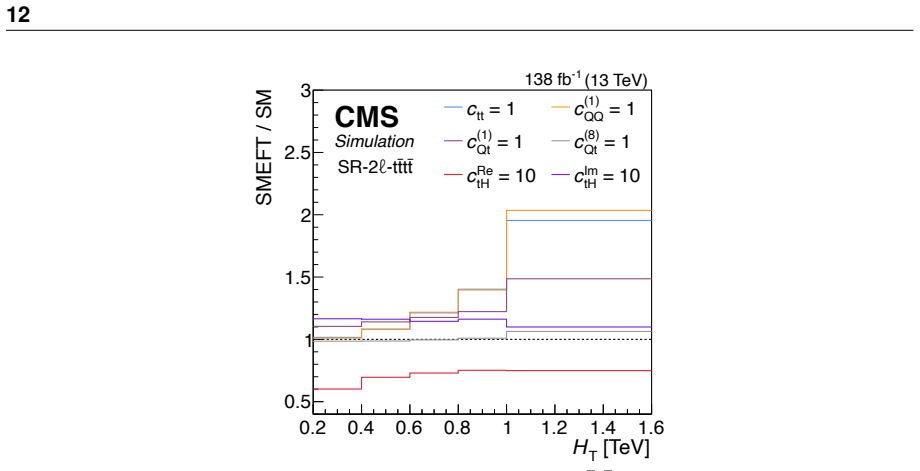
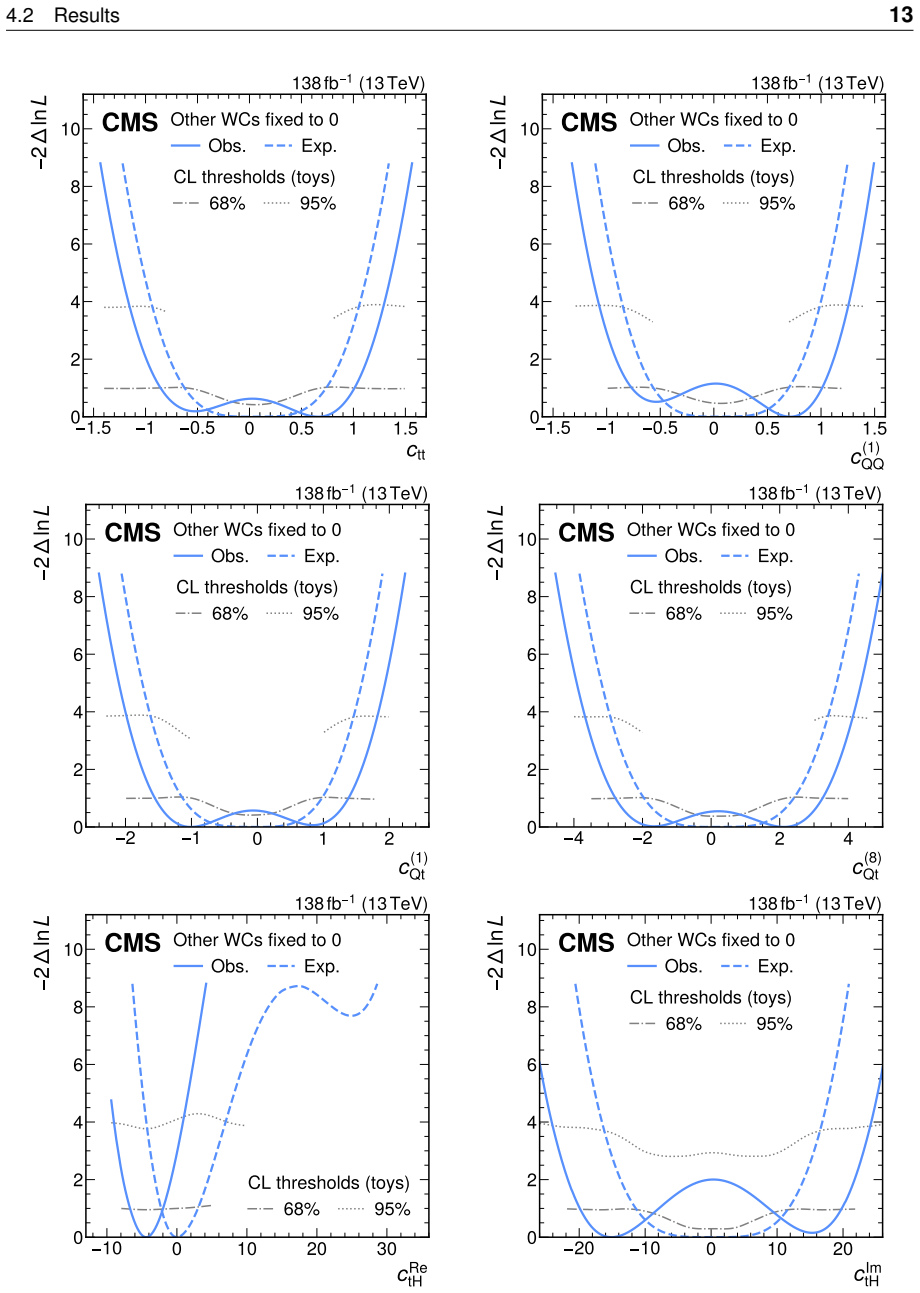
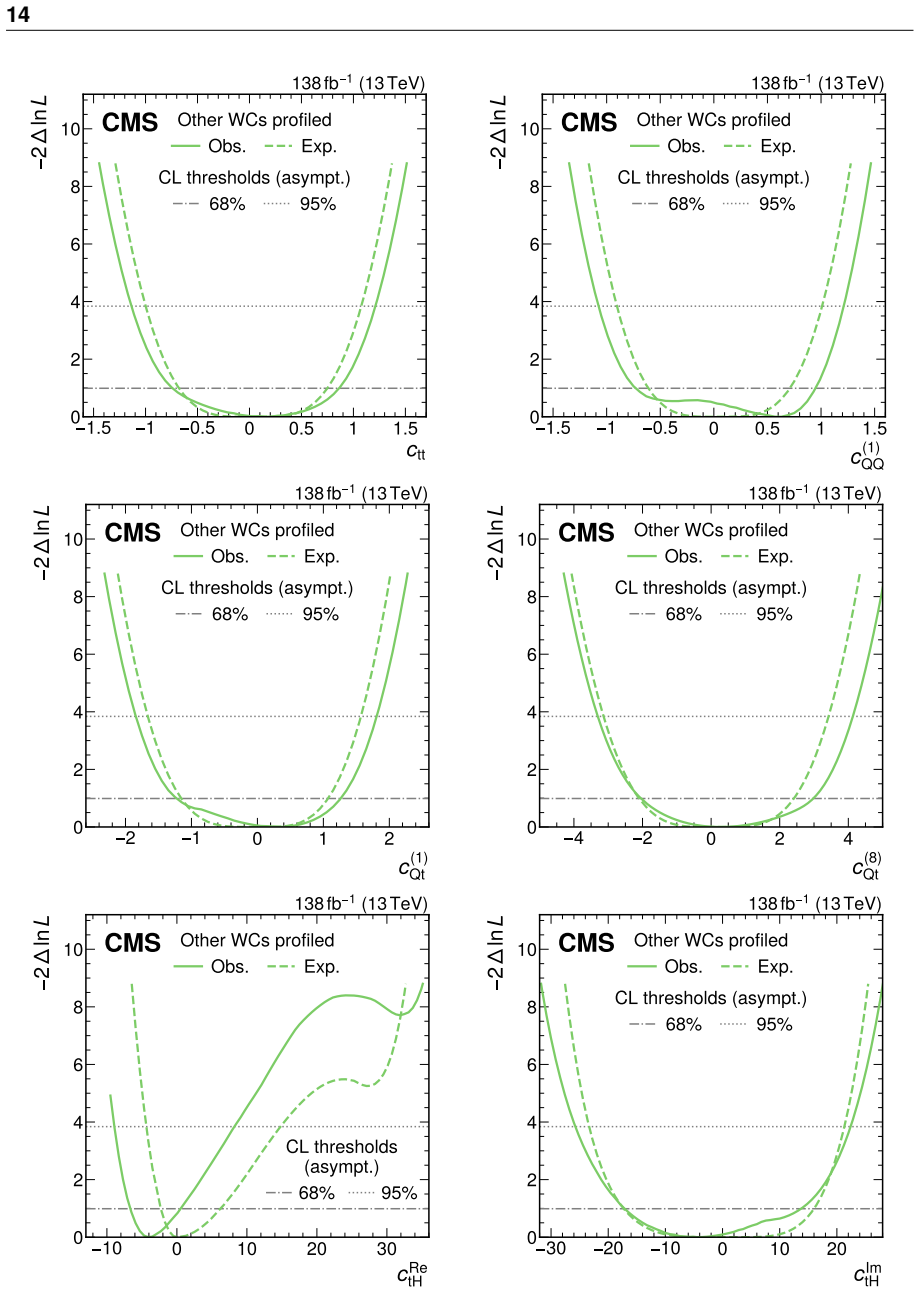
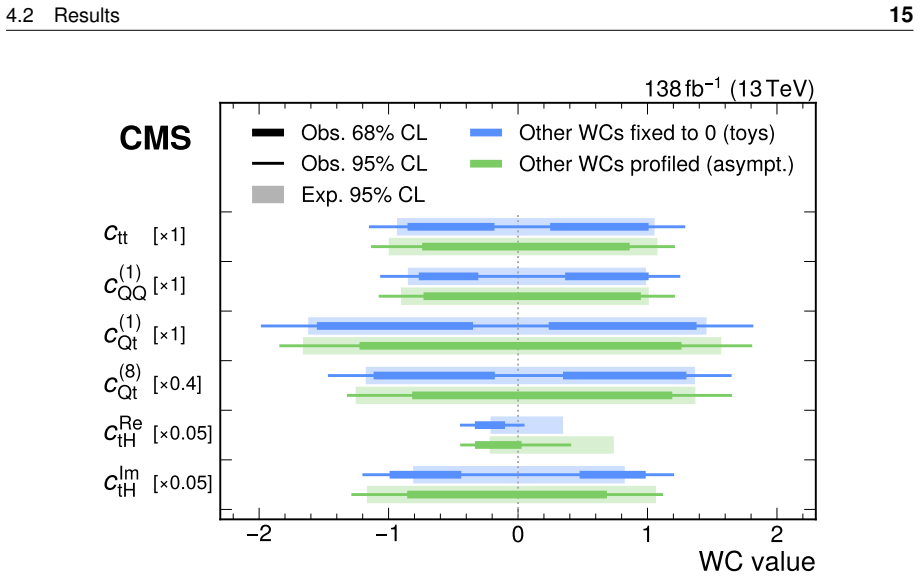
Events with two same-sign, three, or four leptons from 138 fb^{-1} of 13 TeV data constrain six Wilson coefficients modifying interactions between four third-generation quarks or between top quarks and the Higgs boson, exclude narrow topphilic resonances with masses from 400 GeV to 1.6 TeV depending on spin and color, and yield an extraction of the top quark Yukawa coupling that includes possible CP-odd contributions.
What carries the argument
Selection of same-sign dilepton, trilepton, and four-lepton final states from three- and four-top production, interpreted through six dimension-six operators in the standard model effective field theory.
If this is right
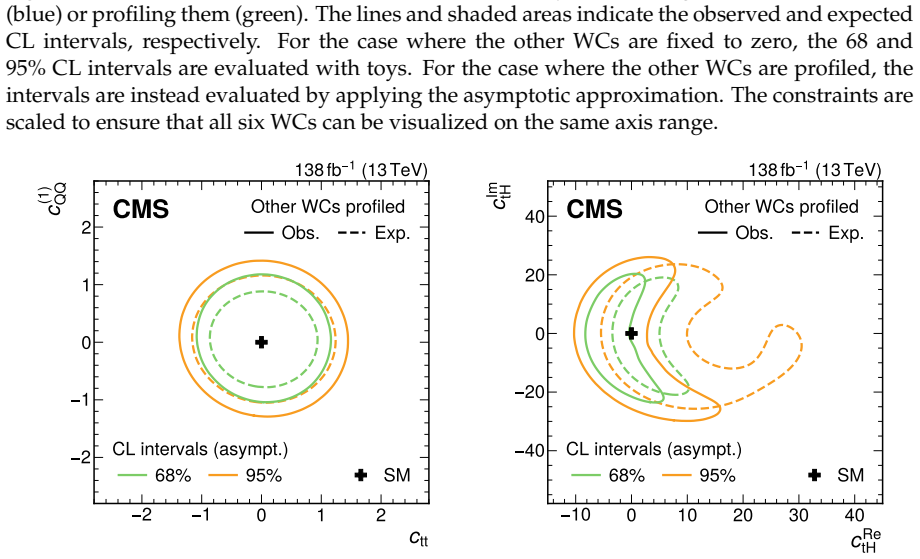
- Upper limits are placed on the magnitudes of the six Wilson coefficients that alter four-top and top-Higgs vertices.
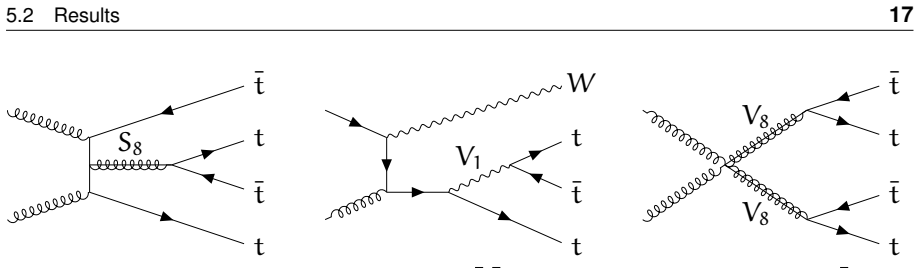
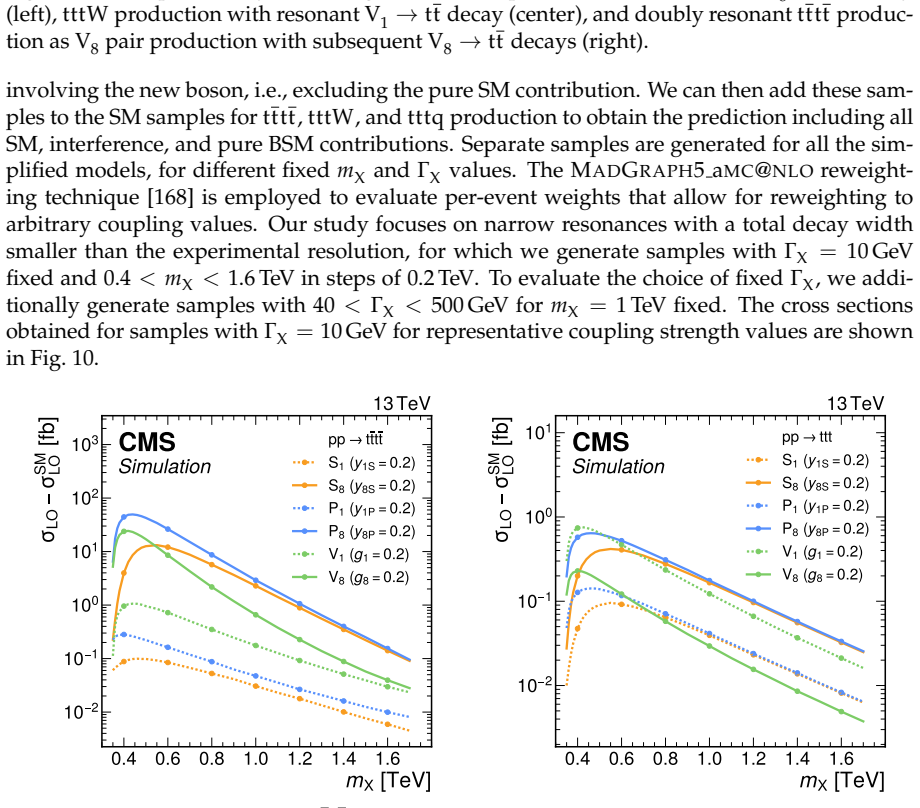
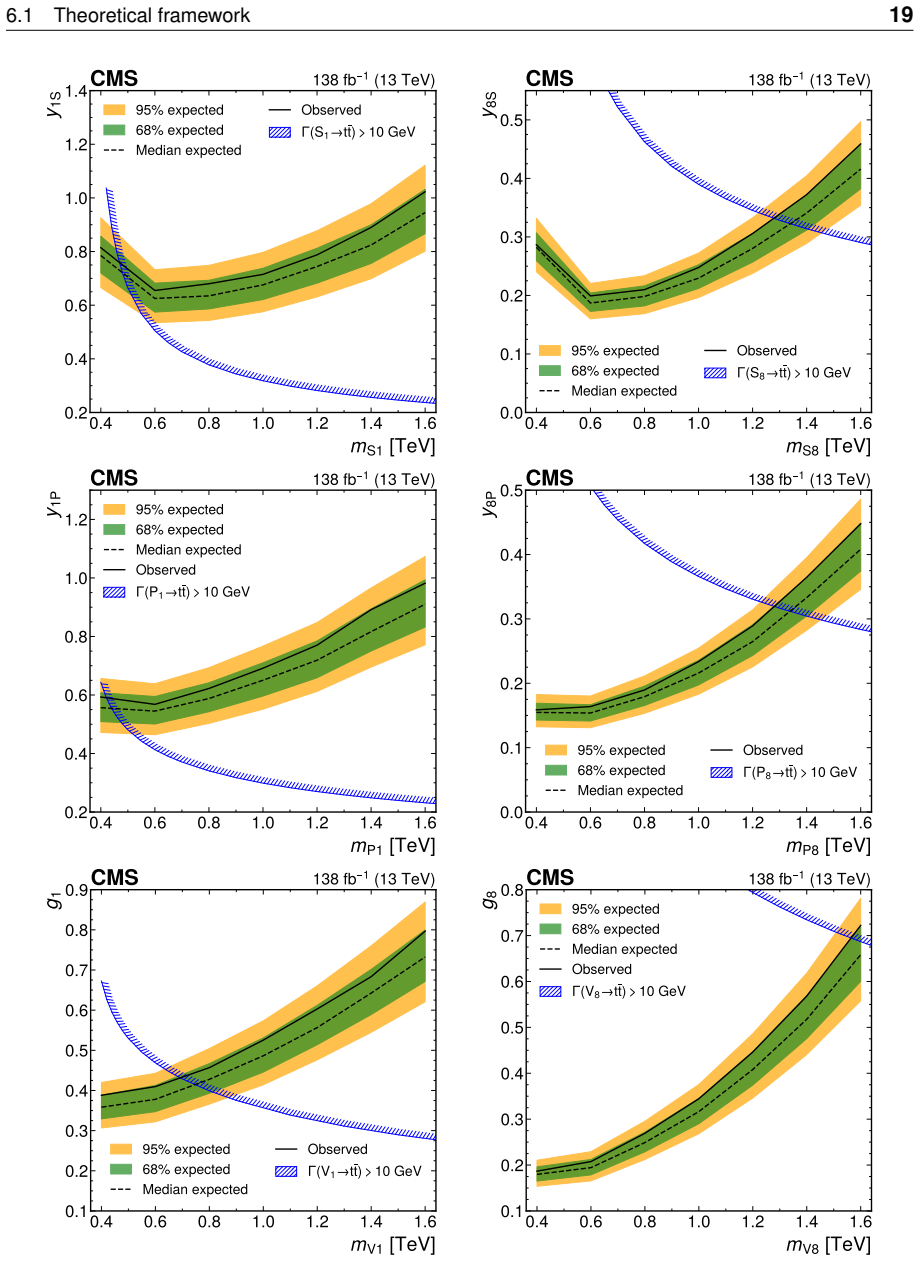
- Narrow resonances coupling preferentially to top quarks are excluded across 400 GeV to 1.6 TeV for several spin and color assignments.
- The top Yukawa coupling is determined allowing both CP-even and CP-odd components.
- The results provide direct input to global SMEFT fits that combine multiple top-quark observables.
Where Pith is reading between the lines
- Future higher-luminosity runs could tighten the same six coefficients enough to distinguish among specific ultraviolet completions.
- The multi-lepton selection strategy developed here can be reused for other rare final states involving third-generation quarks.
- Any future deviation from the extracted Yukawa value would directly affect predictions for Higgs boson production rates in association with top quarks.
Load-bearing premise
Standard-model background processes are accurately predicted by simulation and any beyond-standard-model effects are fully captured by the six chosen Wilson coefficients without significant contributions from higher-dimensional operators.
What would settle it
Observation of a statistically significant excess in the selected multi-lepton events whose kinematic shapes cannot be accommodated by any combination of the six Wilson coefficients or the tested resonance models.
Figures

read the original abstract
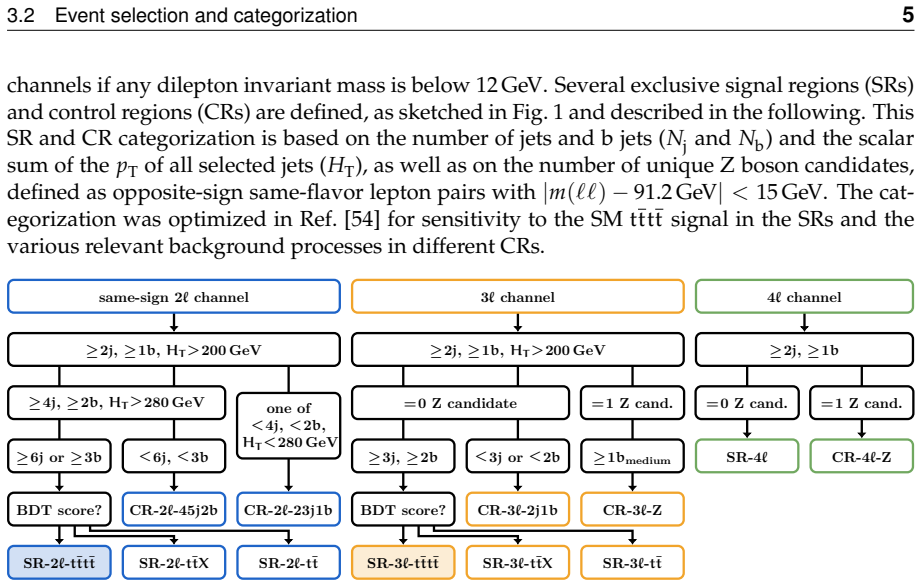
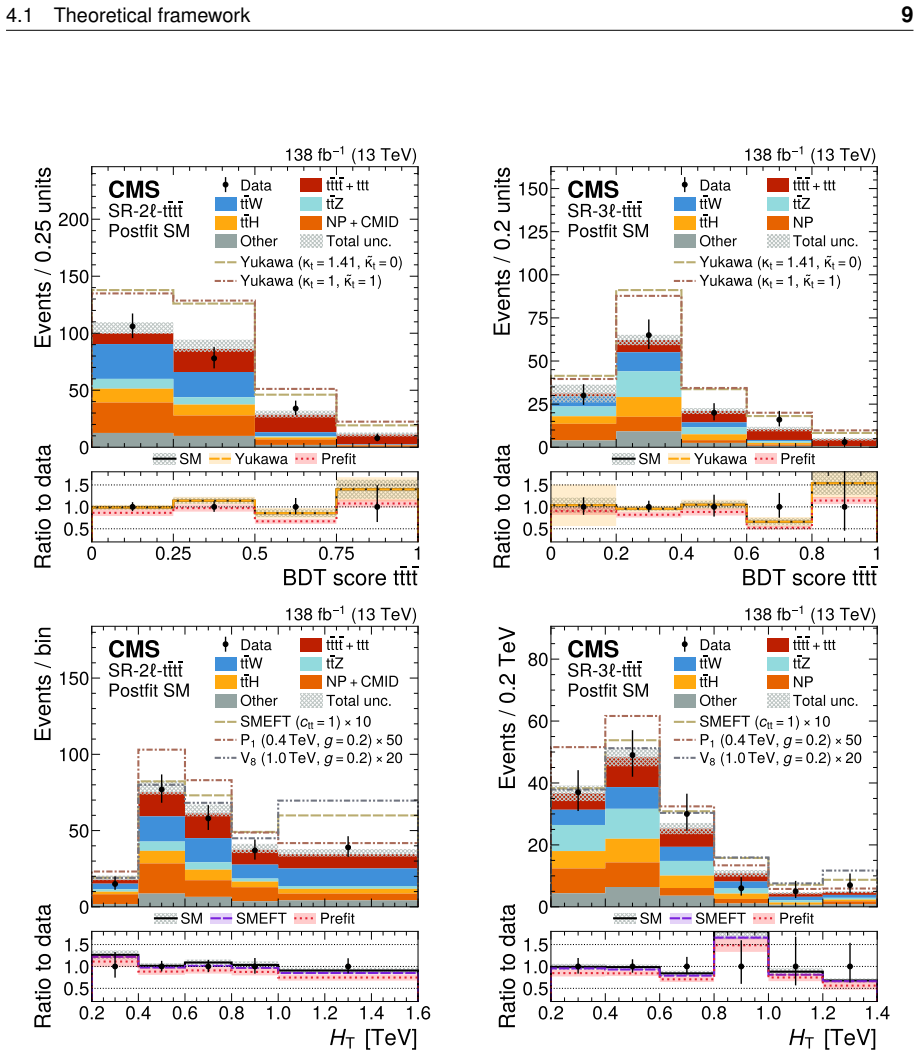
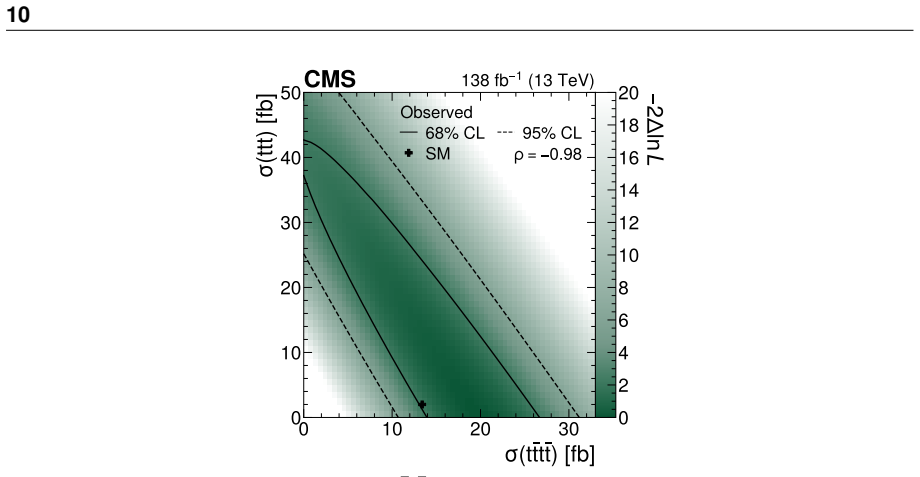
A search for physics beyond the standard model using four and three top quark production events is reported. The analyzed proton-proton collision data were recorded at 13 TeV with the CMS detector at the CERN LHC in 2016$-$2018 and correspond to an integrated luminosity of 138 fb$^{-1}$. Events with two same-sign, three, or four leptons (electrons and/or muons) are selected. Constraints on six Wilson coefficients that modify interactions between four third-generation quarks or between top quarks and the Higgs boson in the standard model effective field theory framework are derived. The data are further used to exclude narrow topphilic heavy resonances in the mass ranges between 400 GeV and 1.6 TeV depending on their spin and color states. Finally, the top quark Yukawa coupling is extracted, considering both $CP$-even and $CP$-odd contributions.
Editorial analysis
A structured set of objections, weighed in public.
Referee Report
Summary. The paper reports a search for beyond the Standard Model physics in three- and four-top quark production using proton-proton collisions at 13 TeV recorded by the CMS detector, corresponding to 138 fb^{-1}. Events with two same-sign, three, or four leptons are selected. The analysis derives constraints on six Wilson coefficients in the SMEFT framework for interactions involving four third-generation quarks or top quarks and the Higgs boson. It also excludes narrow topphilic heavy resonances in mass ranges from 400 GeV to 1.6 TeV depending on spin and color, and extracts the top quark Yukawa coupling including both CP-even and CP-odd contributions.
Significance. If the results hold, this provides significant constraints on SMEFT operators in the top sector and sets limits on potential new resonances. The multi-lepton analysis is a standard and effective approach for these processes. The extraction of the Yukawa coupling with CP considerations is a useful addition to the literature. The large data set allows for meaningful limits.
minor comments (1)
- [Abstract] The abstract would benefit from including at least one numerical result (e.g., a representative limit or excluded mass range) to convey the strength of the constraints immediately.
Simulated Author's Rebuttal
We thank the referee for the positive assessment of the manuscript, the recognition of its significance, and the recommendation for minor revision. No major comments were listed in the report.
Circularity Check
No significant circularity identified
full rationale
The paper reports experimental constraints on six Wilson coefficients, resonance mass exclusions, and the top Yukawa coupling obtained by comparing observed multi-lepton data to simulated SM backgrounds plus BSM signal templates. No equations, self-definitions, or self-citation chains reduce the reported limits to quantities defined by the fit itself or to prior author work. The derivation is self-contained against external data and standard simulation benchmarks.
Axiom & Free-Parameter Ledger
free parameters (1)
- Six Wilson coefficients
axioms (2)
- domain assumption Standard Model background processes are accurately modeled by simulation in the selected phase space
- domain assumption The SMEFT framework with the chosen six operators suffices to describe any new physics effects at 13 TeV without higher-order terms
Reference graph
Works this paper leans on
-
[1]
Supersymmetry, supergravity and particle physics
H. Nilles, “Supersymmetry, supergravity and particle physics”,Phys. Rept.110(1984) 1, doi:10.1016/0370-1573(84)90008-5
-
[2]
G. Farrar and P . Fayet, “Phenomenology of the production, decay, and detection of new hadronic states associated with supersymmetry”,Phys. Lett. B76(1978) 575, doi:10.1016/0370-2693(78)90858-4
-
[3]
Gluino decays with heavier scalar superpartners
M. Toharia and J. Wells, “Gluino decays with heavier scalar superpartners”,JHEP02 (2006) 015,doi:10.1088/1126-6708/2006/02/015,arXiv:hep-ph/0503175
work page internal anchor Pith review Pith/arXiv arXiv doi:10.1088/1126-6708/2006/02/015 2006
-
[4]
T. Plehn and T. Tait, “Seeking sgluons”,J. Phys. G36(2009) 075001, doi:10.1088/0954-3899/36/7/075001,arXiv:0810.3919
work page internal anchor Pith review Pith/arXiv arXiv doi:10.1088/0954-3899/36/7/075001 2009
-
[5]
Searching for sgluons in multitop events at a center-of-mass energy of 8 TeV
S. Calvet, B. Fuks, P . Gris, and L. Valery, “Searching for sgluons in multitop events at a center-of-mass energy of 8 TeV”,JHEP04(2013) 043, doi:10.1007/JHEP04(2013)043,arXiv:1212.3360
work page internal anchor Pith review Pith/arXiv arXiv doi:10.1007/jhep04(2013)043 2013
-
[6]
Probing top-philic sgluons with LHC Run I data
L. Beck et al., “Probing top-philic sgluons with LHC Run 1 data”,Phys. Lett. B746 (2015) 48,doi:10.1016/j.physletb.2015.04.043,arXiv:1501.07580
work page internal anchor Pith review Pith/arXiv arXiv doi:10.1016/j.physletb.2015.04.043 2015
-
[7]
Cornering sgluons with four-top-quark events
L. Darm ´e, B. Fuks, and M. Goodsell, “Cornering sgluons with four-top-quark events”, Phys. Lett. B784(2018) 223,doi:10.1016/j.physletb.2018.08.001, arXiv:1805.10835
work page internal anchor Pith review Pith/arXiv arXiv doi:10.1016/j.physletb.2018.08.001 2018
-
[8]
Top Compositeness at the Tevatron and LHC
B. Lillie, J. Shu, and T. M. P . Tait, “Top compositeness at the Tevatron and LHC”,JHEP 04(2008) 087,doi:10.1088/1126-6708/2008/04/087,arXiv:0712.3057
work page internal anchor Pith review Pith/arXiv arXiv doi:10.1088/1126-6708/2008/04/087 2008
-
[9]
Top Quark Compositeness: Feasibility and Implications
A. Pomarol and J. Serra, “Top quark compositeness: Feasibility and implications”,Phys. Rev. D78(2008) 074026,doi:10.1103/PhysRevD.78.074026,arXiv:0806.3247
work page internal anchor Pith review Pith/arXiv arXiv doi:10.1103/physrevd.78.074026 2008
-
[10]
Manifestations of Top Compositeness at Colliders
K. Kumar, T. M. P . Tait, and R. Vega-Morales, “Manifestations of top compositeness at colliders”,JHEP05(2009) 022,doi:10.1088/1126-6708/2009/05/022, arXiv:0901.3808
work page internal anchor Pith review Pith/arXiv arXiv doi:10.1088/1126-6708/2009/05/022 2009
-
[11]
Composite scalars at the LHC: the Higgs, the Sextet and the Octet
G. Cacciapaglia et al., “Composite scalars at the LHC: the Higgs, the sextet and the octet”,JHEP11(2015) 201,doi:10.1007/JHEP11(2015)201,arXiv:1507.02283
work page internal anchor Pith review Pith/arXiv arXiv doi:10.1007/jhep11(2015)201 2015
-
[12]
Four tops on the real projective plane at LHC
G. Cacciapaglia et al., “Four tops on the real projective plane at LHC”,JHEP10(2011) 042,doi:10.1007/JHEP10(2011)042,arXiv:1107.4616
work page internal anchor Pith review Pith/arXiv arXiv doi:10.1007/jhep10(2011)042 2011
-
[13]
Maximally Symmetric Two Higgs Doublet Model with Natural Standard Model Alignment
P . S. Bhupal Dev and A. Pilaftsis, “Maximally symmetric two Higgs doublet model with natural standard model alignment”,JHEP12(2014) 024, doi:10.1007/JHEP12(2014)024,arXiv:1408.3405. [Erratum: doi:10.1007/JHEP11(2015)147]. 26
work page internal anchor Pith review Pith/arXiv arXiv doi:10.1007/jhep12(2014)024 2014
-
[14]
Higgs Decay to Top Quarks at Hadron Colliders
D. Dicus, A. Stange, and S. Willenbrock, “Higgs decay to top quarks at hadron colliders”,Phys. Lett. B333(1994) 126,doi:10.1016/0370-2693(94)91017-0, arXiv:hep-ph/9404359
work page internal anchor Pith review Pith/arXiv arXiv doi:10.1016/0370-2693(94)91017-0 1994
-
[15]
The Hunt for the Rest of the Higgs Bosons
N. Craig et al., “The hunt for the rest of the Higgs bosons”,JHEP06(2015) 137, doi:10.1007/JHEP06(2015)137,arXiv:1504.04630
work page internal anchor Pith review Pith/arXiv arXiv doi:10.1007/jhep06(2015)137 2015
-
[16]
Heavy Higgs Bosons at Low $\tan \beta$: from the LHC to 100 TeV
N. Craig et al., “Heavy Higgs bosons at low tanβ: from the LHC to 100 TeV”,JHEP01 (2017) 018,doi:10.1007/JHEP01(2017)018,arXiv:1605.08744
work page internal anchor Pith review Pith/arXiv arXiv doi:10.1007/jhep01(2017)018 2017
-
[17]
BSM reach of four-top production at the LHC
Anisha et al., “BSM reach of four-top production at the LHC”,Phys. Rev. D108(2023) 035001,doi:10.1103/PhysRevD.108.035001,arXiv:2302.08281
-
[18]
LHC signatures of a Z' mediator between dark matter and the SU(3) sector
O. Ducu, L. Heurtier, and J. Maurer, “LHC signatures of a Z ′ mediator between dark matter and the SU(3) sector”,JHEP03(2016) 006,doi:10.1007/JHEP03(2016)006, arXiv:1509.05615
work page internal anchor Pith review Pith/arXiv arXiv doi:10.1007/jhep03(2016)006 2016
-
[19]
Top-philic ALP phenomenology at the LHC: the elusive mass-window
S. Blasi et al., “Top-philic ALP phenomenology at the LHC: the elusive mass-window”, JHEP06(2024) 077,doi:10.1007/JHEP06(2024)077,arXiv:2311.16048
-
[20]
Searching for new scalar bosons via triple-top signature in $cg \to tS^0 \to tt\bar t$
M. Kohda, T. Modak, and W.-S. Hou, “Searching for new scalar bosons via triple-top signature in cg→tS 0 →tt t”,Phys. Lett. B776(2018) 379, doi:10.1016/j.physletb.2017.11.056,arXiv:1710.07260
work page internal anchor Pith review Pith/arXiv arXiv doi:10.1016/j.physletb.2017.11.056 2018
-
[21]
What can we learn from triple top-quark production?
Q.-H. Cao, S.-L. Chen, Y. Liu, and X.-P . Wang, “What can we learn from triple top-quark production?”,Phys. Rev. D100(2019) 055035, doi:10.1103/PhysRevD.100.055035,arXiv:1901.04643
-
[22]
H. Khanpour, “Probing top quark FCNC couplings in the triple-top signal at the high energy LHC and future circular collider”,Nucl. Phys. B958(2020) 115141, doi:10.1016/j.nuclphysb.2020.115141,arXiv:1909.03998
-
[23]
$R(D^{(*)})$ in a general two Higgs doublet model
S. Iguro and K. Tobe, “R(D (∗))in a general two Higgs doublet model”,Nucl. Phys. B 925(2017) 560,doi:10.1016/j.nuclphysb.2017.10.014,arXiv:1708.06176
work page internal anchor Pith review Pith/arXiv arXiv doi:10.1016/j.nuclphysb.2017.10.014 2017
-
[24]
Top FCNC induced by a Z ′ boson
S. Cho et al., “Top FCNC induced by a Z ′ boson”,Phys. Rev. D101(2020) 055015, doi:10.1103/PhysRevD.101.055015,arXiv:1910.05925
-
[25]
Search for dark matter mediator in the production of three and four top quarks
E. Abasov et al., “Search for dark matter mediator in the production of three and four top quarks”,Phys. Part. Nucl.56(2025) 440,doi:10.1134/S1063779624701764, arXiv:2407.08308
-
[26]
Non-resonant New Physics in Top Pair Production at Hadron Colliders
C. Degrande et al., “Non-resonant new physics in top pair production at hadron colliders”,JHEP03(2011) 125,doi:10.1007/JHEP03(2011)125, arXiv:1010.6304
work page internal anchor Pith review Pith/arXiv arXiv doi:10.1007/jhep03(2011)125 2011
-
[27]
Constraining $qqtt$ operators from four-top production: a case for enhanced EFT sensitivity
C. Zhang, “Constraining qqtt operators from four-top production: a case for enhanced EFT sensitivity”,Chin. Phys. C42(2018) 023104, doi:10.1088/1674-1137/42/2/023104,arXiv:1708.05928
work page internal anchor Pith review Pith/arXiv arXiv doi:10.1088/1674-1137/42/2/023104 2018
-
[28]
The bH-parameter: an oblique Higgs view
C. Englert, G. F. Giudice, A. Greljo, and M. McCullough, “The bH-parameter: an oblique Higgs view”,JHEP09(2019) 041,doi:10.1007/JHEP09(2019)041, arXiv:1903.07725. References 27
-
[29]
The present and future of four top operators
G. Banelli et al., “The present and future of four top operators”,JHEP02(2021) 043, doi:10.1007/JHEP02(2021)043,arXiv:2010.05915
-
[30]
Top-philic heavy resonances in four-top final states and their EFT interpretation
L. Darm ´e, B. Fuks, and F. Maltoni, “Top-philic heavy resonances in four-top final states and their EFT interpretation”,JHEP09(2021) 143, doi:10.1007/JHEP09(2021)143,arXiv:2104.09512
-
[31]
Complete SMEFT predictions for four top quark production at hadron colliders
R. Aoude, H. El Faham, F. Maltoni, and E. Vryonidou, “Complete SMEFT predictions for four top quark production at hadron colliders”,JHEP10(2022) 163, doi:10.1007/JHEP10(2022)163,arXiv:2208.04962
-
[32]
A. Aleshko, E. Boos, V . Bunichev, and L. Dudko, “Prospects for establishing limits on the SMEFT operators from the production processes of three and four top quarks in hadron collisions”,Int. J. Mod. Phys. A39(2024) 2450119, doi:10.1142/S0217751X24501197,arXiv:2309.12514
-
[33]
A. M. Aleshko, E. E. Boos, V . E. Bunichev, and L. V . Dudko, “Sensitivity of the three top quark production process to the contribution of top-related SMEFT operators”,Phys. Part. Nucl.56(2025) 374,doi:10.1134/S1063779624701661
-
[34]
Constraining four-heavy-quark operators with top-quark, Higgs, and electroweak precision data
S. Di Noi et al., “Constraining four-heavy-quark operators with top-quark, Higgs, and electroweak precision data”,JHEP01(2026) 025,doi:10.1007/JHEP01(2026)025, arXiv:2507.01137
-
[35]
Probing TeV scale Top-Philic Resonances with Boosted Top-Tagging at the High Luminosity LHC
J. H. Kim, K. Kong, S. J. Lee, and G. Mohlabeng, “Probing TeV scale top-philic resonances with boosted top-tagging at the high luminosity LHC”,Phys. Rev. D94 (2016) 035023,doi:10.1103/PhysRevD.94.035023,arXiv:1604.07421
work page internal anchor Pith review Pith/arXiv arXiv doi:10.1103/physrevd.94.035023 2016
-
[36]
Searching for top-philic heavy resonances in boosted four-top final states
L. Darm ´e et al., “Searching for top-philic heavy resonances in boosted four-top final states”,JHEP11(2025) 091,doi:10.1007/JHEP11(2025)091, arXiv:2507.05334
-
[37]
Q.-H. Cao, S.-L. Chen, and Y. Liu, “Probing Higgs width and top quark Yukawa coupling from ttH and t tt t productions”,Phys. Rev. D95(2017) 053004, doi:10.1103/PhysRevD.95.053004,arXiv:1602.01934
work page internal anchor Pith review Pith/arXiv arXiv doi:10.1103/physrevd.95.053004 2017
-
[38]
Limiting Top-Higgs Interaction and Higgs-Boson Width from Multi-Top Productions
Q.-H. Cao et al., “Limiting top quark-Higgs boson interaction and Higgs-boson width from multitop productions”,Phys. Rev. D99(2019) 113003, doi:10.1103/PhysRevD.99.113003,arXiv:1901.04567
work page internal anchor Pith review Pith/arXiv arXiv doi:10.1103/physrevd.99.113003 2019
-
[39]
The ATLAS experiment at the CERN Large Hadron Collider
ATLAS Collaboration, “The ATLAS experiment at the CERN Large Hadron Collider”, JINST3(2008) S08003,doi:10.1088/1748-0221/3/08/S08003
-
[40]
ATLAS Collaboration, “The ATLAS experiment at the CERN Large Hadron Collider: a description of the detector configuration for Run 3”,JINST19(2024) P05063, doi:10.1088/1748-0221/19/05/P05063,arXiv:2305.16623
-
[41]
The CMS experiment at the CERN LHC
CMS Collaboration, “The CMS experiment at the CERN LHC”,JINST3(2008) S08004, doi:10.1088/1748-0221/3/08/S08004
-
[42]
Development of the CMS detector for the CERN LHC Run 3
CMS Collaboration, “Development of the CMS detector for the CERN LHC Run 3”, JINST19(2024) P05064,doi:10.1088/1748-0221/19/05/P05064, arXiv:2309.05466. 28
-
[43]
CMS Collaboration, “Search for physics beyond the standard model in events with two leptons of same sign, missing transverse momentum, and jets in proton-proton collisions at √s=13 TeV”,Eur. Phys. J. C77(2017) 578, doi:10.1140/epjc/s10052-017-5079-z,arXiv:1704.07323
work page internal anchor Pith review Pith/arXiv arXiv doi:10.1140/epjc/s10052-017-5079-z 2017
-
[44]
CMS Collaboration, “Search for standard model production of four top quarks with same-sign and multilepton final states in proton-proton collisions at √s=13 TeV”,Eur. Phys. J. C78(2018) 140,doi:10.1140/epjc/s10052-018-5607-5, arXiv:1710.10614
work page internal anchor Pith review Pith/arXiv arXiv doi:10.1140/epjc/s10052-018-5607-5 2018
-
[45]
ATLAS Collaboration, “Search for new phenomena in events with same-charge leptons and b jets in pp collisions at √s=13 TeV with the ATLAS detector”,JHEP12(2018) 039,doi:10.1007/JHEP12(2018)039,arXiv:1807.11883
work page internal anchor Pith review Pith/arXiv arXiv doi:10.1007/jhep12(2018)039 2018
-
[46]
ATLAS Collaboration, “Search for four-top-quark production in the single-lepton and opposite-sign dilepton final states in pp collisions at √s=13 TeV with the ATLAS detector”,Phys. Rev. D99(2019) 052009,doi:10.1103/PhysRevD.99.052009, arXiv:1811.02305
work page internal anchor Pith review Pith/arXiv arXiv doi:10.1103/physrevd.99.052009 2019
-
[47]
CMS Collaboration, “Search for the production of four top quarks in the single-lepton and opposite-sign dilepton final states in proton-proton collisions at √s=13 TeV”, JHEP11(2019) 082,doi:10.1007/JHEP11(2019)082,arXiv:1906.02805
-
[48]
CMS Collaboration, “Search for production of four top quarks in final states with same-sign or multiple leptons in proton-proton collisions at √s=13 TeV”,Eur. Phys. J. C80(2020) 75,doi:10.1140/epjc/s10052-019-7593-7,arXiv:1908.06463
-
[49]
ATLAS Collaboration, “Evidence for t tt t production in the multilepton final state in proton-proton collisions at √s=13 TeV with the ATLAS detector”,Eur. Phys. J. C80 (2020) 1085,doi:10.1140/epjc/s10052-020-08509-3,arXiv:2007.14858
-
[50]
ATLAS Collaboration, “Measurement of the t tt t production cross section in pp collisions at √s=13 TeV with the ATLAS detector”,JHEP11(2021) 118, doi:10.1007/JHEP11(2021)118,arXiv:2106.11683
-
[51]
Evidence for four-top quark production in proton-proton collisions at √s=13 TeV
CMS Collaboration, “Evidence for four-top quark production in proton-proton collisions at √s=13 TeV”,Phys. Lett. B844(2023) 138076, doi:10.1016/j.physletb.2023.138076,arXiv:2303.03864
-
[52]
Four-top quark physics at the LHC
F. Blekman, F. D ´eliot, V . Dutta, and E. Usai, “Four-top quark physics at the LHC”, Universe8(2022) 638,doi:10.3390/universe8120638,arXiv:2208.04085
-
[53]
Observation of four-top-quark production in the multilepton final state with the ATLAS detector
ATLAS Collaboration, “Observation of four-top-quark production in the multilepton final state with the ATLAS detector”,Eur. Phys. J. C83(2023) 496, doi:10.1140/epjc/s10052-023-11573-0,arXiv:2303.15061
-
[54]
Observation of four top quark production in proton-proton collisions at √s=13 TeV
CMS Collaboration, “Observation of four top quark production in proton-proton collisions at √s=13 TeV”,Phys. Lett. B847(2023) 138290, doi:10.1016/j.physletb.2023.138290,arXiv:2305.13439
-
[55]
ATLAS Collaboration, “Search for pair production of up-type vector-like quarks and for four-top-quark events in final states with multiple b-jets with the ATLAS detector”, JHEP07(2018) 089,doi:10.1007/JHEP07(2018)089,arXiv:1803.09678. References 29
work page internal anchor Pith review Pith/arXiv arXiv doi:10.1007/jhep07(2018)089 2018
-
[56]
CMS Collaboration, “Search for new physics using effective field theory in 13 TeV pp collision events that contain a top quark pair and a boosted Z or Higgs boson”,Phys. Rev. D108(2023) 032008,doi:10.1103/PhysRevD.108.032008, arXiv:2208.12837
-
[57]
ATLAS Collaboration, “Interpretations of the ATLAS measurements of Higgs boson production and decay rates and differential cross-sections in pp collisions at√s=13 TeV”,JHEP11(2024) 097,doi:10.1007/JHEP11(2024)097, arXiv:2402.05742
-
[58]
CMS Collaboration, “Search for physics beyond the standard model in top quark production with additional leptons in the context of effective field theory”,JHEP12 (2023) 068,doi:10.1007/JHEP12(2023)068,arXiv:2307.15761
-
[59]
CMS Collaboration, “Combined effective field theory interpretation of Higgs boson, electroweak vector boson, top quark, and multijet measurements”,Eur. Phys. J. C86 (2026) 331,doi:10.1140/epjc/s10052-025-14997-y,arXiv:2504.02958
work page internal anchor Pith review Pith/arXiv arXiv doi:10.1140/epjc/s10052-025-14997-y 2026
-
[60]
A Monte Carlo global analysis of the Standard Model Effective Field Theory: the top quark sector
N. Hartland et al., “A Monte Carlo global analysis of the standard model effective field theory: the top quark sector”,JHEP04(2019) 100, doi:10.1007/JHEP04(2019)100,arXiv:1901.05965
work page internal anchor Pith review Pith/arXiv arXiv doi:10.1007/jhep04(2019)100 2019
-
[61]
Combined SMEFT interpretation of Higgs, diboson, and top quark data from the LHC
SMEFiT Collaboration, “Combined SMEFT interpretation of Higgs, diboson, and top quark data from the LHC”,JHEP11(2021) 089,doi:10.1007/JHEP11(2021)089, arXiv:2105.00006
-
[62]
Mapping the SMEFT at high-energy colliders: from LEP and the (HL-)LHC to the FCC-ee
E. Celada et al., “Mapping the SMEFT at high-energy colliders: from LEP and the (HL-)LHC to the FCC-ee”,JHEP09(2024) 091,doi:10.1007/JHEP09(2024)091, arXiv:2404.12809
-
[63]
J. de Blas et al., “Constraining new physics effective interactions via a global fit of electroweak, Drell–Yan, Higgs, top, and flavour observables”,JHEP03(2026) 013, doi:10.1007/JHEP03(2026)013,arXiv:2507.06191
-
[64]
Top, Higgs, diboson and electroweak fit to the standard model effective field theory
J. Ellis et al., “Top, Higgs, diboson and electroweak fit to the standard model effective field theory”,JHEP04(2021) 279,doi:10.1007/JHEP04(2021)279, arXiv:2012.02779
-
[65]
The top quark electro-weak couplings after LHC Run 2
V . Miralles et al., “The top quark electro-weak couplings after LHC Run 2”,JHEP02 (2022) 032,doi:10.1007/JHEP02(2022)032,arXiv:2107.13917
-
[66]
ATLAS Collaboration, “Search for t tH/A→t tt t production in the multilepton final state in proton-proton collisions at √s=13 TeV with the ATLAS detector”,JHEP07 (2023) 203,doi:10.1007/JHEP07(2023)203,arXiv:2211.01136
-
[67]
Search for top-philic heavy resonances in pp collisions at√s=13 TeV with the ATLAS detector
ATLAS Collaboration, “Search for top-philic heavy resonances in pp collisions at√s=13 TeV with the ATLAS detector”,Eur. Phys. J. C84(2024) 157, doi:10.1140/epjc/s10052-023-12318-9,arXiv:2304.01678
-
[68]
CMS Collaboration, “Search for t t resonances in highly-boosted lepton+jets and fully hadronic final states in proton-proton collisions at √s=13 TeV”,JHEP07(2017) 001, doi:10.1007/JHEP07(2017)001,arXiv:1704.03366. 30
work page internal anchor Pith review Pith/arXiv arXiv doi:10.1007/jhep07(2017)001 2017
-
[69]
ATLAS Collaboration, “Search for heavy particles decaying into top-quark pairs using lepton-plus-jets events in proton-proton collisions at √s=13 TeV with the ATLAS detector”,Eur. Phys. J. C78(2018) 565,doi:10.1140/epjc/s10052-018-5995-6, arXiv:1804.10823
work page internal anchor Pith review Pith/arXiv arXiv doi:10.1140/epjc/s10052-018-5995-6 2018
-
[70]
CMS Collaboration, “Search for resonant t t production in proton-proton collisions at√s=13 TeV”,JHEP04(2019) 031,doi:10.1007/JHEP04(2019)031, arXiv:1810.05905
work page internal anchor Pith review Pith/arXiv arXiv doi:10.1007/jhep04(2019)031 2019
-
[71]
ATLAS Collaboration, “Search for heavy particles decaying into a top-quark pair in the fully hadronic final state in pp collisions at √s=13 TeV with the ATLAS detector”, Phys. Rev. D99(2019) 092004,doi:10.1103/PhysRevD.99.092004, arXiv:1902.10077
work page internal anchor Pith review Pith/arXiv arXiv doi:10.1103/physrevd.99.092004 2019
-
[72]
Search for heavy Higgs bosons decaying to a top quark pair in proton-proton collisions at √s=13 TeV
CMS Collaboration, “Search for heavy Higgs bosons decaying to a top quark pair in proton-proton collisions at √s=13 TeV”,JHEP04(2020) 171, doi:10.1007/JHEP04(2020)171,arXiv:1908.01115
-
[73]
ATLAS Collaboration, “Search for t t resonances in fully hadronic final states in pp collisions at √s=13 TeV with the ATLAS detector”,JHEP10(2020) 061, doi:10.1007/JHEP10(2020)061,arXiv:2005.05138
-
[74]
ATLAS Collaboration, “Search for heavy neutral Higgs bosons decaying into a top quark pair in 140 fb−1 of proton-proton collision data at √s=13 TeV with the ATLAS detector”,JHEP08(2024) 013,doi:10.1007/JHEP08(2024)013, arXiv:2404.18986
-
[75]
Observation of a pseudoscalar excess at the top quark pair production threshold
CMS Collaboration, “Observation of a pseudoscalar excess at the top quark pair production threshold”,Rep. Prog. Phys.88(2025) 087801, doi:10.1088/1361-6633/adf7d3,arXiv:2503.22382
-
[76]
CMS Collaboration, “Search for heavy pseudoscalar and scalar bosons decaying to a top quark pair in proton-proton collisions at √s=13 TeV”,Rep. Prog. Phys.88(2025) 127801,doi:10.1088/1361-6633/ae2207,arXiv:2507.05119
-
[77]
ATLAS Collaboration, “Search for t t resonances in final states with exactly one or two leptons using 140 fb−1 of pp collision data at √s=13 TeV with the ATLAS experiment”, 2025.arXiv:2512.17856. Submitted toJHEP
arXiv 2025
-
[78]
ATLAS Collaboration, “Observation of a cross-section enhancement near the t t production threshold in √s=13 TeV pp collisions with the ATLAS detector”, 2026. arXiv:2601.11780. Submitted toRep. Prog. Phys
Pith/arXiv arXiv 2026
-
[79]
CMS Collaboration, “Search for new particles decaying into top quark-antiquark pairs in proton-proton collisions at √s=13 TeV”, 2026.arXiv:2603.23454. Submitted to JHEP
arXiv 2026
-
[80]
ATLAS Collaboration, “Search for aCP-odd Higgs boson decaying into a heavy CP-even Higgs boson and a Z boson in theℓ +ℓ−tt andν νb b final states using 140 fb−1 of data collected with the ATLAS detector”,JHEP02(2024) 197, doi:10.1007/JHEP02(2024)197,arXiv:2311.04033. References 31
discussion (0)
Sign in with ORCID, Apple, or X to comment. Anyone can read and Pith papers without signing in.