Cosmic Rulers: Masers as Tools for Probing Structure in the Galaxy and Beyond, from AU to kpc
Pith reviewed 2026-07-01 05:05 UTC · model grok-4.3
The pith
Maser emission acts as cosmic rulers measuring structures from AU around stars to kpc in galaxies.
A machine-rendered reading of the paper's core claim, the machinery that carries it, and where it could break.
Core claim
Maser emission provides an unique window into astronomical sources across vast spatial scales - from tens to hundreds of astronomical units around protostars and evolved stars up to kiloparsecs in distant galaxies. These natural microwave amplifiers penetrate dust shells in star-forming regions, revealing the dynamics of accretion disks and outflows, trace envelopes and winds of evolved stars, map Galactic structure, while also allowing us to follow the evolution of all these systems. Owing to their compactness and brightness masers provide precise astrometry as cosmic rulers.
What carries the argument
Maser emission used as cosmic rulers via precise astrometry of compact, bright spots in dense regions.
If this is right
- Masers will map dynamics of accretion disks and outflows in star-forming regions.
- Masers will trace envelopes and winds around evolved stars.
- Masers will enable mapping of Galactic structure across kiloparsec scales.
- SKA-Mid will allow simultaneous multi-transition and multi-species maser observations.
- Bright masers will support science verification during SKA-Mid deployment.
Where Pith is reading between the lines
- Kinematic data from masers could refine models of how dense gas collapses into stars.
- Multi-species observations might reveal evolutionary sequences in star-forming regions.
- Galactic structure maps from masers could be cross-checked against other tracers like HI or CO.
- New maser species discovered by SKA could extend the range of usable cosmic rulers.
Load-bearing premise
The assumption that SKA-Mid will achieve the required sensitivity and frequency coverage in bands 2, 5a, 5b, and 4 to observe the listed maser species as planned.
What would settle it
SKA-Mid observations that fail to detect the predicted hydroxyl, methanol, formaldehyde, or methylidyne masers in the targeted bands at expected sensitivities, or produce astrometric positions inconsistent with independent distance measurements.
Figures


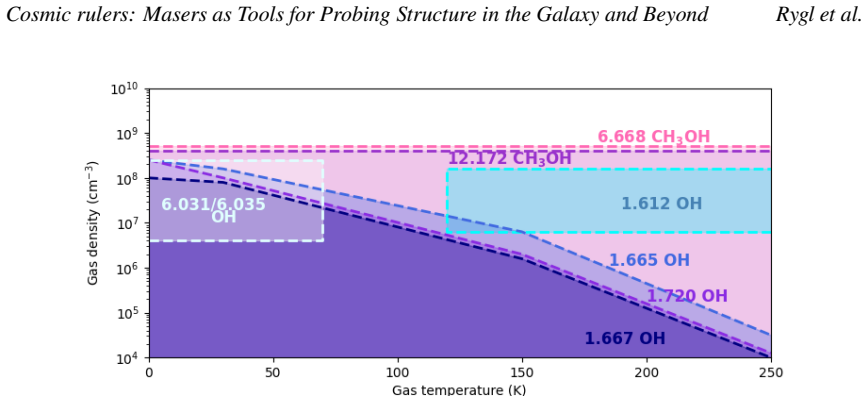


read the original abstract
Maser emission provides an unique window into astronomical sources across vast spatial scales - from tens to hundreds of astronomical units around protostars and evolved stars up to kiloparsecs in distant galaxies. These natural microwave amplifiers penetrate dust shells in star-forming regions, revealing the dynamics of accretion disks and outflows, trace envelopes and winds of evolved stars, map Galactic structure, while also allowing us to follow the evolution of all these systems. Owing to their compactness and brightness masers provide precise astrometry as cosmic rulers: measuring positions, structures and kinematics in dense regions, not easily accessible at other wavelengths. SKA-Mid will observe hydroxyl, methanol, and formaldehyde masers using bands 2, 5a and 5b, and later methylidyne radical masers in band 4. SKA-Mid's sensitivity and broad frequency coverage will support discoveries of new maser types and allow for simultaneous multi-transition and multi-species maser observations. In addition, bright masers can serve in the science verification of the SKA-Mid array during the deployment phase.
Editorial analysis
A structured set of objections, weighed in public.
Referee Report
Summary. The manuscript is a review summarizing the established applications of astrophysical masers as precise astrometric tools ('cosmic rulers') for probing structures across scales from tens to hundreds of AU around protostars and evolved stars to kiloparsecs in distant galaxies. It describes how masers penetrate dust to reveal dynamics in accretion disks, outflows, envelopes, and winds; map Galactic structure; and enable multi-scale kinematic studies. The text additionally outlines SKA-Mid's planned observations of hydroxyl, methanol, formaldehyde, and methylidyne radical masers in bands 2, 5a, 5b, and 4, along with prospects for new discoveries and array verification.
Significance. If the synthesis is accurate, the review compiles known maser capabilities across scales and flags concrete SKA-Mid opportunities, which may aid observers and instrument teams. It correctly credits the compactness and brightness of masers for astrometric utility. Because the central statements rest on prior literature without new derivations, data, or parameter-free predictions, the significance is primarily that of a useful overview rather than an advance in the field.
minor comments (1)
- [Abstract] Abstract: 'an unique window' is grammatically incorrect and should read 'a unique window'.
Simulated Author's Rebuttal
We thank the referee for their positive assessment of the manuscript as a useful overview of masers as astrometric tools and for recommending minor revision. No major comments were provided in the report, so we have no specific points to address point-by-point at this stage. We will incorporate any minor suggestions during revision.
Circularity Check
No significant circularity; descriptive review without derivations or fitted predictions
full rationale
The manuscript is a review paper summarizing established maser applications from AU to kpc scales and SKA-Mid observational prospects. No equations, derivations, parameter fits, or 'predictions' of new quantities appear in the provided text. Central claims are descriptive restatements of prior literature with no load-bearing self-citation chains, self-definitional steps, or renaming of results as novel. The reader's assessment of score 0.0 is consistent with the absence of any testable derivation chain that could reduce to its inputs.
Axiom & Free-Parameter Ledger
Reference graph
Works this paper leans on
-
[1]
New red supergiant stars in the other side of our Galaxy. , keywords =. doi:10.1093/mnras/staf299 , archivePrefix =. 2502.11496 , primaryClass =
-
[2]
The Far Side of the Galactic Bar/Bulge Revealed through Semi-regular Variables. , keywords =. doi:10.3847/1538-3881/ad01bf , archivePrefix =. 2305.19319 , primaryClass =
-
[3]
Unveiling VVV/WISE Mira variables on the far side of the Galactic disk: Distances, kinematics, and a new extinction law. , keywords =. doi:10.1051/0004-6361/202452041 , archivePrefix =. 2411.04623 , primaryClass =
-
[4]
An H2CO 6cm Maser Pinpointing a Possible Circumstellar Torus in IRAS18566+0408
An H _ 2 CO 6 cm Maser Pinpointing a Possible Circumstellar Torus in IRAS 18566+0408. , keywords =. doi:10.1086/521576 , archivePrefix =. 0708.3832 , primaryClass =
work page internal anchor Pith review Pith/arXiv arXiv doi:10.1086/521576
-
[5]
A Search for H _ 2 CO 6 cm Emission toward Young Stellar Objects. III. VLA Observations. , keywords =. doi:10.1086/590496 , archivePrefix =. 0806.1548 , primaryClass =
work page internal anchor Pith review Pith/arXiv arXiv doi:10.1086/590496
-
[6]
Excited-state hydroxyl maser catalogue from the methanol multibeam survey - I. Positions and variability. , keywords =. doi:10.1093/mnras/stw1101 , archivePrefix =. 1605.02506 , primaryClass =
-
[7]
, year = 1970, month = dec, volume =
Detection of Methyl Alcohol in Sagittarius. , year = 1970, month = dec, volume =. doi:10.1086/180654 , adsurl =
-
[8]
Searching for nascent planetary nebulae: OHPNe candidates in the SPLASH survey. , keywords =. doi:10.1093/mnras/stac2341 , archivePrefix =. 2208.09199 , primaryClass =
-
[9]
Precise Measurements of CH Maser Emission and Its Abundance in Translucent Clouds. , keywords =. doi:10.3847/1538-4365/ac27a5 , archivePrefix =. 2109.07822 , primaryClass =
-
[10]
The diversity of methanol maser morphologies from VLBI observations
The diversity of methanol maser morphologies from VLBI observations. , keywords =. doi:10.1051/0004-6361/200912250 , archivePrefix =. 0905.3469 , primaryClass =
work page internal anchor Pith review Pith/arXiv arXiv doi:10.1051/0004-6361/200912250
-
[11]
Detection of strong methanol masers towards galactic H II regions. , keywords =. doi:10.1038/326049a0 , adsurl =
-
[12]
On the uncertainty of magnetic field strength determinations
Zeeman splitting of 6.7 GHz methanol masers. On the uncertainty of magnetic field strength determinations. , keywords =. doi:10.1051/0004-6361/201116648 , adsurl =
-
[13]
Magnetic field in Cepheus A as deduced from OH maser polarimetric observations. , keywords =. doi:10.1111/j.1365-2966.2005.09203.x , archivePrefix =. astro-ph/0505374 , primaryClass =
-
[14]
EVN observations of 6.7 GHz methanol masers in clusters of massive young stellar objects
European VLBI Network observations of 6.7 GHz methanol masers in clusters of massive young stellar objects. , keywords =. doi:10.1051/0004-6361/201322629 , archivePrefix =. 1402.6727 , primaryClass =
work page internal anchor Pith review Pith/arXiv arXiv doi:10.1051/0004-6361/201322629
-
[15]
European VLBI Network imaging of 6.7 GHz methanol masers
European VLBI Network imaging of 6.7 GHz methanol masers. , keywords =. doi:10.1051/0004-6361/201527541 , archivePrefix =. 1601.03197 , primaryClass =
work page internal anchor Pith review Pith/arXiv arXiv doi:10.1051/0004-6361/201527541
-
[16]
The nature of the methanol maser ring G23.657-00.127. II. Expansion of the maser structure. , keywords =. doi:10.1051/0004-6361/202037562 , archivePrefix =. 2004.00916 , primaryClass =
-
[17]
Proper motion study of the 6.7 GHz methanol maser rings. I. A sample of sources with little variation. , keywords =. doi:10.1051/0004-6361/202449491 , archivePrefix =. 2404.07333 , primaryClass =
-
[18]
, keywords =
VLBA polarization observations of the J=7/2, 13.44 GHz OH maser in W3(OH). , keywords =
-
[19]
Seven sources: Astrophysical parameters
Magnetic fields in methanol maser condensations based on data for related regions. Seven sources: Astrophysical parameters. Astronomy Reports , year = 2014, month = jul, volume =. doi:10.1134/S1063772914070026 , adsurl =
-
[20]
VLA Overview of the Bursting H2O Maser Source G25.65+1.05. , keywords =. doi:10.3847/1538-4357/ab3fa4 , archivePrefix =. 1812.11353 , primaryClass =
-
[21]
ATLASGAL - relationship between dense star-forming clumps and interstellar masers. , keywords =. doi:10.1093/mnras/staa2936 , archivePrefix =. 2009.14608 , primaryClass =
-
[22]
12.2-GHz methanol masers towards 1.2-mm dust clumps: quantifying high-mass star formation evolutionary schemes. , keywords =. doi:10.1111/j.1365-2966.2009.15831.x , archivePrefix =. 0910.1223 , primaryClass =
-
[23]
Confirmation of the exclusive association between 6.7-GHz methanol masers and high-mass star formation regions. , keywords =. doi:10.1093/mnras/stt1315 , archivePrefix =. 1307.4453 , primaryClass =
work page internal anchor Pith review Pith/arXiv arXiv doi:10.1093/mnras/stt1315
-
[24]
OH maser emission in the THOR survey of the northern Milky Way. , keywords =. doi:10.1051/0004-6361/201935936 , archivePrefix =. 1907.11720 , primaryClass =
-
[25]
, keywords =
Identification and characterization of nascent planetary nebulae with OH and H _ 2 O masers. , keywords =
-
[26]
, year = 1975, month = dec, volume =
New 1612 MHz OH emission sources. , year = 1975, month = dec, volume =. doi:10.1093/mnras/173.3.649 , adsurl =
-
[27]
Excited-state OH masers at 6.035 GHz. , keywords =. doi:10.1093/mnras/273.2.328 , adsurl =
-
[28]
A new survey for 6.6-GHz methanol masers. , keywords =. doi:10.1093/mnras/279.1.79 , adsurl =
-
[29]
Positions of hydroxyl masers at 1665 and 1667 MHz. , keywords =. doi:10.1046/j.1365-8711.1998.01468.x , adsurl =
-
[30]
The 6-GHz methanol multibeam maser catalogue - I. Galactic Centre region, longitudes 345 to 6. , keywords =. doi:10.1111/j.1365-2966.2010.16339.x , archivePrefix =. 1002.2475 , primaryClass =
-
[31]
The 6-GHz methanol multibeam maser catalogue - III. Galactic longitudes 330 to 345. , keywords =. doi:10.1111/j.1365-2966.2011.19383.x , adsurl =
-
[32]
Detections of 2 cm formaldehyde emissions towards Galactic star-forming regions with 6 cm counterpart. , keywords =. doi:10.1093/mnras/stx011 , adsurl =
-
[33]
The Brightest Known H _ 2 CO Maser in the Milky Way: G339.88-1.26. , keywords =. doi:10.3847/2041-8213/aa9b2c , adsurl =
-
[34]
2002, MNRAS, 329, 355, doi: 10.1046/j.1365-8711.2002.04988.x
Modelling methanol and hydroxyl masers in star-forming regions. , keywords =. doi:10.1046/j.1365-8711.2002.05226.x , adsurl =
-
[35]
Models of class II methanol masers based on improved molecular data. , keywords =. doi:10.1111/j.1365-2966.2005.09077.x , archivePrefix =. astro-ph/0504194 , primaryClass =
-
[36]
OH maser towards IRAS 06056+2131: polarization parameters and evolution status. , keywords =. doi:10.1093/mnras/staa2810 , archivePrefix =. 2101.06664 , primaryClass =
-
[37]
Surveying the Giant H II Regions of the Milky Way with SOFIA. III. W49A. , keywords =. doi:10.3847/1538-4357/ac2d25 , archivePrefix =. 2111.01859 , primaryClass =
-
[38]
, keywords =
VLBI maps and properties of the 6 GHz OH masers in W 3(OH). , keywords =
-
[39]
Discrete Source Survey of 6 GHz OH emission from PNe & pPNe and first 6 GHz images of K 3-35
Discrete Source Survey of 6 GHz OH emission from PNe and pPNe and first 6 GHz images of K 3-35. , keywords =. doi:10.1051/0004-6361/200913387 , archivePrefix =. 1010.0612 , primaryClass =
work page internal anchor Pith review Pith/arXiv arXiv doi:10.1051/0004-6361/200913387
-
[40]
, year = 1974, month = jul, volume =
Formaldehyde Line Emission at 4.8 GHz Near NGC 7538. , year = 1974, month = jul, volume =. doi:10.1086/181553 , adsurl =
-
[41]
The Bolocam Galactic Plane Survey. VII. Characterizing the Properties of Massive Star-forming Regions. , keywords =. doi:10.1088/0004-637X/741/2/110 , archivePrefix =. 1108.1812 , primaryClass =
work page internal anchor Pith review Pith/arXiv arXiv doi:10.1088/0004-637x/741/2/110
-
[42]
OH-IR stars. II. A model for the 1612 MHz masers. , year = 1976, month = apr, volume =. doi:10.1086/154289 , adsurl =
-
[43]
A Survey of the Galactic Plane for 6.7-GHz Methanol Masers I: l = 325.0 - 335.0 ; b = -0.53 - 0.53
A survey of the Galactic plane for 6.7-GHz methanol masers - I. l=325 deg-335 deg b=-0. 53-0. 53. , keywords =. doi:10.1093/mnras/280.2.378 , archivePrefix =. astro-ph/9601016 , primaryClass =
work page internal anchor Pith review Pith/arXiv arXiv doi:10.1093/mnras/280.2.378
-
[44]
An Evolutionary Timeline for High-mass Star Formation
An Evolutionary Timeline for High-mass Star Formation. arXiv e-prints , keywords =. doi:10.48550/arXiv.1210.2139 , archivePrefix =. 1210.2139 , primaryClass =
work page internal anchor Pith review Pith/arXiv arXiv doi:10.48550/arxiv.1210.2139
-
[45]
Cosmic Masers: Proper Motion Toward the Next-Generation Large Projects , year = 2024, editor =
A database of circumstellar OH masers update. Cosmic Masers: Proper Motion Toward the Next-Generation Large Projects , year = 2024, editor =. doi:10.1017/S1743921323002533 , adsurl =
-
[46]
OH spectral evolution of oxygen-rich late-type stars
OH spectral evolution of oxygen-rich late-type stars. , keywords =. doi:10.1051/0004-6361:20034305 , archivePrefix =. astro-ph/0403311 , primaryClass =
work page internal anchor Pith review Pith/arXiv arXiv doi:10.1051/0004-6361:20034305
-
[47]
Methanol and excited OH masers towards W51 - I. Main and South. , keywords =. doi:10.1111/j.1365-2966.2012.20900.x , archivePrefix =. 1203.2527 , primaryClass =
-
[48]
OH masers in the Milky Way and Local Group galaxies in the SKA era
OH masers in the Milky Way and Local Group galaxies in the SKA era. Advancing Astrophysics with the Square Kilometre Array (AASKA14) , year = 2015, month = apr, eid =. doi:10.22323/1.215.0125 , archivePrefix =. 1501.06153 , primaryClass =
work page internal anchor Pith review Pith/arXiv arXiv doi:10.22323/1.215.0125 2015
-
[49]
Full-Polarization Observations of OH Masers in Massive Star-forming Regions. I. Data. , keywords =. doi:10.1086/431669 , archivePrefix =. astro-ph/0505148 , primaryClass =
work page internal anchor Pith review Pith/arXiv arXiv doi:10.1086/431669
-
[50]
Global Very Long Baseline Interferometry Observations of the 6.0 GHz Hydroxyl Masers in Onsala 1. , keywords =. doi:10.1088/0004-637X/716/1/106 , adsurl =
-
[51]
Structure of W3(OH) from Very High Spectral Resolution Observations of 5 Centimeter OH Masers
Structure of W3(OH) from Very High Spectral Resolution Observations of 5 Centimeter OH Masers. , keywords =. doi:10.1086/521096 , archivePrefix =. 0706.3314 , primaryClass =
work page internal anchor Pith review Pith/arXiv arXiv doi:10.1086/521096
-
[52]
, keywords =
The spatial relationship of OH and H2O masers. , keywords =
-
[53]
Observations of 6.7 GHz methanol masers with East-Asian VLBI Network. I. VLBI images of the first epoch of observations. , keywords =. doi:10.1093/pasj/psu015 , archivePrefix =. 1311.3431 , primaryClass =
work page internal anchor Pith review Pith/arXiv arXiv doi:10.1093/pasj/psu015
-
[54]
Infall and outflow within 400 AU from a high-mass protostar. 3D velocity fields from methanol and water masers in AFLG 5142. , keywords =. doi:10.1051/0004-6361/201117854 , archivePrefix =. 1110.1647 , primaryClass =
work page internal anchor Pith review Pith/arXiv arXiv doi:10.1051/0004-6361/201117854
-
[55]
Multidirectional Mass Accretion and Collimated Outflows on Scales of 100-2000 au in Early Stages of High-mass Protostars. , keywords =. doi:10.3847/1538-4357/abc88e , archivePrefix =. 1805.05364 , primaryClass =
-
[56]
The wind speeds, dust content, and mass-loss rates of evolved AGB and RSG stars at varying metallicity. , keywords =. doi:10.1093/mnras/stw2708 , archivePrefix =. 1610.05761 , primaryClass =
work page internal anchor Pith review Pith/arXiv arXiv doi:10.1093/mnras/stw2708
-
[57]
A dearth of OH/IR stars in the Small Magellanic Cloud
A dearth of OH/IR stars in the Small Magellanic Cloud. , keywords =. doi:10.1093/mnras/stx2601 , archivePrefix =. 1710.02184 , primaryClass =
work page internal anchor Pith review Pith/arXiv arXiv doi:10.1093/mnras/stx2601
-
[58]
, keywords =
H _ 2 O and SiO maser emission in OH/IR stars. , keywords =
-
[59]
The magnetic field toward the young planetary nebula K~3-35
The Magnetic Field Toward the Young Planetary Nebula K 3-35. , keywords =. doi:10.1088/0004-637X/695/2/930 , archivePrefix =. 0901.4492 , primaryClass =
work page internal anchor Pith review Pith/arXiv arXiv doi:10.1088/0004-637x/695/2/930
-
[60]
Polarization properties of OH emission in planetary nebulae
Polarization properties of OH emission in planetary nebulae. , keywords =. doi:10.1093/mnras/stw1536 , archivePrefix =. 1606.07004 , primaryClass =
work page internal anchor Pith review Pith/arXiv arXiv doi:10.1093/mnras/stw1536
-
[61]
The 6-GHz methanol multibeam maser catalogue - II. Galactic longitudes 6 to 20. , keywords =. doi:10.1111/j.1365-2966.2010.17376.x , archivePrefix =. 1007.3050 , primaryClass =
-
[62]
Excited-state hydroxyl maser polarimetry: Who ate all the {\pi}s?
Excited-state hydroxyl maser polarimetry: who ate all the s?. , keywords =. doi:10.1093/mnras/stv936 , archivePrefix =. 1504.07062 , primaryClass =
work page internal anchor Pith review Pith/arXiv arXiv doi:10.1093/mnras/stv936
-
[63]
A MERLIN Study of 6-GHz excited-state OH and 6.7-GHz methanol masers in ON1. , keywords =. doi:10.1111/j.1365-2966.2007.12418.x , archivePrefix =. 0709.0604 , primaryClass =
-
[64]
The 6-GHz multibeam maser survey - I. Techniques. , keywords =. doi:10.1111/j.1365-2966.2008.14091.x , archivePrefix =. 0810.5201 , primaryClass =
-
[65]
Distances to southern 6.7-GHz methanol masers through H I self-absorption. , keywords =. doi:10.1111/j.1365-2966.2011.19418.x , adsurl =
-
[66]
The 6-GHz methanol multibeam maser catalogue - IV. Galactic longitudes 186 -330 including the Orion-Monoceros region. , keywords =. doi:10.1111/j.1365-2966.2011.20229.x , archivePrefix =. 1201.0787 , primaryClass =
-
[67]
Discovery of large-scale methanol and hydroxyl maser filaments in W3(OH). , keywords =. doi:10.1111/j.1365-2966.2006.10806.x , adsurl =
-
[68]
On the Relationship of UC HII Regions and Class II Methanol Masers. I. Source Catalogs. , keywords =. doi:10.3847/0004-637X/833/1/18 , archivePrefix =. 1609.03280 , primaryClass =
work page internal anchor Pith review Pith/arXiv arXiv doi:10.3847/0004-637x/833/1/18
-
[69]
2002, MNRAS, 329, 355, doi: 10.1046/j.1365-8711.2002.04988.x
OH masers and magnetic fields in the bipolar outflow source W75N. , keywords =. doi:10.1046/j.1365-8711.2002.05068.x , adsurl =
-
[70]
3-D Kinematics of Water Masers in the W51A Region
3-D Kinematics of Water Masers in the W 51A Region. , keywords =. doi:10.1093/pasj/54.5.741 , archivePrefix =. astro-ph/0207648 , primaryClass =
work page internal anchor Pith review Pith/arXiv arXiv doi:10.1093/pasj/54.5.741
-
[71]
The evolutionary status of protostellar clumps hosting class II methanol masers. , keywords =. doi:10.1093/mnras/staa233 , archivePrefix =. 2001.08449 , primaryClass =
-
[72]
Full-Polarization Observations of OH Masers in Massive Star-forming Regions. II. Maser Properties and the Interpretation of Polarization. , keywords =. doi:10.1086/502650 , archivePrefix =. astro-ph/0601560 , primaryClass =
work page internal anchor Pith review Pith/arXiv arXiv doi:10.1086/502650
-
[73]
Massive young stellar objects in the Local Group spiral galaxy M 33 identified using machine learning. , keywords =. doi:10.1093/mnras/stac2692 , archivePrefix =. 2209.10371 , primaryClass =
-
[74]
Multi-frequency VLBI observations of maser lines during the 6.7 GHz maser flare in the high-mass young stellar object G24.33+0.14. , keywords =. doi:10.1051/0004-6361/202244772 , archivePrefix =. 2302.02723 , primaryClass =
-
[75]
Physical conditions around high-mass young star-forming objects via simultaneous observations of excited OH and methanol masers. , keywords =. doi:10.1051/0004-6361/202452657 , archivePrefix =. 2503.11379 , primaryClass =
-
[76]
Jets and outflows of massive protostars - From cloud collapse to jet launching and cloud dispersal
Jets and outflows of massive protostars. From cloud collapse to jet launching and cloud dispersal. , keywords =. doi:10.1051/0004-6361/201833686 , archivePrefix =. 1811.07009 , primaryClass =
work page internal anchor Pith review Pith/arXiv arXiv doi:10.1051/0004-6361/201833686
-
[77]
Physical characteristics of bright Class I methanol masers
Physical characteristics of bright Class I methanol masers. , keywords =. doi:10.1051/0004-6361/201527974 , archivePrefix =. 1605.09406 , primaryClass =
work page internal anchor Pith review Pith/arXiv arXiv doi:10.1051/0004-6361/201527974
-
[78]
The Chronological Sequence of Circumstellar Masers: Identifying Proto--Planetary Nebulae. , keywords =. doi:10.1086/167194 , adsurl =
-
[79]
OH/IR Star Color Mimics. , keywords =. doi:10.1086/171713 , adsurl =
-
[80]
The Discovery of a New, Very Strong, and Widespread Interstellar Methanol Maser Line. , keywords =. doi:10.1086/186177 , adsurl =
discussion (0)
Sign in with ORCID, Apple, or X to comment. Anyone can read and Pith papers without signing in.