Cosmological Viability of Exponential Infrared f(T) Gravity
Pith reviewed 2026-07-01 04:36 UTC · model grok-4.3
The pith
Exponential infrared f(T) gravity produces two acceleration branches, but data rule out both over standard cosmology.
A machine-rendered reading of the paper's core claim, the machinery that carries it, and where it could break.
Core claim
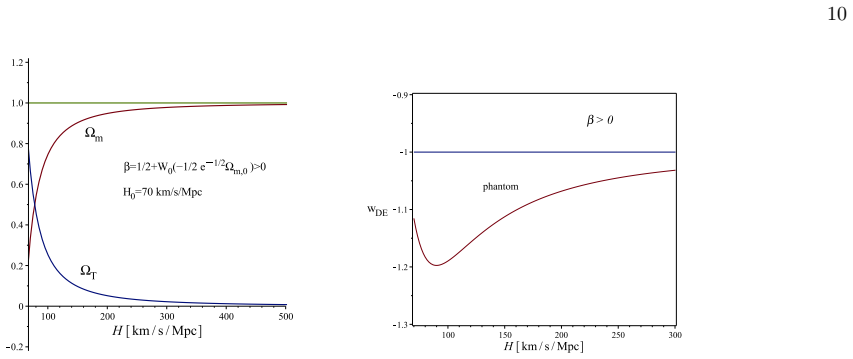
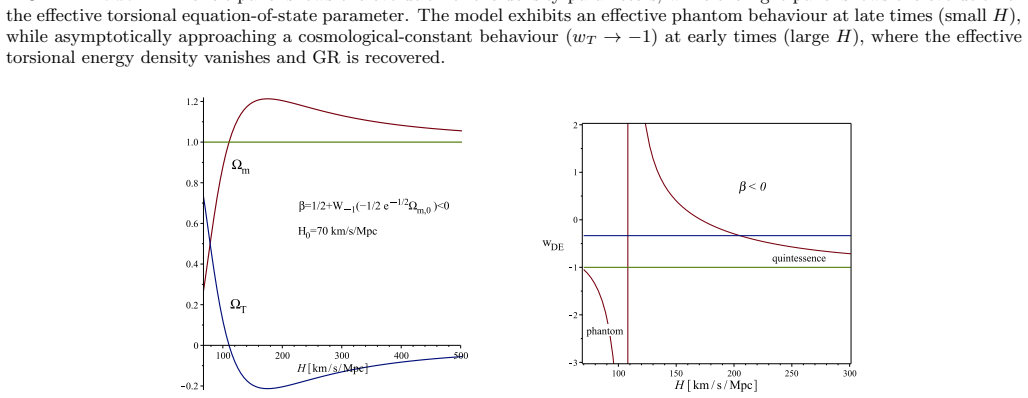
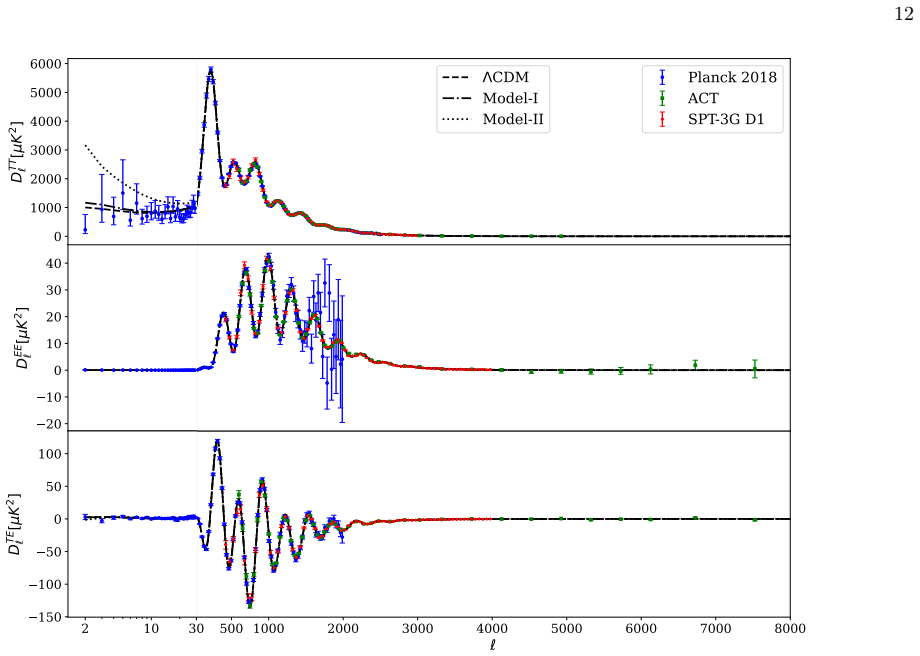
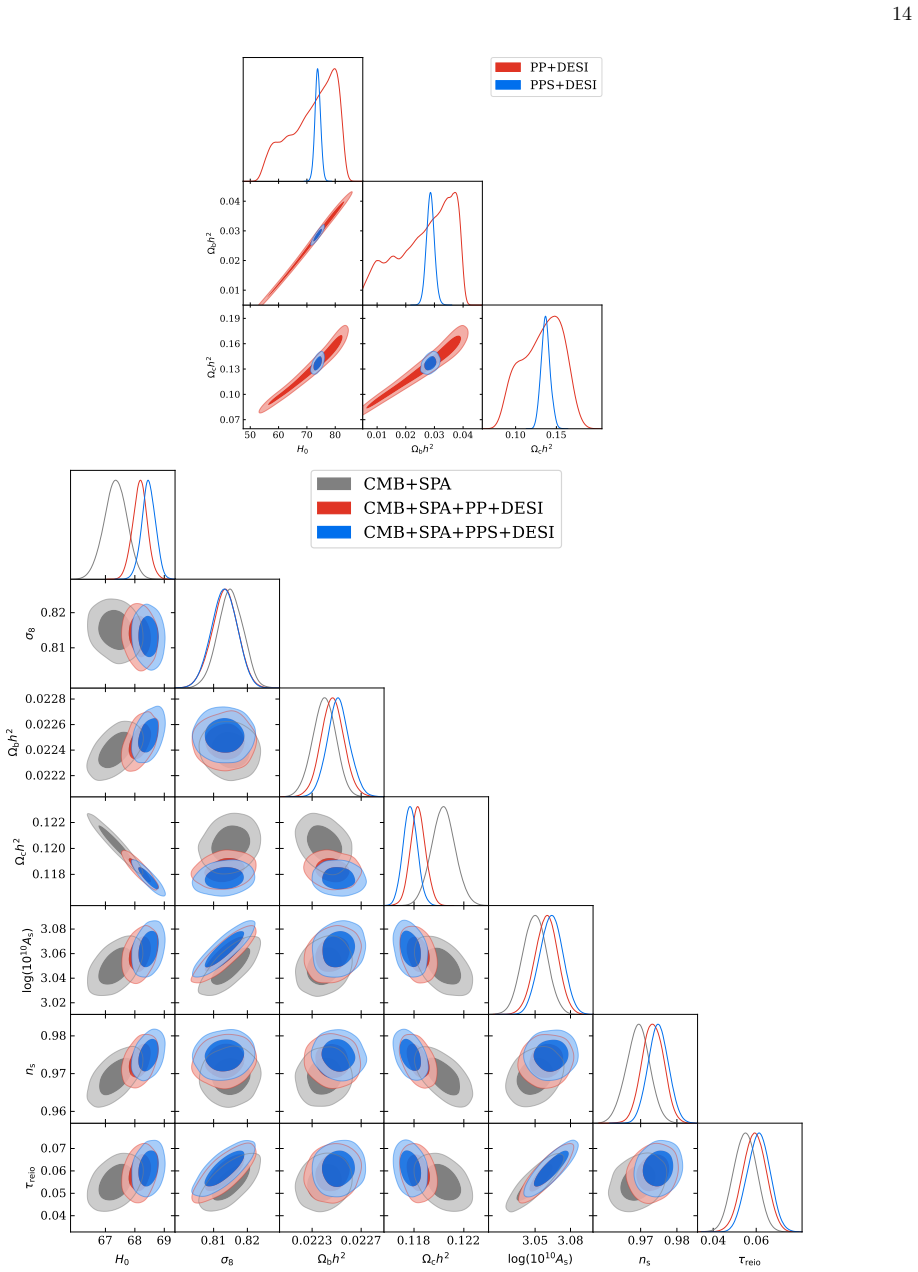
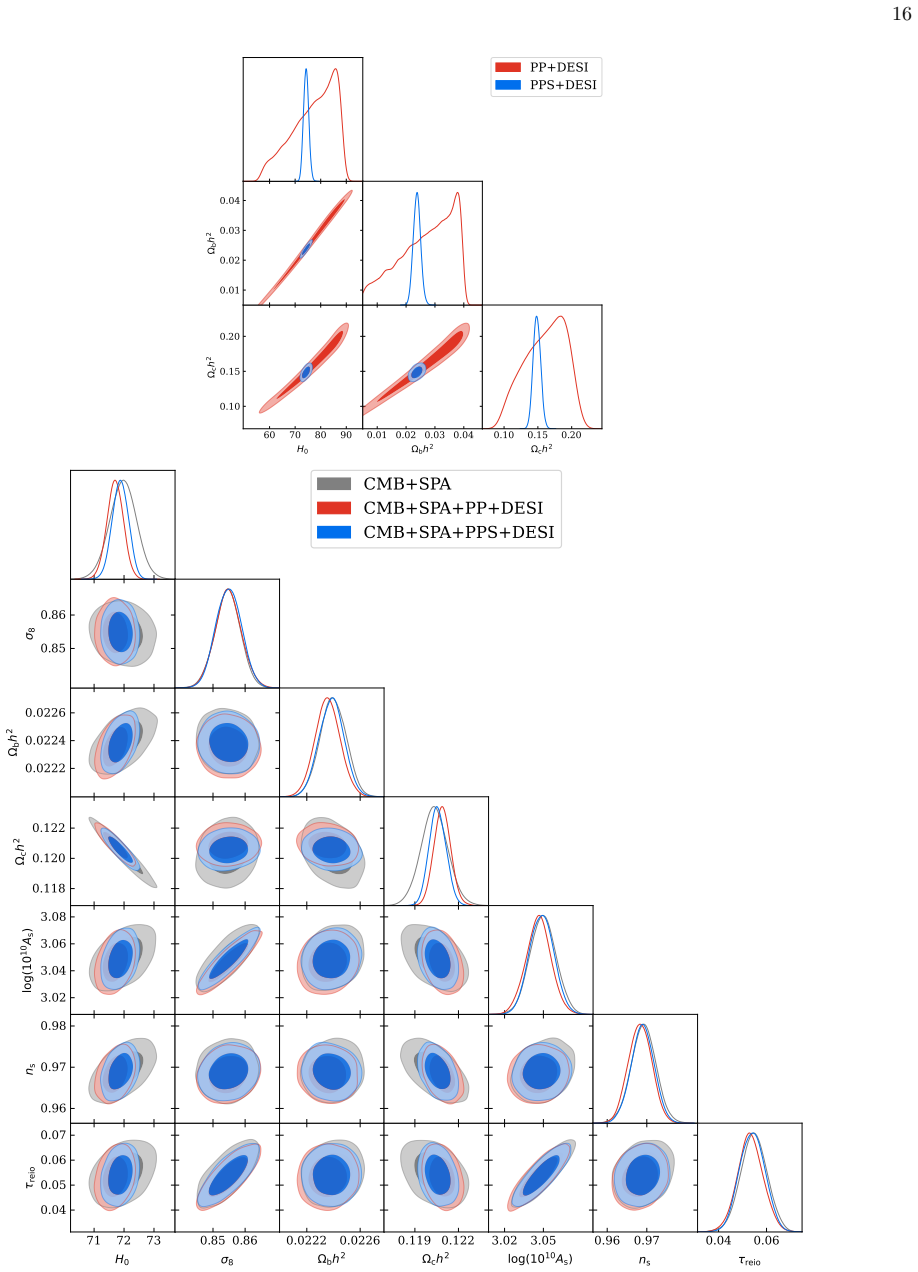
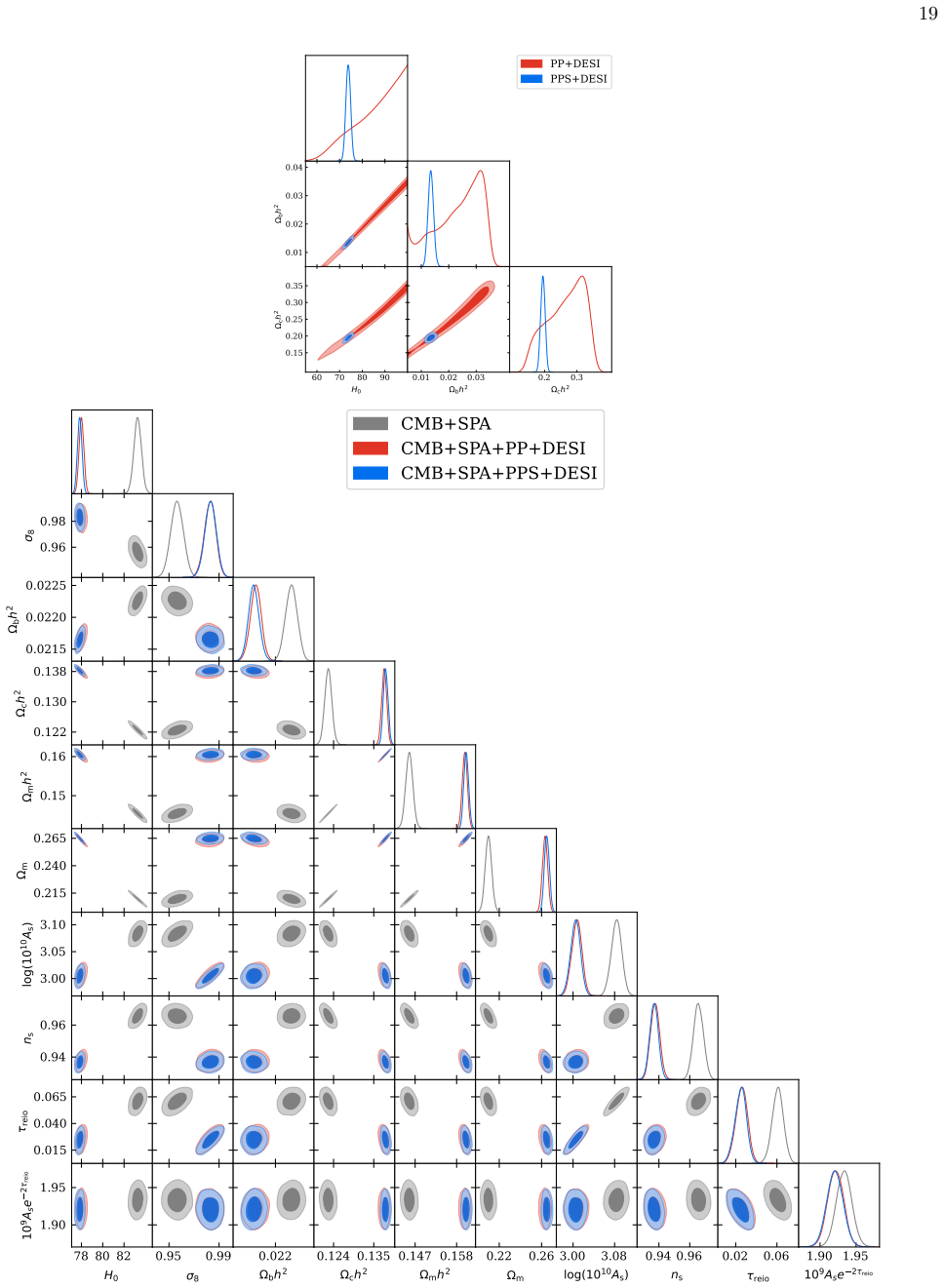
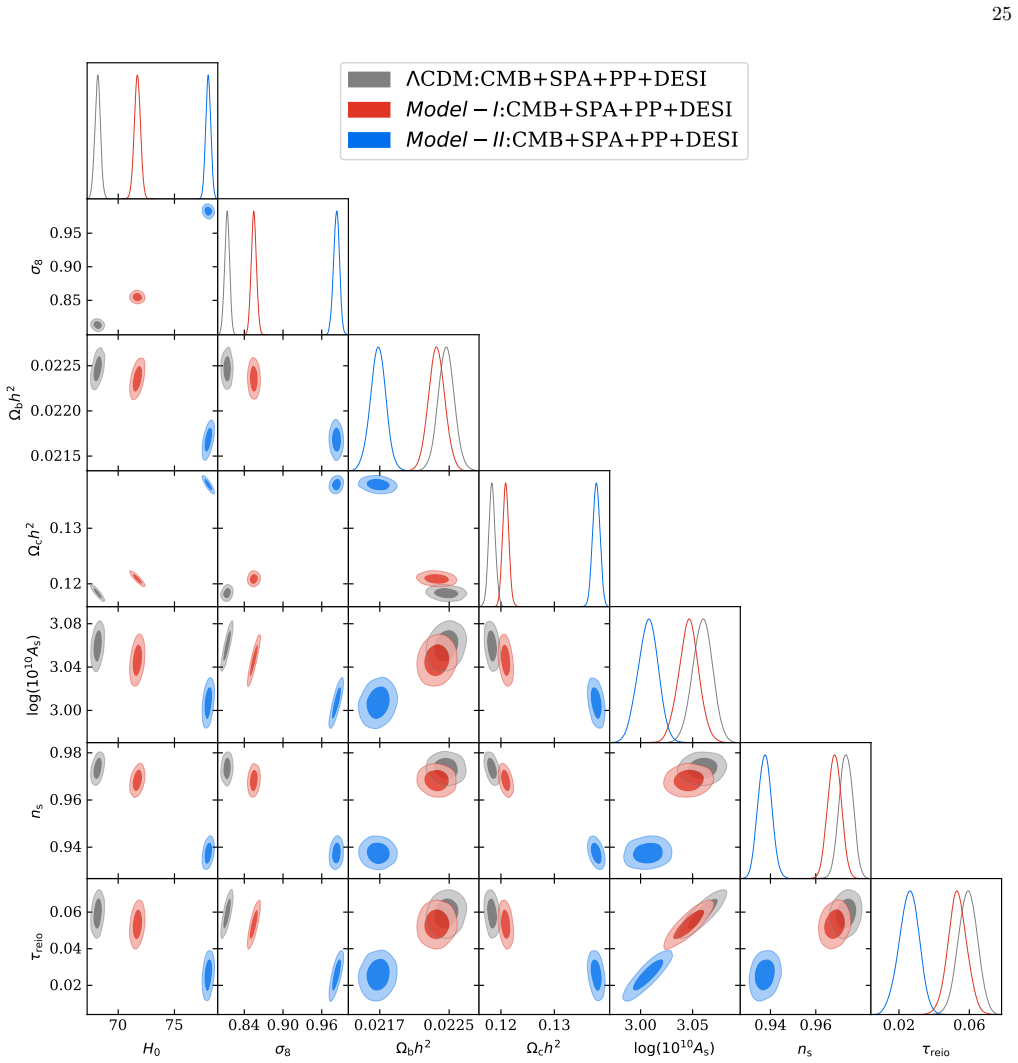
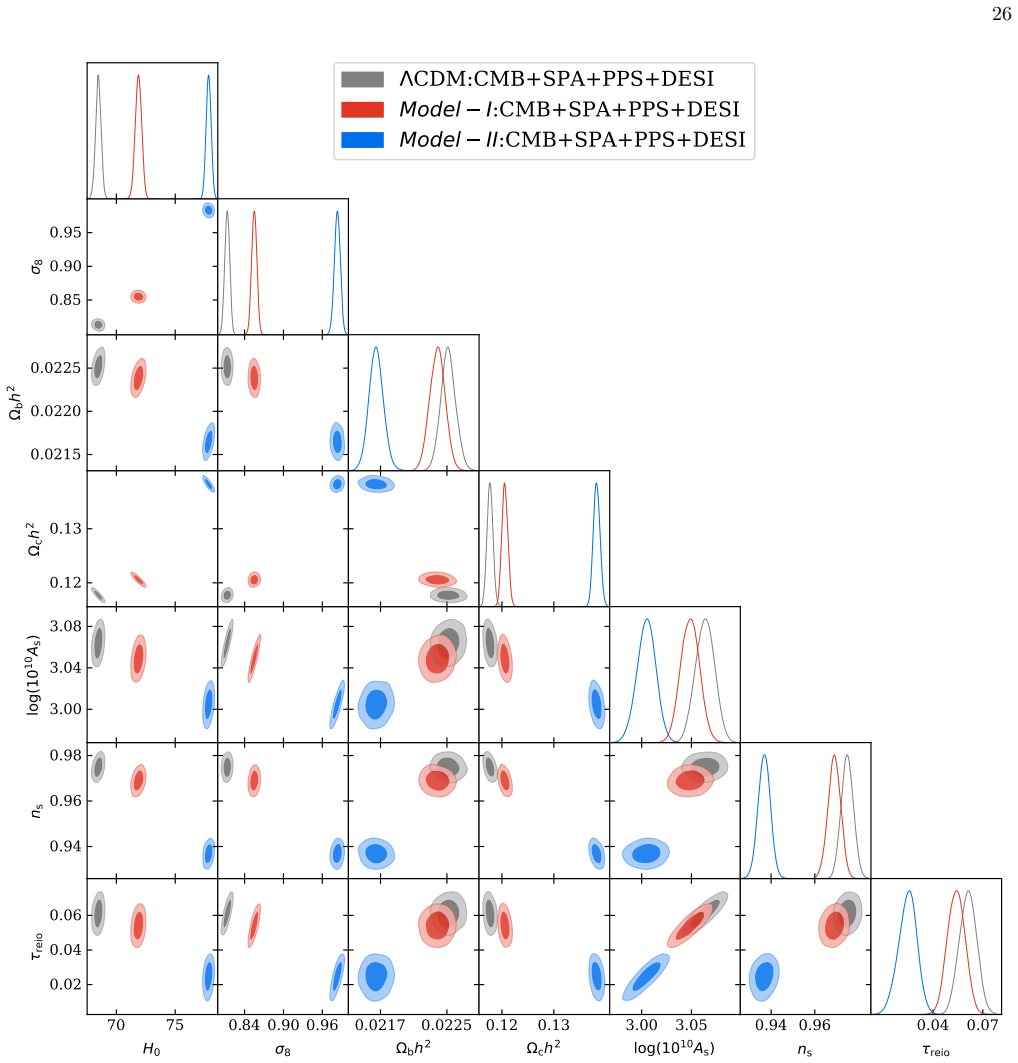
The exponential infrared f(T) model admits two distinct solution branches. Model I behaves like phantom dark energy and reduces the Hubble tension relative to Lambda CDM but is still disfavoured by the combined dataset. Model II produces a negative-to-positive transition in the effective torsional dark-energy density and is decisively ruled out. This exclusion stems from the interplay between background and perturbation constraints: once distance measurements fix the expansion, the model forces correlated parameter shifts that degrade the CMB damping tail fit and drive the optical depth to unphysical values.
What carries the argument
The two distinct solution branches of the exponential infrared f(T) model, each fixing a different evolution for the effective torsional dark-energy density without extra free parameters.
If this is right
- Model I reduces the Hubble tension without enlarging the parameter space.
- Neither branch improves the fit to the combined dataset over Lambda CDM.
- Perturbation observables supply independent tests that can eliminate models allowed by background expansion alone.
- The failure of Model II shows that background and perturbation constraints must be applied jointly for teleparallel gravity models.
Where Pith is reading between the lines
- Similar torsional modifications may need explicit mechanisms to keep perturbation parameters within physical ranges once background data are fixed.
- Full Boltzmann solvers that include both background and linear perturbations will be required for any future f(T) viability tests.
- Tighter future constraints on the reionization optical depth could provide an independent way to test whether the required parameter shifts are viable.
Load-bearing premise
The exponential infrared f(T) form produces exactly two solution branches whose effective torsional dark-energy density evolves exactly as described, with no additional free parameters.
What would settle it
A high-precision measurement of the CMB damping tail and optical depth that remains consistent with the background-constrained shifts in Omega_m h^2, A_s, n_s and tau_reio required by Model II.
Figures


read the original abstract
We investigate the cosmological viability of exponential infrared $f(T)$ teleparallel gravity using current cosmological observations. This framework realizes late-time cosmic acceleration through torsional modifications of gravity without enlarging the six-parameter cosmological parameter space of spatially flat $\Lambda$CDM, and admits two distinct solution branches: a phantom-like model (Model I) and a model featuring a negative-to-positive transition in the effective torsional dark-energy density (Model II). We constrain both branches using CMB observations from Planck, ACT, and SPT together with DESI BAO and Pantheon+ Type Ia supernovae. We find that the principal branch (Model I) alleviates the Hubble tension relative to $\Lambda$CDM, but remains statistically disfavoured by the combined dataset. The secondary branch (Model II) is decisively ruled out. We show that the failure of Model II originates from the interplay between background and perturbation constraints: once late-time distance measurements constrain the expansion history, the model becomes overconstrained, forcing correlated shifts in $\Omega_{\rm m}h^2$, $A_s$, $n_s$, and $\tau_{\rm reio}$, degrading the fit to the CMB damping tail and driving the optical depth to unphysical values. Our results demonstrate that perturbation observables provide stringent and complementary tests of teleparallel gravity beyond the background expansion history.
Editorial analysis
A structured set of objections, weighed in public.
Referee Report
Summary. The manuscript investigates exponential infrared f(T) teleparallel gravity, which realizes late-time acceleration without enlarging the six-parameter space of flat ΛCDM and admits two solution branches: a phantom-like Model I and Model II with a negative-to-positive transition in effective torsional dark-energy density. Using Planck, ACT, SPT CMB data combined with DESI BAO and Pantheon+ supernovae, it finds Model I mildly alleviates the Hubble tension but is statistically disfavoured, while Model II is ruled out by the interplay of background and perturbation constraints that force unphysical shifts in Ω_m h², A_s, n_s, and τ_reio, degrading the CMB damping tail fit. The work emphasizes that perturbation observables provide stringent tests beyond background expansion.
Significance. If the derivations of the two branches and the effective-DE mapping hold, the results demonstrate that current multi-probe datasets can decisively test and exclude branches of teleparallel gravity even when background expansion appears viable, underscoring the complementary role of perturbation constraints in modified gravity viability studies. The parameter-space equivalence to ΛCDM is a notable strength if confirmed.
major comments (2)
- [model definition and branch derivation] The central viability conclusions rest on the assertion (abstract) that the exponential infrared f(T) form yields precisely two solution branches with effective torsional DE density evolving exactly as stated and with zero extra free parameters or degrees of freedom. The modified Friedmann and perturbation equations must be shown to admit no additional solutions or hidden parameter dependence; otherwise the statistical disfavor of Model I and the specific overconstraint mechanism for Model II (shifts in Ω_m h², A_s, n_s, τ_reio) would not follow.
- [perturbation equations and constraints] The explanation that Model II fails due to background-perturbation interplay (abstract) requires explicit confirmation that the perturbation equations for each branch contain no non-standard slip or growth terms beyond the effective-DE mapping; if such terms exist, the claimed degradation of the CMB damping tail fit and the unphysical τ_reio values would need re-derivation.
minor comments (2)
- [model section] Clarify the exact functional form of f(T) and the infrared cutoff scale in the model section to aid reproducibility.
- [data and methodology] Ensure all dataset combinations and priors are tabulated for direct comparison with ΛCDM results.
Simulated Author's Rebuttal
We thank the referee for the careful review and valuable comments. We address each major comment below with clarifications on the model derivations and perturbation structure. These responses confirm the robustness of our conclusions while incorporating explicit statements where helpful.
read point-by-point responses
-
Referee: [model definition and branch derivation] The central viability conclusions rest on the assertion (abstract) that the exponential infrared f(T) form yields precisely two solution branches with effective torsional DE density evolving exactly as stated and with zero extra free parameters or degrees of freedom. The modified Friedmann and perturbation equations must be shown to admit no additional solutions or hidden parameter dependence; otherwise the statistical disfavor of Model I and the specific overconstraint mechanism for Model II (shifts in Ω_m h², A_s, n_s, τ_reio) would not follow.
Authors: We appreciate the referee's focus on uniqueness. Section II derives the modified Friedmann equation from the exponential IR f(T) action, reducing it to a first-order ODE for the torsional DE density ρ_T with boundary conditions of matter domination at high z and late-time acceleration. This ODE admits exactly two analytic solutions: the always-positive phantom branch (Model I) and the sign-transition branch (Model II). No other solutions satisfy the asymptotic conditions, and the f(T) form introduces no extra parameters or degrees of freedom. Numerical checks of the ODE confirm no additional branches in the relevant range. We will add an explicit paragraph in Section II stating this uniqueness to strengthen the presentation. revision: yes
-
Referee: [perturbation equations and constraints] The explanation that Model II fails due to background-perturbation interplay (abstract) requires explicit confirmation that the perturbation equations for each branch contain no non-standard slip or growth terms beyond the effective-DE mapping; if such terms exist, the claimed degradation of the CMB damping tail fit and the unphysical τ_reio values would need re-derivation.
Authors: Section III presents the linear perturbation equations in Newtonian gauge. For both branches the torsional modifications map exactly to an effective perfect fluid with equation-of-state w_T taken from the background solution; no additional slip parameter, anisotropic stress, or non-standard growth terms appear. The perturbation sector is therefore standard once the background expansion is fixed. The overconstraint on Model II (shifts in Ω_m h², A_s, n_s, τ_reio and damping-tail mismatch) follows directly from this structure. We will insert a clarifying sentence in Section III confirming the absence of non-standard terms. revision: yes
Circularity Check
No significant circularity; statistical results data-driven from external datasets
full rationale
The paper defines the exponential infrared f(T) form and its two solution branches (phantom-like Model I; negative-to-positive transition in effective torsional DE for Model II) as part of the model setup, then constrains both using external public datasets (Planck, ACT, SPT, DESI BAO, Pantheon+). No equation reduces a claimed prediction or viability result to a fitted parameter by construction, nor does any central claim rest solely on a self-citation chain whose content is unverified. The statistical conclusions (Model I mildly alleviates H0 tension but disfavored; Model II ruled out via background-perturbation interplay) are obtained by fitting the six-parameter space identical to flat ΛCDM. Minor self-citations for the functional form or prior f(T) results are present but not load-bearing for the data-driven viability assessment.
Axiom & Free-Parameter Ledger
axioms (2)
- domain assumption The exponential infrared f(T) form realizes late-time acceleration while preserving the six-parameter flat Lambda CDM space.
- domain assumption Standard linear perturbation equations in teleparallel gravity correctly describe the CMB damping tail and growth observables for these models.
Reference graph
Works this paper leans on
-
[1]
Xjenza Malta
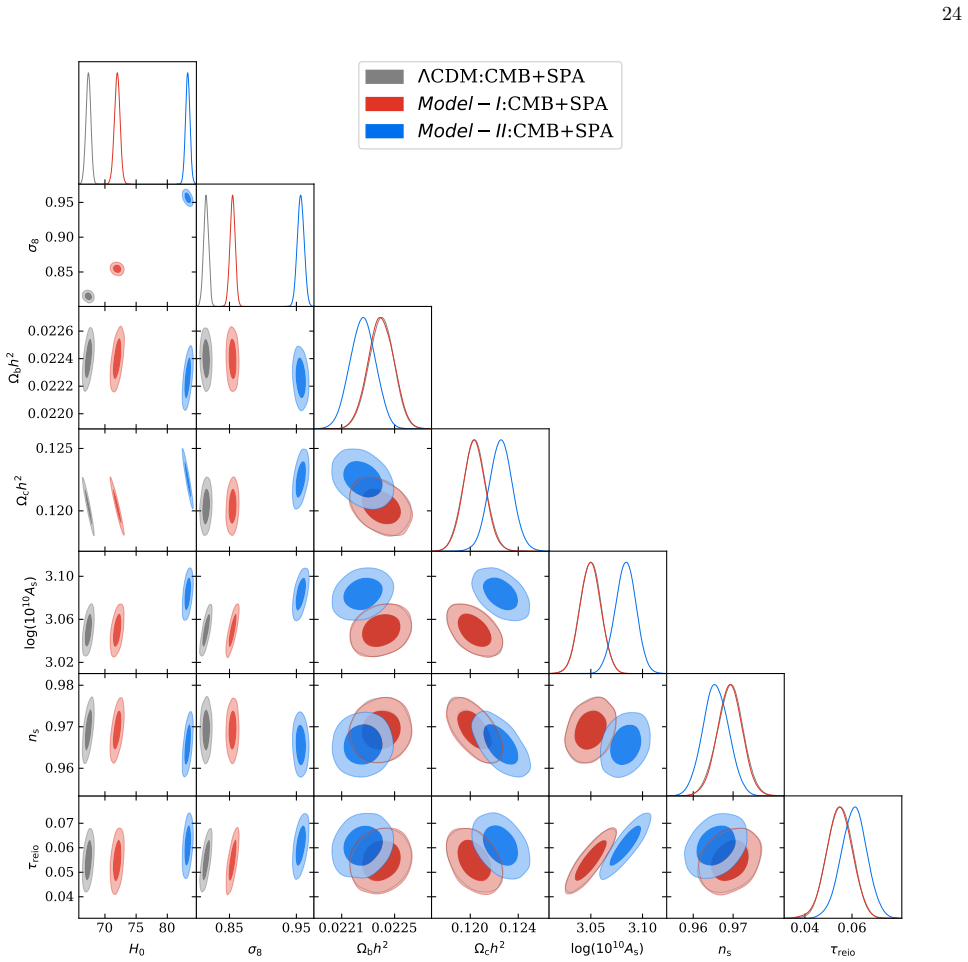
Model II: Negative-to-positive dark energy density transition We note that this branch retains the same minimal six-parameter space as the spatially flat ΛCDM model. How- ever, the effective torsional (dark-energy) density undergoes a transition from negative to positive values during the cosmological evolution. Similar to Model I, the effective torsional...
2018
-
[2]
8, we show the observational constraints obtained from the purely late-Universe dataset PP+DESI
Constraints from purely late universe data In the left panel of Fig. 8, we show the observational constraints obtained from the purely late-Universe dataset PP+DESI. Since both SNIa and BAO measurements are uncalibrated, they do not determine the absolute distance scale and therefore cannot tightly constrain the Hubble constant. This freedom propagates th...
-
[3]
9, we compare the constraints obtained using the purely early-Universe dataset CMB-SPA
Constraints from purely early universe data In Fig. 9, we compare the constraints obtained using the purely early-Universe dataset CMB-SPA. For the primary cosmological parameters, Ωbh2, Ωch2,A s,n s, andτ reio, Model I remains in excellent agreement with ΛCDM, reflecting the fact that the modifications are confined to the late Universe. The main differen...
-
[4]
10 and 11, we compare the three models using the combined early- and late-Universe datasets
Constraints from both early and late universe data In Figs. 10 and 11, we compare the three models using the combined early- and late-Universe datasets. Within the ΛCDM framework, the inclusion of DESI BAO and Type Ia supernovae data shifts several independent cosmological parameters towards larger values, reflecting the well-known tension between CMB and...
-
[5]
R. A. Hulse and J. H. Taylor, Astrophys. J. Lett.195, L51 (1975)
1975
-
[6]
B. P. Abbottet al.(LIGO Scientific, Virgo), Phys. Rev. Lett.116, 061102 (2016), arXiv:1602.03837 [gr-qc]
Pith/arXiv arXiv 2016
-
[7]
First M87 Event Horizon Telescope Results. I. The Shadow of the Supermassive Black Hole
K. Akiyamaet al.(Event Horizon Telescope), Astrophys. J. Lett.875(2019), 10.3847/2041-8213/ab0ec7, arXiv:1906.11238 [astro-ph.GA]
work page internal anchor Pith review Pith/arXiv arXiv doi:10.3847/2041-8213/ab0ec7 2019
-
[8]
First M87 Event Horizon Telescope Results. V. Physical Origin of the Asymmetric Ring
K. Akiyamaet al.(Event Horizon Telescope), Astrophys. J. Lett.875(2019), 10.3847/2041-8213/ab0f43, arXiv:1906.11242 [astro-ph.GA]
work page internal anchor Pith review Pith/arXiv arXiv doi:10.3847/2041-8213/ab0f43 2019
-
[9]
A. G. Riesset al.(Supernova Search Team), Astron. J.116, 1009 (1998), arXiv:astro-ph/9805201
Pith/arXiv arXiv 1998
-
[10]
Perlmutteret al.(Supernova Cosmology Project), Astrophys
S. Perlmutteret al.(Supernova Cosmology Project), Astrophys. J.517, 565 (1999), arXiv:astro-ph/9812133
Pith/arXiv arXiv 1999
-
[11]
D. Scolnicet al., Astrophys. J.938, 113 (2022), arXiv:2112.03863 [astro-ph.CO]
Pith/arXiv arXiv 2022
-
[12]
B. Popovicet al.(DES), Mon. Not. Roy. Astron. Soc.548, stag632 (2026), arXiv:2511.07517 [astro-ph.CO]
Pith/arXiv arXiv 2026
-
[13]
T. J. Hoyt, D. Rubin, G. Aldering, S. Perlmutter, A. Cuceu, and R. Gupta, (2026), arXiv:2601.19424 [astro-ph.CO]
arXiv 2026
-
[14]
Planck 2018 results. VI. Cosmological parameters
N. Aghanimet al.(Planck), Astron. Astrophys.641(2020), 10.1051/0004-6361/201833910, [Erratum: Astron.Astrophys. 652, C4 (2021)], arXiv:1807.06209 [astro-ph.CO]
work page internal anchor Pith review Pith/arXiv arXiv doi:10.1051/0004-6361/201833910 2020
-
[15]
Planck 2018 results. I. Overview and the cosmological legacy of Planck
N. Aghanimet al.(Planck), Astron. Astrophys.641(2020), 10.1051/0004-6361/201833880, arXiv:1807.06205 [astro- ph.CO]
work page internal anchor Pith review Pith/arXiv arXiv doi:10.1051/0004-6361/201833880 2020
-
[16]
Louiset al.(Atacama Cosmology Telescope), JCAP11, 062 (2025), arXiv:2503.14452 [astro-ph.CO]
T. Louiset al.(Atacama Cosmology Telescope), JCAP11, 062 (2025), arXiv:2503.14452 [astro-ph.CO]
Pith/arXiv arXiv 2025
-
[17]
E. Camphuiset al.(SPT-3G), Phys. Rev. D113, 083504 (2026), arXiv:2506.20707 [astro-ph.CO]
Pith/arXiv arXiv 2026
-
[18]
G. Jungman, M. Kamionkowski, and K. Griest, Phys. Rept.267, 195 (1996), arXiv:hep-ph/9506380
Pith/arXiv arXiv 1996
-
[19]
Craig, inBeyond the Standard Model after the first run of the LHC(2013) arXiv:1309.0528 [hep-ph]
N. Craig, inBeyond the Standard Model after the first run of the LHC(2013) arXiv:1309.0528 [hep-ph]
Pith/arXiv arXiv 2013
-
[20]
Adhikariet al.(COSINE-100), Sci
G. Adhikariet al.(COSINE-100), Sci. Adv.7, abk2699 (2021), arXiv:2104.03537 [hep-ex]
arXiv 2021
-
[21]
W. L. Freedman, B. F. Madore, T. Hoyt, I. S. Jang, R. Beaton, M. G. Lee, A. Monson, J. Neeley, and J. Rich, Astrophys. J.891, 57 (2020), arXiv:2002.01550 [astro-ph.GA]
arXiv 2020
-
[22]
S. Birreret al., Astron. Astrophys.643(2020), 10.1051/0004-6361/202038861, arXiv:2007.02941 [astro-ph.CO]
-
[23]
A. G. Riesset al., Astrophys. J. Lett.934(2022), 10.3847/2041-8213/ac5c5b, arXiv:2112.04510 [astro-ph.CO]
work page internal anchor Pith review Pith/arXiv arXiv doi:10.3847/2041-8213/ac5c5b 2022
-
[24]
R. I. Anderson, N. W. Koblischke, and L. Eyer, Astrophys. J. Lett.963(2024), 10.3847/2041-8213/ad284d, arXiv:2303.04790 [astro-ph.CO]
-
[25]
D. Scolnic, A. G. Riess, J. Wu, S. Li, G. S. Anand, R. Beaton, S. Casertano, R. I. Anderson, S. Dhawan, and X. Ke, Astrophys. J. Lett.954(2023), 10.3847/2041-8213/ace978, arXiv:2304.06693 [astro-ph.CO]
-
[26]
D. O. Joneset al., Astrophys. J.933, 172 (2022), arXiv:2201.07801 [astro-ph.CO]
arXiv 2022
-
[27]
G. S. Anand, R. B. Tully, L. Rizzi, A. G. Riess, and W. Yuan, Astrophys. J.932, 15 (2022), arXiv:2108.00007 [astro- ph.CO]
arXiv 2022
-
[28]
W. L. Freedman, Astrophys. J.919, 16 (2021), arXiv:2106.15656 [astro-ph.CO]
arXiv 2021
-
[29]
S. A. Uddinet al., Astrophys. J.970, 72 (2024), arXiv:2308.01875 [astro-ph.CO]
arXiv 2024
-
[30]
C. D. Huanget al., Astrophys. J.963, 83 (2024), arXiv:2312.08423 [astro-ph.CO]
arXiv 2024
-
[31]
S. Li, A. G. Riess, S. Casertano, G. S. Anand, D. M. Scolnic, W. Yuan, L. Breuval, and C. D. Huang, Astrophys. J.966, 20 (2024), arXiv:2401.04777 [astro-ph.CO]
arXiv 2024
-
[32]
D. W. Pesceet al., Astrophys. J. Lett.891(2020), 10.3847/2041-8213/ab75f0, arXiv:2001.09213 [astro-ph.CO]
-
[33]
E. Kourkchi, R. B. Tully, G. S. Anand, H. M. Courtois, A. Dupuy, J. D. Neill, L. Rizzi, and M. Seibert, Astrophys. J. 896, 3 (2020), arXiv:2004.14499 [astro-ph.GA]
arXiv 2020
-
[34]
J. Schombert, S. McGaugh, and F. Lelli, Astron. J.160, 71 (2020), arXiv:2006.08615 [astro-ph.CO]
arXiv 2020
-
[35]
J. P. Blakeslee, J. B. Jensen, C.-P. Ma, P. A. Milne, and J. E. Greene, Astrophys. J.911, 65 (2021), arXiv:2101.02221 [astro-ph.CO]
arXiv 2021
-
[36]
T. de Jaeger, L. Galbany, A. G. Riess, B. E. Stahl, B. J. Shappee, A. V. Filippenko, and W. Zheng, Mon. Not. Roy. Astron. Soc.514, 4620 (2022), arXiv:2203.08974 [astro-ph.CO]
arXiv 2022
-
[37]
Y. S. Murakami, A. G. Riess, B. E. Stahl, W. D. Kenworthy, D.-M. A. Pluck, A. Macoretta, D. Brout, D. O. Jones, D. M. Scolnic, and A. V. Filippenko, JCAP11, 046 (2023), arXiv:2306.00070 [astro-ph.CO]
arXiv 2023
-
[38]
L. Breuval, A. G. Riess, S. Casertano, W. Yuan, L. M. Macri, M. Romaniello, Y. S. Murakami, D. Scolnic, G. S. Anand, and I. Soszy´ nski, Astrophys. J.973, 30 (2024), arXiv:2404.08038 [astro-ph.CO]
arXiv 2024
-
[39]
W. L. Freedman, B. F. Madore, T. J. Hoyt, I. S. Jang, A. J. Lee, and K. A. Owens, Astrophys. J.985, 203 (2025), [Erratum: Astrophys.J. 993, 252 (2025)], arXiv:2408.06153 [astro-ph.CO]
arXiv 2025
-
[40]
A. G. Riesset al., Astrophys. J.977, 120 (2024), arXiv:2408.11770 [astro-ph.CO]
arXiv 2024
-
[41]
C. Voglet al., Astron. Astrophys.702(2025), 10.1051/0004-6361/202452910, arXiv:2411.04968 [astro-ph.CO]
-
[42]
D. Scolnicet al., Astrophys. J. Lett.979(2025), 10.3847/2041-8213/ada0bd, arXiv:2409.14546 [astro-ph.CO]
-
[43]
K. Saidet al., Mon. Not. Roy. Astron. Soc.539, 3627 (2025), arXiv:2408.13842 [astro-ph.CO]
arXiv 2025
- [44]
-
[45]
D. Scolnic, P. Boubel, J. Byrne, A. G. Riess, and G. S. Anand, (2024), arXiv:2412.08449 [astro-ph.CO]
arXiv 2024
-
[46]
S. Li, A. G. Riess, D. Scolnic, S. Casertano, and G. S. Anand, Astrophys. J.988, 97 (2025), arXiv:2502.05259 [astro- ph.CO]
arXiv 2025
-
[47]
J. B. Jensen, J. P. Blakeslee, M. Cantiello, M. Cowles, G. S. Anand, R. B. Tully, E. Kourkchi, and G. Raimondo, (2025), 10.3847/1538-4357/addfd6, arXiv:2502.15935 [astro-ph.CO]. 28
-
[48]
A. G. Riesset al., Astrophys. J. Lett.992(2025), 10.3847/2041-8213/ae0ad6, arXiv:2509.01667 [astro-ph.CO]
-
[49]
D. Benisty, J. Wagner, S. Haridasu, and P. Salucci, JCAP06, 005 (2026), arXiv:2504.04135 [astro-ph.CO]
Pith/arXiv arXiv 2026
-
[50]
M. J. B. Newmanet al., (2025), arXiv:2508.20023 [astro-ph.CO]
arXiv 2025
-
[51]
R. Stiskalek, H. Desmond, E. Tsaprazi, A. Heavens, G. Lavaux, S. McAlpine, and J. Jasche, Mon. Not. Roy. Astron. Soc.546, staf2260 (2026), arXiv:2509.09665 [astro-ph.CO]
Pith/arXiv arXiv 2026
-
[52]
S. Casertanoet al.(H0DN), Astron. Astrophys.708(2026), 10.1051/0004-6361/202557993, arXiv:2510.23823 [astro- ph.CO]
work page internal anchor Pith review Pith/arXiv arXiv doi:10.1051/0004-6361/202557993 2026
-
[53]
A. Agrawalet al., Astrophys. J.1002, 187 (2026), arXiv:2510.07637 [astro-ph.CO]
Pith/arXiv arXiv 2026
-
[54]
A. Bhardwaj, N. Matsunaga, C. D. Huang, A. G. Riess, and M. Rejkuba, Astrophys. J.990, 63 (2025), arXiv:2507.10658 [astro-ph.GA]
arXiv 2025
-
[55]
L. Verde, T. Treu, and A. G. Riess, Nature Astron.3, 891 (2019), arXiv:1907.10625 [astro-ph.CO]
Pith/arXiv arXiv 2019
-
[56]
E. Di Valentinoet al., Astropart. Phys.131, 102605 (2021), arXiv:2008.11284 [astro-ph.CO]
arXiv 2021
-
[57]
E. Di Valentino, O. Mena, S. Pan, L. Visinelli, W. Yang, A. Melchiorri, D. F. Mota, A. G. Riess, and J. Silk, Class. Quant. Grav.38, 153001 (2021), arXiv:2103.01183 [astro-ph.CO]
Pith/arXiv arXiv 2021
-
[58]
L. Perivolaropoulos and F. Skara, New Astron. Rev.95, 101659 (2022), arXiv:2105.05208 [astro-ph.CO]
Pith/arXiv arXiv 2022
-
[59]
Abdallaet al., JHEAp34, 49 (2022), arXiv:2203.06142 [astro-ph.CO]
E. Abdallaet al., JHEAp34, 49 (2022), arXiv:2203.06142 [astro-ph.CO]
Pith/arXiv arXiv 2022
-
[60]
Di Valentino, Universe8, 399 (2022)
E. Di Valentino, Universe8, 399 (2022)
2022
-
[61]
M. Kamionkowski and A. G. Riess, Ann. Rev. Nucl. Part. Sci.73, 153 (2023), arXiv:2211.04492 [astro-ph.CO]
Pith/arXiv arXiv 2023
-
[62]
J.-P. Hu and F.-Y. Wang, Universe9, 94 (2023), arXiv:2302.05709 [astro-ph.CO]
arXiv 2023
- [63]
-
[64]
Di Valentino and D
E. Di Valentino and D. Brout, eds.,The Hubble Constant Tension, Springer Series in Astrophysics and Cosmology (Springer, 2024)
2024
-
[65]
Di Valentinoet al.(CosmoVerse Network), Phys
E. Di Valentinoet al.(CosmoVerse Network), Phys. Dark Univ.49, 101965 (2025), arXiv:2504.01669 [astro-ph.CO]
Pith/arXiv arXiv 2025
-
[66]
M. Abdul Karimet al.(DESI), Phys. Rev. D112, 083515 (2025), arXiv:2503.14738 [astro-ph.CO]
Pith/arXiv arXiv 2025
-
[67]
K. Lodhaet al.(DESI), Phys. Rev. D112, 083511 (2025), arXiv:2503.14743 [astro-ph.CO]
Pith/arXiv arXiv 2025
-
[68]
A. G. Adameet al.(DESI), JCAP02, 021 (2025), arXiv:2404.03002 [astro-ph.CO]
Pith/arXiv arXiv 2025
-
[69]
K. Lodhaet al.(DESI), Phys. Rev. D111, 023532 (2025), arXiv:2405.13588 [astro-ph.CO]
arXiv 2025
-
[70]
M. Cortˆ es and A. R. Liddle, JCAP12, 007 (2024), arXiv:2404.08056 [astro-ph.CO]
arXiv 2024
-
[71]
D. Shlivko and P. J. Steinhardt, Phys. Lett. B855, 138826 (2024), arXiv:2405.03933 [astro-ph.CO]
Pith/arXiv arXiv 2024
-
[72]
O. Luongo and M. Muccino, Astron. Astrophys.690(2024), 10.1051/0004-6361/202450512, arXiv:2404.07070 [astro- ph.CO]
-
[73]
I. D. Gialamas, G. H¨ utsi, K. Kannike, A. Racioppi, M. Raidal, M. Vasar, and H. Veerm¨ ae, Phys. Rev. D111, 043540 (2025), arXiv:2406.07533 [astro-ph.CO]
arXiv 2025
-
[74]
H. Wang and Y.-S. Piao, Phys. Lett. B873, 140180 (2026), arXiv:2404.18579 [astro-ph.CO]
arXiv 2026
-
[75]
G. Ye, M. Martinelli, B. Hu, and A. Silvestri, Phys. Rev. Lett.134, 181002 (2025), arXiv:2407.15832 [astro-ph.CO]
arXiv 2025
-
[76]
Y. Tada and T. Terada, Phys. Rev. D109(2024), 10.1103/PhysRevD.109.L121305, arXiv:2404.05722 [astro-ph.CO]
-
[77]
Y. Carloni, O. Luongo, and M. Muccino, Phys. Rev. D111, 023512 (2025), arXiv:2404.12068 [astro-ph.CO]
arXiv 2025
-
[78]
C.-G. Park, J. de Cruz P´ erez, and B. Ratra, Phys. Rev. D110, 123533 (2024), arXiv:2405.00502 [astro-ph.CO]
arXiv 2024
-
[79]
S. Bhattacharya, G. Borghetto, A. Malhotra, S. Parameswaran, G. Tasinato, and I. Zavala, JCAP09, 073 (2024), arXiv:2405.17396 [astro-ph.CO]
arXiv 2024
-
[80]
J. Rebou¸ cas, D. H. F. de Souza, K. Zhong, V. Miranda, and R. Rosenfeld, JCAP02, 024 (2025), arXiv:2408.14628 [astro-ph.CO]
arXiv 2025
discussion (0)
Sign in with ORCID, Apple, or X to comment. Anyone can read and Pith papers without signing in.