Scattering of Strong Radio Waves by Particles in Strongly Magnetized Plasmas and Implications for Fast Radio Bursts
Pith reviewed 2026-07-01 04:37 UTC · model grok-4.3
The pith
Strong radio waves from fast radio bursts experience scattering cross sections suppressed by relativistic motion when propagating nearly parallel to magnetic field lines, yielding optical depths well below unity.
A machine-rendered reading of the paper's core claim, the machinery that carries it, and where it could break.
Core claim
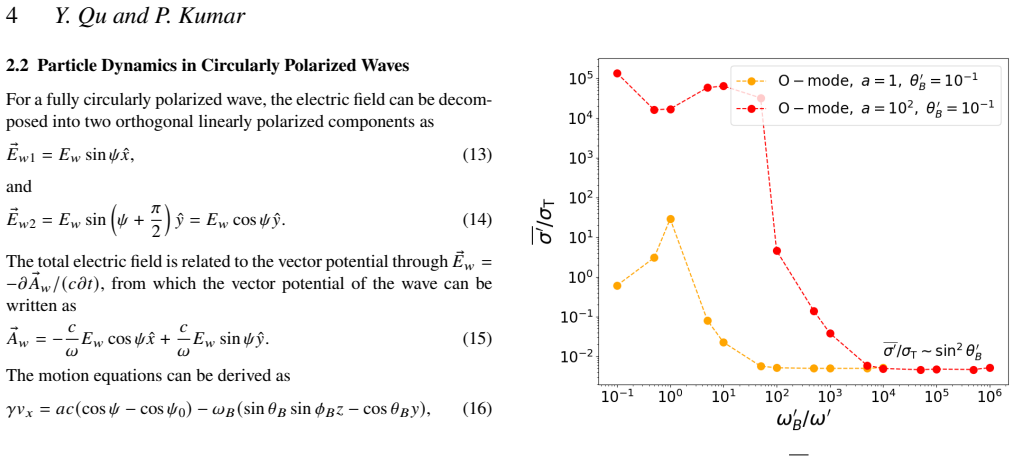
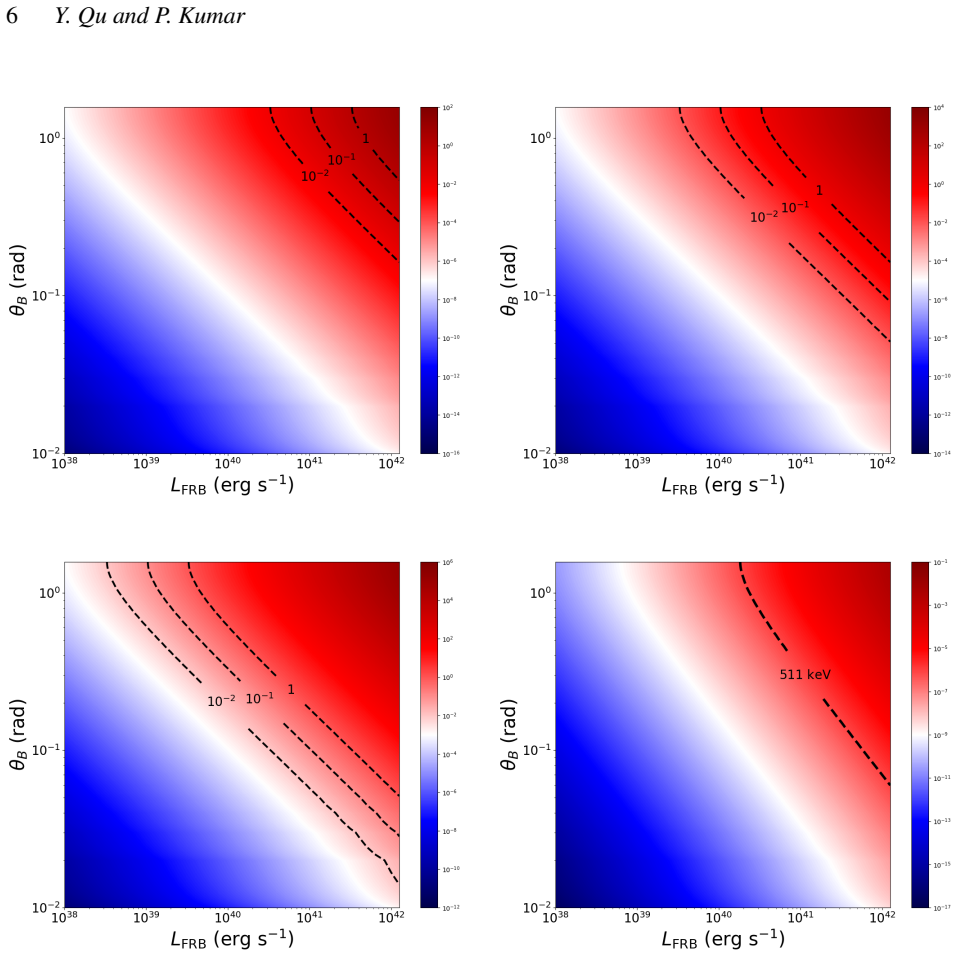
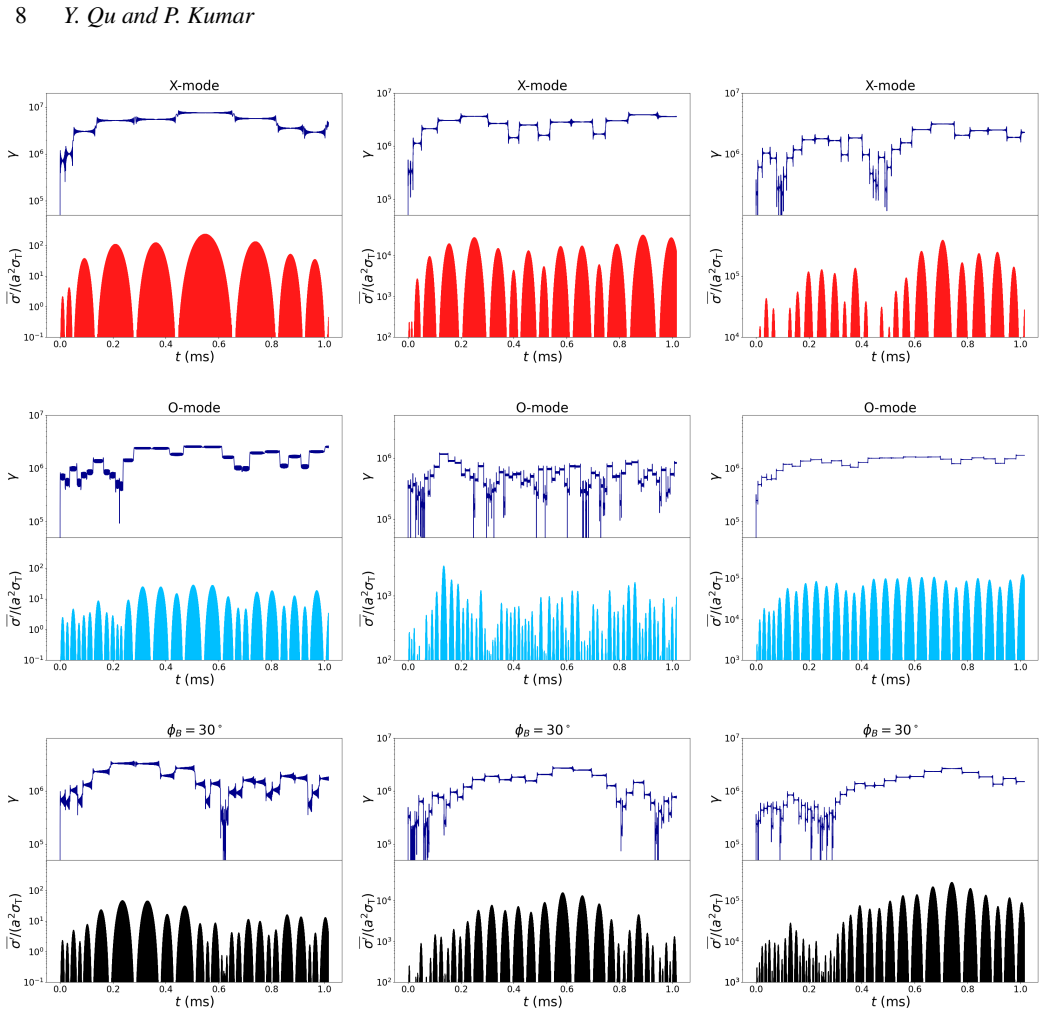
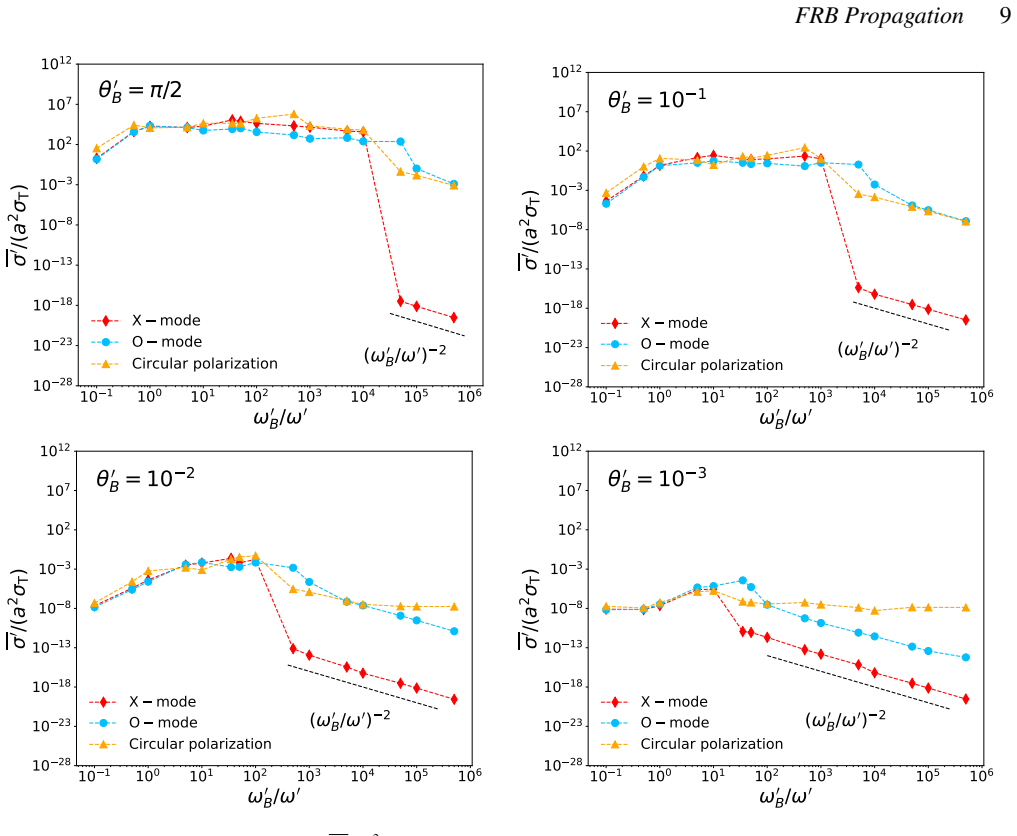
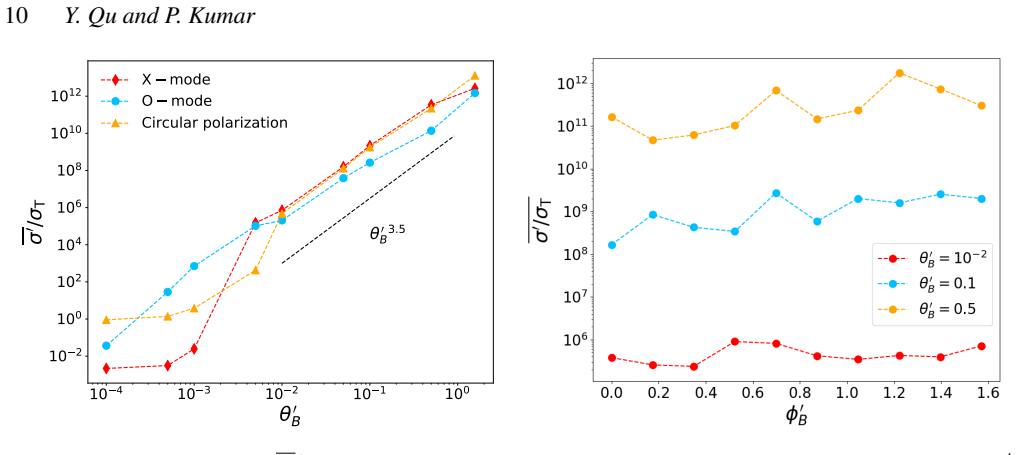
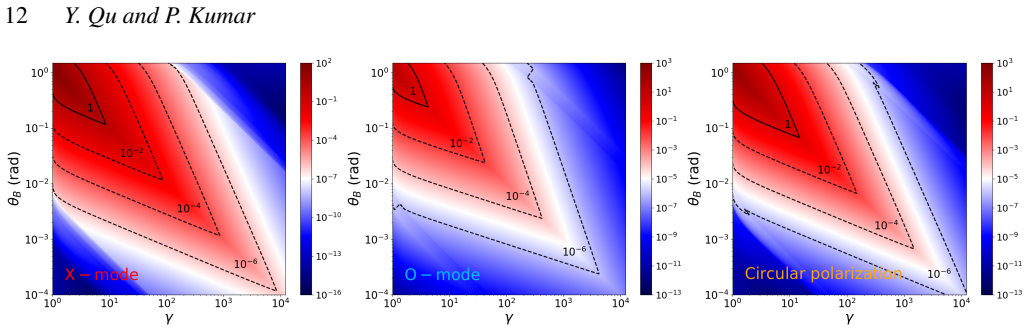
By solving the relativistic motion of a single particle in electromagnetic waves of arbitrary polarization and propagation angle θ_B, the scattering cross section of the O-mode exceeds that of the X-mode when a sin θ_B < ω_B/ω and becomes comparable when a sin θ_B > ω_B/ω; in the strongly magnetized and quasi-parallel limits the cross sections recover linear-regime scalings while being strongly suppressed by relativistic particle motion, producing optical depths well below unity and allowing large-amplitude waves to propagate through open field lines without significant scattering losses.
What carries the argument
Relativistic single-particle scattering cross section computed from the particle trajectory in waves of arbitrary polarization and angle θ_B to the background magnetic field.
If this is right
- Optical depths for both O- and X-modes fall well below unity in the strongly magnetized quasi-parallel regime.
- Curvature radiation losses for O-mode waves are suppressed, permitting escape at moderate plasma multiplicities.
- Field-line straightening by large-amplitude Alfvén waves further reduces θ_B and scattering losses.
- Large-amplitude waves aligned with open field lines can therefore propagate through the magnetosphere without significant single-particle scattering.
Where Pith is reading between the lines
- If the suppression holds, FRB polarization and frequency structure may be preserved from deeper in the magnetosphere than previously expected.
- The same relativistic suppression mechanism could apply to other coherent radio sources in strongly magnetized environments, such as pulsar giant pulses.
- Observational tests could include searching for a correlation between FRB polarization angle and inferred propagation geometry relative to the magnetic axis.
Load-bearing premise
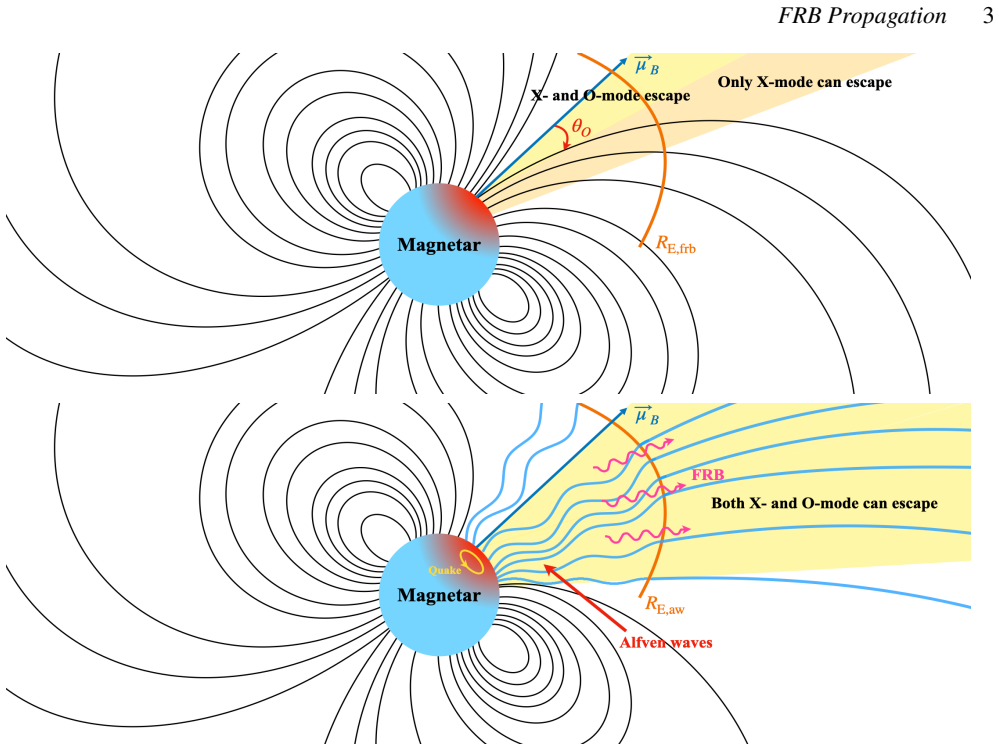
Alfvén waves excited by magnetar crust quakes can reach amplitudes comparable to the background magnetic field and thereby straighten field lines enough to reduce the wave propagation angle θ_B.
What would settle it
A direct numerical integration of the particle motion showing that the optical depth remains above unity for quasi-parallel propagation at the amplitudes and densities inferred for FRB sources.
Figures
read the original abstract
Fast Radio Bursts (FRBs) are millisecond-duration radio transients that are widely believed to originate within magnetar magnetospheres. Large-amplitude radio waves associated with FRBs propagate through strongly magnetized plasmas, where nonlinear scattering can affect their propagation. By solving the relativistic motion of a single particle interacting with electromagnetic waves of arbitrary polarization and propagation angle $\theta_B$, we compute the scattering cross section and the corresponding optical depth. The scattering cross section of the O-mode can exceed that of the X-mode when $a\sin\theta_B < \omega_B/\omega$, and becomes comparable to that of the X-mode when $a\sin\theta_B > \omega_B/\omega$, where $\theta_B$ is the angle between the wave vector and the background field. In the strongly magnetized and quasi-parallel limits, the cross sections asymptotically recover the linear regime scalings and are strongly suppressed by relativistic particle motion, leading to optical depths well below unity. We also show that curvature radiation losses of O-mode waves are strongly suppressed for quasi-parallel propagation, allowing them to escape from the magnetosphere at moderate multiplicities. We propose that Alfv\'en waves excited by magnetar crust quakes can reach amplitudes comparable to the background magnetic field, thus straightening field lines and reducing $\theta_B$. This geometrical alignment enhances the ability of FRBs to freely propagate through the open field line region. These results suggest that large-amplitude waves propagating quasi-parallel to open magnetic field lines can avoid significant single-particle scattering losses, providing a possible condition for their escape.
Editorial analysis
A structured set of objections, weighed in public.
Referee Report
Summary. The paper solves the relativistic Lorentz force for a single charged particle interacting with arbitrarily polarized strong electromagnetic waves at angle θ_B to a background magnetic field B_0. From the resulting particle trajectories it extracts the time-averaged scattering cross sections σ_O and σ_X (and the associated optical depths) as functions of wave amplitude a, frequency ω, and magnetization parameter ω_B/ω. In the strongly magnetized (ω_B ≫ ω) and quasi-parallel (θ_B small) limits the cross sections recover the known linear-regime scalings and are further suppressed by relativistic particle motion, yielding τ ≪ 1. Curvature-radiation losses for the O-mode are likewise shown to be suppressed at small θ_B. The authors propose that Alfvén waves excited by magnetar crust quakes can reach amplitudes a ∼ 1, thereby straightening open field lines, reducing θ_B, and permitting FRB escape.
Significance. If the single-particle derivation is correct, the work supplies a concrete, parameter-free mechanism by which large-amplitude radio waves can avoid significant scattering losses when propagating quasi-parallel to open magnetar field lines. The direct extraction of cross sections from the Lorentz-force trajectory (rather than from a fitted model) is a methodological strength. The final implication for FRB escape, however, rests on an unquantified auxiliary assumption whose removal would leave only the more limited statement that scattering is suppressed for sufficiently small θ_B.
major comments (2)
- [Abstract, §5] Abstract (final paragraph) and §5 (implications): the statement that “Alfvén waves excited by magnetar crust quakes can reach amplitudes comparable to the background magnetic field” is invoked to reduce θ_B and thereby enable escape, yet no amplitude estimate, energy budget, or propagation calculation is supplied. This assumption is load-bearing for the central claim that FRBs “can avoid significant single-particle scattering losses.”
- [§3] §3 (cross-section derivation): while the asymptotic recovery of linear scalings is stated, the manuscript provides neither an explicit numerical check against the known linear cross sections at a ≪ 1 nor an error analysis or comparison to full kinetic simulations. Because the suppression result is the load-bearing quantitative claim, such verification is required to establish the accuracy of the nonlinear expressions.
minor comments (1)
- [§3] Notation for the wave amplitude a and the angle θ_B should be defined once at first use and used consistently; several equations in §3 introduce auxiliary quantities (e.g., the effective E_p) without immediate reference back to the Lorentz-force equation.
Simulated Author's Rebuttal
We thank the referee for the careful and constructive review. We respond point-by-point to the major comments below.
read point-by-point responses
-
Referee: [Abstract, §5] Abstract (final paragraph) and §5 (implications): the statement that “Alfvén waves excited by magnetar crust quakes can reach amplitudes comparable to the background magnetic field” is invoked to reduce θ_B and thereby enable escape, yet no amplitude estimate, energy budget, or propagation calculation is supplied. This assumption is load-bearing for the central claim that FRBs “can avoid significant single-particle scattering losses.”
Authors: We agree that the Alfvén-wave proposal is presented without supporting amplitude or energy-budget calculations. The statement is offered as a physically motivated hypothesis rather than a derived result. In revision we will rephrase the abstract and §5 to present the mechanism as speculative, note that quantitative modeling of Alfvén-wave amplitudes lies outside the present scope, and explicitly state that the scattering-suppression result for small θ_B is independent of this hypothesis. revision: yes
-
Referee: [§3] §3 (cross-section derivation): while the asymptotic recovery of linear scalings is stated, the manuscript provides neither an explicit numerical check against the known linear cross sections at a ≪ 1 nor an error analysis or comparison to full kinetic simulations. Because the suppression result is the load-bearing quantitative claim, such verification is required to establish the accuracy of the nonlinear expressions.
Authors: We accept that an explicit numerical verification would strengthen the presentation. We will add to the revised §3 a direct comparison of the computed σ_O and σ_X against the known linear-regime analytic expressions for a ≪ 1, including a quantitative assessment of agreement across the relevant parameter space. A comparison against full kinetic simulations is beyond the scope of the single-particle Lorentz-force calculation performed here. revision: yes
Circularity Check
No significant circularity; cross sections derived from particle trajectory equations
full rationale
The paper obtains scattering cross sections by directly solving the relativistic single-particle motion equation for arbitrary wave polarization and angle θ_B, then computes optical depths from those expressions. This chain is self-contained and does not reduce to fitted inputs, self-citations, or ansatzes imported from prior work by the same authors. The Alfvén-wave straightening step is explicitly labeled a proposal in the abstract and does not serve as a load-bearing premise for the computed cross sections or optical-depth results. No renaming of known results or uniqueness theorems invoked via self-citation appear in the derivation.
Axiom & Free-Parameter Ledger
axioms (2)
- standard math Relativistic equation of motion for a charged particle in combined background B and wave E,B fields is solved exactly for arbitrary polarization and θ_B.
- domain assumption O-mode and X-mode are the relevant cold-plasma eigenmodes in strongly magnetized plasma.
invented entities (1)
-
Alfvén waves excited by magnetar crust quakes that reach amplitudes comparable to the background magnetic field
no independent evidence
Reference graph
Works this paper leans on
-
[1]
FRB 121102 Bursts Show Complex Time-Frequency Structure
FRB 121102 Bursts Show Complex Time-Frequency Structure. , keywords =. doi:10.3847/2041-8213/ab13ae , archivePrefix =. 1811.10748 , primaryClass =
work page internal anchor Pith review Pith/arXiv arXiv doi:10.3847/2041-8213/ab13ae 2041
-
[2]
Global Kinetic Simulations of Monster Shocks and Their Emission. , keywords =. doi:10.1103/y9p7-1zms , archivePrefix =. 2506.04175 , primaryClass =
-
[3]
Bright Bursts with Submillisecond Structures of FRB 20230607A in a Highly Magnetized Environment. , keywords =. doi:10.3847/1538-4357/addfdb , archivePrefix =. 2504.11173 , primaryClass =
-
[4]
Investigating FRB 20240114A with FAST: Morphological Classification and Drifting Rate Measurements in a Burst-cluster Framework. , keywords =. doi:10.3847/1538-4357/ae314a , archivePrefix =. 2507.14711 , primaryClass =
-
[5]
Magnetospheric origin of a fast radio burst constrained using scintillation. , keywords =. doi:10.1038/s41586-024-08297-w , archivePrefix =. 2406.11053 , primaryClass =
-
[6]
Monster Radiative Shocks in the Perturbed Magnetospheres of Neutron Stars. , keywords =. doi:10.3847/1538-4357/acf659 , archivePrefix =. 2210.13509 , primaryClass =
-
[7]
Conversion Measure of Faraday Rotation-Conversion with application to Fast Radio Bursts
Conversion Measure of Faraday Rotation-Conversion with Application to Fast Radio Bursts. , keywords =. doi:10.3847/1538-4357/ab0fa3 , archivePrefix =. 1902.01485 , primaryClass =
work page internal anchor Pith review Pith/arXiv arXiv doi:10.3847/1538-4357/ab0fa3 1902
-
[8]
Classical Electrodynamics, 3rd Edition
-
[9]
Radiative processes in astrophysics
-
[10]
A bright millisecond radio burst of extragalactic origin
A Bright Millisecond Radio Burst of Extragalactic Origin. Science , keywords =. doi:10.1126/science.1147532 , archivePrefix =. 0709.4301 , primaryClass =
work page internal anchor Pith review Pith/arXiv arXiv doi:10.1126/science.1147532
-
[11]
A Population of Fast Radio Bursts at Cosmological Distances
A Population of Fast Radio Bursts at Cosmological Distances. Science , keywords =. doi:10.1126/science.1236789 , archivePrefix =. 1307.1628 , primaryClass =
work page internal anchor Pith review Pith/arXiv arXiv doi:10.1126/science.1236789
-
[12]
The direct localization of a fast radio burst and its host
A direct localization of a fast radio burst and its host. , keywords =. doi:10.1038/nature20797 , archivePrefix =. 1701.01098 , primaryClass =
work page internal anchor Pith review Pith/arXiv arXiv doi:10.1038/nature20797
-
[13]
A single fast radio burst localized to a massive galaxy at cosmological distance
A single fast radio burst localized to a massive galaxy at cosmological distance. Science , keywords =. doi:10.1126/science.aaw5903 , archivePrefix =. 1906.11476 , primaryClass =
work page internal anchor Pith review Pith/arXiv arXiv doi:10.1126/science.aaw5903 1906
-
[14]
Fast Radio Burst Discovered in the Arecibo Pulsar ALFA Survey
Fast Radio Burst Discovered in the Arecibo Pulsar ALFA Survey. , keywords =. doi:10.1088/0004-637X/790/2/101 , archivePrefix =. 1404.2934 , primaryClass =
work page internal anchor Pith review Pith/arXiv arXiv doi:10.1088/0004-637x/790/2/101
-
[15]
FRBCAT: The Fast Radio Burst Catalogue
FRBCAT: The Fast Radio Burst Catalogue. , keywords =. doi:10.1017/pasa.2016.35 , archivePrefix =. 1601.03547 , primaryClass =
work page internal anchor Pith review Pith/arXiv arXiv doi:10.1017/pasa.2016.35 2016
-
[16]
A Multi-telescope Campaign on FRB 121102: Implications for the FRB Population
A Multi-telescope Campaign on FRB 121102: Implications for the FRB Population. , keywords =. doi:10.3847/1538-4357/aa9700 , archivePrefix =. 1705.07553 , primaryClass =
work page internal anchor Pith review Pith/arXiv arXiv doi:10.3847/1538-4357/aa9700
-
[17]
, year = 1969, month = dec, volume =
Generation and Transfer of Polarized Synchrotron Radiation. , year = 1969, month = dec, volume =
1969
-
[18]
An extreme magneto-ionic environment associated with the fast radio burst source FRB 121102
An extreme magneto-ionic environment associated with the fast radio burst source FRB 121102. , keywords =. doi:10.1038/nature25149 , archivePrefix =. 1801.03965 , primaryClass =
work page internal anchor Pith review Pith/arXiv arXiv doi:10.1038/nature25149
-
[19]
CHIME/FRB Discovery of Eight New Repeating Fast Radio Burst Sources. , keywords =. doi:10.3847/2041-8213/ab4a80 , archivePrefix =. 1908.03507 , primaryClass =
-
[20]
On the FRB luminosity function - - II. Event rate density. , keywords =. doi:10.1093/mnras/staa704 , archivePrefix =. 2003.04848 , primaryClass =
-
[21]
Faraday conversion and magneto-ionic variations in Fast Radio Bursts
Faraday conversion and magneto-ionic variations in fast radio bursts. , keywords =. doi:10.1093/mnrasl/slz038 , archivePrefix =. 1812.07889 , primaryClass =
work page internal anchor Pith review Pith/arXiv arXiv doi:10.1093/mnrasl/slz038
-
[22]
Faraday rotation: effect of magnetic field reversals
Faraday Rotation: Effect of Magnetic Field Reversals. , keywords =. doi:10.1088/0004-637X/725/2/1600 , archivePrefix =. 1010.3442 , primaryClass =
work page internal anchor Pith review Pith/arXiv arXiv doi:10.1088/0004-637x/725/2/1600
-
[23]
Polarization changes of pulsars due to wave propagation through magnetospheres. , keywords =. doi:10.1111/j.1365-2966.2009.16074.x , archivePrefix =. 0910.2793 , primaryClass =
-
[24]
Cyclotron absorption of radio emission within pulsar magnetospheres. , keywords =. doi:10.1046/j.1365-8711.2001.04402.x , adsurl =
-
[25]
Toward an Empirical Theory of Pulsar Emission. V. On the Circular Polarization in Pulsar Radiation. , keywords =. doi:10.1086/168531 , adsurl =
-
[26]
A theory of subpulse polarization patterns from radio pulsars. , keywords =. doi:10.1086/156959 , adsurl =
-
[27]
Polarization transfer in a pulsar magnetosphere. , keywords =. doi:10.1111/j.1365-2966.2005.09941.x , archivePrefix =. astro-ph/0512140 , primaryClass =
-
[28]
Faraday depolarization and induced circular polarization by multipath propagation with application to FRBs. , keywords =. doi:10.1093/mnras/stab3730 , archivePrefix =. 2110.00028 , primaryClass =
-
[29]
FRB coherent emission from decay of Alfv \'e n waves. , keywords =. doi:10.1093/mnras/staa774 , archivePrefix =. 2004.00644 , primaryClass =
-
[30]
Fast radio burst source properties and curvature radiation model
Fast radio burst source properties and curvature radiation model. , keywords =. doi:10.1093/mnras/stx665 , archivePrefix =. 1703.06139 , primaryClass =
work page internal anchor Pith review Pith/arXiv arXiv doi:10.1093/mnras/stx665
-
[31]
Bunching Coherent Curvature Radiation in Three-dimensional Magnetic Field Geometry: Application to Pulsars and Fast Radio Bursts. , keywords =. doi:10.3847/1538-4357/aae685 , archivePrefix =. 1712.02702 , primaryClass =
work page internal anchor Pith review Pith/arXiv arXiv doi:10.3847/1538-4357/aae685
-
[32]
Pair Separation in Parallel Electric Field in Magnetar Magnetosphere and Narrow Spectra of Fast Radio Bursts. , keywords =. doi:10.3847/2041-8213/abb535 , archivePrefix =. 2006.03270 , primaryClass =
-
[33]
A model for fast extragalactic radio bursts
A model for fast extragalactic radio bursts. , keywords =. doi:10.1093/mnrasl/slu046 , archivePrefix =. 1401.6674 , primaryClass =
work page internal anchor Pith review Pith/arXiv arXiv doi:10.1093/mnrasl/slu046
-
[34]
A flaring magnetar in FRB 121102?
A Flaring Magnetar in FRB 121102?. , keywords =. doi:10.3847/2041-8213/aa78f3 , archivePrefix =. 1702.08644 , primaryClass =
work page internal anchor Pith review Pith/arXiv arXiv doi:10.3847/2041-8213/aa78f3 2041
-
[35]
Blast Waves from Magnetar Flares and Fast Radio Bursts. , keywords =. doi:10.3847/1538-4357/ab83eb , archivePrefix =. 1908.07743 , primaryClass =
-
[36]
The synchrotron maser emission from relativistic shocks in Fast Radio Bursts: 1D PIC simulations of cold pair plasmas. , keywords =. doi:10.1093/mnras/stz640 , archivePrefix =. 1901.01029 , primaryClass =
work page internal anchor Pith review Pith/arXiv arXiv doi:10.1093/mnras/stz640 1901
-
[37]
Fast radio bursts as synchrotron maser emission from decelerating relativistic blast waves
Fast radio bursts as synchrotron maser emission from decelerating relativistic blast waves. , keywords =. doi:10.1093/mnras/stz700 , archivePrefix =. 1902.01866 , primaryClass =
work page internal anchor Pith review Pith/arXiv arXiv doi:10.1093/mnras/stz700 1902
-
[38]
Magnetospheric eclipses in the double pulsar system J0737-3039
Magnetospheric Eclipses in the Double-Pulsar System PSR J0737-3039. , keywords =. doi:10.1086/432248 , archivePrefix =. astro-ph/0412355 , primaryClass =
work page internal anchor Pith review Pith/arXiv arXiv doi:10.1086/432248
-
[39]
Propagation-induced Circular Polarisation in Synchrotron Sources. , keywords =. doi:10.1071/AS98211 , adsurl =
-
[40]
Proceedings of the Royal Society of London Series A , year = 1935, month = jun, volume =
The Application of the Magneto-Ionic Theory to the Ionosphere. Proceedings of the Royal Society of London Series A , year = 1935, month = jun, volume =. doi:10.1098/rspa.1935.0101 , adsurl =
-
[41]
, year = 1960, month = may, volume =
Magnetoionic Mode Coupling at High Frequencies. , year = 1960, month = may, volume =. doi:10.1086/146878 , adsurl =
-
[42]
, year = 1969, month = aug, volume =
Pulsar Electrodynamics. , year = 1969, month = aug, volume =. doi:10.1086/150119 , adsurl =
-
[43]
A unified picture of Galactic and cosmological fast radio bursts. , keywords =. doi:10.1093/mnras/staa2450 , archivePrefix =. 2005.06736 , primaryClass =
-
[44]
Coherent Inverse Compton Scattering by Bunches in Fast Radio Bursts. , keywords =. doi:10.3847/1538-4357/ac3979 , archivePrefix =. 2111.06571 , primaryClass =
-
[45]
Electromagnetic Processes in Dispersive Media
-
[46]
Can a Strong Radio Burst Escape the Magnetosphere of a Magnetar?. , keywords =. doi:10.3847/2041-8213/ac2fa0 , archivePrefix =. 2108.07881 , primaryClass =
-
[47]
Sitzungsberichte der K
\"U ber das Gravitationsfeld eines Massenpunktes nach der Einsteinschen Theorie. Sitzungsberichte der K
-
[48]
Nature Astronomy , keywords =
HXMT identification of a non-thermal X-ray burst from SGR J1935+2154 and with FRB 200428. Nature Astronomy , keywords =
-
[49]
The classical theory of fields
-
[50]
The plasma suppression effect can be ignored in realistic FRB models invoking bunched coherent radio emission. , keywords =. doi:10.1093/mnras/stac3111 , archivePrefix =. 2111.12269 , primaryClass =
-
[51]
, year = 1969, month = aug, volume =
Coherent Mechanisms of Radio Emission and Magnetic Models of Pulsars. , year = 1969, month = aug, volume =. doi:10.1007/BF00651351 , adsurl =
-
[52]
On the radiation mechanism of repeating fast radio bursts
On the radiation mechanism of repeating fast radio bursts. , keywords =. doi:10.1093/mnras/sty716 , archivePrefix =. 1710.10270 , primaryClass =
work page internal anchor Pith review Pith/arXiv arXiv doi:10.1093/mnras/sty716
-
[53]
A bright millisecond-duration radio burst from a Galactic magnetar. , keywords =. doi:10.1038/s41586-020-2863-y , archivePrefix =. 2005.10324 , primaryClass =
-
[54]
Nature Physical Science , year = 1972, month = dec, volume =
Lorentz Transformation Properties of the Stokes Parameters. Nature Physical Science , year = 1972, month = dec, volume =. doi:10.1038/physci240161b0 , adsurl =
-
[55]
An X-ray burst from a magnetar enlightening the mechanism of fast radio bursts. Nature Astronomy , keywords =. doi:10.1038/s41550-020-01276-x , archivePrefix =. 2005.12164 , primaryClass =
-
[56]
A peculiar hard X-ray counterpart of a Galactic fast radio burst. Nature Astronomy , keywords =. doi:10.1038/s41550-020-01265-0 , archivePrefix =. 2005.11178 , primaryClass =
-
[57]
A fast radio burst associated with a Galactic magnetar. , keywords =. doi:10.1038/s41586-020-2872-x , archivePrefix =. 2005.10828 , primaryClass =
-
[58]
INTEGRAL Discovery of a Burst with Associated Radio Emission from the Magnetar SGR 1935+2154. , keywords =. doi:10.3847/2041-8213/aba2cf , archivePrefix =. 2005.06335 , primaryClass =
-
[59]
, year = 2022, month = sep, volume =
A fast radio burst source at a complex magnetized site in a barred galaxy. , year = 2022, month = sep, volume =. doi:10.1038/s41586-022-05071-8 , adsurl =
-
[60]
The Astronomer's Telegram , keywords =
Recent high activity from a repeating Fast Radio Burst discovered by CHIME/FRB. The Astronomer's Telegram , keywords =
-
[61]
arXiv e-prints , keywords =
Circularly polarized radio emission from the repeating fast radio burst source FRB 20201124A. arXiv e-prints , keywords =
-
[62]
The physical mechanisms of fast radio bursts. , keywords =. doi:10.1038/s41586-020-2828-1 , archivePrefix =. 2011.03500 , primaryClass =
-
[63]
Wave modes in the magnetospheres of pulsars and magnetars. , keywords =. doi:10.1111/j.1365-2966.2007.11531.x , archivePrefix =. astro-ph/0611924 , primaryClass =
-
[64]
Resonant Conversion of Photon Modes Due to Vacuum Polarization in a Magnetized Plasma: Implications for X-Ray Emission from Magnetars. , keywords =. doi:10.1086/338074 , archivePrefix =. astro-ph/0108127 , primaryClass =
work page internal anchor Pith review Pith/arXiv arXiv doi:10.1086/338074
-
[65]
An inverse Compton scattering (ICS) model of pulsar emission. I. Core and conal emission beams. , keywords =
-
[66]
Constraints on the engines of fast radio bursts. , keywords =. doi:10.1093/mnras/staa1036 , archivePrefix =. 1911.05765 , primaryClass =
-
[67]
High-energy radiation from magnetized neutron stars
-
[68]
Plasmoid Ejection by Alfv \'e n Waves and the Fast Radio Bursts from SGR 1935+2154. , keywords =. doi:10.3847/2041-8213/abafa8 , archivePrefix =. 2006.04649 , primaryClass =
-
[69]
Atmosphere models of magnetized neutron stars: QED effects, radiation spectra and polarization signals. , keywords =. doi:10.1111/j.1365-2966.2006.11098.x , archivePrefix =. astro-ph/0607168 , primaryClass =
-
[70]
Wave Propagation in Pulsar Magnetospheres: Dispersion Relations and Normal Modes of Plasmas in Superstrong Magnetic Fields. , keywords =. doi:10.1086/163978 , adsurl =
-
[71]
An Inverse Compton Scattering Model of Pulsar Emission. III. Polarization. , keywords =. doi:10.1086/308824 , archivePrefix =. astro-ph/9911253 , primaryClass =
work page internal anchor Pith review Pith/arXiv arXiv doi:10.1086/308824
-
[72]
Transparency of fast radio burst waves in magnetar magnetospheres. , keywords =. doi:10.1093/mnras/stac1910 , archivePrefix =. 2204.10953 , primaryClass =
-
[73]
Repeating Fast Radio Bursts from Magnetars with Low Magnetospheric Twist
Repeating Fast Radio Bursts from Magnetars with Low Magnetospheric Twist. , keywords =. doi:10.3847/1538-4357/ab2240 , archivePrefix =. 1904.12036 , primaryClass =
work page internal anchor Pith review Pith/arXiv arXiv doi:10.3847/1538-4357/ab2240 1904
-
[74]
Circular Polarization in Pulsars due to Curvature Radiation
Circular Polarization in Pulsars Due to Curvature Radiation. , keywords =. doi:10.1088/0004-637X/710/1/29 , archivePrefix =. 1001.2671 , primaryClass =
work page internal anchor Pith review Pith/arXiv arXiv doi:10.1088/0004-637x/710/1/29
-
[75]
Magnetospheric Curvature Radiation by Bunches as Emission Mechanism for Repeating Fast Radio Bursts. , keywords =. doi:10.3847/1538-4357/ac4097 , archivePrefix =. 2111.11841 , primaryClass =
-
[76]
Research in Astronomy and Astrophysics , keywords =
Circular Polarization of Fast Radio Bursts in the Curvature Radiation Scenario. Research in Astronomy and Astrophysics , keywords =. doi:10.1088/1674-4527/ac71a5 , archivePrefix =. 2202.05475 , primaryClass =
-
[77]
, keywords =
Pulsar emission as curvature-generated polarized shot noise. , keywords =
-
[78]
A bimodal burst energy distribution of a repeating fast radio burst source. , keywords =. doi:10.1038/s41586-021-03878-5 , archivePrefix =. 2107.08205 , primaryClass =
-
[79]
Physics of the Interstellar and Intergalactic Medium
-
[80]
Propagation of Alfv \'e n waves in the charge starvation regime. , keywords =. doi:10.1093/mnras/stac2446 , adsurl =
discussion (0)
Sign in with ORCID, Apple, or X to comment. Anyone can read and Pith papers without signing in.