Landau-Zener formula and resonant axion conversion in neutron star magnetospheres
Pith reviewed 2026-07-01 04:59 UTC · model grok-4.3
The pith
The Landau-Zener formula often fails for axion-photon conversions in neutron star magnetospheres when resonance width exceeds the conversion region.
A machine-rendered reading of the paper's core claim, the machinery that carries it, and where it could break.
Core claim
The Landau-Zener picture of resonant axion-photon conversion fails when the resonance width exceeds the size of the conversion region, which occurs for many millimeter-to-optical band photons in neutron star magnetospheres; in such cases the conversion probability deviates significantly from the Landau-Zener value, requiring updated limits on axion parameters from polarization searches.
What carries the argument
The criterion obtained by comparing the resonance width to the size of the conversion region, which determines whether the Landau-Zener formula applies to axion-photon conversion.
If this is right
- When the resonance width exceeds the conversion region, the Landau-Zener conversion probability deviates from the numerical result.
- The scale comparison provides a simple test for the validity of the Landau-Zener formula without requiring full numerical computation.
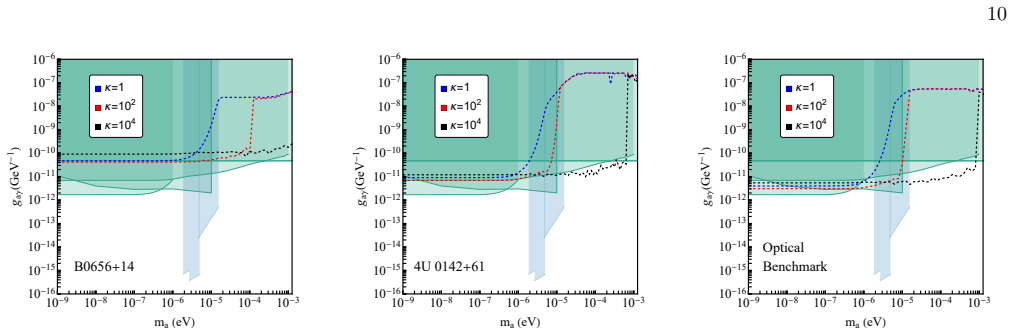
- Constraints on axions from neutron star optical-band polarization searches must be revised when the formula is invalid.
- Numerical methods are required to compute accurate conversion probabilities in cases where the Landau-Zener formula does not apply.
Where Pith is reading between the lines
- Similar scale comparisons between resonance width and region size could be applied to axion conversions in other astrophysical environments.
- Accurate modeling of plasma density profiles is essential for determining the validity criterion in specific neutron star models.
- The revised axion constraints may narrow the parameter space explored in direct detection experiments for axion dark matter.
Load-bearing premise
The modeling of the neutron star magnetosphere and the precise definition of the conversion region size are taken as given.
What would settle it
A direct numerical solution of the axion-photon mixing equations in a model neutron star magnetosphere that either confirms or contradicts the predicted deviation from the Landau-Zener probability when the resonance width exceeds the region size.
Figures
read the original abstract
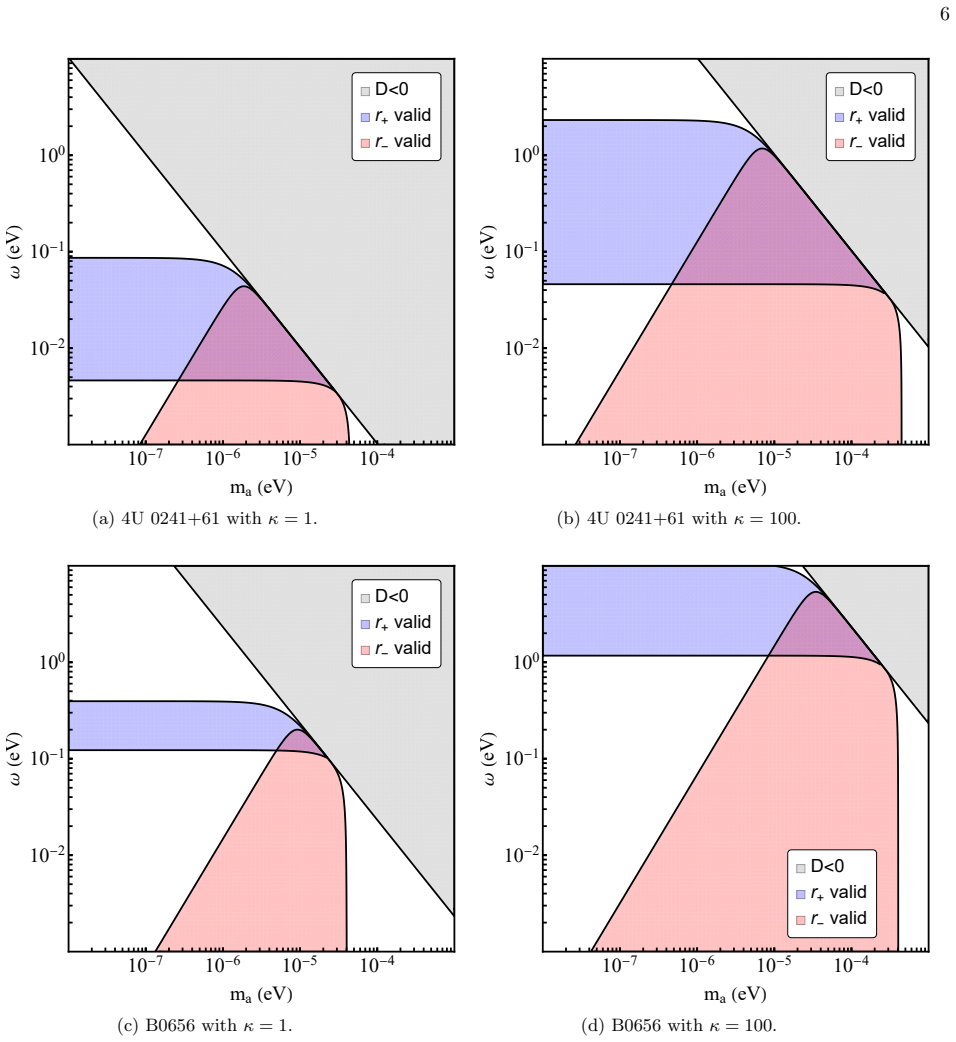
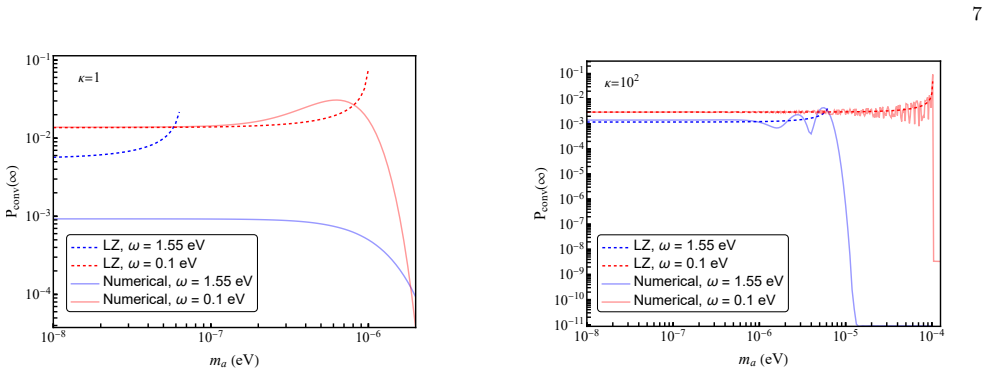
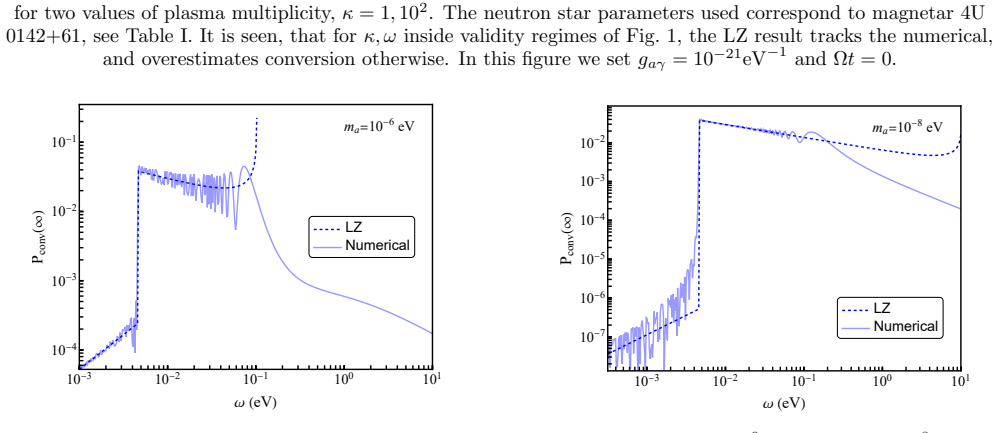
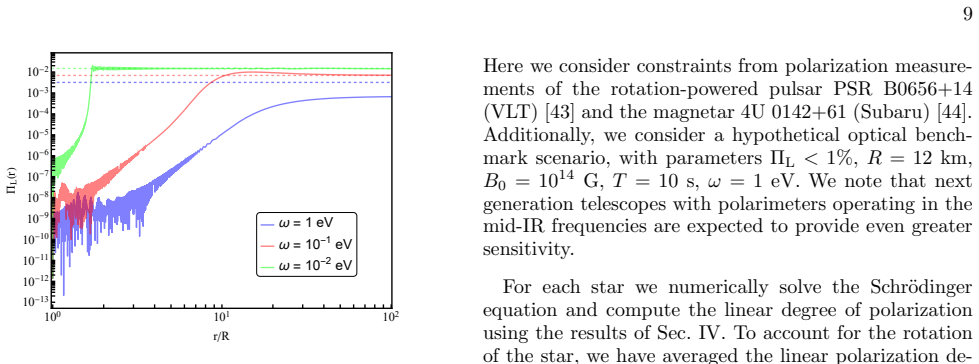
We investigate the Landau-Zener description of resonant axion-photon conversion in neutron star magnetospheres. We find that this picture often fails for axion conversions to millimeter-to-optical band photons due to the characteristic resonance width exceeding the size of the conversion region. This comparison of scales yields a simple criterion for evaluating the validity of the Landau-Zener formula. We verify this criterion numerically, and show that when invalid, the Landau-Zener conversion probability may significantly deviate from the numerical result. In light of these findings, we revise constraints on axions from neutron star optical-band polarization searches.
Editorial analysis
A structured set of objections, weighed in public.
Referee Report
Summary. The manuscript investigates the applicability of the Landau-Zener (LZ) formula to resonant axion-photon conversion in neutron star magnetospheres. It finds that the LZ description often fails for conversions producing photons in the millimeter-to-optical bands because the resonance width exceeds the size of the conversion region. This scale comparison produces a simple validity criterion, which is verified numerically; when the criterion indicates invalidity, the LZ probability deviates from the numerical result. The paper uses these findings to revise constraints on axions from neutron star optical-band polarization searches.
Significance. If the central claims hold, the work is significant for providing a practical, profile-based criterion to assess LZ validity in axion conversion calculations. This directly affects the reliability of constraints derived from astrophysical observations in the optical band and highlights the need for full numerical treatments in regimes where the approximation breaks down. The numerical verification and explicit revision of existing bounds add concrete value to the phenomenology of axion searches.
major comments (2)
- [Numerical verification] Numerical verification (section referenced in abstract): The abstract states that the criterion is verified numerically and that LZ probabilities deviate when invalid, but the manuscript provides no details on the simulation setup, magnetosphere model (e.g., plasma density profile, B-field geometry), grid resolution, error bars, or convergence tests. This absence is load-bearing because the central claim rests on the numerical results confirming the scale-comparison criterion.
- [Criterion derivation] Derivation of validity criterion (scale comparison): The criterion is obtained by comparing resonance width to conversion-region size, both of which are fixed by the assumed radial profiles of plasma density and magnetic field. The manuscript should quantify the sensitivity of the inequality to variations in the density power-law index or dipole geometry, as these choices determine whether the LZ formula is deemed invalid for a given photon frequency.
minor comments (1)
- [Abstract] The abstract mentions revision of constraints but does not specify which existing bounds are affected or by how much; a brief quantitative statement would improve clarity.
Simulated Author's Rebuttal
We thank the referee for their positive evaluation of the work's significance and for the constructive major comments. We address each point below, agreeing that additional details and robustness checks are warranted, and will revise the manuscript accordingly.
read point-by-point responses
-
Referee: [Numerical verification] Numerical verification (section referenced in abstract): The abstract states that the criterion is verified numerically and that LZ probabilities deviate when invalid, but the manuscript provides no details on the simulation setup, magnetosphere model (e.g., plasma density profile, B-field geometry), grid resolution, error bars, or convergence tests. This absence is load-bearing because the central claim rests on the numerical results confirming the scale-comparison criterion.
Authors: We agree that the numerical verification requires more explicit documentation to be fully reproducible and convincing. In the revised manuscript we will add a dedicated subsection (or appendix) detailing the magnetosphere model (Goldreich-Julian plasma density with the adopted power-law index and dipole magnetic-field geometry), the numerical method used to integrate the axion-photon mixing equations, the radial grid resolution and spacing, convergence tests performed by varying grid density, and quantitative error estimates or deviation metrics between LZ and numerical results. This will directly substantiate the central claim. revision: yes
-
Referee: [Criterion derivation] Derivation of validity criterion (scale comparison): The criterion is obtained by comparing resonance width to conversion-region size, both of which are fixed by the assumed radial profiles of plasma density and magnetic field. The manuscript should quantify the sensitivity of the inequality to variations in the density power-law index or dipole geometry, as these choices determine whether the LZ formula is deemed invalid for a given photon frequency.
Authors: The validity criterion is derived under the standard radial profiles assumed for neutron-star magnetospheres. We will add a short robustness analysis in the revised manuscript that varies the plasma-density power-law index over a physically plausible range (approximately -3 to -5) and considers modest deviations from pure dipole geometry. The results show that the conclusion that the LZ approximation fails for optical-band conversions remains robust, although the precise frequency boundary of validity shifts by a modest factor. This quantification will be presented explicitly. revision: yes
Circularity Check
No circularity; scale comparison and numerical verification are independent of inputs
full rationale
The paper's central result is a validity criterion obtained by direct comparison of resonance width to conversion-region size, followed by numerical verification that the LZ formula deviates when the criterion fails. No equations reduce to self-definition, no fitted parameters are relabeled as predictions, and no load-bearing claims rest on self-citations whose content is unverified. The derivation chain is self-contained against external benchmarks (numerical integration) and does not import uniqueness or ansatzes via citation chains. This is the normal non-circular outcome.
Axiom & Free-Parameter Ledger
Reference graph
Works this paper leans on
-
[1]
R. D. Peccei and H. R. Quinn, Phys. Rev. Lett.38, 1440 (1977)
1977
-
[2]
R. D. Peccei and H. R. Quinn, Phys. Rev. D16, 1791 (1977)
1977
-
[3]
Weinberg, Phys
S. Weinberg, Phys. Rev. Lett.40, 223 (1978)
1978
-
[4]
L. F. Abbott and P. Sikivie, Phys. Lett. B120, 133 (1983)
1983
-
[5]
Preskill, M
J. Preskill, M. B. Wise, and F. Wilczek, Phys. Lett. B 120, 127 (1983)
1983
-
[6]
Dine and W
M. Dine and W. Fischler, Phys. Lett. B120, 137 (1983)
1983
-
[7]
Albertuset al., (2026), arXiv:2602.09089 [hep-ph]
C. Albertuset al., WISPedia – the WISPs En- cyclopedia: Cosmic WISPers 2026 – V1.0 (2026), arXiv:2602.09089 [hep-ph]
-
[8]
Chikashige, R
Y. Chikashige, R. N. Mohapatra, and R. D. Peccei, Phys. Lett. B98, 265 (1981)
1981
-
[9]
Wilczek, Phys
F. Wilczek, Phys. Rev. Lett.49, 1549 (1982)
1982
-
[10]
Witten, Phys
E. Witten, Phys. Lett. B149, 351 (1984)
1984
-
[11]
Sikivie, Phys
P. Sikivie, Phys. Rev. Lett.51, 1415 (1983), [Erratum: Phys.Rev.Lett. 52, 695 (1984)]
1983
-
[12]
Raffelt and L
G. Raffelt and L. Stodolsky, Phys. Rev. D37, 1237 (1988)
1988
-
[13]
The landscape of QCD axion models
L. Di Luzio, M. Giannotti, E. Nardi, and L. Visinelli, Phys. Rept.870, 1 (2020), arXiv:2003.01100 [hep-ph]
work page internal anchor Pith review Pith/arXiv arXiv 2020
-
[14]
Sikivie, Invisible Axion Search Methods, Rev
P. Sikivie, Rev. Mod. Phys.93, 015004 (2021), arXiv:2003.02206 [hep-ph]
-
[15]
P. W. Graham, I. G. Irastorza, S. K. Lamoreaux, A. Lind- ner, and K. A. van Bibber, Ann. Rev. Nucl. Part. Sci.65, 485 (2015), arXiv:1602.00039 [hep-ex]
work page internal anchor Pith review Pith/arXiv arXiv 2015
- [16]
-
[17]
Any Light Particle Search II -- Technical Design Report
R. B¨ ahreet al., JINST8, T09001, arXiv:1302.5647 [physics.ins-det]
work page internal anchor Pith review Pith/arXiv arXiv
-
[18]
New CAST Limit on the Axion-Photon Interaction
V. Anastassopouloset al.(CAST), Nature Phys.13, 584 (2017), arXiv:1705.02290 [hep-ex]
work page internal anchor Pith review Pith/arXiv arXiv 2017
-
[19]
S. J. Asztaloset al.(ADMX), Phys. Rev. Lett.104, 041301 (2010), arXiv:0910.5914 [astro-ph.CO]
work page internal anchor Pith review Pith/arXiv arXiv 2010
-
[20]
A Search for Invisible Axion Dark Matter with the Axion Dark Matter Experiment
N. Duet al.(ADMX), Phys. Rev. Lett.120, 151301 (2018), arXiv:1804.05750 [hep-ex]
work page internal anchor Pith review Pith/arXiv arXiv 2018
-
[21]
T. Braineet al.(ADMX), Phys. Rev. Lett.124, 101303 (2020), arXiv:1910.08638 [hep-ex]
-
[22]
C. Bartramet al.(ADMX), Phys. Rev. Lett.127, 261803 (2021), arXiv:2110.06096 [hep-ex]
-
[23]
N. Crisosto, P. Sikivie, N. S. Sullivan, D. B. Tanner, J. Yang, and G. Rybka, Phys. Rev. Lett.124, 241101 (2020), arXiv:1911.05772 [astro-ph.CO]
-
[24]
L. Brouweret al.(DMRadio), Phys. Rev. D106, 103008 12 (2022), arXiv:2204.13781 [hep-ex]
-
[25]
P. Carenza, M. Giannotti, J. Isern, A. Mirizzi, and O. Straniero, Phys. Rept.1117, 1 (2025), arXiv:2411.02492 [hep-ph]
- [26]
-
[27]
A. Hook, Y. Kahn, B. R. Safdi, and Z. Sun, Phys. Rev. Lett.121, 241102 (2018), arXiv:1804.03145 [hep-ph]
work page internal anchor Pith review Pith/arXiv arXiv 2018
- [28]
- [29]
- [30]
-
[31]
Probing Axions with Radiation from Magnetic Stars
D. Lai and J. Heyl, Phys. Rev. D74, 123003 (2006), arXiv:astro-ph/0609775
work page internal anchor Pith review Pith/arXiv arXiv 2006
-
[32]
Constraining the photon-axion coupling constant with magnetic white dwarfs
R. Gill and J. S. Heyl, Phys. Rev. D84, 085001 (2011), arXiv:1105.2083 [astro-ph.HE]
work page internal anchor Pith review Pith/arXiv arXiv 2011
-
[33]
C. Dessert, D. Dunsky, and B. R. Safdi, Phys. Rev. D 105, 103034 (2022), arXiv:2203.04319 [hep-ph]
-
[34]
H.-C. Tian, Z.-Y. Wang, Y.-F. Liang, and Z.-W. Du, Phys. Rev. D111, 123010 (2025), arXiv:2504.10965 [hep- ph]
work page internal anchor Pith review Pith/arXiv arXiv 2025
-
[35]
K. Bondarenko, A. Boyarsky, J. Pradler, and A. Sokolenko, Phys. Lett. B846, 138238 (2023), arXiv:2203.08663 [hep-ph]
- [36]
- [37]
-
[38]
L. D. Landau, Phys. Z. Sowjetunion2, 10.1016/B978-0- 08-010586-4.50014-6 (1932)
-
[39]
Zener, Proc
C. Zener, Proc. Roy. Soc. Lond. A137, 696 (1932)
1932
-
[40]
A. N. Timokhin and A. K. Harding, Astrophys. J.871, 12 (2019), arXiv:1803.08924 [astro-ph.HE]
work page internal anchor Pith review Pith/arXiv arXiv 2019
- [41]
-
[42]
R. N. Manchester, G. B. Hobbs, A. Teoh, and M. Hobbs, The Astronomical Journal129, 1993–2006 (2005)
1993
-
[43]
R. P. Mignani, P. Moran, A. Shearer, V. Testa, A. Sowikowska, B. Rudak, K. Krzeszowki, and G. Kanbach, Astron. Astrophys.583, A105 (2015), arXiv:1510.01057 [astro-ph.HE]
work page internal anchor Pith review Pith/arXiv arXiv 2015
-
[44]
Z. Wang, Y. T. Tanaka, C. Wang, K. S. Kawabata, Y. Fukazawa, R. Itoh, and A. Tziamtzis, Astrophys. J. 814, 89 (2015), arXiv:1506.08494 [astro-ph.HE]
work page internal anchor Pith review Pith/arXiv arXiv 2015
-
[45]
B. Kern, C. Martin, B. Mazin, and J. P. Halpern, Astro- phys. J.597, 1049 (2003), arXiv:astro-ph/0307544
work page internal anchor Pith review Pith/arXiv arXiv 2003
-
[46]
Cikota, F
A. Cikota, F. Patat, S. Cikota, and T. Faran, Monthly Notices of the Royal Astronomical Society464, 4146 (2016)
2016
-
[47]
Kashikawa, K
N. Kashikawa, K. Aoki, R. Asai, N. Ebizuka, M. Inata, M. Iye, K. S. Kawabata, G. Kosugi, Y. Ohyama, K. Okita, T. Ozawa, Y. Saito, T. Sasaki, K. Sekiguchi, Y. Shimizu, H. Taguchi, T. Takata, Y. Yadoumaru, and M. Yoshida, Publications of the Astronomical Society of Japan54, 819 (2002)
2002
-
[48]
D. A. H. Buckley, P. A. Charles, K. H. Nordsieck, and D. O’Donoghue, inThe Scientific Requirements for Ex- tremely Large Telescopes, IAU Symposium, Vol. 232, edited by P. Whitelock, M. Dennefeld, and B. Leibundgut (2006) pp. 1–12
2006
- [49]
-
[50]
X-ray spectra from magnetar candidates. I. Monte Carlo simulations in the non-relativistic regime
L. Nobili, R. Turolla, and S. Zane, Mon. Not. Roy. As- tron. Soc.386, 1527 (2008), arXiv:0802.2647 [astro-ph]
work page internal anchor Pith review Pith/arXiv arXiv 2008
-
[51]
M. van Adelsberg and D. Lai, Mon. Not. Roy. Astron. Soc.373, 1495 (2006), arXiv:astro-ph/0607168
work page internal anchor Pith review Pith/arXiv arXiv 2006
-
[52]
Wuensch, S
W. Wuensch, S. De Panfilis-Wuensch, Y. K. Semertzidis, J. T. Rogers, A. C. Melissinos, H. J. Halama, B. E. Moskowitz, A. G. Prodell, W. B. Fowler, and F. A. Nezrick, Phys. Rev. D40, 3153 (1989)
1989
-
[53]
First results from a second generation galactic axion experiment
C. Hagmannet al., Nucl. Phys. B Proc. Suppl.51, 209 (1996), arXiv:astro-ph/9607022
work page internal anchor Pith review Pith/arXiv arXiv 1996
-
[54]
D. Noordhuis, A. Prabhu, S. J. Witte, A. Y. Chen, F. Cruz, and C. Weniger, Phys. Rev. Lett.131, 111004 (2023), arXiv:2209.09917 [hep-ph]
- [55]
-
[56]
Goldreich and W
P. Goldreich and W. H. Julian, Astrophys. J.157, 869 (1969)
1969
discussion (0)
Sign in with ORCID, Apple, or X to comment. Anyone can read and Pith papers without signing in.