Temperature Field Reconstruction of Tungsten Monoblock Divertor on EAST using Physics-aware Neural Operator Transformer
Pith reviewed 2026-07-01 05:42 UTC · model grok-4.3
The pith
A physics-aware neural operator transformer reconstructs tungsten monoblock divertor temperatures in real time by embedding heat diffusion rules into graph attention and slicing-based aggregation.
A machine-rendered reading of the paper's core claim, the machinery that carries it, and where it could break.
Core claim
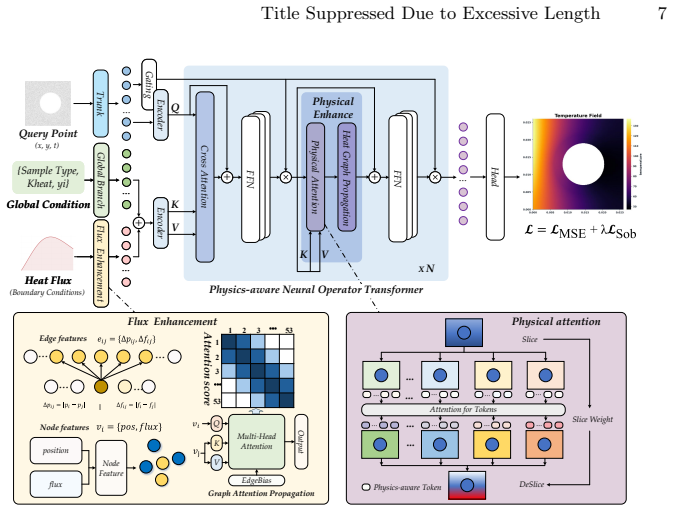
The Physics-aware Neural Operator Transformer models boundary heat-flux relations as a structured graph, applies graph attention to capture spatial physical dependencies, uses a physics-aware neural operator module with slicing to aggregate points under similar conditions and model diffusion, and adds gradient-constrained Sobolev regularization; the resulting predictions of the divertor temperature field show higher accuracy and preserved physical consistency on EAST tungsten monoblock data.
What carries the argument
The Physics-aware Neural Operator Transformer (PNOT), which represents heat-flux boundaries as a graph for attention and applies slicing-based aggregation plus Sobolev loss to enforce diffusion physics.
If this is right
- Real-time temperature field reconstruction becomes possible for active control of fusion devices.
- Physical consistency is maintained even when the model runs faster than conventional numerical solvers.
- Prediction errors decrease when the graph attention and Sobolev terms are included versus baseline operators.
- The same architecture can be applied to other divertor geometries once the graph is redefined for the new shape.
Where Pith is reading between the lines
- The method could be coupled directly to real-time diagnostic streams to trigger protective actions before melting occurs.
- Retraining the operator on data from different tokamaks might allow transfer without full re-derivation of the mesh.
- Because the slicing step groups points by physical similarity, the model may generalize to transient events not seen in training.
Load-bearing premise
Boundary heat-flux relations in the monoblock can be captured by a graph whose attention and slicing steps encode the dominant spatiotemporal heat diffusion.
What would settle it
Compare PNOT outputs against independent high-resolution FEM runs or EAST sensor measurements on a set of previously unseen heat-flux boundary conditions; systematic deviation in temperature values or violation of the heat equation would falsify the claim.
Figures



read the original abstract
Accurate modeling of the divertor temperature field is essential for preventing material melting and damage and for extending the service life of fusion devices. However, conventional numerical methods, such as the Finite Element Method (FEM), are computationally expensive and therefore unsuitable for real-time applications. Therefore, a fast and generalizable method is required for real-time reconstruction of the divertor temperature field and subsequent real-time control. To address the above issue, we propose a Physics-aware Neural Operator Transformer (PNOT) to characterize the spatiotemporal evolution of the divertor temperature field. It models boundary heat-flux relations as a structured graph and employs graph attention to explicitly capture spatial physical dependencies. Inspired by physics-aware attention, we further develop a physics-aware neural operator module to aggregate query points with similar physical conditions via slicing and model heat diffusion, while a gradient-constrained Sobolev regularization loss enforces consistency between function values and their derivatives. Experimental results show that these physical constraints improve prediction accuracy while preserving physical consistency. The source code of this paper will be released on https://github.com/Event-AHU/OpenFusion
Editorial analysis
A structured set of objections, weighed in public.
Referee Report
Summary. The manuscript proposes a Physics-aware Neural Operator Transformer (PNOT) for reconstructing the spatiotemporal temperature field of the tungsten monoblock divertor on EAST. Boundary heat-flux relations are modeled as a structured graph with graph attention to capture spatial dependencies; a physics-aware neural operator module aggregates query points via slicing to model heat diffusion; and a gradient-constrained Sobolev regularization loss enforces consistency between function values and derivatives. The central claim is that these physical constraints improve prediction accuracy while preserving physical consistency, with source code promised for release.
Significance. If the quantitative claims hold, the method could offer a computationally efficient alternative to FEM for real-time divertor monitoring and control in fusion devices, directly addressing material damage risks. The explicit incorporation of physics via graph attention and Sobolev loss, combined with the code-release commitment, strengthens potential impact and verifiability.
major comments (2)
- [Abstract] Abstract: the claim that 'Experimental results show that these physical constraints improve prediction accuracy while preserving physical consistency' is presented without any quantitative metrics, baseline comparisons, dataset details, ablation results, or error tables. This absence makes it impossible to evaluate whether the stated improvements are supported or load-bearing for the central claim.
- [Method] Method section (physics-aware neural operator module): the assumption that slicing-based aggregation on a graph-attention model of boundary fluxes will capture the dominant spatiotemporal heat diffusion for the specific tungsten monoblock geometry is not accompanied by targeted validation experiments or sensitivity analysis on the geometry; without such tests the modeling choice remains an unverified modeling decision rather than a demonstrated necessity.
minor comments (1)
- [Abstract] Abstract: the GitHub link is supplied but the code is not yet released, preventing immediate reproducibility checks.
Simulated Author's Rebuttal
We thank the referee for the constructive and detailed comments on our manuscript. We address each major comment point by point below and indicate where revisions will be made to strengthen the paper.
read point-by-point responses
-
Referee: [Abstract] Abstract: the claim that 'Experimental results show that these physical constraints improve prediction accuracy while preserving physical consistency' is presented without any quantitative metrics, baseline comparisons, dataset details, ablation results, or error tables. This absence makes it impossible to evaluate whether the stated improvements are supported or load-bearing for the central claim.
Authors: We agree that the abstract claim would be stronger with explicit quantitative support. In the revised manuscript we will expand the abstract to include key metrics (e.g., error reductions relative to baselines, ablation results on the physics-aware components, and dataset characteristics) drawn from the experimental section, thereby making the claim directly verifiable within the abstract. revision: yes
-
Referee: [Method] Method section (physics-aware neural operator module): the assumption that slicing-based aggregation on a graph-attention model of boundary fluxes will capture the dominant spatiotemporal heat diffusion for the specific tungsten monoblock geometry is not accompanied by targeted validation experiments or sensitivity analysis on the geometry; without such tests the modeling choice remains an unverified modeling decision rather than a demonstrated necessity.
Authors: The slicing aggregation is motivated by the need to group query points that share similar physical boundary conditions, consistent with the underlying heat-diffusion physics. The overall PNOT framework is evaluated on EAST tungsten monoblock data. Nevertheless, we acknowledge that dedicated sensitivity analysis on the geometry and slicing parameters would provide stronger justification. We will add targeted experiments and analysis in the revised method section to demonstrate the necessity of this design choice. revision: yes
Circularity Check
No significant circularity detected
full rationale
The paper presents a standard physics-informed neural operator (PNOT) that trains a graph-attention model plus Sobolev regularization against external simulation or measurement targets for the divertor temperature field. No derivation step reduces by construction to a fitted parameter renamed as a prediction, nor does any load-bearing premise rest on a self-citation chain whose cited result is itself unverified within the paper. The central claim—that added physical constraints improve accuracy while preserving consistency—is an empirical statement evaluated on held-out data, not a self-referential definition or ansatz smuggled via prior work by the same authors. The derivation chain therefore remains self-contained against external benchmarks.
Axiom & Free-Parameter Ledger
axioms (2)
- domain assumption Boundary heat-flux relations can be represented as a structured graph whose attention mechanism captures the essential spatial physical dependencies of heat diffusion.
- domain assumption Aggregating query points with similar physical conditions via slicing and enforcing gradient consistency via Sobolev loss will improve both accuracy and physical consistency.
invented entities (1)
-
Physics-aware Neural Operator Transformer (PNOT)
no independent evidence
Reference graph
Works this paper leans on
-
[1]
In: Fluids engineering division summer meeting
Cai, S., Wang, Z., Chryssostomidis, C., Karniadakis, G.E.: Heat transfer pre- diction with unknown thermal boundary conditions using physics-informed neu- ral networks. In: Fluids engineering division summer meeting. vol. 83730, p. V003T05A054. American Society of Mechanical Engineers (2020) 18 Zikang Yan et al
2020
-
[2]
Journal of Machine Learning Research26(300), 1–52 (2025)
Calvello, E., Kovachki, N.B., Levine, M.E., Stuart, A.M.: Continuum attention for neural operators. Journal of Machine Learning Research26(300), 1–52 (2025)
2025
-
[3]
Advances in neural information processing systems34, 24924–24940 (2021)
Cao, S.: Choose a transformer: Fourier or galerkin. Advances in neural information processing systems34, 24924–24940 (2021)
2021
-
[4]
Book- boon (2010)
Causon, D., Mingham, C.: Introductory finite difference methods for PDEs. Book- boon (2010)
2010
-
[5]
Progress in Nuclear Energy188, 105895 (2025)
Cheng, Q., Sahadath, M.H., Yang, H., Pan, S., Ji, W.: Surrogate modeling of heat transferunderflowfluctuation conditionsusing fourierbasis-deep operator network with uncertainty quantification. Progress in Nuclear Energy188, 105895 (2025)
2025
-
[6]
International Journal of Heat and Mass Transfer258, 128335 (2026)
Ding, S., Tian, Y., Qin, L., Ma, H., Yang, R.: Physics-informed hierarchical neural operator for solving inverse problem of unsteady heat conduction. International Journal of Heat and Mass Transfer258, 128335 (2026)
2026
-
[7]
Handbook of nu- merical analysis7, 713–1018 (2000)
Eymard, R., Gallouët, T., Herbin, R.: Finite volume methods. Handbook of nu- merical analysis7, 713–1018 (2000)
2000
-
[8]
Advances in neural information processing systems34, 24048–24062 (2021)
Gupta, G., Xiao, X., Bogdan, P.: Multiwavelet-based operator learning for differen- tial equations. Advances in neural information processing systems34, 24048–24062 (2021)
2021
-
[9]
arXiv preprint arXiv:2403.03542 (2024)
Hao, Z., Su, C., Liu, S., Berner, J., Ying, C., Su, H., Anandkumar, A., Song, J., Zhu, J.: Dpot: Auto-regressive denoising operator transformer for large-scale pde pre-training. arXiv preprint arXiv:2403.03542 (2024)
-
[10]
Hao, Z., Wang, Z., Su, H., Ying, C., Dong, Y., Liu, S., Cheng, Z., Song, J., Zhu, J.: Gnot:Ageneralneuraloperatortransformerforoperatorlearning.In:International conference on machine learning. pp. 12556–12569. PMLR (2023)
2023
-
[11]
In: International conference on computational science
Hennigh, O., Narasimhan, S., Nabian, M.A., Subramaniam, A., Tangsali, K., Fang, Z., Rietmann, M., Byeon, W., Choudhry, S.: Nvidia simnet™: An ai-accelerated multi-physics simulation framework. In: International conference on computational science. pp. 447–461. Springer (2021)
2021
-
[12]
From Theory to Application: A Practical Introduction to Neural Operators in Scientific Computing
Jha, P.K.: From theory to application: A practical introduction to neural operators in scientific computing. arXiv preprint arXiv:2503.05598 (2025)
work page internal anchor Pith review Pith/arXiv arXiv 2025
-
[13]
Nature Reviews Physics3(6), 422–440 (2021)
Karniadakis, G.E., Kevrekidis, I.G., Lu, L., Perdikaris, P., Wang, S., Yang, L.: Physics-informed machine learning. Nature Reviews Physics3(6), 422–440 (2021)
2021
-
[14]
Journal of Machine Learning Research24(89), 1–97 (2023)
Kovachki, N., Li, Z., Liu, B., Azizzadenesheli, K., Bhattacharya, K., Stuart, A., Anandkumar, A.: Neural operator: Learning maps between function spaces with applications to pdes. Journal of Machine Learning Research24(89), 1–97 (2023)
2023
-
[15]
arXiv preprint arXiv:2507.20065 (2025)
Li, X., Li, Z., Kovachki, N., Anandkumar, A.: Geometric operator learning with optimal transport. arXiv preprint arXiv:2507.20065 (2025)
-
[16]
arXiv preprint arXiv:2205.13671 (2022)
Li, Z., Meidani, K., Farimani, A.B.: Transformer for partial differential equations’ operator learning. arXiv preprint arXiv:2205.13671 (2022)
-
[17]
Li, Z., Huang, D.Z., Liu, B., Anandkumar, A.: Fourier neural operator with learned deformationsforpdesongeneralgeometries.JournalofMachineLearningResearch 24(388), 1–26 (2023)
2023
-
[18]
Fourier Neural Operator for Parametric Partial Differential Equations
Li, Z., Kovachki, N., Azizzadenesheli, K., Liu, B., Bhattacharya, K., Stuart, A., Anandkumar, A.: Fourier neural operator for parametric partial differential equa- tions. arXiv preprint arXiv:2010.08895 (2020)
work page internal anchor Pith review Pith/arXiv arXiv 2010
-
[19]
Neural Operator: Graph Kernel Network for Partial Differential Equations
Li, Z., Kovachki, N., Azizzadenesheli, K., Liu, B., Bhattacharya, K., Stuart, A., Anandkumar, A.: Neural operator: Graph kernel network for partial differential equations. arXiv preprint arXiv:2003.03485 (2020)
work page internal anchor Pith review Pith/arXiv arXiv 2003
-
[20]
Advances in Neural Information Processing Systems36, 35836–35854 (2023) Title Suppressed Due to Excessive Length 19
Li, Z., Kovachki, N., Choy, C., Li, B., Kossaifi, J., Otta, S., Nabian, M.A., Stadler, M., Hundt, C., Azizzadenesheli, K., et al.: Geometry-informed neural operator for large-scale 3d pdes. Advances in Neural Information Processing Systems36, 35836–35854 (2023) Title Suppressed Due to Excessive Length 19
2023
-
[21]
ACM/IMS Journal of Data Science1(3), 1–27 (2024)
Li, Z., Zheng, H., Kovachki, N., Jin, D., Chen, H., Liu, B., Azizzadenesheli, K., Anandkumar, A.: Physics-informed neural operator for learning partial differential equations. ACM/IMS Journal of Data Science1(3), 1–27 (2024)
2024
-
[22]
Nature machine intelligence3(3), 218–229 (2021)
Lu, L., Jin, P., Pang, G., Zhang, Z., Karniadakis, G.E.: Learning nonlinear op- erators via deeponet based on the universal approximation theorem of operators. Nature machine intelligence3(3), 218–229 (2021)
2021
-
[23]
Advances in Neural Information Processing Systems38, 150039– 150101 (2026)
Mousavi, S., Wen, S., Lingsch, L., Herde, M., Raonic, B., Mishra, S.: Rigno: A graph-based framework for robust and accurate operator learning for pdes on ar- bitrary domains. Advances in Neural Information Processing Systems38, 150039– 150101 (2026)
2026
-
[24]
Additive Manufacturing95, 104498 (2024)
Peng, B., Panesar, A.: Multi-layer thermal simulation using physics-informed neu- ral network. Additive Manufacturing95, 104498 (2024)
2024
-
[25]
arXiv preprint arXiv:2204.11127 (2022)
Rahman, M.A., Ross, Z.E., Azizzadenesheli, K.: U-no: U-shaped neural operators. arXiv preprint arXiv:2204.11127 (2022)
-
[26]
In: Dynamics of Earth’s Fluid System, pp
Reddy, J.N.: An introduction to the finite element method. In: Dynamics of Earth’s Fluid System, pp. 199–226. CRC Press (2026)
2026
-
[27]
IEEE Transactions on Plasma Science46(7), 2672–2676 (2018)
Shi, B., Yang, C., Yang, Z., Cheng, D., Wang, H., Yang, J., Zhang, H., Qi, J., Zhang, Q., Gong, X., et al.: Study of temperature and heat flux on the east divertor target plate in lhw+ nbi/icrh h-mode. IEEE Transactions on Plasma Science46(7), 2672–2676 (2018)
2018
-
[28]
Chinese Physics Letters34(9), 095201 (2017)
Shi, B., Yang, Z.D., Zhang, B., Yang, C., Gan, K.F., Chen, M.W., Yang, J.H., Zhang, H., Qi, J.L., Gong, X.Z., et al.: Heat flux on east divertor plate in h-mode with lhcd/lhcd+ nbi. Chinese Physics Letters34(9), 095201 (2017)
2017
-
[29]
In: Proceedings of the IEEE/CVF Conference on Computer Vision and Pattern Recognition
Sun, D., Zhou, X., Wang, X., Si, H., Lyu, W., Tang, J., Luo, B.: Nestor: A nested moe-based neural operator for large-scale pde pre-training. In: Proceedings of the IEEE/CVF Conference on Computer Vision and Pattern Recognition. pp. 6147– 6156 (2026)
2026
-
[30]
arXiv preprint arXiv:2111.13802 (2021)
Tran, A., Mathews, A., Xie, L., Ong, C.S.: Factorized fourier neural operators. arXiv preprint arXiv:2111.13802 (2021)
-
[31]
Computer Methods in Applied Mechanics and Engineering404, 115783 (2023)
Tripura,T.,Chakraborty,S.:Waveletneuraloperatorforsolvingparametricpartial differential equations in computational mechanics problems. Computer Methods in Applied Mechanics and Engineering404, 115783 (2023)
2023
-
[32]
Advances in Neural Information Pro- cessing Systems30(2017)
Vaswani,A.,Shazeer,N.,Parmar,N.,Uszkoreit,J.,Jones,L.,Gomez,A.N.,Kaiser, Ł., Polosukhin, I.: Attention is all you need. Advances in Neural Information Pro- cessing Systems30(2017)
2017
-
[33]
Advances in Neural Information Processing Systems38, 31498–31527 (2026)
Wang, H., Xin, H., Wang, J., Yang, X., Zha, F., Jiang, Y., et al.: Mixture-of- experts operator transformer for large-scale pde pre-training. Advances in Neural Information Processing Systems38, 31498–31527 (2026)
2026
-
[34]
In: International Conference on Neural Information Processing
Wang, T., Wang, C.: Latent neural operator pretraining for solving time-dependent pdes. In: International Conference on Neural Information Processing. pp. 163–178. Springer (2024)
2024
-
[35]
Machine Intelligence Research20(4), 447–482 (2023)
Wang, X., Chen, G., Qian, G., Gao, P., Wei, X.Y., Wang, Y., Tian, Y., Gao, W.: Large-scale multi-modal pre-trained models: A comprehensive survey. Machine Intelligence Research20(4), 447–482 (2023)
2023
-
[36]
arXiv preprint arXiv:2404.09516 (2024)
Wang, X., Wang, S., Ding, Y., Li, Y., Wu, W., Rong, Y., Kong, W., Huang, J., Li, S., Yang, H., et al.: State space model for new-generation network alternative to transformers: A survey. arXiv preprint arXiv:2404.09516 (2024)
-
[37]
arXiv preprint arXiv:2508.03776 (2025) 20 Zikang Yan et al
Wang,X.,Yan,Z.,Si,H.,Yang,Z.,Yang,Q.,Sun,D.,Lyu,W.,Tang,J.:Revisiting heat flux analysis of tungsten monoblock divertor on east using physics-informed neural network. arXiv preprint arXiv:2508.03776 (2025) 20 Zikang Yan et al
-
[38]
Advances in Neural Information Pro- cessing Systems38, 155423–155501 (2026)
Wen, S., Kumbhat, A., Lingsch, L., Mousavi, S., Zhao, Y., Chandrashekar, P., Mishra, S.: Geometry aware operator transformer as an efficient and accurate neu- ral surrogate for pdes on arbitrary domains. Advances in Neural Information Pro- cessing Systems38, 155423–155501 (2026)
2026
-
[39]
arXiv preprint arXiv:2301.12664 (2023)
Wu, H., Hu, T., Luo, H., Wang, J., Long, M.: Solving high-dimensional pdes with latent spectral models. arXiv preprint arXiv:2301.12664 (2023)
-
[40]
Transolver: A Fast Transformer Solver for PDEs on General Geometries
Wu, H., Luo, H., Wang, H., Wang, J., Long, M.: Transolver: A fast transformer solver for pdes on general geometries. arXiv preprint arXiv:2402.02366 (2024)
work page internal anchor Pith review Pith/arXiv arXiv 2024
-
[41]
International Journal of Heat and Mass Transfer217, 124671 (2023)
Xu, J., Wei, H., Bao, H.: Physics-informed neural networks for studying heat trans- fer in porous media. International Journal of Heat and Mass Transfer217, 124671 (2023)
2023
-
[42]
Fusion Engineering and Design152, 111448 (2020)
Yang, Z., He, P., Yan, H., Bin, Z., Shuangbao, S., Wang, F., Chen, M., Jia, G., Gong, X.: The development of a three-dimensional finite element method code for the heat flux analysis of tungsten monoblock divertor on east. Fusion Engineering and Design152, 111448 (2020)
2020
-
[43]
International Communications in Heat and Mass Transfer175, 111125 (2026)
Yuan, J., Zeng, L., Gui, Y., Shi, Y., Xia, B., Wei, D.: A transient heat conduction prediction method for complex structures based on neural operators. International Communications in Heat and Mass Transfer175, 111125 (2026)
2026
-
[44]
Physics of Fluids34(11) (2022)
Zhang, B., Wu, G., Gu, Y., Wang, X., Wang, F.: Multi-domain physics-informed neural network for solving forward and inverse problems of steady-state heat con- duction in multilayer media. Physics of Fluids34(11) (2022)
2022
discussion (0)
Sign in with ORCID, Apple, or X to comment. Anyone can read and Pith papers without signing in.