Putting Jet Substructure on Track(s)
Pith reviewed 2026-07-02 18:50 UTC · model grok-4.3
The pith
Projected energy correlators up to four points are now calculated on tracks at next-to-leading collinear logarithmic accuracy.
A machine-rendered reading of the paper's core claim, the machinery that carries it, and where it could break.
Core claim
By leveraging recent progress in factorization theorems and renormalization-group techniques developed for full jets, the paper computes projected energy correlators up to four points at next-to-leading collinear logarithmic accuracy for track-based observables. This provides the first complete calculations of jet substructure observables on tracks at the LHC, made possible by performing the appropriate projection onto tracks.
What carries the argument
Projected energy correlators, which capture multi-point correlations in jet energy flow after projection onto tracks and evolved using factorization and renormalization-group methods.
If this is right
- Precise and systematically improvable theoretical predictions become available for track-based jet substructure observables.
- Enhanced comparisons between theory and experiment are possible due to the angular resolution of tracking detectors.
- New ways open to search for new physics and measure Standard Model parameters using jet substructure at higher precision.
- Subtle correlations in the dynamics of the strong nuclear force can be studied with improved resolution.
Where Pith is reading between the lines
- The same projection technique could simplify experimental analyses by reducing dependence on calorimeter energy resolution.
- These calculations provide a benchmark for validating Monte Carlo event generators in the track sector.
- Extending the method to other jet observables or higher point correlators follows naturally from the factorization framework.
- Reduced theoretical uncertainties in LHC jet analyses that rely on tracking information become feasible.
Load-bearing premise
The factorization theorems and renormalization-group techniques developed for full jets apply without modification to track-based observables once the appropriate projection is performed.
What would settle it
A comparison of the calculated four-point projected energy correlator values against LHC experimental data using tracking information at the stated accuracy would directly test whether the factorization applies to tracks.
Figures
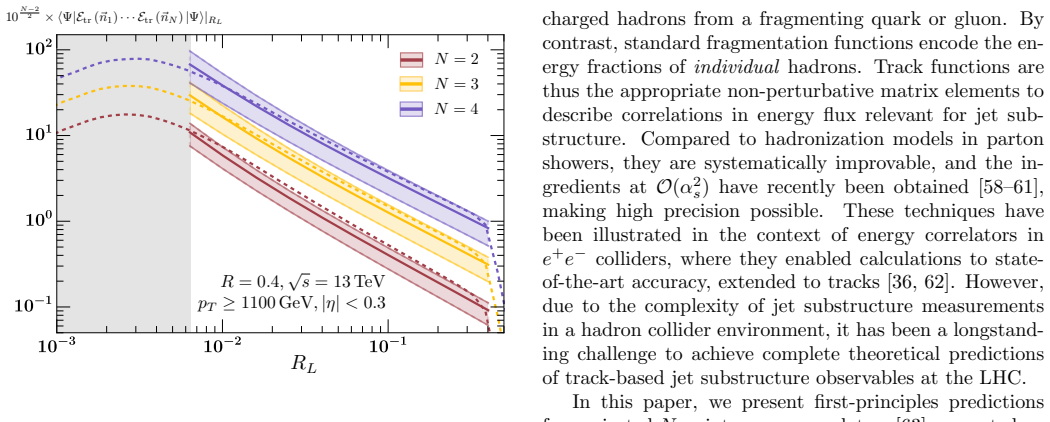
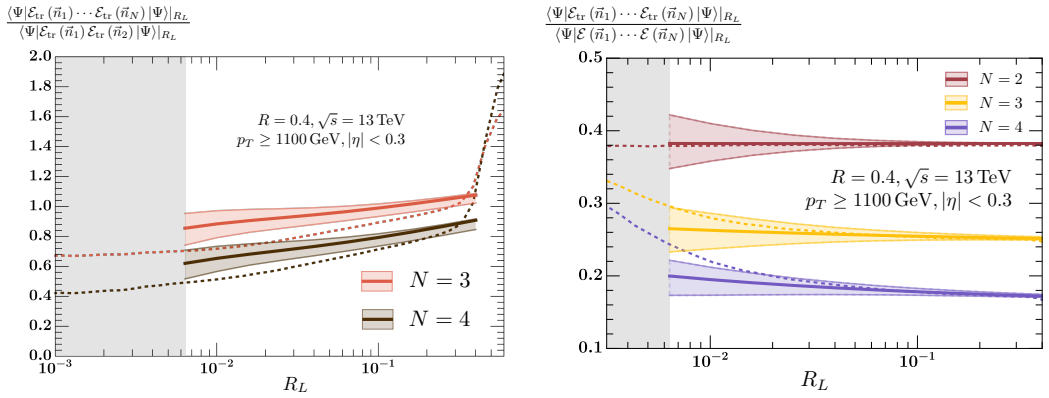
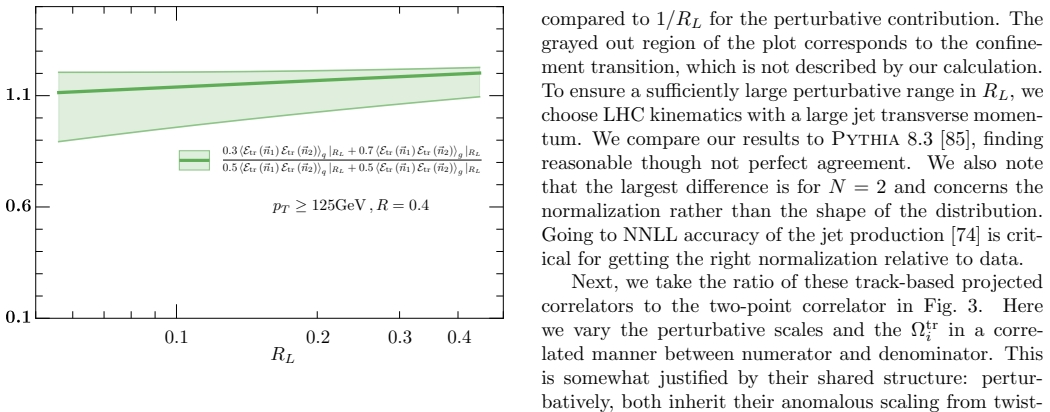
read the original abstract
One of the main advances in analysis strategies at the Large Hadron Collider (LHC) has been the ability to study the detailed structure of energy flow within high transverse momentum jets, a field referred to as jet substructure. Jet substructure has provided new ways to search for new physics, measure Standard Model parameters, and study the dynamics of the strong nuclear force. To push to the next level of precision, and to make measurements of increasingly subtle correlations, requires exquisite angular resolution achieved through the use of tracking information. In this paper we leverage recent progress in our understanding of factorization theorems and renormalization group techniques to present the first complete calculations of jet substructure observables at the LHC on tracks. We compute projected energy correlators up to four points at next-to-leading collinear logarithmic accuracy, matching the state of the art for jet substructure observables, but extending to tracks. This marks a significant step in enhancing the collider physics program, enabling precise and systematically improvable comparisons between experimental measurements and theoretical calculations, made possible by the exceptional angular resolution of tracking.
Editorial analysis
A structured set of objections, weighed in public.
Referee Report
Summary. The manuscript claims to present the first complete calculations of jet substructure observables on tracks by computing projected energy correlators up to four points at next-to-leading collinear logarithmic accuracy, achieved by applying existing factorization theorems and renormalization-group techniques to track-based projections.
Significance. If the central results hold, this work would extend the state of the art for energy correlators from full jets to track observables, enabling systematically improvable theoretical predictions that match the angular resolution of LHC tracking detectors and supporting more precise measurements of jet substructure.
major comments (2)
- [derivation of track projection] The section deriving the track projection (near the discussion of leveraging recent factorization progress): the assertion that existing collinear factorization theorems and RG evolution apply without modification requires an explicit demonstration that the projection operator commutes with the collinear splitting functions and does not generate additional logarithmic enhancements or alter the anomalous dimensions at NLL accuracy; the skeptic concern that track sampling of only charged particles could introduce uncontrolled power corrections or modify the effective jet function is not addressed by a concrete check against known limits.
- [four-point correlator calculation] The calculation of the four-point projected correlator: without an error estimate or validation step showing reduction to the known full-jet result in the limit where track and calorimeter information coincide, the claim of matching NLL accuracy for tracks remains unverified.
minor comments (2)
- [Abstract] The abstract states the accuracy level but does not define the precise projection operator or list the relevant equations; adding a short equation reference would improve clarity.
- [main text] Notation for the track projection operator is introduced without a dedicated equation number in the main text; consistent labeling would aid readability.
Simulated Author's Rebuttal
We thank the referee for their careful reading of the manuscript and for providing constructive comments that will help improve the clarity and rigor of our presentation. We address each of the major comments below.
read point-by-point responses
-
Referee: The section deriving the track projection (near the discussion of leveraging recent factorization progress): the assertion that existing collinear factorization theorems and RG evolution apply without modification requires an explicit demonstration that the projection operator commutes with the collinear splitting functions and does not generate additional logarithmic enhancements or alter the anomalous dimensions at NLL accuracy; the skeptic concern that track sampling of only charged particles could introduce uncontrolled power corrections or modify the effective jet function is not addressed by a concrete check against known limits.
Authors: We agree that an explicit demonstration of the commutation between the track projection operator and the collinear splitting functions would strengthen the manuscript. Although the projection is a linear operator that acts on the energy flow and preserves the leading-power collinear factorization at NLL, we will add a dedicated paragraph or short appendix in the revised version that explicitly verifies this property, shows that no additional logarithmic enhancements are generated, and provides a concrete check in a known limit to address concerns about power corrections from sampling only charged particles. revision: yes
-
Referee: The calculation of the four-point projected correlator: without an error estimate or validation step showing reduction to the known full-jet result in the limit where track and calorimeter information coincide, the claim of matching NLL accuracy for tracks remains unverified.
Authors: The four-point correlator is obtained by applying the same track projection consistently within the existing factorization framework used for lower-point functions. To verify the NLL accuracy, we will include in the revision an explicit validation step, such as taking the limit where the track efficiency approaches one, demonstrating numerical or analytical reduction to the known full-jet result, and providing an associated error estimate. revision: yes
Circularity Check
No significant circularity in derivation chain
full rationale
The paper applies established factorization theorems and RG evolution (developed for full jets) to track projections via an operator, presenting explicit NLL calculations for up to four-point correlators as an extension. No quoted step reduces a prediction to a fitted parameter by construction, renames a known result, or relies on a load-bearing self-citation whose content is itself unverified within the paper. The derivation remains self-contained against external benchmarks.
Axiom & Free-Parameter Ledger
axioms (2)
- domain assumption Factorization theorems separate hard, collinear, and soft contributions for jet substructure observables
- standard math Renormalization-group techniques resum collinear logarithms to NLL accuracy
Reference graph
Works this paper leans on
-
[1]
A. J. Larkoski, I. Moult, B. Nachman, Jet Substructure at the Large Hadron Collider: A Review of Recent Advances in Theory and Machine Learning, Phys. Rept. 841 (2020) 1–63.arXiv: 1709.04464,doi:10.1016/j.physrep.2019.11.001
-
[2]
Kogler, et al., Jet Substructure at the Large Hadron Collider: Experimental Review, Rev
R. Kogler, et al., Jet Substructure at the Large Hadron Collider: Experimental Review, Rev. Mod. Phys. 91 (4) (2019) 045003. arXiv:1803.06991,doi:10.1103/RevModPhys.91.045003
-
[3]
I. Moult, H. X. Zhu, Energy Correlators: A Journey From The- ory to Experiment (6 2025).arXiv:2506.09119
-
[4]
G. F. Sterman, Jet Structure in e+ e- Annihilation with Mass- less Hadrons (12 1975)
1975
-
[5]
N. A. Sveshnikov, F. V. Tkachov, Jets and quantum field theory, Phys. Lett. B 382 (1996) 403–408.arXiv:hep-ph/9512370,doi: 10.1016/0370-2693(96)00558-8
work page internal anchor Pith review Pith/arXiv arXiv doi:10.1016/0370-2693(96)00558-8 1996
-
[6]
F. V. Tkachov, Measuring multi - jet structure of hadronic energy flow or What is a jet?, Int. J. Mod. Phys. A 12 (1997) 5411–5529.arXiv:hep-ph/9601308,doi:10.1142/ S0217751X97002899
work page internal anchor Pith review Pith/arXiv arXiv 1997
-
[7]
G. P. Korchemsky, G. F. Sterman, Power corrections to event shapes and factorization, Nucl. Phys. B 555 (1999) 335–351. arXiv:hep-ph/9902341,doi:10.1016/S0550-3213(99)00308-9
work page internal anchor Pith review Pith/arXiv arXiv doi:10.1016/s0550-3213(99)00308-9 1999
-
[8]
C. L. Basham, L. S. Brown, S. D. Ellis, S. T. Love, Energy Cor- relations in electron-Positron Annihilation in Quantum Chro- modynamics: Asymptotically Free Perturbation Theory, Phys. Rev. D 19 (1979) 2018.doi:10.1103/PhysRevD.19.2018
-
[9]
C. L. Basham, L. S. Brown, S. D. Ellis, S. T. Love, Energy Correlations in Perturbative Quantum Chromodynamics: A Conjecture for All Orders, Phys. Lett. B 85 (1979) 297–299. doi:10.1016/0370-2693(79)90601-4
-
[10]
C. L. Basham, L. S. Brown, S. D. Ellis, S. T. Love, Electron - Positron Annihilation Energy Pattern in Quantum Chromody- namics: Asymptotically Free Perturbation Theory, Phys. Rev. D 17 (1978) 2298.doi:10.1103/PhysRevD.17.2298
-
[12]
P. T. Komiske, I. Moult, J. Thaler, H. X. Zhu, Analyzing N- Point Energy Correlators inside Jets with CMS Open Data, Phys. Rev. Lett. 130 (5) (2023) 051901.arXiv:2201.07800, doi:10.1103/PhysRevLett.130.051901
- [13]
- [14]
-
[15]
A. Hayrapetyan, et al., Measurement of Energy Correlators in- side Jets and Determination of the Strong CouplingαS(mZ), Phys. Rev. Lett. 133 (7) (2024) 071903.arXiv:2402.13864, doi:10.1103/PhysRevLett.133.071903. 5
-
[16]
Energy-energy correlators in p-Pb collisions at $\sqrt{s_{\rm NN}} = 5.02$ TeV
D. Ali Hassan Abdallah, et al., Energy-energy correlators in p- Pb collisions at √sNN = 5.02 TeV (6 2026).arXiv:2606.18143
work page internal anchor Pith review Pith/arXiv arXiv 2026
-
[17]
D. A. H. Abdallah, et al., Probing jet evolution with charged energy correlators in small systems (6 2026).arXiv:2606.18093
work page internal anchor Pith review Pith/arXiv arXiv 2026
-
[18]
V. Chekhovsky, et al., Observation of nuclear modification of energy-energy correlators inside jets in heavy ion collisions, Phys. Lett. B 866 (2025) 139556.arXiv:2503.19993,doi: 10.1016/j.physletb.2025.139556
-
[19]
Energy Correlators Within Jets in Transversely Polarized Proton-Proton Collisions at √s= 200 GeV (4 2026).arXiv: 2604.15543
work page internal anchor Pith review Pith/arXiv arXiv 2026
-
[20]
H. Chen, M.-X. Luo, I. Moult, T.-Z. Yang, X. Zhang, H. X. Zhu, Three point energy correlators in the collinear limit: sym- metries, dualities and analytic results, JHEP 08 (08) (2020) 028. arXiv:1912.11050,doi:10.1007/JHEP08(2020)028
-
[21]
H. Chen, I. Moult, J. Thaler, H. X. Zhu, Non-Gaussianities in collider energy flux, JHEP 07 (2022) 146.arXiv:2205.02857, doi:10.1007/JHEP07(2022)146
-
[22]
H. Bossi, A. S. Kudinoor, I. Moult, D. Pablos, A. Rai, K. Ra- jagopal, Imaging the wakes of jets with energy-energy-energy correlators, JHEP 12 (2024) 073.arXiv:2407.13818,doi: 10.1007/JHEP12(2024)073
- [23]
- [24]
-
[25]
C.-H. Chang, H. Chen, X. Liu, D. Simmons-Duffin, F. Yuan, H. X. Zhu, Quantum Scaling in Energy Correlators beyond the Confinement Transition, Phys. Rev. Lett. 136 (8) (2026) 081903. arXiv:2507.15923,doi:10.1103/9ml8-xkfc
-
[26]
E. Herrmann, Z.-B. Kang, J. Penttala, C. Zhang, Collinear limit of the energy-energy correlator ine +e− collisions: transition from perturbative to non-perturbative regimes (7 2025).arXiv: 2507.17704
-
[27]
J. Barata, P. Caucal, A. Soto-Ontoso, R. Szafron, Advanc- ing the understanding of energy-energy correlators in heavy- ion collisions, JHEP 11 (2024) 060.arXiv:2312.12527,doi: 10.1007/JHEP11(2024)060
-
[28]
C. Andres, F. Dominguez, J. Holguin, C. Marquet, I. Moult, Seeing beauty in the quark-gluon plasma with energy correla- tors, Phys. Rev. D 110 (3) (2024) L031503.arXiv:2307.15110, doi:10.1103/PhysRevD.110.L031503
- [29]
-
[30]
Z. Yang, Y. He, I. Moult, X.-N. Wang, Probing the Short- Distance Structure of the Quark-Gluon Plasma with Energy Correlators, Phys. Rev. Lett. 132 (1) (2024) 011901.arXiv: 2310.01500,doi:10.1103/PhysRevLett.132.011901
-
[31]
C. Andres, F. Dominguez, J. Holguin, C. Marquet, I. Moult, Simple Scaling Laws for Energy Correlators in Nuclear Matter, Phys. Rev. Lett. 136 (12) (2026) 122301.arXiv:2411.15298, doi:10.1103/sw7p-7jbp
-
[32]
C. Andres, F. Dominguez, J. Holguin, C. Marquet, I. Moult, Towards an interpretation of the first measurements of energy correlators in the quark-gluon plasma, JHEP 03 (2025) 166. arXiv:2407.07936,doi:10.1007/JHEP03(2025)166
-
[33]
J. Holguin, I. Moult, A. Pathak, M. Procura, New paradigm for precision top physics: Weighing the top with energy correlators, Phys. Rev. D 107 (11) (2023) 114002.arXiv:2201.08393,doi: 10.1103/PhysRevD.107.114002
-
[34]
J. Holguin, I. Moult, A. Pathak, M. Procura, R. Sch¨ ofbeck, D. Schwarz, Top quark mass extractions from energy correla- tors: a feasibility study, JHEP 04 (2025) 072.arXiv:2407. 12900,doi:10.1007/JHEP04(2025)072
-
[35]
J. Holguin, I. Moult, A. Pathak, M. Procura, R. Sch¨ ofbeck, D. Schwarz, Using the W Boson as a Standard Candle to Reach the Top: Calibrating Energy-Correlator-Based Top Mass Mea- surements, Phys. Rev. Lett. 134 (23) (2025) 231903.arXiv: 2311.02157,doi:10.1103/j4sp-fcmd
-
[36]
H. Bossi, et al., Energy Correlators from Partons to Hadrons: Unveiling the Dynamics of the Strong Interactions with Archival ALEPH Data (10 2025).arXiv:2511.00149
-
[37]
H. Bossi, Y.-C. Chen, Y. Chen, J. Zhang, G. M. Innocenti, A. Badea, A. Baty, M. Maggi, C. McGinn, Y.-J. Lee, Anal- ysis note: measurement of energy-energy correlator ine +e− collisions at 91 GeV with archived ALEPH data (5 2025). arXiv:2505.11828
-
[38]
Zhang, T.-A
J. Zhang, T.-A. Sheng, Y.-C. Chen, H. Bossi, A. Badea, A. Baty, C. McGinn, Y.-J. Lee, Y. Chen, Analysis note: measurement of thrust and track energy-energy correlator ine +e− collisions at 91.2 GeV with DELPHI open data (10 2025).arXiv:2510. 18762
2025
-
[39]
S. Acharya, et al., Exposing the parton-hadron transition within jets with energy-energy correlators in pp collisions at √s= 5.02 TeV (9 2024).arXiv:2409.12687
-
[40]
S. Acharya, et al., Energy-energy correlators in charm-tagged jets in proton-proton collisions at√s=13TeV (4 2025).arXiv: 2504.03431
-
[41]
B. E. Aboona, et al., Measurement of Two-Point Energy Cor- relators within Jets in p+p Collisions at s=200 GeV, Phys. Rev. Lett. 135 (11) (2025) 111901.arXiv:2502.15925,doi: 10.1103/wv2t-dkgn
-
[42]
J. C. Collins, G. F. Sterman, Soft Partons in QCD, Nucl. Phys. B 185 (1981) 172–188.doi:10.1016/0550-3213(81)90370-9
-
[43]
G. T. Bodwin, Factorization of the Drell-Yan Cross-Section in Perturbation Theory, Phys. Rev. D 31 (1985) 2616, [Erratum: Phys.Rev.D 34, 3932 (1986)].doi:10.1103/PhysRevD.34.3932
-
[44]
J. C. Collins, D. E. Soper, G. F. Sterman, Factorization for Short Distance Hadron - Hadron Scattering, Nucl. Phys. B 261 (1985) 104–142.doi:10.1016/0550-3213(85)90565-6
-
[45]
J. C. Collins, D. E. Soper, G. F. Sterman, Soft Gluons and Factorization, Nucl. Phys. B 308 (1988) 833–856.doi:10.1016/ 0550-3213(88)90130-7
1988
-
[46]
J. C. Collins, D. E. Soper, G. F. Sterman, Factorization of Hard Processes in QCD, Adv. Ser. Direct. High Energy Phys. 5 (1989) 1–91.arXiv:hep-ph/0409313,doi:10.1142/9789814503266_ 0001
work page internal anchor Pith review Pith/arXiv arXiv doi:10.1142/9789814503266_ 1989
-
[47]
Collins, Foundations of Perturbative QCD, Vol
J. Collins, Foundations of Perturbative QCD, Vol. 32, Cam- bridge University Press, 2011.doi:10.1017/9781009401845
-
[48]
G. C. Nayak, J.-W. Qiu, G. F. Sterman, Fragmentation, NRQCD and NNLO factorization analysis in heavy quarko- nium production, Phys. Rev. D 72 (2005) 114012.arXiv: hep-ph/0509021,doi:10.1103/PhysRevD.72.114012
work page internal anchor Pith review Pith/arXiv arXiv doi:10.1103/physrevd.72.114012 2005
-
[49]
C. W. Bauer, S. Fleming, M. E. Luke, Summing Sudakov log- arithms inB→X sγin effective field theory., Phys. Rev. D 63 (2000) 014006.arXiv:hep-ph/0005275,doi:10.1103/ PhysRevD.63.014006
work page internal anchor Pith review Pith/arXiv arXiv 2000
-
[50]
C. W. Bauer, S. Fleming, D. Pirjol, I. W. Stewart, An Effective field theory for collinear and soft gluons: Heavy to light decays, Phys. Rev. D 63 (2001) 114020.arXiv:hep-ph/0011336,doi: 10.1103/PhysRevD.63.114020
work page internal anchor Pith review Pith/arXiv arXiv doi:10.1103/physrevd.63.114020 2001
-
[51]
C. W. Bauer, I. W. Stewart, Invariant operators in collinear effective theory, Phys. Lett. B 516 (2001) 134–142.arXiv: hep-ph/0107001,doi:10.1016/S0370-2693(01)00902-9
work page internal anchor Pith review Pith/arXiv arXiv doi:10.1016/s0370-2693(01)00902-9 2001
-
[52]
C. W. Bauer, D. Pirjol, I. W. Stewart, Soft collinear factoriza- tion in effective field theory, Phys. Rev. D 65 (2002) 054022. arXiv:hep-ph/0109045,doi:10.1103/PhysRevD.65.054022
work page internal anchor Pith review Pith/arXiv arXiv doi:10.1103/physrevd.65.054022 2002
-
[53]
C. W. Bauer, S. Fleming, D. Pirjol, I. Z. Rothstein, I. W. Stewart, Hard scattering factorization from effective field the- ory, Phys. Rev. D 66 (2002) 014017.arXiv:hep-ph/0202088, doi:10.1103/PhysRevD.66.014017
work page internal anchor Pith review Pith/arXiv arXiv doi:10.1103/physrevd.66.014017 2002
-
[54]
Soft-collinear effective theory and heavy-to-light currents beyond leading power
M. Beneke, A. P. Chapovsky, M. Diehl, T. Feldmann, Soft collinear effective theory and heavy to light currents beyond leading power, Nucl. Phys. B 643 (2002) 431–476.arXiv: hep-ph/0206152,doi:10.1016/S0550-3213(02)00687-9
work page internal anchor Pith review Pith/arXiv arXiv doi:10.1016/s0550-3213(02)00687-9 2002
-
[55]
I. Z. Rothstein, I. W. Stewart, An Effective Field Theory for Forward Scattering and Factorization Violation, JHEP 08 6 (2016) 025.arXiv:1601.04695,doi:10.1007/JHEP08(2016)025
-
[56]
Calculating Track-Based Observables for the LHC
H.-M. Chang, M. Procura, J. Thaler, W. J. Waalewijn, Cal- culating Track-Based Observables for the LHC, Phys. Rev. Lett. 111 (2013) 102002.arXiv:1303.6637,doi:10.1103/ PhysRevLett.111.102002
work page internal anchor Pith review Pith/arXiv arXiv 2013
-
[57]
Calculating Track Thrust with Track Functions
H.-M. Chang, M. Procura, J. Thaler, W. J. Waalewijn, Cal- culating Track Thrust with Track Functions, Phys. Rev. D 88 (2013) 034030.arXiv:1306.6630,doi:10.1103/PhysRevD.88. 034030
work page internal anchor Pith review Pith/arXiv arXiv doi:10.1103/physrevd.88 2013
- [58]
-
[59]
Y. Li, I. Moult, S. S. van Velzen, W. J. Waalewijn, H. X. Zhu, Extending Precision Perturbative QCD with Track Functions, Phys. Rev. Lett. 128 (18) (2022) 182001.arXiv:2108.01674, doi:10.1103/PhysRevLett.128.182001
-
[60]
M. Jaarsma, Y. Li, I. Moult, W. Waalewijn, H. X. Zhu, Renor- malization group flows for track function moments, JHEP 06 (2022) 139.arXiv:2201.05166,doi:10.1007/JHEP06(2022)139
-
[61]
H. Chen, M. Jaarsma, Y. Li, I. Moult, W. J. Waalewijn, H. X. Zhu, Collinear parton dynamics beyond Dokshitzer-Gribov- Lipatov-Altarelli-Parisi framework, Phys. Rev. D 111 (7) (2025) 076021.arXiv:2210.10061,doi:10.1103/PhysRevD. 111.076021
-
[62]
M. Jaarsma, Y. Li, I. Moult, W. J. Waalewijn, H. X. Zhu, From DGLAP to Sudakov: Precision Predictions for Energy-Energy Correlators (12 2025).arXiv:2512.11950
-
[63]
H. Chen, I. Moult, X. Zhang, H. X. Zhu, Rethinking jets with energy correlators: Tracks, resummation, and analytic continu- ation, Phys. Rev. D 102 (5) (2020) 054012.arXiv:2004.11381, doi:10.1103/PhysRevD.102.054012
-
[64]
M. Jaarsma, Y. Li, I. Moult, W. J. Waalewijn, H. X. Zhu, En- ergy correlators on tracks: resummation and non-perturbative effects, JHEP 12 (2023) 087.arXiv:2307.15739,doi:10.1007/ JHEP12(2023)087
- [65]
-
[66]
K. Lee, I. Moult, Joint Track Functions: Expanding the Space of Calculable Correlations at Colliders (8 2023).arXiv:2308. 01332
2023
-
[67]
S. T. Schindler, I. W. Stewart, Z. Sun, Renormalons in the energy-energy correlator, JHEP 10 (2023) 187, [Erratum: JHEP 10, 175 (2024)].arXiv:2305.19311,doi:10.1007/JHEP10(2023) 187
-
[68]
H. Chen, P. F. Monni, Z. Xu, H. X. Zhu, Scaling Violation in Power Corrections to Energy Correlators from the Light- Ray Operator Product Expansion, Phys. Rev. Lett. 133 (23) (2024) 231901.arXiv:2406.06668,doi:10.1103/PhysRevLett. 133.231901
- [69]
-
[70]
A. Budhraja, I. Pels, W. J. Waalewijn, Higher-point Energy Correlators: Factorization in the Back-to-Back Limit & Non- perturbative Effects (3 2026).arXiv:2603.16996
-
[71]
M. van Beekveld, M. Dasgupta, B. K. El-Menoufi, J. Helliwell, A. Karlberg, P. F. Monni, Two-loop anomalous dimensions for small-R jet versus hadronic fragmentation functions, JHEP 07 (2024) 239.arXiv:2402.05170,doi:10.1007/JHEP07(2024)239
-
[72]
K. Lee, I. Moult, X. Zhang, Revisiting single inclusive jet pro- duction: timelike factorization and reciprocity, JHEP 05 (2025) 129.arXiv:2409.19045,doi:10.1007/JHEP05(2025)129
- [73]
-
[74]
T. Generet, K. Lee, I. Moult, R. Poncelet, X. Zhang, Small radius inclusive jet production at the LHC through NNLO+NNLL, JHEP 08 (2025) 015.arXiv:2503.21866,doi: 10.1007/JHEP08(2025)015
-
[75]
L. J. Dixon, I. Moult, H. X. Zhu, Collinear limit of the energy- energy correlator, Phys. Rev. D 100 (1) (2019) 014009.arXiv: 1905.01310,doi:10.1103/PhysRevD.100.014009
work page internal anchor Pith review Pith/arXiv arXiv doi:10.1103/physrevd.100.014009 2019
-
[76]
K. Lee, B. Me¸ caj, I. Moult, Conformal collider physics meets LHC data, Phys. Rev. D 111 (1) (2025) L011502.arXiv:2205. 03414,doi:10.1103/PhysRevD.111.L011502
-
[77]
Aversa, M
F. Aversa, M. Greco, P. Chiappetta, J. P. Guillet, HIGHER ORDER CORRECTIONS TO QCD JETS: GLUON-GLUON PROCESSES, Phys. Lett. B 211 (1988) 465.doi:10.1016/ 0370-2693(88)91894-1
1988
-
[78]
F. Aversa, P. Chiappetta, M. Greco, J. P. Guillet, Higher Order Corrections to QCD Jets, Phys. Lett. B 210 (1988) 225.doi: 10.1016/0370-2693(88)90377-2
-
[79]
F. Aversa, P. Chiappetta, M. Greco, J. P. Guillet, QCD Cor- rections to Parton-Parton Scattering Processes, Nucl. Phys. B 327 (1989) 105.doi:10.1016/0550-3213(89)90288-5
-
[80]
F. Aversa, M. Greco, P. Chiappetta, J. P. Guillet, Jet Produc- tion in Hadronic Collisions to O (α −s3), Z. Phys. C 46 (1990) 253.doi:10.1007/BF01556000
-
[81]
F. Aversa, M. Greco, P. Chiappetta, J. P. Guillet, Jet inclusive production to O (alpha−s 3) : Comparison with data, Phys. Rev. Lett. 65 (1990) 401–403.doi:10.1103/PhysRevLett.65. 401
discussion (0)
Sign in with ORCID, Apple, or X to comment. Anyone can read and Pith papers without signing in.