The evolution of high-z proto-star clusters into local globular clusters
Pith reviewed 2026-07-02 17:50 UTC · model grok-4.3
The pith
Simulations show high-redshift JWST clumps can evolve into local globular clusters if they contain multiple stellar populations.
A machine-rendered reading of the paper's core claim, the machinery that carries it, and where it could break.
Core claim
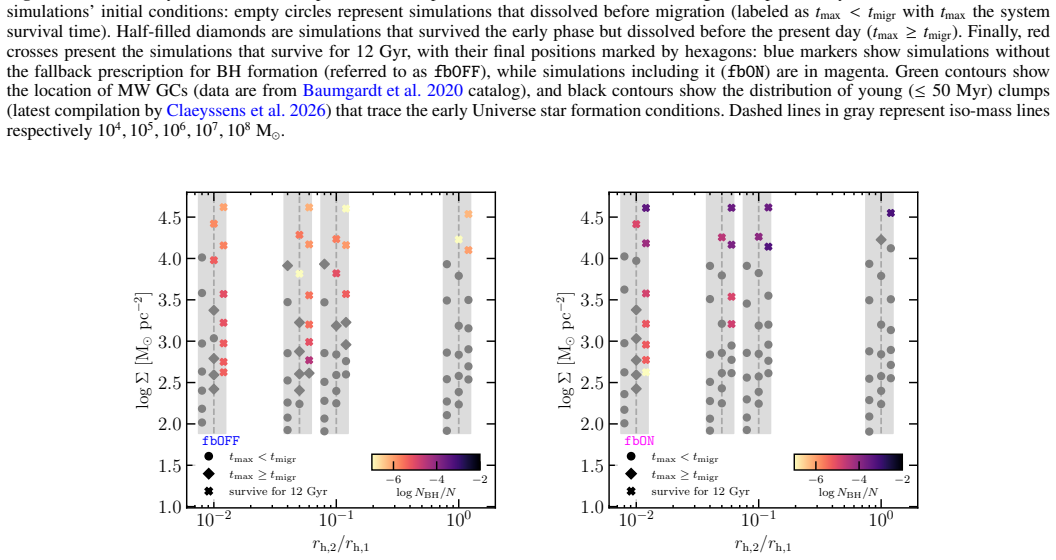
Systems hosting multiple populations are more likely to endure the early strong tidal field than single-population clusters. After 12 Gyr, such systems have properties consistent with those of Galactic GCs. Our work confirms that the high-z clumps observed by JWST can be the progenitors of the local GCs. A population of stellar-mass BHs within a proto-star cluster favors its disruption, but surviving systems can retain a sizable population of BHs.
What carries the argument
N-body simulations of proto-star cluster evolution that include stellar interactions, stellar evolution, multiple stellar populations, stellar-mass black holes, and a time-dependent cosmological tidal field.
Load-bearing premise
The initial conditions chosen for the proto-star clusters and the modeled physical processes accurately represent real high-z systems.
What would settle it
Finding that observed high-z clumps have initial masses, sizes, or metallicities outside the simulated range and that no combination of multiple populations and black-hole retention reproduces the present-day Galactic globular-cluster population.
Figures

read the original abstract
The James Webb Space Telescope (JWST) detected numerous massive and relatively compact stellar clumps around proto-galaxies at high redshift (z>0.5). Their properties suggest that these systems may represent proto-globular clusters (GCs), but their possible connection to local old GCs is poorly understood. In this Letter, we explore the dynamical evolution of proto-star clusters, building the missing evolutionary link between high-z systems observed by JWST and local GCs. Our simulations include the effects of stellar interactions, stellar evolution, and the strong time-dependent cosmological tidal field in which these proto-star clusters evolve. We also explore the role of multiple stellar populations and stellar-mass black holes (BHs), two fundamental ingredients in stellar cluster dynamics. We show that systems hosting multiple populations (as routinely observed in local GCs) are more likely to endure the early strong tidal field than single-population clusters. In addition, after 12 Gyr, such systems have properties consistent with those of Galactic GCs. Our work confirms that the high-z clumps observed by JWST can be the progenitors of the local GCs. Finally, we show that a population of stellar-mass BHs within a proto-star cluster favors its disruption, but that surviving systems can retain a sizable population of BHs.
Editorial analysis
A structured set of objections, weighed in public.
Referee Report
Summary. The manuscript presents N-body simulations (using NBODY6++GPU with added tidal field and stellar evolution) of high-redshift proto-star clusters. It incorporates stellar interactions, evolution, a time-dependent cosmological tidal field, multiple stellar populations, and stellar-mass black holes. The central result is that multiple-population systems survive the early strong tidal field better than single-population ones and, after 12 Gyr of evolution, exhibit structural and dynamical properties consistent with local Galactic globular clusters. The work concludes that JWST-observed high-z clumps can be the progenitors of present-day GCs, while stellar-mass BHs increase disruption risk but can be retained in survivors.
Significance. If the initial conditions are representative of JWST clumps, this provides a forward dynamical link between high-redshift stellar clumps and local GCs, highlighting the protective role of multiple populations against tidal disruption. The inclusion of BH dynamics and the time-dependent tidal field are strengths, as is the use of unreduced forward simulations rather than parameter fitting. This could inform interpretations of JWST data on early cluster formation.
major comments (1)
- [Section 2] Section 2: No table, figure, or quantitative comparison is provided that overlays the simulated initial conditions (masses, half-mass radii, densities, IMF, binary fractions) against the observed JWST high-z clump catalog at z>6. The survival of multiple-population systems and BH retention are reported as outcomes, but without demonstrating that the chosen starting parameters are typical (rather than systematically denser or more massive than the median observed clump), these results cannot be shown to be generic rather than artifacts of the specific initial setup.
minor comments (2)
- [Abstract] Abstract: The detection redshift is given as z>0.5 while the progenitor claim focuses on z>6 clumps; the specific redshifts and lookback times adopted for the simulations should be stated explicitly for clarity.
- The description of the time-dependent cosmological tidal field implementation would benefit from a brief statement of how the field strength evolves with redshift to allow readers to assess its fidelity.
Simulated Author's Rebuttal
We thank the referee for their constructive review. The single major comment is addressed below; we agree it identifies a gap and will revise accordingly.
read point-by-point responses
-
Referee: [Section 2] Section 2: No table, figure, or quantitative comparison is provided that overlays the simulated initial conditions (masses, half-mass radii, densities, IMF, binary fractions) against the observed JWST high-z clump catalog at z>6. The survival of multiple-population systems and BH retention are reported as outcomes, but without demonstrating that the chosen starting parameters are typical (rather than systematically denser or more massive than the median observed clump), these results cannot be shown to be generic rather than artifacts of the specific initial setup.
Authors: We agree that an explicit quantitative comparison would strengthen the claim that our results are generic. Our initial conditions (masses ~10^5-10^6 M⊙, half-mass radii ~3-10 pc, central densities ~10^3-10^5 M⊙ pc^{-3}) were selected to lie within the ranges reported for JWST z>6 clumps in the literature. However, the manuscript does not overlay these values against the observed catalog medians or distributions, nor does it tabulate IMF or binary-fraction choices against high-z constraints. In revision we will add a table (or figure) in Section 2 that directly compares our fiducial and explored initial parameters to the median and 16-84 percentile ranges from published JWST clump catalogs at z>6. This addition will demonstrate that the chosen setups are representative rather than systematically extreme, thereby supporting the generality of the multiple-population survival and BH-retention results. revision: yes
Circularity Check
No significant circularity; forward N-body evolution from stated initial conditions.
full rationale
The paper performs direct N-body integrations (NBODY6++GPU with added cosmological tidal field and stellar evolution) starting from chosen initial masses, radii, densities, IMF, binary fractions, and multiple-population setups. The reported outcomes—survival rates, final structural parameters after 12 Gyr, and BH retention—are direct numerical results of those integrations rather than quantities fitted to the target JWST or Galactic GC data and then relabeled as predictions. No self-definitional loop, fitted-input-called-prediction, or load-bearing self-citation chain appears in the abstract or described methodology; the central claim rests on the independent dynamical evolution under the stated physics.
Axiom & Free-Parameter Ledger
Reference graph
Works this paper leans on
-
[1]
Production of intermediate-mass black holes in globular clusters. , keywords =. doi:10.1046/j.1365-8711.2002.05112.x , archivePrefix =. astro-ph/0106188 , primaryClass =
-
[2]
The runaway growth of intermediate-mass black holes in dense star clusters
The Runaway Growth of Intermediate-Mass Black Holes in Dense Star Clusters. , keywords =. doi:10.1086/341798 , archivePrefix =. astro-ph/0201055 , primaryClass =
work page internal anchor Pith review Pith/arXiv arXiv doi:10.1086/341798
-
[3]
A rapid channel for the collisional formation and gravitational wave-driven mergers of supermassive black hole seeds at high redshift. , keywords =. doi:10.1093/mnrasl/slaf064 , archivePrefix =. 2503.21879 , primaryClass =
-
[4]
FROST-CLUSTERS -- III. Metallicity-dependent intermediate mass black hole formation by runaway collisions in dense star clusters. arXiv e-prints , keywords =. doi:10.48550/arXiv.2601.07917 , archivePrefix =. 2601.07917 , primaryClass =
-
[5]
The formation, evolution, and disruption of star clusters with improved gravitational dynamics in simulated dwarf galaxies. , keywords =. doi:10.1093/mnras/staf350 , archivePrefix =. 2410.01891 , primaryClass =
-
[6]
Great balls of FIRE II: The evolution and destruction of star clusters across cosmic time in a Milky Way-mass galaxy. , keywords =. doi:10.1093/mnras/stad578 , archivePrefix =. 2203.16547 , primaryClass =
-
[7]
Star cluster formation in cosmological simulations. III. Dynamical and chemical evolution
Star cluster formation in cosmological simulations - III. Dynamical and chemical evolution. , keywords =. doi:10.1093/mnras/stz1114 , archivePrefix =. 1810.11036 , primaryClass =
work page internal anchor Pith review Pith/arXiv arXiv doi:10.1093/mnras/stz1114
-
[8]
Thirty systems with space-based light curves
Evolution of star clusters in arbitrary tidal fields. , keywords =. doi:10.1111/j.1365-2966.2011.19531.x , archivePrefix =. 1107.5820 , primaryClass =
-
[9]
A Systematic Analysis of Star Cluster Disruption by Tidal Shocks. II. Predicting Star Cluster Dissolution Rates from a Time-series Analysis of Their Tidal Histories. , keywords =. doi:10.3847/1538-4357/ad7a7b , archivePrefix =. 2410.16389 , primaryClass =
-
[10]
doi:10.1046/j.1365-8711.2003.06653.x , eprint =
Dynamical evolution of star clusters in tidal fields. , keywords =. doi:10.1046/j.1365-8711.2003.06286.x , archivePrefix =. astro-ph/0211471 , primaryClass =
-
[11]
Evolution of star clusters on eccentric orbits
Evolution of star clusters on eccentric orbits. , keywords =. doi:10.1093/mnras/stv2325 , archivePrefix =. 1510.01337 , primaryClass =
work page internal anchor Pith review Pith/arXiv arXiv doi:10.1093/mnras/stv2325
-
[12]
The milky way total mass profile as inferred from Gaia DR2. , keywords =. doi:10.1093/mnras/staa1017 , archivePrefix =. 1911.04557 , primaryClass =
-
[13]
The E-MOSAICS project: simulating the formation and co-evolution of galaxies and their star cluster populations. , keywords =. doi:10.1093/mnras/stx3124 , archivePrefix =. 1712.00019 , primaryClass =
work page internal anchor Pith review Pith/arXiv arXiv doi:10.1093/mnras/stx3124
-
[14]
10, held in Cambridge, England, August 12-15, 1970.)
Monte Carlo Models of Star Clusters (Part of the Proceedings of the IAU Colloquium No. 10, held in Cambridge, England, August 12-15, 1970.). , year = 1971, month = oct, volume =. doi:10.1007/BF00649159 , adsurl =
-
[15]
10 Gravitational N-Body Problem (ed
The Monte Carlo Method (Papers appear in the Proceedings of IAU Colloquium No. 10 Gravitational N-Body Problem (ed. by Myron Lecar), R. Reidel Publ. Co. , Dordrecht-Holland.). , year = 1971, month = nov, volume =. doi:10.1007/BF00649201 , adsurl =
-
[16]
MOCCA code for star cluster simulations - I. Blue Stragglers, first results
MOCCA code for star cluster simulations - I. Blue stragglers, first results. , keywords =. doi:10.1093/mnras/sts415 , archivePrefix =. 1207.6700 , primaryClass =
work page internal anchor Pith review Pith/arXiv arXiv doi:10.1093/mnras/sts415
-
[17]
A Comprehensive Study of Binary Compact Objects as Gravitational Wave Sources: Evolutionary Channels, Rates, and Physical Properties. , keywords =. doi:10.1086/340304 , archivePrefix =. astro-ph/0111452 , primaryClass =
work page internal anchor Pith review Pith/arXiv arXiv doi:10.1086/340304
-
[18]
Comprehensive analytic formulae for stellar evolution as a function of mass and metallicity. , keywords =. doi:10.1046/j.1365-8711.2000.03426.x , archivePrefix =. astro-ph/0001295 , primaryClass =
-
[19]
Evolution of binary stars and the effect of tides on binary populations. , keywords =. doi:10.1046/j.1365-8711.2002.05038.x , archivePrefix =. astro-ph/0201220 , primaryClass =
-
[20]
The time-scale of escape from star clusters. , keywords =. doi:10.1046/j.1365-8711.2000.03811.x , archivePrefix =. astro-ph/9910468 , primaryClass =
-
[21]
Absolute V-band magnitudes and mass-to-light ratios of Galactic globular clusters. , keywords =. doi:10.1017/pasa.2020.38 , archivePrefix =. 2009.09611 , primaryClass =
-
[22]
Star formation at the smallest scales: a JWST study of the clump populations in SMACS0723. , keywords =. doi:10.1093/mnras/stac3791 , archivePrefix =. 2208.10450 , primaryClass =
-
[23]
A first GLIMPSE into star clusters populations across cosmic time. arXiv e-prints , keywords =. doi:10.48550/arXiv.2601.16281 , archivePrefix =. 2601.16281 , primaryClass =
-
[24]
A statistical study of 233 pulsar proper motions. , keywords =. doi:10.1111/j.1365-2966.2005.09087.x , archivePrefix =. astro-ph/0504584 , primaryClass =
-
[25]
Stellar collisions during binary-binary and binary-single star interactions. , keywords =. doi:10.1111/j.1365-2966.2004.07914.x , archivePrefix =. astro-ph/0401004 , primaryClass =
-
[26]
Spatially Resolved Physical Properties of Young Star Clusters and Star-forming Clumps in the Brightest z>6 Galaxy, the Strongly Lensed Cosmic Spear at z=6.2. arXiv e-prints , keywords =. doi:10.48550/arXiv.2512.08054 , archivePrefix =. 2512.08054 , primaryClass =
-
[27]
The Sparkler: Evolved High-redshift Globular Cluster Candidates Captured by JWST. , keywords =. doi:10.3847/2041-8213/ac90ca , archivePrefix =. 2208.02233 , primaryClass =
-
[28]
Formation of a low-mass galaxy from star clusters in a 600-million-year-old Universe. , keywords =. doi:10.1038/s41586-024-08293-0 , archivePrefix =. 2402.08696 , primaryClass =
-
[29]
Early Results from GLASS-JWST. VII. Evidence for Lensed, Gravitationally Bound Protoglobular Clusters at z = 4 in the Hubble Frontier Field A2744. , keywords =. doi:10.3847/2041-8213/ac8c2d , archivePrefix =. 2208.00520 , primaryClass =
-
[30]
JWST/NIRCam Probes Young Star Clusters in the Reionization Era Sunrise Arc. , keywords =. doi:10.3847/1538-4357/acb59a , archivePrefix =. 2211.09839 , primaryClass =
-
[31]
JWST spectroscopic confirmation of the Cosmic Gems arc at z = 9.625: Insights into the small-scale structure of a post-burst system. , keywords =. doi:10.1051/0004-6361/202556574 , archivePrefix =. 2507.18705 , primaryClass =
-
[32]
Bound star clusters observed in a lensed galaxy 460 Myr after the Big Bang. , keywords =. doi:10.1038/s41586-024-07703-7 , archivePrefix =. 2401.03224 , primaryClass =
-
[33]
The structure of star clusters. III. Some simple dynamical models. , year = 1966, month = feb, volume =. doi:10.1086/109857 , adsurl =
-
[34]
On the variation of the initial mass function. , keywords =. doi:10.1046/j.1365-8711.2001.04022.x , archivePrefix =. astro-ph/0009005 , primaryClass =
-
[35]
The Hubble Space Telescope UV Legacy Survey of Galactic Globular Clusters. I. Overview of the Project and Detection of Multiple Stellar Populations. , keywords =. doi:10.1088/0004-6256/149/3/91 , archivePrefix =. 1410.4564 , primaryClass =
work page internal anchor Pith review Pith/arXiv arXiv doi:10.1088/0004-6256/149/3/91
-
[36]
The Hubble Space Telescope UV Legacy Survey of Galactic globular clusters - IX. The Atlas of multiple stellar populations. , keywords =. doi:10.1093/mnras/stw2531 , archivePrefix =. 1610.00451 , primaryClass =
work page internal anchor Pith review Pith/arXiv arXiv doi:10.1093/mnras/stw2531
-
[37]
Multiple Stellar Populations in Globular Clusters
Multiple Stellar Populations in Globular Clusters. , keywords =. doi:10.1146/annurev-astro-081817-051839 , archivePrefix =. 1712.01286 , primaryClass =
work page internal anchor Pith review Pith/arXiv arXiv doi:10.1146/annurev-astro-081817-051839
-
[38]
What is a globular cluster? An observational perspective. , keywords =. doi:10.1007/s00159-019-0119-3 , archivePrefix =. 1911.02835 , primaryClass =
-
[39]
A Family Picture: Tracing the Dynamical Path of the Structural Properties of Multiple Populations in Globular Clusters. , keywords =. doi:10.3847/2041-8213/ab45f7 , archivePrefix =. 1910.00613 , primaryClass =
-
[40]
A 3D view of multiple populations' kinematics in Galactic globular clusters. , keywords =. doi:10.1051/0004-6361/202451054 , archivePrefix =. 2409.03827 , primaryClass =
-
[41]
Formation of second-generation stars in globular clusters. , keywords =. doi:10.1093/mnras/stz2055 , archivePrefix =. 1906.09137 , primaryClass =
-
[42]
Formation and dynamical evolution of multiple stellar generations in globular clusters. , keywords =. doi:10.1111/j.1365-2966.2008.13915.x , archivePrefix =. 0809.1438 , primaryClass =
-
[43]
Rotation and multiple stellar population in globular clusters
Rotation and Multiple Stellar Population in Globular Clusters. , keywords =. doi:10.1088/2041-8205/724/1/L99 , archivePrefix =. 1010.3841 , primaryClass =
work page internal anchor Pith review Pith/arXiv arXiv doi:10.1088/2041-8205/724/1/l99 2041
-
[44]
The role of rotation on the formation of second generation stars in globular clusters. , keywords =. doi:10.1093/mnras/stac2328 , archivePrefix =. 2209.05178 , primaryClass =
-
[45]
Binary Black Hole Mergers from Globular Clusters: Implications for Advanced LIGO
Binary Black Hole Mergers from Globular Clusters: Implications for Advanced LIGO. , keywords =. doi:10.1103/PhysRevLett.115.051101 , archivePrefix =. 1505.00792 , primaryClass =
work page internal anchor Pith review Pith/arXiv arXiv doi:10.1103/physrevlett.115.051101
-
[46]
Binary Black Hole Mergers from Globular Clusters: the Impact of Globular Cluster Properties
Binary black hole mergers from globular clusters: the impact of globular cluster properties. , keywords =. doi:10.1093/mnras/sty2211 , archivePrefix =. 1808.04514 , primaryClass =
work page internal anchor Pith review Pith/arXiv arXiv doi:10.1093/mnras/sty2211
-
[47]
The effect of stellar-mass black holes on the structural evolution of massive star clusters. , keywords =. doi:10.1111/j.1745-3933.2007.00330.x , archivePrefix =. 0704.2494 , primaryClass =
-
[48]
Black holes and core expansion in massive star clusters. , keywords =. doi:10.1111/j.1365-2966.2008.13052.x , archivePrefix =. 0802.0513 , primaryClass =
-
[49]
Dynamical evolution of black hole sub-systems in idealised star clusters
Dynamical evolution of black hole subsystems in idealized star clusters. , keywords =. doi:10.1093/mnras/stt628 , archivePrefix =. 1304.3401 , primaryClass =
work page internal anchor Pith review Pith/arXiv arXiv doi:10.1093/mnras/stt628
-
[50]
Modeling Dense Star Clusters in the Milky Way and Beyond with the CMC Cluster Catalog. , keywords =. doi:10.3847/1538-4365/ab7919 , archivePrefix =. 1911.00018 , primaryClass =
-
[51]
How initial size governs core collapse in globular clusters
How Initial Size Governs Core Collapse in Globular Clusters. , keywords =. doi:10.3847/1538-4357/aaf646 , archivePrefix =. 1808.02204 , primaryClass =
work page internal anchor Pith review Pith/arXiv arXiv doi:10.3847/1538-4357/aaf646
-
[52]
Natal Kicks of Stellar-Mass Black Holes by Asymmetric Mass Ejection in Fallback Supernovae
Natal kicks of stellar mass black holes by asymmetric mass ejection in fallback supernovae. , keywords =. doi:10.1093/mnras/stt1106 , archivePrefix =. 1306.0007 , primaryClass =
work page internal anchor Pith review Pith/arXiv arXiv doi:10.1093/mnras/stt1106
-
[53]
The dynamical evolution of the stellar clumps in the Sparkler galaxy. , keywords =. doi:10.1051/0004-6361/202554669 , archivePrefix =. 2507.13904 , primaryClass =
-
[54]
Discovery of Ancient Globular Cluster Candidates in the Relic, a Quiescent Galaxy at z = 2.5. , keywords =. doi:10.3847/1538-4357/ae5177 , archivePrefix =. 2501.07627 , primaryClass =
-
[55]
The Physics of Star Cluster Formation and Evolution. , keywords =. doi:10.1007/s11214-020-00689-4 , archivePrefix =. 2005.00801 , primaryClass =
-
[56]
Star Clusters Near and Far; Tracing Star Formation Across Cosmic Time. , keywords =. doi:10.1007/s11214-020-00690-x , archivePrefix =. 2005.06188 , primaryClass =
-
[57]
Cosmic wallflowers: the circumgalactic origins of isolated ultra-compact star clusters at $z>7$
Cosmic wallflowers: the circumgalactic origins of isolated ultra-compact star clusters at z>7. arXiv e-prints , keywords =. doi:10.48550/arXiv.2601.05333 , archivePrefix =. 2601.05333 , primaryClass =
work page internal anchor Pith review Pith/arXiv arXiv doi:10.48550/arxiv.2601.05333
-
[58]
SIEGE: IV. Compact star clusters in cosmological simulations with a high star formation efficiency and subparsec resolution. , keywords =. doi:10.1051/0004-6361/202453252 , archivePrefix =. 2505.06346 , primaryClass =
-
[59]
Formation of Globular Clusters in Atomic-cooling Halos Via Rapid Gas Condensation and Fragmentation during the Epoch of Reionization. , keywords =. doi:10.3847/0004-637X/823/1/52 , archivePrefix =. 1510.05671 , primaryClass =
work page internal anchor Pith review Pith/arXiv arXiv doi:10.3847/0004-637x/823/1/52
-
[60]
Self-consistent proto-globular cluster formation in cosmological simulations of high-redshift galaxies. , keywords =. doi:10.1093/mnras/staa527 , archivePrefix =. 1906.11261 , primaryClass =
-
[61]
Formation of proto-globular cluster candidates in cosmological simulations of dwarf galaxies at z > 4. , keywords =. doi:10.1093/mnras/stad1071 , archivePrefix =. 2204.00638 , primaryClass =
-
[62]
Star cluster formation and survival in the first galaxies. , keywords =. doi:10.1093/mnras/stad1092 , archivePrefix =. 2212.13946 , primaryClass =
-
[63]
Sub-parsec resolution cosmological simulations of star-forming clumps at high redshift with feedback of individual stars. , keywords =. doi:10.1093/mnras/stac2387 , archivePrefix =. 2206.13538 , primaryClass =
-
[64]
SIEGE: III. The formation of dense stellar clusters in sub-parsec resolution cosmological simulations with individual star feedback. , keywords =. doi:10.1051/0004-6361/202452876 , archivePrefix =. 2411.02502 , primaryClass =
-
[65]
Globular clusters as the relics of regular star formation in 'normal' high-redshift galaxies
Globular clusters as the relics of regular star formation in `normal' high-redshift galaxies. , keywords =. doi:10.1093/mnras/stv2026 , archivePrefix =. 1509.02163 , primaryClass =
work page internal anchor Pith review Pith/arXiv arXiv doi:10.1093/mnras/stv2026
-
[66]
Mass Evaporation Rate of Globular Clusters in a Strong Tidal Field
Mass evaporation rate of globular clusters in a strong tidal field. , keywords =. doi:10.1093/mnras/stx1350 , archivePrefix =. 1706.06635 , primaryClass =
work page internal anchor Pith review Pith/arXiv arXiv doi:10.1093/mnras/stx1350
-
[67]
Scaling of N-body calculations. , keywords =. doi:10.1046/j.1365-8711.2001.04272.x , archivePrefix =. astro-ph/0012330 , primaryClass =
-
[68]
Treatment of realistic tidal field in Monte Carlo simulations of star clusters
Treatment of realistic tidal field in Monte Carlo simulations of star clusters. , keywords =. doi:10.1093/mnras/stu1426 , archivePrefix =. 1407.4169 , primaryClass =
work page internal anchor Pith review Pith/arXiv arXiv doi:10.1093/mnras/stu1426
-
[69]
Escape from a tidally limited star cluster. , keywords =. doi:10.1093/mnras/284.4.811 , adsurl =
-
[70]
Dynamical Evolution of Globular Clusters in Hierarchical Cosmology
Dynamical Evolution of Globular Clusters in Hierarchical Cosmology. , keywords =. doi:10.1086/591777 , archivePrefix =. astro-ph/0608069 , primaryClass =
work page internal anchor Pith review Pith/arXiv arXiv doi:10.1086/591777
-
[71]
Effects of Tidal Shocks on the Evolution of Globular Clusters
Effects of Tidal Shocks on the Evolution of Globular Clusters. , keywords =. doi:10.1086/307659 , archivePrefix =. astro-ph/9806245 , primaryClass =
work page internal anchor Pith review Pith/arXiv arXiv doi:10.1086/307659
-
[72]
Tidal-Shock Relaxation: A Reexamination of Tidal Shocks in Stellar Systems. , keywords =. doi:10.1086/175114 , adsurl =
-
[73]
Destruction of the Galactic Globular Cluster System
Destruction of the Galactic Globular Cluster System. , keywords =. doi:10.1086/303441 , archivePrefix =. astro-ph/9603042 , primaryClass =
work page internal anchor Pith review Pith/arXiv arXiv doi:10.1086/303441
-
[74]
The Effect of the Galactic Spheroid on Globular Cluster Evolution
The effect of the Galactic spheroid on globular cluster evolution. , keywords =. doi:10.1093/mnras/288.3.749 , archivePrefix =. astro-ph/9604049 , primaryClass =
work page internal anchor Pith review Pith/arXiv arXiv doi:10.1093/mnras/288.3.749
-
[75]
, year = 1972, month = sep, volume =
On the Evolution of Globular Clusters. , year = 1972, month = sep, volume =. doi:10.1086/181018 , adsurl =
-
[76]
Dynamical evolution of multiple-population globular clusters. , keywords =. doi:10.1093/mnras/stab223 , archivePrefix =. 2102.01717 , primaryClass =
-
[77]
Dissolution of tidally filling star clusters harbouring black hole subsystems
MOCCA survey data base- I. Dissolution of tidally filling star clusters harbouring black hole subsystems. , keywords =. doi:10.1093/mnras/stz1460 , archivePrefix =. 1904.01227 , primaryClass =
-
[78]
MOCCA Code for Star Cluster Simulations - II. Comparison with N-body Simulations
MOCCA code for star cluster simulations - II. Comparison with N-body simulations. , keywords =. doi:10.1093/mnras/stt307 , archivePrefix =. 1112.6246 , primaryClass =
work page internal anchor Pith review Pith/arXiv arXiv doi:10.1093/mnras/stt307
-
[79]
Million-Body Star Cluster Simulations: Comparisons between Monte Carlo and Direct $N$-body
Million-body star cluster simulations: comparisons between Monte Carlo and direct N-body. , keywords =. doi:10.1093/mnras/stw2121 , archivePrefix =. 1601.04227 , primaryClass =
work page internal anchor Pith review Pith/arXiv arXiv doi:10.1093/mnras/stw2121
-
[80]
The structural properties of multiple populations in the dynamically young globular cluster NGC 2419. , keywords =. doi:10.1051/0004-6361/202346792 , archivePrefix =. 2307.09508 , primaryClass =
discussion (0)
Sign in with ORCID, Apple, or X to comment. Anyone can read and Pith papers without signing in.