REVIEW 3 minor 12 references
Critic complexity measured by spectral effective-rank entropy of weight matrices can be tracked in actor-critic training and altered by adding an entropy penalty to the critic loss.
Reviewed by Pith at T0; open to challenge. T0 means a machine referee read the full paper against a public rubric. the ladder, T0–T4 →
Critic complexity quantified by spectral effective-rank entropy is measurable during TD3/PPO training, associated with behavior in a heterogeneous way, and can be altered by adding a spectral-entropy penalty to the critic loss.
T0 review reviewed 2026-07-02 challenge →
load-bearing objection The paper adds a spectral effective-rank entropy measure on critic weights plus a direct penalty to control it, but the reported links to training outcomes stay heterogeneous and lack quantitative backing.
Gauging, Measuring, and Controlling Critic Complexity in Actor-Critic Reinforcement Learning
The pith
A machine-rendered reading of the paper's core claim, the machinery that carries it, and where it could break.
The reading
Core claim
Actor-critic methods can measure critic complexity throughout training using spectral effective-rank entropy on weight matrices and can control that quantity by penalizing spectral entropy in the critic loss. Experiments show the measure is observable and associated with training behavior, yet the association varies across TD3, PPO, tasks, and hyperparameters. The penalty reliably shifts the spectral quantity while return outcomes remain dependent on the specific task.
What carries the argument
Spectral effective-rank entropy, a rank-like summary of the singular-value distributions of critic weight matrices, used both to gauge complexity and as the target of a penalty term added to the critic loss.
Load-bearing premise
Changes in the spectral effective-rank entropy of critic weight matrices reflect meaningful shifts in critic complexity that relate causally to training dynamics.
What would settle it
Running the complexity-control experiment and finding that the spectral-entropy penalty leaves the measured spectral quantity unchanged would falsify the claim that critic complexity can be directly controlled.
If this is right
- Critic complexity becomes an observable diagnostic that can be recorded alongside return and temporal-difference error during training.
- The link between complexity and training behavior is heterogeneous rather than uniform across algorithms and environments.
- A penalty on spectral entropy in the critic loss can be used to change the complexity measure on demand.
- Any performance consequences of complexity control must be evaluated per task rather than assumed to be generally positive.
Where Pith is reading between the lines
- If the heterogeneity persists, complexity targets would likely need per-task tuning rather than a single default value.
- The same spectral-entropy penalty might be tested on the actor network or in offline RL to check whether control remains effective outside online actor-critic loops.
- Longer training runs could reveal whether sustained control of complexity reduces overfitting or improves sample efficiency in a consistent direction.
Editorial analysis
A structured set of objections, weighed in public.
Referee Report
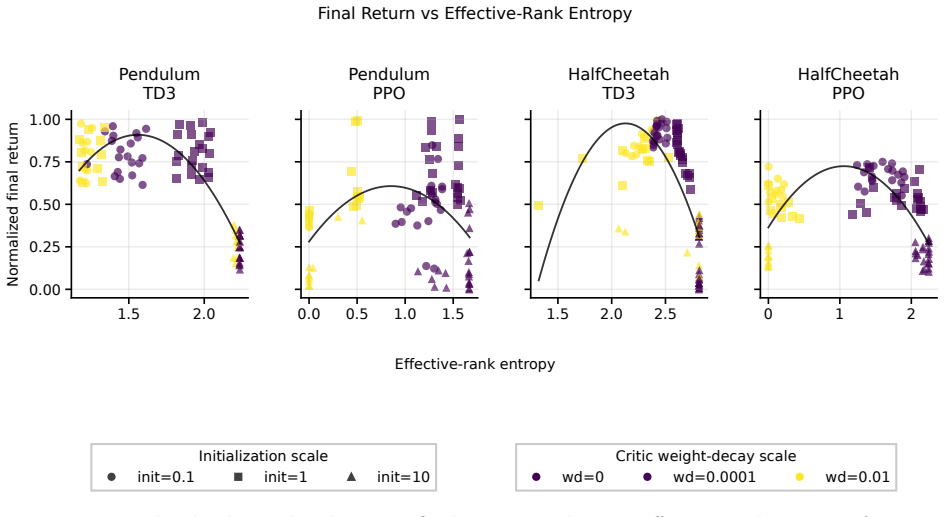
Summary. The manuscript introduces critic complexity as an additional diagnostic and intervention dimension for actor-critic RL, operationalized via spectral effective-rank entropy computed from the singular-value distribution of critic weight matrices. Experiments with TD3 and PPO track this measure alongside return and Monte Carlo value-estimation bias, reporting that the quantity is measurable throughout training and exhibits systematic but heterogeneous associations with training behavior across algorithms, tasks, and hyperparameters. A direct intervention is then tested by augmenting the critic loss with a spectral-entropy penalty; the paper claims this reliably alters the targeted spectral quantity, while treating any return effects as task-dependent rather than a general performance claim.
Significance. If the reported associations and controllability results hold under the stated experimental conditions, the work supplies a concrete, directly manipulable summary statistic for critic model complexity that is not reducible to conventional indirect metrics such as TD error or returns. The explicit scoping to heterogeneous associations and task-dependent return effects is a methodological strength that prevents overgeneralization. The demonstration that an added loss term can control the spectral quantity itself constitutes a falsifiable, actionable contribution. The stress-test concern that the measure might be an incidental correlate rather than a meaningful summary does not land, because the central claims are limited to measurability, observed associations, and controllability of the spectral quantity; no causal mediation claim linking the measure to training dynamics is asserted.
minor comments (3)
- The abstract states that the intervention 'reliably changes the targeted spectral quantity' but does not report effect sizes, number of runs, or any statistical summary; adding a short quantitative statement (e.g., mean change and variability across seeds) would strengthen the controllability claim without altering scope.
- Notation for the spectral effective-rank entropy should be introduced with an explicit equation in the methods section so that readers can reproduce the exact rank-like summary from the singular-value vector.
- Figure captions for the association plots should state the number of independent seeds and whether error bars represent standard deviation or standard error.
Simulated Author's Rebuttal
We thank the referee for the positive and accurate summary of our manuscript, which correctly identifies the scope of our claims on measurability, heterogeneous associations, and controllability of critic complexity without overgeneralization. The recommendation for minor revision is noted. No major comments were raised in the report.
Circularity Check
No significant circularity; derivation is self-contained
full rationale
The paper defines spectral effective-rank entropy directly from the singular-value distribution of critic weights as a new diagnostic. It then reports empirical associations between this quantity and training metrics (return, value bias) across TD3/PPO runs, plus the effect of an added penalty term on the same quantity. These associations are observational results from experiments, not quantities fitted or predicted by construction from the measure itself. No self-citations, uniqueness theorems, or ansatzes imported from prior author work are invoked to support the measurability, heterogeneity, or controllability claims. The intervention result (penalty changes the targeted spectral quantity) follows from the explicit loss modification and is presented as such, without being reframed as an independent prediction.
Axiom & Free-Parameter Ledger
axioms (1)
- domain assumption Spectral effective-rank entropy of critic weight matrices is a valid and useful scalar summary of critic model complexity.
invented entities (1)
-
critic complexity
no independent evidence
Cite this review
Pith. "Pith review of Gauging, Measuring, and Controlling Critic Complexity in Actor-Critic Reinforcement Learning." pith.science (2026). https://pith.science/paper/Y7W63XFC
@misc{pith2026260700452,
  author       = {Pith},
  title        = {Pith review of: Gauging, Measuring, and Controlling Critic Complexity in Actor-Critic Reinforcement Learning},
  year         = {2026},
  howpublished = {\url{https://pith.science/paper/Y7W63XFC}},
  note         = {Machine review of arXiv:2607.00452}
}
read the original abstract
Actor-critic methods depend on learned critics, but critic quality is often evaluated only indirectly through return, temporal-difference error, or value loss. Critic complexity is introduced as an additional diagnostic and intervention dimension for actor-critic reinforcement learning. The analysis uses spectral effective-rank entropy, a rank-like summary of the singular-value distributions of critic weight matrices, to assess critic model complexity. Across TD3 and PPO experiments, critic complexity is tracked together with return and Monte Carlo value-estimation bias. The results show that critic complexity is measurable throughout training and is systematically associated with training behavior, while also making clear that the relationship is heterogeneous across algorithms, tasks, and hyperparameters. A direct complexity-control intervention is then evaluated by adding a spectral-entropy penalty to the critic loss. This intervention reliably changes the targeted spectral quantity, demonstrating that critic complexity can be controlled rather than only observed. Return effects are treated as task-dependent evidence rather than as a general performance claim, because overall complexity-control results vary.
Figures

Reference graph
Works this paper leans on
-
[1]
Hado van Hasselt. Double Q-learning. InAdvances in Neural Information Processing Systems, 2010. 6 Table 2: Main-task regularizer summary across PPO and TD3 on Pendulum-v1 and HalfCheetah- v4. All rows use seeds 0 and 1; values are mean±SEM. Bold marks the best value within each algorithm/task block across entropy coefficients.Entropy regularization reliab...
work page 2010
-
[2]
Deep Reinforcement Learning with Double Q-learning
Hado van Hasselt, Arthur Guez, and David Silver. Deep Reinforcement Learning with Double Q-learning. InProceedings of the AAAI Conference on Artificial Intelligence, 2016
work page 2016
-
[3]
Proximal Policy Optimization Algorithms
John Schulman, Filip Wolski, Prafulla Dhariwal, Alec Radford, and Oleg Klimov. Proximal Policy Optimization Algorithms.arXiv preprint arXiv:1707.06347, 2017
work page internal anchor Pith review Pith/arXiv arXiv 2017
-
[4]
Addressing Function Approximation Error in Actor-Critic Methods
Scott Fujimoto, Herke van Hoof, and David Meger. Addressing Function Approximation Error in Actor-Critic Methods. InProceedings of the International Conference on Machine Learning, 2018
work page 2018
-
[5]
Soft Actor-Critic: Off- Policy Maximum Entropy Deep Reinforcement Learning with a Stochastic Actor
Tuomas Haarnoja, Aurick Zhou, Pieter Abbeel, and Sergey Levine. Soft Actor-Critic: Off- Policy Maximum Entropy Deep Reinforcement Learning with a Stochastic Actor. InProceed- ings of the International Conference on Machine Learning, 2018
work page 2018
-
[6]
Understanding deep learning requires rethinking generalization
Chiyuan Zhang, Samy Bengio, Moritz Hardt, Benjamin Recht, and Oriol Vinyals. Under- standing Deep Learning Requires Rethinking Generalization.arXiv preprint arXiv:1611.03530, 2016
work page internal anchor Pith review Pith/arXiv arXiv 2016
-
[7]
Peter L. Bartlett, Dylan J. Foster, and Matus J. Telgarsky. Spectrally-normalized margin bounds for neural networks. InAdvances in Neural Information Processing Systems, 2017
work page 2017
-
[8]
Spectral Normal- ization for Generative Adversarial Networks
Takeru Miyato, Toshiki Kataoka, Masanori Koyama, and Yuichi Yoshida. Spectral Normal- ization for Generative Adversarial Networks. InInternational Conference on Learning Repre- sentations, 2018
work page 2018
-
[9]
The Effective Rank: A Measure of Effective Dimensionality
Olivier Roy and Martin Vetterli. The Effective Rank: A Measure of Effective Dimensionality. In15th European Signal Processing Conference, pages 606–610, 2007. 7 Table 3: Cross-task regularizer summary. All rows use seeds 0 and 1; values are mean±SEM. Bold marks the best value within each algorithm/task block across entropy coefficients, using the same col...
work page 2007
-
[10]
Ziming Liu, Eric J. Michaud, and Max Tegmark. Omnigrok: Grokking Beyond Algorithmic Data. InInternational Conference on Learning Representations, 2023
work page 2023
-
[11]
Com- plexity Control Facilitates Reasoning-Based Compositional Generalization in Transformers
Zhongwang Zhang, Pengxiao Lin, Zhiwei Wang, Yaoyu Zhang, and Zhi-Qin John Xu. Com- plexity Control Facilitates Reasoning-Based Compositional Generalization in Transformers. arXiv preprint arXiv:2501.08537, 2025
-
[12]
Neural Weight Norm = Kolmogorov Complexity
Tiberiu Musat. Neural Weight Norm = Kolmogorov Complexity.arXiv preprint arXiv:2605.10878, 2026. 8
work page internal anchor Pith review Pith/arXiv arXiv 2026
This paper was first reviewed by grok-4.3 on July 2, 2026.
discussion (0)
Sign in with ORCID, Apple, or X to comment. Anyone can read and Pith papers without signing in.