Distinct spin properties and astrophysical origin of low mass binary black holes in gravitational wave data
Pith reviewed 2026-07-02 07:53 UTC · model grok-4.3
The pith
Binary black hole mergers change spin behavior at a transition mass of about 15 solar masses, marking two distinct formation channels.
A machine-rendered reading of the paper's core claim, the machinery that carries it, and where it could break.
Core claim
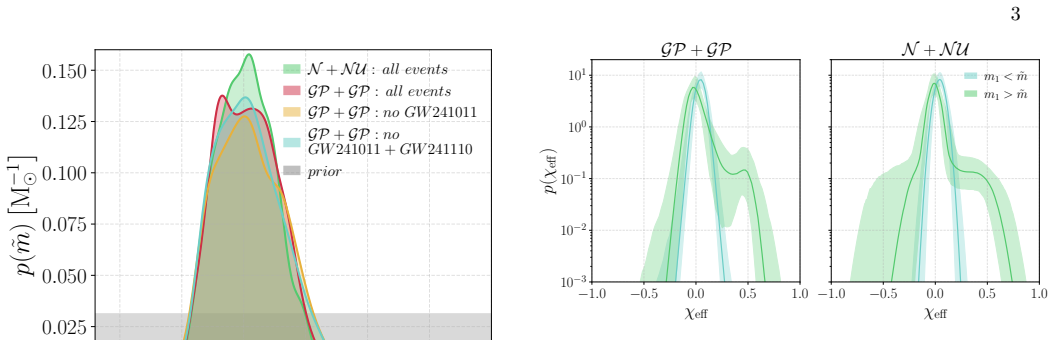
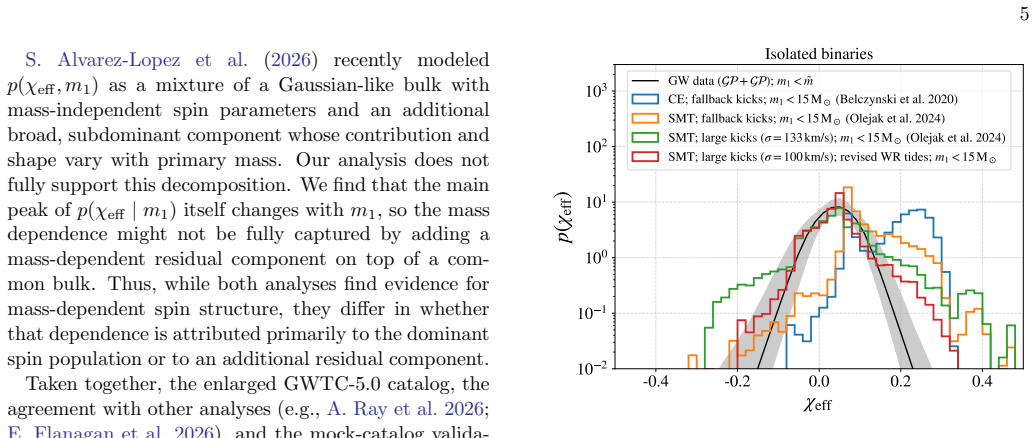
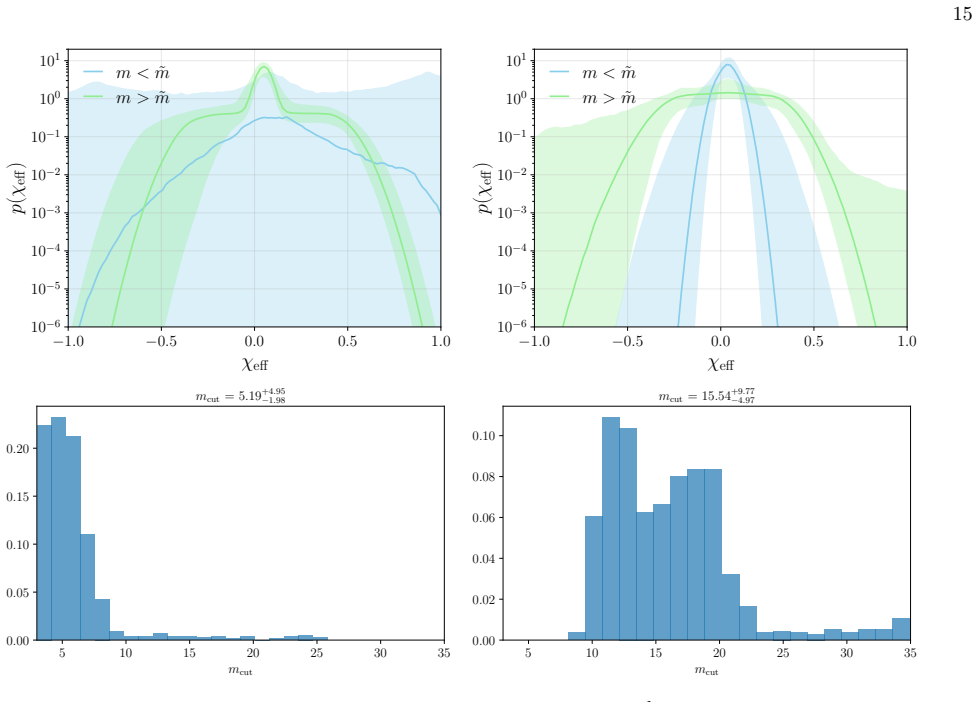
Hierarchical Bayesian inference on GWTC-5.0 data infers a transition mass of 15.2 solar masses separating two effective-spin populations. Below the transition the distribution is narrow, peaks at small positive values, and retains significant support for negative values; above the transition it is broader with its peak shifted to values consistent with zero. The dominant low-mass population near 10 solar masses is therefore statistically distinct and arises from a different channel, broadly consistent with massive stellar multiples in the field but incompatible with isolated binary evolution under standard fallback-kick prescriptions.
What carries the argument
A data-driven transition mass that partitions the binary black hole population into two components, each with its own effective-spin distribution, recovered through hierarchical Bayesian inference.
If this is right
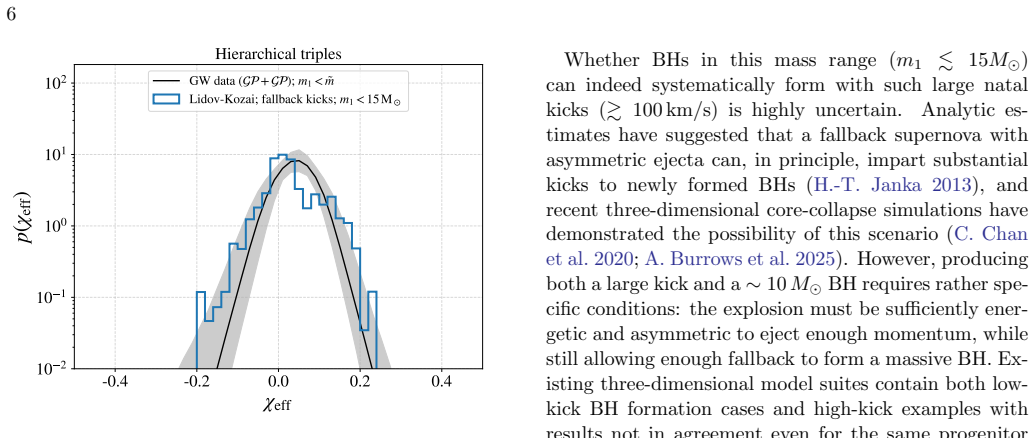
- The low-mass population requires either natal kicks exceeding roughly 100 km/s or dynamical processing inside hierarchical triples.
- Isolated binary evolution with standard fallback kicks cannot account for the observed negative effective spins below the transition.
- The spin properties of the two populations remain distinguishable even after accounting for measurement uncertainty and selection.
- The concentration of mergers near 10 solar masses traces to a formation route separate from that producing higher-mass events.
Where Pith is reading between the lines
- Mass-dependent spin evolution must be built into population-synthesis codes if they are to reproduce the observed split.
- The relative rates of the two channels could be tracked by counting events on either side of the transition in future data releases.
- If the low-mass channel is dominated by triples, the fraction of mergers with measurable eccentricity or higher-order effects may also rise at low mass.
Load-bearing premise
The observed mergers are produced by exactly two spin populations whose dividing mass can be read directly from the catalog, and mock catalogs fully represent the null case of no mass dependence together with all selection effects.
What would settle it
A future catalog in which the effective-spin distributions inferred below and above 15 solar masses become statistically indistinguishable, or in which the recovered transition mass lies well outside the present uncertainty interval.
Figures
read the original abstract
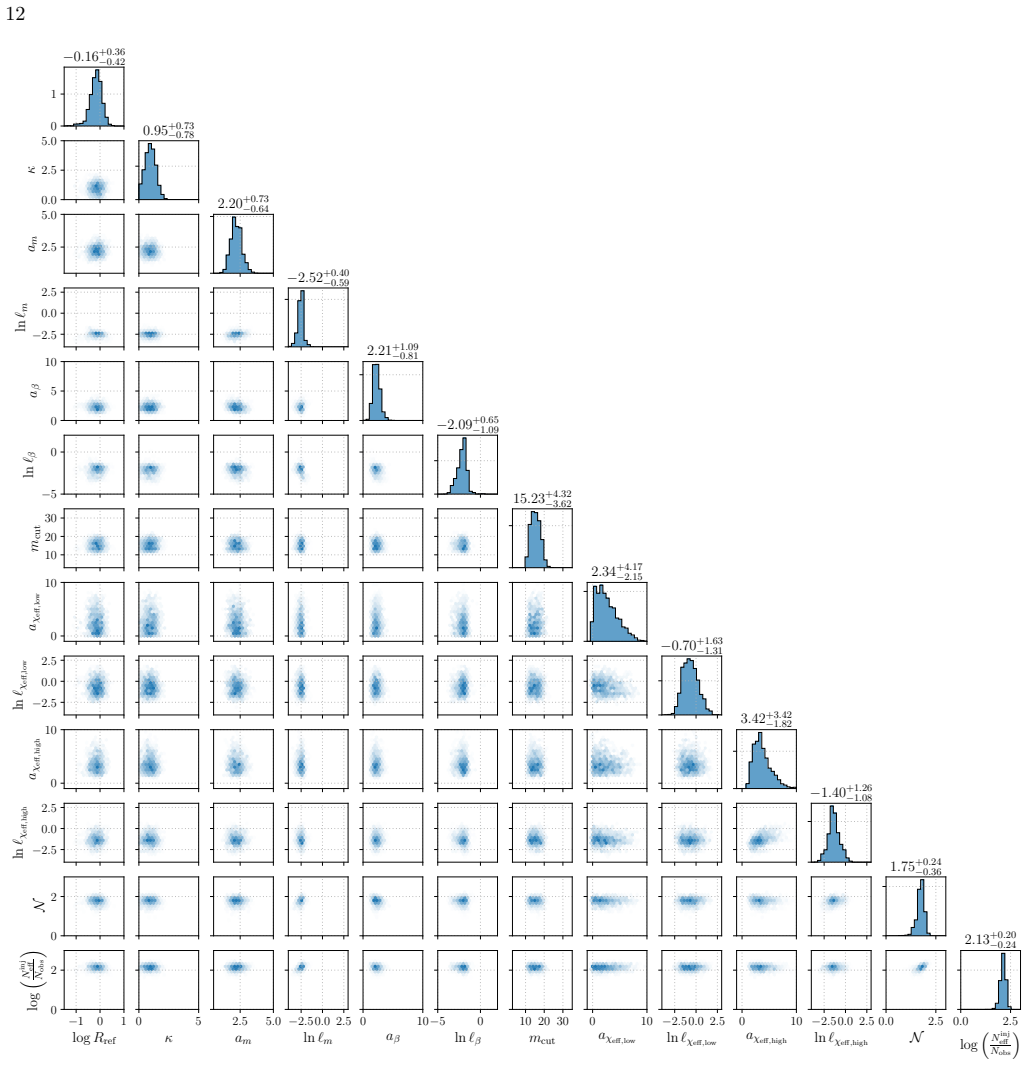
We analyze the effective-spin distribution of binary black hole mergers in GWTC-5.0 as a function of primary black hole mass using hierarchical Bayesian inference. We model the population as a mixture of two spin components separated by a transition mass scale inferred directly from the data. We find strong evidence for a transition at $\tilde{m} = 15.2^{+4.3}_{-3.6}\, M_\odot$. Mock-catalog analyses show that such a transition is unlikely to arise from finite-sample fluctuations of a mass-independent $\chi_{\rm eff}$ population and the posterior predictive distributions of $\chi_{\rm eff}$ inferred below and above the transition are clearly distinct. Below the transition mass, the effective-spin distribution is narrow, peaks at a small positive value $\chi_{\rm eff}>0$, but also shows significant support for negative $\chi_{\rm eff}$. Above the transition, the distribution is broader and its peak shifts to values consistent with $\chi_{\rm eff}\simeq0$, making its support at both positive and negative $\chi_{\rm eff}$ roughly similar. These findings suggest that the dominant merger population concentrated around $10\,M_{\odot}$ is statistically distinct from the rest and that it arises from a different formation channel. We show that this low-mass population is broadly consistent with formation from massive stellar multiples in the field: it may either arise from isolated binary star evolution but only if black hole natal kicks below $\tilde{m}$ are generally very large ($\gtrsim100\,\rm km/s$) or be caused by the dynamical evolution of hierarchical triples. In contrast, isolated binary evolution with standard fallback kick models cannot reproduce the support for negative $\chi_{\rm eff}$.
Editorial analysis
A structured set of objections, weighed in public.
Referee Report
Summary. The paper applies hierarchical Bayesian inference to the effective-spin (χ_eff) distribution of binary black hole mergers in GWTC-5.0, modeling the population as a two-component mixture whose transition mass ilde{m} is inferred from the data. It reports a transition at ilde{m} = 15.2^{+4.3}_{-3.6} M_⊙, with the low-mass component showing a narrow χ_eff distribution peaked at small positive values (yet with negative support) and the high-mass component showing a broader distribution centered near zero. Mock-catalog tests are presented to argue that the transition is unlikely under a mass-independent χ_eff population, and the low-mass population is interpreted as arising from a distinct channel (isolated evolution with large kicks or dynamical triples) inconsistent with standard fallback-kick isolated binaries.
Significance. If the central inference holds after addressing selection modeling, the result would provide direct evidence for multiple formation channels in the observed BBH population and would constrain natal-kick magnitudes and the relative contributions of isolated versus dynamical channels at low masses. The use of data-driven transition inference and mock validation under a null hypothesis are positive features that strengthen falsifiability.
major comments (2)
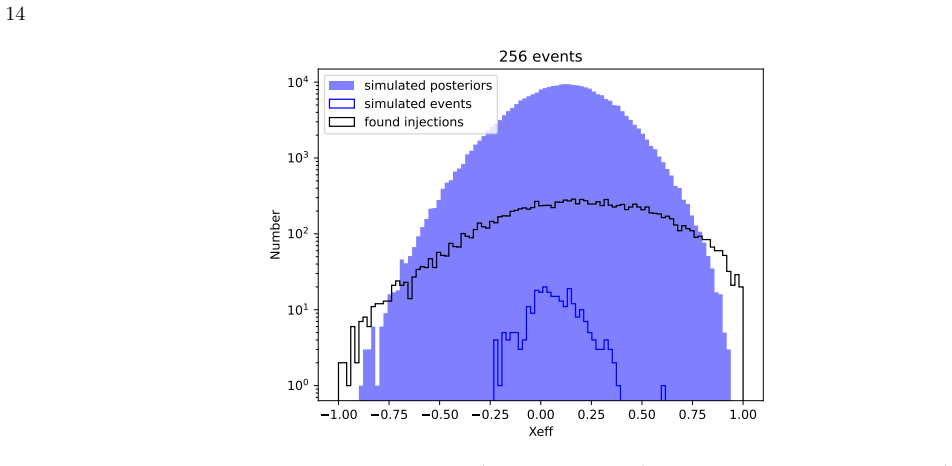
- [Abstract] Abstract and methods section on mock catalogs: the statement that the mocks 'fully capture' selection effects does not include explicit verification that the null (mass-independent χ_eff) catalogs reproduce the observed joint mass-χ_eff distribution after forward-modeling the full GW detection probability (SNR and waveform morphology dependence on both mass and spin) and the parameter-estimation covariances present in GWTC-5.0; without this check an apparent transition could be induced by unmodeled selection rather than intrinsic population structure.
- [Results] Results section on posterior predictive distributions: the reported distinction between the χ_eff posteriors below and above ilde{m} relies on the two-component mixture model; no quantitative model-comparison metric (e.g., Bayes factor against a single mass-dependent spin distribution or against a three-component model) is provided to demonstrate that the two-component transition is preferred over smoother alternatives.
minor comments (2)
- Notation for the transition mass alternates between ilde{m} and m_tilde without a single defining equation; a dedicated equation block would improve clarity.
- The interpretation paragraph comparing to isolated binary evolution with fallback kicks would benefit from a brief quantitative reference to the kick-velocity distributions used in the cited population-synthesis studies.
Simulated Author's Rebuttal
We thank the referee for their constructive comments on our manuscript. We address each major comment point by point below, with plans to revise where appropriate to strengthen the analysis.
read point-by-point responses
-
Referee: [Abstract] Abstract and methods section on mock catalogs: the statement that the mocks 'fully capture' selection effects does not include explicit verification that the null (mass-independent χ_eff) catalogs reproduce the observed joint mass-χ_eff distribution after forward-modeling the full GW detection probability (SNR and waveform morphology dependence on both mass and spin) and the parameter-estimation covariances present in GWTC-5.0; without this check an apparent transition could be induced by unmodeled selection rather than intrinsic population structure.
Authors: We acknowledge that while our mock catalogs were constructed by drawing from the observed mass distribution and applying the selection effects incorporated in the hierarchical inference (including detection probability), we did not include an explicit end-to-end forward simulation verifying reproduction of the full joint mass-χ_eff distribution under the null hypothesis after accounting for SNR and waveform morphology dependence on mass and spin, nor the parameter-estimation covariances from GWTC-5.0. We will add this verification step in the revised manuscript to rule out selection-induced artifacts. revision: yes
-
Referee: [Results] Results section on posterior predictive distributions: the reported distinction between the χ_eff posteriors below and above ilde{m} relies on the two-component mixture model; no quantitative model-comparison metric (e.g., Bayes factor against a single mass-dependent spin distribution or against a three-component model) is provided to demonstrate that the two-component transition is preferred over smoother alternatives.
Authors: We agree that a quantitative metric such as a Bayes factor would provide stronger evidence for the two-component model over alternatives. Our current emphasis is on the data-driven inference of the transition mass and the resulting distinct posterior predictive distributions for χ_eff. We will compute and report Bayes factors comparing the two-component model to a single mass-dependent spin distribution (and note results for a three-component variant) in the revised manuscript. revision: yes
Circularity Check
No significant circularity; central result is direct hierarchical inference from GWTC-5.0
full rationale
The paper models the BBH population as a two-component mixture with a transition mass ilde{m} treated as a free parameter inferred via hierarchical Bayesian inference on the observed events. The transition value, the component spin distributions, and the claim of statistical distinction are outputs of that fit, not inputs redefined as predictions. Mock-catalog tests compare against an explicit null (mass-independent \chi_eff) and are described as capturing selection effects; this is an external falsification step rather than a self-referential loop. No self-citation, ansatz smuggling, or uniqueness theorem from prior author work is invoked as load-bearing in the derivation chain. The result remains a data-driven posterior statement whose validity hinges on modeling assumptions that are stated and tested rather than tautological.
Axiom & Free-Parameter Ledger
free parameters (2)
- transition mass scale \tilde{m} =
15.2 M_\odot
- parameters of the narrow and broad chi_eff distributions
axioms (1)
- domain assumption The binary black hole population can be modeled as a mixture of two distinct spin components separated by a transition mass scale.
Reference graph
Works this paper leans on
-
[1]
G., Abouelfettouh , I., Acernese , F., et al
Abac , A. G., Abouelfettouh , I., Acernese , F., et al. 2025, title GW241011 and GW241110: Exploring Binary Formation and Fundamental Physics with Asymmetric, High-spin Black Hole Coalescences , , 993, L21, 10.3847/2041-8213/ae0d54
-
[2]
Abbott , R., Abbott , T. D., Abraham , S., et al. 2021, title Population Properties of Compact Objects from the Second LIGO-Virgo Gravitational-Wave Transient Catalog , , 913, L7, 10.3847/2041-8213/abe949
-
[3]
Abbott , R., Abbott , T. D., Acernese , F., et al. 2023, title Population of Merging Compact Binaries Inferred Using Gravitational Waves through GWTC-3 , Physical Review X, 13, 011048, 10.1103/PhysRevX.13.011048
-
[4]
Abbott, R. e. a. 2020a, title GWTC-2: Compact Binary Coalescences Observed by LIGO and Virgo During the First Half of the Third Observing Run , . 2010.14527
work page internal anchor Pith review Pith/arXiv arXiv 2010
-
[5]
Abbott, R. e. a. 2021, title GWTC-2: Compact Binary Coalescences Observed by LIGO and Virgo during the First Half of the Third Observing Run, Physical Review X, 11, 10.1103/physrevx.11.021053
-
[6]
Abbott, R. e. a. 2023, title GWTC-3: Compact Binary Coalescences Observed by LIGO and Virgo during the Second Part of the Third Observing Run, Phys. Rev. X, 13, 041039, 10.1103/PhysRevX.13.041039
-
[7]
Abbott et al. 2019, title GWTC-1: A Gravitational-Wave Transient Catalog of Compact Binary Mergers Observed by LIGO and Virgo during the First and Second Observing Runs , Physical Review X, 9, 031040, 10.1103/PhysRevX.9.031040
-
[8]
Afroz, S., & Mukherjee, S. 2025 a , Phase Space of Binary Black Holes from Gravitational Wave Observations to Unveil its Formation History, 2411.07304
-
[9]
Afroz, S., & Mukherjee, S. 2025 b , Binary Black Hole Phase Space Discovers the Signature of Pair Instability Supernovae Mass Gap, 2509.09123
-
[10]
Ajith, P., Hannam, M., Husa, S., et al. 2011, title Inspiral-Merger-Ringdown Waveforms for Black-Hole Binaries with Nonprecessing Spins , Physical Review Letters, 106, 241101, 10.1103/PhysRevLett.106.241101
-
[11]
Alvarez-Lopez , S., Heinzel , J., & Vitale , S. 2026, title Evidence for additional structure in the effective spin distribution hints at multiple formation pathways in GWTC-5.0 , arXiv e-prints, arXiv:2606.12205, 10.48550/arXiv.2606.12205
work page internal anchor Pith review Pith/arXiv arXiv doi:10.48550/arxiv.2606.12205 2026
-
[12]
Antoni , A., & Quataert , E. 2022, title Numerical simulations of the random angular momentum in convection: Implications for supergiant collapse to form black holes , , 511, 176, 10.1093/mnras/stab3776
-
[13]
Antonini, F., Callister, T., Dosopoulou, F., Romero-Shaw, I. M., & Chattopadhyay, D. 2025, title Inferring the pair-instability mass gap from gravitational wave data, Phys. Rev. D, 112, 063040, 10.1103/nxnr-pdyx
-
[14]
Antonini , F., Gieles , M., Dosopoulou , F., & Chattopadhyay , D. 2023, title Coalescing black hole binaries from globular clusters: mass distributions and comparison to gravitational wave data from GWTC-3 , , 522, 466, 10.1093/mnras/stad972
-
[15]
Antonini , F., & Rasio , F. A. 2016, title Merging Black Hole Binaries in Galactic Nuclei: Implications for Advanced-LIGO Detections , , 831, 187, 10.3847/0004-637X/831/2/187
-
[16]
L., Petrovich , C., & Fischer , C
Antonini , F., Rodriguez , C. L., Petrovich , C., & Fischer , C. L. 2018, title Precessional dynamics of black hole triples: binary mergers with near-zero effective spin , Mon. Not. R. Astron. Soc., 480, L58, 10.1093/mnrasl/sly126
-
[17]
Antonini, F., Romero-Shaw, I., & Callister, T. 2026, title Gravitational-wave constraints on the pair-instability mass gap and nuclear burning in massive stars, Nat Astron, 10.1038/s41550-026-02847-0
-
[18]
Antonini , F., Romero-Shaw , I. M., & Callister , T. 2025a, title Star Cluster Population of High Mass Black Hole Mergers in Gravitational Wave Data , , 134, 011401, 10.1103/PhysRevLett.134.011401
-
[19]
Antonini , F., Toonen , S., & Hamers , A. S. 2017, title Binary Black Hole Mergers from Field Triples: Properties, Rates, and the Impact of Stellar Evolution , Astrophys. J., 841, 77, 10.3847/1538-4357/aa6f5e
-
[20]
Arca Sedda , M., Mapelli , M., Benacquista , M., & Spera , M. 2023, title Isolated and dynamical black hole mergers with B-POP: the role of star formation and dynamics, star cluster evolution, natal kicks, mass and spins, and hierarchical mergers , , 520, 5259, 10.1093/mnras/stad331
-
[21]
Arca Sedda , M., Paiella , L., Ugolini , C., et al. 2026, title Isolated or Dynamical? Tracing Black Hole Binary Formation through the Population of Gravitational-Wave Sources , arXiv e-prints, arXiv:2603.20430, 10.48550/arXiv.2603.20430
-
[22]
2017, title MOCCA-SURVEY Database - I
Askar , A., Szkudlarek , M., Gondek-Rosi \'n ska , D., Giersz , M., & Bulik , T. 2017, title MOCCA-SURVEY Database - I. Coalescing binary black holes originating from globular clusters , , 464, L36, 10.1093/mnrasl/slw177
-
[23]
Revising the Spin and Kick Connection in Isolated Binary Black Holes2024
Baibhav , V., & Kalogera , V. 2024, title Revising the Spin and Kick Connection in Isolated Binary Black Holes , arXiv e-prints, arXiv:2412.03461, 10.48550/arXiv.2412.03461
-
[24]
A., Adamcewicz, C., Doctor, Z., & Kalogera, V
Banagiri, S., Callister, T. A., Adamcewicz, C., Doctor, Z., & Kalogera, V. 2025 a , title Structure and Skewness of the Effective Inspiral Spin Distribution of Binary Black Hole Mergers, The Astrophysical Journal, 990, 147, 10.3847/1538-4357/adf4c6
-
[25]
Banagiri, S., Thrane, E., & Lasky, P. D. 2025 b , Evidence for Three Subpopulations of Merging Binary Black Holes at Different Primary Masses, 2509.15646
work page internal anchor Pith review Pith/arXiv arXiv 2025
-
[26]
On the effective spin-mass ratio relation of binary black hole mergers that evolved in isolation
Banerjee , S., & Olejak , A. 2024, title On the effective spin-mass ratio relation of binary black hole mergers that evolved in isolation , arXiv e-prints, arXiv:2411.15112, 10.48550/arXiv.2411.15112
work page internal anchor Pith review Pith/arXiv arXiv doi:10.48550/arxiv.2411.15112 2024
-
[27]
S., Fragos , T., Qin , Y., et al
Bavera , S. S., Fragos , T., Qin , Y., et al. 2020, title The origin of spin in binary black holes. Predicting the distributions of the main observables of Advanced LIGO , , 635, A97, 10.1051/0004-6361/201936204
-
[28]
Belczynski, K., Wiktorowicz, G., Fryer, C. L., Holz, D. E., & Kalogera, V. 2012, title MISSING BLACK HOLES UNVEIL THE SUPERNOVA EXPLOSION MECHANISM , The Astrophysical Journal, 757, 91, 10.1088/0004-637X/757/1/91
-
[29]
Belczynski , K., Klencki , J., Fields , C. E., et al. 2020, title Evolutionary roads leading to low effective spins, high black hole masses, and O1/O2 rates for LIGO/Virgo binary black holes , , 636, A104, 10.1051/0004-6361/201936528
-
[30]
The first decade of gravitational-wave measurements of black hole spins
Biscoveanu, S. 2026, The first decade of gravitational-wave measurements of black hole spins, 2606.06209
work page internal anchor Pith review Pith/arXiv arXiv 2026
-
[31]
Biscoveanu , S., Callister , T. A., Haster , C.-J., et al. 2022, title The Binary Black Hole Spin Distribution Likely Broadens with Redshift , , 932, L19, 10.3847/2041-8213/ac71a8
-
[32]
2018, JAX : composable transformations of P ython+ N um P y programs, 0.3.13 http://github.com/jax-ml/jax
Bradbury, J., Frostig, R., Hawkins, P., et al. 2018, JAX : composable transformations of P ython+ N um P y programs, 0.3.13 http://github.com/jax-ml/jax
2018
-
[33]
2025, title Channels of Stellar-mass Black Hole Formation , , 987, 164, 10.3847/1538-4357/addd04
Burrows , A., Wang , T., & Vartanyan , D. 2025, title Channels of Stellar-mass Black Hole Formation , , 987, 164, 10.3847/1538-4357/addd04
-
[34]
Callister, T., Fishbach, M., Holz, D. E., & Farr, W. M. 2020, title Shouts and Murmurs: Combining Individual Gravitational-wave Sources with the Stochastic Background to Measure the History of Binary Black Hole Mergers, The Astrophysical Journal Letters, 896, L32, 10.3847/2041-8213/ab9743
-
[35]
Callister , T. A., Haster , C.-J., Ng , K. K. Y., Vitale , S., & Farr , W. M. 2021, title Who Ordered That? Unequal-mass Binary Black Hole Mergers Have Larger Effective Spins , , 922, L5, 10.3847/2041-8213/ac2ccc
-
[36]
Chan , C., M \"u ller , B., & Heger , A. 2020, title The impact of fallback on the compact remnants and chemical yields of core-collapse supernovae , , 495, 3751, 10.1093/mnras/staa1431
-
[37]
S., Collaboration, V., & Collaboration, K
Collaboration, L. S., Collaboration, V., & Collaboration, K. 2025, GWTC-4: Compact Binary Coalescences Observed by LIGO and Virgo During the O3b Observing Run, Zenodo, 10.5281/zenodo.16053484
-
[38]
Dorozsmai , A., Romero-Shaw , I. M., Vijaykumar , A., et al. 2025, title Hierarchical Triples vs. Globular Clusters: Binary black hole merger eccentricity distributions compete and evolve with redshift , , 10.1093/mnras/staf1938
-
[39]
2022, Precision Requirements for Monte Carlo Sums within Hierarchical Bayesian Inference, 2204.00461
Essick, R., & Farr, W. 2022, Precision Requirements for Monte Carlo Sums within Hierarchical Bayesian Inference, 2204.00461
-
[40]
Essick, R., Coughlin, M. W., Zevin, M., et al. 2025, title Compact binary coalescence sensitivity estimates with injection campaigns during the LIGO-Virgo-KAGRA Collaborations' fourth observing run, Phys. Rev. D, 112, 102001, 10.1103/44x3-hv3y
-
[41]
M., Edelman , B., Zevin , M., et al
Farah , A. M., Edelman , B., Zevin , M., et al. 2023, title Things That Might Go Bump in the Night: Assessing Structure in the Binary Black Hole Mass Spectrum , The Astrophysical Journal, 955, 107, 10.3847/1538-4357/aced02
-
[42]
M., Stevenson , S., Miller , M
Farr , W. M., Stevenson , S., Miller , M. C., et al. 2017, title Distinguishing spin-aligned and isotropic black hole populations with gravitational waves , , 548, 426, 10.1038/nature23453
-
[43]
Fishbach, M., Holz, D. E., & Farr, W. M. 2018, title Does the Black Hole Merger Rate Evolve with Redshift? The Astrophysical Journal Letters, 863, L41, 10.3847/2041-8213/aad800
-
[44]
Flanagan , E., Antonini , F., Callister , T., et al. 2026, title Transitions in the Mass-ratio and Spin Properties of Binary Black Holes in GWTC-5 , arXiv e-prints, arXiv:2606.14472. 2606.14472
-
[45]
L., Belczynski , K., Wiktorowicz , G., et al
Fryer , C. L., Belczynski , K., Wiktorowicz , G., et al. 2012, title Compact Remnant Mass Function: Dependence on the Explosion Mechanism and Metallicity , , 749, 91, 10.1088/0004-637X/749/1/91
-
[46]
2019, title Most Black Holes Are Born Very Slowly Rotating , , 881, L1, 10.3847/2041-8213/ab339b
Fuller , J., & Ma , L. 2019, title Most Black Holes Are Born Very Slowly Rotating , , 881, L1, 10.3847/2041-8213/ab339b
-
[47]
Galaudage, S. 2026, Compactness Peaks and Subpopulations: Probing Stellar Physics and Formation Channels of Merging Binary Black Holes, 2605.25994
work page internal anchor Pith review Pith/arXiv arXiv 2026
-
[48]
Galaudage , S., & Lamberts , A. 2025, title Compactness peaks: An astrophysical interpretation of the mass distribution of merging binary black holes , , 694, A186, 10.1051/0004-6361/202451654
-
[49]
Gerosa , D., Berti , E., O'Shaughnessy , R., et al. 2018, title Spin orientations of merging black holes formed from the evolution of stellar binaries , , 98, 084036, 10.1103/PhysRevD.98.084036
-
[50]
Godfrey , J., Edelman , B., & Farr , B. 2023, title Cosmic Cousins: Identification of a Subpopulation of Binary Black Holes Consistent with Isolated Binary Evolution , arXiv e-prints, arXiv:2304.01288, 10.48550/arXiv.2304.01288
-
[51]
Grishin , E., Perets , H. B., & Fragione , G. 2018, title Quasi-secular evolution of mildly hierarchical triple systems: analytics and applications for GW sources and hot Jupiters , Mon. Not. R. Astron. Soc., 481, 4907, 10.1093/mnras/sty2477
-
[52]
Hoy , C., Fairhurst , S., Hannam , M., & Tiwari , V. 2022, title Understanding How Fast Black Holes Spin by Analyzing Data from the Second Gravitational-wave Catalogue , , 928, 75, 10.3847/1538-4357/ac54a3
-
[53]
Hussain, A., Isi, M., & Zimmerman, A. 2024, Hints of spin-magnitude correlations and a rapidly spinning subpopulation of binary black holes, 2411.02252
-
[54]
Janka , H.-T. 2013, title Natal kicks of stellar mass black holes by asymmetric mass ejection in fallback supernovae , , 434, 1355, 10.1093/mnras/stt1106
-
[55]
Janka , H.-T., & Kresse , D. 2024, title Interplay between neutrino kicks and hydrodynamic kicks of neutron stars and black holes , , 369, 80, 10.1007/s10509-024-04343-1
-
[56]
Karathanasis , C., Mukherjee , S., & Mastrogiovanni , S. 2023, title Binary black holes population and cosmology in new lights: signature of PISN mass and formation channel in GWTC-3 , , 523, 4539, 10.1093/mnras/stad1373
-
[57]
1962, title Secular perturbations of asteroids with high inclination and eccentricity , Astron
Kozai , Y. 1962, title Secular perturbations of asteroids with high inclination and eccentricity , Astron. J., 67, 591, 10.1086/108790
-
[58]
Lidov , M. L. 1962, title The evolution of orbits of artificial satellites of planets under the action of gravitational perturbations of external bodies , Planet. Space Sci., 9, 719, 10.1016/0032-0633(62)90129-0
-
[59]
Liu , B., & Lai , D. 2018, title Black Hole and Neutron Star Binary Mergers in Triple Systems: Merger Fraction and Spin-Orbit Misalignment , Astrophys. J., 863, 68, 10.3847/1538-4357/aad09f
-
[60]
Lovegrove , E., & Woosley , S. E. 2013, title Very Low Energy Supernovae from Neutrino Mass Loss , , 769, 109, 10.1088/0004-637X/769/2/109
-
[61]
Maga \ n a Hernandez , I., & Palmese , A. 2025, title Astrophysics informed Gaussian processes for gravitational-wave populations: Evidence for the onset of the pair-instability supernova mass gap , arXiv e-prints, arXiv:2508.19208, 10.48550/arXiv.2508.19208
-
[62]
Mandel , I. 2016, title Estimates of black hole natal kick velocities from observations of low-mass X-ray binaries , , 456, 578, 10.1093/mnras/stv2733
-
[63]
Mangipudi , A., Grishin , E., Trani , A. A., & Mandel , I. 2022, title Extreme Eccentricities of Triple Systems: Analytic Results , , 934, 44, 10.3847/1538-4357/ac7958
-
[64]
Mapelli , M., Dall'Amico , M., Bouffanais , Y., et al. 2021, title Hierarchical black hole mergers in young, globular and nuclear star clusters: the effect of metallicity, spin and cluster properties , , 505, 339, 10.1093/mnras/stab1334
-
[65]
Martinez , M. A. S., O'Connor , C. E., K ro g lu , F., & Rasio , F. A. 2026, title Getting Tilted: Random Walk of Binary Black Hole Spin-Orbit Alignment in Dense Star Clusters , arXiv e-prints, arXiv:2606.21691, 10.48550/arXiv.2606.21691
work page internal anchor Pith review Pith/arXiv arXiv doi:10.48550/arxiv.2606.21691 2026
-
[66]
Moe , M., & Di Stefano , R. 2017, title Mind Your Ps and Qs: The Interrelation between Period (P) and Mass-ratio (Q) Distributions of Binary Stars , , 230, 15, 10.3847/1538-4365/aa6fb6
work page internal anchor Pith review doi:10.3847/1538-4365/aa6fb6 2017
-
[67]
Mould , M., Heinzel , J., \'A lvarez-L \'o pez , S., et al. 2026, title Measurement prospects for the pair-instability mass cutoff with gravitational waves , , 113, 103021, 10.1103/sqy9-nnqq
-
[68]
Nadezhin , D. K. 1980, title Some Secondary Indications of Gravitational Collapse , , 69, 115, 10.1007/BF00638971
-
[69]
O'Leary , R. M., Rasio , F. A., Fregeau , J. M., Ivanova , N., & O'Shaughnessy , R. 2006, title Binary Mergers and Growth of Black Holes in Dense Star Clusters , , 637, 937, 10.1086/498446
-
[70]
Olejak , A., & Belczynski , K. 2021, title The Implications of High Black Hole Spins for the Origin of Binary Black Hole Mergers , , 921, L2, 10.3847/2041-8213/ac2f48
-
[71]
L., Belczynski , K., & Baibhav , V
Olejak , A., Fryer , C. L., Belczynski , K., & Baibhav , V. 2022, title The role of supernova convection for the lower mass gap in the isolated binary formation of gravitational wave sources , , 516, 2252, 10.1093/mnras/stac2359
-
[72]
Olejak , A., Klencki , J., Xu , X.-T., et al. 2024, title Unequal-mass highly spinning binary black hole mergers in the stable mass transfer formation channel , , 689, A305, 10.1051/0004-6361/202450480
-
[73]
BBH-Genesis: Disentangling Binary Black Hole Formation Channels with GWTC-4
Padhyegurjar, S., & Mukherjee, S. 2026, BBH-Genesis: Disentangling Binary Black Hole Formation Channels with GWTC-4, 2606.00234
work page internal anchor Pith review Pith/arXiv arXiv 2026
-
[74]
Composable Effects for Flexible and Accelerated Probabilistic Programming in NumPyro
Phan , D., Pradhan , N., & Jankowiak , M. 2019, title Composable Effects for Flexible and Accelerated Probabilistic Programming in NumPyro , arXiv e-prints, arXiv:1912.11554, 10.48550/arXiv.1912.11554
work page internal anchor Pith review Pith/arXiv arXiv doi:10.48550/arxiv.1912.11554 2019
-
[75]
Signatures of a subpopulation of hierarchical mergers in the GWTC-4 gravitational-wave dataset
Plunkett, C., Callister, T., Zevin, M., & Vitale, S. 2026, Signatures of a subpopulation of hierarchical mergers in the GWTC-4 gravitational-wave dataset, 2601.07908
work page internal anchor Pith review Pith/arXiv arXiv 2026
-
[76]
Reversible-jump MCMC reveals binary black hole subpopulations with distinct redshift evolution
Qiu Cheng , A., Toubiana , A., Biscoveanu , S., & Gair , J. 2026, title Reversible-jump MCMC reveals binary black hole subpopulations with distinct redshift evolution , arXiv e-prints, arXiv:2605.25980, 10.48550/arXiv.2605.25980
work page internal anchor Pith review Pith/arXiv arXiv doi:10.48550/arxiv.2605.25980 2026
-
[77]
Racine , \'E . 2008, title Analysis of spin precession in binary black hole systems including quadrupole-monopole interaction , , 78, 044021, 10.1103/PhysRevD.78.044021
-
[78]
M., Breivik, K., & Creighton, J
Ray, A., Hernandez, I. M., Breivik, K., & Creighton, J. 2024, Searching for binary black hole sub-populations in gravitational wave data using binned Gaussian processes, 2404.03166
-
[79]
Ray , A., Mukherjee , S., Zevin , M., & Kalogera , V. 2026, title On the Astrophysical Origin of Binary Black Hole Subpopulations: A Tale of Three Channels? , arXiv e-prints, arXiv:2603.17987, 10.48550/arXiv.2603.17987
-
[80]
Rinaldi, S., Wong, C., Vaccaro, M. P., et al. 2026, title When the black holes align: a subpopulation of aligned massive binary black holes observed via gravitational waves , 2606.23305
work page internal anchor Pith review Pith/arXiv arXiv 2026
discussion (0)
Sign in with ORCID, Apple, or X to comment. Anyone can read and Pith papers without signing in.