Faithful by Definition: Emotion Analysis via Natural Semantic Metalanguage Explications
Pith reviewed 2026-07-02 13:04 UTC · model grok-4.3
The pith
Emotion labels are computed from fixed rules applied to Natural Semantic Metalanguage explications of the input rather than from the model.
A machine-rendered reading of the paper's core claim, the machinery that carries it, and where it could break.
Core claim
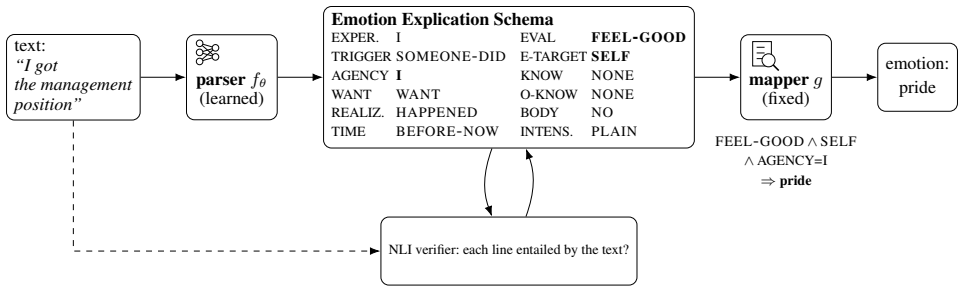
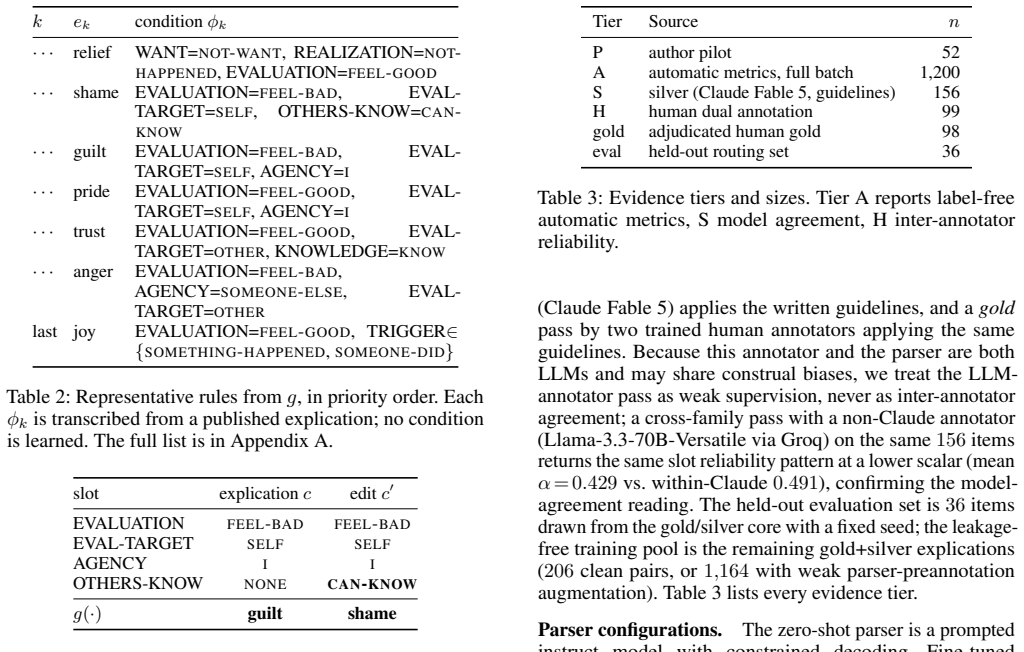
A learned parser converts input text into a twelve-slot Natural Semantic Metalanguage explication; a fixed decision list transcribed from published semantic definitions then computes the emotion label from the explication alone. The label is therefore produced by definition from the explication, confining all empirical risk to the parser and enabling per-line auditability of the explanation against the input.
What carries the argument
The explication interface: a parser that produces a twelve-slot Natural Semantic Metalanguage script, followed by a fixed rule-based decision list that maps the slots to an emotion label.
If this is right
- The emotion label is determined solely by the explication and the rule list, independent of any learned weights inside the parser.
- Every step from input text to label can be inspected and verified line by line through entailment checks.
- Empirical error is confined to the parser's slot-filling accuracy rather than distributed across an opaque classifier.
- The released EmoExpl-1200 dataset supplies per-line verification metadata that supports direct auditing of the parser.
Where Pith is reading between the lines
- The same rule-list structure could be reused for other affective tasks if corresponding semantic definitions are available.
- Targeted correction of individual slots in the parser output might improve accuracy without retraining the entire model.
- The approach isolates the verification problem to the parser, which may allow incremental dataset expansion focused on slot accuracy.
Load-bearing premise
The fixed decision list of rules correctly maps the twelve-slot explications to the intended emotion labels for event descriptions.
What would settle it
A collection of event descriptions for which the generated explications have been manually verified slot-by-slot yet the rule list produces emotion labels that systematically disagree with human judgments on the same events.
Figures


read the original abstract
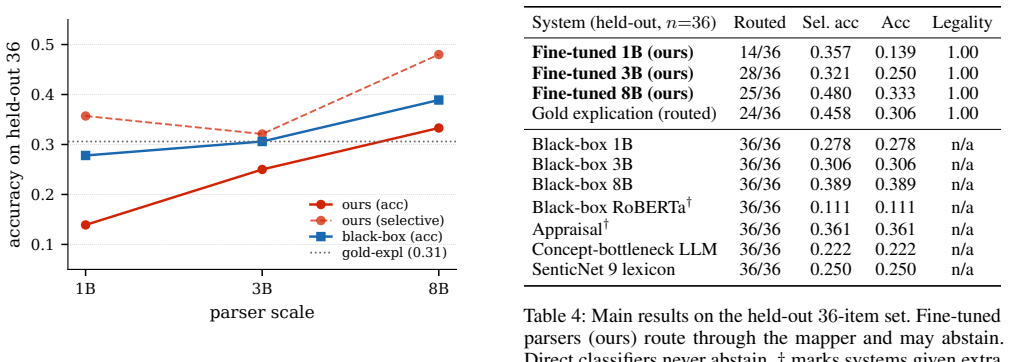
Explanations for emotion classifiers are usually produced post hoc, with no guarantee that they reflect the computation behind the label. We present an explication interface for event-based emotion analysis. A parser maps the input text to an explication, a short script in the closed vocabulary of Natural Semantic Metalanguage organized into twelve typed slots, and a fixed decision list of rules transcribed from published semantic definitions computes the label from the explication alone. The faithfulness guarantee is therefore causal and definitional, while all empirical risk lives in the learned parser, which the per-line entailment interface makes auditable against the input. On crowd-sourced event descriptions, our fine-tuned parser reaches 0.33 accuracy and 0.48 selective accuracy on a small held-out set, suggesting that the interface trades insignificant accuracy difference to a black-box model for a verifiable, inspectable decision basis for first-person event-based emotion analysis. We also release EmoExpl-1200 with per-line verification metadata and the full rule set.
Editorial analysis
A structured set of objections, weighed in public.
Referee Report
Summary. The paper claims to provide a faithful emotion analysis interface for event descriptions by mapping input text via a learned parser to a twelve-slot Natural Semantic Metalanguage (NSM) explication, then applying a fixed decision list of rules transcribed from published semantic definitions to compute the label from the explication alone. This makes the faithfulness guarantee causal and definitional, with all empirical risk isolated to the parser (auditable via per-line entailment). On crowd-sourced event descriptions the fine-tuned parser reaches 0.33 accuracy and 0.48 selective accuracy on a small held-out set; the authors release EmoExpl-1200 with per-line verification metadata and the full rule set.
Significance. If the central claim holds, the work offers a meaningful contribution to explainable NLP by replacing post-hoc explanations with definitional faithfulness grounded in published NSM semantics. The explicit separation of the empirical parser from the rule-based label computation, together with the release of the dataset and full rule set, provides concrete value for auditability and reproducibility in first-person event-based emotion analysis.
major comments (2)
- [section describing the fixed decision list] The section describing the fixed decision list: the manuscript states that the rules are transcribed from published semantic definitions but supplies no side-by-side comparison, error audit, or domain-specific validation confirming that the transcribed list preserves the original definitions' conditions exactly for event descriptions. This is load-bearing for the definitional faithfulness claim; any addition, omission, or reinterpretation of a slot condition would mean the label is determined by the authors' encoding rather than the published definitions.
- [Evaluation section] Evaluation section / abstract: the reported 0.33 accuracy on the small held-out set is presented without error bars, baseline comparisons to black-box models, or details on parser training and evaluation procedure. While the paper frames this as trading insignificant accuracy for verifiability, the absence of these elements prevents assessment of whether the accuracy difference is indeed insignificant.
minor comments (1)
- [Abstract] The abstract refers to an 'insignificant accuracy difference' to a black-box model; this quantitative comparison should be stated explicitly with numbers in the main text.
Simulated Author's Rebuttal
We thank the referee for their constructive comments on the manuscript. We address each major comment below and indicate the revisions we will incorporate.
read point-by-point responses
-
Referee: [section describing the fixed decision list] The section describing the fixed decision list: the manuscript states that the rules are transcribed from published semantic definitions but supplies no side-by-side comparison, error audit, or domain-specific validation confirming that the transcribed list preserves the original definitions' conditions exactly for event descriptions. This is load-bearing for the definitional faithfulness claim; any addition, omission, or reinterpretation of a slot condition would mean the label is determined by the authors' encoding rather than the published definitions.
Authors: We agree that explicit verification is required to substantiate the definitional faithfulness claim. The current manuscript does not include a side-by-side comparison or domain-specific audit of the transcribed rules. We will revise the relevant section to add a comparison table mapping each rule to its source NSM definition, along with an error audit confirming that the conditions for event descriptions are preserved exactly, without addition, omission, or reinterpretation. revision: yes
-
Referee: [Evaluation section] Evaluation section / abstract: the reported 0.33 accuracy on the small held-out set is presented without error bars, baseline comparisons to black-box models, or details on parser training and evaluation procedure. While the paper frames this as trading insignificant accuracy for verifiability, the absence of these elements prevents assessment of whether the accuracy difference is indeed insignificant.
Authors: We acknowledge that the evaluation lacks the elements needed to assess the accuracy trade-off. In the revision we will add error bars to all reported metrics, include baseline comparisons against black-box models on the same held-out set, and expand the parser training and evaluation details (including data splits, fine-tuning procedure, and protocol). These additions will allow direct evaluation of whether the accuracy difference is insignificant relative to the verifiability gain. revision: yes
Circularity Check
No significant circularity; derivation is self-contained
full rationale
The paper's central claim rests on a fixed decision list transcribed from external published NSM semantic definitions (Wierzbicka/Goddard et al.), with the parser as a separate learned component whose output is audited per-line against input text. No equation or step reduces the label computation to a fitted parameter, self-defined quantity, or self-citation chain; the rules are released for inspection and the faithfulness guarantee is stated as following directly from the external definitions rather than being constructed from the present model's outputs. This matches the default expectation of non-circularity.
Axiom & Free-Parameter Ledger
free parameters (1)
- fine-tuned parser parameters
axioms (2)
- domain assumption Natural Semantic Metalanguage provides a closed, universal vocabulary sufficient to explicate event-based emotions
- domain assumption The published semantic definitions used for the decision list are accurate and domain-appropriate for the crowd-sourced event descriptions
invented entities (1)
-
twelve typed slots for NSM explications
no independent evidence
Reference graph
Works this paper leans on
-
[1]
Towards Universal Semantics With Large Language Models. arXiv:2505.11764. Cambria, E.; Mao, R.; Zhang, X.; Xiao, L.; Shen, T.; and Anand, A
-
[2]
Towards In- trinsic Interpretability of Large Language Models: A Survey of Design Principles and Architectures. arXiv:2604.16042. Goddard, C.; and Wierzbicka, A. 2014.Words and Meanings: Lexical Semantics Across Domains, Languages, and Cultures. Oxford University Press. Huang, Y .; Chen, S.; Cai, H.; and Dhingra, B
work page internal anchor Pith review Pith/arXiv arXiv 2014
-
[3]
Measuring Faithfulness in Chain-of-Thought Reasoning
Measuring Faithfulness in Chain-of- Thought Reasoning. arXiv:2307.13702. Liu, G. K.-M.; Yona, G.; Caciularu, A.; Szpektor, I.; Rudner, T. G. J.; and Cohan, A
work page internal anchor Pith review Pith/arXiv arXiv
-
[4]
MetaFaith: Faithful Natural Language Uncertainty Expression in LLMs. InProceedings of EMNLP. ArXiv:2505.24858. Liu, Y .; Ott, M.; Goyal, N.; Du, J.; Joshi, M.; Chen, D.; Levy, O.; Lewis, M.; Zettlemoyer, L.; and Stoyanov, V
-
[5]
RoBERTa: A Robustly Optimized BERT Pretraining Approach
RoBERTa: A Robustly Optimized BERT Pretraining Ap- proach. arXiv:1907.11692. Lyu, Q.; Apidianaki, M.; and Callison-Burch, C
work page internal anchor Pith review Pith/arXiv arXiv 1907
-
[6]
Walk the Talk? Measuring the Faithfulness of Large Language Model Explanations. InProceedings of ICLR. ArXiv:2504.14150. Miao, M. M.; and Ungar, L
-
[7]
Closing the Confidence-Faithfulness Gap in Large Language Models. arXiv:2603.25052. Ming, Y .; Purushwalkam, S.; Pandit, S.; Ke, Z.; Nguyen, X.-P.; Xiong, C.; and Joty, S
-
[8]
InAdvances in Neural Information Processing Systems (NeurIPS)
Towards Interpretability Without Sacri- fice: Faithful Dense Layer Decomposition with Mixture of Decoders. InAdvances in Neural Information Processing Systems (NeurIPS). Ortony, A.; Clore, G. L.; and Collins, A. 1988.The Cognitive Structure of Emotions. Cambridge University Press. Pavlick, E.; and Kwiatkowski, T
1988
-
[9]
Verbosity Tradeoffs and the Impact of Scale on the Faithfulness of LLM Self-Explanations
Verbosity Tradeoffs and the Impact of Scale on the Faithfulness of LLM Self-Explanations. arXiv:2503.13445. Smith, C. A.; and Ellsworth, P. C
work page internal anchor Pith review Pith/arXiv arXiv
-
[10]
Breaking the Chain: A Causal Analysis of LLM Faithfulness to Intermediate Structures
Breaking the Chain: A Causal Analysis of LLM Faithfulness to Intermedi- ate Structures. arXiv:2603.16475. Sui, Y .; He, Y .; Liu, N.; He, X.; Wang, K.; and Hooi, B
work page internal anchor Pith review Pith/arXiv arXiv
-
[11]
Mechanistic Interpretability of Emotion Inference in Large Language Models. InFindings of ACL. ArXiv:2502.05489. Tang, X.; Li, J.; Hu, K.; Du, N.; Li, X.; Zhang, X.; Sun, W.; and Xie, S
-
[12]
CogniBench: A Legal-Inspired Framework and Dataset for Assessing Cognitive Faithful- ness of Large Language Models. InProceedings of ACL. ArXiv:2505.20767. Tangney, J. P.; and Dearing, R. L. 2002.Shame and Guilt. Guilford Press. Tracy, J. L.; and Robins, R. W
-
[13]
In Proceedings of EMNLP
Self-Critique and Re- finement for Faithful Natural Language Explanations. In Proceedings of EMNLP. Wierzbicka, A. 1996.Semantics: Primes and Universals. Oxford University Press. Wierzbicka, A. 1999.Emotions Across Languages and Cul- tures: Diversity and Universals. Cambridge University Press. Xing, F.; Malandri, L.; Zhang, Y .; and Cambria, E
1996
-
[14]
Table 8: Emotion concepts analyzed with the NSM approach by Wierzbicka (1999)
and the complete routing confusion matrix (Fig- ure 8). Table 8: Emotion concepts analyzed with the NSM approach by Wierzbicka (1999). Category Emotion concepts Bad things happening sad, unhappy, distressed, upset, sorrow, sorry, grief, despair, depressed Good things happening joy, contented, pleased, delighted, excited People doing bad thing anger, indig...
1999
discussion (0)
Sign in with ORCID, Apple, or X to comment. Anyone can read and Pith papers without signing in.