Dark matter energy exchange in stars orbiting supermassive black holes
Pith reviewed 2026-07-02 09:58 UTC · model grok-4.3
The pith
Dark matter scattering can match the luminosity of stars orbiting close to supermassive black holes at cross sections of 10^{-36} cm² for a spiked density profile.
A machine-rendered reading of the paper's core claim, the machinery that carries it, and where it could break.
Core claim
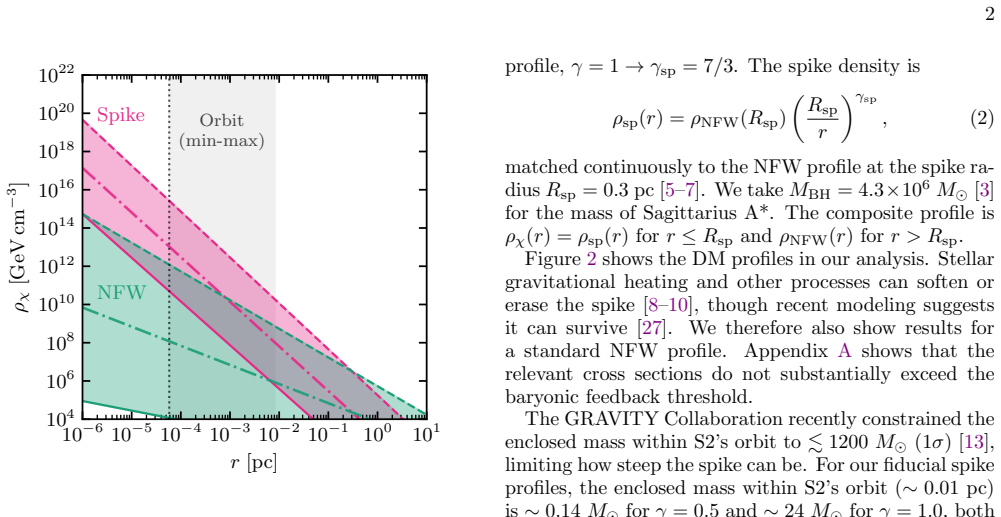
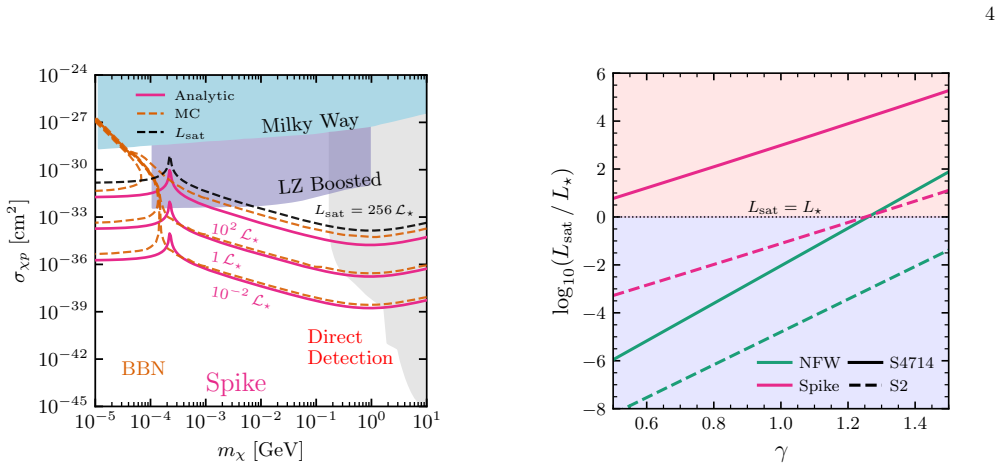
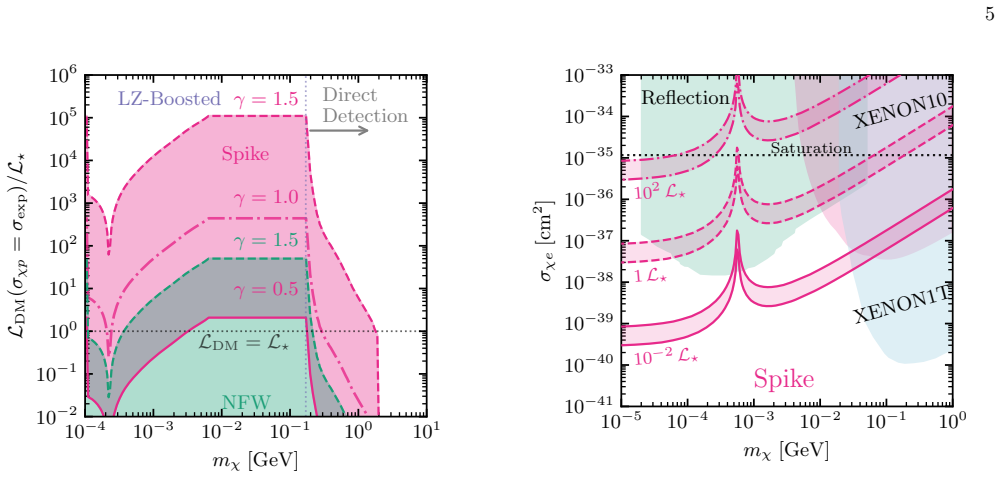
Stars on tight orbits around the supermassive black hole at the Galactic Center pass through regions where the dark matter density may be strongly enhanced. For a spiked dark matter profile, the exchange reaches the stellar luminosity at σ_χp ∼ 10^{-36} cm² for MeV-GeV masses and σ_χe ∼ 5×10^{-38} cm² for sub-MeV masses, opening a new annihilation-free route toward dark-star phases. These cross sections lie within the range predicted by freeze-in scenarios and are consistent with cosmic-ray-boosted and solar-reflection dark matter constraints.
What carries the argument
The orbit-averaged DM-induced energy exchange rate computed for a star on a relativistic orbit in a spiked dark matter density profile.
If this is right
- The energy exchange can reach the level of the star's own luminosity.
- This occurs at cross sections compatible with freeze-in dark matter production.
- The values remain consistent with constraints from cosmic-ray boosted dark matter and solar reflection.
- Stars can reach dark-star phases without requiring dark matter annihilation.
Where Pith is reading between the lines
- If the spiked profile is present, measurements of stellar energy output near galactic centers could constrain dark matter scattering cross sections.
- The mechanism could be tested by comparing predicted and observed luminosities for other known close-orbit stars.
- Applying this to different galactic centers might reveal similar effects if spikes form there too.
Load-bearing premise
The dark matter density near the supermassive black hole is enhanced in a spiked profile that the star's orbit samples.
What would settle it
Observation or modeling that the dark matter density profile around Sagittarius A* does not have a strong enough spike to make the energy exchange match luminosity at the stated cross sections.
Figures

read the original abstract
Stars on tight orbits around the supermassive black hole at the Galactic Center pass through regions where the dark matter~(DM) density may be strongly enhanced. We compute the orbit-averaged DM-induced energy exchange for S4714 as an example. It is a star on an exceptionally close and relativistic orbit around Sagittarius~A*. For a spiked dark matter profile, the exchange reaches the stellar luminosity at $\sigma_{\chi p} \sim 10^{-36}~\mathrm{cm}^2$ for MeV-GeV masses and $\sigma_{\chi e} \sim 5\times10^{-38}~\mathrm{cm}^2$ for sub-MeV masses, opening a new annihilation-free route toward dark-star phases. These cross sections lie within the range predicted by freeze-in scenarios and are consistent with cosmic-ray--boosted and solar-reflection dark matter constraints.
Editorial analysis
A structured set of objections, weighed in public.
Referee Report
Summary. The manuscript computes the orbit-averaged energy exchange rate between dark matter and the star S4714 on its close, relativistic orbit around Sagittarius A*. For an assumed spiked DM density profile, the exchange equals stellar luminosity at σ_χp ∼ 10^{-36} cm² (MeV-GeV masses) and σ_χe ∼ 5×10^{-38} cm² (sub-MeV masses), framing this as an annihilation-free channel toward dark-star phases that lies inside freeze-in and cosmic-ray-boosted constraints.
Significance. If the modeling assumptions hold, the result identifies a new astrophysical signature of DM scattering near SMBHs that connects laboratory-accessible cross sections to observable stellar properties, without invoking annihilation. No machine-checked proofs or public code are reported, but the forward calculation from standard profiles and orbital data is a clear strength.
major comments (2)
- [DM profile modeling (abstract and profile section)] The spiked DM density profile is load-bearing for the central claim that the quoted cross sections reach L_star. Without a quantitative sensitivity study showing how the required σ values shift for a non-spiked (e.g., NFW or adiabatically contracted but non-spiked) profile at ∼10^{-3} pc, the result cannot be assessed as lying inside the freeze-in window.
- [Energy exchange calculation] The orbit-averaged energy-exchange formula and its numerical evaluation (including integration limits, DM velocity distribution, and relativistic corrections for S4714) are not visible in sufficient detail to verify the quoted cross-section thresholds; this prevents confirmation that the luminosity-matching values are robust.
minor comments (1)
- [Abstract] The abstract states the cross sections without quoting the exact spike parameters (e.g., power-law index or normalization radius) used; a one-sentence definition or reference would improve clarity.
Simulated Author's Rebuttal
We thank the referee for the detailed and constructive report. We address each major comment below. Where revisions are needed to improve clarity and robustness, we will incorporate them in the revised manuscript.
read point-by-point responses
-
Referee: [DM profile modeling (abstract and profile section)] The spiked DM density profile is load-bearing for the central claim that the quoted cross sections reach L_star. Without a quantitative sensitivity study showing how the required σ values shift for a non-spiked (e.g., NFW or adiabatically contracted but non-spiked) profile at ∼10^{-3} pc, the result cannot be assessed as lying inside the freeze-in window.
Authors: The spiked profile is the physically motivated case for the Galactic Center due to adiabatic contraction from SMBH growth, as standard in the literature for such orbits. For non-spiked profiles the DM density drops sharply and the required cross sections would increase substantially, potentially outside the freeze-in window; our claim is therefore scoped to the spiked scenario as a possible new signature. We will add a short quantitative sensitivity paragraph (including order-of-magnitude estimates for NFW and contracted non-spiked cases at the relevant radii) to make this dependence explicit. revision: yes
-
Referee: [Energy exchange calculation] The orbit-averaged energy-exchange formula and its numerical evaluation (including integration limits, DM velocity distribution, and relativistic corrections for S4714) are not visible in sufficient detail to verify the quoted cross-section thresholds; this prevents confirmation that the luminosity-matching values are robust.
Authors: We agree that additional detail is required for reproducibility. The orbit average is obtained by integrating the local energy-transfer rate (using the standard DM-star scattering kinematics) along the relativistic orbit of S4714, with the DM velocity distribution taken as isotropic in the spike frame and relativistic corrections applied to the relative velocity and energy transfer. We will insert the explicit integral expression, the adopted integration limits, the form of the velocity distribution, and the treatment of relativistic effects into the methods section of the revised manuscript. revision: yes
Circularity Check
No circularity; forward calculation from external profile assumption
full rationale
The derivation computes orbit-averaged energy exchange rates from an input spiked DM density profile, S4714 orbital data, and scattering cross sections, then compares the result to stellar luminosity to obtain required sigma values. No equations reduce outputs to fitted inputs by construction, no self-citations are load-bearing for the central result, and the spiked profile is invoked as a modeling choice rather than derived internally. The calculation is self-contained against external benchmarks and does not exhibit any of the enumerated circular patterns.
Axiom & Free-Parameter Ledger
axioms (1)
- domain assumption Dark matter density follows a spiked profile near the supermassive black hole
Reference graph
Works this paper leans on
-
[1]
SINFONI in the Galactic Center: young stars and IR flares in the central light month
F. Eisenhaueret al., SINFONI in the Galactic Center: Young stars and IR flares in the central light month, As- trophys. J.628, 246 (2005), arXiv:astro-ph/0502129
work page internal anchor Pith review Pith/arXiv arXiv 2005
-
[2]
On the nature of the fast moving star S2 in the Galactic Center
F. Martins, S. Gillessen, F. Eisenhauer, R. Genzel, T. Ott, and S. Trippe, On the nature of the fast mov- ing star S2 in the Galactic Center, Astrophys. J. Lett. 672, L119 (2008), arXiv:0711.3344 [astro-ph]
work page internal anchor Pith review Pith/arXiv arXiv 2008
-
[3]
R. Abuteret al.(GRAVITY), Detection of the gravita- tional redshift in the orbit of the star S2 near the Galactic centre massive black hole, Astron. Astrophys.615, L15 (2018), arXiv:1807.09409 [astro-ph.GA]
work page internal anchor Pith review Pith/arXiv arXiv 2018
-
[4]
F. Peißker, A. Eckart, M. Zajaˇ cek, B. Ali, and M. Parsa, S62 and S4711: Indications of a Population of Faint Fast-moving Stars inside the S2 Orbit—S4711 on a 7.6 yr Orbit around Sgr A*, Astrophys. J.899, 50 (2020), arXiv:2008.04764 [astro-ph.GA]
-
[5]
Dark matter annihilation at the galactic center
P. Gondolo and J. Silk, Dark matter annihilation at the galactic center, Phys. Rev. Lett.83, 1719 (1999), arXiv:astro-ph/9906391
work page internal anchor Pith review Pith/arXiv arXiv 1999
-
[6]
G. D. Quinlan, L. Hernquist, and S. Sigurdsson, Models of Galaxies with Central Black Holes: Adiabatic Growth in Spherical Galaxies, Astrophys. J.440, 554 (1995), arXiv:astro-ph/9407005
work page internal anchor Pith review Pith/arXiv arXiv 1995
-
[7]
Dark matter distributions around massive black holes: A general relativistic analysis
L. Sadeghian, F. Ferrer, and C. M. Will, Dark mat- ter distributions around massive black holes: A general relativistic analysis, Phys. Rev. D88, 063522 (2013), arXiv:1305.2619 [astro-ph.GA]
work page internal anchor Pith review Pith/arXiv arXiv 2013
-
[8]
Time-Dependent Models for Dark Matter at the Galactic Center
G. Bertone and D. Merritt, Time-dependent models for dark matter at the Galactic Center, Phys. Rev. D72, 103502 (2005), arXiv:astro-ph/0501555
work page internal anchor Pith review Pith/arXiv arXiv 2005
-
[9]
Dark Matter Dynamics and Indirect Detection
G. Bertone and D. Merritt, Dark matter dynamics and indirect detection, Mod. Phys. Lett. A20, 1021 (2005), arXiv:astro-ph/0504422
work page internal anchor Pith review Pith/arXiv arXiv 2005
- [10]
- [11]
-
[12]
Dynamical constraints on a dark matter spike at the Galactic Centre from stellar orbits
T. Lacroix, Dynamical constraints on a dark matter spike at the Galactic Centre from stellar orbits, Astron. Astro- phys.619, A46 (2018), arXiv:1801.01308 [astro-ph.GA]
work page internal anchor Pith review Pith/arXiv arXiv 2018
-
[13]
K. Abd El Dayemet al.(GRAVITY), Improving con- straints on the extended mass distribution in the Galactic center with stellar orbits, Astron. Astrophys.692, A242 (2024), arXiv:2409.12261 [astro-ph.GA]
-
[14]
Dark stars at the Galactic centre - the main sequence
P. Scott, M. Fairbairn, and J. Edsjo, Dark stars at the Galactic centre - the main sequence, Mon. Not. Roy. As- tron. Soc.394, 82 (2009), arXiv:0809.1871 [astro-ph]
work page internal anchor Pith review Pith/arXiv arXiv 2009
- [15]
- [16]
- [17]
- [18]
- [19]
-
[20]
J. F. Navarro, C. S. Frenk, and S. D. M. White, The Structure of cold dark matter halos, Astrophys. J.462, 563 (1996), arXiv:astro-ph/9508025
work page internal anchor Pith review Pith/arXiv arXiv 1996
-
[21]
PPPC 4 DM ID: A Poor Particle Physicist Cookbook for Dark Matter Indirect Detection
M. Cirelli, G. Corcella, A. Hektor, G. Hutsi, M. Kadastik, P. Panci, M. Raidal, F. Sala, and A. Strumia, PPPC 4 DM ID: A Poor Particle Physicist Cookbook for Dark Matter Indirect Detection, JCAP03, 051, [Erratum: JCAP 10, E01 (2012)], arXiv:1012.4515 [hep-ph]
work page internal anchor Pith review Pith/arXiv arXiv 2012
-
[22]
O. Y. Gnedin and J. R. Primack, Dark Matter Profile in the Galactic Center, Phys. Rev. Lett.93, 061302 (2004), arXiv:astro-ph/0308385
work page internal anchor Pith review Pith/arXiv arXiv 2004
-
[23]
Made-to-Measure models of the Galactic Box/Peanut bulge: stellar and total mass in the bulge region
M. Portail, C. Wegg, O. Gerhard, and I. Martinez- Valpuesta, Made-to-measure models of the Galactic box/peanut bulge: stellar and total mass in the bulge region, Monthly Notices of the Royal Astronomical Soci- ety448, 713 (2015), arXiv:1502.00633 [astro-ph.GA]
work page internal anchor Pith review Pith/arXiv arXiv 2015
-
[24]
An estimate of the DM profile in the Galactic bulge region
F. Iocco and M. Benito, An estimate of the DM profile in the Galactic bulge region, Phys. Dark Univ.15, 90 (2017), arXiv:1611.09861 [astro-ph.GA]
work page internal anchor Pith review Pith/arXiv arXiv 2017
-
[25]
The Density of Dark Matter in the Galactic Bulge and Implications for Indirect Detection
D. Hooper, The Density of Dark Matter in the Galac- tic Bulge and Implications for Indirect Detection, Phys. Dark Univ.15, 53 (2017), arXiv:1608.00003 [astro- ph.HE]
work page internal anchor Pith review Pith/arXiv arXiv 2017
-
[26]
M. Baumgart, S. Bottaro, D. Redigolo, N. L. Rodd, and T. R. Slatyer, Testing real WIMPs with CTAO, JHEP 02, 213, arXiv:2507.15937 [hep-ph]
- [27]
-
[28]
Gould, Resonant enhancements in wimp capture by the earth, Astrophys
A. Gould, Resonant enhancements in wimp capture by the earth, Astrophys. J.321, 571 (1987)
1987
-
[29]
Gould, WIMP Distribution in and Evaporation From the Sun, Astrophys
A. Gould, WIMP Distribution in and Evaporation From the Sun, Astrophys. J.321, 560 (1987)
1987
-
[30]
Modules for Experiments in Stellar Astrophysics (MESA)
B. Paxton, L. Bildsten, A. Dotter, F. Herwig, P. Lesaffre, and F. Timmes, Modules for Experiments in Stellar As- trophysics (MESA), Astrophysical Journal Supplement Series192, 3 (2011), arXiv:1009.1622 [astro-ph.SR]
work page internal anchor Pith review Pith/arXiv arXiv 2011
-
[31]
B. Paxton, M. Cantiello, P. Arras, L. Bildsten, E. F. Brown, A. Dotter, C. Mankovich, M. H. Montgomery, D. Stello, F. X. Timmes, and R. Townsend, Modules for Experiments in Stellar Astrophysics (MESA): Plan- ets, Oscillations, Rotation, and Massive Stars, The As- trophysical Journal Supplement Series208, 4 (2013), arXiv:1301.0319 [astro-ph.SR]
work page internal anchor Pith review Pith/arXiv arXiv 2013
-
[32]
Modules for Experiments in Stellar Astrophysics (MESA): Binaries, Pulsations, and Explosions
B. Paxton, P. Marchant, J. Schwab, E. B. Bauer, L. Bild- sten, M. Cantiello, L. Dessart, R. Farmer, H. Hu, N. Langer, R. H. D. Townsend, D. M. Townsley, and F. X. Timmes, Modules for Experiments in Stellar Astro- physics (MESA): Binaries, Pulsations, and Explosions, 11 The Astrophysical Journal Supplement Series220, 15 (2015), arXiv:1506.03146 [astro-ph.SR]
work page internal anchor Pith review Pith/arXiv arXiv 2015
-
[33]
B. Paxtonet al., Modules for Experiments in Stellar Astrophysics (MESA): Convective Boundaries, Element Diffusion, and Massive Star Explosions, Astrophys. J. Suppl.234, 34 (2018), arXiv:1710.08424 [astro-ph.SR]
work page internal anchor Pith review Pith/arXiv arXiv 2018
-
[34]
B. Paxton, R. Smolec, J. Schwab, A. Gautschy, L. Bild- sten, M. Cantiello, A. Dotter, R. Farmer, J. A. Goldberg, A. S. Jermyn, S. M. Kanbur, P. Marchant, A. Thoul, R. H. D. Townsend, W. M. Wolf, M. Zhang, and F. X. Timmes, Modules for Experiments in Stellar As- trophysics (MESA): Pulsating Variable Stars, Rotation, Convective Boundaries, and Energy Conser...
work page internal anchor Pith review Pith/arXiv arXiv 2019
- [35]
-
[36]
J. Aalberset al.(LZ), New Constraints on Cos- mic Ray-Boosted Dark Matter from the LUX-ZEPLIN Experiment, Phys. Rev. Lett.134, 241801 (2025), arXiv:2503.18158 [hep-ex]
-
[37]
Billardet al., Direct detection of dark matter—appec committee report*, Rept
J. Billardet al., Direct detection of dark matter—appec committee report*, Rept. Prog. Phys.85, 056201 (2022), arXiv:2104.07634 [hep-ex]
-
[38]
Results on MeV-scale dark matter from a gram-scale cryogenic calorimeter operated above ground
G. Angloheret al.(CRESST), Results on MeV-scale dark matter from a gram-scale cryogenic calorimeter op- erated above ground, Eur. Phys. J. C77, 637 (2017), arXiv:1707.06749 [astro-ph.CO]
work page internal anchor Pith review Pith/arXiv arXiv 2017
-
[39]
G. Angloheret al.(CRESST), Testing spin-dependent dark matter interactions with lithium aluminate tar- gets in CRESST-III, Phys. Rev. D106, 092008 (2022), arXiv:2207.07640 [astro-ph.CO]
-
[40]
A. Aguilar-Arevaloet al.(DAMIC), Results on low-mass weakly interacting massive particles from a 11 kg-day target exposure of DAMIC at SNOLAB, Phys. Rev. Lett. 125, 241803 (2020), arXiv:2007.15622 [astro-ph.CO]
-
[41]
Low-Mass Dark Matter Search with the DarkSide-50 Experiment
P. Agneset al.(DarkSide), Low-Mass Dark Mat- ter Search with the DarkSide-50 Experiment, Phys. Rev. Lett.121, 081307 (2018), arXiv:1802.06994 [astro- ph.HE]
work page internal anchor Pith review Pith/arXiv arXiv 2018
-
[42]
DarkSide-50 532-day Dark Matter Search with Low-Radioactivity Argon
P. Agneset al.(DarkSide), DarkSide-50 532-day Dark Matter Search with Low-Radioactivity Argon, Phys. Rev. D98, 102006 (2018), arXiv:1802.07198 [astro-ph.CO]
work page internal anchor Pith review Pith/arXiv arXiv 2018
-
[43]
Dark Matter Search Results from a One Tonne$\times$Year Exposure of XENON1T
E. Aprileet al.(XENON), Dark Matter Search Results from a One Ton-Year Exposure of XENON1T, Phys. Rev. Lett.121, 111302 (2018), arXiv:1805.12562 [astro- ph.CO]
work page internal anchor Pith review Pith/arXiv arXiv 2018
-
[44]
Aprileet al.(XENON), Light Dark Matter Search with Ionization Signals in XENON1T, Phys
E. Aprileet al.(XENON), Light Dark Matter Search with Ionization Signals in XENON1T, Phys. Rev. Lett. 123, 251801 (2019), arXiv:1907.11485 [hep-ex]
- [45]
-
[46]
G. Krnjaic and S. D. McDermott, Implications of BBN Bounds for Cosmic Ray Upscattered Dark Matter, Phys. Rev. D101, 123022 (2020), arXiv:1908.00007 [hep-ph]
- [47]
-
[48]
E. O. Nadler, V. Gluscevic, K. K. Boddy, and R. H. Wechsler, Constraints on Dark Matter Microphysics from the Milky Way Satellite Population, Astrophys. J. Lett.878, 32 (2019), [Erratum: Astrophys.J.Lett. 897, L46 (2020), Erratum: Astrophys.J. 897, L46 (2020)], arXiv:1904.10000 [astro-ph.CO]
- [49]
-
[50]
Zhanget al.(PandaX), Search for Light Dark Matter with 259 Days of Data in PandaX-4T, Phys
M. Zhanget al.(PandaX), Search for Light Dark Matter with 259 Days of Data in PandaX-4T, Phys. Rev. Lett. 135, 211001 (2025), arXiv:2507.11930 [hep-ex]
-
[51]
New Constraints and Prospects for sub-GeV Dark Matter Scattering off Electrons in Xenon
R. Essig, T. Volansky, and T.-T. Yu, New Constraints and Prospects for sub-GeV Dark Matter Scattering off Electrons in Xenon, Phys. Rev. D96, 043017 (2017), arXiv:1703.00910 [hep-ph]
work page internal anchor Pith review Pith/arXiv arXiv 2017
-
[52]
Dark matter and the first stars: a new phase of stellar evolution
D. Spolyar, K. Freese, and P. Gondolo, Dark matter and the first stars: a new phase of stellar evolution, Phys. Rev. Lett.100, 051101 (2008), arXiv:0705.0521 [astro- ph]
work page internal anchor Pith review Pith/arXiv arXiv 2008
-
[53]
Dark Matter capture and annihilation on the First Stars: preliminary estimates
F. Iocco, Dark Matter Capture and Annihilation on the First Stars: Preliminary Estimates, Astrophys. J. Lett. 677, L1 (2008), arXiv:0802.0941 [astro-ph]
work page internal anchor Pith review Pith/arXiv arXiv 2008
-
[54]
I. V. Moskalenko and L. Wai, Dark matter burners: Pre- liminary estimates (2006), arXiv:astro-ph/0608535
work page internal anchor Pith review Pith/arXiv arXiv 2006
-
[55]
K. Freese, T. Rindler-Daller, D. Spolyar, and M. Valluri, Dark Stars: A Review, Rept. Prog. Phys.79, 066902 (2016), arXiv:1501.02394 [astro-ph.CO]
work page internal anchor Pith review Pith/arXiv arXiv 2016
-
[56]
F. Peißker, A. Eckart, M. Zajaˇ cek, and S. Britzen, Obser- vation of S4716-a Star with a 4 yr Orbit around Sgr A*, Astrophys. J.933, 49 (2022), arXiv:2207.02142 [astro- ph.GA]
-
[57]
R. Abuteret al.(GRAVITY), Mass distribution in the Galactic Center based on interferometric astrometry of multiple stellar orbits, Astron. Astrophys.657, L12 (2022), arXiv:2112.07478 [astro-ph.GA]
-
[58]
King’s College London, King’s Computational Research, Engineering and Technology Environment (CREATE) (2026)
2026
-
[59]
The Galactic Center Massive Black Hole and Nuclear Star Cluster
R. Genzel, F. Eisenhauer, and S. Gillessen, The Galac- tic Center massive black hole and nuclear star cluster, Rev. Mod. Phys.82, 3121 (2010), arXiv:1006.0064 [astro- ph.GA]
work page internal anchor Pith review Pith/arXiv arXiv 2010
-
[60]
The structure of the nuclear stellar cluster of the Milky Way
R. Schodelet al., The structure of the nuclear stellar cluster of the Milky Way (2007), arXiv:astro-ph/0703178
work page internal anchor Pith review Pith/arXiv arXiv 2007
-
[61]
The nuclear star cluster of the Milky Way
R. Schoedel, D. Merritt, and A. Eckart, The nuclear star cluster of the Milky Way, J. Phys. Conf. Ser.131, 012044 (2008), arXiv:0810.0204 [astro-ph]
work page internal anchor Pith review Pith/arXiv arXiv 2008
-
[62]
F. K. Baganoffet al., Chandra x-ray spectroscopic imag- ing of Sgr A* and the central parsec of the Galaxy, As- trophys. J.591, 891 (2003), arXiv:astro-ph/0102151
work page internal anchor Pith review Pith/arXiv arXiv 2003
-
[63]
P. G. Mezger, W. J. Duschl, and R. Zylka, The Galactic Center: a laboratory for AGN?, Astronomy and Astro- physics Review7, 289 (1996)
1996
-
[64]
B. Betancourt Kamenetskaia, M. Fujiwara, A. Ibarra, and T. Toma, Dark matter spikes with strongly self- interacting particles, JCAP09, 074, arXiv:2506.12642 [hep-ph]
-
[65]
D. N. Spergel and P. J. Steinhardt, Observational ev- idence for selfinteracting cold dark matter, Phys. Rev. Lett.84, 3760 (2000), arXiv:astro-ph/9909386
work page internal anchor Pith review Pith/arXiv arXiv 2000
-
[66]
M. Kaplinghat, S. Tulin, and H.-B. Yu, Dark Matter Halos as Particle Colliders: Unified Solution to Small- Scale Structure Puzzles from Dwarfs to Clusters, Phys. 12 Rev. Lett.116, 041302 (2016), arXiv:1508.03339 [astro- ph.CO]
work page internal anchor Pith review Pith/arXiv arXiv 2016
-
[67]
Z.-C. Zhang and Y. Tang, Velocity distribution of dark matter in spikes around Schwarzschild black holes and effects on gravitational waves from extreme-mass- ratio inspirals, Phys. Rev. D110, 103008 (2024), arXiv:2403.18529 [astro-ph.GA]
-
[68]
Z.-C. Zhang, H.-C. Yuan, and Y. Tang, Universal den- sity and velocity distributions of dark matter around massive black holes, Phys. Rev. D112, 043025 (2025), arXiv:2503.02573 [astro-ph.GA]
-
[69]
A. K. Drukier, K. Freese, and D. N. Spergel, Detecting Cold Dark Matter Candidates, Phys. Rev. D33, 3495 (1986)
1986
-
[70]
M. Habibi, S. Gillessen, F. Martins, F. Eisenhauer, P. M. Plewa, O. Pfuhl, E. George, J. Dexter, I. Waisberg, T. Ott, S. von Fellenberg, M. Baub¨ ock, A. Jimenez- Rosales, and R. Genzel, Twelve Years of Spectroscopic Monitoring in the Galactic Center: The Closest Look at S-stars near the Black Hole, Astrophys. J.847, 120 (2017), arXiv:1708.06353 [astro-ph.SR]
work page internal anchor Pith review Pith/arXiv arXiv 2017
-
[71]
The GWs from the S-stars revolving around the SMBH at Sgr A*
R.-G. Cai, T.-B. Liu, and S.-J. Wang, Gws from s- stars revolving around smbh at sgr a**, Commun. Theor. Phys.70, 735 (2018), arXiv:1808.03164 [gr-qc]
work page internal anchor Pith review Pith/arXiv arXiv 2018
discussion (0)
Sign in with ORCID, Apple, or X to comment. Anyone can read and Pith papers without signing in.