Learning Cardiac Motion Priors for Implicit Neural Representations
Pith reviewed 2026-07-02 13:47 UTC · model grok-4.3
The pith
Learned priors from meta-learning and related methods accelerate adaptation of implicit neural representations for cardiac motion estimation.
A machine-rendered reading of the paper's core claim, the machinery that carries it, and where it could break.
Core claim
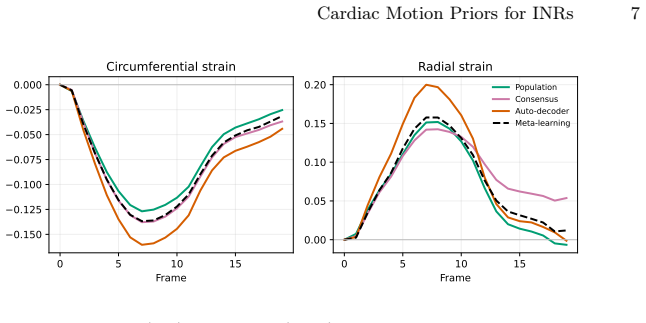
All four learned priors substantially improve early adaptation performance compared with random initialisation; auto-decoders recover large deformations faster during early steps, while meta-learning achieves strong early performance and maintains the best adaptation trajectory over fifty iterations.
What carries the argument
Four strategies (joint population optimisation, weight-averaged consensus prior, auto-decoders, and meta-learning) that encode cardiac motion patterns to initialise and guide optimisation of implicit neural representations for motion field estimation.
If this is right
- Meta-learning sustains performance gains across extended optimisation runs.
- Auto-decoders enable quicker recovery of large deformations in early adaptation steps.
- Simple consensus priors obtained by weight averaging provide effective guidance at low computational cost.
- All learned priors reduce sensitivity of INR fitting to the choice of initial weights.
Where Pith is reading between the lines
- The same prior-learning strategies could be tested on other dynamic imaging tasks such as respiratory or brain motion estimation.
- Clinical workflows processing large cardiac MRI cohorts might shorten analysis time by storing and reusing these priors.
- Cross-scanner validation would be needed before deployment to avoid hidden biases from the UK Biobank acquisition protocol.
Load-bearing premise
Priors learned from UK Biobank short-axis tagged images will generalise to new image sequences or different acquisition protocols without introducing systematic bias.
What would settle it
On an external tagged MRI test set from a different scanner or protocol, the meta-learned prior shows no improvement or worse tracking accuracy than random initialisation after the same number of adaptation iterations.
Figures


read the original abstract
Implicit neural representations (INRs) are well suited to cardiac motion estimation, providing continuous, compact representations of motion fields. However, fitting an INR to each image sequence is time-consuming and sensitive to the optimisation trajectory. Learned priors can help guide optimisation towards plausible motion fields and enable faster adaptation, but learning priors for cardiac motion INRs remains under-explored. In this work, we compare four strategies for learning cardiac motion priors, including a population prior learned by joint optimisation, a consensus prior obtained by weight averaging, auto-decoders, and meta-learning. Using short-axis tagged cardiac magnetic resonance images from the UK Biobank, we evaluate their impact on tracking accuracy, motion behaviour, and adaptation trajectory. All learned priors substantially improved early adaptation performance compared with random initialisation. While the simple consensus prior was effective, auto-decoders recovered large deformations faster during early adaptation. Meta-learning achieved strong early performance and maintained the best adaptation trajectory over 50 iterations.
Editorial analysis
A structured set of objections, weighed in public.
Referee Report
Summary. This paper investigates strategies for learning cardiac motion priors to improve the fitting of implicit neural representations (INRs) to cardiac image sequences. It compares four approaches—joint optimisation of a population prior, consensus prior via weight averaging, auto-decoders, and meta-learning—using short-axis tagged CMR images from the UK Biobank. The evaluation focuses on tracking accuracy, motion behaviour, and adaptation trajectory during optimisation. The key findings are that all learned priors enhance early adaptation performance relative to random initialisation, auto-decoders are faster at recovering large deformations, and meta-learning yields the strongest and most sustained adaptation trajectory over 50 iterations.
Significance. Should the empirical findings prove robust under rigorous validation, this study makes a meaningful contribution to the application of INRs in medical image analysis by systematically comparing prior learning methods for cardiac motion. The demonstration that meta-learning outperforms other strategies in adaptation speed and stability could influence the design of future INR-based motion estimation pipelines, potentially leading to more efficient clinical workflows. The work is timely given the growing interest in continuous representations for dynamic imaging.
major comments (2)
- [Methods] Methods section (data handling and experimental protocol): The manuscript provides no information on subject-level train/test splits, cross-validation folds, or external cohorts with differing acquisition protocols when learning priors from UK Biobank short-axis tagged images and evaluating adaptation on held-out sequences. This is load-bearing for the central claim that learned priors capture population-level motion structure (rather than dataset-specific artifacts), because without such controls the reported improvements in early adaptation and meta-learning trajectory could arise from reduced domain shift within the same cohort.
- [Results] Results (adaptation trajectory analysis): Claims that meta-learning 'maintained the best adaptation trajectory over 50 iterations' and that 'all learned priors substantially improved early adaptation' lack reported statistical tests, subject-wise variance, or multiple random seeds; without these, it is unclear whether the ranking among joint optimisation, consensus, auto-decoders, and meta-learning is reliable.
minor comments (2)
- [Abstract] Abstract: Claims of 'substantially improved' performance would be strengthened by inclusion of at least one quantitative metric (e.g., Dice or endpoint error at iteration 5) with error bars.
- [Figures] Figure captions and legends: Ensure all plots of adaptation trajectories explicitly label the y-axis metric, indicate number of subjects or runs, and distinguish the four prior strategies with consistent line styles.
Simulated Author's Rebuttal
We thank the referee for the constructive feedback. We address each major comment below and will revise the manuscript to incorporate the requested details and analyses.
read point-by-point responses
-
Referee: [Methods] Methods section (data handling and experimental protocol): The manuscript provides no information on subject-level train/test splits, cross-validation folds, or external cohorts with differing acquisition protocols when learning priors from UK Biobank short-axis tagged images and evaluating adaptation on held-out sequences. This is load-bearing for the central claim that learned priors capture population-level motion structure (rather than dataset-specific artifacts), because without such controls the reported improvements in early adaptation and meta-learning trajectory could arise from reduced domain shift within the same cohort.
Authors: We agree that explicit reporting of data splits is required to support claims about population-level motion priors. The experiments used a subject-level partition of the UK Biobank cohort (priors learned on one set of subjects, adaptation evaluated on held-out subjects from the same acquisition protocol), but this was not described in the manuscript. We will revise the Methods section to detail the exact subject-wise train/test split, note the absence of cross-validation or external cohorts, and discuss the resulting limitation on generalizability beyond the UK Biobank short-axis tagged CMR distribution. revision: yes
-
Referee: [Results] Results (adaptation trajectory analysis): Claims that meta-learning 'maintained the best adaptation trajectory over 50 iterations' and that 'all learned priors substantially improved early adaptation' lack reported statistical tests, subject-wise variance, or multiple random seeds; without these, it is unclear whether the ranking among joint optimisation, consensus, auto-decoders, and meta-learning is reliable.
Authors: We acknowledge that the reported trajectories lack statistical support and variance estimates. In the revision we will augment the adaptation figures with subject-wise standard deviation bands, add paired statistical comparisons (e.g., Wilcoxon tests) between methods at selected iterations, and report results aggregated over multiple random seeds for the INR optimisation. These additions will allow readers to assess the reliability of the observed performance ordering. revision: yes
Circularity Check
No circularity: empirical comparison of optimization strategies on held-out sequences
full rationale
The paper is an empirical study comparing four prior-learning strategies (joint optimisation, consensus, auto-decoders, meta-learning) for cardiac motion INRs. Claims rest on measured adaptation trajectories and tracking accuracy on UK Biobank short-axis tagged images. No equations, derivations, or fitted parameters are presented whose outputs reduce by construction to the inputs; performance gains are reported as experimental outcomes rather than algebraic identities. No self-citation chains or uniqueness theorems are invoked as load-bearing premises. The derivation chain is therefore self-contained and externally falsifiable via the reported metrics.
Axiom & Free-Parameter Ledger
Reference graph
Works this paper leans on
-
[1]
In: Proc
Alvarez-Florez, L., Haddou, S.B., Tjong, F.V.Y., Igum, I.: Tagged-Informed Prior for Motion Quantification in Cine CMR Using Implicit Neural Representations. In: Proc. 9th Int. Conf. Med. Imaging Deep Learn. pp. 2003–2018. PMLR (May 2026), https://proceedings.mlr.press/v315/ alvarez-florez26a.html
2003
-
[2]
In: STACOM
Alvarez-Florez, L., Sander, J., Bourfiss, M., Tjong, F.V.Y., Velthuis, B.K., Išgum, I.: Deep Learning for Automatic Strain Quantification in Ar- rhythmogenic Right Ventricular Cardiomyopathy. In: STACOM. pp. 25–
-
[3]
https://doi.org/10.1007/ 978-3-031-52448-6_3
Springer Nature Switzerland, Cham (2024). https://doi.org/10.1007/ 978-3-031-52448-6_3
2024
-
[4]
Amiranashvili, T., Lüdke, D., Li, H.B., Zachow, S., Menze, B.H.: Learning continuous shape priors from sparse data with neural implicit functions. Medical Image Analysis94, 103099 (May 2024). https://doi.org/10.1016/j. media.2024.103099
work page doi:10.1016/j 2024
-
[5]
Medical Image Analysis89, 102925 (Oct 2023)
Arratia López, P., Mella, H., Uribe, S., Hurtado, D.E., Sahli Costabal, F.: WarpPINN: Cine-MR image registration with physics-informed neural net- works. Medical Image Analysis89, 102925 (Oct 2023). https://doi.org/10. 1016/j.media.2023.102925
-
[6]
Gordaliza, P., Georgantas, C., van Heeswijk, R.B., Richiardi, J.: NIMOSEF: Neural Implicit Motion and Segmentation Functions
Banus, J., Delaloye, A., M. Gordaliza, P., Georgantas, C., van Heeswijk, R.B., Richiardi, J.: NIMOSEF: Neural Implicit Motion and Segmentation Functions. In: Med. Image Comput. Comput. Assist. Interv. – MICCAI
-
[7]
pp. 444–454. Springer Nature Switzerland, Cham (2026). https://doi. org/10.1007/978-3-032-05141-7_43
-
[8]
Bell, A., Choi, Y.K., Petersen, S.E., King, A., Nazir, M.S., Young, A.A.: Implicit neural representations of intramyocardial motion and strain. In: STACOM. pp. 150–159. Springer Nature Switzerland, Cham (2026). https: //doi.org/10.1007/978-3-032-17734-6_15
-
[9]
Chandrashekara, R., Rao, A., Sanchez-Ortiz, G.I., Mohiaddin, R.H., Rueck- ert, D.: Construction of a statistical model for cardiac motion analysis using nonrigid image registration. In: Inf. Process. Med. Imaging. pp. 599–610. Springer Berlin Heidelberg, Berlin, Heidelberg (2003). https://doi.org/10. 1007/978-3-540-45087-0_50
2003
-
[10]
Inverse Probl.24(Jun 2008)
Fischer, B., Modersitzki, J.: Ill-posed medicine - An introduction to im- age registration. Inverse Probl.24(Jun 2008). https://doi.org/10.1088/ 0266-5611/24/3/034008
2008
-
[11]
Garzia, S., Rygiel, P., Dummer, S., Cademartiri, F., Celi, S., Wolterink, J.M.: Neural Fields for Continuous Periodic Motion Estimation in 4D Car- diovascular Imaging. In: STACOM. pp. 378–389. Springer Nature Switzer- land, Cham (2025). https://doi.org/10.1007/978-3-031-87756-8_37
-
[12]
In: STACOM
Lowes, M.M., Pedersen, J.J., Hansen, B.S., Kofoed, K.F., Sermesant, M., Paulsen, R.R.: Implicit Neural Representations for Registration of Left Cardiac Motion Priors for INRs 11 Ventricle Myocardium During a Cardiac Cycle. In: STACOM. pp. 172–
-
[13]
https://doi.org/10.1007/ 978-3-031-87756-8_17
Springer-Verlag, Marrakesh, Morocco (2025). https://doi.org/10.1007/ 978-3-031-87756-8_17
2025
-
[14]
In: 2021 IEEE/CVF International Conference on Computer Vision (ICCV)
Mehta, I., Gharbi, M., Barnes, C., Shechtman, E., Ramamoorthi, R., Chandraker, M.: Modulated Periodic Activations for Generalizable Lo- cal Functional Representations. In: ICCV. pp. 14194–14203 (Oct 2021). https://doi.org/10.1109/ICCV48922.2021.01395
-
[15]
In: 2023 IEEE/CVF Interna- tional Conference on Computer Vision Workshops (ICCVW)
Molaei, A., Aminimehr, A., Tavakoli, A., Kazerouni, A., Azad, B., Azad, R., Merhof, D.: Implicit Neural Representation in Medical Imaging: A Comparative Survey. In: 2023 IEEECVF Int. Conf. Comput. Vis. Work- shop ICCVW. pp. 2373–2383. IEEE, Paris, France (Oct 2023). https: //doi.org/10.1109/ICCVW60793.2023.00252
-
[16]
Park, J.J., Florence, P., Straub, J., Newcombe, R., Lovegrove, S.: DeepSDF: Learning Continuous Signed Distance Functions for Shape Representation. In: 2019 IEEECVF Conf. Comput. Vis. Pattern Recognit. CVPR. pp. 165– 174 (Jun 2019). https://doi.org/10.1109/CVPR.2019.00025
-
[17]
J Cardiovasc Magn Reson18, 8 (Feb 2016)
Petersen, S.E., Matthews, P.M., Francis, J.M., Robson, M.D., Zemrak, F., Boubertakh, R., Young, A.A., Hudson, S., Weale, P., Garratt, S., Collins, R., Piechnik, S., Neubauer, S.: UK Biobank’s cardiovascular mag- netic resonance protocol. J Cardiovasc Magn Reson18, 8 (Feb 2016). https://doi.org/10.1186/s12968-016-0227-4
-
[18]
Shen, C., Zhu, H., Zhou, Y., Liu, Y., Yi, S., Dong, L., Zhao, W., Brady, D.J., Cao, X., Ma, Z., Lin, Y.: Continuous 3D Myocardial Motion Tracking via Echocardiography. IEEE Trans. Med. Imaging43(12), 4236–4252 (Dec 2024). https://doi.org/10.1109/TMI.2024.3419780
-
[19]
Sitzmann, V., Chan, E., Tucker, R., Snavely, N., Wetzstein, G.: MetaSDF: Meta-Learning Signed Distance Functions. In: Adv. Neu- ral Inf. Process. Syst. vol. 33, pp. 10136–10147. Curran Asso- ciates, Inc. (2020), https://papers.neurips.cc/paper_files/paper/2020/file/ 731c83db8d2ff01bdc000083fd3c3740-Paper.pdf
2020
-
[20]
Sitzmann, V., Martel, J., Bergman, A., Lindell, D., Wetzstein, G.: Implicit Neural Representations with Periodic Activation Functions. In: Adv. Neural Inf. Process. Syst. vol. 33, pp. 7462–7473. Curran Associates, Inc. (2020), https://proceedings.neurips.cc/paper/2020/hash/ 53c04118df112c13a8c34b38343b9c10-Abstract.html
2020
-
[21]
press/v172/wolterink22a.html
Wolterink, J.M., Zwienenberg, J.C., Brune, C.: Implicit Neural Representa- tionsforDeformableImageRegistration.In:Proc.5thInt.Conf.Med.Imag- ingDeepLearn.pp.1349–1359.PMLR(Dec2022),https://proceedings.mlr. press/v172/wolterink22a.html
-
[22]
IEEE Trans Med Imaging14(3), 413–421 (1995)
Young, A.A., Kraitchman, D.L., Dougherty, L., Axel, L.: Tracking and fi- nite element analysis of stripe deformation in magnetic resonance tagging. IEEE Trans Med Imaging14(3), 413–421 (1995). https://doi.org/10.1109/ 42.414605
1995
discussion (0)
Sign in with ORCID, Apple, or X to comment. Anyone can read and Pith papers without signing in.