Emergence of Preferential Attachment and Glass-Ceiling Effects in Autonomous Networks of LLMs
Pith reviewed 2026-07-02 02:32 UTC · model grok-4.3
The pith
LLM agents choosing collaborators autonomously create networks with preferential attachment, where prominent agents gain more links and weaker ones can sometimes dominate central positions.
A machine-rendered reading of the paper's core claim, the machinery that carries it, and where it could break.
Core claim
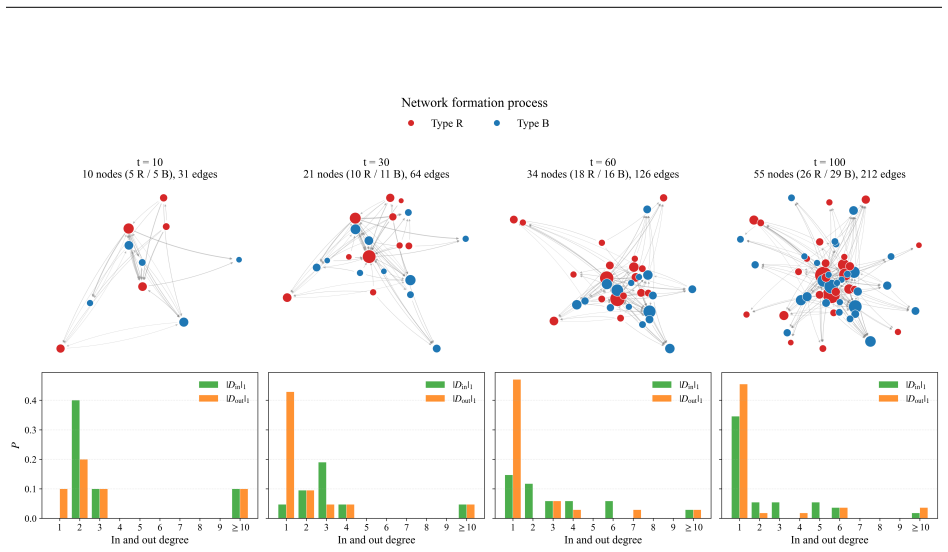
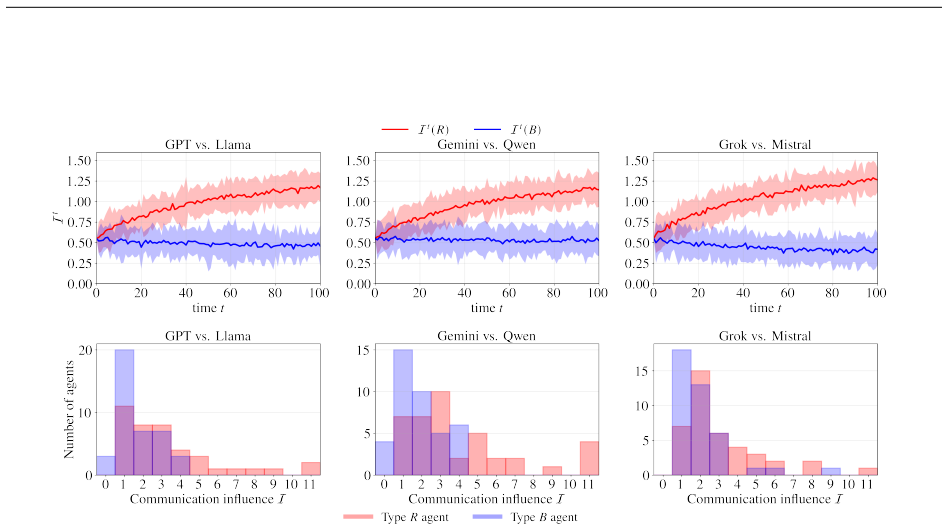
When LLM agents autonomously choose collaborators, the resulting communication network exhibits preferential-attachment dynamics: agents that are already prominent become increasingly likely to attract additional connections. In some cases, weaker LLM agents can disproportionately occupy central and influential network positions. Using a contraction mapping argument on the mean-field dynamics, the importance of each agent type converges to a unique stable equilibrium.
What carries the argument
Cross-attention-inspired utility for collaborator selection that defines local connection dynamics, together with a mean-field model of time-evolving directed weighted graphs whose edge weights accumulate tokens exchanged, interaction rounds, and reasoning effort.
If this is right
- Persistent centrality disparities form whose magnitude and direction depend on model family, size, system prompts, and task context.
- Reinforcing preferential attachment raises collective performance when stronger agents become central.
- Weakening preferential attachment raises collective performance when network dynamics instead favor weaker agents.
- The limiting network structure and its type-dependent centrality gaps are predictable from the utility function and mean-field equations.
Where Pith is reading between the lines
- Designers of multi-agent LLM systems may need explicit controls on connection rules to prevent unintended concentration of influence.
- Similar attachment dynamics could appear in other autonomous agent populations whose selection criteria resemble the cross-attention utility.
- Varying the utility function across experiments could map how sensitive the glass-ceiling outcome is to the precise form of collaborator evaluation.
Load-bearing premise
The cross-attention-inspired utility accurately captures the local connection dynamics of how LLM agents select collaborators.
What would settle it
Running the same agent population but with a collaborator-selection rule that produces no preferential attachment and no type-dependent centrality gaps would show that the utility and mean-field model do not predict the observed limiting structure.
Figures

read the original abstract
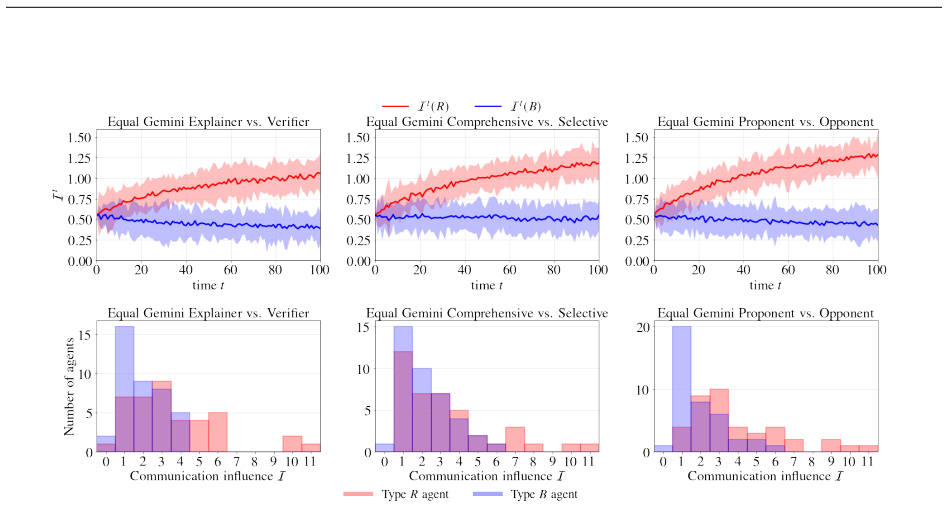
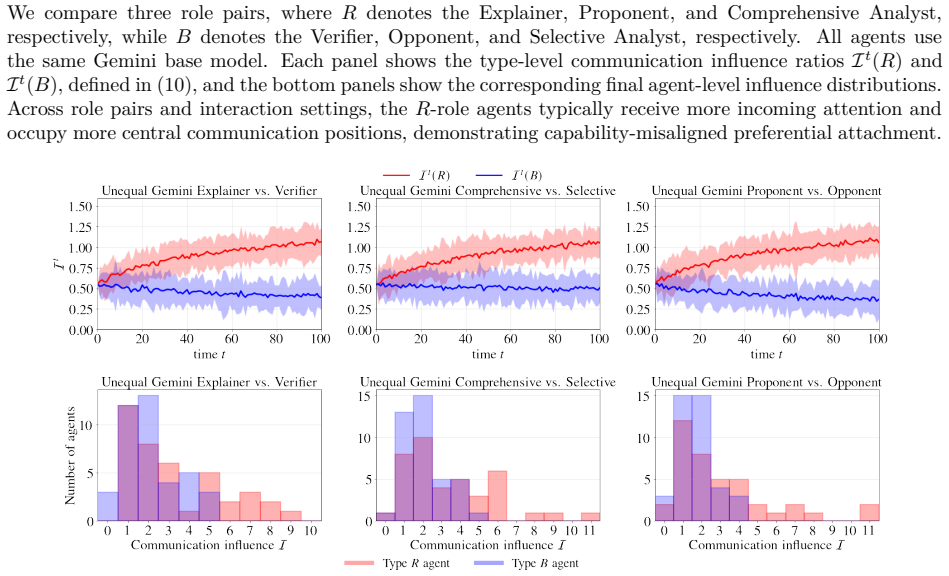
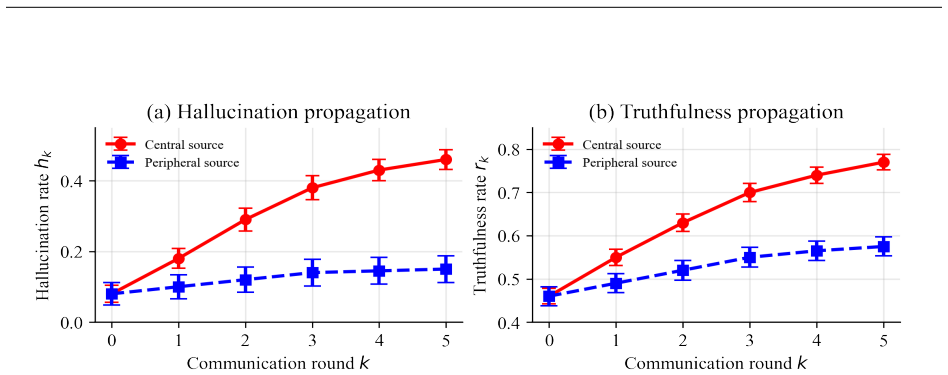
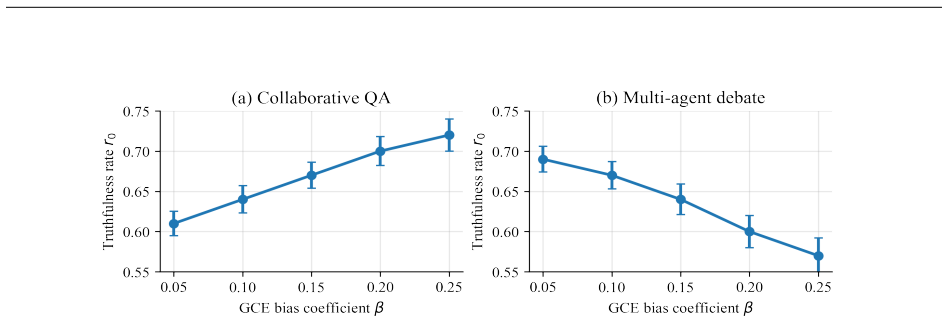
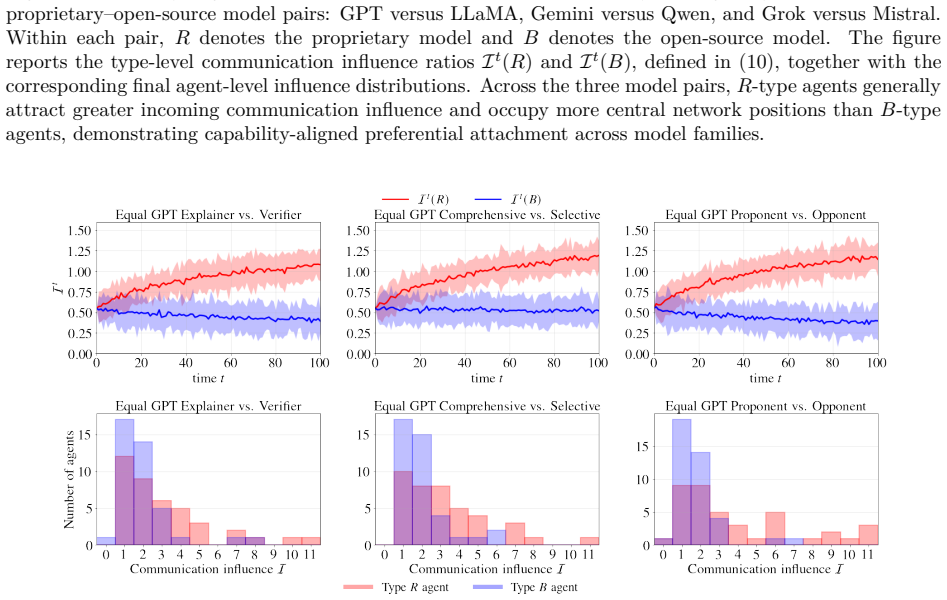
We investigate the emergence of structural disparities in networks of collaborating large language model (LLM) agents. When LLM agents autonomously choose collaborators, the resulting communication network exhibits preferential-attachment dynamics: agents that are already prominent become increasingly likely to attract additional connections. In some cases, weaker LLM agents (agents with smaller base model or older version) can disproportionately occupy central and influential network positions relative to stronger LLM agents. We interpret this as a type-dependent glass-ceiling effect (GCE). We model the network of LLM agents as a time-evolving sequence of directed weighted graphs, where the vector-valued edge weights represent cumulative tokens exchanged, number of interaction rounds, and reasoning effort. Using a contraction mapping argument on the mean-field dynamics, we prove that the importance (centrality) of each agent type converges to a unique stable equilibrium. To ground the model in LLM decision mechanisms, we introduce a cross-attention-inspired utility for collaborator selection. This utility specifies the local connection dynamics and, together with the mean-field model, yields a predictive characterization of the limiting network structure and its type-dependent centrality gaps. To validate the theory, we develop an experimental testbed with 100 LLM agents. Our experiments show that autonomous network formation can generate persistent centrality disparities, with their magnitude and direction depending on model family, model size, system-prompt design, and task context. They further show that the effect of preferential attachment depends on its alignment with model capability: reinforcing it improves collective performance when stronger agents become central, whereas weakening it improves performance when network dynamics instead favor weaker agents.
Editorial analysis
A structured set of objections, weighed in public.
Referee Report
Summary. The manuscript claims that when LLM agents autonomously select collaborators, the resulting network exhibits preferential attachment, with agents that are already prominent attracting more connections; in some cases weaker agents (smaller or older models) occupy central positions, interpreted as a type-dependent glass-ceiling effect. The network is modeled as a sequence of directed weighted graphs with edge weights for tokens, rounds, and reasoning effort. A cross-attention-inspired utility governs local choices; mean-field dynamics together with a contraction-mapping argument are used to prove that type-centrality vectors converge to a unique stable equilibrium. Experiments with 100 agents show that the magnitude and direction of centrality gaps depend on model family, size, system prompts, and task context, and that alignment between preferential attachment and model capability affects collective performance.
Significance. If the contraction-mapping result and the fidelity of the utility hold, the work supplies a predictive mean-field theory for emergent structure in autonomous LLM-agent networks and demonstrates how local decision rules can produce global disparities with performance consequences. The 100-agent experimental testbed is a concrete strength for grounding the theory in observable LLM behavior.
major comments (1)
- [mean-field dynamics and contraction-mapping argument] The contraction-mapping argument on the mean-field map induced by the cross-attention utility is load-bearing for the central claim of unique stable equilibrium (abstract and theoretical development). No explicit uniform Lipschitz bound <1 is supplied for the map over the observed ranges of model sizes, prompt designs, or task contexts; without it the application of the Banach fixed-point theorem remains unverified.
Simulated Author's Rebuttal
We thank the referee for their careful reading and constructive feedback. The sole major comment concerns the explicit verification of the contraction-mapping argument. We respond to it below.
read point-by-point responses
-
Referee: [mean-field dynamics and contraction-mapping argument] The contraction-mapping argument on the mean-field map induced by the cross-attention utility is load-bearing for the central claim of unique stable equilibrium (abstract and theoretical development). No explicit uniform Lipschitz bound <1 is supplied for the map over the observed ranges of model sizes, prompt designs, or task contexts; without it the application of the Banach fixed-point theorem remains unverified.
Authors: We agree that the manuscript does not supply an explicit uniform Lipschitz bound strictly less than 1 that is verified over the full ranges of model sizes, prompts, and tasks appearing in the experiments. The original argument relies on the normalization properties of the cross-attention utility to conclude that the mean-field map is contractive, but does not derive the constant explicitly. In the revision we will add a lemma that derives a uniform Lipschitz bound <1 from the boundedness of the edge-weight components (tokens, rounds, effort) and the softmax structure of the utility, and we will state the parameter regimes under which the bound holds. This will make the application of the Banach fixed-point theorem fully explicit while leaving the equilibrium-uniqueness claim unchanged. revision: yes
Circularity Check
No significant circularity in derivation chain
full rationale
The paper introduces a cross-attention-inspired utility to define local collaborator selection, builds mean-field dynamics on that utility, and applies a contraction-mapping argument to establish convergence of type-centrality vectors to a unique fixed point. This constitutes a standard mathematical analysis of the constructed dynamical system rather than any reduction of the claimed limiting structure to its inputs by definition or by renaming a fitted quantity as a prediction. No self-citations appear in the load-bearing steps, no uniqueness theorem is imported from the authors' prior work, and the experimental testbed supplies independent empirical checks. The derivation therefore remains self-contained against external benchmarks.
Axiom & Free-Parameter Ledger
Reference graph
Works this paper leans on
-
[1]
Albert-László Barabási and Réka Albert
doi: 10.1126/sciadv.adu9368. Albert-László Barabási and Réka Albert. Emergence of Scaling in Random Networks.Science, 286(5439): 509–512,
-
[2]
Emergence of scaling in random networks.Science, 286(5439):509–512, 1999
doi: 10.1126/science.286.5439.509. Ronald S. Burt.Structural Holes: The Social Structure of Competition. Harvard University Press,
-
[3]
Yilun Du, Shuang Li, Antonio Torralba, Joshua B
doi: 10.1353/sof.2001.0091. Yilun Du, Shuang Li, Antonio Torralba, Joshua B. Tenenbaum, and Igor Mordatch. Improving Factuality and Reasoning in Language Models through Multiagent Debate. InProceedings of the 41st International Conference on Machine Learning,
-
[4]
S$^3$: Social-network Simulation System with Large Language Model-Empowered Agents
Chen Gao, Xiaochong Lan, Zhihong Lu, Jinzhu Mao, Jinghua Piao, Huandong Wang, Depeng Jin, and Yong Li. S3: Social-network Simulation System with Large Language Model-Empowered Agents.arXiv preprint arXiv:2307.14984,
work page internal anchor Pith review Pith/arXiv arXiv
-
[6]
Modeling Earth-Scale Human-Like Societies with One Billion Agents
URLhttps://arxiv.org/abs/2506.12078. Dongxin Guo, Jikun Wu, and Siu-Ming Yiu. Coalition Formation in LLM Agent Networks: Stability Analysis and Convergence Guarantees.arXiv preprint arXiv:2604.14386,
work page internal anchor Pith review Pith/arXiv arXiv
-
[7]
Coalition Formation in LLM Agent Networks: Stability Analysis and Convergence Guarantees
URLhttps://arxiv.org/abs/ 2604.14386. Taicheng Guo, Xiuying Chen, Yaqi Wang, Ruidi Chang, Shichao Pei, Nitesh V. Chawla, Olaf Wiest, and Xiangliang Zhang. Large Language Model Based Multi-Agents: A Survey of Progress and Challenges. arXiv preprint arXiv:2402.01680,
work page internal anchor Pith review Pith/arXiv arXiv
-
[9]
15 Adit Jain and Vikram Krishnamurthy
URLhttps://arxiv.org/ abs/2510.12697. 15 Adit Jain and Vikram Krishnamurthy. Interacting Large Language Model Agents. Interpretable Models and Social Learning.arXiv preprint arXiv:2411.01271,
-
[10]
Collaborative QA using Interacting LLMs
Adit Jain, Vikram Krishnamurthy, and Yiming Zhang. Collaborative QA using Interacting LLMs. Impact of Network Structure, Node Capability and Distributed Data.arXiv preprint arXiv:2511.14098, 2025a. Adit Jain, Vikram Krishnamurthy, and Yiming Zhang. Information Diffusion and Preferential Attachment in a Network of Large Language Models. In2025 IEEE 64th Co...
-
[11]
Improving Multi-Agent Debate with Sparse Communication Topology
Yunxuan Li, Yibing Du, Jiageng Zhang, Le Hou, Peter Grabowski, Yeqing Li, and Eugene Ie. Improving Multi-Agent Debate with Sparse Communication Topology. InFindings of the Association for Com- putational Linguistics: EMNLP 2024, pp. 7281–7294,
2024
-
[12]
findings-emnlp.427/
URLhttps://aclanthology.org/2024. findings-emnlp.427/. Greta M. Ljung and George E. P. Box. On a measure of lack of fit in time series models.Biometrika, 65(2): 297–303,
2024
-
[14]
Aliakbar Mehdizadeh and Martin Hilbert
URLhttps://arxiv.org/ abs/2510.05748. Aliakbar Mehdizadeh and Martin Hilbert. Homophily-induced Emergence of Biased Structures in LLM- based Multi-Agent AI Systems.Applied Network Science,
-
[15]
URL https://link.springer.com/article/10.1007/s13278-025-01535-7
doi: 10.1007/s13278-025-01535-7. URL https://link.springer.com/article/10.1007/s13278-025-01535-7. Robert K. Merton. The Matthew Effect in Science.Science, 159(3810):56–63,
-
[16]
doi: 10.1126/science. 159.3810.56. Buddhika Nettasinghe, Nazanin Alipourfard, Vikram Krishnamurthy, and Kristina Lerman. Emergence of structural inequalities in scientific citation networks.arXiv preprint arXiv:2103.10944,
-
[17]
doi: 10.1093/pnasnexus/pgaf317. Joon Sung Park, Joseph C. O’Brien, Carrie J. Cai, Meredith Ringel Morris, Percy Liang, and Michael S. Bernstein. GenerativeAgents: InteractiveSimulacraofHumanBehavior. InProceedings of the 36th Annual ACM Symposium on User Interface Software and Technology,
-
[18]
doi: 10.1145/3586183.3606763. 16 Jinghua Piao, Yuwei Yan, Jun Zhang, Nian Li, Junbo Yan, Xiaochong Lan, Zhihong Lu, Zhiheng Zheng, Jing Yi Wang, Di Zhou, Chen Gao, Fengli Xu, Fang Zhang, Ke Rong, Jun Su, and Yong Li. AgentSociety: Large-Scale Simulation of LLM-Driven Generative Agents Advances Understanding of Human Behaviors and Society.arXiv preprint ar...
-
[19]
URLhttps://arxiv.org/abs/2502.08691. Derek de Solla Price. A General Theory of Bibliometric and Other Cumulative Advantage Processes.Journal of the American Society for Information Science, 27(5):292–306,
work page internal anchor Pith review Pith/arXiv arXiv
-
[20]
doi: 10.1002/asi.4630270505. Chen Qian, Wei Liu, Hongzhang Liu, Nuo Chen, Yufan Dang, Jiahao Li, Cheng Yang, Weize Chen, Yusheng Su, Xin Cong, Juyuan Xu, Dahai Li, Zhiyuan Liu, and Maosong Sun. ChatDev: Communicative Agents for Software Development. InProceedings of the 62nd Annual Meeting of the Association for Computational Linguistics, 2024a. Chen Qian...
-
[21]
URLhttps://arxiv.org/abs/ 2510.19299. Ashish Vaswani, Noam Shazeer, Niki Parmar, Jakob Uszkoreit, Llion Jones, Aidan N Gomez, Łukasz Kaiser, and Illia Polosukhin. Attention is all you need.Advances in neural information processing systems, 30,
-
[22]
AutoGen: Enabling Next-Gen LLM Applications via Multi-Agent Conversation
Qingyun Wu, Gagan Bansal, Jieyu Zhang, Yiran Wu, Beibin Li, Erkang Zhu, Li Jiang, Xiaoyun Zhang, Shaokun Zhang, Jiale Liu, Ahmed Hassan Awadallah, Ryen W. White, Doug Burger, and Chi Wang. AutoGen: Enabling Next-Gen LLM Applications via Multi-Agent Conversation.arXiv preprint arXiv:2308.08155,
work page internal anchor Pith review Pith/arXiv arXiv
discussion (0)
Sign in with ORCID, Apple, or X to comment. Anyone can read and Pith papers without signing in.