FastBridge: Closing the Model-Based Realization Gap in Safety Filters on 3D Gaussian Splatting for Fast Quadrotor Flight
Pith reviewed 2026-07-02 10:55 UTC · model grok-4.3
The pith
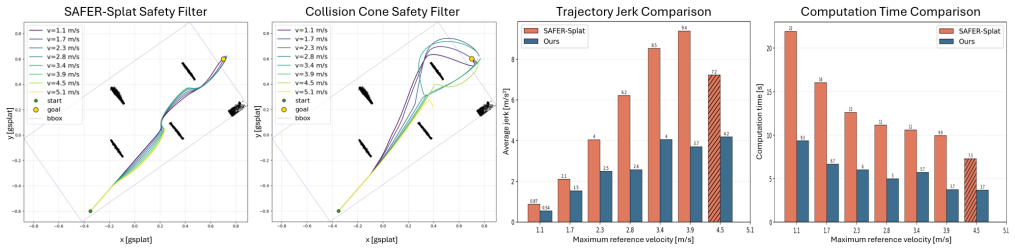
A safety filter using full quadrotor dynamics on 3D Gaussian Splatting maps reduces trajectory jerk by 47% and runs 2.25 times faster than prior methods.
A machine-rendered reading of the paper's core claim, the machinery that carries it, and where it could break.
Core claim
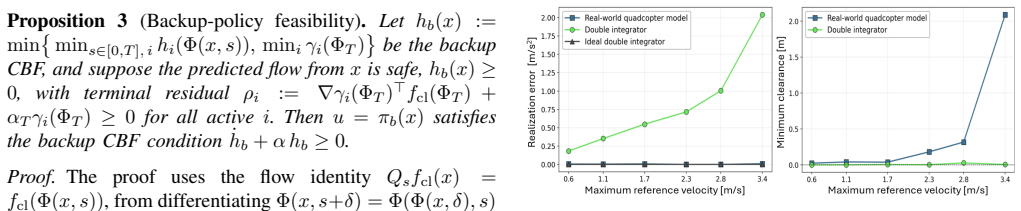
We derive a high-relative-degree collision cone exponential CBF and a backup CBF that preserves QP feasibility under input constraints using a forward-simulated backup policy. This actuator-aware safety filter is enforced through the full quadrotor dynamics on 3DGS representations, achieving 47% less trajectory jerk and 2.25 times faster execution than prior 3DGS safety filters, validated in simulation and hardware.
What carries the argument
High-relative-degree collision cone exponential CBF paired with a forward-simulated backup CBF that maintains QP feasibility under actuator limits.
Load-bearing premise
The forward-simulated backup policy is assumed to reliably preserve quadratic-program feasibility under actuator constraints while running in real time on perception-derived 3DGS maps.
What would settle it
A hardware trial in which the quadratic program becomes infeasible during a high-speed maneuver in a cluttered 3DGS environment despite activation of the backup policy, or independent tests that fail to reproduce the 47% jerk reduction and 2.25x speed-up.
Figures

read the original abstract
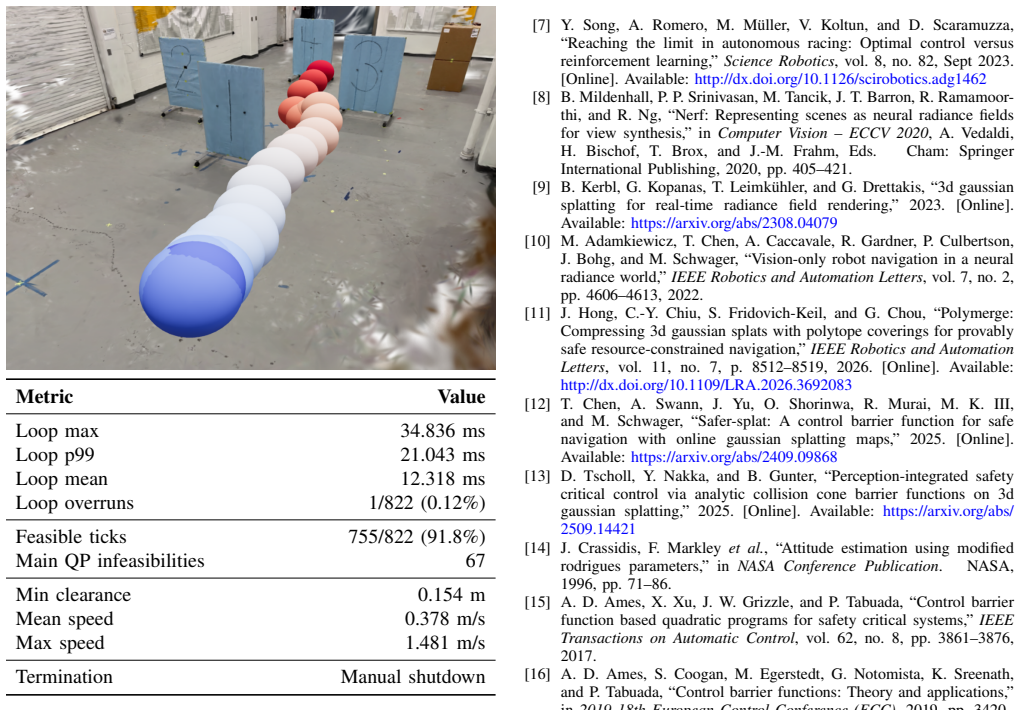
Fast quadrotor flight requires safe obstacle avoidance under tight onboard compute limits. While 3D Gaussian Splatting (3DGS) provides a continuous, geometry-aware scene representation for perception-driven navigation, existing 3DGS safety filters use reduced-order models such as single- and double-integrators that ignore actuator limits and assume commanded accelerations are realized instantaneously. Building on an analytic collision cone barrier for 3DGS, we introduce a nonlinear, actuator-aware safety filter enforced through the full quadrotor dynamics. We derive a high-relative-degree collision cone exponential CBF and a backup CBF that preserves QP feasibility under input constraints using a forward-simulated backup policy. Compared with a state-of-the-art 3DGS safety filter, our approach reduces trajectory jerk by 47% and runs 2.25 times faster. We validate the method in simulation and on hardware for real-time navigation in cluttered, perception-derived environments.
Editorial analysis
A structured set of objections, weighed in public.
Referee Report
Summary. The paper claims to develop FastBridge, an actuator-aware safety filter for quadrotors navigating using 3D Gaussian Splatting maps. Building on an analytic collision cone barrier, it derives a high-relative-degree collision cone exponential CBF and introduces a backup CBF that uses a forward-simulated backup policy to preserve quadratic program feasibility under input constraints with the full quadrotor dynamics. The method is shown to reduce trajectory jerk by 47% and run 2.25 times faster than a state-of-the-art 3DGS safety filter, with validation in both simulation and hardware experiments for real-time navigation in cluttered environments.
Significance. If the central claims hold, this contribution is significant because it closes the realization gap between simplified models and full dynamics in safety-critical control for agile quadrotor flight. By incorporating actuator limits explicitly via the backup policy, it enables more realistic safety filters on perception-derived representations like 3DGS. The reported performance gains and hardware validation provide concrete evidence of practicality. Strengths include the analytic derivation of the CBF and the focus on real-time feasibility.
major comments (2)
- [Abstract] Abstract: The claim that the backup CBF 'preserves QP feasibility under input constraints using a forward-simulated backup policy' is central, yet the abstract provides no information on the simulation parameters (e.g., horizon length, time step) or empirical feasibility rates across test scenarios; without this, the load-bearing assumption that the policy reliably maintains feasibility in real time on 3DGS maps cannot be evaluated.
- [Validation] Validation: The 47% jerk reduction and 2.25x speedup are key results supporting superiority over SOTA, but without details on the baseline implementation, number of trials, or statistical significance in the reported experiments, it is unclear if these improvements are robust.
minor comments (1)
- Clarify the notation for the collision cone in the main text to ensure it matches the abstract description.
Simulated Author's Rebuttal
We appreciate the referee's feedback highlighting areas where the presentation of our central contributions can be strengthened. We provide point-by-point responses to the major comments and commit to revisions that address the concerns raised.
read point-by-point responses
-
Referee: [Abstract] Abstract: The claim that the backup CBF 'preserves QP feasibility under input constraints using a forward-simulated backup policy' is central, yet the abstract provides no information on the simulation parameters (e.g., horizon length, time step) or empirical feasibility rates across test scenarios; without this, the load-bearing assumption that the policy reliably maintains feasibility in real time on 3DGS maps cannot be evaluated.
Authors: We agree that the abstract would benefit from including information on the simulation parameters and empirical feasibility rates to better support the central claim. In the revised manuscript, we will update the abstract to incorporate a brief description of the backup policy parameters and the observed feasibility rates. revision: yes
-
Referee: [Validation] Validation: The 47% jerk reduction and 2.25x speedup are key results supporting superiority over SOTA, but without details on the baseline implementation, number of trials, or statistical significance in the reported experiments, it is unclear if these improvements are robust.
Authors: We acknowledge that the reported performance improvements would be more convincing with explicit details on the baseline implementation, number of trials, and statistical significance. We will revise the validation section to include these details, such as describing the baseline, reporting the number of experimental trials, and providing statistical analysis of the results. revision: yes
Circularity Check
No circularity: derivations presented as independent from inputs
full rationale
The abstract and description outline a derivation of a high-relative-degree collision cone exponential CBF plus a backup CBF via forward simulation, with empirical performance claims (47% jerk reduction, 2.25x speedup) against a prior 3DGS filter. No equations, parameter fits, or self-citation chains are supplied that would reduce any claimed prediction or result to the inputs by construction. The central steps (analytic barrier extension, QP feasibility via backup policy) are described as new contributions without evidence of self-definitional closure or fitted-input renaming. This matches the default expectation of a self-contained derivation.
Axiom & Free-Parameter Ledger
axioms (1)
- standard math Standard control barrier function theory for high-relative-degree systems applies to the collision-cone formulation.
Reference graph
Works this paper leans on
-
[1]
Autonomous drone racing: A survey,
D. Hanover, A. Loquercio, L. Bauersfeld, A. Romero, R. Penicka, Y . Song, G. Cioffi, E. Kaufmann, and D. Scaramuzza, “Autonomous drone racing: A survey,”IEEE Transactions on Robotics, vol. 40, 2024
work page 2024
-
[2]
Ag- ilicious: Open-source and open-hardware agile quadrotor for vision- based flight,
P. Foehn, E. Kaufmann, A. Romero, R. Penicka, S. Sun, L. Bauersfeld, T. Laengle, G. Cioffi, Y . Song, A. Loquercio, and D. Scaramuzza, “Ag- ilicious: Open-source and open-hardware agile quadrotor for vision- based flight,”Science Robotics, vol. 7, no. 67, p. eabl6259, 2022
work page 2022
-
[3]
Minimum snap trajectory generation and control for quadrotors,
D. Mellinger and V . Kumar, “Minimum snap trajectory generation and control for quadrotors,” in2011 IEEE International Conference on Robotics and Automation, 2011, pp. 2520–2525
work page 2011
-
[4]
Minimum-time quadrotor waypoint flight in cluttered environments,
R. Penicka and D. Scaramuzza, “Minimum-time quadrotor waypoint flight in cluttered environments,”CoRR, vol. abs/2202.03947, 2022. [Online]. Available: https://arxiv.org/abs/2202.03947
-
[5]
Model predictive contouring control for near-time-optimal quadrotor flight,
A. Romero, S. Sun, P. Foehn, and D. Scaramuzza, “Model predictive contouring control for near-time-optimal quadrotor flight,” CoRR, vol. abs/2108.13205, 2021. [Online]. Available: https: //arxiv.org/abs/2108.13205
-
[6]
Champion-level drone racing using deep reinforce- ment learning,
E. Kaufmann, L. Bauersfeld, A. Loquercio, M. M ¨uller, V . Koltun, and D. Scaramuzza, “Champion-level drone racing using deep reinforce- ment learning,”Nature, vol. 620, no. 7976, pp. 982–987, 2023
work page 2023
-
[7]
Reaching the limit in autonomous racing: Optimal control versus reinforcement learning,
Y . Song, A. Romero, M. M ¨uller, V . Koltun, and D. Scaramuzza, “Reaching the limit in autonomous racing: Optimal control versus reinforcement learning,”Science Robotics, vol. 8, no. 82, Sept 2023. [Online]. Available: http://dx.doi.org/10.1126/scirobotics.adg1462
-
[8]
Nerf: Representing scenes as neural radiance fields for view synthesis,
B. Mildenhall, P. P. Srinivasan, M. Tancik, J. T. Barron, R. Ramamoor- thi, and R. Ng, “Nerf: Representing scenes as neural radiance fields for view synthesis,” inComputer Vision – ECCV 2020, A. Vedaldi, H. Bischof, T. Brox, and J.-M. Frahm, Eds. Cham: Springer International Publishing, 2020, pp. 405–421
work page 2020
-
[9]
arXiv preprint arXiv:2308.04079 (2023)
B. Kerbl, G. Kopanas, T. Leimk ¨uhler, and G. Drettakis, “3d gaussian splatting for real-time radiance field rendering,” 2023. [Online]. Available: https://arxiv.org/abs/2308.04079
-
[10]
Vision-only robot navigation in a neural radiance world,
M. Adamkiewicz, T. Chen, A. Caccavale, R. Gardner, P. Culbertson, J. Bohg, and M. Schwager, “Vision-only robot navigation in a neural radiance world,”IEEE Robotics and Automation Letters, vol. 7, no. 2, pp. 4606–4613, 2022
work page 2022
-
[11]
J. Hong, C.-Y . Chiu, S. Fridovich-Keil, and G. Chou, “Polymerge: Compressing 3d gaussian splats with polytope coverings for provably safe resource-constrained navigation,”IEEE Robotics and Automation Letters, vol. 11, no. 7, p. 8512–8519, 2026. [Online]. Available: http://dx.doi.org/10.1109/LRA.2026.3692083
-
[12]
Safer-splat: A control barrier function for safe navigation with online gaussian splatting maps,
T. Chen, A. Swann, J. Yu, O. Shorinwa, R. Murai, M. K. III, and M. Schwager, “Safer-splat: A control barrier function for safe navigation with online gaussian splatting maps,” 2025. [Online]. Available: https://arxiv.org/abs/2409.09868
-
[13]
D. Tscholl, Y . Nakka, and B. Gunter, “Perception-integrated safety critical control via analytic collision cone barrier functions on 3d gaussian splatting,” 2025. [Online]. Available: https://arxiv.org/abs/ 2509.14421
-
[14]
Attitude estimation using modified rodrigues parameters,
J. Crassidis, F. Markleyet al., “Attitude estimation using modified rodrigues parameters,” inNASA Conference Publication. NASA, 1996, pp. 71–86
work page 1996
-
[15]
Control barrier function based quadratic programs for safety critical systems,
A. D. Ames, X. Xu, J. W. Grizzle, and P. Tabuada, “Control barrier function based quadratic programs for safety critical systems,”IEEE Transactions on Automatic Control, vol. 62, no. 8, pp. 3861–3876, 2017
work page 2017
-
[16]
Control barrier functions: Theory and applications,
A. D. Ames, S. Coogan, M. Egerstedt, G. Notomista, K. Sreenath, and P. Tabuada, “Control barrier functions: Theory and applications,” in2019 18th European Control Conference (ECC), 2019, pp. 3420– 3431
work page 2019
-
[17]
Constructive safety using control barrier functions,
P. Wieland and F. Allg ¨ower, “Constructive safety using control barrier functions,”IFAC Proceedings Volumes, vol. 40, no. 12, pp. 462–467, 2007, 7th IFAC Symposium on Nonlinear Control Systems. [Online]. Available: https://www.sciencedirect.com/science/article/pii/ S1474667016355690
work page 2007
-
[18]
Q. Nguyen and K. Sreenath, “Exponential control barrier functions for enforcing high relative-degree safety-critical constraints,” in2016 American Control Conference (ACC), 2016, pp. 322–328
work page 2016
-
[19]
Backup control barrier functions: Formulation and comparative study,
Y . Chen, M. Jankovic, M. Santillo, and A. D. Ames, “Backup control barrier functions: Formulation and comparative study,” in2021 60th IEEE Conference on Decision and Control (CDC), 2021, pp. 6835– 6841
work page 2021
-
[20]
An online approach to active set invariance,
T. Gurriet, M. Mote, A. D. Ames, and E. Feron, “An online approach to active set invariance,” in2018 IEEE Conference on Decision and Control (CDC), 2018, pp. 3592–3599
work page 2018
-
[21]
Geometric tracking control of a quadrotor uav on se(3),
T. Lee, M. Leok, and N. H. McClamroch, “Geometric tracking control of a quadrotor uav on se(3),” in49th IEEE Conference on Decision and Control (CDC), 2010, pp. 5420–5425
work page 2010
-
[22]
Model Predictive Controller for Quadcopter Trajectory Tracking Based on Feedback Linearization,
Z. Cai, S. Zhang, and X. Jing, “Model Predictive Controller for Quadcopter Trajectory Tracking Based on Feedback Linearization,” IEEE Access, vol. 9, pp. 162 909–162 918, 2021. [Online]. Available: https://ieeexplore.ieee.org/document/9642982
-
[23]
Nerfstudio: A modular framework for neural radiance field development,
M. Tancik, E. Weber, E. Ng, R. Li, B. Yi, J. Kerr, T. Wang, A. Kristoffersen, J. Austin, K. Salahi, A. Ahuja, D. McAllister, and A. Kanazawa, “Nerfstudio: A modular framework for neural radiance field development,” inACM SIGGRAPH 2023 Conference Proceedings, ser. SIGGRAPH ’23, 2023. VI. APPENDIX This appendix collects the derivations deferred from Sec- ti...
work page 2023
discussion (0)
Sign in with ORCID, Apple, or X to comment. Anyone can read and Pith papers without signing in.