AI Assistance for Human Review of Default Judgments
Pith reviewed 2026-07-04 00:14 UTC · model grok-4.3
The pith
An AI assistant using cited case excerpts raises default judgment review accuracy by 6% and speed by 26%.
A machine-rendered reading of the paper's core claim, the machinery that carries it, and where it could break.
Core claim
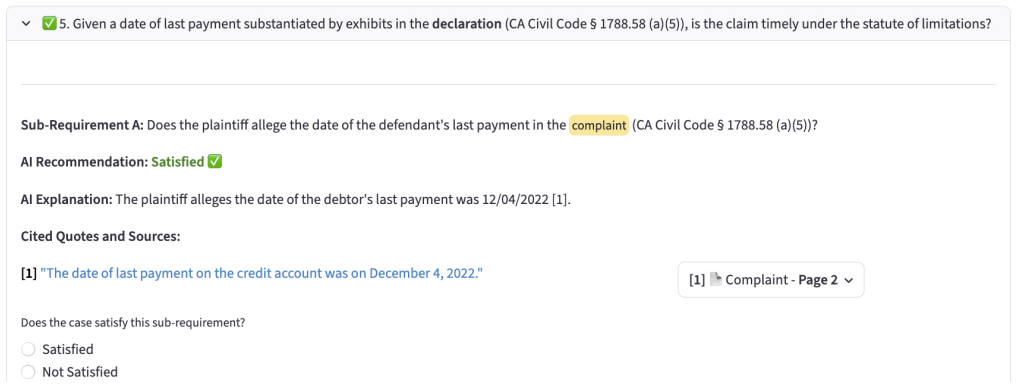
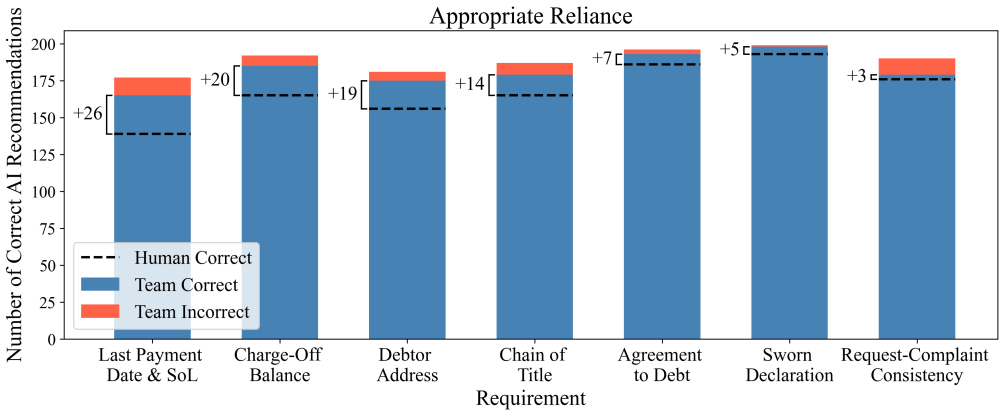
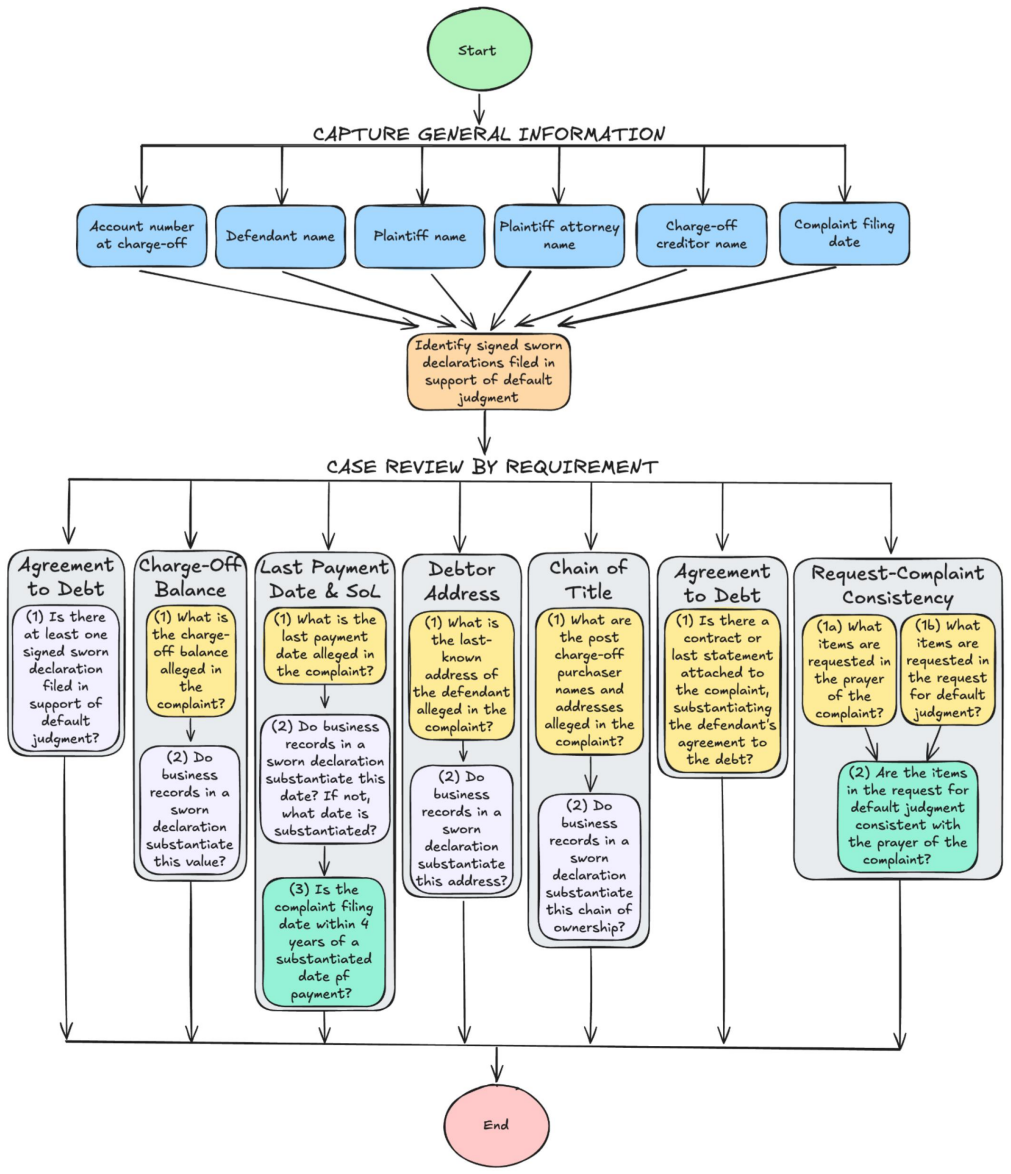
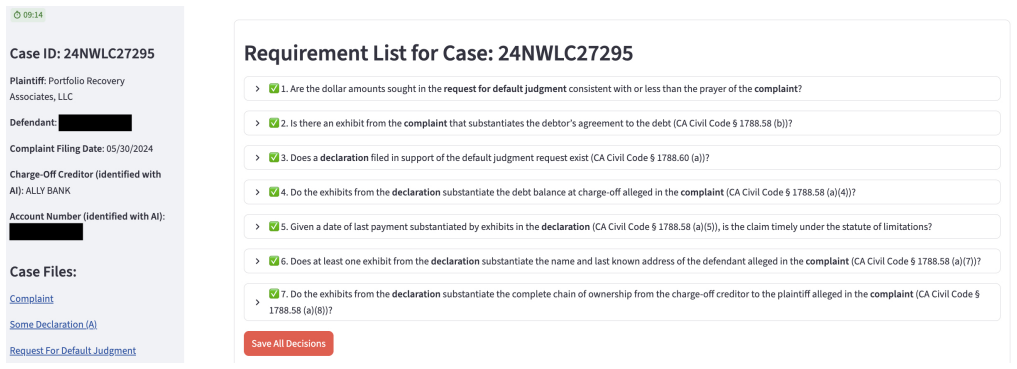
The Default Assistant employs large language models to evaluate a case with respect to predetermined legal requirements and provide cited recommendations for an expert user's review. Explanations are grounded in cited quotes and tables from the original case filings. In a controlled study with 66 law students that conservatively simulates court review, aided users were 6.0% more accurate on the average requirement and 25.9% faster, with error reductions up to 62% and time savings up to 34% on statutory requirements.
What carries the argument
The Default Assistant, an LLM system that scores cases against legal requirements and supplies verifiable excerpts from the source documents for human checking.
If this is right
- Statutory requirements see the largest error drops (up to 62%) and time savings (up to 34%).
- The 4% rate of major defects found in the audit could be lowered through systematic AI-supported checks.
- Review time per requirement falls enough to let the same staff handle more of the millions of annual cases.
- Citation grounding lets users verify outputs directly against filings rather than trusting model text alone.
Where Pith is reading between the lines
- The same citation-grounded pattern could be applied to other high-volume court tasks such as motion review or discovery disputes.
- Real deployment would need separate measurement of how often reviewers actually follow, override, or ignore the AI suggestions under time pressure.
- If the tool reduces amendment rates, it could shorten the overall case lifecycle and lower costs for both courts and litigants.
Load-bearing premise
Gains measured with law students who had more time and resources will appear when the same tool is used by actual court staff working under real constraints.
What would settle it
A field trial with sitting court reviewers processing live default cases that shows no accuracy gain or no time savings, or shows losses on either measure.
Figures




read the original abstract
Overwhelmed courts in the United States review millions of default judgments each year. Unfortunately, such manual reviews are time-consuming and prone to error. In an audit of 188 debt collection cases granted default judgment by the Superior Court of Los Angeles, we find that 4% contained major defects that should have entirely prevented default judgment, 10% contained inconsistencies requiring reduced judgments, and 32% contained errors requiring amendment prior to judgment. To support courthouses in default judgment review, we collaborated with courthouse attorneys and judges in designing a Default Assistant. The Default Assistant employs large language models to evaluate a case with respect to predetermined legal requirements and provide cited recommendations for an expert user's review. We equip users to verify these recommendations by grounding the assistant's explanations in cited quotes and tables from the original case filings. We conduct a controlled study with 66 law students that conservatively simulates court review, with more time and resources than court staff. We nevertheless find users aided by the Default Assistant were 6.0% more accurate on the average requirement than unaided reviewers (p < 1.0e-4). Simultaneously, users were 25.9% faster in reviewing the average requirement than unaided reviewers (p < 2.5e-10). Statutory requirements demanding extensive document search realized the largest gains, with error reductions and time savings from AI assistance up to 62% and 34%, respectively, relative to unassisted user performance and with differences statistically significant (p < 0.05). Our work provides a proof-of-concept that AI assistants with citations have the potential to help resource-constrained courts conduct default judgment review more accurately and efficiently.
Editorial analysis
A structured set of objections, weighed in public.
Referee Report
Summary. The manuscript audits 188 debt collection default judgment cases from the Los Angeles Superior Court, reporting 4% with major defects that should have prevented judgment, 10% with inconsistencies requiring reduced judgments, and 32% with errors requiring amendment. It describes the collaborative design of a Default Assistant that uses LLMs to evaluate cases against predetermined legal requirements and generates cited recommendations grounded in quotes and tables from the filings. A controlled user study with 66 law students (explicitly described as providing more time and resources than actual court staff) finds that AI-aided reviewers achieve 6.0% higher accuracy on the average requirement (p < 1.0e-4) and 25.9% faster review times (p < 2.5e-10), with larger gains (up to 62% error reduction) on statutory requirements. The paper concludes that the assistant has potential to help resource-constrained courts.
Significance. If the measured accuracy and speed gains hold under real courthouse conditions, the work could support meaningful improvements in error rates and throughput for the millions of default judgments reviewed annually. Strengths include the real-world audit of actual court cases, direct collaboration with courthouse attorneys and judges, statistically significant results from a controlled experiment, and the emphasis on citation-grounded explanations to support expert verification. These elements provide a concrete proof-of-concept for LLM assistance in legal review tasks.
major comments (1)
- [Abstract] Abstract (final sentence) and the description of the controlled study: the central claim that the Default Assistant 'has the potential to help resource-constrained courts' rests on the reported +6.0% accuracy and +25.9% speed gains. However, these results were obtained with 66 law students who, per the abstract, had 'more time and resources than court staff.' No data, sensitivity analysis, or discussion is provided on whether comparable benefits would be observed under the actual time pressure, case volume, and domain-expertise profile of courthouse personnel. This external-validity gap directly affects whether the measured deltas support the policy-oriented conclusion.
minor comments (2)
- [Evaluation / User Study] The manuscript lacks sufficient detail on LLM prompting strategies, the exact operational definitions of each legal requirement, participant training protocols, and the precise mapping between the simulation conditions and real court constraints. These omissions make it difficult to assess reproducibility and the robustness of the reported p-values.
- [Abstract] The abstract notes post-hoc selection of 'statutory requirements' for the larger-gain analysis; clarification is needed on whether this selection was pre-registered or could introduce selection bias in the error-reduction claims.
Simulated Author's Rebuttal
We thank the referee for the constructive feedback emphasizing external validity. We address the major comment below and will revise the manuscript accordingly.
read point-by-point responses
-
Referee: [Abstract] Abstract (final sentence) and the description of the controlled study: the central claim that the Default Assistant 'has the potential to help resource-constrained courts' rests on the reported +6.0% accuracy and +25.9% speed gains. However, these results were obtained with 66 law students who, per the abstract, had 'more time and resources than court staff.' No data, sensitivity analysis, or discussion is provided on whether comparable benefits would be observed under the actual time pressure, case volume, and domain-expertise profile of courthouse personnel. This external-validity gap directly affects whether the measured deltas support the policy-oriented conclusion.
Authors: We agree that the controlled study used law students rather than actual courthouse personnel and that no sensitivity analysis or direct data under real courthouse conditions (time pressure, case volume, expertise) is provided. The manuscript already states that the study 'conservatively simulates court review, with more time and resources than court staff,' and the statistically significant gains were observed even under these more favorable conditions for reviewers. We view this as supporting the 'potential' claim in a proof-of-concept sense, but we acknowledge the inference to real-world courthouse settings is not directly tested. We will revise the manuscript to add an expanded limitations discussion that explicitly addresses this external-validity gap, including differences in domain expertise, time constraints, and the need for future field validation with court staff. revision: yes
- Direct empirical data or sensitivity analysis from actual courthouse personnel under operational time pressure, case volume, and expertise constraints (would require a separate field study).
Circularity Check
Empirical user study with direct performance measurements; no derivations or self-referential reductions
full rationale
The paper reports an audit of 188 cases and a controlled user study with 66 law students measuring accuracy (+6.0%) and speed (+25.9%) gains from the Default Assistant. These are direct empirical outcomes from randomized comparison, not derived from equations, fitted parameters, or prior self-citations. No load-bearing steps reduce to inputs by construction. The external-validity concern (law students vs. real court staff) is a limitation of generalizability, not circularity in the derivation chain. The work is self-contained against its stated benchmarks.
Axiom & Free-Parameter Ledger
axioms (1)
- domain assumption Predetermined legal requirements for default judgments can be reliably checked via document review and are suitable for LLM evaluation.
Reference graph
Works this paper leans on
-
[1]
Slobodkin, Andrew and Chen, Yuhui and Zhang, Yiming and Khashabi, Daniel and Durrett, Greg , title =. Proceedings of the 62nd Annual Meeting of the Association for Computational Linguistics (ACL 2024) , year =
work page 2024
-
[2]
The Extractive-Abstractive Spectrum: Uncovering Verifiability Trade-offs in LLM Generations , author=. 2024 , eprint=
work page 2024
-
[3]
In search of verifiability: Explanations rarely enable complementary performance in AI-advised decision making , author=. AI Magazine , volume=. 2024 , publisher=
work page 2024
-
[4]
Proceedings of the 2021 CHI conference on human factors in computing systems , pages=
Does the whole exceed its parts? the effect of ai explanations on complementary team performance , author=. Proceedings of the 2021 CHI conference on human factors in computing systems , pages=
work page 2021
-
[5]
Model-Agnostic Interpretability of Machine Learning
Model-agnostic interpretability of machine learning , author=. arXiv preprint arXiv:1606.05386 , year=
work page internal anchor Pith review Pith/arXiv arXiv
-
[6]
Advances in neural information processing systems , volume=
A unified approach to interpreting model predictions , author=. Advances in neural information processing systems , volume=
-
[7]
“Cyborg Justice” and the Risk of Technological--Legal Lock-In , author=. Columbia law review , volume=. 2019 , publisher=
work page 2019
-
[8]
A rule of persons, not machines: the limits of legal automation , author=. Geo. Wash. L. Rev. , volume=. 2019 , publisher=
work page 2019
- [9]
-
[10]
Exploring llms applications in law: A literature review on current legal nlp approaches , author=. IEEE Access , year=
-
[11]
Ethics of data and analytics , pages=
Machine bias , author=. Ethics of data and analytics , pages=. 2022 , publisher=
work page 2022
-
[12]
Government Information Quarterly , volume=
Automation bias in public administration--an interdisciplinary perspective from law and psychology , author=. Government Information Quarterly , volume=. 2024 , publisher=
work page 2024
-
[13]
Towards eXplainable Artificial Intelligence (XAI) in tax law: the need for a minimum legal standard , author=. World tax journal , volume=. 2022 , publisher=
work page 2022
-
[14]
Proceedings of the ACM on Human-Computer Interaction , volume=
Explanations can reduce overreliance on ai systems during decision-making , author=. Proceedings of the ACM on Human-Computer Interaction , volume=. 2023 , publisher=
work page 2023
-
[15]
Default Procedures , author=. U. Pa. L. Rev. , volume=. 2024 , publisher=
work page 2024
-
[16]
Dirty Debts Sold Dirt Cheap , author=. Harv. J. on Legis. , volume=. 2015 , publisher=
work page 2015
-
[17]
Available at SSRN 2700745 , year=
The Landscape of Civil Litigation in State Courts , author=. Available at SSRN 2700745 , year=
-
[18]
University of Illinois Chicago School of Law July , year=
One-Sided Litigation: Lessons from Civil Docket Data in California Debt Collection Lawsuits , author=. University of Illinois Chicago School of Law July , year=
-
[19]
New data release shows that 3.6 million eviction cases were filed in the United States in 2018 , author=. Eviction Lab , volume=
work page 2018
-
[20]
Eviction's fallout: housing, hardship, and health , author=. Social forces , volume=. 2015 , publisher=
work page 2015
-
[21]
Fifty years after the Consumer Credit Protection Act: The high price of wage garnishments , author=. Mitchell Hamline L. Rev. , volume=. 2019 , publisher=
work page 2019
-
[22]
arXiv preprint arXiv:2504.01349 , year=
Tasks and Roles in Legal AI: Data Curation, Annotation, and Verification , author=. arXiv preprint arXiv:2504.01349 , year=
-
[23]
New England journal of medicine , volume=
A surgical safety checklist to reduce morbidity and mortality in a global population , author=. New England journal of medicine , volume=. 2009 , publisher=
work page 2009
-
[24]
Kim, Sunnie S. Y. and Vaughan, Jennifer Wortman and Liao, Q. Vera and Lombrozo, Tania and Russakovsky, Olga , title =. Proceedings of the 2025 CHI Conference on Human Factors in Computing Systems , articleno =. 2025 , isbn =. doi:10.1145/3706598.3714020 , abstract =
-
[25]
Yin, Leon and Alba, Davey and Nicoletti, Leonardo , title =. Bloomberg , year =
-
[26]
Educational and psychological measurement , volume=
A coefficient of agreement for nominal scales , author=. Educational and psychological measurement , volume=. 1960 , publisher=
work page 1960
-
[27]
Systematic content analysis of judicial opinions , author=. Calif. L. Rev. , volume=. 2008 , publisher=
work page 2008
-
[28]
Journal of Empirical Legal Studies , volume =
Nielsen, Aileen and Skylaki, Stavroula and Norkute, Milda and Stremitzer, Alexander , title =. Journal of Empirical Legal Studies , volume =. doi:https://doi.org/10.1111/jels.12396 , url =. https://onlinelibrary.wiley.com/doi/pdf/10.1111/jels.12396 , abstract =
-
[29]
Lawyering in the age of artificial intelligence , author=. Minn. L. Rev. , volume=. 2024 , publisher=
work page 2024
-
[30]
Proceedings of the ACM on Human-computer Interaction , volume=
To trust or to think: cognitive forcing functions can reduce overreliance on AI in AI-assisted decision-making , author=. Proceedings of the ACM on Human-computer Interaction , volume=. 2021 , publisher=
work page 2021
-
[31]
Access to Justice in the Age of AI: Evidence from US Federal Courts , author=. 2026 , institution=
work page 2026
-
[32]
Translational psychiatry , volume=
How machine-learning recommendations influence clinician treatment selections: the example of antidepressant selection , author=. Translational psychiatry , volume=. 2021 , publisher=
work page 2021
-
[33]
WebGPT: Browser-assisted question-answering with human feedback
Webgpt: Browser-assisted question-answering with human feedback , author=. arXiv preprint arXiv:2112.09332 , year=
work page internal anchor Pith review Pith/arXiv arXiv
-
[34]
Teaching language models to support answers with verified quotes
Teaching language models to support answers with verified quotes , author=. arXiv preprint arXiv:2203.11147 , year=
work page internal anchor Pith review Pith/arXiv arXiv
-
[35]
Assisting in Writing W ikipedia-like Articles From Scratch with Large Language Models
Shao, Yijia and Jiang, Yucheng and Kanell, Theodore and Xu, Peter and Khattab, Omar and Lam, Monica. Assisting in Writing W ikipedia-like Articles From Scratch with Large Language Models. Proceedings of the 2024 Conference of the North American Chapter of the Association for Computational Linguistics: Human Language Technologies (Volume 1: Long Papers). 2...
-
[36]
Jiang, Yucheng and Shao, Yijia and Ma, Dekun and Semnani, Sina and Lam, Monica. Into the Unknown Unknowns: Engaged Human Learning through Participation in Language Model Agent Conversations. Proceedings of the 2024 Conference on Empirical Methods in Natural Language Processing. 2024
work page 2024
-
[37]
L ong C ite: Enabling LLM s to Generate Fine-grained Citations in Long-Context QA
Zhang, Jiajie and Bai, Yushi and Lv, Xin and Gu, Wanjun and Liu, Danqing and Zou, Minhao and Cao, Shulin and Hou, Lei and Dong, Yuxiao and Feng, Ling and Li, Juanzi. L ong C ite: Enabling LLM s to Generate Fine-grained Citations in Long-Context QA. Findings of the Association for Computational Linguistics: ACL 2025. 2025. doi:10.18653/v1/2025.findings-acl.264
-
[38]
arXiv preprint arXiv:2210.08726 , year=
Rarr: Researching and revising what language models say, using language models , author=. arXiv preprint arXiv:2210.08726 , year=
-
[39]
Citation-Enhanced Generation for LLM -based Chatbots
Li, Weitao and Li, Junkai and Ma, Weizhi and Liu, Yang. Citation-Enhanced Generation for LLM -based Chatbots. Proceedings of the 62nd Annual Meeting of the Association for Computational Linguistics (Volume 1: Long Papers). 2024. doi:10.18653/v1/2024.acl-long.79
-
[40]
Advances in Neural Information Processing Systems , volume=
Language models don't always say what they think: Unfaithful explanations in chain-of-thought prompting , author=. Advances in Neural Information Processing Systems , volume=
-
[41]
LicenseGPT: A fine-tuned foundation model for publicly available dataset license compliance , author=. Proceedings of the 33rd ACM International Conference on the Foundations of Software Engineering , pages=
discussion (0)
Sign in with ORCID, Apple, or X to comment. Anyone can read and Pith papers without signing in.