Discovery of an Inflated Hot Neptune and Its Formation from Jovian Mass Loss
Pith reviewed 2026-07-03 18:37 UTC · model grok-4.3
The pith
An inflated hot Neptune likely began as a cold Jovian planet that shed up to 90 percent of its mass during eccentric migration.
A machine-rendered reading of the paper's core claim, the machinery that carries it, and where it could break.
Core claim
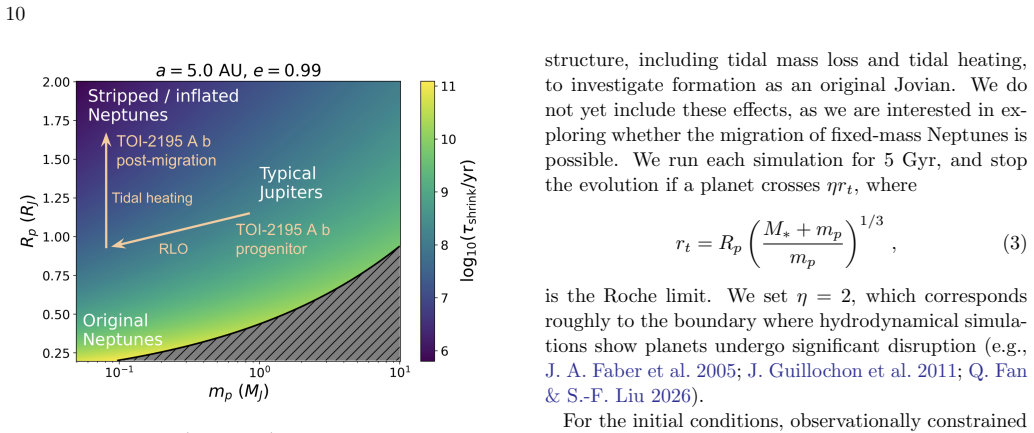
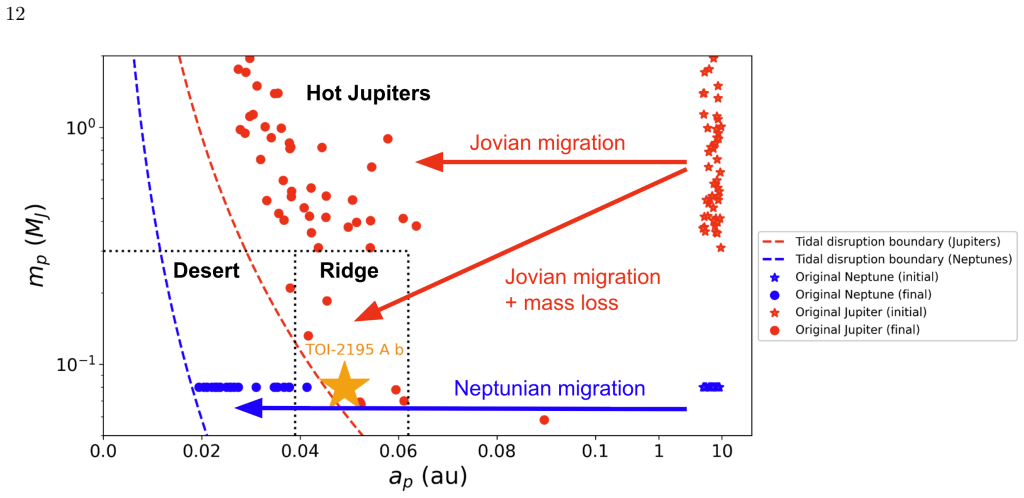
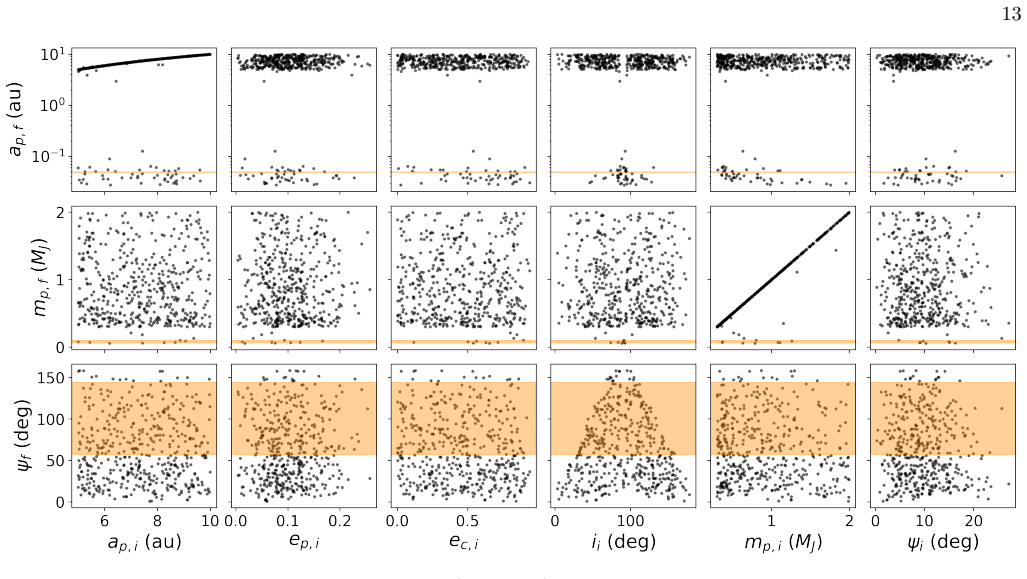
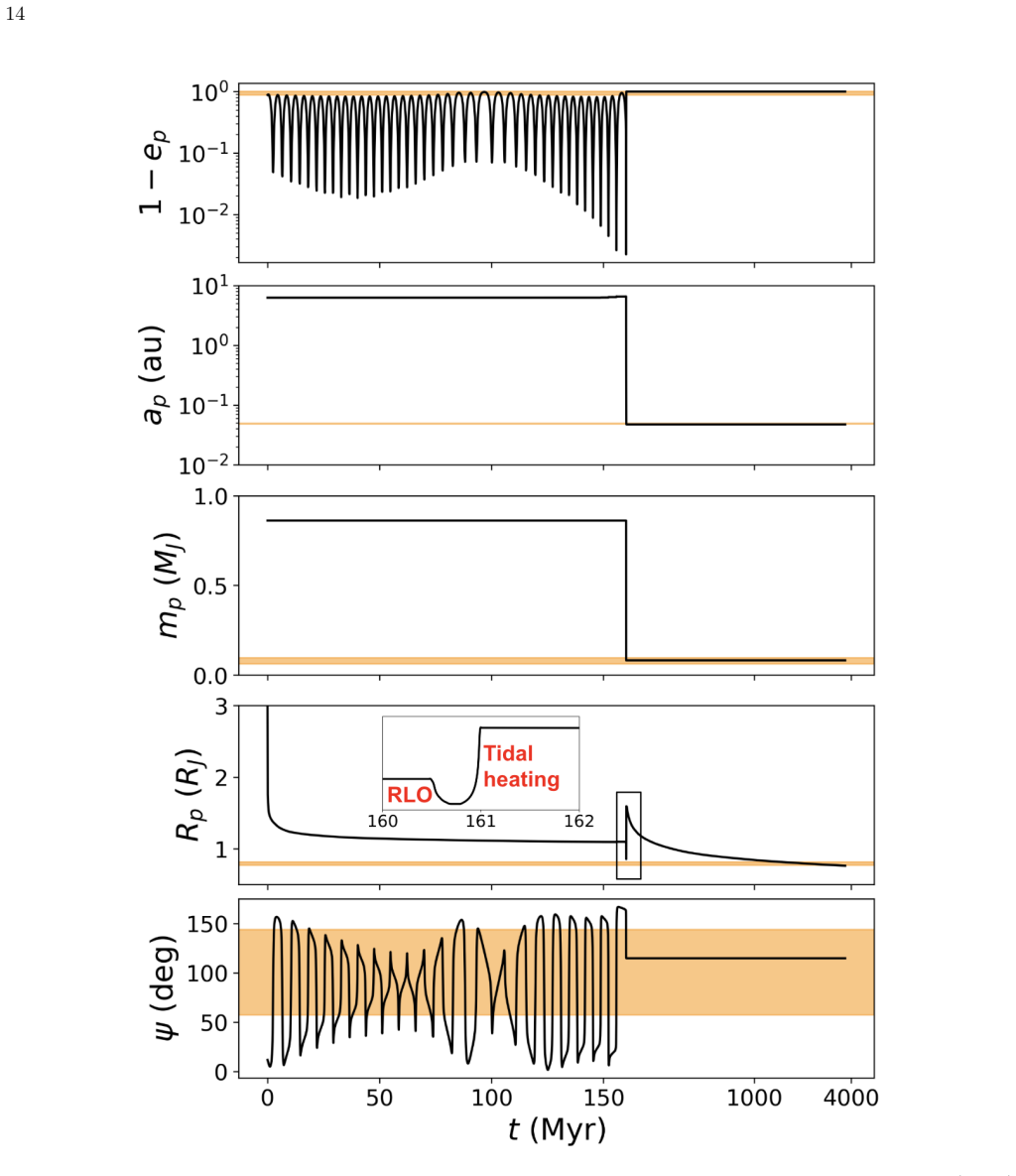
The planet may have originated as a cold, Jovian planet that was excited to high eccentricities via the stellar Eccentric Kozai-Lidov mechanism, where it lost up to ∼90% of its mass via Roche lobe overflow during close periastron passages, enabling rapid tidal migration and radius inflation due to tidal heating.
What carries the argument
Coupled dynamical and structural modeling that starts from an initial Jovian configuration and reproduces the observed mass, radius, period, and near-polar orbit.
If this is right
- Puffy hot Neptunes with periods of three to six days can form from more massive Jovians that lose most of their mass during high-eccentricity migration.
- The same mechanism can produce near-polar orbits when a wide stellar companion is present.
- Tidal heating during the final migration stage is sufficient to inflate the radius to the observed value.
- This formation channel supplies a test for planetary migration theories that can be checked against other short-period Neptunes.
Where Pith is reading between the lines
- Similar mass-loss histories may explain other inflated Neptunes whose densities are lower than expected from in-situ formation.
- Wide binary companions around other hot-Neptune hosts could be searched to identify additional systems shaped by the same eccentricity excitation.
- The final orbital period and obliquity may correlate with the amount of mass lost, offering a way to test the model on larger samples.
Load-bearing premise
The modeling reproduces the planet's current properties from a Jovian starting point without post-hoc parameter adjustments that force the match.
What would settle it
A measurement showing the planet's orbit is not near-polar or that its mass and radius cannot be reached by any sequence of mass loss and tidal evolution from a Jovian progenitor.
Figures


read the original abstract
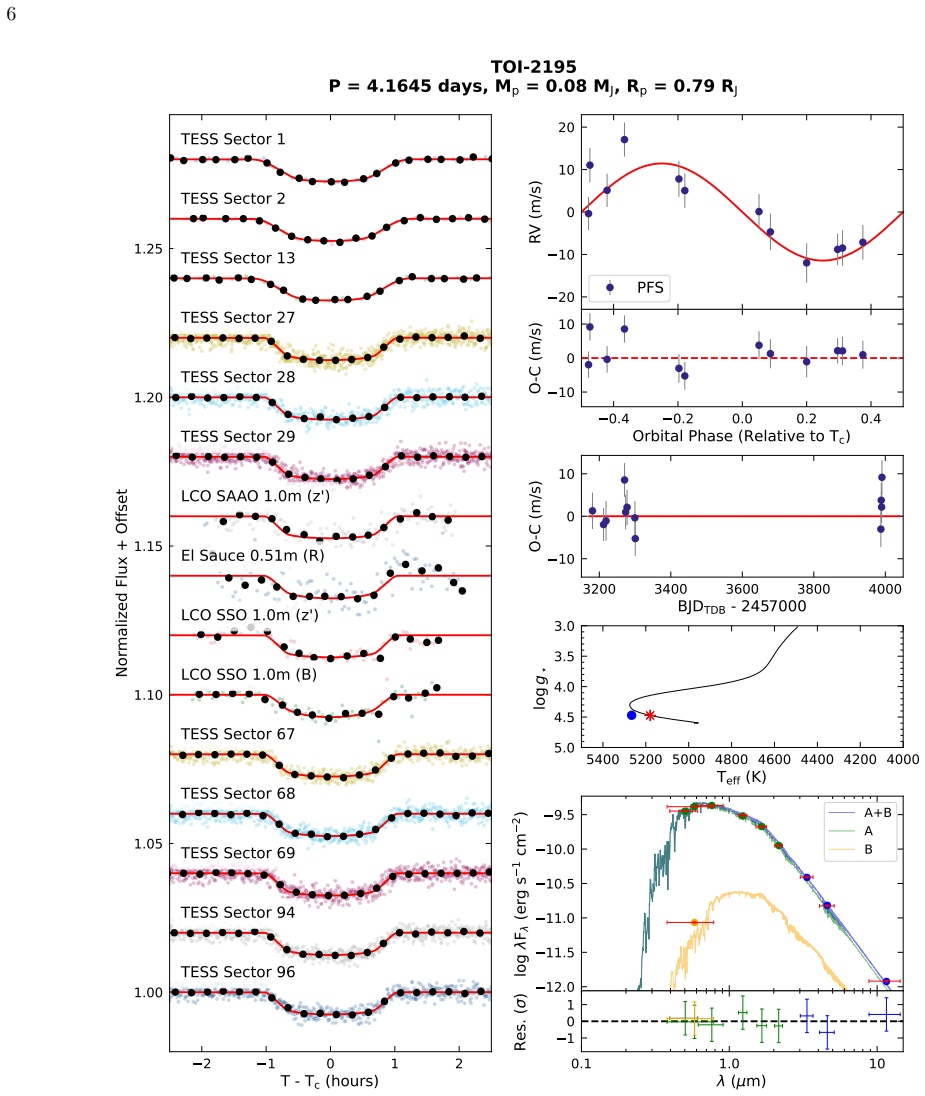
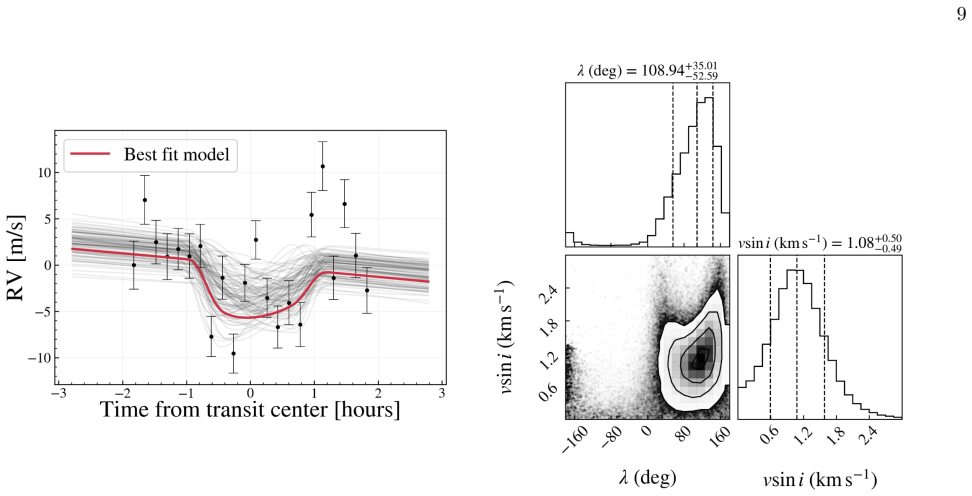
The production of Neptune-like planets with orbital periods of 3--6 days is challenging for conventional models of high-eccentricity migration. We present the discovery and characterization of TOI-2195~A~b, an inflated hot Neptune ($P = 4.16$ days, $m_p= 1.46M_{\rm Nep},\,R_p = 0.79R_{\rm J}$) orbiting an early K-type star with a wide binary companion at $\sim 600$~au. Detection of the Rossiter-McLaughlin effect at $\sim2.6\sigma$ confidence with Magellan/PFS reveals the planet is likely on a near-polar orbit with a sky-projected stellar obliquity $\lambda = {109^{+35}_{-53}} ^{\circ}$. We perform coupled dynamical and structural modeling that reproduces the observed characteristics of the system. We show that the planet may have originated as a cold, Jovian planet that was excited to high eccentricities via the stellar Eccentric Kozai-Lidov (EKL) mechanism, where it lost up to $\sim90\%$ of its mass via Roche lobe overflow during close periastron passages, enabling rapid tidal migration and radius inflation due to tidal heating. TOI-2195 A b provides a test for planetary migration theories, and our simulations suggest that puffy hot Neptunes originated as more massive Jovians that underwent mass loss during high-eccentricity migration.
Editorial analysis
A structured set of objections, weighed in public.
Referee Report
Summary. The paper reports the discovery and characterization of TOI-2195 A b, an inflated hot Neptune (P=4.16 d, m_p=1.46 M_Nep, R_p=0.79 R_J) around an early K star with a ~600 au binary companion. A ~2.6σ Rossiter-McLaughlin detection indicates a near-polar orbit (λ=109^{+35}_{-53}°). Coupled dynamical-structural modeling is presented showing the planet could have formed from an initial cold Jovian via stellar EKL excitation, losing up to ~90% mass through Roche-lobe overflow at periastron, followed by tidal migration and radius inflation from tidal heating. The simulations are stated to reproduce the observed system properties, supporting high-eccentricity migration with mass loss as a pathway for puffy hot Neptunes.
Significance. If the formation pathway can be shown to be robust rather than tuned, the result would be significant for testing high-eccentricity migration models and explaining the population of short-period inflated Neptunes. The planet parameters add to the sample of hot Neptunes, but the marginal RM significance limits the strength of the obliquity claim and thus the EKL link.
major comments (2)
- [Abstract] Abstract: the central claim that 'coupled dynamical and structural modeling reproduces the observed characteristics' is load-bearing for the proposed EKL+RLOF formation scenario, yet supplies no initial conditions (e.g., starting Jovian mass or a), integrator details for EKL, mass-loss rate prescription during periastron RLOF, tidal evolution equations, or any grid/search/sensitivity tests. This prevents assessment of whether the match is an independent outcome or the result of post-hoc parameter selection (initial mass and mass-loss fraction).
- [Abstract] Abstract (Rossiter-McLaughlin section): the RM detection is reported at only ~2.6σ, providing marginal evidence for the claimed near-polar orbit (λ=109^{+35}_{-53}°). This weakens support for invoking the EKL mechanism to explain the obliquity, as the formation pathway relies on this orbital configuration.
minor comments (1)
- [Abstract] The abstract would be clearer if it explicitly stated the statistical significance of the RM detection alongside the λ value.
Simulated Author's Rebuttal
We thank the referee for their constructive feedback. We address each major comment below and outline revisions to improve clarity and balance in the presentation.
read point-by-point responses
-
Referee: [Abstract] Abstract: the central claim that 'coupled dynamical and structural modeling reproduces the observed characteristics' is load-bearing for the proposed EKL+RLOF formation scenario, yet supplies no initial conditions (e.g., starting Jovian mass or a), integrator details for EKL, mass-loss rate prescription during periastron RLOF, tidal evolution equations, or any grid/search/sensitivity tests. This prevents assessment of whether the match is an independent outcome or the result of post-hoc parameter selection (initial mass and mass-loss fraction).
Authors: The abstract summarizes the key outcome of the modeling; the full technical details—including initial conditions (a cold Jovian with mass ~1 M_Jup at several au), the EKL integrator, mass-loss prescription at periastron, tidal equations, and sensitivity tests—are presented in Section 5 of the manuscript. To address the concern about transparency, we will revise the abstract to briefly note that the reproduction uses physically motivated starting parameters and is supported by the sensitivity analysis in the main text, allowing readers to evaluate robustness directly. revision: yes
-
Referee: [Abstract] Abstract (Rossiter-McLaughlin section): the RM detection is reported at only ~2.6σ, providing marginal evidence for the claimed near-polar orbit (λ=109^{+35}_{-53}°). This weakens support for invoking the EKL mechanism to explain the obliquity, as the formation pathway relies on this orbital configuration.
Authors: We agree that the 2.6σ RM detection is marginal and the obliquity uncertainties are substantial, making the evidence for a near-polar orbit tentative rather than definitive. The EKL pathway is presented as consistent with the available data rather than proven by it. We will revise the abstract and relevant sections to use more cautious phrasing (e.g., 'suggestive of a near-polar orbit at marginal significance') and add a caveat on the need for higher-precision confirmation, while retaining the formation scenario as a viable hypothesis. revision: yes
Circularity Check
Coupled dynamical-structural modeling reproduces observed properties by parameter adjustment
specific steps
-
fitted input called prediction
[Abstract]
"We perform coupled dynamical and structural modeling that reproduces the observed characteristics of the system. We show that the planet may have originated as a cold, Jovian planet that was excited to high eccentricities via the stellar Eccentric Kozai-Lidov (EKL) mechanism, where it lost up to ∼90% of its mass via Roche lobe overflow during close periastron passages, enabling rapid tidal migration and radius inflation due to tidal heating."
The modeling is asserted to reproduce the exact observed m_p = 1.46 M_Nep, R_p = 0.79 R_J, P = 4.16 d and near-polar orbit. Because the abstract supplies no external benchmark or parameter-free prediction, the 90 % mass-loss fraction and initial Jovian configuration must have been selected to achieve that reproduction; the claimed formation pathway therefore reduces to the fitted inputs by construction.
full rationale
The paper's central formation claim rests on coupled modeling that is explicitly stated to reproduce the observed mass, radius, period and orbit. This matches the pattern of fitted inputs called prediction: initial Jovian mass, semimajor axis, eccentricity excitation, and mass-loss fraction are necessarily tuned until the final state matches the data, after which the tuned pathway is presented as the origin story. No independent first-principles derivation or grid search that succeeds without post-hoc adjustment is shown in the provided text.
Axiom & Free-Parameter Ledger
free parameters (2)
- initial Jovian mass
- mass-loss fraction
axioms (2)
- domain assumption The wide binary companion at ~600 au can drive Eccentric Kozai-Lidov eccentricity excitation of the planet.
- domain assumption Roche lobe overflow during periastron passages removes envelope mass without destroying the planet core.
Reference graph
Works this paper leans on
-
[1]
Hunter, J. D. , Title =. Computing in Science & Engineering , Volume =
-
[2]
Planetary Systems Composite Parameters , publisher =. doi:10.26133/NEA13 , url =
-
[3]
doi:10.5281/zenodo.4556063 , url =
Matthew Bourque and Néstor Espinoza and Joseph Filippazzo and Mees Fix and Teagan King and Catherine Martlin and Jennifer Medina and Natasha Batalha and Michael Fox and Jules Fowler and Jonathan Fraine and Matthew Hill and Nikole Lewis and Kevin Stevenson and Jeff Valenti and Hannah Wakeford , title =. doi:10.5281/zenodo.4556063 , url =
-
[4]
Computing in Science & Engineering , volume=
The NumPy array: a structure for efficient numerical computation , author=. Computing in Science & Engineering , volume=. 2011 , publisher=
2011
-
[5]
Nature Methods , year = "2020", volume=
SciPy 1.0: Fundamental Algorithms for Scientific Computing in Python. Nature Methods , year = "2020", volume=
2020
-
[6]
Ankit Rohatgi , title =
-
[7]
Mathematica 12.1.1.0 , url =
-
[8]
Charles R. Harris and K. Jarrod Millman and St. Array programming with. 2020 , month = sep, journal =. doi:10.1038/s41586-020-2649-2 , publisher =
-
[9]
and Haberland, Matt and Reddy, Tyler and Cournapeau, David and Burovski, Evgeni and Peterson, Pearu and Weckesser, Warren and Bright, Jonathan and
Virtanen, Pauli and Gommers, Ralf and Oliphant, Travis E. and Haberland, Matt and Reddy, Tyler and Cournapeau, David and Burovski, Evgeni and Peterson, Pearu and Weckesser, Warren and Bright, Jonathan and. Nature Methods , year =
-
[10]
J. D. Computing in Science Engineering , title=. 2007 , volume=
2007
-
[11]
Astropy: A Community Python Package for Astronomy
doi:10.1051/0004-6361/201322068 , Eid =. arXiv , Author =:1307.6212 , Journal =
work page internal anchor Pith review Pith/arXiv arXiv doi:10.1051/0004-6361/201322068
-
[13]
The Astropy Project: Sustaining and Growing a Community-oriented Open-source Project and the Latest Major Release (v5.0) of the Core Package. , keywords =. doi:10.3847/1538-4357/ac7c74 , archivePrefix =. 2206.14220 , primaryClass =
work page internal anchor Pith review Pith/arXiv arXiv doi:10.3847/1538-4357/ac7c74
-
[14]
\ less\ tt\ greater\ astroquery\ less\ /Tt\ greater\ :
Ginsburg, Adam and Sip. \ less\ tt\ greater\ astroquery\ less\ /Tt\ greater\ :. 2019 , month = feb, journal =. doi:10.3847/1538-3881/aafc33 , langid =
-
[15]
doi:10.5281/zenodo.13819579 , url =
The pandas development team , title =. doi:10.5281/zenodo.13819579 , url =
-
[16]
Publications of the Astronomical Society of the Pacific , author =
, Keywords =. doi:10.1086/670067 , Eprint =
-
[17]
Communications in Applied Mathematics and Computational Science , Month = jan, Number =
Goodman, Jonathan and Weare, Jonathan , Citeulike-Article-Id =. Communications in Applied Mathematics and Computational Science , Month = jan, Number =. 2010 , Bdsk-Url-1 =. doi:10.2140/camcos.2010.5.65 , Issn =
-
[18]
Inference from Iterative Simulation Using Multiple Sequences. Statistical Science , year = "1992", month = "Jan", volume =. doi:10.1214/ss/1177011136 , adsurl =
-
[19]
Geweke, John. [Statistics, Probability and Chaos]: Comment: Inference and Prediction in the Presence of Uncertainty and Determinism. Statist. Sci. 1992. doi:10.1214/ss/1177011446
-
[20]
arXiv , Author =:1507.08285 , Journal =
work page internal anchor Pith review Pith/arXiv arXiv
-
[21]
RadVel: The Radial Velocity Modeling Toolkit
RadVel: The Radial Velocity Modeling Toolkit. , keywords =. 2018. doi:10.1088/1538-3873/aaaaa8 , archivePrefix =. 1801.01947 , primaryClass =
work page internal anchor Pith review Pith/arXiv arXiv doi:10.1088/1538-3873/aaaaa8 2018
-
[22]
SYNTHE spectrum synthesis programs and line data
-
[23]
Eastman, Jason and Gaudi, B. Scott and Agol, Eric , year =. Publications of the Astronomical Society of the Pacific , volume =. doi:10.1086/669497 , langid =
-
[24]
arXiv e-prints , keywords =
EXOFASTv2: A public, generalized, publication-quality exoplanet modeling code. arXiv e-prints , keywords =
-
[25]
and Laughlin, Gregory , year =
Adams, Fred C. and Laughlin, Gregory , year =. Long-. The Astrophysical Journal , volume =. doi:10.1086/506145 , langid =
-
[26]
Collins, Karen A. and Kielkopf, John F. and Stassun, Keivan G. and Hessman, Frederic V. , year =. , issn =. doi:10.3847/1538-3881/153/2/77 , langid =
-
[27]
ascl:1812.013 , adsurl =
Lightkurve: Kepler and TESS time series analysis in Python. ascl:1812.013 , adsurl =
-
[28]
Yee, Samuel W. and Petigura, Erik A. and. Precision. 2017 , month = feb, journal =. doi:10.3847/1538-4357/836/1/77 , langid =
-
[29]
Prevalence of Earth-size Planets Orbiting Sun-like Stars
-
[30]
A library of high resolution synthetic stellar spectra from 300 nm to 1.8 m with solar and -enhanced composition. , keywords =. doi:10.1051/0004-6361:20053511 , archivePrefix =. astro-ph/0505511 , primaryClass =
work page internal anchor Pith review Pith/arXiv arXiv doi:10.1051/0004-6361:20053511
-
[31]
isochrones: Stellar model grid package
-
[32]
Choi, Jieun and Dotter, Aaron and Conroy, Charlie and Cantiello, Matteo and Paxton, Bill and Johnson, Benjamin D. , year =. The Astrophysical Journal , volume =. doi:10.3847/0004-637X/823/2/102 , langid =
work page internal anchor Pith review doi:10.3847/0004-637x/823/2/102
-
[33]
The Astrophysical Journal Supplement Series , volume =
Dotter, Aaron , year =. The Astrophysical Journal Supplement Series , volume =. doi:10.3847/0067-0049/222/1/8 , langid =
work page internal anchor Pith review doi:10.3847/0067-0049/222/1/8
-
[34]
Analytic Lightcurves for Planetary Transit Searches
Analytic Light Curves for Planetary Transit Searches. , keywords =. 2002. doi:10.1086/345520 , archivePrefix =. astro-ph/0210099 , primaryClass =
work page internal anchor Pith review Pith/arXiv arXiv doi:10.1086/345520 2002
-
[35]
A box-fitting algorithm in the search for periodic transits
A Box-Fitting Algorithm in the Search for Periodic Transits , author =. 2002 , month = aug, journal =. doi:10.1051/0004-6361:20020802 , archiveprefix =. astro-ph/0206099 , eprinttype =
work page internal anchor Pith review Pith/arXiv arXiv doi:10.1051/0004-6361:20020802 2002
-
[36]
Vanderburg, Andrew and Johnson, John Asher , year =. A. Publications of the Astronomical Society of the Pacific , volume =. doi:10.1086/678764 , langid =
-
[37]
and Vanderburg, Andrew , year =
Shallue, Christopher J. and Vanderburg, Andrew , year =. Identifying. The Astronomical Journal , volume =. doi:10.3847/1538-3881/aa9e09 , langid =
-
[38]
Carter, Joshua A. and Agol, Eric , year =. The Astrophysical Journal , volume =. doi:10.1088/0004-637X/765/2/132 , langid =
-
[39]
Kruse, Ethan and Agol, Eric and Luger, Rodrigo and. Detection of. 2019 , month = sep, journal =. doi:10.3847/1538-4365/ab346b , langid =
-
[40]
Kostov, Veselin B. and Mullally, Susan E. and Quintana, Elisa V. and Coughlin, Jeffrey L. and Mullally, Fergal and Barclay, Thomas and Col. Discovery and. 2019 , month = feb, journal =. doi:10.3847/1538-3881/ab0110 , langid =
-
[41]
Nature , year = 2012, month = jun, volume =
An Abundance of Small Exoplanets around Stars with a Wide Range of Metallicities , author =. 2012 , month = jun, journal =. doi:10.1038/nature11121 , langid =
-
[42]
, year = 1971, month = aug, volume =
Spectroscopic binaries with circular orbits. , year = 1971, month = aug, volume =. doi:10.1086/111159 , adsurl =
-
[43]
ascl:1306.007 , adsurl =
Tapir: A web interface for transit/eclipse observability. ascl:1306.007 , adsurl =
-
[44]
Brahm, Rafael and Jord. , publisher =. 2017 , month = feb, volume =. doi:10.1088/1538-3873/aa5455 , langid =
-
[45]
Hartman, J. D. and Bakos, G. Vartools:. 2016 , month = oct, journal =. doi:10.1016/j.ascom.2016.05.006 , langid =
-
[46]
Yu, Liang and Vanderburg, Andrew and Huang, Chelsea and Shallue, Christopher J. and Crossfield, Ian J. M. and Gaudi, B. Scott and Daylan, Tansu and Dattilo, Anne and Armstrong, David J. and Ricker, George R. and Vanderspek, Roland K. and Latham, David W. and Seager, Sara and Dittmann, Jason and Doty, John P. and Glidden, Ana and Quinn, Samuel N. , year =....
-
[47]
Feinstein, Adina D. and Montet, Benjamin T. and. Eleanor: An. 2019 , month = jul, journal =. doi:10.1088/1538-3873/ab291c , langid =
-
[48]
Zaspe: A Code to Measure Stellar Atmospheric Parameters and Their Covariance from Spectra , shorttitle =
Brahm, Rafael and Jord. Zaspe: A Code to Measure Stellar Atmospheric Parameters and Their Covariance from Spectra , shorttitle =. 2017 , month = may, journal =
2017
-
[49]
, year =
Gray, Richard O. , year =. Astrophysics Source Code Library , pages =
-
[50]
and Kurucz, R
Castelli, F. and Kurucz, R. L. , year =. New
-
[51]
FITSH- a software package for image processing. , keywords =. doi:10.1111/j.1365-2966.2011.19813.x , archivePrefix =. 1111.1998 , primaryClass =
-
[52]
Estimating the
Schwarz, Gideon , year =. Estimating the. The Annals of Statistics , volume =
-
[53]
A Fourth Planet in the Kepler-51 System Revealed by Transit Timing Variations. , keywords =. doi:10.3847/1538-3881/ad83d3 , archivePrefix =. 2410.01625 , primaryClass =
-
[54]
jnkepler: Differentiable N-body model for multi-planet systems
-
[55]
Barycorrpy: Barycentric velocity calculation and leap second management
-
[56]
Bouma, Luke G. and Palumbo, Elsa K. and Hillenbrand, Lynne A. , year = 2023, month = apr, volume =. The. doi:10.3847/2041-8213/acc589 , urldate =
-
[57]
Astronomy & Astrophysics , author =
Planetary nebulae seen with TESS: Discovery of new binary central star candidates from Cycle 1. , keywords =. doi:10.1051/0004-6361/201937118 , archivePrefix =. 1911.09991 , primaryClass =
-
[58]
Orbital Parameter Determination for Wide Stellar Binary Systems in the Age of Gaia. , keywords =. doi:10.3847/1538-4357/ab8389 , archivePrefix =. 2003.11106 , primaryClass =
-
[59]
Orbits for the Impatient: A Bayesian Rejection-sampling Method for Quickly Fitting the Orbits of Long-period Exoplanets. , keywords =. doi:10.3847/1538-3881/aa6930 , archivePrefix =. 1703.10653 , primaryClass =
work page internal anchor Pith review Pith/arXiv arXiv doi:10.3847/1538-3881/aa6930
-
[60]
Instrumentation in Astronomy VIII , year = 1994, editor =
HIRES: the high-resolution echelle spectrometer on the Keck 10-m Telescope. Instrumentation in Astronomy VIII , year = 1994, editor =. doi:10.1117/12.176725 , adsurl =
-
[61]
and Johnson, John Asher and Marcy, Geoffrey W
Howard, Andrew W. and Johnson, John Asher and Marcy, Geoffrey W. and Fischer, Debra A. and Wright, Jason T. and Bernat, David and Henry, Gregory W. and Peek, Kathryn M. G. and Isaacson, Howard and Apps, Kevin and Endl, Michael and Cochran, William D. and Valenti, Jeff A. and Anderson, Jay and Piskunov, Nikolai E. , year =. The Astrophysical Journal , volu...
-
[62]
Howard, Andrew W. and Fulton, Benjamin J. , year =. Limits on. Publications of the Astronomical Society of the Pacific , volume =. doi:10.1088/1538-3873/128/969/114401 , langid =
-
[63]
and Fulton, Benjamin and Isaacson, Howard and Kane, Stephen R
Dalba, Paul A. and Fulton, Benjamin and Isaacson, Howard and Kane, Stephen R. and Howard, Andrew W. , year =. Multiple. The Astronomical Journal , volume =. doi:10.3847/1538-3881/abad27 , langid =
-
[64]
Journal of Astronomical Telescopes, Instruments, and Systems , author =
Transiting Exoplanet Survey Satellite (TESS). Journal of Astronomical Telescopes, Instruments, and Systems , year = 2015, month = jan, volume =. doi:10.1117/1.JATIS.1.1.014003 , adsurl =
work page internal anchor Pith review doi:10.1117/1.jatis.1.1.014003 2015
-
[65]
and Catanzarite, Joseph H
Twicken, Joseph D. and Catanzarite, Joseph H. and Clarke, Bruce D. and Girouard, Forrest and Jenkins, Jon M. and Klaus, Todd C. and Li, Jie and McCauliff, Sean D. and Seader, Shawn E. and Tenenbaum, Peter and Wohler, Bill and Bryson, Stephen T. and Burke, Christopher J. and Caldwell, Douglas A. and Haas, Michael R. and Henze, Christopher E. and Sanderfer,...
-
[66]
and Burke, Christopher J
Li, Jie and Tenenbaum, Peter and Twicken, Joseph D. and Burke, Christopher J. and Jenkins, Jon M. and Quintana, Elisa V. and Rowe, Jason F. and Seader, Shawn E. , year =. Kepler. Publications of the Astronomical Society of the Pacific , volume =
-
[67]
and Twicken, Joseph D
Jenkins, Jon M. and Twicken, Joseph D. and McCauliff, Sean and Campbell, Jennifer and Sanderfer, Dwight and Lung, David and. The. Software and. 2016 , month = aug, volume =
2016
-
[68]
and Tenenbaum, Peter and Twicken, Joseph D
Caldwell, Douglas A. and Tenenbaum, Peter and Twicken, Joseph D. and Jenkins, Jon M. and Ting, Eric and Smith, Jeffrey C. and Hedges, Christina and Fausnaugh, Michael M. and Rose, Mark and Burke, Christopher , year =. Research Notes of the AAS , volume =. doi:10.3847/2515-5172/abc9b3 , langid =
-
[69]
Huang, Chelsea X. and Vanderburg, Andrew and P. Photometry of 10. 2020 , month = nov, journal =. doi:10.3847/2515-5172/abca2e , langid =
-
[70]
Huang, Chelsea X. and Vanderburg, Andrew and P. Photometry of 10. 2020 , month = nov, journal =. doi:10.3847/2515-5172/abca2d , langid =
-
[71]
Fausnaugh, Michael M. and Burke, Christopher J. and Ricker, George R. and Vanderspek, Roland , year =. Calibrated. Research Notes of the AAS , volume =. doi:10.3847/2515-5172/abd63a , langid =
-
[72]
Kunimoto, Michelle and Huang, Chelsea and Tey, Evan and Fong, Willie and Hesse, Katharine and Shporer, Avi and Guerrero, Natalia and Fausnaugh, Michael and Vanderspek, Roland and Ricker, George , year =. Quick-Look. Research Notes of the AAS , issn =. doi:10.3847/2515-5172/ac2ef0 , langid =
-
[73]
Quick-Look
Kunimoto, Michelle and Tey, Evan and Fong, Willie and Hesse, Katharine and Shporer, Avi and Fausnaugh, Michael and Vanderspek, Roland and Ricker, George , year =. Quick-Look. Research Notes of the AAS , volume =
-
[74]
Research Notes of the American Astronomical Society , keywords =
QLP Data Release Notes 003: GPU-based Transit Search. Research Notes of the American Astronomical Society , keywords =. doi:10.3847/2515-5172/acbc13 , archivePrefix =. 2302.01293 , primaryClass =
-
[75]
and Fausnaugh, Michael and Huang, Chelsea X
Kunimoto, Michelle and Daylan, Tansu and Guerrero, Natalia and Fong, William and Bryson, Steve and Ricker, George R. and Fausnaugh, Michael and Huang, Chelsea X. and Sha, Lizhou and Shporer, Avi and Vanderburg, Andrew and Vanderspek, Roland K. and Yu, Liang , year =. The. The Astrophysical Journal Supplement Series , volume =. doi:10.3847/1538-4365/ac5688...
-
[76]
Guerrero, Natalia M. and Seager, S. and Huang, Chelsea X. and Vanderburg, Andrew and Soto, Aylin Garcia and Mireles, Ismael and Hesse, Katharine and Fong, William and Glidden, Ana and Shporer, Avi and Latham, David W. and Collins, Karen A. and Quinn, Samuel N. and Burt, Jennifer and Dragomir, Diana and Crossfield, Ian and Vanderspek, Roland and Fausnaugh,...
-
[77]
Mireles, Ismael and Hesse, Katharine and Guerrero, Natalia and Kunimoto, Michelle and Huang, Chelsea and Fong, William , year =. Results from the. Posters from the TESS Science Conference II (TSC2) , pages =. doi:10.5281/zenodo.5130661 , langid =
-
[78]
Stumpe, Martin C. and Smith, Jeffrey C. and Cleve, Jeffrey E. Van and Twicken, Joseph D. and Barclay, Thomas S. and Fanelli, Michael N. and Girouard, Forrest R. and Jenkins, Jon M. and Kolodziejczak, Jeffery J. and McCauliff, Sean D. and Morris, Robert L. , year =. Kepler. Publications of the Astronomical Society of the Pacific , volume =. doi:10.1086/667...
work page internal anchor Pith review doi:10.1086/667698
-
[79]
Smith, Jeffrey C. and Stumpe, Martin C. and Cleve, Jeffrey E. Van and Jenkins, Jon M. and Barclay, Thomas S. and Fanelli, Michael N. and Girouard, Forrest R. and Kolodziejczak, Jeffery J. and McCauliff, Sean D. and Morris, Robert L. and Twicken, Joseph D. , year =. Kepler. Publications of the Astronomical Society of the Pacific , volume =. doi:10.1086/667...
work page internal anchor Pith review doi:10.1086/667697
-
[80]
Stumpe, Martin C. and Smith, Jeffrey C. and Catanzarite, Joseph H. and Cleve, Jeffrey E. Van and Jenkins, Jon M. and Twicken, Joseph D. and Girouard, Forrest R. , year =. Multiscale. Publications of the Astronomical Society of the Pacific , volume =. doi:10.1086/674989 , langid =
-
[81]
and Bonati, Marco and Giguere, Matthew J
Tokovinin, Andrei and Fischer, Debra A. and Bonati, Marco and Giguere, Matthew J. and Moore, Peter and Schwab, Christian and Spronck, Julien F. P. and Szymkowiak, Andrew , year =. Publications of the Astronomical Society of the Pacific , volume =. doi:10.1086/674012 , langid =
discussion (0)
Sign in with ORCID, Apple, or X to comment. Anyone can read and Pith papers without signing in.