A possible high-redshift origin for the short GRB 061201: implications of a compact binary merger beyond cosmic noon
Pith reviewed 2026-07-03 19:39 UTC · model grok-4.3
The pith
GRB 061201 likely originated in a faint galaxy at redshift greater than 2.
A machine-rendered reading of the paper's core claim, the machinery that carries it, and where it could break.
Core claim
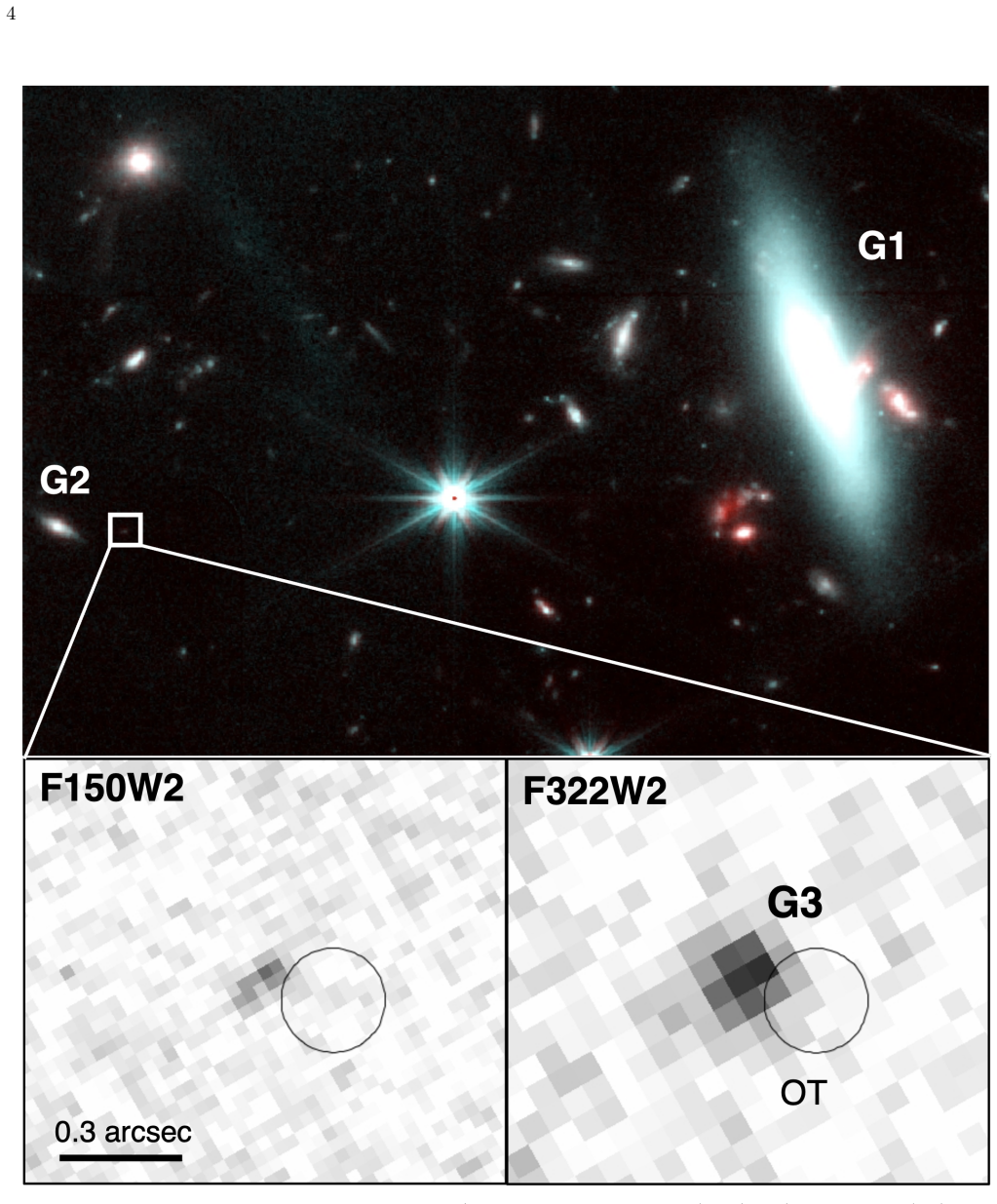
The observations of GRB 061201 are more naturally explained if the burst occurred within a faint F322W2~28.4 AB mag galaxy at z>2. By combining constraints from the afterglow and deep near-infrared imaging from JWST, a distant origin provides a coherent explanation of the burst phenomenology.
What carries the argument
The faint JWST-detected near-infrared source interpreted as the host galaxy at z>2, together with afterglow modeling that accommodates high-redshift scenarios.
If this is right
- GRB 061201 would rank among the most distant short GRBs observed.
- The compact binary merger population would extend to when the universe was about two billion years old.
- Short GRBs could contribute to r-process element production at earlier cosmic times than previously established.
- Previous low-redshift host associations for this burst would be ruled out in favor of a single distant site.
Where Pith is reading between the lines
- Short GRBs may commonly arise in faint, low-mass galaxies that are hard to detect at high redshift.
- Systematic JWST follow-up of other short GRBs without clear hosts could reveal additional high-z events.
- Binary merger rates in the early universe may have been higher than models based only on low-z detections imply.
Load-bearing premise
The faint source detected by JWST is the actual host galaxy of the burst rather than an unrelated background object.
What would settle it
A spectroscopic redshift measurement of the faint galaxy that shows it lies at low redshift, or quantitative afterglow fitting that definitively excludes all z>2 solutions.
Figures
read the original abstract
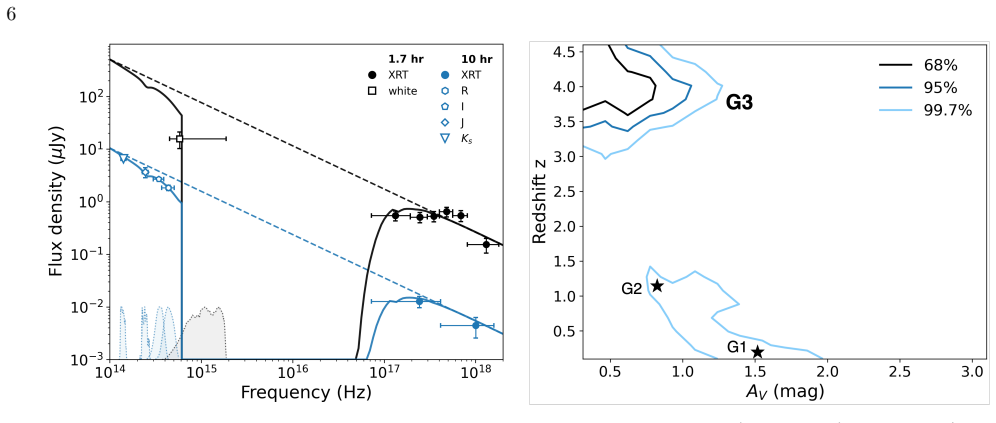
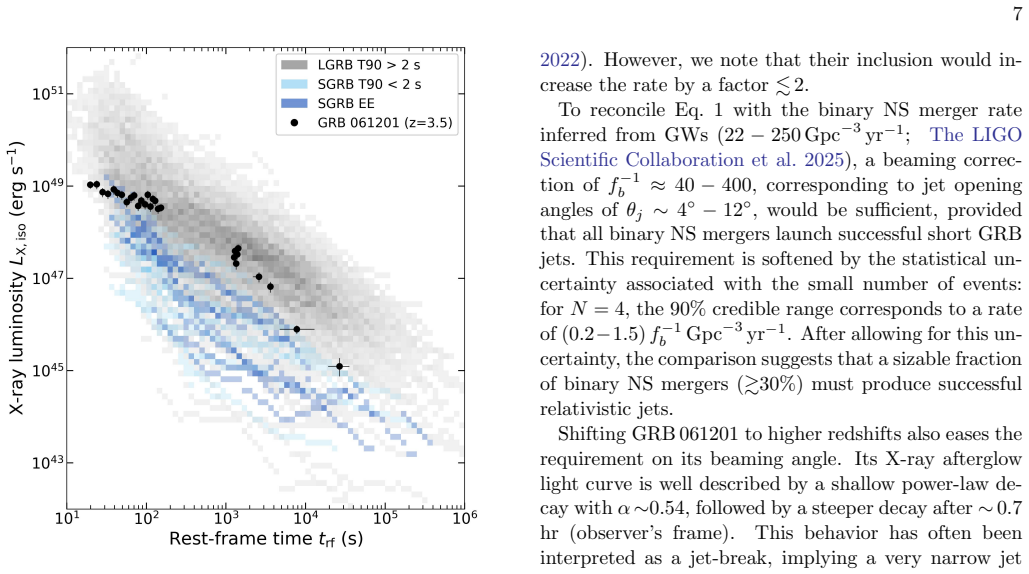
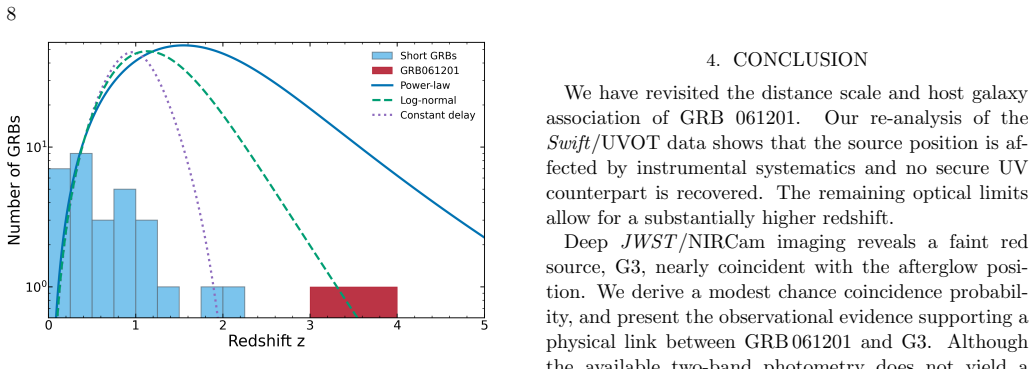
Short gamma-ray bursts (GRBs) at redshift z>2 remain exceptionally rare, yet they are crucial for tracing compact binary mergers in the early Universe and understanding their role in the production of r-process elements. GRB 061201 is an unusual and still debated event: although its optical afterglow was accurately localized, no secure coincident host galaxy was identified, and the proposed associations with nearby galaxies all require a large separation between the GRB and its birth site. In this work, we revisit GRB 061201 and argue that the observations are more naturally explained if the burst occurred within a faint F322W2~28.4 AB mag galaxy at z>2. By combining constraints from the afterglow and deep near-infrared imaging from JWST, we show that a distant origin provides a coherent explanation of the burst phenomenology. If confirmed, GRB 061201 would represent one of the most distant short GRBs known, extending the observed compact merger population to an epoch when the Universe was only about two billion years old.
Editorial analysis
A structured set of objections, weighed in public.
Referee Report
Summary. The paper argues that short GRB 061201 is more naturally explained as originating in a faint (F322W2 ~28.4 AB mag) galaxy at z>2 detected by JWST, rather than the previously proposed low-redshift associations that require large projected offsets; the claim rests on combining afterglow constraints with deep NIR imaging to provide a coherent picture of the burst phenomenology.
Significance. If the z>2 host association is confirmed, GRB 061201 would be among the most distant short GRBs known, extending the observed compact-merger population to an epoch when the Universe was ~2 Gyr old and strengthening constraints on early r-process enrichment. The work illustrates the diagnostic power of JWST for faint, high-redshift GRB hosts.
major comments (2)
- [Host identification and JWST imaging discussion] The central claim that the F322W2~28.4 source is the true host (rather than a background interloper) and that afterglow data favor z>2 requires a quantitative chance-alignment probability based on the localization error circle and the surface density of similarly faint sources; this calculation is not reported.
- [Afterglow constraints and modeling] No explicit afterglow light-curve fits, spectral-index constraints, host-extinction values, or likelihood comparisons (e.g., χ^{2} or Bayesian evidence) between the proposed z>2 model and the rejected low-z alternatives are provided, so the statement that a distant origin 'more naturally explains' the observations cannot be verified from the presented material.
minor comments (1)
- [Abstract] The abstract states the magnitude as F322W2~28.4 AB mag; confirm the exact filter and magnitude system is used consistently in the text and tables.
Simulated Author's Rebuttal
We thank the referee for their constructive feedback, which highlights areas where additional quantitative support will strengthen the manuscript. We address each major comment below and have revised the paper to incorporate the requested analyses.
read point-by-point responses
-
Referee: The central claim that the F322W2~28.4 source is the true host (rather than a background interloper) and that afterglow data favor z>2 requires a quantitative chance-alignment probability based on the localization error circle and the surface density of similarly faint sources; this calculation is not reported.
Authors: We agree that an explicit chance-alignment probability calculation is essential for rigorously supporting the host identification. The original manuscript discussed the low likelihood qualitatively based on the source faintness and small error circle but did not report the numerical value. In the revised manuscript we have added this calculation, using the GRB localization uncertainty and the observed surface density of F322W2 ≈ 28.4 sources in the JWST field, yielding a chance coincidence probability below 1%. revision: yes
-
Referee: No explicit afterglow light-curve fits, spectral-index constraints, host-extinction values, or likelihood comparisons (e.g., χ^{2} or Bayesian evidence) between the proposed z>2 model and the rejected low-z alternatives are provided, so the statement that a distant origin 'more naturally explains' the observations cannot be verified from the presented material.
Authors: The referee is correct that the manuscript presents the afterglow constraints in a primarily qualitative manner without explicit modeling or statistical comparisons. While the text argues that low-redshift associations require implausibly large offsets, no fitted light-curve parameters or model comparison metrics were included. The revised version will add a dedicated section with afterglow spectral-index constraints, host-extinction estimates, and χ² comparisons between the z>2 and low-z scenarios to allow direct verification of the preference for the high-redshift origin. revision: yes
Circularity Check
No circularity: argument rests on external observational constraints
full rationale
The paper presents an observational re-interpretation of GRB 061201 using afterglow data and JWST imaging to favor a high-redshift host association. No equations, fitted parameters, or derivation chain are described that reduce by construction to the paper's own inputs. No self-citations are invoked as load-bearing uniqueness theorems or ansatzes. The central claim is therefore sensitive to external data (chance alignment probabilities, afterglow model comparisons) rather than internal definitions, making the analysis self-contained against external benchmarks.
Axiom & Free-Parameter Ledger
axioms (1)
- standard math Standard flat Lambda-CDM cosmology for converting redshift to distance and luminosity
Reference graph
Works this paper leans on
-
[1]
The second Konus-Wind catalog of short gamma-ray bursts
The Second Konus-Wind Catalog of Short Gamma-Ray Bursts. , keywords =. doi:10.3847/0067-0049/224/1/10 , archivePrefix =. 1603.06832 , primaryClass =
work page internal anchor Pith review Pith/arXiv arXiv doi:10.3847/0067-0049/224/1/10
-
[2]
The Observed Offset Distribution of Gamma-Ray Bursts from Their Host Galaxies: A Robust Clue to the Nature of the Progenitors. , keywords =. doi:10.1086/338893 , archivePrefix =. astro-ph/0010176 , primaryClass =
work page internal anchor Pith review Pith/arXiv arXiv doi:10.1086/338893
-
[3]
A study of the prompt and afterglow emission of the short GRB 061201. , keywords =. doi:10.1051/0004-6361:20078006 , adsurl =
-
[4]
An online repository of Swift/XRT light curves of GRBs
An online repository of Swift/XRT light curves of -ray bursts. , keywords =. doi:10.1051/0004-6361:20077530 , archivePrefix =. 0704.0128 , primaryClass =
work page internal anchor Pith review Pith/arXiv arXiv doi:10.1051/0004-6361:20077530
-
[5]
The Two Micron All Sky Survey (2MASS). , keywords =. doi:10.1086/498708 , adsurl =
-
[6]
SExtractor: Software for source extraction. , keywords =. doi:10.1051/aas:1996164 , adsurl =
-
[7]
Astronomical Data Analysis Software and Systems XV , year = 2006, editor =
Automatic Astrometric and Photometric Calibration with SCAMP. Astronomical Data Analysis Software and Systems XV , year = 2006, editor =
2006
-
[8]
GRB Coordinates Network , year = 2006, month = jan, volume =
GRB060522: z = 5.11 Keck-LRIS redshift. GRB Coordinates Network , year = 2006, month = jan, volume =
2006
-
[9]
Counts and Colors of Faint Galaxies in the U and R Bands
Counts and colours of faint galaxies in the U and R bands. , keywords =. doi:10.1093/mnras/288.2.404 , archivePrefix =. astro-ph/9702241 , primaryClass =
work page internal anchor Pith review Pith/arXiv arXiv doi:10.1093/mnras/288.2.404
-
[10]
Parameter estimation in X-ray astronomy. , keywords =. doi:10.1086/154592 , adsurl =
-
[11]
Planck 2018 results. VI. Cosmological parameters. , keywords =. doi:10.1051/0004-6361/201833910 , archivePrefix =. 1807.06209 , primaryClass =
work page internal anchor Pith review Pith/arXiv arXiv doi:10.1051/0004-6361/201833910 2018
-
[12]
Short Gamma-Ray Bursts with Extended Emission
Short Gamma-Ray Bursts with Extended Emission. , keywords =. doi:10.1086/502796 , archivePrefix =. astro-ph/0601190 , primaryClass =
work page internal anchor Pith review Pith/arXiv arXiv doi:10.1086/502796
-
[13]
Intrinsic spectra and energetics of BeppoSAX Gamma-Ray Bursts with known redshifts
Intrinsic spectra and energetics of BeppoSAX Gamma-Ray Bursts with known redshifts. , keywords =. doi:10.1051/0004-6361:20020722 , archivePrefix =. astro-ph/0205230 , primaryClass =
work page internal anchor Pith review Pith/arXiv arXiv doi:10.1051/0004-6361:20020722
-
[14]
VizieR Online Data Catalog: The VISTA Hemisphere Survey (VHS) catalog DR5 (McMahon+, 2020)
2020
-
[15]
Prime Extragalactic Areas for Reionization and Lensing Science: Project Overview and First Results
JWST PEARLS. Prime Extragalactic Areas for Reionization and Lensing Science: Project Overview and First Results. , keywords =. doi:10.3847/1538-3881/aca163 , archivePrefix =. 2209.04119 , primaryClass =
-
[16]
The Stellar Ages and Masses of Short Gamma-ray Burst Host Galaxies: Investigating the Progenitor Delay Time Distribution and the Role of Mass and Star Formation in the Short Gamma-ray Burst Rate. , keywords =. doi:10.1088/0004-637X/725/1/1202 , archivePrefix =. 1009.1147 , primaryClass =
work page internal anchor Pith review Pith/arXiv arXiv doi:10.1088/0004-637x/725/1/1202
-
[17]
Eighteen Years of Kilonova Discoveries with Swift. Universe , keywords =. doi:10.3390/universe9060245 , archivePrefix =. 2305.18531 , primaryClass =
-
[18]
Afterglow Emission from Naked Gamma-Ray Bursts
Afterglow Emission from Naked Gamma-Ray Bursts. , keywords =. doi:10.1086/312905 , archivePrefix =. astro-ph/0006317 , primaryClass =
work page internal anchor Pith review Pith/arXiv arXiv doi:10.1086/312905
-
[19]
Constraints on the circumburst environments of short gamma-ray bursts. , keywords =. doi:10.1093/mnras/staa1433 , archivePrefix =. 2004.00031 , primaryClass =
-
[20]
A lanthanide-rich kilonova in the aftermath of a long gamma-ray burst. , keywords =. doi:10.1038/s41586-023-06979-5 , archivePrefix =. 2308.00638 , primaryClass =
-
[21]
The Burst Alert Telescope (BAT) on the Swift MIDEX Mission
The Burst Alert Telescope (BAT) on the SWIFT Midex Mission. , keywords =. doi:10.1007/s11214-005-5096-3 , archivePrefix =. astro-ph/0507410 , primaryClass =
work page internal anchor Pith review Pith/arXiv arXiv doi:10.1007/s11214-005-5096-3
-
[22]
A Merger within a Merger: Chandra Pinpoints the Short GRB 230906A in a Peculiar Environment. , keywords =. doi:10.3847/2041-8213/ae2a2f , archivePrefix =. 2510.15867 , primaryClass =
-
[23]
The Swift Ultra-Violet/Optical Telescope
The Swift Ultra-Violet/Optical Telescope. , keywords =. doi:10.1007/s11214-005-5095-4 , archivePrefix =. astro-ph/0507413 , primaryClass =
work page internal anchor Pith review Pith/arXiv arXiv doi:10.1007/s11214-005-5095-4
-
[24]
Axisymmetric Radiative Transfer Models of Kilonovae. , keywords =. doi:10.3847/1538-4357/abe1b5 , archivePrefix =. 2004.00102 , primaryClass =
-
[25]
Impact of ejecta morphology and composition on the electromagnetic signatures of neutron star mergers. , keywords =. doi:10.1093/mnras/sty1018 , archivePrefix =. 1705.07084 , primaryClass =
work page internal anchor Pith review Pith/arXiv arXiv doi:10.1093/mnras/sty1018
-
[26]
A nearby long gamma-ray burst from a merger of compact objects. , keywords =. doi:10.1038/s41586-022-05327-3 , archivePrefix =. 2209.03363 , primaryClass =
-
[27]
Revealing the high redshift host galaxy of the short GRB 061201 with JWST
Revealing the high redshift host galaxy of the short GRB 061201 with JWST. arXiv e-prints , keywords =. doi:10.48550/arXiv.2606.02032 , archivePrefix =. 2606.02032 , primaryClass =
work page internal anchor Pith review Pith/arXiv arXiv doi:10.48550/arxiv.2606.02032
-
[28]
Hubble Space Telescope Observations of Short Gamma-Ray Burst Host Galaxies: Morphologies, Offsets, and Local Environments. , keywords =. doi:10.1088/0004-637X/708/1/9 , archivePrefix =. 0909.1804 , primaryClass =
work page internal anchor Pith review Pith/arXiv arXiv doi:10.1088/0004-637x/708/1/9
-
[29]
The Locations of Short Gamma-ray Bursts as Evidence for Compact Object Binary Progenitors
The Locations of Short Gamma-Ray Bursts as Evidence for Compact Object Binary Progenitors. , keywords =. doi:10.1088/0004-637X/776/1/18 , archivePrefix =. 1307.0819 , primaryClass =
work page internal anchor Pith review Pith/arXiv arXiv doi:10.1088/0004-637x/776/1/18
-
[30]
Gravitational Waves and Gamma-rays from a Binary Neutron Star Merger: GW170817 and GRB 170817A
Gravitational Waves and Gamma-Rays from a Binary Neutron Star Merger: GW170817 and GRB 170817A. , keywords =. doi:10.3847/2041-8213/aa920c , archivePrefix =. 1710.05834 , primaryClass =
work page internal anchor Pith review Pith/arXiv arXiv doi:10.3847/2041-8213/aa920c 2041
-
[31]
GW170817: Observation of Gravitational Waves from a Binary Neutron Star Inspiral
GW170817: Observation of Gravitational Waves from a Binary Neutron Star Inspiral. , keywords =. doi:10.1103/PhysRevLett.119.161101 , archivePrefix =. 1710.05832 , primaryClass =
work page internal anchor Pith review Pith/arXiv arXiv doi:10.1103/physrevlett.119.161101
-
[32]
Tellurium emission line in kilonova AT 2017gfo. , keywords =. doi:10.1093/mnrasl/slad128 , archivePrefix =. 2307.00988 , primaryClass =
-
[33]
On the offset of short gamma-ray bursts. , keywords =. doi:10.1111/j.1365-2966.2010.16752.x , archivePrefix =. 1004.2042 , primaryClass =
-
[34]
Calibration of X-ray absorption in our Galaxy
Calibration of X-ray absorption in our Galaxy. , keywords =. doi:10.1093/mnras/stt175 , archivePrefix =. 1303.0843 , primaryClass =
work page internal anchor Pith review Pith/arXiv arXiv doi:10.1093/mnras/stt175
-
[35]
Measuring Reddening with SDSS Stellar Spectra and Recalibrating SFD
Measuring Reddening with Sloan Digital Sky Survey Stellar Spectra and Recalibrating SFD. , keywords =. doi:10.1088/0004-637X/737/2/103 , archivePrefix =. 1012.4804 , primaryClass =
work page internal anchor Pith review Pith/arXiv arXiv doi:10.1088/0004-637x/737/2/103
-
[36]
Origin of the heavy elements in binary neutron-star mergers from a gravitational wave event
Origin of the heavy elements in binary neutron-star mergers from a gravitational-wave event. , keywords =. doi:10.1038/nature24453 , archivePrefix =. 1710.05463 , primaryClass =
work page internal anchor Pith review Pith/arXiv arXiv doi:10.1038/nature24453
-
[37]
Spectroscopic identification of r-process nucleosynthesis in a double neutron star merger
Spectroscopic identification of r-process nucleosynthesis in a double neutron-star merger. , keywords =. doi:10.1038/nature24298 , archivePrefix =. 1710.05858 , primaryClass =
work page internal anchor Pith review Pith/arXiv arXiv doi:10.1038/nature24298
-
[38]
Nucleosynthesis, neutrino bursts and -rays from coalescing neutron stars. , keywords =. doi:10.1038/340126a0 , adsurl =
-
[39]
Instrumental Tip-of-the-iceberg Effects on the Prompt Emission of Swift/BAT Gamma-ray Bursts. , keywords =. doi:10.3847/1538-4357/ac4d94 , archivePrefix =. 2111.13392 , primaryClass =
-
[40]
The Implications of the Compton (GRO) Observations for Cosmological Gamma-Ray Bursts. , keywords =. doi:10.1086/186345 , adsurl =
-
[41]
The rate, luminosity function and time delay of non-Collapsar short GRBs
The rate, luminosity function and time delay of non-Collapsar short GRBs. , keywords =. doi:10.1093/mnras/stv123 , archivePrefix =. 1405.5878 , primaryClass =
work page internal anchor Pith review Pith/arXiv arXiv doi:10.1093/mnras/stv123
-
[42]
Radiation Backgrounds at Cosmic Dawn: X-Rays from Compact Binaries
Radiation Backgrounds at Cosmic Dawn: X-Rays from Compact Binaries. , keywords =. doi:10.3847/1538-4357/aa6af9 , archivePrefix =. 1606.07887 , primaryClass =
work page internal anchor Pith review Pith/arXiv arXiv doi:10.3847/1538-4357/aa6af9
-
[43]
GRB090426: the environment of a rest-frame 0.35-s gamma-ray burst at a redshift of 2.609. , keywords =. doi:10.1111/j.1365-2966.2009.15733.x , archivePrefix =. 0907.1661 , primaryClass =
-
[44]
An observational imprint of the Collapsar model of long Gamma Ray Bursts
An Observational Imprint of the Collapsar Model of Long Gamma-Ray Bursts. , keywords =. doi:10.1088/0004-637X/749/2/110 , archivePrefix =. 1111.2990 , primaryClass =
work page internal anchor Pith review Pith/arXiv arXiv doi:10.1088/0004-637x/749/2/110
-
[45]
Short GRB Host Galaxies. II. A Legacy Sample of Redshifts, Stellar Population Properties, and Implications for Their Neutron Star Merger Origins. , keywords =. doi:10.3847/1538-4357/ac91d1 , archivePrefix =. 2206.01764 , primaryClass =
-
[46]
Evidence of Extended Emission in GRB 181123B and Other High-redshift Short GRBs. , keywords =. doi:10.3847/2041-8213/abf562 , archivePrefix =. 2103.02558 , primaryClass =
-
[47]
Identifying the Location in the Host Galaxy of the Short GRB 111117A with the Chandra Subarcsecond Position. , keywords =. doi:10.1088/0004-637X/766/1/41 , archivePrefix =. 1205.6774 , primaryClass =
work page internal anchor Pith review Pith/arXiv arXiv doi:10.1088/0004-637x/766/1/41
-
[48]
Initial Populations of Black Holes in Star Clusters
Initial Populations of Black Holes in Star Clusters. , keywords =. doi:10.1086/506186 , archivePrefix =. astro-ph/0508005 , primaryClass =
work page internal anchor Pith review Pith/arXiv arXiv doi:10.1086/506186
-
[49]
A Study of Compact Object Mergers as Short Gamma-ray Burst Progenitors
A Study of Compact Object Mergers as Short Gamma-Ray Burst Progenitors. , keywords =. doi:10.1086/505169 , archivePrefix =. astro-ph/0601458 , primaryClass =
work page internal anchor Pith review Pith/arXiv arXiv doi:10.1086/505169
-
[50]
Double Compact Objects. I. The Significance of the Common Envelope on Merger Rates. , keywords =. doi:10.1088/0004-637X/759/1/52 , archivePrefix =. 1202.4901 , primaryClass =
work page internal anchor Pith review Pith/arXiv arXiv doi:10.1088/0004-637x/759/1/52
-
[51]
Observational Inference on the Delay Time Distribution of Short Gamma-Ray Bursts. , keywords =. doi:10.3847/2041-8213/ac91cd , archivePrefix =. 2206.02814 , primaryClass =
-
[52]
The Swift Gamma-Ray Burst Mission
The Swift Gamma-Ray Burst Mission. , keywords =. doi:10.1086/422091 , archivePrefix =. astro-ph/0405233 , primaryClass =
work page internal anchor Pith review Pith/arXiv arXiv doi:10.1086/422091
-
[53]
A deep survey of short GRB host galaxies over z 0-2: implications for offsets, redshifts, and environments. , keywords =. doi:10.1093/mnras/stac1982 , archivePrefix =. 2204.09059 , primaryClass =
-
[54]
Short GRB Host Galaxies. I. Photometric and Spectroscopic Catalogs, Host Associations, and Galactocentric Offsets. , keywords =. doi:10.3847/1538-4357/ac91d0 , archivePrefix =. 2206.01763 , primaryClass =
-
[55]
A Short Gamma-ray Burst ``No-host'' Problem? Investigating Large Progenitor Offsets for Short GRBs with Optical Afterglows. , keywords =. doi:10.1088/0004-637X/722/2/1946 , archivePrefix =. 1007.0003 , primaryClass =
work page internal anchor Pith review Pith/arXiv arXiv doi:10.1088/0004-637x/722/2/1946 1946
-
[56]
On the nature of the 'hostless' short GRBs
On the nature of the `hostless' short GRBs. , keywords =. doi:10.1093/mnras/stt1975 , archivePrefix =. 1402.0766 , primaryClass =
work page internal anchor Pith review Pith/arXiv arXiv doi:10.1093/mnras/stt1975
-
[57]
GRB Coordinates Network , year = 2006, month = jan, volume =
GRB 061201: SOAR confirmation of candidate afterglow. GRB Coordinates Network , year = 2006, month = jan, volume =
2006
-
[58]
A Comparison of the Afterglows of Short- and Long-Duration Gamma-Ray Bursts
A Comparison of the Afterglows of Short- and Long-duration Gamma-ray Bursts. , keywords =. doi:10.1088/0004-637X/701/1/824 , archivePrefix =. 0806.3607 , primaryClass =
work page internal anchor Pith review Pith/arXiv arXiv doi:10.1088/0004-637x/701/1/824
-
[59]
Astronomical Data Analysis Software and Systems V , year = 1996, editor =
XSPEC: The First Ten Years. Astronomical Data Analysis Software and Systems V , year = 1996, editor =
1996
-
[60]
GW190425: Observation of a Compact Binary Coalescence with Total Mass 3.4 M _. , keywords =. doi:10.3847/2041-8213/ab75f5 , archivePrefix =. 2001.01761 , primaryClass =
-
[61]
A short gamma-ray burst apparently asssociated with an elliptical galaxy at redshift z=0.225
A short -ray burst apparently associated with an elliptical galaxy at redshift z = 0.225. , keywords =. doi:10.1038/nature04142 , archivePrefix =. astro-ph/0505630 , primaryClass =
work page internal anchor Pith review Pith/arXiv arXiv doi:10.1038/nature04142
-
[62]
Neutron Star Mergers Might not be the Only Source of r-Process Elements in the Milky Way
Neutron Star Mergers Might Not Be the Only Source of r-process Elements in the Milky Way. , keywords =. doi:10.3847/1538-4357/ab10db , archivePrefix =. 1809.03525 , primaryClass =
work page internal anchor Pith review Pith/arXiv arXiv doi:10.3847/1538-4357/ab10db
-
[63]
A multi-wavelength analysis of a collection of short-duration GRBs observed between 2012-2015
A multiwavelength analysis of a collection of short-duration GRBs observed between 2012 and 2015. , keywords =. doi:10.1093/mnras/stz530 , archivePrefix =. 1902.07900 , primaryClass =
work page internal anchor Pith review Pith/arXiv arXiv doi:10.1093/mnras/stz530 2012
-
[64]
Host Galaxy Properties of Gamma-Ray Bursts Involving Neutron Star Binary Mergers and Their Impact on Kilonovae Rates. , keywords =. doi:10.3847/1538-4357/ad6b2a , archivePrefix =. 2408.01048 , primaryClass =
-
[65]
Short GRBs: Opening Angles, Local Neutron Star Merger Rate, and Off-axis Events for GRB/GW Association. , keywords =. doi:10.3847/1538-4357/aab76d , archivePrefix =. 1708.07008 , primaryClass =
work page internal anchor Pith review Pith/arXiv arXiv doi:10.3847/1538-4357/aab76d
-
[66]
Wide Jets or Low Rates: Reconciling Short GRB and Gravitational-Wave Neutron Star Merger Rates
Wide Jets or Low Rates: Reconciling Short GRB and Gravitational-Wave Neutron Star Merger Rates. arXiv e-prints , keywords =. doi:10.48550/arXiv.2604.05046 , archivePrefix =. 2604.05046 , primaryClass =
work page internal anchor Pith review Pith/arXiv arXiv doi:10.48550/arxiv.2604.05046
-
[67]
GWTC-4.0: Population Properties of Merging Compact Binaries
GWTC-4.0: Population Properties of Merging Compact Binaries. arXiv e-prints , keywords =. doi:10.48550/arXiv.2508.18083 , archivePrefix =. 2508.18083 , primaryClass =
work page internal anchor Pith review Pith/arXiv arXiv doi:10.48550/arxiv.2508.18083
-
[68]
, keywords =
Cosmological gamma-ray bursts. , keywords =
-
[69]
Lanthanide Features in Near-infrared Spectra of Kilonovae. , keywords =. doi:10.3847/1538-4357/ac8c36 , archivePrefix =. 2206.04232 , primaryClass =
-
[70]
The Missing Link: Merging Neutron Stars Naturally Produce Jet-like Structures and Can Power Short Gamma-ray Bursts. , keywords =. doi:10.1088/2041-8205/732/1/L6 , archivePrefix =. 1101.4298 , primaryClass =
work page internal anchor Pith review Pith/arXiv arXiv doi:10.1088/2041-8205/732/1/l6 2041
-
[71]
Formation Rates of Black Hole Accretion Disk Gamma-Ray Bursts
Formation Rates of Black Hole Accretion Disk Gamma-Ray Bursts. , keywords =. doi:10.1086/307992 , archivePrefix =. astro-ph/9904122 , primaryClass =
work page internal anchor Pith review Pith/arXiv arXiv doi:10.1086/307992
-
[72]
, keywords =
Neutron Star Collisions and the r-Process. , keywords =
-
[73]
R-Process in Neutron Star Mergers. , keywords =. doi:10.1086/312343 , adsurl =
-
[74]
Natal Kicks and Time Delays in Merging Neutron Star Binaries: Implications for r-process Nucleosynthesis in Ultra-faint Dwarfs and in the Milky Way. , keywords =. doi:10.3847/2041-8205/829/1/L13 , archivePrefix =. 1607.02148 , primaryClass =
work page internal anchor Pith review Pith/arXiv arXiv doi:10.3847/2041-8205/829/1/l13 2041
-
[75]
Multi-color observations of short GRB afterglows: 20 events observed between 2007 and 2010
Multi-color observations of short GRB afterglows: 20 events observed between 2007 and 2010. , keywords =. doi:10.1051/0004-6361/201219551 , archivePrefix =. 1206.1806 , primaryClass =
work page internal anchor Pith review Pith/arXiv arXiv doi:10.1051/0004-6361/201219551 2007
-
[76]
An origin for short g-ray bursts unassociated with current star formation
An origin for short -ray bursts unassociated with current star formation. , keywords =. doi:10.1038/nature04392 , archivePrefix =. astro-ph/0511579 , primaryClass =
work page internal anchor Pith review Pith/arXiv arXiv doi:10.1038/nature04392
-
[77]
Formation of Double Neutron Star Systems
Formation of Double Neutron Star Systems. , keywords =. doi:10.3847/1538-4357/aa7e89 , archivePrefix =. 1706.09438 , primaryClass =
work page internal anchor Pith review Pith/arXiv arXiv doi:10.3847/1538-4357/aa7e89
-
[78]
Double Neutron Star Formation: Merger Times, Systemic Velocities, and Travel Distances
Double neutron star formation: merger times, systemic velocities, and travel distances. , keywords =. doi:10.1093/mnras/stz1066 , archivePrefix =. 1904.06137 , primaryClass =
work page internal anchor Pith review Pith/arXiv arXiv doi:10.1093/mnras/stz1066 1904
-
[79]
LISA and the Existence of a Fast-merging Double Neutron Star Formation Channel. , keywords =. doi:10.3847/2041-8213/ab5b9a , archivePrefix =. 1910.13436 , primaryClass =
-
[80]
Ultrafast Compact Binary Mergers. , keywords =. doi:10.3847/1538-4357/ad32cd , archivePrefix =. 2312.02269 , primaryClass =
discussion (0)
Sign in with ORCID, Apple, or X to comment. Anyone can read and Pith papers without signing in.