Sensitivity Analysis and Optimization of Stochastic Epidemic Models under Parameter Uncertainty
Pith reviewed 2026-07-03 00:57 UTC · model grok-4.3
The pith
Unbiased gradient estimators show that parameter uncertainty reduces sensitivity in stochastic epidemic models and produces more conservative optimization policies.
A machine-rendered reading of the paper's core claim, the machinery that carries it, and where it could break.
Core claim
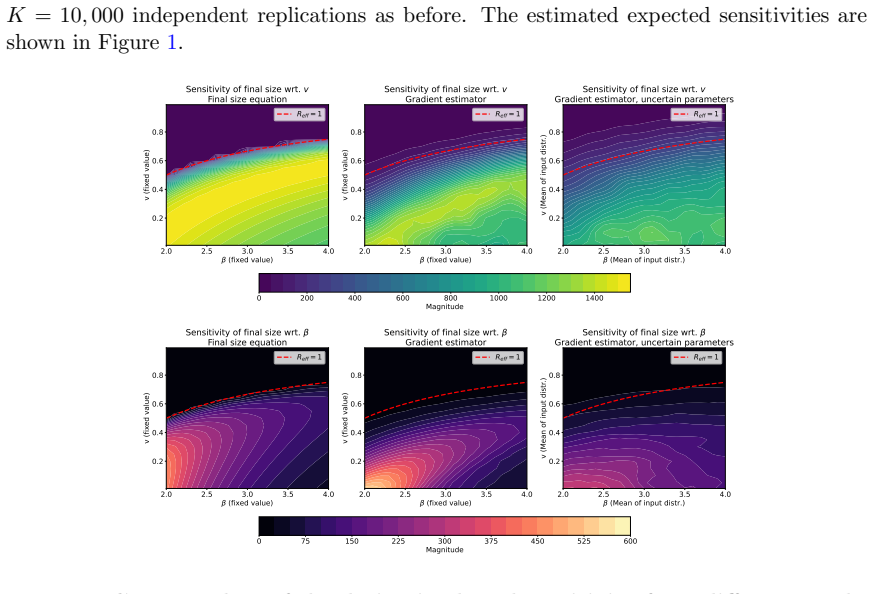
The authors derive unbiased gradient estimators that accommodate uncertainties represented as distributions over the parameters of interest, such as those arising from Bayesian calibration. Specifically, they estimate the sensitivity of total infections over a finite time horizon with respect to the proportion immunized (v) and the contact rate (β). Comparing the proposed estimators with deterministic limit approximations based on large populations reveals differences due to the finite population and time horizon. The estimators exhibit lower variance than finite-difference estimators for the derivative with respect to β, but higher variance for the derivative with respect to v. Simulation e
What carries the argument
Unbiased gradient estimators that accommodate distributions over model parameters for sensitivity of total infections to immunization proportion and contact rate.
If this is right
- Sensitivity estimates differ from those obtained via deterministic large-population limits because of finite population size and finite time horizon.
- The estimators have lower variance than finite-difference methods when differentiating with respect to the contact rate but higher variance when differentiating with respect to the immunization proportion.
- Indirect effects such as herd immunity appear less pronounced once parameter uncertainty is included.
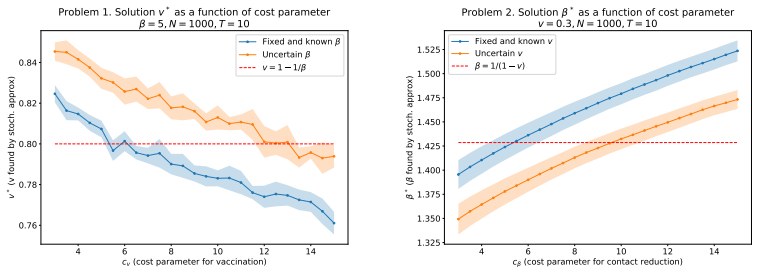
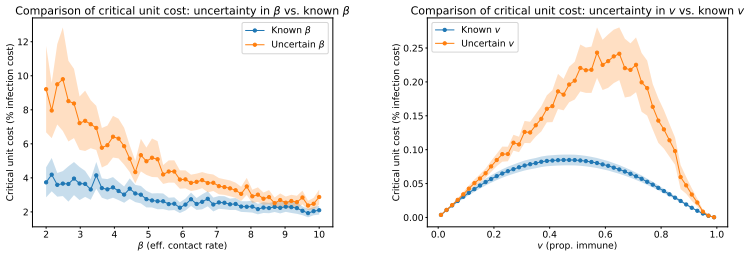
- Optimization that balances intervention costs against infection costs yields more conservative policies under parameter uncertainty than under point estimates.
Where Pith is reading between the lines
- Real-world vaccination planning that ignores parameter uncertainty may overestimate the strength of indirect protection and therefore adopt insufficiently cautious targets.
- The same estimator construction could be tested on continuous-time epidemic models or on networks with heterogeneous contact patterns to check whether the reduction in sensitivity persists.
- If Bayesian calibration produces wider parameter distributions than those used in the simulations, the shift toward conservative policies would be even stronger.
Load-bearing premise
The discrete-time stochastic epidemic model is correctly specified and the parameter distributions accurately capture the uncertainty arising from Bayesian calibration.
What would settle it
A controlled simulation on a known stochastic epidemic process with specified parameter distributions in which the proposed gradient estimators exhibit bias, or empirical epidemic data in which incorporating parameter distributions fails to produce more conservative optimization outcomes than fixed-parameter analysis.
Figures
read the original abstract
To address sensitivity analysis and optimization for a discrete-time stochastic epidemic model, we derive unbiased gradient estimators that accommodate uncertainties represented as distributions over the parameters of interest, such as those arising from Bayesian calibration. Specifically, we estimate the sensitivity of total infections over a finite time horizon with respect to the proportion immunized ($v$) and the contact rate ($\beta$). Comparing the proposed estimators with deterministic limit approximations based on large populations reveals differences due to the finite population and time horizon. The estimators exhibit lower variance than finite-difference estimators for the derivative with respect to $\beta$, but higher variance for the derivative with respect to $v$. Simulation experiments indicate parameter uncertainty reduces sensitivity to the parameters of interest. In particular, indirect effects of vaccination, such as herd immunity, are less pronounced compared to when parameters are known. For optimization problems balancing intervention and infection costs, incorporating parametric uncertainty leads to more conservative policies.
Editorial analysis
A structured set of objections, weighed in public.
Referee Report
Summary. The manuscript claims to derive unbiased gradient estimators for sensitivity analysis of total infections over a finite horizon in a discrete-time stochastic epidemic model, with respect to vaccination proportion v and contact rate β, while accommodating parameter uncertainty represented as distributions (e.g., from Bayesian calibration). It compares these estimators to deterministic large-population approximations, reports variance comparisons versus finite-difference methods, and uses simulations to conclude that parameter uncertainty reduces sensitivity (e.g., weaker indirect vaccination effects like herd immunity) and yields more conservative optimal policies when balancing intervention and infection costs.
Significance. If the unbiasedness claims hold under verifiable regularity conditions and the simulation results prove robust, the approach could enable more reliable sensitivity and optimization analyses for epidemic models that incorporate epistemic uncertainty from parameter estimation, addressing a practical gap between deterministic approximations and stochastic models with finite populations.
major comments (2)
- [Abstract and gradient estimator derivation] Abstract (first paragraph) and the section deriving the gradient estimators: the central claim of unbiased estimators for sensitivities under random parameters implicitly requires interchanging differentiation and expectation, i.e., d/dθ E_θ[f(X)] = E_θ[d/dθ f(X)] for the epidemic trajectory functional f. No regularity conditions (e.g., dominated convergence, Lipschitz continuity of the discrete-time transition kernel, or parameter-independent support) are stated to justify this interchange; if violated for the chosen parameter distributions, the estimators are biased and the downstream claims on reduced sensitivity and conservative policies do not follow.
- [Simulation experiments] The simulation experiments section: the reported reductions in sensitivity and shifts to conservative policies rest on the assumption that the discrete-time stochastic model is correctly specified and that the parameter distributions accurately capture uncertainty from Bayesian calibration, but no details on the model equations, transition probabilities, or experimental setup (e.g., population size, time horizon, specific distributions) are provided to allow verification of these effects.
minor comments (2)
- [Abstract] The abstract states that the estimators exhibit lower variance than finite-difference methods for the derivative w.r.t. β but higher for v, yet provides no quantitative values, sample sizes, or variance reduction factors to support this comparison.
- [Model description] Notation for the epidemic process (e.g., definition of total infections, the functional f, and how v and β enter the transition kernel) should be introduced explicitly early in the manuscript rather than assumed from context.
Simulated Author's Rebuttal
We thank the referee for the thoughtful comments, which help strengthen the presentation of our results on unbiased gradient estimators for stochastic epidemic models. We respond to each major comment below.
read point-by-point responses
-
Referee: [Abstract and gradient estimator derivation] Abstract (first paragraph) and the section deriving the gradient estimators: the central claim of unbiased estimators for sensitivities under random parameters implicitly requires interchanging differentiation and expectation, i.e., d/dθ E_θ[f(X)] = E_θ[d/dθ f(X)] for the epidemic trajectory functional f. No regularity conditions (e.g., dominated convergence, Lipschitz continuity of the discrete-time transition kernel, or parameter-independent support) are stated to justify this interchange; if violated for the chosen parameter distributions, the estimators are biased and the downstream claims on reduced sensitivity and conservative policies do not follow.
Authors: We agree that an explicit statement of regularity conditions is needed to rigorously support the interchange of differentiation and expectation. The revised manuscript will add a dedicated paragraph in the gradient estimator section listing the assumptions: finite time horizon, bounded transition probabilities, and application of the dominated convergence theorem given the compact parameter support and discrete state space. These conditions hold for the binomial transition kernels used in the model. revision: yes
-
Referee: [Simulation experiments] The simulation experiments section: the reported reductions in sensitivity and shifts to conservative policies rest on the assumption that the discrete-time stochastic model is correctly specified and that the parameter distributions accurately capture uncertainty from Bayesian calibration, but no details on the model equations, transition probabilities, or experimental setup (e.g., population size, time horizon, specific distributions) are provided to allow verification of these effects.
Authors: The model equations and binomial transition probabilities are defined in Section 2 of the manuscript, and the parameter distributions are described as posteriors from Bayesian calibration. To improve self-containment and verifiability, the revised simulation section will add an explicit table listing N=1000, T=50, and the exact distributions (e.g., β ~ N(0.4, 0.05)). We will also include pseudocode for the Monte Carlo procedure. revision: partial
Circularity Check
No circularity: gradient estimators derived independently of fitted inputs
full rationale
The paper derives unbiased gradient estimators for sensitivities w.r.t. v and β under parameter distributions using standard stochastic-gradient techniques applied to the discrete-time epidemic process. No step reduces a claimed prediction or sensitivity to a quantity already fitted from the same data by construction, nor does any load-bearing premise rest on a self-citation chain. Simulation results on reduced sensitivity and conservative policies are presented as empirical outcomes, not tautological consequences of the estimators themselves. The derivation chain is self-contained against external benchmarks.
Axiom & Free-Parameter Ledger
axioms (2)
- standard math Interchange of derivative and expectation is valid for the gradient estimators in the discrete-time Markov chain epidemic model
- domain assumption Parameter uncertainty is accurately captured by the supplied distributions from Bayesian calibration
Reference graph
Works this paper leans on
-
[1]
Ecological Monographs , volume=
Grenfell, Bryan T and Bj. Ecological Monographs , volume=. 2002 , publisher=
2002
-
[2]
Lomeli, Luis DJ and Ngo, Michelle N and Wakefield, Jon and Shahbaba, Babak and Minin, Vladimir N , journal=
-
[3]
SIAM Journal on Optimization , volume =
Wu, Di and Zhu, Helin and Zhou, Enlu , title =. SIAM Journal on Optimization , volume =. 2018 , doi =. https://doi.org/10.1137/16M1101933 , abstract =
-
[4]
2021 , publisher=
Cakmak, Sait and Wu, Di and Zhou, Enlu , journal=. 2021 , publisher=
2021
-
[5]
Mathematical Biosciences , volume=
Capistr. Mathematical Biosciences , volume=. 2012 , publisher=
2012
-
[6]
2015 , publisher=
Fu, Michael C , booktitle=. 2015 , publisher=
2015
-
[7]
2015 , publisher=
Chau, Marie and Fu, Michael C , booktitle=. 2015 , publisher=
2015
-
[8]
2007 , publisher=
Law, Averill M and Kelton, W David , edition=. 2007 , publisher=
2007
-
[9]
Bulletin of Mathematical Biology , author=. 2012 , month=sept, pages=. doi:10.1007/s11538-012-9749-6 , abstractNote=
-
[10]
Serfozo, Richard , year=
-
[11]
Journal of The Royal Society Interface , author=. 2024 , month=sept, pages=. doi:10.1098/rsif.2024.0299 , abstractNote=
-
[12]
C.J.E. Metcalf and M. Ferrari and A.L. Graham and B.T. Grenfell , abstract =. Understanding Herd Immunity , journal =. 2015 , issn =. doi:https://doi.org/10.1016/j.it.2015.10.004 , url =
-
[13]
Spatio-Temporal Analysis of Surveillance Data , booktitle=
Wakefield, Jon and Dong, Tracy Qi and Minin, Vladimir N , year=. Spatio-Temporal Analysis of Surveillance Data , booktitle=
-
[14]
Communications of the ACM , volume=
Likelihood ratio gradient estimation for stochastic systems , author=. Communications of the ACM , volume=. 1990 , publisher=
1990
-
[15]
1996 , volume=
Optimization of Stochastic Models: The Interface Between Simulation and Optimization , author=. 1996 , volume=
1996
-
[16]
2020 , publisher=
Saltelli, Andrea and Bammer, Gabriele and Bruno, Isabelle and Charters, Erica and Di Fiore, Monica and Didier, Emmanuel and Nelson Espeland, Wendy and Kay, John and Lo Piano, Samuele and Mayo, Deborah and others , journal=. 2020 , publisher=
2020
-
[17]
2022 , publisher=
Ioannidis, John PA and Cripps, Sally and Tanner, Martin A , journal=. 2022 , publisher=
2022
-
[18]
2022 , publisher=
Taleb, Nassim Nicholas and Bar-Yam, Yaneer and Cirillo, Pasquale , journal=. 2022 , publisher=
2022
-
[19]
Pinson, Pierre and Makridakis, Spyros , journal=
-
[20]
2000 , publisher=
Hethcote, Herbert W , journal=. 2000 , publisher=
2000
-
[21]
2015 , publisher=
Roberts, Mick and Andreasen, Viggo and Lloyd, Alun and Pellis, Lorenzo , journal=. 2015 , publisher=
2015
-
[22]
Coffeng and Philip Dawid and Daniela
Ben Swallow and Paul Birrell and Joshua Blake and Mark Burgman and Peter Challenor and Luc E. Coffeng and Philip Dawid and Daniela. Epidemics , volume =. 2022 , issn =. doi:https://doi.org/10.1016/j.epidem.2022.100547 , url =
-
[23]
2008 , publisher=
Allen, Linda JS , booktitle=. 2008 , publisher=
2008
-
[24]
doi:10.1007/978-1-4612-1158-7 , publisher=
Andersson, Håkan and Britton, Tom , year=. doi:10.1007/978-1-4612-1158-7 , publisher=
-
[25]
2019 , publisher=
Britton, Tom and Pardoux, Etienne and Ball, Franck and Laredo, Catherine and Sirl, David and Tran, Viet Chi , volume=. 2019 , publisher=
2019
-
[26]
Railsback, Steven F and Grimm, Volker , year=
-
[27]
BMC Infectious Diseases , volume=
Ajelli, Marco and Gon. BMC Infectious Diseases , volume=. 2010 , publisher=
2010
-
[28]
History and Philosophy of the Life Sciences , volume=
Iranzo, Valeriano and P. History and Philosophy of the Life Sciences , volume=. 2021 , publisher=
2021
-
[29]
PLoS Computational Biology , volume=
Kerr, Cliff C and Stuart, Robyn M and Mistry, Dina and Abeysuriya, Romesh G and Rosenfeld, Katherine and Hart, Gregory R and N. PLoS Computational Biology , volume=
-
[30]
Annual Review of Public Health , volume=
Tracy, Melissa and Cerd. Annual Review of Public Health , volume=. 2018 , publisher=
2018
-
[31]
Nsoesie, Elaine O and Beckman, Richard J and Marathe, Madhav V , journal=
-
[32]
2022 , publisher=
Borgonovo, Emanuele and Pangallo, Marco and Rivkin, Jan and Rizzo, Leonardo and Siggelkow, Nicolaj , journal=. 2022 , publisher=
2022
-
[33]
Kouye, Henri Mermoz , year=
-
[34]
2019 , publisher=
Berhe, Hailay Weldegiorgis and Makinde, Oluwole Daniel and Theuri, David Mwangi , journal=. 2019 , publisher=
2019
-
[35]
Mester, Rachel and Landeros, Alfonso and Rackauckas, Chris and Lange, Kenneth , journal=
-
[36]
2023 , publisher=
Lu, Xuefei and Borgonovo, Emanuele , journal=. 2023 , publisher=
2023
-
[37]
Saltelli, Andrea and Ratto, Marco and Andres, Terry and Campolongo, Francesca and Cariboni, Jessica and Gatelli, Debora and Saisana, Michaela and Tarantola, Stefano , year=
-
[38]
2016 , publisher=
Kucherenko, Sergei and Song, Shugfang , booktitle=. 2016 , publisher=
2016
-
[39]
2016 , publisher=
De Lozzo, Matthias and Marrel, Amandine , journal=. 2016 , publisher=
2016
-
[40]
2026 , publisher=
Mirsaeedi, Fatemeh and Sheikhalishahi, Mohammad and Mohammadi, Mehrdad and Pirayesh, Amir and Ivanov, Dmitry , journal=. 2026 , publisher=
2026
-
[41]
Nsoesie, Elaine O and Beckman, Richard J and Shashaani, Sara and Nagaraj, Kalyani S and Marathe, Madhav V , journal=
-
[42]
2021 , publisher=
Gillis, Melissa and Urban, Ryley and Saif, Ahmed and Kamal, Noreen and Murphy, Matthew , journal=. 2021 , publisher=
2021
-
[43]
2017 , publisher=
Paleshi, Arsalan and Bae, Ki-Hwan and Evans, Gerald and Heragu, Sunderesh , journal=. 2017 , publisher=
2017
-
[44]
2025 , publisher=
Ye, Yang and Pandey, Abhishek and Bawden, Carolyn and Sumsuzzman, Dewan Md and Rajput, Rimpi and Shoukat, Affan and Singer, Burton H and Moghadas, Seyed M and Galvani, Alison P , journal=. 2025 , publisher=
2025
-
[45]
2008 , publisher=
Tanner, Matthew W and Sattenspiel, Lisa and Ntaimo, Lewis , journal=. 2008 , publisher=
2008
-
[46]
IISE Transactions on Healthcare Systems Engineering , volume=
Yin, Xuecheng and B. IISE Transactions on Healthcare Systems Engineering , volume=. 2022 , publisher=
2022
-
[47]
and La, Richard J
Park, Shinkyu and Certorio, Jair and Martins, Nuno C. and La, Richard J. , journal=. Epidemic Population Games and Perturbed Best Response Dynamics , year=
-
[48]
Gao, Zhijian and Li, Shuxin and An, Bo , journal=
-
[49]
Chopra, Ayush and Rodr
-
[50]
PLoS One , volume=
Navascu. PLoS One , volume=. 2021 , publisher=
2021
-
[51]
2024 , publisher=
Trostle, Parker and Guinness, Joseph and Reich, Brian J , journal=. 2024 , publisher=
2024
-
[52]
2020 , publisher=
Peng, Yijie and Fu, Michael C and Heidergott, Bernd and Lam, Henry , journal=. 2020 , publisher=
2020
-
[53]
2013 , publisher=
Wu, Jianyong and Dhingra, Radhika and Gambhir, Manoj and Remais, Justin V , journal=. 2013 , publisher=
2013
-
[54]
2017 , organization=
Alaeddini, Atiye and Klein, Daniel J , booktitle=. 2017 , organization=
2017
-
[55]
Computational Statistics , volume=
Rupp, Kevin and Schill, Rudolf and S. Computational Statistics , volume=. 2024 , publisher=
2024
-
[56]
Robertson and Ben Swallow and Cerian R
Liza Hadley and Peter Challenor and Chris Dent and Valerie Isham and Denis Mollison and Duncan A. Robertson and Ben Swallow and Cerian R. Webb , keywords =. Epidemics , volume =. 2021 , issn =. doi:https://doi.org/10.1016/j.epidem.2021.100499 , url =
-
[57]
Mathematics and Computers in Simulation , volume =
I.M Sobol' , keywords =. Mathematics and Computers in Simulation , volume =. 2001 , issn =. doi:https://doi.org/10.1016/S0378-4754(00)00270-6 , url =
discussion (0)
Sign in with ORCID, Apple, or X to comment. Anyone can read and Pith papers without signing in.