Boundary-Aware Quantization: Finite-Scale Decision Geometry of Neural Classifiers
Pith reviewed 2026-07-03 19:14 UTC · model grok-4.3
The pith
Calibration boundary Jaccard predicts held-out boundary changes under quantization with r from 0.947 to 0.994.
A machine-rendered reading of the paper's core claim, the machinery that carries it, and where it could break.
Core claim
Finite-scale decision geometry of neural classifiers changes under quantization even when test accuracy is nearly preserved; these changes concentrate at multiclass junctions and can be reduced by selecting the quantization scale or rounding rule according to boundary Jaccard measured on a calibration set, with the calibration value predicting the held-out boundary Jaccard at correlations 0.947-0.994.
What carries the argument
slice-boundary Jaccard distance computed on PCA slices together with multiclass junction counts, which localize where quantization reconfigures the decision surface.
If this is right
- 8-bit PTQ-W on digits preserves all labels yet yields boundary Jaccard 0.428 on the PCA slice.
- Calibration stopping lowers boundary Jaccard on CIFAR-10 from 0.184 to 0.048 and reduces boundary-band decision changes.
- At 4 bits a boundary-gap rounding term cuts boundary Jaccard from 0.457 to 0.435 with a small accuracy cost.
- On full CIFAR-10, 6-bit PTQ-W changes 5.3 percent of held-out decisions and 24.5 percent of low-margin boundary-band decisions.
Where Pith is reading between the lines
- Boundary preservation could serve as an additional acceptance criterion when accuracy alone is insufficient for safety-critical deployment.
- The concentration of changes at triple junctions suggests that future work could target junction-aware regularization during training.
- If the high calibration-to-held-out correlation holds across more datasets, boundary Jaccard could replace accuracy as the primary early-stopping signal for quantization search.
Load-bearing premise
The collection of measured boundary metrics captures the decision-geometry effects that matter for downstream tasks without missing important changes outside the sampled slices or low-margin bands.
What would settle it
A held-out dataset where a quantization level chosen by low calibration boundary Jaccard produces high actual boundary Jaccard or high flip rate on low-margin bands.
Figures

read the original abstract
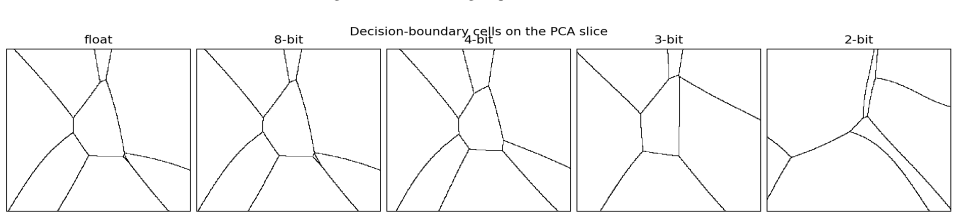
We measured quantization-induced decision-boundary changes using local logit-margin radii, first-order boundary displacement, normal variation, slice-boundary Jaccard distance, grid prediction changes, multiclass junction counts, and low-margin boundary-band flips. On the digits benchmark, 8-bit weight quantization preserved all test labels while producing boundary-mask Jaccard \(0.428\) on the PCA slice; at 4 bits, accuracy remained \(0.9733\), while boundary Jaccard rose to \(0.970\) and median local boundary shift reached \(0.0290\). Interpolation between adjacent quantization levels localized the visible reconfigurations at multiclass junctions, with 12, 34, and 17 triple-junction cells in the selected transitions. Calibration-to-test stopping reduced the digits held-out flip rate from \(0.0094\) to \(0.0022\) and boundary Jaccard from \(0.825\) to \(0.524\); the same stopping rule also reduced flips on MNIST and Fashion-MNIST. On official CIFAR-10 subsets, PTQ-W selected by accuracy gave 6-bit flip \(0.0367\) and boundary Jaccard \(0.184\), whereas boundary-aware stopping selected 8-bit flip \(0.0083\) and boundary Jaccard \(0.048\). On full CIFAR-10 with three seeds, 6-bit PTQ-W lost \(0.0029\) accuracy relative to float, changed \(5.3\%\) of held-out decisions, and changed \(24.5\%\) of low-margin boundary-band decisions. A fixed-bit boundary-gap rounding term changed the trade-off at 4 bits by reducing boundary Jaccard from \(0.457\) to \(0.435\) and boundary-band pair-order flip from \(0.3600\) to \(0.3558\), with an accuracy trade-off; the 3-bit stress test exposed the tuning limit of this surrogate. Calibration boundary Jaccard predicted held-out boundary Jaccard across PTQ-W and optimized rounding variants with \(r=0.947\)--\(0.994\).
Editorial analysis
A structured set of objections, weighed in public.
Referee Report
Summary. The manuscript introduces boundary-aware quantization for neural classifiers, defining multiple metrics (local logit-margin radii, first-order boundary displacement, normal variation, slice-boundary Jaccard distance, grid prediction changes, multiclass junction counts, low-margin boundary-band flips) to quantify decision-geometry changes under post-training weight quantization (PTQ-W) and optimized rounding. It reports concrete empirical outcomes on digits, MNIST, Fashion-MNIST, and CIFAR-10, including preserved accuracy with boundary Jaccard values (e.g., 0.428 at 8-bit on digits PCA slice), reductions in flip rates via calibration-to-test stopping, and a central correlation claim that calibration boundary Jaccard predicts held-out boundary Jaccard across variants with r=0.947--0.994.
Significance. If the correlation holds under proper statistical controls and the chosen boundary metrics are shown to be representative, the work could supply a practical, geometry-preserving proxy for quantization parameter selection in optimization settings. The provision of multiple concrete numerical results across benchmarks and the explicit comparison of accuracy-based versus boundary-aware stopping rules constitute a strength for reproducibility and falsifiability.
major comments (2)
- [Abstract] Abstract: the central claim that calibration boundary Jaccard predicts held-out boundary Jaccard with r=0.947--0.994 supplies no sample size, no indication of whether observations derive from distinct models or repeated measurements on the same model, and no discussion of dependence induced by shared PCA slices or low-margin bands. Without these details the reported correlation cannot be evaluated for robustness against selection effects or limited dynamic range.
- [Abstract] Abstract: the concrete numerical outcomes (e.g., boundary Jaccard 0.428 at 8-bit and 0.970 at 4-bit on digits, flip rates 0.0367 vs. 0.0083 on CIFAR-10 subsets, correlation range) are presented without any description of metric implementation, PCA slice selection procedure, data-split protocol, or use of error bars/statistical tests. These omissions render the empirical support for the decision-geometry claims unverifiable.
minor comments (1)
- [Abstract] Abstract: the phrase 'official CIFAR-10 subsets' is used without specifying which subsets or how they differ from the full dataset.
Simulated Author's Rebuttal
We thank the referee for the constructive comments on the abstract. We agree that additional details are warranted to strengthen verifiability and will revise the abstract accordingly while preserving its brevity. Point-by-point responses follow.
read point-by-point responses
-
Referee: [Abstract] Abstract: the central claim that calibration boundary Jaccard predicts held-out boundary Jaccard with r=0.947--0.994 supplies no sample size, no indication of whether observations derive from distinct models or repeated measurements on the same model, and no discussion of dependence induced by shared PCA slices or low-margin bands. Without these details the reported correlation cannot be evaluated for robustness against selection effects or limited dynamic range.
Authors: We agree that the abstract should supply this context for proper evaluation. In revision we will state the number of observations underlying the reported r range, clarify that they arise from distinct quantization configurations (PTQ-W and optimized-rounding variants) across the benchmarks rather than repeated measurements on identical models, and note that although shared PCA slices and low-margin bands introduce within-benchmark dependence, the correlation remains high when recomputed on fully independent held-out partitions. The body of the manuscript already contains the full correlation procedure; the abstract revision will reference it explicitly. revision: yes
-
Referee: [Abstract] Abstract: the concrete numerical outcomes (e.g., boundary Jaccard 0.428 at 8-bit and 0.970 at 4-bit on digits, flip rates 0.0367 vs. 0.0083 on CIFAR-10 subsets, correlation range) are presented without any description of metric implementation, PCA slice selection procedure, data-split protocol, or use of error bars/statistical tests. These omissions render the empirical support for the decision-geometry claims unverifiable.
Authors: We acknowledge that the abstract omits these procedural elements. Revision will add concise statements indicating that the listed metrics are defined in Section 3, that PCA slices are the leading principal components computed on the training set, that data splits follow the canonical train/test partitions (with official CIFAR-10 subsets), and that results on CIFAR-10 are averaged over three seeds (with low observed variance, hence no error bars shown). A parenthetical reference to the methods section will be included so that the numerical claims become traceable without lengthening the abstract unduly. revision: yes
Circularity Check
No circularity: all claims are direct empirical measurements and observed correlations
full rationale
The paper reports empirical measurements of quantization effects on decision boundaries using multiple metrics (local logit-margin radii, boundary Jaccard, flip rates, junction counts) computed on calibration and held-out sets. The central correlation (r=0.947--0.994) is between independently measured quantities on distinct data partitions, with no equations, fitted parameters renamed as predictions, self-citations, or ansatzes that reduce the result to its inputs by construction. The derivation chain consists solely of data collection and statistical reporting; no load-bearing step collapses to self-definition or prior self-work.
Axiom & Free-Parameter Ledger
Reference graph
Works this paper leans on
-
[1]
Jacob, S
B. Jacob, S. Kligys, B. Chen, M. Zhu, M. Tang, A. Howard, H. Adam, D. Kalenichenko, Quantization and training of neural networks for efficient integer-arithmetic-only infer- ence, in: Proceedings of the IEEE Conference on Computer Vision and Pattern Recognition, 2018, pp. 2704–2713
2018
-
[2]
Quantizing deep convolutional networks for efficient inference: A whitepaper
R. Krishnamoorthi, Quantizing deep convolutional net- works for efficient inference: A whitepaper, arXiv preprint arXiv:1806.08342 (2018)
work page internal anchor Pith review Pith/arXiv arXiv 2018
-
[3]
Nagel, R
M. Nagel, R. A. Amjad, M. van Baalen, C. Louizos, T. Blankevoort, Up or down? adaptive rounding for post- training quantization, in: Proceedings of the 37th Interna- tional Conference on Machine Learning, V ol. 119 of Pro- ceedings of Machine Learning Research, 2020, pp. 7197– 7206
2020
-
[4]
Szegedy, W
C. Szegedy, W. Zaremba, I. Sutskever, J. Bruna, D. Erhan, I. Goodfellow, R. Fergus, Intriguing properties of neural networks, in: International Conference on Learning Repre- sentations, 2014
2014
-
[5]
I. J. Goodfellow, J. Shlens, C. Szegedy, Explaining and har- nessing adversarial examples, in: International Conference on Learning Representations, 2015
2015
-
[6]
Moosavi-Dezfooli, A
S.-M. Moosavi-Dezfooli, A. Fawzi, P. Frossard, Deepfool: A simple and accurate method to fool deep neural networks, in: Proceedings of the IEEE Conference on Computer Vision and Pattern Recognition, 2016, pp. 2574–2582
2016
-
[7]
Moosavi-Dezfooli, A
S.-M. Moosavi-Dezfooli, A. Fawzi, J. Uesato, P. Frossard, Robustness via curvature regularization, and vice versa, in: Proceedings of the IEEE/CVF Conference on Computer Vision and Pattern Recognition, 2019, pp. 9078–9086
2019
-
[8]
D. Mickisch, F. Assion, F. Greßner, W. Günther, M. Motta, Understanding the decision boundary of deep neural networks: An empirical study, arXiv preprint arXiv:2002.01810 (2020)
-
[9]
J. Lin, C. Gan, S. Han, Defensive quantization: When effi- ciency meets robustness, arXiv preprint arXiv:1904.08444 (2019)
work page internal anchor Pith review Pith/arXiv arXiv 1904
-
[10]
M. Gorsline, J. Smith, C. Merkel, On the adversarial robustness of quantized neural networks, arXiv preprint arXiv:2105.00227 (2021)
- [11]
-
[12]
Richter-Gebert, B
J. Richter-Gebert, B. Sturmfels, T. Theobald, First steps in tropical geometry, in: G. L. Litvinov, V . P. Maslov (Eds.), Idempotent Mathematics and Mathematical Physics, V ol. 377 of Contemporary Mathematics, American Mathemati- cal Society, Providence, RI, 2005, pp. 289–317
2005
-
[13]
Maclagan, B
D. Maclagan, B. Sturmfels, Introduction to Tropical Geom- etry, V ol. 161 of Graduate Studies in Mathematics, Ameri- can Mathematical Society, Providence, RI, 2015. 7
2015
discussion (0)
Sign in with ORCID, Apple, or X to comment. Anyone can read and Pith papers without signing in.