A global girth obstruction for Garg--Mineyev taiko product structures
Pith reviewed 2026-07-03 11:15 UTC · model grok-4.3
The pith
No product structure with support sizes m,n at least 2 admits a coherent orientation satisfying both no-fold and triple-girth conditions.
A machine-rendered reading of the paper's core claim, the machinery that carries it, and where it could break.
Core claim
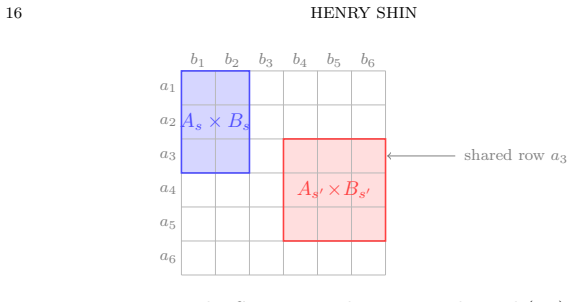
No product structure, even or odd, with support sizes m,n≥2 admits a coherent orientation for which the no-fold and triple-girth conditions both hold. Consequently the Garg--Mineyev triple-girth product-structure assembly route produces neither zero-divisor nor unit counterexamples over F2 for any such support-size pair. The obstruction is structural: high middle-link girth forces a signed-color rectangle decomposition, after which the product identity, pressure inequalities, Fisher inequalities, and a dual Fisher bound force the middle link to girth 4 or 6; in the girth-6 case the minimum of the two horizontal-link girths is at most 5.
What carries the argument
The signed-color rectangle decomposition of the board forced by the no-fold condition together with high middle-link girth, combined with the pressure and Fisher inequalities that produce the girth dichotomy.
If this is right
- The triple-girth product-structure route is closed for every pair m,n≥2.
- Neither zero-divisor nor unit counterexamples over F2 arise from this assembly method.
- The obstruction is global and structural rather than an artifact of bounded search.
- Characteristic-two affine-plane constructions attain equality in the sharper weighted-dual-Fisher frontier when middle girth is 6 and one horizontal girth is 4.
Where Pith is reading between the lines
- Relaxing the no-fold condition or allowing other board orientations might reopen the search for counterexamples.
- The finite certificate sharpens the girth frontier but is not needed to establish the main no-T4 obstruction.
- Similar girth-pressure arguments could apply to related product constructions in other group-ring settings.
Load-bearing premise
The product structure is required to satisfy the no-fold condition together with the triple-girth condition on the middle and horizontal links.
What would settle it
A coherent orientation of any product structure with m,n≥2 in which the middle link has girth at least 7, or girth exactly 6 while both horizontal links have girth at least 6, would falsify the claim.
Figures
read the original abstract
Mineyev's taiko construction, in Garg--Mineyev's finite support-size formulation, gives a concrete route from finite support data to zero divisors and units in group rings of torsion-free CAT(0) groups over $\mathbb{F}_2$. We prove that this triple-girth product-structure route is globally closed: no product structure, even or odd, with support sizes $m,n\ge2$ admits a coherent orientation for which the no-fold and triple-girth conditions both hold. Consequently the Garg--Mineyev triple-girth product-structure assembly route produces neither zero-divisor nor unit counterexamples over $\mathbb{F}_2$ for any such support-size pair. The obstruction is structural, not a bounded-search artifact. High middle-link girth forces signed colors into a balanced near-disjoint rectangle decomposition of the board, with the single odd defect omitted. The product identity, pressure inequalities, Fisher inequalities, and a dual Fisher bound force the middle link to have girth $4$ or $6$; in the girth-six case, the minimum of the two horizontal-link girths is at most $5$. This dichotomy rules out every triple-girth branch. A weighted dual Fisher inequality and an exact finite certificate sharpen the frontier: if the middle link has girth $6$, the horizontal girth is at most $4$, and characteristic-two affine-plane constructions attain equality. Thus the Garg--Mineyev finite failures reflect a structural barrier in the taiko geometry itself. The finite certificate is used only for this sharper frontier, not for the no-$T_4$ obstruction.
Editorial analysis
A structured set of objections, weighed in public.
Referee Report
Summary. The manuscript proves a global combinatorial obstruction for the Garg--Mineyev taiko product-structure construction: no product structure (even or odd) with support sizes m,n≥2 admits a coherent orientation satisfying both the no-fold condition and the triple-girth condition on the middle and horizontal links. Consequently the construction yields neither zero-divisor nor unit counterexamples over F2. The argument proceeds by showing that high middle-link girth forces a balanced near-disjoint rectangle decomposition (single odd defect omitted), after which product identities, pressure inequalities, Fisher inequalities and a dual Fisher bound force the middle girth to be 4 or 6; in the girth-6 case the minimum horizontal girth is at most 5. A weighted dual Fisher inequality together with an exact finite certificate sharpens the boundary case.
Significance. If the central derivation holds, the result supplies a structural explanation for the observed finite failures of the taiko route rather than a computational artifact, thereby closing one concrete avenue toward counterexamples in group rings of torsion-free CAT(0) groups. The explicit finite certificate that attains equality in the girth-6 / horizontal-girth-4 case is a positive technical contribution that makes the frontier sharp.
major comments (2)
- [rectangle decomposition step (abstract and main proof)] The forcing claim that high middle-link girth, under the no-fold condition, places every signed-coloring into the balanced near-disjoint rectangle decomposition is load-bearing for the entire dichotomy. The manuscript must supply a complete, self-contained argument (or lemma) establishing that no exceptions exist; any coherent orientation that respects no-fold yet evades the rectangle form would render the subsequent pressure/Fisher analysis inapplicable to that case.
- [girth-6 case analysis] In the girth-6 case the assertion that the minimum of the two horizontal-link girths is at most 5 is derived from the product identity together with the Fisher and dual-Fisher bounds. The derivation should be checked for any implicit dependence on the precise support sizes m,n or on the coherence of the orientation; if the bounds are not uniform, the obstruction may fail to cover all pairs.
minor comments (2)
- The abstract is compact; a brief parenthetical reminder of the definitions of 'no-fold' and 'triple-girth' would improve accessibility without lengthening the text.
- All inequalities (pressure, Fisher, weighted dual Fisher) should be stated with their exact hypotheses and the precise board geometry to which they apply.
Simulated Author's Rebuttal
We thank the referee for the careful and constructive report, which highlights the load-bearing steps in our argument. We respond point by point to the major comments and indicate where revisions will be made.
read point-by-point responses
-
Referee: [rectangle decomposition step (abstract and main proof)] The forcing claim that high middle-link girth, under the no-fold condition, places every signed-coloring into the balanced near-disjoint rectangle decomposition is load-bearing for the entire dichotomy. The manuscript must supply a complete, self-contained argument (or lemma) establishing that no exceptions exist; any coherent orientation that respects no-fold yet evades the rectangle form would render the subsequent pressure/Fisher analysis inapplicable to that case.
Authors: We agree that a fully self-contained presentation of the rectangle decomposition is necessary for clarity. The current proof derives the forcing via case analysis on signed colorings satisfying no-fold and high middle girth, but we will extract this into a dedicated lemma (with its own statement and complete proof) in the revised manuscript to eliminate any possibility of overlooked exceptions. revision: yes
-
Referee: [girth-6 case analysis] In the girth-6 case the assertion that the minimum of the two horizontal-link girths is at most 5 is derived from the product identity together with the Fisher and dual-Fisher bounds. The derivation should be checked for any implicit dependence on the precise support sizes m,n or on the coherence of the orientation; if the bounds are not uniform, the obstruction may fail to cover all pairs.
Authors: The product identity and the Fisher/dual-Fisher bounds are formulated and proved for arbitrary m,n ≥ 2; they invoke only the no-fold condition (which already incorporates coherence) and do not rely on specific numerical values of the support sizes. Direct substitution into the inequalities confirms that the resulting upper bound on the minimum horizontal girth remains at most 5 uniformly across all such pairs. No dependence that would exclude particular (m,n) arises, so the obstruction covers the full range. revision: no
Circularity Check
No circularity; combinatorial forcing from girth definitions to rectangle decomposition is independent of the target obstruction
full rationale
The derivation proceeds by proving that high middle-link girth forces a balanced near-disjoint rectangle decomposition (via the paper's own combinatorial arguments on signed-color boards), after which the product identity together with pressure, Fisher, and dual-Fisher inequalities directly imply middle girth 4 or 6 and a horizontal-girth bound of at most 5. These steps are self-contained within the stated definitions of no-fold, triple-girth, and the board geometry; they do not reduce any claimed result to a fitted parameter renamed as prediction, a self-citation chain, or an ansatz imported from the authors' prior work. The finite certificate is explicitly scoped to sharpening the frontier only and is not used for the no-T4 obstruction itself.
Axiom & Free-Parameter Ledger
axioms (2)
- domain assumption The taiko product structure is defined on a board whose links admit girth measurements and coherent orientations with signed colors.
- domain assumption Fisher inequalities and pressure inequalities hold for the product identities in this geometry.
Reference graph
Works this paper leans on
-
[1]
N. Alon, S. Hoory, and N. Linial, The Moore bound for irregular graphs,Graphs Combin.18(2002), no. 1, 53–57, doi:10.1007/s003730200002
-
[2]
Carter, New examples of torsion-free non-unique product groups,J
W. Carter, New examples of torsion-free non-unique product groups,J. Group Theory 17(2014), no. 3, 445–464, doi:10.1515/jgt-2013-0051
-
[3]
Gardam, A counterexample to the unit conjecture for group rings,Ann
G. Gardam, A counterexample to the unit conjecture for group rings,Ann. of Math. (2)194(2021), no. 3, 967–979, doi:10.4007/annals.2021.194.3.9
-
[4]
G. Gardam, Non-trivial units of complex group rings, arXiv:2312.05240v2 (2024), doi:10.48550/arXiv.2312.05240
-
[5]
M. Garg and I. Mineyev, On zero-divisors and units in group rings of torsion-free CAT(0) groups, arXiv:2501.07646v2 (2025), doi:10.48550/arXiv.2501.07646
-
[6]
R. L. Graham and H. O. Pollak, On the addressing problem for loop switching,Bell System Tech. J.50(1971), 2495–2519, doi:10.1002/j.1538-7305.1971.tb02618.x
-
[7]
Higman, The units of group-rings,Proc
G. Higman, The units of group-rings,Proc. London Math. Soc. (2)46(1940), 231– 248, doi:10.1112/plms/s2-46.1.231. 44 HENRY SHIN
-
[8]
D. R. Hughes and F. C. Piper,Projective Planes, Graduate Texts in Mathematics6, Springer-Verlag, New York–Berlin, 1973
1973
-
[9]
Kaplansky, Problems in the theory of rings, inReport of a Conference on Lin- ear Algebras, National Academy of Sciences–National Research Council Publ
I. Kaplansky, Problems in the theory of rings, inReport of a Conference on Lin- ear Algebras, National Academy of Sciences–National Research Council Publ. 502, Washington, DC, 1957, pp. 1–3
1957
-
[10]
Problems in the theory of rings
I. Kaplansky, “Problems in the theory of rings” revisited,Amer. Math. Monthly77 (1970), 445–454, doi:10.1080/00029890.1970.11992519
-
[11]
K˝ ov´ ari, V
T. K˝ ov´ ari, V. T. S´ os, and P. Tur´ an, On a problem of K. Zarankiewicz,Colloq. Math. 3(1954), 50–57
1954
-
[12]
Mineyev,The topology and geometry of units and zero-divisors: origami, preprint, available athttps://mineyev.web.illinois.edu/art/top-geom-uzd-origami.pdf, accessed 29 June 2026
I. Mineyev,The topology and geometry of units and zero-divisors: origami, preprint, available athttps://mineyev.web.illinois.edu/art/top-geom-uzd-origami.pdf, accessed 29 June 2026
2026
-
[13]
A. G. Murray, More counterexamples to the unit conjecture for group rings, arXiv:2106.02147 (2021), doi:10.48550/arXiv.2106.02147
-
[14]
D. S. Passman,The Algebraic Structure of Group Rings, Pure and Applied Mathe- matics, Wiley-Interscience, New York, 1977
1977
-
[15]
S. D. Promislow, A simple example of a torsion-free, nonunique product group,Bull. London Math. Soc.20(1988), no. 4, 302–304, doi:10.1112/blms/20.4.302
-
[16]
E. Rips and Y. Segev, Torsion-free group without unique product property,J. Algebra 108(1987), no. 1, 116–126, doi:10.1016/0021-8693(87)90125-6
-
[17]
On Zero Divisors with Small Support in Group Rings of Torsion-Free Groups
P. Schweitzer, On zero divisors with small support in group rings of torsion-free groups,J. Group Theory16(2013), no. 5, 667–693, doi:10.1515/jgt-2013-0017; arXiv:1202.6645
work page internal anchor Pith review Pith/arXiv arXiv doi:10.1515/jgt-2013-0017 2013
-
[18]
J. H. van Lint and R. M. Wilson,A Course in Combinatorics, 2nd ed., Cambridge University Press, Cambridge, 2001. San Diego, CA, USA Email address:hkshin@gmail.com
2001
discussion (0)
Sign in with ORCID, Apple, or X to comment. Anyone can read and Pith papers without signing in.