Post-starburst Galaxies with Active Galactic Nucleus: Properties and Evolutionary Sequences
Pith reviewed 2026-07-03 10:03 UTC · model grok-4.3
The pith
Ring-like post-starburst galaxies can evolve into AGN-PSBs while high-mass central ones follow a merger-driven path, showing AGN feedback is not required for PSB formation.
A machine-rendered reading of the paper's core claim, the machinery that carries it, and where it could break.
Core claim
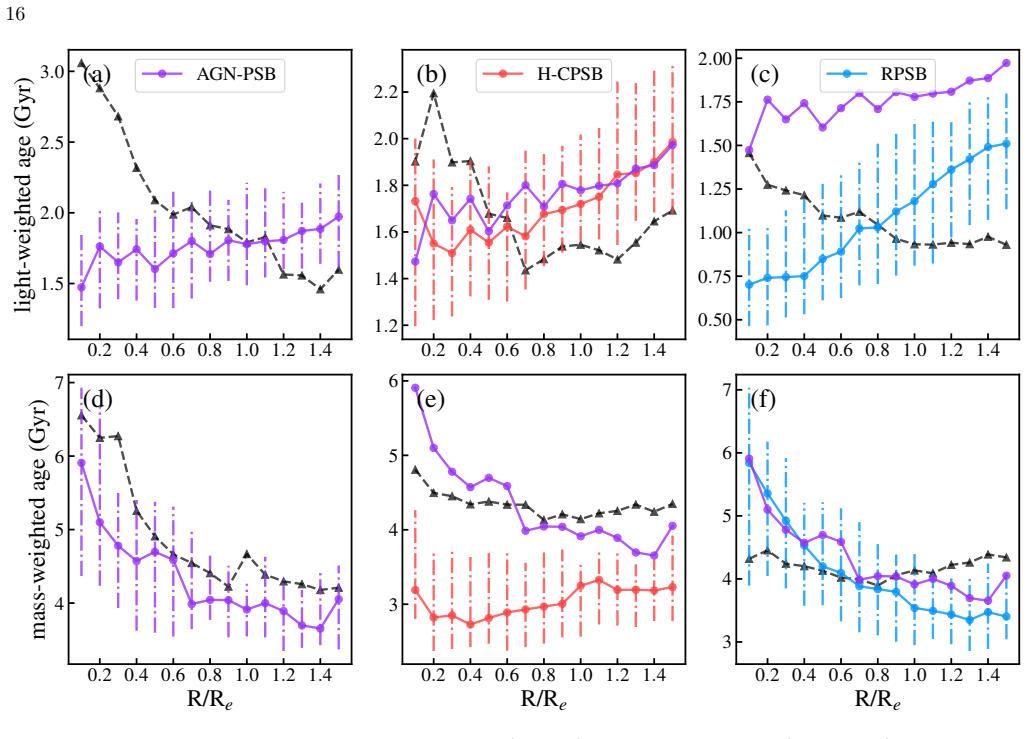
Based on radial profiles of mass-weighted age and V_star/σ_star, RPSBs can evolve into AGN-PSBs, whereas H-CPSBs likely follow a distinct evolutionary pathway. The existence of RPSBs and IPSBs also indicates that AGN feedback is not a necessary condition for the formation of PSB.
What carries the argument
Radial profiles of mass-weighted stellar age and the stellar velocity-to-dispersion ratio V_star/σ_star, used to distinguish evolutionary sequences among post-starburst subtypes.
If this is right
- RPSBs transition into AGN-PSBs as central activity develops.
- H-CPSBs arise primarily through mergers and do not follow the same sequence.
- AGN feedback is not required to form post-starburst galaxies, since RPSBs and IPSBs exist without it.
- AGN-PSBs and RPSBs favor less violent external processes than the merger-dominated H-CPSBs.
- All three subtypes display younger central stellar populations than their outskirts, opposite to control galaxies.
Where Pith is reading between the lines
- If the proposed sequence is correct, AGN activity appears after the initial ring-like quenching rather than causing it.
- The subtype distinctions suggest that spatially resolved data are needed to separate quenching channels that global spectra would mix.
- Environmental effects such as ram-pressure stripping may dominate the ring-like channel, offering a testable contrast to merger-driven paths.
Load-bearing premise
That differences in radial profiles of mass-weighted age and V_star/σ_star between RPSBs and AGN-PSBs trace a temporal sequence rather than separate formation channels or selection biases in AGN identification.
What would settle it
Finding that RPSBs and AGN-PSBs exhibit identical mass-weighted age gradients with no kinematic or merger-fraction differences that would support a later-stage AGN phase.
Figures


read the original abstract
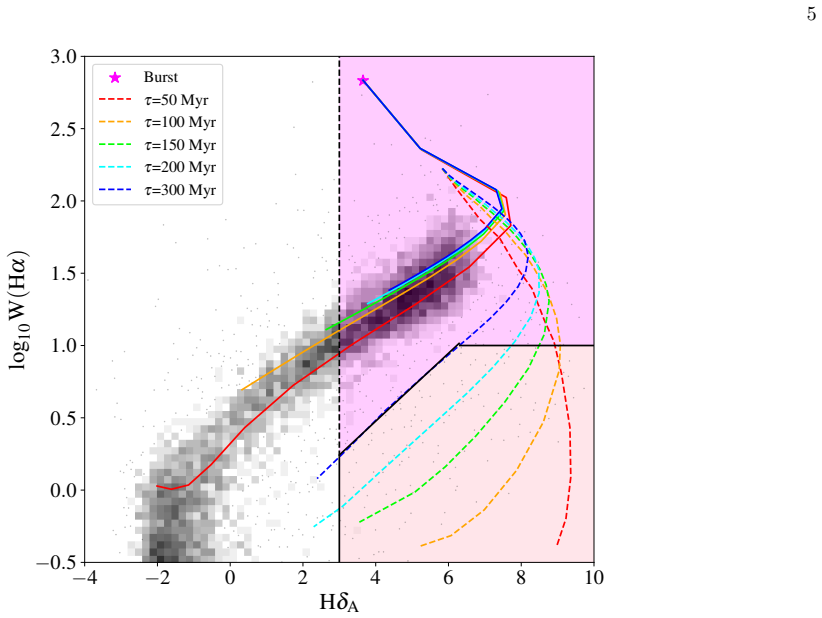
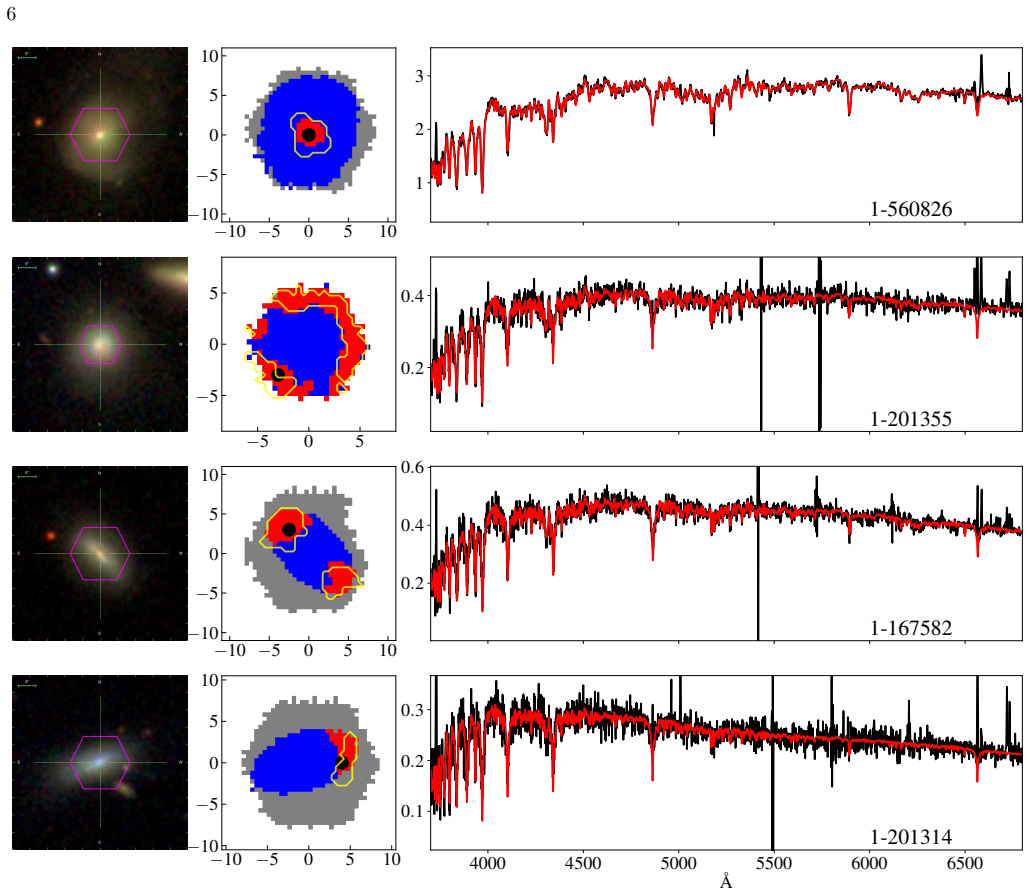
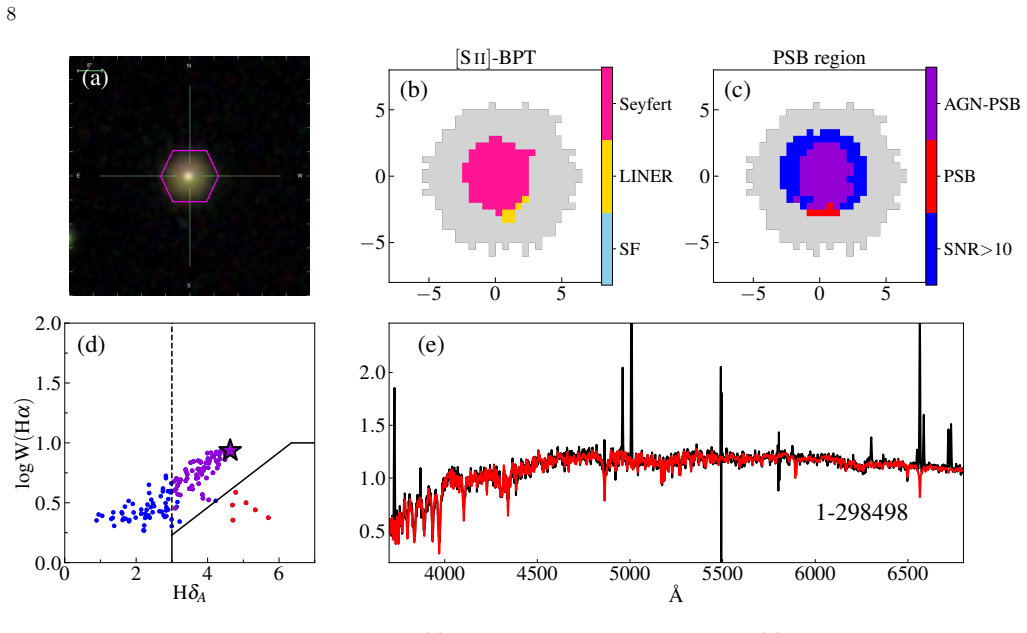
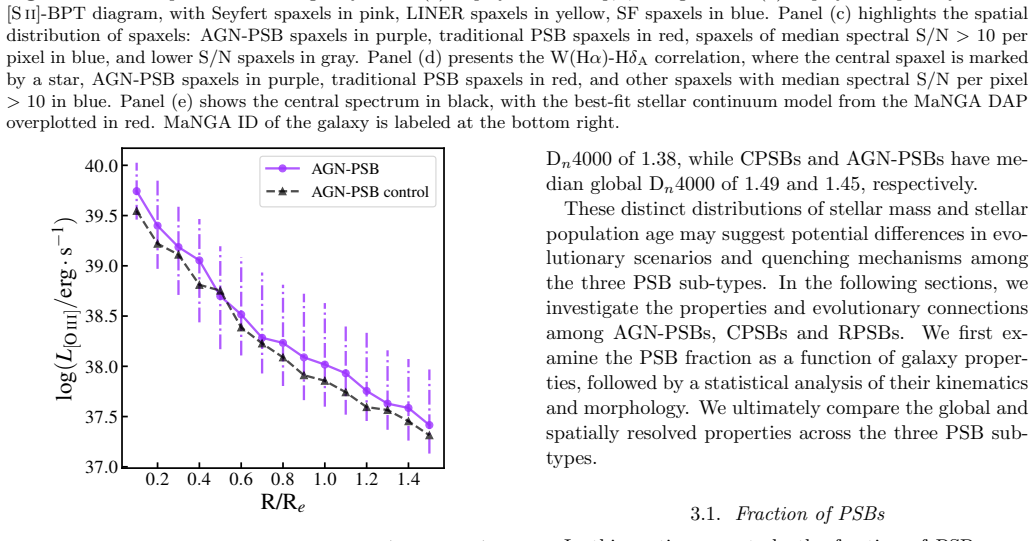
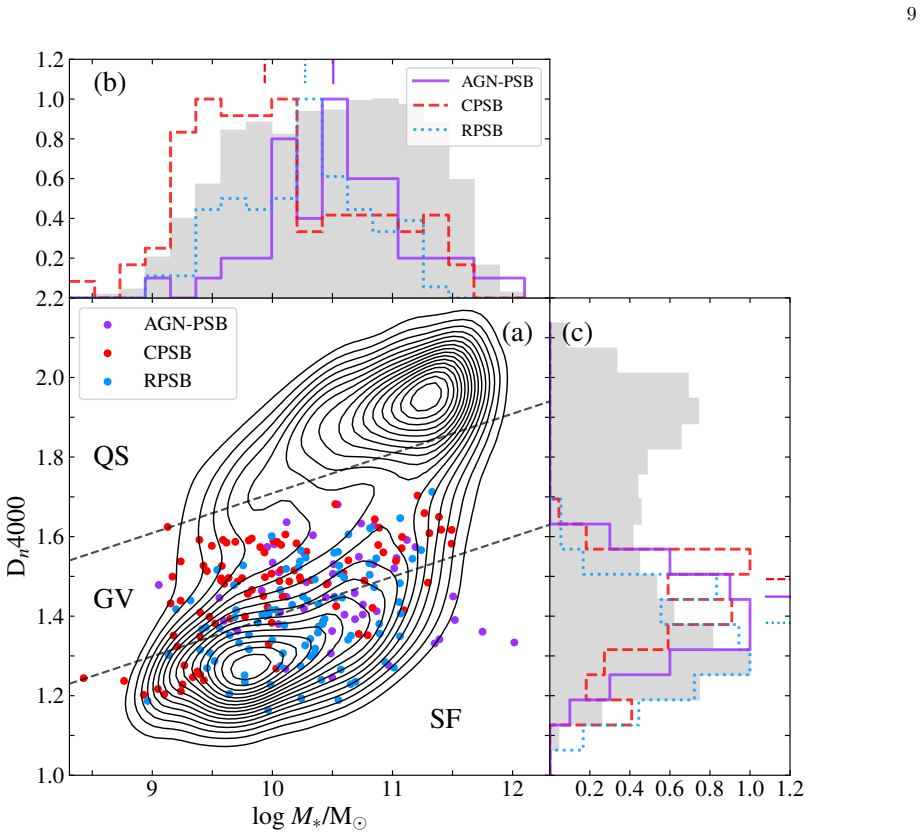
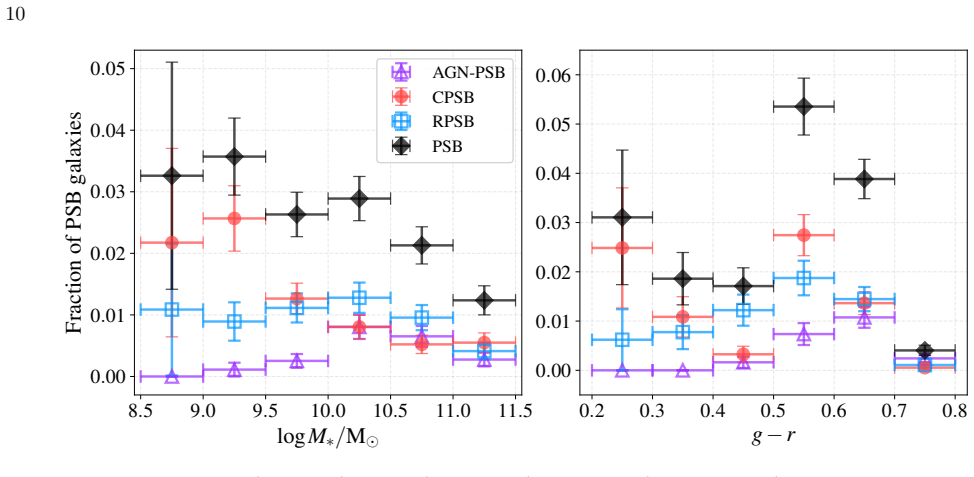
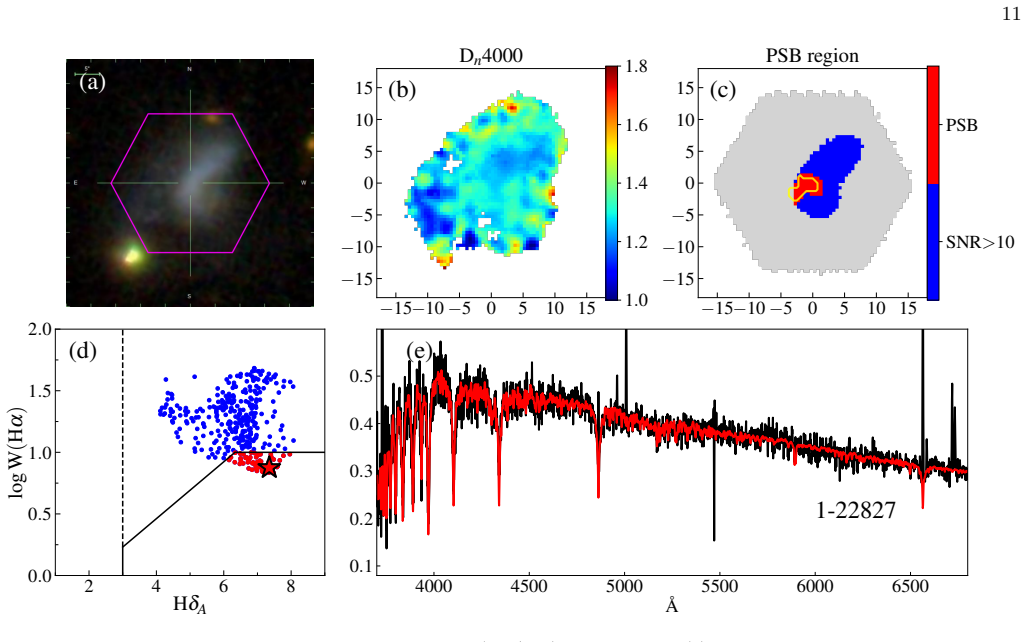
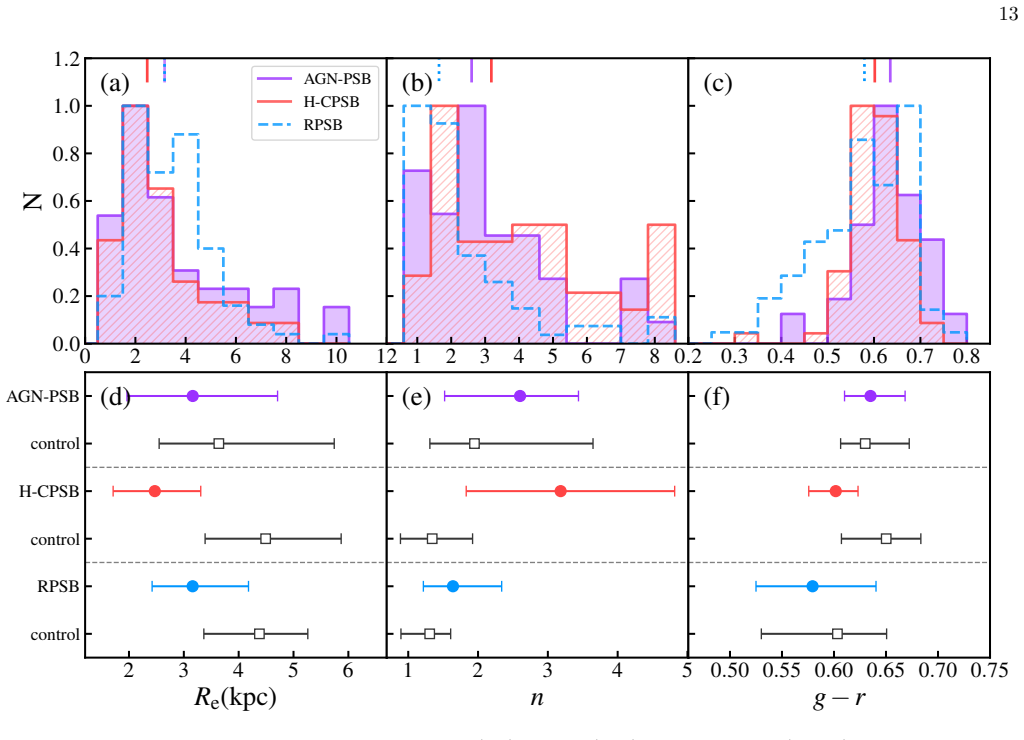
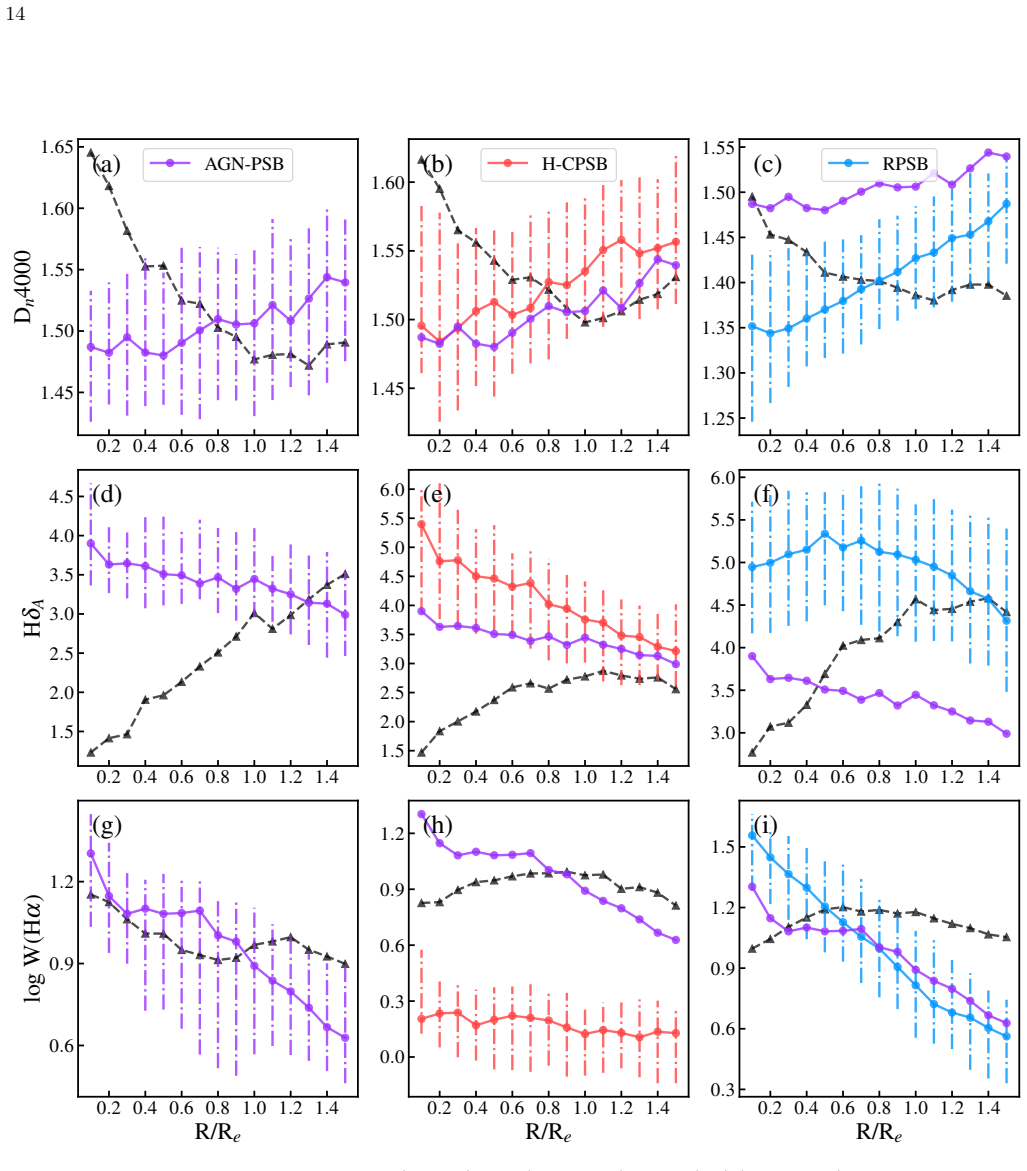
Post-starburst (PSB) galaxies, identified by strong Balmer absorption and weak nebular emission, provide a key laboratory for studying rapid quenching. Using the final data release of the SDSS-IV MaNGA survey, we follow the traditional PSB selection criteria of Chen et al. (2019) and develop a new method to identify regions that simultaneously exhibit PSB features and nuclear activities (AGN-PSBs). Our final sample comprises 48 AGN-PSBs, 92 central PSBs (CPSBs), 89 ring-like PSBs (RPSBs), and 828 irregular PSBs (IPSBs). We find the global and spatially resolved properties of CPSBs and RPSBs are consistent with the results of Chen et al. (2019). In this work, we focus on the properties of AGN-PSBs, comparing them with CPSBs, RPSBs, and control galaxies. Similar to CPSBs and RPSBs, AGN-PSBs show positive $\mathrm{D}_{n}4000$ gradients relative to negative $\mathrm{D}_{n}4000$ gradients of their controls, which indicates younger stellar populations in the central region than that in the outskirt. Among the three sub-types, high-mass CPSBs (H-CPSBs, with $\log(M_{*}/M_{\odot})>9.5$) display the highest incidence of merger remnants and gas--star kinematic misalignment, consistent with a merger/interaction-dominated origin. AGN-PSBs and RPSBs, however, show lower and comparable fractions of merger remnants and gas--star kinematic misalignment, favoring less violent external mechanisms. Based on radial profiles of mass-weighted age and $V_{\rm star}/\sigma_{\rm star}$, we suggest that RPSBs can evolve into AGN-PSBs, whereas H-CPSBs likely follow a distinct evolutionary pathway. The existence of RPSBs and IPSBs also indicates that AGN feedback is not a necessary condition for the formation of PSB.
Editorial analysis
A structured set of objections, weighed in public.
Referee Report
Summary. The paper uses the final MaNGA release to select 48 AGN-PSBs (via a new method combining PSB spectral features with nuclear activity), 92 CPSBs, 89 RPSBs, and 828 IPSBs following Chen et al. (2019) criteria. It compares global and spatially resolved properties (Dn4000 gradients, merger fractions, gas-star misalignment) across subtypes and controls, finding positive Dn4000 gradients in all PSB types. Based on radial profiles of mass-weighted age and V_star/σ_star, it proposes that RPSBs evolve into AGN-PSBs while high-mass CPSBs follow a distinct merger-driven path, and concludes that AGN feedback is not required for PSB formation.
Significance. If the proposed evolutionary links are robust, the work would clarify the diversity of quenching pathways in PSBs and the non-essential role of AGN feedback, extending Chen et al. (2019) with spatially resolved data and an AGN-PSB subsample. The analysis employs standard methods on public MaNGA data and reports consistent global properties with prior samples.
major comments (2)
- [Abstract] Abstract: the inference that differences in radial profiles of mass-weighted age and V_star/σ_star indicate RPSBs evolve into AGN-PSBs (rather than reflecting distinct formation channels or AGN-selection biases) is load-bearing for the central claim but rests on single-epoch observations without quantitative tests (e.g., matched controls or forward modeling) to rule out alternatives.
- [Results on radial profiles and evolutionary inference] The section discussing radial profiles and evolutionary sequences: the claim that AGN-PSBs and RPSBs favor less violent mechanisms (lower merger fractions) is used to support the sequence, yet no explicit check is shown for whether AGN-PSB identification preferentially selects centrally concentrated young populations that could produce the observed profile differences by construction.
minor comments (2)
- [Abstract] Abstract: no error bars, uncertainties, or robustness metrics are provided for the key profile comparisons or incidence rates.
- Notation for V_star/σ_star and mass-weighted age should be defined at first use with reference to the exact MaNGA-derived quantities.
Simulated Author's Rebuttal
We thank the referee for the constructive comments on our manuscript. We address each major comment below with clarifications on our analysis and proposed revisions to better contextualize the evolutionary inferences and address potential biases.
read point-by-point responses
-
Referee: [Abstract] Abstract: the inference that differences in radial profiles of mass-weighted age and V_star/σ_star indicate RPSBs evolve into AGN-PSBs (rather than reflecting distinct formation channels or AGN-selection biases) is load-bearing for the central claim but rests on single-epoch observations without quantitative tests (e.g., matched controls or forward modeling) to rule out alternatives.
Authors: We acknowledge that the proposed evolutionary link from RPSBs to AGN-PSBs is an interpretation drawn from single-epoch MaNGA observations. It is supported by the close similarity in mass-weighted age and V_star/σ_star radial profiles between these two subtypes (distinct from H-CPSBs), together with their comparably low merger fractions and gas-star misalignments. We cannot add forward modeling or new matched-control simulations within the scope of this work. We will revise the abstract and discussion to present the sequence as a suggested pathway based on observed similarities, while explicitly discussing alternative interpretations including distinct channels and AGN-selection effects, and softening the language accordingly. revision: partial
-
Referee: [Results on radial profiles and evolutionary inference] The section discussing radial profiles and evolutionary sequences: the claim that AGN-PSBs and RPSBs favor less violent mechanisms (lower merger fractions) is used to support the sequence, yet no explicit check is shown for whether AGN-PSB identification preferentially selects centrally concentrated young populations that could produce the observed profile differences by construction.
Authors: The AGN-PSB selection combines PSB spectral features with nuclear activity, which could in principle favor central concentrations. However, all PSB subtypes (including CPSBs and RPSBs) exhibit positive Dn4000 gradients, and the mass-weighted age profiles are compared across the full samples. We will add an explicit discussion and supplementary check in the results section examining whether profile differences persist after accounting for central concentration metrics, to demonstrate that the observed distinctions are not solely by construction of the AGN-PSB identification. revision: yes
- We cannot perform forward modeling, hydrodynamic simulations, or extensive new quantitative matched-control tests to definitively rule out alternatives to the evolutionary sequence, as these lie beyond the observational scope and resources of the current study.
Circularity Check
No circularity: observational comparisons and interpretive suggestion remain independent of inputs
full rationale
The paper reports sample selection via established criteria from Chen et al. (2019), then compares global and resolved properties (Dn4000 gradients, merger fractions, kinematic misalignment, mass-weighted age and Vstar/σstar profiles) across AGN-PSBs, CPSBs, RPSBs and controls drawn from MaNGA. The evolutionary suggestion is presented as an inference from profile differences rather than any equation, fit, or self-citation that reduces the claim to its own inputs by construction. No fitted parameters are renamed as predictions, no uniqueness theorems are invoked, and the self-citation is limited to sample definition and is not load-bearing for the central interpretive step. The derivation chain is therefore self-contained against external data.
Axiom & Free-Parameter Ledger
free parameters (1)
- high-mass threshold =
log(M*/M_sun) > 9.5
axioms (1)
- domain assumption Traditional PSB selection criteria of Chen et al. (2019) correctly isolate post-starburst spectral features without significant contamination.
Reference graph
Works this paper leans on
-
[1]
Alatalo, K., Cales, S. L., Appleton, P. N., et al. 2014, ApJL, 794, L13, doi: 10.1088/2041-8205/794/1/L13
-
[2]
Alatalo, K., Cales, S. L., Rich, J. A., et al. 2016, ApJS, 224, 38, doi: 10.3847/0067-0049/224/2/38
-
[3]
2023, VizieR Online Data Catalog: BPT class and AGN classification (Alban+, 2023), VizieR On-line Data Catalog: J/A+A/674/A85
Alban, M., & Wylezalek, D. 2023, VizieR Online Data Catalog: BPT class and AGN classification (Alban+, 2023), VizieR On-line Data Catalog: J/A+A/674/A85. Originally published in: 2023A&A...674A..85A
2023
-
[4]
2025, MNRAS, 539, 3568, doi: 10.1093/mnras/staf659 22
Almaini, O., Wild, V., Maltby, D., et al. 2025, MNRAS, 539, 3568, doi: 10.1093/mnras/staf659 22
-
[5]
K., Glazebrook, K., Brinkmann, J., et al
Baldry, I. K., Glazebrook, K., Brinkmann, J., et al. 2004, ApJ, 600, 681, doi: 10.1086/380092
-
[6]
Baldwin, J. A., Phillips, M. M., & Terlevich, R. 1981, PASP, 93, 5, doi: 10.1086/130766
-
[7]
Goto, T. 2005, MNRAS, 360, 587, doi: 10.1111/j.1365-2966.2005.09047.x
-
[8]
Baron, D., Netzer, H., Poznanski, D., Prochaska, J. X., & F¨ orster Schreiber, N. M. 2017, MNRAS, 470, 1687, doi: 10.1093/mnras/stx1329
-
[9]
Baron, D., Netzer, H., Prochaska, J. X., et al. 2018, MNRAS, 480, 3993, doi: 10.1093/mnras/sty2113
-
[10]
Bekki, K., Couch, W. J., Shioya, Y., & Vazdekis, A. 2005, MNRAS, 359, 949, doi: 10.1111/j.1365-2966.2005.08932.x
-
[11]
F., Wolf, C., Meisenheimer, K., et al
Bell, E. F., Wolf, C., Meisenheimer, K., et al. 2004, ApJ, 608, 752, doi: 10.1086/420778
-
[12]
Blake, C., Pracy, M. B., Couch, W. J., et al. 2004, MNRAS, 355, 713, doi: 10.1111/j.1365-2966.2004.08351.x
-
[13]
Blanton, M. R., Bershady, M. A., Abolfathi, B., et al. 2017, AJ, 154, 28, doi: 10.3847/1538-3881/aa7567
-
[14]
Brough, S., van de Sande, J., Owers, M. S., et al. 2017, ApJ, 844, 59, doi: 10.3847/1538-4357/aa7a11
-
[15]
Brown, M. J. I., Dey, A., Jannuzi, B. T., et al. 2007, ApJ, 654, 858, doi: 10.1086/509652 Bruzual A., G. 1983, ApJ, 273, 105, doi: 10.1086/161352
-
[16]
Bundy, K., Bershady, M. A., Law, D. R., et al. 2015, ApJ, 798, 7, doi: 10.1088/0004-637X/798/1/7
work page internal anchor Pith review doi:10.1088/0004-637x/798/1/7 2015
-
[17]
2001, PASP, 113, 1449, doi: 10.1086/324269
Calzetti, D. 2001, PASP, 113, 1449, doi: 10.1086/324269
-
[18]
2004, PASP, 116, 138, doi: 10.1086/381875
Cappellari, M., & Emsellem, E. 2004, PASP, 116, 138, doi: 10.1086/381875
work page internal anchor Pith review doi:10.1086/381875 2004
-
[19]
2022, ApJ, 933, 228, doi: 10.3847/1538-4357/ac75b4
Chen, X., Lin, Z., Kong, X., et al. 2022, ApJ, 933, 228, doi: 10.3847/1538-4357/ac75b4
-
[20]
Chen, Y.-M., Shi, Y., Tremonti, C. A., et al. 2016, Nature Communications, 7, 13269, doi: 10.1038/ncomms13269
-
[21]
2019, MNRAS, 489, 5709, doi: 10.1093/mnras/stz2494
Chen, Y.-M., Shi, Y., Wild, V., et al. 2019, MNRAS, 489, 5709, doi: 10.1093/mnras/stz2494
-
[22]
2024, ApJ, 961, 216, doi: 10.3847/1538-4357/ad1510
Cheng, Z., Li, C., Li, N., Yan, R., & Mo, H. 2024, ApJ, 961, 216, doi: 10.3847/1538-4357/ad1510
-
[23]
2019, MNRAS, 484, 5192, doi: 10.1093/mnras/stz349
Chown, R., Li, C., Athanassoula, E., et al. 2019, MNRAS, 484, 5192, doi: 10.1093/mnras/stz349
-
[24]
Couch, W. J., & Sharples, R. M. 1987, MNRAS, 229, 423, doi: 10.1093/mnras/229.3.423
-
[25]
Schechter, P. L. 1983, ApJ, 266, 41, doi: 10.1086/160757
-
[26]
A., van de Voort, F., Rowlands, K., et al
Davis, T. A., van de Voort, F., Rowlands, K., et al. 2019, MNRAS, 484, 2447, doi: 10.1093/mnras/stz180 D’Eugenio, F., P´ erez-Gonz´ alez, P. G., Maiolino, R., et al. 2024, Nature Astronomy, 8, 1443, doi: 10.1038/s41550-024-02345-1
-
[27]
Dey, A., Schlegel, D. J., Lang, D., et al. 2019, AJ, 157, 168, doi: 10.3847/1538-3881/ab089d
-
[28]
Dressler, A., & Gunn, J. E. 1983, ApJ, 270, 7, doi: 10.1086/161093
-
[29]
Dressler, A., Smail, I., Poggianti, B. M., et al. 1999, ApJS, 122, 51, doi: 10.1086/313213
-
[30]
Drory, N., MacDonald, N., Bershady, M. A., et al. 2015, AJ, 149, 77, doi: 10.1088/0004-6256/149/2/77
-
[31]
2024, The Open Journal of Astrophysics, 7, 121, doi: 10.33232/001c.127779
Ellison, S., Ferreira, L., Wild, V., et al. 2024, The Open Journal of Astrophysics, 7, 121, doi: 10.33232/001c.127779
-
[32]
L., Wilkinson, S., Woo, J., et al
Ellison, S. L., Wilkinson, S., Woo, J., et al. 2022, MNRAS, 517, L92, doi: 10.1093/mnrasl/slac109
-
[33]
Emsellem, E., Cappellari, M., Krajnovi´ c, D., et al. 2007, MNRAS, 379, 401, doi: 10.1111/j.1365-2966.2007.11752.x —. 2011, MNRAS, 414, 888, doi: 10.1111/j.1365-2966.2011.18496.x
-
[34]
2019, MNRAS, 483, 2057, doi: 10.1093/mnras/sty3135
Fischer, J.-L., Dom´ ınguez S´ anchez, H., & Bernardi, M. 2019, MNRAS, 483, 2057, doi: 10.1093/mnras/sty3135
-
[35]
French, K. D. 2021, PASP, 133, 072001, doi: 10.1088/1538-3873/ac0a59
-
[36]
2017, MNRAS, 466, 1903, doi: 10.1093/mnras/stw3209
Gatto, A., Walch, S., Naab, T., et al. 2017, MNRAS, 466, 1903, doi: 10.1093/mnras/stw3209
-
[37]
Goto, T. 2005, MNRAS, 357, 937, doi: 10.1111/j.1365-2966.2005.08701.x —. 2006, MNRAS, 369, 1765, doi: 10.1111/j.1365-2966.2006.10413.x —. 2007a, MNRAS, 381, 187, doi: 10.1111/j.1365-2966.2007.12227.x —. 2007b, MNRAS, 377, 1222, doi: 10.1111/j.1365-2966.2007.11674.x
-
[38]
Goto, T., Yamauchi, C., Fujita, Y., et al. 2003, MNRAS, 346, 601, doi: 10.1046/j.1365-2966.2003.07114.x
-
[39]
Green, A. W., Croom, S. M., Scott, N., et al. 2018, MNRAS, 475, 716, doi: 10.1093/mnras/stx3135
-
[40]
Gunn, J. E., Siegmund, W. A., Mannery, E. J., et al. 2006, AJ, 131, 2332, doi: 10.1086/500975
-
[41]
Puxley, P. J. 1986, MNRAS, 221, 41P, doi: 10.1093/mnras/221.1.41P
-
[42]
Hogg, D. W., Masjedi, M., Berlind, A. A., et al. 2006, ApJ, 650, 763, doi: 10.1086/507172
-
[43]
Hopkins, P. F., Hernquist, L., Cox, T. J., et al. 2006, ApJS, 163, 1, doi: 10.1086/499298
work page internal anchor Pith review doi:10.1086/499298 2006
-
[44]
F., Kereˇ s, D., O˜ norbe, J., et al
Hopkins, P. F., Kereˇ s, D., O˜ norbe, J., et al. 2014, MNRAS, 445, 581, doi: 10.1093/mnras/stu1738
work page internal anchor Pith review doi:10.1093/mnras/stu1738 2014
-
[45]
Ilbert, O., McCracken, H. J., Le F` evre, O., et al. 2013, A&A, 556, A55, doi: 10.1051/0004-6361/201321100
-
[46]
1977, ApJL, 218, L43, doi: 10.1086/182572 23
Illingworth, G. 1977, ApJL, 218, L43, doi: 10.1086/182572 23
-
[47]
2014, ApJ, 787, 63, doi: 10.1088/0004-637X/787/1/63
Jin, S.-W., Gu, Q., Huang, S., Shi, Y., & Feng, L.-L. 2014, ApJ, 787, 63, doi: 10.1088/0004-637X/787/1/63
-
[48]
Kauffmann, G., Heckman, T. M., Tremonti, C., et al. 2003, MNRAS, 346, 1055, doi: 10.1111/j.1365-2966.2003.07154.x Kereˇ s, D., Katz, N., Weinberg, D. H., & Dav´ e, R. 2005, MNRAS, 363, 2, doi: 10.1111/j.1365-2966.2005.09451.x
-
[49]
Kewley, L. J., Dopita, M. A., Sutherland, R. S., Heisler, C. A., & Trevena, J. 2001, ApJ, 556, 121, doi: 10.1086/321545
work page internal anchor Pith review doi:10.1086/321545 2001
-
[50]
Kewley, L. J., Groves, B., Kauffmann, G., & Heckman, T. 2006, MNRAS, 372, 961, doi: 10.1111/j.1365-2966.2006.10859.x
-
[51]
Kocevski, D. D., Lemaux, B. C., Lubin, L. M., et al. 2011, ApJL, 737, L38, doi: 10.1088/2041-8205/737/2/L38 Krajnovi´ c, D., Cappellari, M., de Zeeuw, P. T., & Copin, Y. 2006, MNRAS, 366, 787, doi: 10.1111/j.1365-2966.2005.09902.x
-
[52]
Lagos, C. d. P. 2018, arXiv e-prints, arXiv:1810.13074, doi: 10.48550/arXiv.1810.13074
work page internal anchor Pith review Pith/arXiv arXiv doi:10.48550/arxiv.1810.13074 2018
-
[53]
Lanz, L., Stepanoff, S., Hickox, R. C., et al. 2022, ApJ, 935, 29, doi: 10.3847/1538-4357/ac7d56
-
[54]
Law, D. R., Yan, R., Bershady, M. A., et al. 2015, AJ, 150, 19, doi: 10.1088/0004-6256/150/1/19
-
[55]
R., Cherinka, B., Yan, R., et al
Law, D. R., Cherinka, B., Yan, R., et al. 2016, AJ, 152, 83, doi: 10.3847/0004-6256/152/4/83
-
[56]
2024, MNRAS, 528, 4029, doi: 10.1093/mnras/stae225
Leung, H.-H., Wild, V., Papathomas, M., et al. 2024, MNRAS, 528, 4029, doi: 10.1093/mnras/stae225
-
[57]
2025, MNRAS, 543, 738, doi: 10.1093/mnras/staf1493
Chen, Y. 2025, MNRAS, 543, 738, doi: 10.1093/mnras/staf1493
-
[58]
2021, MNRAS, 501, 14, doi: 10.1093/mnras/staa3618
Li, S.-l., Shi, Y., Bizyaev, D., et al. 2021, MNRAS, 501, 14, doi: 10.1093/mnras/staa3618
-
[59]
2017, ApJ, 838, 105, doi: 10.3847/1538-4357/aa657a
Lin, L., Li, C., He, Y., Xiao, T., & Wang, E. 2017, ApJ, 838, 105, doi: 10.3847/1538-4357/aa657a
-
[60]
T., Almaini, O., Wild, V., et al
Maltby, D. T., Almaini, O., Wild, V., et al. 2018, MNRAS, 480, 381, doi: 10.1093/mnras/sty1794
-
[61]
Maltby, D. T., Almaini, O., McLure, R. J., et al. 2019, MNRAS, 489, 1139, doi: 10.1093/mnras/stz2211
-
[62]
2015, A&A, 582, A37, doi: 10.1051/0004-6361/201526187
Melnick, J., Telles, E., De Propris, R., & Chu, Z.-H. 2015, A&A, 582, A37, doi: 10.1051/0004-6361/201526187
-
[63]
2013, ApJ, 777, 18, doi: 10.1088/0004-637X/777/1/18
Muzzin, A., Marchesini, D., Stefanon, M., et al. 2013, ApJ, 777, 18, doi: 10.1088/0004-637X/777/1/18
work page internal anchor Pith review doi:10.1088/0004-637x/777/1/18 2013
-
[64]
2014, MNRAS, 444, 3357, doi: 10.1093/mnras/stt1919
Naab, T., Oser, L., Emsellem, E., et al. 2014, MNRAS, 444, 3357, doi: 10.1093/mnras/stt1919
-
[65]
Paccagnella, A., Vulcani, B., Poggianti, B. M., et al. 2019, MNRAS, 482, 881, doi: 10.1093/mnras/sty2728
-
[66]
Pawlik, M. M., McAlpine, S., Trayford, J. W., et al. 2019, Nature Astronomy, 3, 440, doi: 10.1038/s41550-019-0725-z
-
[67]
Pawlik, M. M., Wild, V., Walcher, C. J., et al. 2016, MNRAS, 456, 3032, doi: 10.1093/mnras/stv2878
-
[68]
M., Taj Aldeen, L., Wild, V., et al
Pawlik, M. M., Taj Aldeen, L., Wild, V., et al. 2018, MNRAS, 477, 1708, doi: 10.1093/mnras/sty589
-
[69]
M., Smail, I., Dressler, A., et al
Poggianti, B. M., Smail, I., Dressler, A., et al. 1999, ApJ, 518, 576, doi: 10.1086/307322
-
[70]
Quintero, A. D., Hogg, D. W., Blanton, M. R., et al. 2004, ApJ, 602, 190, doi: 10.1086/380601
-
[71]
Pipe3D, a pipeline to analyze Integral Field Spectroscopy data: I. New fitting phylosophy of FIT3D
Rowlands, K., Wild, V., Bourne, N., et al. 2018, MNRAS, 473, 1168, doi: 10.1093/mnras/stx1903 S´ anchez, S. F., P´ erez, E., S´ anchez-Bl´ azquez, P., et al. 2016a, RMxAA, 52, 21, doi: 10.48550/arXiv.1509.08552 —. 2016b, RMxAA, 52, 171, doi: 10.48550/arXiv.1602.01830 S´ anchez-Bl´ azquez, P., Peletier, R. F., Jim´ enez-Vicente, J., et al. 2006, MNRAS, 371...
work page internal anchor Pith review Pith/arXiv arXiv doi:10.1093/mnras/stx1903 2018
-
[72]
2021, ApJ, 919, 134, doi: 10.3847/1538-4357/ac0f7f
Sazonova, E., Alatalo, K., Rowlands, K., et al. 2021, ApJ, 919, 134, doi: 10.3847/1538-4357/ac0f7f
-
[73]
Schmitt, H. R., Storchi-Bergmann, T., & Cid Fernandes, R. 1999, MNRAS, 303, 173, doi: 10.1046/j.1365-8711.1999.02203.x
-
[74]
J., Verrico, M., Bezanson, R., et al
Setton, D. J., Verrico, M., Bezanson, R., et al. 2022, ApJ, 931, 51, doi: 10.3847/1538-4357/ac6096
-
[75]
Smee, S. A., Gunn, J. E., Uomoto, A., et al. 2013, AJ, 146, 32, doi: 10.1088/0004-6256/146/2/32
-
[76]
2011, ApJ, 741, 77, doi: 10.1088/0004-637X/741/2/77
Jonsson, P. 2011, ApJ, 741, 77, doi: 10.1088/0004-637X/741/2/77
-
[77]
Socolovsky, M., Almaini, O., Hatch, N. A., et al. 2018, MNRAS, 476, 1242, doi: 10.1093/mnras/sty312
-
[78]
H., Franx, M., Illingworth, G., Kelson, D
Tran, K.-V. H., Franx, M., Illingworth, G., Kelson, D. D., & van Dokkum, P. 2003, ApJ, 599, 865, doi: 10.1086/379804
-
[79]
Tran, K.-V. H., Franx, M., Illingworth, G. D., et al. 2004, ApJ, 609, 683, doi: 10.1086/421237
-
[80]
A., Moustakas, J., & Diamond-Stanic, A
Tremonti, C. A., Moustakas, J., & Diamond-Stanic, A. M. 2007, ApJL, 663, L77, doi: 10.1086/520083 van de Sande, J., Bland-Hawthorn, J., Brough, S., et al. 2017, MNRAS, 472, 1272, doi: 10.1093/mnras/stx1751
work page internal anchor Pith review doi:10.1086/520083 2007
discussion (0)
Sign in with ORCID, Apple, or X to comment. Anyone can read and Pith papers without signing in.