Polynomial mixing for polygonal side matchings
Pith reviewed 2026-07-03 06:36 UTC · model grok-4.3
The pith
A Markov chain on chord diagrams mixes in polynomial time when the genus is held fixed.
A machine-rendered reading of the paper's core claim, the machinery that carries it, and where it could break.
Core claim
The authors prove that the genus-preserving chord-swap chain on diagrams of any fixed genus is irreducible with uniform stationary distribution and has mixing time polynomial in the number of chords.
What carries the argument
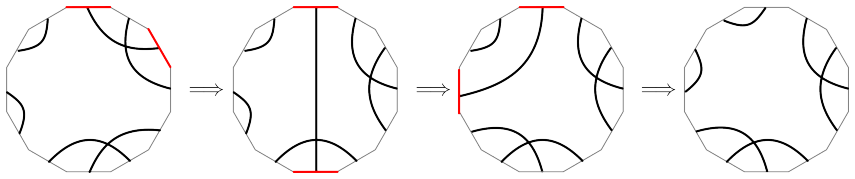
The genus-preserving swap operation, which selects two chords and exchanges their endpoints only if the resulting diagram has the same genus.
If this is right
- Uniform sampling of chord diagrams of fixed genus can be performed in polynomial time.
- Statistics on random chord diagrams of fixed genus become computationally accessible via this chain.
- The same swap rule yields a polynomial-time sampler for the non-crossing case as a special instance.
- The result supplies a concrete algorithmic tool for exploring combinatorial objects counted by higher-genus Catalan-like numbers.
Where Pith is reading between the lines
- The connectivity proof likely relies on a canonical path or coupling argument that could be adapted to other topological invariants.
- If the same swap rule works for diagrams on surfaces with boundary, the mixing result might extend to maps with prescribed face degrees.
- Polynomial mixing opens the door to Monte Carlo methods for estimating the number of diagrams of a given genus and size.
Load-bearing premise
The allowed swaps connect every pair of chord diagrams that share the same genus.
What would settle it
An explicit pair of same-genus diagrams with no sequence of genus-preserving swaps connecting them, or a direct calculation showing super-polynomial mixing time for some fixed genus.
Figures
read the original abstract
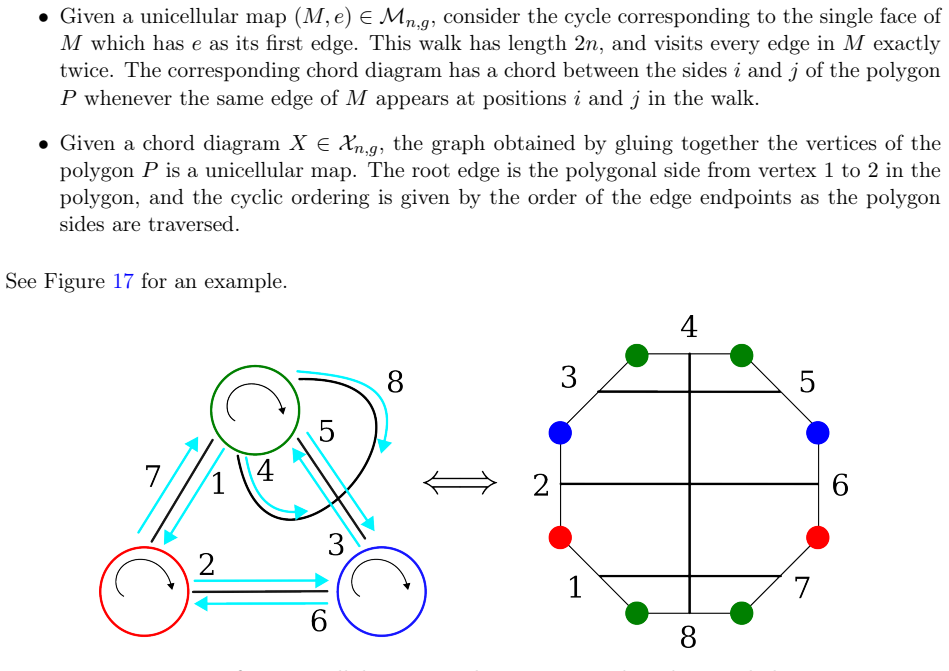
We introduce a natural Markov chain on chord diagrams, which, at every step, selects two random chords and swaps them if doing so preserves the diagram's genus. This generalizes the chord swap chain on the Catalan structure of non-intersecting chord diagrams. We show that for fixed genus, the chain mixes in polynomial time.
Editorial analysis
A structured set of objections, weighed in public.
Referee Report
Summary. The paper introduces a Markov chain on chord diagrams of fixed genus g, with transitions that select two random chords and swap their endpoints if the swap preserves genus. This generalizes the chord-swap chain on non-crossing (Catalan) diagrams. The central claim is that the chain mixes in polynomial time for any fixed g.
Significance. If the result holds, it supplies the first polynomial-time uniform sampler for chord diagrams of fixed positive genus, extending known polynomial mixing for the g=0 case. Such samplers are useful in enumerative combinatorics and the study of random maps or surfaces.
major comments (1)
- The polynomial mixing claim requires that the genus-preserving swap graph is connected on the set of all chord diagrams of genus g (so that the unique stationary distribution is uniform). The abstract states the mixing result but supplies no argument, section, or lemma establishing this connectivity for g>0; without it the claimed stationary distribution and mixing bound do not follow.
Simulated Author's Rebuttal
We thank the referee for the careful reading and for identifying this important gap. We address the comment below.
read point-by-point responses
-
Referee: The polynomial mixing claim requires that the genus-preserving swap graph is connected on the set of all chord diagrams of genus g (so that the unique stationary distribution is uniform). The abstract states the mixing result but supplies no argument, section, or lemma establishing this connectivity for g>0; without it the claimed stationary distribution and mixing bound do not follow.
Authors: We agree that an explicit proof of connectivity is required to establish that the chain is irreducible and that the stationary distribution is uniform. The manuscript contains no such argument, section, or lemma for g>0. We will add a dedicated lemma (or short section) proving that the genus-preserving swap graph is connected on the set of all chord diagrams of fixed genus g. The proof will show that any two diagrams of the same genus can be connected by a sequence of allowed swaps, for example by reducing both to a canonical representative while preserving genus at each step. revision: yes
Circularity Check
No circularity: mixing-time bound rests on explicit chain analysis, not self-definition or fitted inputs
full rationale
The paper defines a genus-preserving swap chain on chord diagrams and claims a polynomial mixing-time result for fixed genus. This is a standard Markov-chain proof task (irreducibility + conductance or canonical paths) whose validity depends on whether the authors correctly establish connectivity and the mixing bound; it does not reduce any claimed quantity to a fitted parameter or to a self-citation that itself assumes the target statement. No equation or step equates a derived object to its own input by construction, and the stationary distribution being uniform follows directly from reversibility once irreducibility is shown, rather than being smuggled in. The derivation is therefore self-contained against external benchmarks.
Axiom & Free-Parameter Ledger
axioms (1)
- standard math Markov chains on finite state spaces admit well-defined stationary distributions and mixing times when the chain is irreducible and aperiodic.
Reference graph
Works this paper leans on
-
[1]
Madras, Neal and Randall, Dana , TITLE =. Ann. Appl. Probab. , FJOURNAL =. 2002 , NUMBER =. doi:10.1214/aoap/1026915617 , URL =
-
[2]
Flajolet, Philippe and Sedgewick, Robert , TITLE =. 2009 , PAGES =. doi:10.1017/CBO9780511801655 , URL =
-
[3]
Lando, Sergei K. and Zvonkin, Alexander K. , TITLE =. 2004 , PAGES =. doi:10.1007/978-3-540-38361-1 , URL =
-
[4]
Levin, David A. and Peres, Yuval , TITLE =. 2017 , PAGES =. doi:10.1090/mbk/107 , URL =
-
[5]
2016 , school=
Problems in catalan mixing and matchings in regular hypergraphs , author=. 2016 , school=
2016
-
[6]
, author=
On the mixing time of the triangulation walk and other Catalan structures. , author=. Randomization methods in algorithm design , volume=
-
[7]
Jerrum, Mark and Son, Jung-Bae and Tetali, Prasad and Vigoda, Eric , TITLE =. Ann. Appl. Probab. , FJOURNAL =. 2004 , NUMBER =. doi:10.1214/105051604000000639 , URL =
discussion (0)
Sign in with ORCID, Apple, or X to comment. Anyone can read and Pith papers without signing in.