REVIEW 3 major objections 78 references
Merging models can stand in for multi-task retraining when pricing private datasets.
Reviewed by Pith at T0; open to challenge. T0 means a machine referee read the full paper against a public rubric. the ladder, T0–T4 →
T0 review · grok-4.5
2026-07-12 03:07 UTC pith:2BMJPIN2
load-bearing objection Solid multi-task + privacy data-valuation paper that pairs clean Shapley-error bounds with usable experiments; the second-order merging assumption is the real soft spot but does not sink the contribution. the 3 major comments →
Efficient Decentralized Multi-task Dataset Valuation via Model Merging
The pith
A machine-rendered reading of the paper's core claim, the machinery that carries it, and where it could break.
Core claim
Task-arithmetic model merging can serve as a faithful, privacy-compatible proxy for multi-task coalition utility, so that Shapley-style multi-task dataset values can be estimated from merged models alone rather than from retraining on every seller subset.
What carries the argument
DMVM: each seller's fine-tuned model is turned into a task vector; for any coalition the buyer evaluates a scaled sum of those vectors (task arithmetic) as the utility of that coalition, then aggregates the marginals into approximate Shapley values, with secure masks and an unmergeable layer transform protecting individual models.
Load-bearing premise
The method assumes that a simple average of task vectors is close enough to a model trained jointly on the same data that the difference in loss is well controlled by a second-order bound; if that gap is large, the value estimates drift.
What would settle it
On a marketplace where true multi-task Shapley values can still be computed by full coalition retraining, measure whether the absolute gap |true value − DMVM value| stays inside the stated bound (2αn² − 2αn + 2n + α − 1)LC, and whether rank correlation collapses when the second-order remainder is large (e.g., large learning rate or many epochs).
Editorial analysis
A structured set of objections, weighed in public.
Referee Report
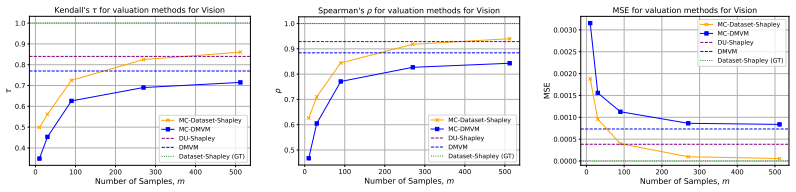
Summary. The paper proposes DMVM, a framework for multi-task dataset valuation in decentralized marketplaces that approximates coalition utilities via task-arithmetic model merging rather than retraining on raw seller data. Sellers fine-tune a shared pretrained model locally; the buyer evaluates merged models on multi-task validation sets and estimates Shapley values. A secure aggregation protocol with unmergeable layer transformations is introduced so that individual models and raw data are never revealed. Theorems 4.1–4.3 bound the gap between true multi-task Dataset Shapley values and the merging-based (and privacy-aware) proxies under Lipschitz loss and a second-order merging approximation. Experiments on vision and NLP marketplaces report Kendall τ roughly 0.75–0.85 and low MSE against privileged retraining-based ground truth, with MC-DMVM improving the efficiency–accuracy trade-off.
Significance. If the claims hold, this is a useful contribution at the intersection of data valuation, model merging, and privacy-preserving marketplaces. Multi-task dataset valuation is underexplored; most prior work is single-task and assumes centralized data access. Using task arithmetic as a utility proxy is a natural and timely idea, and the paper pairs it with explicit error bounds, a privacy protocol, and systematic vision/NLP experiments including controlled relevance spectra and harmful-data detection. The MC variant and scalability projections make the approach more practical than exponential retraining. Strengths include clear problem formulation, non-circular evaluation against independently computed multi-task Shapley, and concrete algorithmic detail (Algorithm 1). The main significance is practical: a deployable valuation path when raw data cannot be shared and buyers care about multiple tasks.
major comments (3)
- Theorems 4.1–4.3 rest on the starting inequality ||θ_merge_S − θ_MTL_S||₂ ≤ s(αs+1)C from Zhou et al., which is invoked only after higher-order remainder O(η³) is declared negligible (Appendix A.4; also stated in Thm 4.1). The subsequent Lipschitz step and convex-combination argument are clean, but the paper never measures ||θ_merge − θ_MTL|| or the realized loss/utility gap on the same coalitions that enter the Shapley sums for the models, optimizers, and short fine-tuning regimes used in §5 and A.10. Without that check, the absolute bounds are not shown to be informative for the experimental setting; if higher-order terms dominate, C no longer controls the gap and the error chain is non-informative. Please either (i) report empirical merge–MTL parameter and utility gaps on representative coalitions, or (ii) clearly reframe the theorems as conditional on that assumption and de-emphasize
- §4.2 and Thm 4.3 exclude |S|<2 for privacy, adding a 2R/n term. The unmergeable transformation (permutation on MLP pairs; scalar ρ on consecutive linear/QK layers) is presented as preventing reconstruction by differencing overlapping merges. The security argument is informal: there is no threat model, no analysis of residual leakage under adaptive subset queries, and no discussion of whether other modules (LayerNorm, embeddings, residual paths, attention value/output projections) remain linearly reconstructible. For a claimed privacy-aware marketplace protocol this is load-bearing. Either provide a clearer adversary model and argument that the full architecture is covered, or qualify the protocol as a heuristic defense against simple algebraic unmerging rather than a complete privacy guarantee.
- Ground-truth and privileged baselines in §5 / A.10 are computed with only 2–3 epochs of coalition training, while DMVM uses independently fine-tuned seller models merged with α=1/|S|. Short training can make the multi-task optimum closer to a linear combination of task vectors, potentially inflating agreement between merge-based and retraining-based utilities. Tables 2–3 and Figures 2–4 therefore may overstate fidelity relative to a more fully optimized MTL oracle. Please report at least one ablation with longer coalition training (or stronger multi-task baselines) for a subset of n, or explicitly discuss this as a limitation of the evaluation design.
Circularity Check
No significant circularity: DMVM proxy and error bounds are not defined in terms of the recovered Shapley rankings, and evaluation uses independently retrained multi-task ground truth.
full rationale
The derivation chain is: (i) define true coalition utility u(S) via multi-task training on raw seller subsets; (ii) define proxy û(S) via task-arithmetic merging of independently fine-tuned models; (iii) bound |u−û| using the external Zhou et al. second-order merging gap plus Lipschitz continuity; (iv) lift that gap through the Shapley linear combination (and Hoeffding for MC) to obtain Theorems 4.1–4.3. None of these steps defines the proxy in terms of the final seller ranking or fits a free parameter to the target Shapley values and then re-labels the fit as a prediction. Empirical claims compare DMVM/MC-DMVM against Dataset Shapley, MC-Dataset-Shapley, and DU-Shapley computed by retraining on raw coalitions—an independent oracle, not a quantity recovered by construction. Self-citations (e.g., Amiri et al. on task-agnostic valuation, Alipour & Amiri on reversible merging) appear only in related work and do not underwrite the error bounds or the numerical rankings. The load-bearing soft spot is an external modeling assumption (higher-order O(η³) terms negligible), which is a correctness risk, not circularity. Score 0 is therefore appropriate.
Axiom & Free-Parameter Ledger
free parameters (2)
- α (task-arithmetic scaling)
- C = (h+2 choose 2) H_max G_max
axioms (4)
- domain assumption Difference between task-arithmetic merge and full multi-task GD is O(η³) beyond second order (Zhou et al. lemma).
- domain assumption Loss L is L-Lipschitz continuous in model parameters.
- ad hoc to paper MTL baseline is full-batch gradient descent.
- domain assumption Average validation performance (or negative loss) is the correct multi-task utility for Shapley.
invented entities (2)
-
DMVM utility proxy û(S) via task-arithmetic merge
independent evidence
-
Unmergeable transformation (permutation / scalar ρ on consecutive layers)
no independent evidence
Cite this review
Pith. "Pith review of Efficient Decentralized Multi-task Dataset Valuation via Model Merging." pith.science (2026). https://pith.science/paper/2BMJPIN2
@misc{pith2026260703346,
  author       = {Pith},
  title        = {Pith review of: Efficient Decentralized Multi-task Dataset Valuation via Model Merging},
  year         = {2026},
  howpublished = {\url{https://pith.science/paper/2BMJPIN2}},
  note         = {Machine review of arXiv:2607.03346}
}
read the original abstract
Accurate and efficient dataset valuation is essential for enabling fair and transparent data marketplaces, especially when multiple contributors provide data for training multi-task models. Most existing valuation methods, however, are limited to single-task settings, overlooking scenarios where a buyer aims to optimize performance across multiple downstream tasks. Moreover, traditional valuation approaches, such as Shapley-based or retraining-based methods, are computationally expensive and poorly suited for decentralized environments without a trusted central coordinator and with strict privacy constraints. We propose DMVM (Decentralized Multi-task Valuation via Model Merging), a novel framework that bypasses retraining and data sharing by leveraging task arithmetic to infer dataset contributions directly from model combinations. Instead of retraining or sharing raw data, DMVM quantifies how models trained on different datasets combine in parameter space to infer each dataset's marginal utility across multiple tasks. This formulation yields a valuation process that is scalable, computationally efficient, and explicitly aligned with multi-task generalization behavior. To support decentralized deployment, we introduce a secure aggregation protocol that enables collaborative valuation without revealing individual model parameters or private data. We also provide theoretical error bounds characterizing the approximation quality of DMVM and validate our framework through comprehensive experiments on computer vision and natural language processing tasks.
Figures




Reference graph
Works this paper leans on
-
[1]
A marketplace for data: An algorithmic solution
Anish Agarwal, Munther Dahleh, and Tuhin Sarkar. A marketplace for data: An algorithmic solution. InProceedings of the 2019 ACM Conference on Economics and Computation, EC ’19, page 701–726, New York, NY , USA, 2019. Association for Computing Machinery. ISBN 9781450367929. doi: 10.1145/3328526.3329589. URL https://doi.org/10.1145/ 3328526.3329589
-
[2]
Arash Ahmadian, Seraphina Goldfarb-Tarrant, Beyza Ermis, Marzieh Fadaee, Sara Hooker, et al. Mix data or merge models? optimizing for diverse multi-task learning.arXiv preprint arXiv:2410.10801, 2024
Pith/arXiv arXiv 2024
-
[3]
Towards reversible model merging for low-rank weights.arXiv preprint arXiv:2510.14163, 2025
Mohammadsajad Alipour and Mohammad Mohammadi Amiri. Towards reversible model merging for low-rank weights.arXiv preprint arXiv:2510.14163, 2025
arXiv 2025
-
[4]
Fundamentals of task- agnostic data valuation
Mohammad Mohammadi Amiri, Frederic Berdoz, and Ramesh Raskar. Fundamentals of task- agnostic data valuation. InProceedings of the AAAI Conference on Artificial Intelligence, volume 37, pages 9226–9234, 2023
2023
-
[5]
Food-101–mining discriminative components with random forests
Lukas Bossard, Matthieu Guillaumin, and Luc Van Gool. Food-101–mining discriminative components with random forests. InEuropean conference on computer vision, pages 446–461. Springer, 2014
2014
-
[6]
Huaiguang Cai. Chg shapley: Efficient data valuation and selection towards trustworthy machine learning.arXiv preprint arXiv:2406.11730, 2024
Pith/arXiv arXiv 2024
-
[7]
Towards model-based pricing for machine learning in a data marketplace
Lingjiao Chen, Paraschos Koutris, and Arun Kumar. Towards model-based pricing for machine learning in a data marketplace. InProceedings of the 2019 International Conference on Management of Data, SIGMOD ’19, page 1535–1552, New York, NY , USA, 2019. Association for Computing Machinery. ISBN 9781450356435. doi: 10.1145/3299869.3300078. URL https://doi.org/...
-
[8]
Wei-Jia Chen, Min-Yen Tsai, Cheng-Yi Lee, and Chia-Mu Yu. Defending unauthorized model merging via dual-stage weight protection.arXiv preprint arXiv:2511.11851, 2025
arXiv 2025
-
[9]
Remote sensing image scene classification: Benchmark and state of the art.Proceedings of the IEEE, 105(10):1865–1883, 2017
Gong Cheng, Junwei Han, and Xiaoqiang Lu. Remote sensing image scene classification: Benchmark and state of the art.Proceedings of the IEEE, 105(10):1865–1883, 2017
2017
-
[10]
Saurab Chhachhi and Fei Teng. A joint energy and differentially-private smart meter data market.arXiv preprint arXiv:2412.07688, 2024
Pith/arXiv arXiv 2024
-
[11]
Aggarwal, and Yao Ma
Hongliang Chi, Wei Jin, Charu C. Aggarwal, and Yao Ma. Precedence-constrained winter value for effective graph data valuation. InThe Thirteenth International Conference on Learning Representations, 2025. URLhttps://openreview.net/forum?id=tVRVE0OAyb
2025
-
[12]
Chi, Jeff Dean, Jacob Devlin, Adam Roberts, Denny Zhou, Quoc V
Hyung Won Chung, Le Hou, Shayne Longpre, Barret Zoph, Yi Tay, William Fedus, Eric Li, Xuezhi Wang, Mostafa Dehghani, Siddhartha Brahma, Albert Webson, Shixiang Shane Gu, Zhuyun Dai, Mirac Suzgun, Xinyun Chen, Aakanksha Chowdhery, Sharan Narang, Gaurav Mishra, Adams Yu, Vincent Zhao, Yanping Huang, Andrew Dai, Hongkun Yu, Slav Petrov, Ed H. Chi, Jeff Dean,...
Pith/arXiv arXiv 2022
-
[13]
Describing textures in the wild
Mircea Cimpoi, Subhransu Maji, Iasonas Kokkinos, Sammy Mohamed, and Andrea Vedaldi. Describing textures in the wild. InProceedings of the IEEE conference on computer vision and pattern recognition, pages 3606–3613, 2014
2014
-
[14]
Boolq: Exploring the surprising difficulty of natural yes/no questions
Christopher Clark, Kenton Lee, Ming-Wei Chang, Tom Kwiatkowski, Michael Collins, and Kristina Toutanova. Boolq: Exploring the surprising difficulty of natural yes/no questions. InProceedings of the 2019 conference of the north American chapter of the association for computational linguistics: Human language technologies, volume 1 (long and short papers), ...
2019
-
[15]
Peter Clark, Isaac Cowhey, Oren Etzioni, Tushar Khot, Ashish Sabharwal, Carissa Schoenick, and Oyvind Tafjord. Think you have solved question answering? try arc, the ai2 reasoning challenge.arXiv:1803.05457v1, 2018
Pith/arXiv arXiv 2018
-
[16]
Training verifiers to solve math word problems.arXiv preprint arXiv:2110.14168, 2021
Karl Cobbe, Vineet Kosaraju, Mohammad Bavarian, Mark Chen, Heewoo Jun, Lukasz Kaiser, Matthias Plappert, Jerry Tworek, Jacob Hilton, Reiichiro Nakano, Christopher Hesse, and John Schulman. Training verifiers to solve math word problems.arXiv preprint arXiv:2110.14168, 2021
Pith/arXiv arXiv 2021
-
[17]
Emnist: Extending mnist to handwritten letters
Gregory Cohen, Saeed Afshar, Jonathan Tapson, and Andre Van Schaik. Emnist: Extending mnist to handwritten letters. In2017 international joint conference on neural networks (IJCNN), pages 2921–2926. IEEE, 2017
2017
-
[18]
Ali Falahati and Mohammad Mohammadi Amiri. Disentangled structural and featural represen- tation for task-agnostic graph valuation.arXiv preprint arXiv:2408.12659, 2024
Pith/arXiv arXiv 2024
-
[19]
Du-shapley: A shapley value proxy for efficient dataset valuation.Advances in Neural Information Processing Systems, 37:1973–2000, 2024
Felipe Garrido Lucero, Benjamin Heymann, Maxime V ono, Patrick Loiseau, and Vianney Perchet. Du-shapley: A shapley value proxy for efficient dataset valuation.Advances in Neural Information Processing Systems, 37:1973–2000, 2024
1973
-
[20]
Did aristotle use a laptop? a question answering benchmark with implicit reasoning strategies
Mor Geva, Daniel Khashabi, Elad Segal, Tushar Khot, Dan Roth, and Jonathan Berant. Did aristotle use a laptop? a question answering benchmark with implicit reasoning strategies. Transactions of the Association for Computational Linguistics, 9:346–361, 2021
2021
-
[21]
Data shapley: Equitable valuation of data for machine learning
Amirata Ghorbani and James Zou. Data shapley: Equitable valuation of data for machine learning. In Kamalika Chaudhuri and Ruslan Salakhutdinov, editors,Proceedings of the 36th International Conference on Machine Learning, volume 97 ofProceedings of Machine Learning Research, pages 2242–2251. PMLR, 09–15 Jun 2019. URL https://proceedings.mlr. press/v97/gho...
2019
-
[22]
The llama 3 herd of models.arXiv preprint arXiv:2407.21783, 2024
Aaron Grattafiori, Abhimanyu Dubey, Abhinav Jauhri, Abhinav Pandey, Abhishek Kadian, Ahmad Al-Dahle, Aiesha Letman, Akhil Mathur, Alan Schelten, Alex Vaughan, et al. The llama 3 herd of models.arXiv preprint arXiv:2407.21783, 2024
Pith/arXiv arXiv 2024
-
[23]
Patrick Helber, Benjamin Bischke, Andreas Dengel, and Damian Borth. Eurosat: A novel dataset and deep learning benchmark for land use and land cover classification.IEEE Journal of Selected Topics in Applied Earth Observations and Remote Sensing, 12(7):2217–2226, 2019
2019
-
[24]
Jonathan J. Hull. A database for handwritten text recognition research.IEEE Transactions on pattern analysis and machine intelligence, 16(5):550–554, 2002
2002
-
[25]
Editing models with task arithmetic
Gabriel Ilharco, Marco Tulio Ribeiro, Mitchell Wortsman, Ludwig Schmidt, Hannaneh Ha- jishirzi, and Ali Farhadi. Editing models with task arithmetic. InThe Eleventh International Conference on Learning Representations, 2023. URL https://openreview.net/forum? id=6t0Kwf8-jrj
2023
-
[26]
Private, augmentation-robust and task-agnostic data valuation approach for data marketplace
Tayyebeh Jahani-Nezhad, Parsa Moradi, Mohammad Ali Maddah-Ali, and Giuseppe Caire. Private, augmentation-robust and task-agnostic data valuation approach for data marketplace. arXiv preprint arXiv:2411.00745, 2024
Pith/arXiv arXiv 2024
-
[27]
Efficient task-specific data valuation for nearest neighbor algorithms.Proc
Ruoxi Jia, David Dao, Boxin Wang, Frances Ann Hubis, Nezihe Merve Gurel, Bo Li, Ce Zhang, Costas Spanos, and Dawn Song. Efficient task-specific data valuation for nearest neighbor algorithms.Proc. VLDB Endow., 12(11):1610–1623, July 2019. ISSN 2150-8097. doi: 10.14778/3342263.3342637. URLhttps://doi.org/10.14778/3342263.3342637
-
[28]
Ruoxi Jia, David Dao, Boxin Wang, Frances Ann Hubis, Nick Hynes, Nezihe Merve Gürel, Bo Li, Ce Zhang, Dawn Song, and Costas J. Spanos. Towards efficient data valuation based on the shapley value. In Kamalika Chaudhuri and Masashi Sugiyama, editors,Proceedings of the Twenty-Second International Conference on Artificial Intelligence and Statistics, volume 8...
2019
-
[29]
Pubmedqa: A dataset for biomedical research question answering
Qiao Jin, Bhuwan Dhingra, Zhengping Liu, William Cohen, and Xinghua Lu. Pubmedqa: A dataset for biomedical research question answering. InProceedings of the 2019 Conference on Empirical Methods in Natural Language Processing and the 9th International Joint Conference on Natural Language Processing (EMNLP-IJCNLP), pages 2567–2577, 2019
2019
-
[30]
Disrupting model merging: A parameter-level defense without sacrificing accuracy
Wei Junhao, Yu Zhe, and Jun Sakuma. Disrupting model merging: A parameter-level defense without sacrificing accuracy. InProceedings of the IEEE/CVF International Conference on Computer Vision (ICCV), pages 17698–17707, October 2025
2025
-
[31]
Understanding black-box predictions via influence functions
Pang Wei Koh and Percy Liang. Understanding black-box predictions via influence functions. InInternational conference on machine learning, pages 1885–1894. PMLR, 2017
2017
-
[32]
3d object representations for fine- grained categorization
Jonathan Krause, Michael Stark, Jia Deng, and Li Fei-Fei. 3d object representations for fine- grained categorization. In2013 IEEE International Conference on Computer Vision Workshops, pages 554–561, 2013. doi: 10.1109/ICCVW.2013.77
-
[33]
Learning multiple layers of features from tiny images
Alex Krizhevsky, Geoffrey Hinton, et al. Learning multiple layers of features from tiny images. 2009
2009
-
[34]
Gradient-based learning applied to document recognition.Proceedings of the IEEE, 86(11):2278–2324, 1998
Yann LeCun, Léon Bottou, Yoshua Bengio, and Patrick Haffner. Gradient-based learning applied to document recognition.Proceedings of the IEEE, 86(11):2278–2324, 1998
1998
-
[35]
When is task vector provably effective for model editing? a generalization analysis of nonlinear transformers
Hongkang Li, Yihua Zhang, Shuai Zhang, Pin-Yu Chen, Sijia Liu, and Meng Wang. When is task vector provably effective for model editing? a generalization analysis of nonlinear transformers. InThe Thirteenth International Conference on Learning Representations, 2025. URLhttps://openreview.net/forum?id=vRvVVb0NAz
2025
-
[36]
Jian Liu, Leyang Cui, Hanmeng Liu, Dandan Huang, Yile Wang, and Yue Zhang. Logiqa: A challenge dataset for machine reading comprehension with logical reasoning.arXiv preprint arXiv:2007.08124, 2020
Pith/arXiv arXiv 2007
-
[37]
Dealer: an end-to-end model marketplace with differential privacy.Proc
Jinfei Liu, Jian Lou, Junxu Liu, Li Xiong, Jian Pei, and Jimeng Sun. Dealer: an end-to-end model marketplace with differential privacy.Proc. VLDB Endow., 14(6):957–969, February
-
[38]
ISSN 2150-8097. doi: 10.14778/3447689.3447700. URL https://doi.org/10. 14778/3447689.3447700
-
[39]
Data measurements for decentralized data markets.arXiv preprint arXiv:2406.04257, 2024
Charles Lu, Mohammad Mohammadi Amiri, and Ramesh Raskar. Data measurements for decentralized data markets.arXiv preprint arXiv:2406.04257, 2024
Pith/arXiv arXiv 2024
-
[40]
Maas, Raymond E
Andrew L. Maas, Raymond E. Daly, Peter T. Pham, Dan Huang, Andrew Y . Ng, and Christopher Potts. Learning word vectors for sentiment analysis. InProceedings of the 49th Annual Meeting of the Association for Computational Linguistics: Human Language Technologies, pages 142– 150, Portland, Oregon, USA, June 2011. Association for Computational Linguistics. U...
2011
-
[41]
Sasan Maleki, Long Tran-Thanh, Greg Hines, Talal Rahwan, and Alex Rogers. Bounding the es- timation error of sampling-based shapley value approximation.arXiv preprint arXiv:1306.4265, 2013
Pith/arXiv arXiv 2013
-
[42]
Merging models with fisher-weighted averaging
Michael S Matena and Colin A Raffel. Merging models with fisher-weighted averaging. Advances in Neural Information Processing Systems, 35:17703–17716, 2022
2022
-
[43]
Can a suit of armor conduct electricity? a new dataset for open book question answering
Todor Mihaylov, Peter Clark, Tushar Khot, and Ashish Sabharwal. Can a suit of armor conduct electricity? a new dataset for open book question answering. InEMNLP, 2018
2018
-
[44]
Scalable data ablation approximations for language models through modular training and merging
Clara Na, Ian Magnusson, Ananya Harsh Jha, Tom Sherborne, Emma Strubell, Jesse Dodge, and Pradeep Dasigi. Scalable data ablation approximations for language models through modular training and merging. InProceedings of the 2024 Conference on Empirical Methods in Natural Language Processing, pages 21125–21141, 2024
2024
-
[45]
Yuval Netzer, Tao Wang, Adam Coates, Alessandro Bissacco, Bo Wu, and Andrew Y . Ng. Reading digits in natural images with unsupervised feature learning. InNIPS Workshop on Deep Learning and Unsupervised Feature Learning 2011, 2011. URL http://ufldl.stanford. edu/housenumbers/nips2011_housenumbers.pdf. 13
2011
-
[46]
Selectformer: Private and practical data selec- tion for transformers
Xu Ouyang, Felix Xiaozhu Lin, and Yangfeng Ji. Selectformer: Private and practical data selec- tion for transformers. InThe Thirteenth International Conference on Learning Representations,
-
[47]
URLhttps://openreview.net/forum?id=2cF3f9t31y
-
[48]
Medmcqa: A large-scale multi-subject multi-choice dataset for medical domain question answering
Ankit Pal, Logesh Kumar Umapathi, and Malaikannan Sankarasubbu. Medmcqa: A large-scale multi-subject multi-choice dataset for medical domain question answering. In Gerardo Flores, George H Chen, Tom Pollard, Joyce C Ho, and Tristan Naumann, editors,Proceedings of the Conference on Health, Inference, and Learning, volume 174 ofProceedings of Machine Learni...
2022
-
[49]
Parkhi, Andrea Vedaldi, Andrew Zisserman, and C
Omkar M. Parkhi, Andrea Vedaldi, Andrew Zisserman, and C. V . Jawahar. Cats and dogs. In IEEE Conference on Computer Vision and Pattern Recognition, 2012
2012
-
[50]
Recognizing indoor scenes
Ariadna Quattoni and Antonio Torralba. Recognizing indoor scenes. In2009 IEEE conference on computer vision and pattern recognition, pages 413–420. IEEE, 2009
2009
-
[51]
Qwen2.5 technical report, 2025
Qwen, :, An Yang, Baosong Yang, Beichen Zhang, Binyuan Hui, Bo Zheng, Bowen Yu, Chengyuan Li, Dayiheng Liu, Fei Huang, Haoran Wei, Huan Lin, Jian Yang, Jianhong Tu, Jianwei Zhang, Jianxin Yang, Jiaxi Yang, Jingren Zhou, Junyang Lin, Kai Dang, Keming Lu, Keqin Bao, Kexin Yang, Le Yu, Mei Li, Mingfeng Xue, Pei Zhang, Qin Zhu, Rui Men, Runji Lin, Tianhao Li,...
Pith/arXiv arXiv 2025
-
[52]
Learning transferable visual models from natural language supervision
Alec Radford, Jong Wook Kim, Chris Hallacy, Aditya Ramesh, Gabriel Goh, Sandhini Agar- wal, Girish Sastry, Amanda Askell, Pamela Mishkin, Jack Clark, Gretchen Krueger, and Ilya Sutskever. Learning transferable visual models from natural language supervision. In Marina Meila and Tong Zhang, editors,Proceedings of the 38th International Conference on Machin...
2021
-
[53]
A value for n-person games
Lloyd S Shapley et al. A value for n-person games. 1953
1953
-
[54]
The german traffic sign recognition benchmark: A multi-class classification competition
Johannes Stallkamp, Marc Schlipsing, Jan Salmen, and Christian Igel. The german traffic sign recognition benchmark: A multi-class classification competition. InThe 2011 International Joint Conference on Neural Networks, pages 1453–1460, 2011. doi: 10.1109/IJCNN.2011.6033395
-
[55]
CommonsenseQA: A question answering challenge targeting commonsense knowledge
Alon Talmor, Jonathan Herzig, Nicholas Lourie, and Jonathan Berant. CommonsenseQA: A question answering challenge targeting commonsense knowledge. InProceedings of the 2019 Conference of the North American Chapter of the Association for Computational Lin- guistics: Human Language Technologies, Volume 1 (Long and Short Papers), pages 4149– 4158, Minneapoli...
-
[56]
Fusionbench: A comprehensive benchmark of deep model fusion.Journal of Machine Learning Research, 2025
Anke Tang, Li Shen, Yong Luo, Enneng Yang, Han Hu, Lefei Zhang, Bo Du, and Dacheng Tao. Fusionbench: A comprehensive benchmark of deep model fusion.Journal of Machine Learning Research, 2025
2025
-
[57]
Heterogeneous graph data valuation: A shapley value- based approach
Xin Tang, Yanzhe Lei, and Chao Li. Heterogeneous graph data valuation: A shapley value- based approach. In2025 40th Youth Academic Annual Conference of Chinese Association of Automation (YAC), pages 2871–2876, 2025. doi: 10.1109/Y AC66630.2025.11150137
work page doi:10.1109/y 2025
-
[58]
Merge to mix: Mixing datasets via model merging.arXiv preprint arXiv:2505.16066, 2025
Zhixu Silvia Tao, Kasper Vinken, Hao-Wei Yeh, Avi Cooper, and Xavier Boix. Merge to mix: Mixing datasets via model merging.arXiv preprint arXiv:2505.16066, 2025
Pith/arXiv arXiv 2025
-
[59]
Private data valuation and fair payment in data marketplaces.arXiv preprint arXiv:2210.08723, 2022
Zhihua Tian, Jian Liu, Jingyu Li, Xinle Cao, Ruoxi Jia, Jun Kong, Mengdi Liu, and Kui Ren. Private data valuation and fair payment in data marketplaces.arXiv preprint arXiv:2210.08723, 2022
Pith/arXiv arXiv 2022
-
[60]
Attention is all you need.Advances in neural information processing systems, 30, 2017
Ashish Vaswani, Noam Shazeer, Niki Parmar, Jakob Uszkoreit, Llion Jones, Aidan N Gomez, Łukasz Kaiser, and Illia Polosukhin. Attention is all you need.Advances in neural information processing systems, 30, 2017. 14
2017
-
[61]
GLUE: A multi-task benchmark and analysis platform for natural language understanding
Alex Wang, Amanpreet Singh, Julian Michael, Felix Hill, Omer Levy, and Samuel Bowman. GLUE: A multi-task benchmark and analysis platform for natural language understanding. In Tal Linzen, Grzegorz Chrupała, and Afra Alishahi, editors,Proceedings of the 2018 EMNLP Workshop BlackboxNLP: Analyzing and Interpreting Neural Networks for NLP, pages 353– 355, Bru...
-
[62]
Wang, Prateek Mittal, Dawn Song, and Ruoxi Jia
Jiachen T. Wang, Prateek Mittal, Dawn Song, and Ruoxi Jia. Data shapley in one training run. InThe Thirteenth International Conference on Learning Representations, 2025. URL https://openreview.net/forum?id=HD6bWcj87Y
2025
-
[63]
Zihao Wang, Enneng Yang, Lu Yin, Shiwei Liu, and Li Shen. Model unmerging: Making your models unmergeable for secure model sharing.arXiv preprint arXiv:2509.01548, 2025
Pith/arXiv arXiv 2025
-
[64]
Scaling intelligence through model merging: A comprehensive survey.Authorea Preprints, 2025
Zijing Wang, Yongkang Liu, Yingfeng Luo, Ming Wang, Zhen Song, Shi Feng, Xiaocui Yang, Dingyang Lin, Daling Wang, Yifei Zhang, et al. Scaling intelligence through model merging: A comprehensive survey.Authorea Preprints, 2025
2025
-
[65]
Model soups: averaging weights of multiple fine-tuned models improves accuracy without increasing inference time
Mitchell Wortsman, Gabriel Ilharco, Samir Ya Gadre, Rebecca Roelofs, Raphael Gontijo-Lopes, Ari S Morcos, Hongseok Namkoong, Ali Farhadi, Yair Carmon, Simon Kornblith, et al. Model soups: averaging weights of multiple fine-tuned models improves accuracy without increasing inference time. InInternational conference on machine learning, pages 23965–23998. P...
2022
-
[66]
Visual transformers: Token-based image representation and processing for computer vision, 2020
Bichen Wu, Chenfeng Xu, Xiaoliang Dai, Alvin Wan, Peizhao Zhang, Zhicheng Yan, Masayoshi Tomizuka, Joseph Gonzalez, Kurt Keutzer, and Peter Vajda. Visual transformers: Token-based image representation and processing for computer vision, 2020
2020
-
[67]
Han Xiao, Kashif Rasul, and Roland V ollgraf. Fashion-mnist: a novel image dataset for benchmarking machine learning algorithms.arXiv preprint arXiv:1708.07747, 2017
Pith/arXiv arXiv 2017
-
[68]
Ehinger, Aude Oliva, and Antonio Torralba
Jianxiong Xiao, James Hays, Krista A. Ehinger, Aude Oliva, and Antonio Torralba. Sun database: Large-scale scene recognition from abbey to zoo. In2010 IEEE Computer Society Conference on Computer Vision and Pattern Recognition, pages 3485–3492, 2010. doi: 10. 1109/CVPR.2010.5539970
arXiv 2010
-
[69]
Ties-merging: Resolving interference when merging models.Advances in Neural Information Processing Systems, 36:7093–7115, 2023
Prateek Yadav, Derek Tam, Leshem Choshen, Colin A Raffel, and Mohit Bansal. Ties-merging: Resolving interference when merging models.Advances in Neural Information Processing Systems, 36:7093–7115, 2023
2023
-
[70]
On the inflation of knn-shapley value.arXiv preprint arXiv:2405.17489, 2024
Ziao Yang, Han Yue, Jian Chen, and Hongfu Liu. On the inflation of knn-shapley value.arXiv preprint arXiv:2405.17489, 2024
Pith/arXiv arXiv 2024
-
[71]
Data valuation using reinforcement learning
Jinsung Yoon, Sercan Arik, and Tomas Pfister. Data valuation using reinforcement learning. In International Conference on Machine Learning, pages 10842–10851. PMLR, 2020
2020
-
[72]
Language models are super mario: Absorbing abilities from homologous models as a free lunch
Le Yu, Bowen Yu, Haiyang Yu, Fei Huang, and Yongbin Li. Language models are super mario: Absorbing abilities from homologous models as a free lunch. InForty-first International Conference on Machine Learning, 2024
2024
-
[73]
Character-level convolutional networks for text classification.Advances in neural information processing systems, 28, 2015
Xiang Zhang, Junbo Zhao, and Yann LeCun. Character-level convolutional networks for text classification.Advances in neural information processing systems, 28, 2015
2015
-
[74]
Paws: Paraphrase adversaries from word scrambling
Yuan Zhang, Jason Baldridge, and Luheng He. Paws: Paraphrase adversaries from word scrambling. InProceedings of the 2019 Conference of the North American Chapter of the Association for Computational Linguistics: Human Language Technologies, Volume 1 (Long and Short Papers), pages 1298–1308, 2019
2019
-
[75]
Yuchen Zhang and Mohammad Mohammadi Amiri. Toward efficient influence function: Dropout as a compression tool.arXiv preprint arXiv:2509.15651, 2025
Pith/arXiv arXiv 2025
-
[76]
On task vectors and gradients.arXiv preprint arXiv:2508.16082, 2025
Luca Zhou, Daniele Solombrino, Donato Crisostomi, Maria Sofia Bucarelli, Giuseppe Alessio D’Inverno, Fabrizio Silvestri, and Emanuele Rodolà. On task vectors and gradients.arXiv preprint arXiv:2508.16082, 2025. 15
arXiv 2025
-
[77]
Multi-task code llms: Data mix or model merge?arXiv preprint arXiv:2601.21115, 2026
Mingzhi Zhu, Boris Sobolev, Rahul Krishna, Raju Pavuluri, Stacy Patterson, and Michele Merler. Multi-task code llms: Data mix or model merge?arXiv preprint arXiv:2601.21115, 2026. A Appendix A.1 Algorithm Algorithm 1DMVM: Decentralized Multi-task Valuation via Secure Model Merging 1: Input:Buyer queries a potential group of sellers [n], base model weights...
arXiv 2026
-
[78]
Moreover, the Shapley coefficients form a convex combination, i.e., 1 n P S⊆[n]\{i} 1 ( n−1 |S| ) = 1
+ 1)C, respectively, using inequality (4). Moreover, the Shapley coefficients form a convex combination, i.e., 1 n P S⊆[n]\{i} 1 ( n−1 |S| ) = 1. Therefore, applying Lemma A.1 with b= 1 yields inequality (a). 18 A.5 Error bound of our privacy-aware method Assuming that we want to exclude subsets of size less than k. Let R be the maximum marginal utility, ...
2000
discussion (0)
Sign in with ORCID, Apple, or X to comment. Anyone can read and Pith papers without signing in.