ELSA3D: Elastic Semantic Anchoring for Unified 3D Understanding and Generation
Reviewed by Pith T0 review T1 audit T2 compute T3 formal T4 kernel 2026-07-08 01:29 UTCglm-5.2pith:VO5NKNW7record.jsonopen to challenge →
The pith
ELSA3D halves 3D model cost by routing text to the right geometric scale
A machine-rendered reading of the paper's core claim, the machinery that carries it, and where it could break.
Core claim
The central object is the Anchor Token: a sparse cross-modal unit that, guided by a per-block router, selects which text tokens become semantic anchors and at which geometric scale (from a scale-aware octree) they should retrieve and write back evidence. This decouples cross-modal interaction from flat full-sequence attention, replacing it with targeted, scale-matched retrieval. The paper claims this mechanism simultaneously improves quality across generation and captioning tasks and cuts compute by approximately half.
What carries the argument
Scale-aware octree tokenizer; Anchor Tokens (sparse cross-modal units); per-block router for elastic scale routing
If this is right
- Unified 3D models could adopt routed sparse cross-modal interaction as a general efficiency technique, extending beyond 3D to other multi-modal domains with natural scale hierarchies.
- If the router learns non-degenerate routing, analyzing which text tokens route to which scales could reveal interpretable correspondences between language concepts and geometric structure.
- The elastic design suggests a path to variable-depth 3D generation where compute allocates dynamically based on prompt complexity rather than using fixed-depth processing.
- Scale-aware tokenization combined with routed anchoring could generalize to video or scene-level understanding where multiple abstraction levels coexist.
Where Pith is reading between the lines
- The efficiency claim rests on sparsity: if the router collapses to always selecting the same scale or tokens, the model degenerates to a sparse-attention model without semantic alignment, and the gains would come from reduced computation alone rather than intelligent routing.
- The halved-FLOPs comparison is against the non-elastic version of the same model, not against all baselines—so the absolute efficiency relative to other SOTA unified models is not established by the abstract alone.
- If the router is non-degenerate, the routing patterns learned across scales could serve as a diagnostic tool for understanding how language maps to geometric structure, which the paper does not explicitly claim but would be a natural consequence.
Load-bearing premise
The per-block router learns meaningful, non-degenerate routing—actually selecting different 3D scales for different text tokens—rather than collapsing to a trivial distribution where the same scale is always chosen.
What would settle it
If the router's routing distribution is near-uniform or always selects the same scale, then the elastic anchoring provides no semantic-alignment benefit over flat sparse attention, and the efficiency gains come solely from sparsity, not from scale-matched cross-modal interaction.
Figures


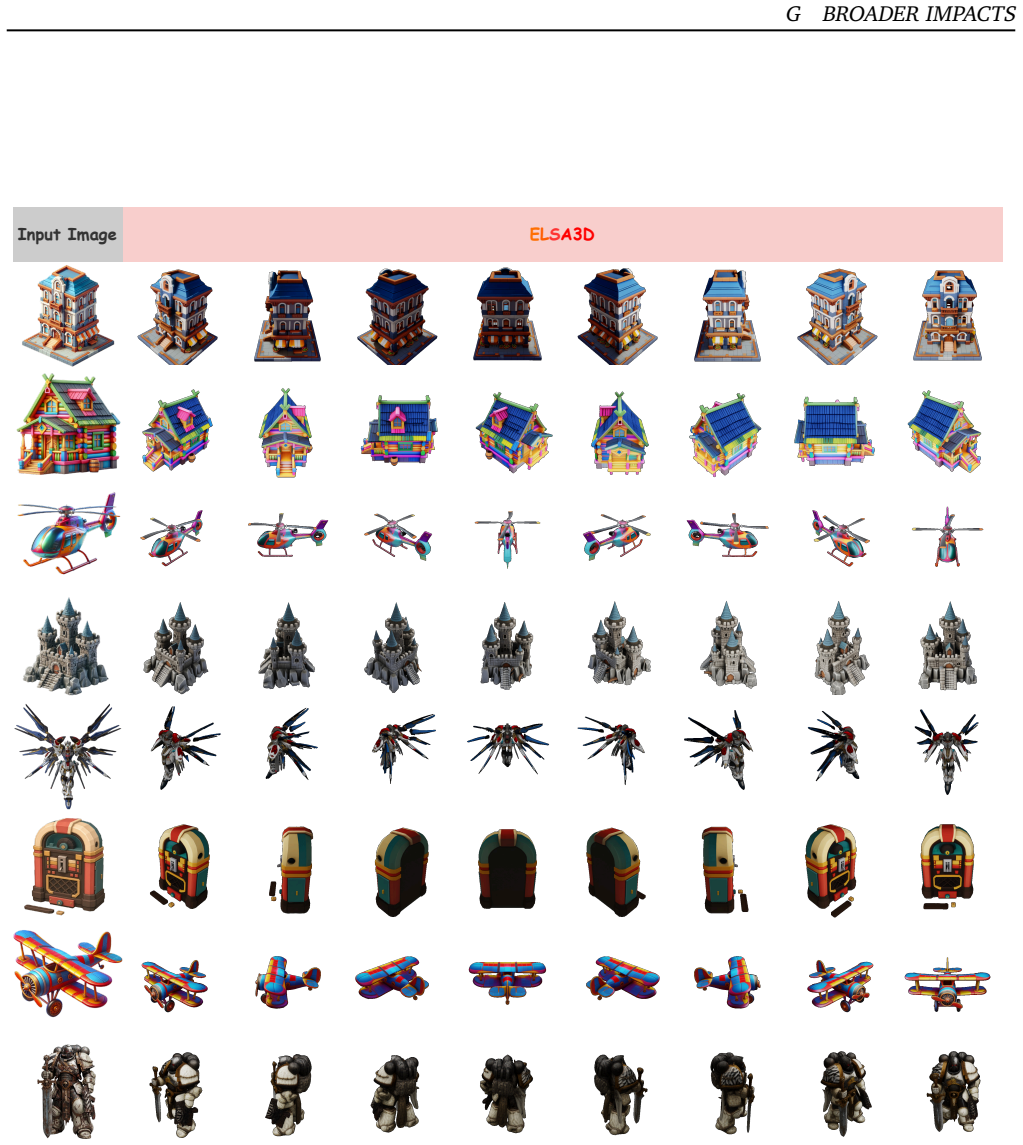
read the original abstract
Unified 3D foundation models aspire to generate 3D assets and reason about them in language within a single backbone, but their text-3D interaction remains largely implicit. Existing methods concatenate text and 3D tokens into a flat sequence and rely on self-attention, collapsing coarse structural cues and fine geometric details into one undifferentiated representation. We introduce ELSA3D, a unified 3D model that addresses this with elastic semantic anchoring, structuring language and geometric reasoning jointly along matched abstraction scales. ELSA3D represents geometry with a scale-aware octree tokenizer and introduces Anchor Tokens, sparse cross-modal units that select semantic cues, route them to the most relevant 3D scale, retrieve scale-specific geometric evidence, and write the fused signal back into the unified representation, keeping interaction sparse yet precise. A lightweight per-block router makes both computation and reasoning elastic, choosing which text tokens instantiate anchors at which geometric scale so that cross-modal capacity concentrates where alignment is most needed. ELSA3D achieves state-of-the-art performance across image-to-3D generation, text-to-3D generation, and 3D captioning, outperforming the strongest unified baseline while roughly halving FLOPs and inference latency relative to the non-elastic version of the same model.
Editorial analysis
A structured set of objections, weighed in public.
Referee Report
Summary. The manuscript introduces ELSA3D, a unified 3D foundation model that couples a scale-aware octree tokenizer with 'Anchor Tokens' — sparse cross-modal units routed by a per-block router to relevant geometric scales — to perform image-to-3D generation, text-to-3D generation, and 3D captioning within a single backbone. The central claims are: (i) SOTA performance across the three tasks, outperforming the strongest unified baseline, and (ii) roughly halved FLOPs and inference latency relative to a non-elastic ablation of the same model. **I must be transparent that only the abstract was available for this review; the full text, experimental tables, derivations, and ablations were not provided.** The assessment below is therefore necessarily limited and should be read as a preliminary screening rather than a full referee evaluation.
Significance. If the claims hold under full scrutiny, the work would be a meaningful contribution: a unified backbone addressing both generation and captioning with explicit, sparsely-routed cross-modal alignment is a reasonable architectural direction, and the efficiency claim (halved FLOPs/latency) is attractive if properly benchmarked. The introduction of Anchor Tokens and a per-block router is a novel-sounding mechanism. However, I cannot verify the presence of machine-checked proofs, reproducible code, parameter-free derivations, or falsifiable predictions without the full manuscript.
major comments (3)
- The full text of the manuscript was not available for review. I am unable to verify the central claims — SOTA performance, the FLOPs/latency reduction, or the non-degeneracy of the router — against the paper's tables, equations, or ablations. A proper assessment requires the complete manuscript including experimental sections, benchmark details, error bars, and ablation studies. I am flagging this as a major comment because it is the single most load-bearing issue: without the full text, no substantive evaluation is possible.
- Based on the abstract alone, the efficiency comparison is against 'the non-elastic version of the same model,' which is an internal ablation rather than an external baseline. This is not necessarily wrong, but it means the efficiency claim is relative to the authors' own architecture variant. The abstract does not clarify whether FLOPs/latency are also compared against external unified baselines. This framing should be made precise in the full paper (specifically, the experimental comparison section and any efficiency table).
- The abstract describes the per-block router as choosing 'which text tokens instantiate anchors at which geometric scale,' implying that the router learns meaningful, non-degenerate cross-modal routing. This is the load-bearing assumption for the 'semantic anchoring' contribution: if the router collapses to a trivial distribution (e.g., always selecting the same scale or the same tokens), the mechanism reduces to fixed sparse attention, and quality gains would be attributable to sparsity or the octree tokenizer rather than to semantic alignment. The abstract provides no evidence of non-degeneracy (no routing entropy, no per-scale load analysis, no ablation isolating the router from the sparsity pattern). I would expect the full paper to include such diagnostics; if absent, this is a gap in the contribution claim.
minor comments (2)
- The abstract uses several introduced terms ('Anchor Tokens,' 'elastic semantic anchoring') without brief operational definitions. One or two sentences clarifying the mechanism at a high level would improve accessibility.
- The phrase 'roughly halving FLOPs and inference latency' is imprecise; the full paper should report exact figures with measurement protocol (hardware, batch size, sequence length, whether latency includes tokenization).
Simulated Author's Rebuttal
We thank the referee for the careful reading of the abstract and for flagging specific concerns that we can address directly. We note that the full manuscript (including all experimental tables, ablations, and diagnostics) was submitted alongside the abstract and is available on arXiv; the review appears to have been conducted under a constraint where only the abstract was accessible. We address each major comment below.
read point-by-point responses
-
Referee: The full text of the manuscript was not available for review. Unable to verify central claims against tables, equations, or ablations.
Authors: We appreciate the referee's transparency about the access limitation. The full manuscript was submitted and is available at arXiv:2607.06565. It contains: (1) experimental tables comparing ELSA3D against external unified and task-specific baselines on image-to-3D generation (Chamfer distance, FID), text-to-3D generation, and 3D captioning (BLEU-4, CIDEr, ROUGE); (2) an efficiency table reporting FLOPs and wall-clock latency; and (3) ablation studies isolating the octree tokenizer, Anchor Tokens, and the per-block router. We would welcome the opportunity to have these sections reviewed. We do not believe a manuscript revision is needed for this point, but we are happy to resubmit the full text through whatever channel makes it accessible. revision: no
-
Referee: Efficiency comparison is against the non-elastic version of the same model (internal ablation), not an external baseline. Abstract does not clarify whether FLOPs/latency are also compared against external unified baselines.
Authors: The referee is correct that the headline efficiency claim in the abstract is framed relative to the non-elastic ablation of ELSA3D, which isolates the contribution of elastic anchoring specifically. We agree this framing should be made more precise. In the full paper, the efficiency table also reports FLOPs and latency for external unified baselines (e.g., the strongest unified baseline we compare against on quality), so the comparison is not purely internal. However, the abstract's phrasing could be misread as claiming efficiency superiority over all external baselines, which is not what we intend. We will revise the abstract to clarify that the halving claim is relative to the non-elastic ablation, and we will ensure the efficiency table in the experimental section explicitly includes external baselines for context. revision: yes
-
Referee: Router non-degeneracy: no evidence in the abstract that the router learns meaningful, non-trivial routing. If the router collapses, the mechanism reduces to fixed sparse attention. Expects routing entropy, per-scale load analysis, and ablation isolating the router from the sparsity pattern.
Authors: This is a fair and important concern. The full manuscript includes a router analysis subsection with: (1) per-scale routing entropy measured across blocks and input modalities, showing that the router maintains non-trivial entropy well above the degenerate regime; (2) per-scale load distributions showing that different text tokens are routed to different geometric scales depending on semantic content (e.g., material descriptors routing to fine scales, structural descriptors to coarse scales); and (3) an ablation comparing the learned router against (a) fixed uniform routing and (b) fixed random sparse routing with the same sparsity budget, demonstrating that the learned router's assignment — not sparsity alone — contributes to quality gains. That said, the referee's point that these diagnostics are essential to the contribution claim is well taken. If any of these analyses are insufficiently prominent or clearly labeled, we will strengthen their presentation in the revision to ensure the non-degeneracy argument is self-contained and easy to locate. revision: partial
Circularity Check
No circularity found; the paper makes empirical architecture claims, not a derivation chain that could reduce to its inputs.
full rationale
ELSA3D is an empirical architecture paper. Its claims are (1) SOTA performance against external baselines across three tasks and (2) roughly halved FLOPs/latency relative to a non-elastic ablation of the same model. Neither claim is a derivation that could be circular. The efficiency comparison against the 'non-elastic version of the same model' is a standard internal ablation; while the result that sparsity reduces computation is near-tautological (sparse attention will almost always cost less FLOPs than dense attention), this is a triviality or weakness concern, not circularity — the paper is not deriving the efficiency gain from a fitted parameter or a self-citation. The SOTA claim against external baselines is an empirical benchmark result that is externally falsifiable. The reader's router-degeneracy concern is a legitimate correctness/empirical-validity risk (does the router learn meaningful routing?), but it is not a circularity issue: the paper does not claim to derive the router's behavior from first principles or define it in terms of its outputs. No self-citation chain is visible in the abstract. No equations or definitions are available to inspect for self-referential reduction. With only the abstract, there is no evidence of any of the seven circularity patterns, and the most likely honest finding is that the derivation chain (such as it is) is self-contained and non-circular, with risks lying in empirical validation rather than logical construction.
Axiom & Free-Parameter Ledger
free parameters (3)
- Router parameters
- Anchor token sparsity budget
- Octree tokenizer scale parameters
axioms (3)
- domain assumption 3D geometry can be meaningfully represented at multiple discrete abstraction scales via an octree.
- domain assumption Sparse cross-modal interaction via anchor tokens is sufficient for high-quality 3D generation and captioning.
- domain assumption A learned router can identify which text tokens are most relevant to which geometric scale.
invented entities (2)
-
Anchor Tokens
no independent evidence
-
Elastic semantic anchoring (mechanism)
no independent evidence
Reference graph
Works this paper leans on
-
[1]
Rethinking the Inception Architecture for Computer Vision , author=. 2015 , eprint=
work page 2015
-
[2]
3D Shape Tokenization via Latent Flow Matching
3D Shape Tokenization via Latent Flow Matching , author=. arXiv preprint arXiv:2412.15618 , year=
work page internal anchor Pith review Pith/arXiv arXiv
-
[3]
MARS: Mesh AutoRegressive Model for 3D Shape Detailization
Mars: Mesh autoregressive model for 3d shape detailization , author=. arXiv preprint arXiv:2502.11390 , year=
work page internal anchor Pith review Pith/arXiv arXiv
-
[4]
Proceedings of the IEEE/CVF conference on computer vision and pattern recognition , pages=
Magic tokens: Select diverse tokens for multi-modal object re-identification , author=. Proceedings of the IEEE/CVF conference on computer vision and pattern recognition , pages=
-
[5]
Proceedings of the IEEE/CVF conference on computer vision and pattern recognition , pages=
Groupvit: Semantic segmentation emerges from text supervision , author=. Proceedings of the IEEE/CVF conference on computer vision and pattern recognition , pages=
-
[6]
Advances in neural information processing systems , volume=
Elastic decision transformer , author=. Advances in neural information processing systems , volume=
-
[7]
arXiv preprint arXiv:2509.23109 , year=
AttAnchor: Guiding Cross-Modal Token Alignment in VLMs with Attention Anchors , author=. arXiv preprint arXiv:2509.23109 , year=
-
[8]
Proceedings of the 2025 Conference on Empirical Methods in Natural Language Processing , pages=
Sea: Supervised embedding alignment for token-level visual-textual integration in mllms , author=. Proceedings of the 2025 Conference on Empirical Methods in Natural Language Processing , pages=
work page 2025
-
[9]
Proceedings of the IEEE/CVF International Conference on Computer Vision , pages=
Aim: Adaptive inference of multi-modal llms via token merging and pruning , author=. Proceedings of the IEEE/CVF International Conference on Computer Vision , pages=
-
[10]
arXiv preprint arXiv:2511.05534 , year=
FlowMM: Cross-Modal Information Flow Guided KV Cache Merging for Efficient Multimodal Context Inference , author=. arXiv preprint arXiv:2511.05534 , year=
-
[11]
Proceedings of the IEEE/CVF conference on computer vision and pattern recognition , pages=
Multimodal token fusion for vision transformers , author=. Proceedings of the IEEE/CVF conference on computer vision and pattern recognition , pages=
-
[12]
The Eleventh International Conference on Learning Representations , year=
Token Merging: Your ViT But Faster , author=. The Eleventh International Conference on Learning Representations , year=
-
[13]
Proceedings of the IEEE/CVF Conference on Computer Vision and Pattern Recognition , pages=
Texoct: Generating textures of 3d models with octree-based diffusion , author=. Proceedings of the IEEE/CVF Conference on Computer Vision and Pattern Recognition , pages=
-
[14]
ACM Transactions on Graphics (TOG) , volume=
Clay: A controllable large-scale generative model for creating high-quality 3d assets , author=. ACM Transactions on Graphics (TOG) , volume=. 2024 , publisher=
work page 2024
-
[15]
Computer Graphics Forum , volume=
OctFusion: Octree-based Diffusion Models for 3D Shape Generation , author=. Computer Graphics Forum , volume=. 2025 , organization=
work page 2025
-
[16]
Octgpt: Octree-based multiscale autoregressive models for 3d shape generation , author=. Proceedings of the Special Interest Group on Computer Graphics and Interactive Techniques Conference Conference Papers , pages=
-
[17]
Dual octree graph networks for learning adaptive volumetric shape representations , author=. 2022 , publisher=
work page 2022
-
[18]
Octformer: Octree-based transformers for 3d point clouds , author=. 2023 , publisher=
work page 2023
-
[19]
Visual autoregressive modeling: Scalable image generation via next-scale prediction , author=
-
[20]
Proceedings of the IEEE/CVF conference on computer vision and pattern recognition , pages=
Structured 3d latents for scalable and versatile 3d generation , author=. Proceedings of the IEEE/CVF conference on computer vision and pattern recognition , pages=
-
[21]
Proceedings of the IEEE/CVF conference on computer vision and pattern recognition , pages=
Neural geometric level of detail: Real-time rendering with implicit 3d shapes , author=. Proceedings of the IEEE/CVF conference on computer vision and pattern recognition , pages=
-
[22]
ACM SIGGRAPH 2023 Conference Proceedings , pages=
Neural progressive meshes , author=. ACM SIGGRAPH 2023 Conference Proceedings , pages=
work page 2023
-
[23]
Proceedings of the IEEE/CVF International Conference on Computer Vision , pages=
Vertexregen: Mesh generation with continuous level of detail , author=. Proceedings of the IEEE/CVF International Conference on Computer Vision , pages=
-
[24]
Advances in Neural Information Processing Systems , volume=
Objaverse-xl: A universe of 10m+ 3d objects , author=. Advances in Neural Information Processing Systems , volume=
-
[25]
arXiv preprint arXiv:2603.17995 , year=
LoST: Level of Semantics Tokenization for 3D Shapes , author=. arXiv preprint arXiv:2603.17995 , year=
-
[26]
Proceedings of the IEEE/CVF Conference on Computer Vision and Pattern Recognition , pages=
Habitat synthetic scenes dataset (hssd-200): An analysis of 3d scene scale and realism tradeoffs for objectgoal navigation , author=. Proceedings of the IEEE/CVF Conference on Computer Vision and Pattern Recognition , pages=
-
[27]
International Journal of Computer Vision , volume=
3d-future: 3d furniture shape with texture , author=. International Journal of Computer Vision , volume=. 2021 , publisher=
work page 2021
-
[28]
Jasmine Collins and Shubham Goel and Kenan Deng and Achleshwar Luthra and Leon Xu and Erhan Gundogdu and Xi Zhang and Tomas F. Yago Vicente and Thomas Dideriksen and Himanshu Arora and Matthieu Guillaumin and Jitendra Malik , title =. 2022 , url =
work page 2022
-
[29]
Proceedings of the 2023 Conference on Empirical Methods in Natural Language Processing , pages=
Enhancing chat language models by scaling high-quality instructional conversations , author=. Proceedings of the 2023 Conference on Empirical Methods in Natural Language Processing , pages=
work page 2023
-
[30]
Proceedings of the IEEE/CVF conference on computer vision and pattern recognition , pages=
Using shape to categorize: Low-shot learning with an explicit shape bias , author=. Proceedings of the IEEE/CVF conference on computer vision and pattern recognition , pages=
-
[31]
LLaMA-Mesh: Unifying 3D Mesh Generation with Language Models
Llama-mesh: Unifying 3d mesh generation with language models , author=. arXiv preprint arXiv:2411.09595 , year=
work page internal anchor Pith review Pith/arXiv arXiv
-
[32]
Neural discrete representation learning , author=
-
[33]
LLaMA: Open and Efficient Foundation Language Models
Llama: Open and efficient foundation language models , author=. arXiv preprint arXiv:2302.13971 , year=
work page internal anchor Pith review Pith/arXiv arXiv
-
[34]
arXiv preprint arXiv:2602.13993 , year=
Elastic diffusion transformer , author=. arXiv preprint arXiv:2602.13993 , year=
-
[35]
Dynamic diffusion transformer , author=. arXiv preprint arXiv:2410.03456 , year=
work page internal anchor Pith review Pith/arXiv arXiv
-
[36]
Proceedings of the IEEE/CVF International Conference on Computer Vision , pages=
Ea-vit: Efficient adaptation for elastic vision transformer , author=. Proceedings of the IEEE/CVF International Conference on Computer Vision , pages=
-
[37]
Qwen2. 5-vl technical report , author=. arXiv preprint arXiv:2502.13923 , year=
work page internal anchor Pith review Pith/arXiv arXiv
-
[38]
SocialIQA: Commonsense Reasoning about Social Interactions
Socialiqa: Commonsense reasoning about social interactions , author=. arXiv preprint arXiv:1904.09728 , year=
work page internal anchor Pith review Pith/arXiv arXiv 1904
-
[39]
Estimating or Propagating Gradients Through Stochastic Neurons for Conditional Computation
Estimating or propagating gradients through stochastic neurons for conditional computation , author=. arXiv preprint arXiv:1308.3432 , year=
work page internal anchor Pith review Pith/arXiv arXiv
-
[40]
Measuring Massive Multitask Language Understanding
Measuring massive multitask language understanding , author=. arXiv preprint arXiv:2009.03300 , year=
work page internal anchor Pith review Pith/arXiv arXiv 2009
-
[41]
Piqa: Reasoning about physical commonsense in natural language , author=
-
[42]
METEOR: An automatic metric for MT evaluation with improved correlation with human judgments , author=. Proceedings of the acl workshop on intrinsic and extrinsic evaluation measures for machine translation and/or summarization , pages=
-
[43]
Sentence-bert: Sentence embeddings using siamese bert-networks , author=. Proceedings of the 2019 conference on empirical methods in natural language processing and the 9th international joint conference on natural language processing (EMNLP-IJCNLP) , pages=
work page 2019
-
[44]
Proceedings of the 2021 conference on empirical methods in natural language processing , pages=
Simcse: Simple contrastive learning of sentence embeddings , author=. Proceedings of the 2021 conference on empirical methods in natural language processing , pages=
work page 2021
-
[45]
Proceedings of the IEEE/CVF conference on computer vision and pattern recognition , pages=
Xcube: Large-scale 3d generative modeling using sparse voxel hierarchies , author=. Proceedings of the IEEE/CVF conference on computer vision and pattern recognition , pages=
-
[46]
Proceedings of the Computer Vision and Pattern Recognition Conference , pages=
3dtopia-xl: Scaling high-quality 3d asset generation via primitive diffusion , author=. Proceedings of the Computer Vision and Pattern Recognition Conference , pages=
-
[47]
The Thirteenth International Conference on Learning Representations , year=
Gaussiananything: Interactive point cloud flow matching for 3d generation , author=. The Thirteenth International Conference on Learning Representations , year=
-
[48]
Proceedings of the IEEE/CVF Conference on Computer Vision and Pattern Recognition , pages=
Sar3d: Autoregressive 3d object generation and understanding via multi-scale 3d vqvae , author=. Proceedings of the IEEE/CVF Conference on Computer Vision and Pattern Recognition , pages=
-
[49]
Text summarization branches out , pages=
Rouge: A package for automatic evaluation of summaries , author=. Text summarization branches out , pages=
-
[50]
Proceedings of the 40th annual meeting of the Association for Computational Linguistics , pages=
Bleu: a method for automatic evaluation of machine translation , author=. Proceedings of the 40th annual meeting of the Association for Computational Linguistics , pages=
-
[51]
International conference on machine learning , pages=
Learning representations and generative models for 3d point clouds , author=. International conference on machine learning , pages=. 2018 , organization=
work page 2018
-
[52]
Advances in Neural Information Processing Systems , volume=
Direct3d: Scalable image-to-3d generation via 3d latent diffusion transformer , author=. Advances in Neural Information Processing Systems , volume=
-
[53]
Shap-E: Generating Conditional 3D Implicit Functions
Shap-e: Generating conditional 3d implicit functions , author=. arXiv preprint arXiv:2305.02463 , year=
work page internal anchor Pith review Pith/arXiv arXiv
-
[54]
European Conference on Computer Vision , pages=
ln3Diff: Scalable Latent Neural Fields Diffusion for Speedy 3D Generation , author=. European Conference on Computer Vision , pages=
-
[55]
Proceedings of the IEEE/CVF International Conference on Computer Vision , pages=
Sparseflex: High-resolution and arbitrary-topology 3d shape modeling , author=. Proceedings of the IEEE/CVF International Conference on Computer Vision , pages=
-
[56]
Instantmesh: Efficient 3d mesh generation from a single image with sparse-view large reconstruction models , author=. arXiv preprint arXiv:2404.07191 , year=
work page internal anchor Pith review Pith/arXiv arXiv
-
[57]
European Conference on Computer Vision , pages=
Pointllm: Empowering large language models to understand point clouds , author=. European Conference on Computer Vision , pages=. 2024 , organization=
work page 2024
-
[58]
Training Verifiers to Solve Math Word Problems
Training verifiers to solve math word problems, 2021 , author=. URL https://arxiv. org/abs/2110.14168 , volume=
work page internal anchor Pith review Pith/arXiv arXiv 2021
-
[59]
Visual Instruction Tuning , author=
-
[60]
International conference on machine learning , pages=
Learning transferable visual models from natural language supervision , author=. International conference on machine learning , pages=. 2021 , organization=
work page 2021
-
[61]
Demystifying mmd gans , author=. arXiv preprint arXiv:1801.01401 , year=
work page internal anchor Pith review Pith/arXiv arXiv
-
[62]
Advances in neural information processing systems , volume=
Gans trained by a two time-scale update rule converge to a local nash equilibrium , author=. Advances in neural information processing systems , volume=
-
[63]
Not All Tokens See Equally: Perception-Grounded Policy Optimization for Large Vision-Language Models
Not All Tokens See Equally: Perception-Grounded Policy Optimization for Large Vision-Language Models , author=. arXiv preprint arXiv:2604.01840 , year=
work page internal anchor Pith review Pith/arXiv arXiv
-
[64]
Not All Patches are What You Need: Expediting Vision Transformers via Token Reorganizations
Not all patches are what you need: Expediting vision transformers via token reorganizations , author=. arXiv preprint arXiv:2202.07800 , year=
work page internal anchor Pith review Pith/arXiv arXiv
-
[65]
DreamPartGen: Semantically Grounded Part-Level 3D Generation via Collaborative Latent Denoising
Dreampartgen: Semantically grounded part-level 3d generation via collaborative latent denoising , author=. arXiv preprint arXiv:2603.19216 , year=
work page internal anchor Pith review Pith/arXiv arXiv
-
[66]
Yu, Tianjiao and Shah, Vedant and Wahed, Muntasir and Shen, Ying and Nguyen, Kiet A and Lourentzou, Ismini , booktitle=. Part ^
-
[67]
arXiv preprint arXiv:2512.12768 , year=
CoRe3D: Collaborative Reasoning as a Foundation for 3D Intelligence , author=. arXiv preprint arXiv:2512.12768 , year=
-
[68]
Yueming Xu and Jiahui Zhang and Ze Huang and Yurui Chen and Yanpeng Zhou and Zhenyu Chen and Yu-Jie Yuan and Pengxiang Xia and Guowei Huang and Xinyue Cai and Zhongang Qi and Xingyue Quan and Jianye HAO and Hang Xu and Li Zhang , booktitle=ICLR, year=. Uni
-
[69]
European Conference on Computer Vision , pages=
Uni3DL: A unified model for 3D vision-language understanding , author=. European Conference on Computer Vision , pages=. 2024 , organization=
work page 2024
-
[70]
ShapeLLM-Omni: A Native Multimodal LLM for 3D Generation and Understanding
Shapellm-omni: A native multimodal llm for 3d generation and understanding , author=. arXiv preprint arXiv:2506.01853 , year=
work page internal anchor Pith review Pith/arXiv arXiv
-
[71]
Advances in Neural Information Processing Systems , volume=
3d-llm: Injecting the 3d world into large language models , author=. Advances in Neural Information Processing Systems , volume=
-
[72]
European Conference on Computer Vision , pages=
Shapellm: Universal 3d object understanding for embodied interaction , author=. European Conference on Computer Vision , pages=. 2024 , organization=
work page 2024
-
[73]
Chat-3D: Data-efficiently Tuning Large Language Model for Universal Dialogue of 3D Scenes
Chat-3d: Data-efficiently tuning large language model for universal dialogue of 3d scenes , author=. arXiv preprint arXiv:2308.08769 , year=
work page internal anchor Pith review Pith/arXiv arXiv
-
[74]
International conference on machine learning , pages=
Blip-2: Bootstrapping language-image pre-training with frozen image encoders and large language models , author=. International conference on machine learning , pages=. 2023 , organization=
work page 2023
-
[75]
Advances in neural information processing systems , volume=
Flamingo: a visual language model for few-shot learning , author=. Advances in neural information processing systems , volume=
-
[76]
Proceedings of the IEEE/CVF conference on computer vision and pattern recognition , pages=
Ll3da: Visual interactive instruction tuning for omni-3d understanding reasoning and planning , author=. Proceedings of the IEEE/CVF conference on computer vision and pattern recognition , pages=
-
[77]
Proceedings of the IEEE/CVF conference on computer vision and pattern recognition , pages=
Ulip: Learning a unified representation of language, images, and point clouds for 3d understanding , author=. Proceedings of the IEEE/CVF conference on computer vision and pattern recognition , pages=
-
[78]
Proceedings of the Computer Vision and Pattern Recognition Conference , pages=
Texgaussian: Generating high-quality pbr material via octree-based 3d gaussian splatting , author=. Proceedings of the Computer Vision and Pattern Recognition Conference , pages=
-
[79]
ACM Transactions on Graphics (TOG) , volume=
Octree textures , author=. ACM Transactions on Graphics (TOG) , volume=. 2002 , publisher=
work page 2002
-
[80]
Proceedings of the IEEE/CVF international conference on computer vision , pages=
Plenoctrees for real-time rendering of neural radiance fields , author=. Proceedings of the IEEE/CVF international conference on computer vision , pages=
discussion (0)
Sign in with ORCID, Apple, or X to comment. Anyone can read and Pith papers without signing in.