REVIEW 2 major objections 7 minor 178 references
Ignoring linear relativistic effects can shift local non-Gaussianity constraints by 1–3σ in Stage-IV galaxy surveys, and multi-tracer clustering can make some of those effects measurable.
Reviewed by Pith at T0; open to challenge. T0 means a machine referee read the full paper against a public rubric. the ladder, T0–T4 →
T0 review · grok-4.5
2026-07-10 23:10 UTC pith:A7Y3DMVQ
load-bearing objection First practical full-GR Bayesian SFB pipeline for Stage-IV PNG forecasts; the 1–3σ f_NL bias and multi-tracer Doppler gains are real under the stated assumptions. the 2 major comments →
Impact and measurability of linear relativistic effects in galaxy surveys
The pith
A machine-rendered reading of the paper's core claim, the machinery that carries it, and where it could break.
Core claim
Neglecting linear-order general-relativistic contributions when analyzing the three-dimensional galaxy power spectrum can bias local f_NL constraints at the 1–3σ level for Euclid and SPHEREx. The degeneracy between relativistic and primordial-non-Gaussianity terms is strongly tracer-dependent; lensing is measurable at high significance for several tracers; multi-tracer analyses substantially improve Doppler measurability; and, assuming general relativity, relativistic clustering partially breaks the exact b_ϕ f_NL product degeneracy of Newtonian linear analyses, while the resulting b_ϕ constraints remain weak for the configurations studied.
What carries the argument
The spherical Fourier-Bessel (SFB) power spectrum of multi-tracer galaxy clustering on the light cone, evaluated with a Chebyshev decomposition of the radial kernels so that the full set of linear relativistic terms can be recomputed in roughly one second and used inside Bayesian inference.
Load-bearing premise
The forecasts assume that the local non-Gaussianity bias is tied to the linear bias by the universality relation and that this same bias equals the evolution bias, plus a default magnification bias of one for all SPHEREx samples that have not been measured directly.
What would settle it
Apply the same full-GR SFB pipeline to early DESI or Euclid spectroscopic catalogs (or to mocks with independently measured magnification and evolution biases) and check whether the recovered f_NL shifts by the predicted 1–3σ when GR terms are dropped, and whether multi-tracer Doppler constraints reach the forecasted few-sigma level.
If this is right
- PNG analyses aiming for σ(f_NL) ~ 5 with Euclid or SPHEREx must include linear GR terms tracer by tracer or risk percent-to-factor-of-two level biases.
- Lensing amplitude can be used as an independent cross-check of magnification bias measured from flux-perturbation pipelines.
- Multi-tracer combinations of DESI and SPHEREx samples turn the Doppler term from undetectable into a several-sigma signal.
- Joint PNG–GR inference provides a consistent way to fold residual b_ϕ uncertainty into marginalized f_NL without forcing an external prior.
- Optimized subsample splits that maximize differences in linear, magnification, and evolution bias can further improve both PNG and GR measurability.
Where Pith is reading between the lines
- Once real magnification-bias measurements exist for SPHEREx, the forecasted f_NL bias map will need to be recomputed; samples near s ≈ 0.4 may flip from ‘GR-critical’ to ‘GR-safe’.
- The same Chebyshev-SFB engine is a natural backbone for joint analyses with CMB lensing or intensity mapping, where integrated GR terms gain extra leverage.
- If future multi-tracer samples can push σ(b_ϕ,0) below ~1, power-spectrum-only f_NL constraints without external b_ϕ priors become realistic.
- The tracer dependence of the GR–PNG degeneracy implies that sample selection itself is a design variable for Stage-V surveys, not only volume and number density.
Editorial analysis
A structured set of objections, weighed in public.
Referee Report
Summary. This paper forecasts constraints on local primordial non-Gaussianity (f_NL) and linear-order relativistic effects in the spherical Fourier-Bessel (SFB) power spectrum for DESI, Euclid, and SPHEREx. A Chebyshev decomposition accelerates multi-tracer SFB evaluations with the full set of linear GR terms, enabling both Fisher forecasts and simulated Bayesian inference (MCMC and nested sampling). The central results are: (i) fitting full-GR data vectors with Newtonian models can bias f_NL at the 1–3σ level for Euclid Hα and SPHEREx; (ii) GR–PNG degeneracies are strongly tracer-dependent, with the largest degradation from the gravitational-potential term; (iii) lensing is detectable at high SNR for several tracers, while multi-tracer analyses substantially improve Doppler constraints; and (iv) under GR and the b_ϕ–be equivalence, relativistic clustering partially breaks the Newtonian b_ϕ f_NL product degeneracy, though residual b_ϕ constraints remain weak and projection-dominated.
Significance. The work is a timely and technically substantial contribution to ultra-large-scale structure forecasting for Stage-IV surveys. Its main methodological advance is a validated Chebyshev scheme that reduces full-GR SFB evaluations to O(1 s), enabling the first Bayesian inference with the complete linear relativistic kernel in 3D clustering. The mismatch tests (full-GR data vs Newtonian model), mode-cut scans, multi-tracer amplitude forecasts, and joint PNG–GR sampling of b_ϕ are carefully designed and clearly reported. If the results hold under more realistic windows and selection functions, they provide concrete guidance on when GR must be included for unbiased f_NL analyses and on the practical reach of multi-tracer relativistic measurements.
major comments (2)
- [Abstract; §III C 3; §IV B; Fig. 11; Table V] The headline claim that neglecting GR biases f_NL at the 1–3σ level for SPHEREx (Abstract; §IV B; Figs. 9–10) is computed under the fiducial choice s=1 for all five SPHEREx samples (§III C 3), which is not measured from data or simulation. Fig. 11 and Table V show that both the f_NL shift and the GR-amplitude constraints depend strongly on s (vanishing near s≈0.4). The abstract and conclusions should state this dependence explicitly and qualify the SPHEREx bias numbers as conditional on the assumed magnification bias, while leaving the Euclid result (which uses literature s) unqualified.
- [§IV B; §IV C 1; Figs. 11–12] In §IV B the authors attribute the GR-induced f_NL shifts primarily to lensing, supported by the s-variation test in Fig. 11 and by the small shift for DESI QSO (s≈0.276). A cleaner, load-bearing check would be a term-by-term mismatch: generate data vectors with only lensing, only Doppler, or only GP turned on, and refit with the Newtonian model. Without that decomposition, the claim that “lensing magnification [is] the dominant source of the GR-induced shifts” remains plausible but not fully isolated from residual GP–PNG confusion for tracers where ϵ_GP and f_NL are partially degenerate (§IV C 1, Fig. 12).
minor comments (7)
- [§III A] §III A and Eq. (22): the use of noiseless theory data vectors is standard for misspecification bias, but a short sentence clarifying that the reported “Nσ” shifts are relative to the posterior width under the same idealized covariance (not a single noisy realization) would help non-specialist readers.
- [§I; §III] §I and §III: the paper ignores survey masks and integral constraints in the theory model, retaining only an f_sky rescaling in the covariance and an ℓ_min cut. A brief quantitative estimate of residual IC leakage for SPHEREx (f_sky=0.75, ℓ_min=2) would strengthen confidence that the large-scale PNG/GR results are not artificially optimistic.
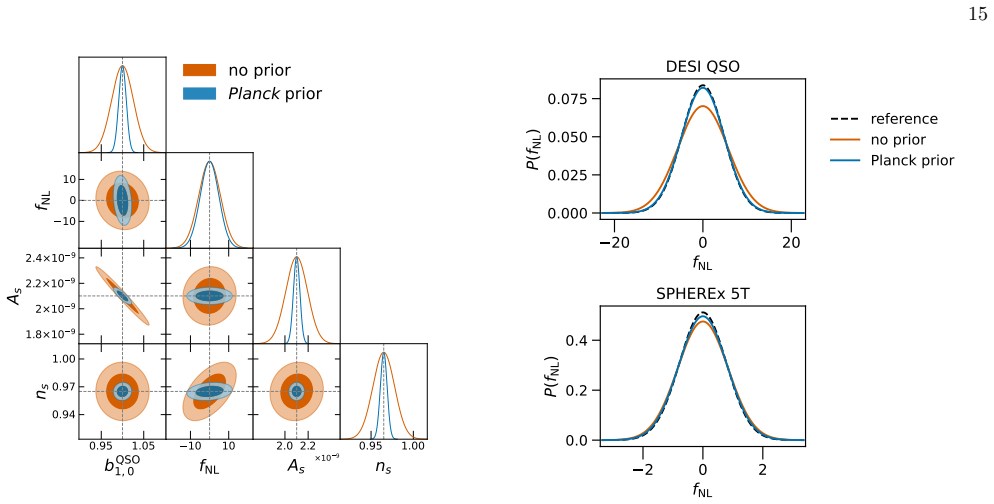
- [Fig. 2; §III; Fig. 17] Fig. 2 caption and §III: Fisher–MCMC agreement is shown only for DESI QSO under Newtonian modeling. A one-sentence note on whether similar agreement holds for the more non-Gaussian b_ϕ–f_NL posteriors (Fig. 17) would be useful, even if nested sampling is used there for that reason.
- [Table III; §IV A 1; §III C 3] Table III vs inference runs: baseline Fisher uses k_max=0.08 h/Mpc and full redshift ranges, while inference uses k_max=0.06 h/Mpc and z∈[0,2] for SPHEREx. Cross-referencing these choices more prominently when comparing σ(f_NL) numbers would avoid confusion.
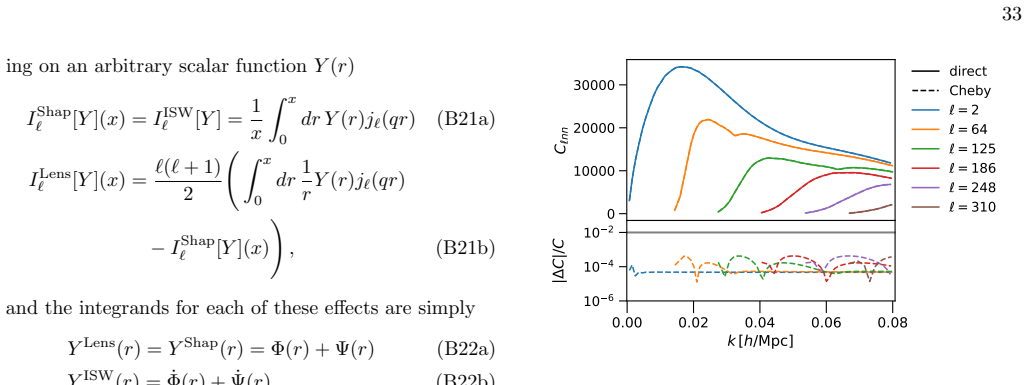
- [Appendix B; Figs. 25–26] Appendix B: the Chebyshev accuracy for GR terms is stated as percent-level (Fig. 26). Given that GR is subdominant, this is adequate, but a short statement of the maximum fractional error on C_ℓnn for the full (density+RSD+GR) spectrum at the scales used in inference would complete the validation.
- [Throughout; Appendix B.4] Typographical: “evoluton bias” (p. 3), “diminsihes” (p. 17), “non-pertubative” (p. 29), and “Implementaion” (Appendix B.4 heading) should be corrected.
- [Fig. 1; §II C; §IV D] Fig. 1 is a helpful summary of the four bias cases; referring back to it when switching between Case 1 (baseline) and Case 3 (§IV D) would improve readability.
Circularity Check
No significant circularity: standard mismatch forecasts and model-conditional claims under externally motivated bias assumptions.
full rationale
This is a forecasting paper. Fiducial cosmology is Planck 2018; tracer n(z), b1, and s are taken from DESI data releases, Euclid/SPHEREx forecast products, or literature measurements (Secs. III C 1–3). The bϕ–be equivalence (Eq. 12) is imported from Sullivan & Seljak and related peak-background-split arguments, not derived from the same likelihood that is later sampled. Case 1 is adopted as a transparent baseline (Fig. 1, Sec. II C), and the paper quantifies sensitivity to s and to alternative bias parametrizations (Fig. 11, Tables V, VII; Sec. IV D). The central scientific results—1–3σ fNL bias when full-GR data vectors are fit with Newtonian models, tracer-dependent GR–PNG degeneracies, multi-tracer Doppler gains, and weak residual bϕ constraints—are obtained from controlled mismatch tests and amplitude forecasts under stated assumptions, not from fitting a parameter and re-labeling a related quantity as a prediction. Self-citations to the authors’ prior SFB methodology papers supply computational infrastructure (kernels, Iso-qr, discrete basis) that is validated against CLASS/angular spectra; they do not force the forecast conclusions by uniqueness theorems or ansatz smuggling. No step reduces a claimed prediction to its own input by construction.
Axiom & Free-Parameter Ledger
free parameters (4)
- Chebyshev coefficients of b1(z), s,0, b_ϕ,0 (or p)
- ϵ_Dopp, ϵ_Lens, ϵ_GP
- f_NL
- SPHEREx magnification bias s
axioms (5)
- domain assumption Linear-order relativistic galaxy number counts (Eq. 2) in conformal Newtonian gauge, ignoring observer terms for ℓ≥2
- domain assumption b_ϕ–be equivalence (Eq. 12) under peak-background split, used as Case 1 baseline
- domain assumption Universality relation b_ϕ = 2δ_c(b1−p) with p=1 (or 1.6 for QSO)
- ad hoc to paper Gaussian likelihood for SFB power spectra + f_sky covariance approximation; noiseless simulated data vectors
- domain assumption Planck 2018 ΛCDM + fixed late-time parameters; linear theory only up to k_max=0.06–0.08 h/Mpc
read the original abstract
The three-dimensional galaxy power spectrum is a powerful probe of primordial non-Gaussianity (PNG) and additional general relativistic (GR) effects on large scales, which can be constrained by current and upcoming large-scale structure surveys. In this work, we forecast the measurability of local PNG and linear-order relativistic effects in the spherical Fourier-Bessel (SFB) power spectrum for DESI, Euclid, and SPHEREx surveys. A Chebyshev-decomposition scheme is employed to accelerate the multi-tracer SFB power-spectrum calculations. Fisher forecasts establish baseline constraints and test the sensitivity of $f_{\rm NL}$ constraints to SFB mode cuts and to the marginalization over primordial cosmological parameters, while simulated Bayesian inference is used to quantify the impact and measurability of relativistic effects. We find that neglecting GR effects can bias $f_{\rm NL}$ constraints at the $1$-$3\sigma$ level for Euclid and SPHEREx. The degeneracy between GR and PNG terms is strongly tracer dependent, with the degradation of $\sigma(f_{\rm NL})$ ranging from a few percent to nearly a factor of two when the GR amplitudes are varied. Lensing can be detected at high significance for several tracers, while multi-tracer analyses substantially improve the measurability of the Doppler term. Assuming GR, we show that relativistic clustering partially breaks the exact $b_\phi f_{\rm NL}$ product degeneracy present in Newtonian linear power-spectrum analyses, although the resulting $b_\phi$ constraints remain weak for the survey configurations considered. The joint PNG-GR inference consistently propagates uncertainty in $b_\phi$ into the marginalized $f_{\rm NL}$ constraint. This firmly establishes the path toward extracting cosmological information from ultra-large-scale galaxy clustering.
Figures





Reference graph
Works this paper leans on
-
[1]
Detectability of GR terms We now explore whether the GR terms themselves can be detected. The results are illustrated in Figs. 12 and 13 for selected tracers and summarized for every sample 0 400 GP 50 0 50 fNL 20 0 20 Dopp 20 0 20 Dopp 50 0 50 fNL ELG ELG+QSO LRG+ELG+QSO Tracer(s) Redshift σ(ϵDopp) σ(ϵGP) ELG [0 .8, 1.6] 11 130 ELG+QSO [0 .8, 1.6] 1 .7 3...
work page 2026
-
[2]
Perturbative approximation We compare the exact radial convolution treatment of redshift error/FoG with the perturbative approximation introduced in Refs. [48, 49]. We review the derivation of the perturbative method and then discuss the comple- mentarity of the two approaches. We first demonstrate how the redshift-error operator defined in Eqs. A1 and A6...
-
[3]
Motivation In the SFB PS computation of Eqs. 16 and 17, the main computational bottleneck lies in filling the SFB ker- nel Wnℓ(q), which involves radial integrals over spherical Bessel functions. Ref. [49] proposed the Iso-qr integration method for constructing the SFB kernels under Newto- nian RSD, which was later extended to include GR effects in Ref. [...
-
[4]
Chebyshev polynomials The Chebyshev polynomials are defined as Tn(cos θ) = cos(nθ), (B1) or, equivalently, by the recursion relation T0(t) = 1, T1(t) = t, Tn+1(t) = 2t Tn(t) − Tn−1(t). (B2) They form a complete and orthonormal basis over the interval [ −1, 1], and are widely used in approximation theory due to their favorable convergence properties and ne...
work page 2000
-
[5]
2 (exclud- ing observer terms)
Decomposing angular kernels We summarize the angular kernels ∆ ℓ(x, q) corre- sponding to all linear-order GR effects in Eq. 2 (exclud- ing observer terms). Following Refs. [17, 41, 46], these kernels are ∆ℓ(x, q)PNG = fNLbϕ(x) α(q, x) Dm(x, q)jℓ(qx) (B9a) ∆ℓ(x, q)DRSD = b1(x)Dm(x, q)jℓ(qx) + q H(x) v(x, q)j′′ ℓ (qx) (B9b) ∆ℓ(x, q)Doppler = A1(x)v(x, q)j′...
-
[6]
B16 and B24, only a few coefficients are needed because the functions in Eqs
Implementaion For the Chebyshev decompositions in Eqs. B16 and B24, only a few coefficients are needed because the functions in Eqs. B11 and B23 are smooth (see Fig. 24 as an example). We also require the bias parametriza- tion in Sec. III D to have fewer degrees of freedom than the Chebyshev expansion orders used here. For the non- integrated terms, we t...
-
[7]
To precompute the SFB kernel templates, we still use the Iso-qr integration scheme described in Refs
As a result, we use 25 templates for the non-integrated terms (including leading-order FoG) and 32 templates for the integrated terms. To precompute the SFB kernel templates, we still use the Iso-qr integration scheme described in Refs. [41, 49]. Computing the full template set can take tens of minutes 34 on a single CPU. These templates can then be store...
-
[8]
DESI Collaboration, JCAP 2025, 017 (2025), arXiv:2411.12020 [astro-ph.CO]
work page internal anchor Pith review Pith/arXiv arXiv 2025
- [9]
- [10]
-
[11]
Acoustic Signatures in the Primary Microwave Background Bispectrum
E. Komatsu and D. N. Spergel, Phys. Rev. D 63, 063002 (2001), arXiv:astro-ph/0005036 [astro-ph]
work page internal anchor Pith review Pith/arXiv arXiv 2001
-
[12]
Primordial Non-Gaussianities from Inflation Models
X. Chen, Advances in Astronomy 2010, 638979 (2010), arXiv:1002.1416 [astro-ph.CO]
work page internal anchor Pith review Pith/arXiv arXiv 2010
-
[13]
The Effective Field Theory of Multifield Inflation
L. Senatore and M. Zaldarriaga, Journal of High Energy Physics 2012, 24 (2012), arXiv:1009.2093 [hep-th]
work page internal anchor Pith review Pith/arXiv arXiv 2012
-
[14]
Testing Inflation with Large Scale Structure: Connecting Hopes with Reality
M. Alvarez, T. Baldauf, J. R. Bond, et al. , arXiv e- prints , arXiv:1412.4671 (2014), arXiv:1412.4671 [astro- ph.CO]
work page internal anchor Pith review Pith/arXiv arXiv 2014
-
[15]
Non-Gaussian features of primordial fluctuations in single field inflationary models
J. Maldacena, Journal of High Energy Physics 2003, 013 (2003), arXiv:astro-ph/0210603 [astro-ph]
work page internal anchor Pith review Pith/arXiv arXiv 2003
-
[16]
Single field consistency relation for the 3-point function
P. Creminelli and M. Zaldarriaga, JCAP 2004, 006 (2004), arXiv:astro-ph/0407059 [astro-ph]
work page internal anchor Pith review Pith/arXiv arXiv 2004
-
[17]
N. Dalal, O. Dore, D. Huterer, and A. Shirokov, Phys. Rev. D 77, 123514 (2008), arXiv:0710.4560 [astro-ph]
work page internal anchor Pith review Pith/arXiv arXiv 2008
-
[18]
Constraints on local primordial non-Gaussianity from large scale structure
A. Slosar, C. Hirata, U. Seljak, et al. , JCAP 2008, 031 (2008), arXiv:0805.3580 [astro-ph]
work page internal anchor Pith review Pith/arXiv arXiv 2008
-
[19]
The effect of primordial non-Gaussianity on halo bias
S. Matarrese and L. Verde, Astrophys. J. Lett. 677, L77 (2008), arXiv:0801.4826 [astro-ph]
work page internal anchor Pith review Pith/arXiv arXiv 2008
- [20]
-
[21]
A. J. S. Hamilton, in The Evolving Universe , Astro- physics and Space Science Library, Vol. 231, edited by D. Hamilton (1998) p. 185, arXiv:astro-ph/9708102 [astro-ph]
work page internal anchor Pith review Pith/arXiv arXiv 1998
-
[22]
J. Yoo, A. L. Fitzpatrick, and M. Zaldarriaga, Phys. Rev. D 80, 083514 (2009), arXiv:0907.0707 [astro- ph.CO]
work page internal anchor Pith review Pith/arXiv arXiv 2009
-
[23]
The linear power spectrum of observed source number counts
A. Challinor and A. Lewis, Phys. Rev. D 84, 043516 (2011), arXiv:1105.5292 [astro-ph.CO]
work page internal anchor Pith review Pith/arXiv arXiv 2011
-
[24]
What galaxy surveys really measure
C. Bonvin and R. Durrer, Phys. Rev. D 84, 063505 (2011), arXiv:1105.5280 [astro-ph.CO]
work page internal anchor Pith review Pith/arXiv arXiv 2011
-
[25]
Large-scale clustering of galaxies in general relativity
D. Jeong, F. Schmidt, and C. M. Hirata, Phys. Rev. D 85, 023504 (2012), arXiv:1107.5427 [astro-ph.CO]
work page internal anchor Pith review Pith/arXiv arXiv 2012
-
[26]
Wide-angle and relativistic effects in Fourier-space clustering statistics
M. Noorikuhani and R. Scoccimarro, Phys. Rev. D 107, 083528 (2023), arXiv:2207.12383 [astro-ph.CO]
work page internal anchor Pith review Pith/arXiv arXiv 2023
-
[27]
Large Scale Limit of the Observed Galaxy Power Spectrum
M. Foglieni, M. Pantiri, E. Di Dio, and E. Castorina, Phys. Rev. Lett. 131, 111201 (2023), arXiv:2303.03142 [astro-ph.CO]
work page internal anchor Pith review Pith/arXiv arXiv 2023
-
[28]
Ultra large-scale cosmology in next-generation experiments with single tracers
D. Alonso, P. Bull, P. G. Ferreira, et al. , Astrophys. J. 814, 145 (2015), arXiv:1505.07596 [astro-ph.CO]
work page internal anchor Pith review Pith/arXiv arXiv 2015
-
[29]
Constraining ultra large-scale cosmology with multiple tracers in optical and radio surveys
D. Alonso and P. G. Ferreira, Phys. Rev. D 92, 063525 (2015), arXiv:1507.03550 [astro-ph.CO]
work page internal anchor Pith review Pith/arXiv arXiv 2015
-
[30]
Observational signatures of modified gravity on ultra-large scales
T. Baker and P. Bull, Astrophys. J. 811, 116 (2015), arXiv:1506.00641 [astro-ph.CO]
work page internal anchor Pith review Pith/arXiv arXiv 2015
- [31]
-
[32]
D. S. Blanco and C. Bonvin, Phys. Rev. D 104, 063516 (2021), arXiv:2102.05086 [astro-ph.CO]
work page internal anchor Pith review Pith/arXiv arXiv 2021
-
[33]
Measuring the distortion of time with relativistic effects in large-scale structure
D. Sobral Blanco and C. Bonvin, Mon. Not. R. As- tron. Soc. 519, L39 (2023), arXiv:2205.02567 [astro- ph.CO]
work page internal anchor Pith review Pith/arXiv arXiv 2023
-
[34]
Disentangling modified gravity from a dark force with gravitational redshift
S. Castello, Z. Wang, L. Dam, et al., Phys. Rev. D 110, 103523 (2024), arXiv:2404.09379 [astro-ph.CO]
work page internal anchor Pith review Pith/arXiv arXiv 2024
-
[35]
S. Castello, Z. Zheng, C. Bonvin, and L. Amendola, Phys. Rev. D 111, 123559 (2025), arXiv:2412.08627 [astro-ph.CO]
work page internal anchor Pith review Pith/arXiv arXiv 2025
-
[36]
D. S. Blanco, C. Bonvin, C. Clarkson, and R. Maartens, JCAP 2024, 029 (2024), arXiv:2406.19908 [astro- ph.CO]
work page internal anchor Pith review Pith/arXiv arXiv 2024
-
[37]
J. M. Sullivan and U. Seljak, Phys. Rev. D 112, 083522 (2025), arXiv:2503.21736 [astro-ph.CO]
work page internal anchor Pith review Pith/arXiv arXiv 2025
-
[38]
Estimating non-gaussian bias using counts of tracers
N. Dalal and W. J. Percival, JCAP 2026, 037 (2026), 35 arXiv:2503.21024 [astro-ph.CO]
work page internal anchor Pith review Pith/arXiv arXiv 2026
-
[39]
On the impact of galaxy bias uncertainties on primordial non-Gaussianity constraints
A. Barreira, JCAP 2020, 031 (2020), arXiv:2009.06622 [astro-ph.CO]
work page internal anchor Pith review Pith/arXiv arXiv 2020
-
[40]
A. Barreira, JCAP 2022, 013 (2022), arXiv:2205.05673 [astro-ph.CO]
work page internal anchor Pith review Pith/arXiv arXiv 2022
-
[41]
J. M. Sullivan, T. Prijon, and U. Seljak, JCAP 2023, 004 (2023), arXiv:2303.08901 [astro-ph.CO]
work page internal anchor Pith review Pith/arXiv arXiv 2023
-
[42]
Towards optimal and robust $f_{\rm NL}$ constraints with multi-tracer analyses
A. Barreira and E. Krause, JCAP 2023, 044 (2023), arXiv:2302.09066 [astro-ph.CO]
work page internal anchor Pith review Pith/arXiv arXiv 2023
-
[43]
O. Lahav, Spherical harmonic reconstruction of cos- mic density and velocity fields (1993), arXiv:astro- ph/9309030 [astro-ph]
- [44]
-
[45]
A. F. Heavens and A. N. Taylor, Mon. Not. R. As- tron. Soc. 275, 483 (1995), arXiv:astro-ph/9409027 [astro-ph]
work page internal anchor Pith review Pith/arXiv arXiv 1995
-
[46]
All-Sky Analysis of the General Relativistic Galaxy Power Spectrum
J. Yoo and V. Desjacques, Phys. Rev. D 88, 023502 (2013), arXiv:1301.4501 [astro-ph.CO]
work page internal anchor Pith review Pith/arXiv arXiv 2013
-
[47]
The full-sky Spherical Fourier-Bessel power spectrum in general relativity
F. Semenzato, D. Bertacca, and A. Raccanelli, Phys. Rev. D 111, 023522 (2025), arXiv:2406.09545 [astro- ph.CO]
work page internal anchor Pith review Pith/arXiv arXiv 2025
-
[48]
R. Y. Wen, H. S. Grasshorn Gebhardt, C. Hein- rich, and O. Dor´ e, Phys. Rev. D 110, 123501 (2024), arXiv:2407.02753 [astro-ph.CO]
work page internal anchor Pith review Pith/arXiv arXiv 2024
-
[49]
V. Tansella, C. Bonvin, R. Durrer, et al. , JCAP 2018, 019 (2018), arXiv:1708.00492 [astro-ph.CO]
work page internal anchor Pith review Pith/arXiv arXiv 2018
-
[50]
The observed galaxy power spectrum in General Relativity
E. Castorina and E. Di Dio, JCAP 2022, 061 (2022), arXiv:2106.08857 [astro-ph.CO]
work page internal anchor Pith review Pith/arXiv arXiv 2022
-
[51]
S. Bruton, J. R. Cheshire, O. Dor´ e,et al., arxiv (2026), arXiv:2605.10935 [astro-ph.CO]
work page internal anchor Pith review Pith/arXiv arXiv 2026
-
[52]
D. Blas, J. Lesgourgues, and T. Tram, JCAP 2011, 034 (2011), arXiv:1104.2933 [astro-ph.CO]
work page internal anchor Pith review Pith/arXiv arXiv 2011
-
[53]
The CLASSgal code for Relativistic Cosmological Large Scale Structure
E. Di Dio, F. Montanari, J. Lesgourgues, and R. Dur- rer, JCAP 2013, 044 (2013), arXiv:1307.1459 [astro- ph.CO]
work page internal anchor Pith review Pith/arXiv arXiv 2013
-
[54]
Proper Fourier decomposition formalism for cosmological fields in spherical shells
L. Samushia, arXiv e-prints , arXiv:1906.05866 (2019), arXiv:1906.05866 [astro-ph.CO]
work page internal anchor Pith review Pith/arXiv arXiv 1906
-
[55]
H. S. Grasshorn Gebhardt and O. Dor´ e, Phys. Rev. D 104, 123548 (2021), arXiv:2102.10079 [astro-ph.CO]
work page internal anchor Pith review Pith/arXiv arXiv 2021
-
[56]
H. S. Grasshorn Gebhardt and O. Dor´ e, Phys. Rev. D 109, 083502 (2024), arXiv:2310.17677 [astro-ph.IM]
work page internal anchor Pith review Pith/arXiv arXiv 2024
-
[57]
Integral constraints in spectroscopic surveys
A. de Mattia and V. Ruhlmann-Kleider, JCAP 2019, 036 (2019), arXiv:1904.08851 [astro-ph.CO]
work page internal anchor Pith review Pith/arXiv arXiv 2019
-
[58]
Planck 2018 results. VI. Cosmological parameters
Planck Collaboration VI, Astron. Astrophys. 641, A6 (2020), arXiv:1807.06209
work page internal anchor Pith review Pith/arXiv arXiv 2020
- [59]
-
[60]
Galaxy Power Spectrum in General Relativity
N. Grimm, F. Scaccabarozzi, J. Yoo, et al., JCAP 2020, 064 (2020), arXiv:2005.06484 [astro-ph.CO]
work page internal anchor Pith review Pith/arXiv arXiv 2020
-
[61]
Galaxy Two-Point Correlation Function in General Relativity
F. Scaccabarozzi, J. Yoo, and S. G. Biern, JCAP 2018, 024 (2018), arXiv:1807.09796 [astro-ph.CO]
work page internal anchor Pith review Pith/arXiv arXiv 2018
-
[62]
Y. B. Ginat, V. Desjacques, D. Jeong, and F. Schmidt, JCAP 2021, 031 (2021), arXiv:2106.15139 [astro- ph.CO]
work page internal anchor Pith review Pith/arXiv arXiv 2021
-
[63]
On the kinematic cosmic dipole tension
C. Dalang and C. Bonvin, Mon. Not. R. Astron. Soc. 512, 3895 (2022), arXiv:2111.03616 [astro-ph.CO]
work page internal anchor Pith review Pith/arXiv arXiv 2022
-
[64]
Magnification bias in galaxy surveys with complex sample selection functions
M. von Wietersheim-Kramsta, B. Joachimi, J. L. van den Busch, et al. , Mon. Not. R. Astron. Soc. 504, 1452 (2021), arXiv:2101.05261 [astro-ph.CO]
work page internal anchor Pith review Pith/arXiv arXiv 2021
-
[65]
Constraining primordial non-Gaussianity from DESI quasar targets and Planck CMB lensing
A. Krolewski, W. J. Percival, S. Ferraro, et al. , JCAP 2024, 021 (2024), arXiv:2305.07650 [astro-ph.CO]
work page internal anchor Pith review Pith/arXiv arXiv 2024
-
[66]
Euclid preparation: XIX. Impact of magnification on photometric galaxy clustering
Euclid Collaboration, F. Lepori, I. Tutusaus, et al. , Astron. Astrophys. 662, A93 (2022), arXiv:2110.05435 [astro-ph.CO]
work page internal anchor Pith review Pith/arXiv arXiv 2022
-
[67]
J. Elvin-Poole, N. MacCrann, S. Everett, et al. , Mon. Not. R. Astron. Soc. 523, 3649 (2023), arXiv:2209.09782 [astro-ph.CO]
work page internal anchor Pith review Pith/arXiv arXiv 2023
-
[68]
R. Zhou, S. Ferraro, M. White, et al. , JCAP 2023, 097 (2023), arXiv:2309.06443 [astro-ph.CO]
work page internal anchor Pith review Pith/arXiv arXiv 2023
-
[69]
Magnification Bias Estimators for Realistic Surveys: an Application to the BOSS Survey
L. Wenzl, S.-F. Chen, and R. Bean, Mon. Not. R. As- tron. Soc. 527, 1760 (2024), arXiv:2308.05892 [astro- ph.CO]
work page internal anchor Pith review Pith/arXiv arXiv 2024
-
[70]
Magnification and evolution biases in large-scale structure surveys
R. Maartens, J. Fonseca, S. Camera, et al., JCAP 2021, 009 (2021), arXiv:2107.13401 [astro-ph.CO]
work page internal anchor Pith review Pith/arXiv arXiv 2021
-
[71]
M. S. Wang, F. Beutler, and D. Bacon, Mon. Not. R. As- tron. Soc. 499, 2598 (2020), arXiv:2007.01802 [astro- ph.CO]
work page internal anchor Pith review Pith/arXiv arXiv 2020
-
[72]
N. Palanque-Delabrouille, C. Magneville, C. Y` eche, et al. , Astron. Astrophys. 587, A41 (2016), arXiv:1509.05607 [astro-ph.CO]
work page internal anchor Pith review Pith/arXiv arXiv 2016
-
[73]
B. Friedman-Shaw, A. Krolewski, M. Foglieni, and N. Afshordi, JCAP 2025, 059 (2025), arXiv:2410.04705 [astro-ph.CO]
work page internal anchor Pith review Pith/arXiv arXiv 2025
-
[74]
D. W. Hogg, I. K. Baldry, M. R. Blanton, and D. J. Eisenstein, arXiv e-prints , astro-ph/0210394 (2002), arXiv:astro-ph/0210394 [astro-ph]
work page internal anchor Pith review Pith/arXiv arXiv 2002
-
[75]
Primordial non-Gaussianity: large-scale structure signature in the perturbative bias model
P. McDonald, Phys. Rev. D 78, 123519 (2008), arXiv:0806.1061 [astro-ph]
work page internal anchor Pith review Pith/arXiv arXiv 2008
-
[76]
Galaxy Bias and Primordial Non-Gaussianity
V. Assassi, D. Baumann, and F. Schmidt, JCAP 2015, 043 (2015), arXiv:1510.03723 [astro-ph.CO]
work page internal anchor Pith review Pith/arXiv arXiv 2015
-
[77]
Non-local bias in the halo bispectrum with primordial non-Gaussianity
M. Tellarini, A. J. Ross, G. Tasinato, and D. Wands, JCAP 2015, 004 (2015), arXiv:1504.00324 [astro- ph.CO]
work page internal anchor Pith review Pith/arXiv arXiv 2015
-
[78]
Constraints on Multi-Field Inflation from the BOSS Galaxy Survey
G. Cabass, M. M. Ivanov, O. H. E. Philcox, et al., Phys. Rev. D 106, 043506 (2022), arXiv:2204.01781 [astro- ph.CO]
work page internal anchor Pith review Pith/arXiv arXiv 2022
-
[79]
A. Chudaykin, M. M. Ivanov, and O. H. E. Philcox, arXiv e-prints , arXiv:2512.04266 (2025), arXiv:2512.04266 [astro-ph.CO]
-
[80]
M. Rezaie, A. J. Ross, H.-J. Seo, et al., Mon. Not. R. As- tron. Soc. 532, 1902 (2024), arXiv:2307.01753 [astro- ph.CO]
work page internal anchor Pith review Pith/arXiv arXiv 1902
discussion (0)
Sign in with ORCID, Apple, or X to comment. Anyone can read and Pith papers without signing in.