REVIEW 2 major objections 6 minor 68 references
SWIFT: A Small-World Interaction Framework for Flow-Aware Trajectory Prediction in Autonomous Driving
T0 review · 2 major / 6 minor · reviewed 2026-07-14 · grok-4.5
Pith's one-line read Trajectory prediction improves when agent interactions are built from small-world network structure and traffic-flow regimes instead of pure data-driven proximity.
desk verdict Solid engineering paper: classical small-world + three-phase priors turned into a hybrid graph that actually moves the numbers on three public benchmarks. read the letter →
The pith
A machine-rendered reading of the paper's core claim, the machinery that carries it, and where it could break.
The reading
What carries the argument
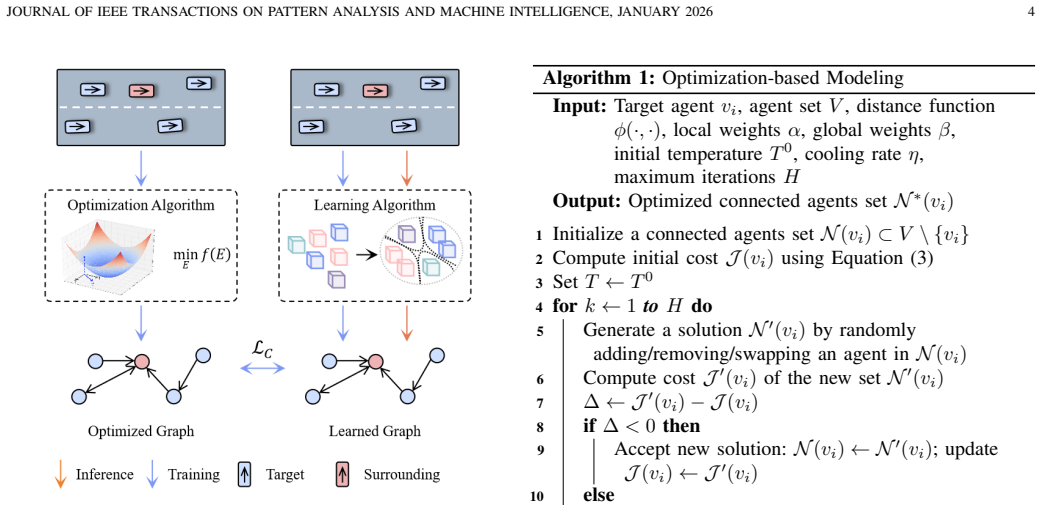
The Small-World Interaction Network: a hybrid optimization-plus-learning procedure that constructs a directed interaction graph by minimizing a connection-cost plus isolation-cost objective (Eq. 3), then trains a differentiable edge predictor to inherit those small-world edges; the graph parameters are further modulated by a Flow Regime Encoder derived from Optimal-Velocity-Model stability conditions.
What would settle it
Train and test on the same NGSIM split after replacing the small-world optimization target with ordinary k-nearest-neighbor edges (or after randomly shuffling the regime labels); if the accuracy, noise-robustness and cross-location gains disappear, the structural priors are not doing the claimed work.
Extended reading notes
Core claim
Embedding small-world topology and traffic-flow regimes as explicit inductive biases yields a trajectory predictor that systematically outperforms purely data-driven interaction models on accuracy, cross-location generalization, noise robustness, and sample efficiency across highway, urban, and campus scenes.
Load-bearing premise
That the hand-crafted cost minimized by simulated annealing produces a trustworthy ground-truth interaction graph that can supervise the learned edges, and that the three OVM-derived flow regimes can be labeled accurately enough from scene statistics to train the regime encoder.
Editorial analysis
A structured set of objections, weighed in public.
Referee Report
Summary. The paper proposes SWIFT, a trajectory-prediction framework that injects structural inductive biases from small-world network theory and three-phase traffic flow theory into interaction modeling. It constructs agent interaction graphs via a hybrid Simulated-Annealing / learned Small-World Interaction Network (Eqs. 2–12, Alg. 1), modulates graph parameters (α, β, γ) with a Flow Regime Encoder grounded in an OVM linear-stability analysis (Theorem 2, Definitions 1–3), and aggregates direct, co-influenced, and co-influencing relations through multi-channel graph convolutions (Defs. 4–6, Eqs. 76–83). Multimodal trajectories are decoded with static map, dynamic interaction, and hybrid attention/Mamba stages. On nuScenes, MoCAD, and NGSIM the model reports consistent gains over strong baselines in accuracy, plus improved sample efficiency (60% data), noise robustness, and cross-location transfer (I-80 ↔ US-101), supported by component ablations and qualitative case studies.
Significance. If the reported gains hold under independent reimplementation, the work is a solid contribution to structure-aware trajectory prediction: it couples a network-science prior (small-world connectivity) with a traffic-theoretic regime model, rather than relying solely on proximity or attention. Strengths that should be credited include (i) explicit finite-iteration SA guarantees (Theorem 1) and a full linear-stability derivation of free/synchronized/congested regimes (Theorem 2 + Lemma 1), (ii) multi-dataset evaluation spanning urban, campus, and highway regimes with complementary metrics, and (iii) non-accuracy axes—sample efficiency (Table IV), observation noise (Table V), and cross-location transfer (Tables VI–VII)—plus ablations of FRE/SWIN, fusion, φ, and loss weights. These go beyond typical accuracy-only papers and make the structure-aware claim falsifiable. The result is of clear interest to autonomous-driving prediction and to graph-based multi-agent forecasting more broadly.
major comments (2)
- Section III-D and IV-A4 define the regime loss Lb as cross-entropy against a one-hot ground-truth label yreg, and Section IV-A1 reports precise regime fractions (e.g., NGSIM free-flow 90.48%). The manuscript never states the concrete labeling procedure that maps raw scene statistics (density, speed, spacing) to {f,s,c} labels, nor how the unobserved OVM sensitivity a and V'(s0) in Definitions 1–3 are estimated or thresholded in practice. Without this, FRE and Lb are not reproducible and the claimed flow-aware adaptation cannot be independently verified. Please specify the labeling rule (features, thresholds or classifier, and any calibration of a) used to produce yreg on each dataset.
- Tables I–III and the generalization/robustness tables report single point estimates with no multi-seed means/stds or statistical tests. Given that several absolute gains are modest (e.g., nuScenes minADE5 1.24→1.15; NGSIM 1 s where BAT remains better at 0.23 vs 0.34), multi-run variance is needed to support the claim of consistent outperformance across regimes. Please add at least seed-averaged results (mean ± std) for the main tables, or a significance test against the strongest baseline per dataset.
minor comments (6)
- Theorem 1 restates a standard high-probability bound on the SA stationary distribution; the |S_ε| factor is typically large and the bound is not tight. A short remark that this is a formal guarantee of the optimization scheme rather than a practical mixing-time result would set expectations correctly.
- Eq. (11)–(12): the roles of α, β in the learned edge construction versus the SA objective (Eq. 3) are easy to conflate. Clarify whether the FRE-predicted α, β are the same scalars used in both the SA cost and the MLP fusion, or only the latter at inference.
- Implementation: map-free MoCAD/NGSIM substitutes road features with interaction features (IV-A3). State this substitution more prominently in the trajectory-generation section so readers do not assume HD-map inputs on those benchmarks.
- Fig. 6 color scale is described as normalized minADE1 but absolute ranges and the exact normalization are not given; adding a colorbar legend with numeric range would help.
- Typographical: “W AKE” appears with a space in Table I and text; unify to “WAKE”. “arXiv:2607.09741v1 [cs.RO] 3 Jul 2026” in the header is a future date—confirm metadata.
- Related work on small-world traffic (e.g., NEST, cited as [30]) is brief; a sentence contrasting SWIFT’s hybrid SA+learning graph with purely neuromodulated hypergraph designs would sharpen novelty.
Circularity Check
No significant circularity: SA-derived Eop and OVM regime labels are independent structural priors, not restatements of the trajectory objective; end-to-end gains are measured on external public benchmarks.
full rationale
The derivation chain is self-contained. Structural Graph Optimization (Alg. 1, Eq. 3) minimizes a hand-crafted connection+isolation cost J(vi) that depends only on inter-agent distances ϕ; the resulting Eop supervises Ele via binary cross-entropy Lc (Eq. 99) but is never defined from future trajectories or La. Theorem 2 and Definitions 1–3 derive free/synchronized/congested regimes from the classical OVM linear-stability criterion V'(s0)<a/2; Lb is ordinary cross-entropy to those scene-statistic labels and does not recycle trajectory error. Multi-relational matrices Mp/Mi/Mt and the hybrid decoder are ordinary GNN/attention modules. All reported gains (Tables I–VII, X) are end-to-end minADE/RMSE against public ground-truth trajectories on nuScenes/MoCAD/NGSIM, with ablations that remove FRE/SWIN still leaving residual performance. Self-citations (WAKE, BAT, HLTP, NEST, GaVa) appear only as baselines or related work and are not invoked as uniqueness theorems that force the architecture. The residual score of 1 reflects only the ordinary supervised-learning loop that any graph-regularized predictor exhibits; nothing reduces a claimed prediction to its own inputs by construction.
Assumptions & free parameters
free parameters (5)
- loss weights λa, λb, λc =
1.0 / 0.3–0.5 / 0.3–0.5
- connection-cost exponent φ =
3
- local/global weights α, β and threshold γ =
regime-dependent intervals [0.3–0.9]
- SA temperature schedule T0, η, H
- number of trajectory modes K
assumptions (4)
- domain assumption Real traffic networks exhibit small-world properties (high clustering, short path lengths).
- domain assumption Three-phase traffic theory (free / synchronized / congested) correctly partitions interaction regimes.
- domain assumption The Optimal Velocity Model linearization yields a valid stability criterion V'(s0)<a/2.
- ad hoc to paper Simulated Annealing with geometric cooling produces a sufficiently accurate approximation of the global minimizer of J(vi).
invented entities (3)
-
Small-World Interaction Network (hybrid SA + learned edge set)
-
Flow Regime Encoder
-
Co-Influenced and Co-Influencing adjacency matrices Mi, Mt
Cite this review
Pith. "Pith review of SWIFT: A Small-World Interaction Framework for Flow-Aware Trajectory Prediction in Autonomous Driving." pith.science (2026). https://pith.science/paper/SI47LWM6
@misc{pith2026260709741,
  author       = {Pith},
  title        = {Pith review of: SWIFT: A Small-World Interaction Framework for Flow-Aware Trajectory Prediction in Autonomous Driving},
  year         = {2026},
  howpublished = {\url{https://pith.science/paper/SI47LWM6}},
  note         = {Machine review of arXiv:2607.09741}
}
read the original abstract
Accurate trajectory prediction in autonomous driving hinges on modeling dynamic and context-dependent interactions among traffic agents. However, most existing approaches are purely data-driven and lack structural priors, which limits their generalization under distribution shifts. In this work, interaction modeling is revisited through the structure and dynamics of traffic networks, and SWIFT (Small-World Interaction Framework for Trajectory prediction) is proposed as a unified framework that integrates small-world networks with traffic flow theory. SWIFT introduces structural inductive biases via a Small-World Interaction Network that captures both local and global dependencies, and a Flow Regime Encoder that adapts the interaction structure to scene-level traffic states. Interaction reasoning is further enhanced through a multi-relational graph module that explicitly encodes direct and higher-order agent relationships. Extensive experiments on three real-world datasets, nuScenes, MoCAD, and NGSIM, show that SWIFT consistently outperforms strong baselines in prediction accuracy across diverse traffic regimes. Beyond accuracy, SWIFT exhibits improved generalization to unseen locations and regimes, robustness under noisy observations, and strong performance with limited training data, supporting the effectiveness of its structure-aware design.
Figures


Figures from the paper (5 more)


Reference graph
Works this paper leans on
-
[1]
Smemo: social memory for trajectory forecasting,
F. Marchetti, F. Becattini, L. Seidenari, and A. Del Bimbo, “Smemo: social memory for trajectory forecasting,” IEEE Transactions on Pattern Analysis and Machine Intelligence, vol. 46, no. 6, pp. 4410–4425, 2024
2024
-
[2]
Modality exploration, retrieval and adaptation for trajectory prediction,
J. Sun, Y . Li, L. Chai, and C. Lu, “Modality exploration, retrieval and adaptation for trajectory prediction,” IEEE Transactions on Pattern Analysis and Machine Intelligence , vol. 45, no. 12, pp. 15 051–15 064, 2023
2023
-
[3]
Decoupling motion forecasting into directional intentions and dynamic states,
B. Zhang, N. Song, and L. Zhang, “Decoupling motion forecasting into directional intentions and dynamic states,” NIPS, 2024
2024
-
[4]
End-point drive and reverse enhanced decoding-based traffic participants trajectory prediction under bird’s eye view,
C. Liu, J. Xie, F. Chang, T. Li, S. Li, and Y . Wang, “End-point drive and reverse enhanced decoding-based traffic participants trajectory prediction under bird’s eye view,”IEEE Transactions on Intelligent Transportation Systems, 2025
2025
-
[5]
Sa-tp: A safety-aware trajectory prediction and planning model for autonomous driving,
H. Liao, Z. Li, K. Zhu, K. Li, and C. Xu, “Sa-tp: A safety-aware trajectory prediction and planning model for autonomous driving,” IEEE Transactions on Robotics , 2025
2025
-
[6]
Social force embedded mixed graph convolutional network for multi-class trajectory prediction,
Q. Du, X. Wang, S. Yin, L. Li, and H. Ning, “Social force embedded mixed graph convolutional network for multi-class trajectory prediction,” IEEE Transactions on Intelligent Vehicles , 2024
2024
-
[7]
Heterogeneous graph social pooling for interaction-aware vehicle trajectory prediction,
X. Mo, Y . Xing, and C. Lv, “Heterogeneous graph social pooling for interaction-aware vehicle trajectory prediction,”Transportation Research Part E: Logistics and Transportation Review, vol. 191, p. 103748, 2024
2024
-
[8]
Diversity of information pathways drives sparsity in real-world networks,
A. Ghavasieh and M. De Domenico, “Diversity of information pathways drives sparsity in real-world networks,” Nature Physics, vol. 20, no. 3, pp. 512–519, 2024
2024
Show all 68 references
-
[9]
B. S. Kerner, Introduction to modern traffic flow theory and control: the long road to three-phase traffic theory . Springer Science & Business Media, 2009
2009
-
[10]
Three-phase traffic theory and highway capacity,
——, “Three-phase traffic theory and highway capacity,” Physica A: Statistical Mechanics and its Applications , vol. 333, pp. 379–440, 2004
2004
-
[11]
Attention-aware social graph transformer networks for stochastic trajectory prediction,
Y . Liu, B. Li, X. Wang, C. Sammut, and L. Yao, “Attention-aware social graph transformer networks for stochastic trajectory prediction,” IEEE Transactions on Knowledge and Data Engineering , 2024
2024
-
[12]
Intention- aware vehicle trajectory prediction based on spatial-temporal dynamic attention network for internet of vehicles,
X. Chen, H. Zhang, F. Zhao, Y . Hu, C. Tan, and J. Yang, “Intention- aware vehicle trajectory prediction based on spatial-temporal dynamic attention network for internet of vehicles,” IEEE Transactions on Intel- ligent Transportation Systems, vol. 23, no. 10, pp. 19 471–19 483, 2022
2022
-
[13]
Helbing, Social self-organization: Agent-based simulations and ex- periments to study emergent social behavior
D. Helbing, Social self-organization: Agent-based simulations and ex- periments to study emergent social behavior . Springer, 2012
2012
-
[14]
Dstigcn: Deformable spatial- temporal interaction graph convolution network for pedestrian trajectory prediction,
W. Chen, H. Sang, J. Wang, and Z. Zhao, “Dstigcn: Deformable spatial- temporal interaction graph convolution network for pedestrian trajectory prediction,” IEEE Transactions on Intelligent Transportation Systems , 2025
2025
-
[15]
Mtp-go: Graph- based probabilistic multi-agent trajectory prediction with neural odes,
T. Westny, J. Oskarsson, B. Olofsson, and E. Frisk, “Mtp-go: Graph- based probabilistic multi-agent trajectory prediction with neural odes,” IEEE Transactions on Intelligent Vehicles , 2023
2023
-
[16]
Us highway 101 dataset,
G. SIMulation, “Us highway 101 dataset,” 2007
2007
-
[17]
Hi-scl: Fighting long-tailed challenges in trajectory prediction with hierarchical wave-semantic contrastive learning,
Z. Lan, Y . Ren, H. Yu, L. Liu, Z. Li, Y . Wang, and Z. Cui, “Hi-scl: Fighting long-tailed challenges in trajectory prediction with hierarchical wave-semantic contrastive learning,” Transportation Research Part C: Emerging Technologies, vol. 165, p. 104735, 2024
2024
-
[18]
Physics- informed trajectory prediction for autonomous driving under missing observation,
H. Liao, C. Wang, Z. Li, Y . Li, B. Wang, G. Li, and C. Xu, “Physics- informed trajectory prediction for autonomous driving under missing observation,” International Joint Conference On Artificial Intelligence , 2024
2024
-
[19]
Social lstm: Human trajectory prediction in crowded spaces,
A. Alahi, K. Goel, V . Ramanathan, A. Robicquet, L. Fei-Fei, and S. Savarese, “Social lstm: Human trajectory prediction in crowded spaces,” in Proceedings of the IEEE conference on computer vision and pattern recognition, 2016, pp. 961–971
2016
-
[20]
A cognitive-based trajectory prediction approach for autonomous driving,
H. Liao, Y . Li, Z. Li, C. Wang, Z. Cui, S. E. Li, and C. Xu, “A cognitive-based trajectory prediction approach for autonomous driving,” IEEE Transactions on Intelligent Vehicles , 2024
2024
-
[21]
Multimodal trajectory prediction conditioned on lane-graph traversals,
N. Deo, E. Wolff, and O. Beijbom, “Multimodal trajectory prediction conditioned on lane-graph traversals,” in Conference on Robot Learning. PMLR, 2022, pp. 203–212
2022
-
[22]
Q-eanet: Implicit social modeling for trajectory prediction via experience-anchored queries,
J. Chen, Z. Wang, J. Wang, and B. Cai, “Q-eanet: Implicit social modeling for trajectory prediction via experience-anchored queries,” IET Intelligent Transport Systems, vol. 18, no. 6, pp. 1004–1015, 2024
2024
-
[23]
Toward human-like trajec- tory prediction for autonomous driving: A behavior-centric approach,
H. Liao, Z. Li, G. Zhang, K. Li, and C. Xu, “Toward human-like trajec- tory prediction for autonomous driving: A behavior-centric approach,” Transportation Science, 2025
2025
-
[24]
Nettraj: A network-based vehicle trajectory prediction model with directional representation and spatiotemporal attention mechanisms,
Y . Liang and Z. Zhao, “Nettraj: A network-based vehicle trajectory prediction model with directional representation and spatiotemporal attention mechanisms,” IEEE Transactions on Intelligent Transportation Systems, vol. 23, no. 9, pp. 14 470–14 481, 2021
2021
-
[25]
Collective dynamics of ‘small- world’networks,
D. J. Watts and S. H. Strogatz, “Collective dynamics of ‘small- world’networks,”nature, vol. 393, no. 6684, pp. 440–442, 1998
1998
-
[26]
Cultural and opinion dynamics in small-world “social
Y . Lee, “Cultural and opinion dynamics in small-world “social” net- works,” The Journal of Mathematical Sociology , pp. 1–26, 2024
2024
-
[27]
Navigation in a small world,
J. M. Kleinberg, “Navigation in a small world,” Nature, vol. 406, no. 6798, pp. 845–845, 2000
2000
-
[28]
Electric vehicle charging planning: A complex systems perspective,
A. P. Zhao, S. Li, Z. Li, Z. Wang, X. Fei, Z. Hu, M. Alhazmi, X. Yan, C. Wu, S. Lu et al. , “Electric vehicle charging planning: A complex systems perspective,” IEEE Transactions on Smart Grid , 2024
2024
-
[29]
A shockwave profile model for traffic flow on congested urban arterials,
X. Wu and H. X. Liu, “A shockwave profile model for traffic flow on congested urban arterials,” Transportation Research Part B: Method- ological, vol. 45, no. 10, pp. 1768–1786, 2011
2011
-
[30]
Nest: A neuromodulated small-world hypergraph trajectory prediction model for autonomous driving,
C. Wang, H. Liao, B. Wang, Y . Guan, B. Rao, Z. Pu, Z. Cui, C.-Z. Xu, and Z. Li, “Nest: A neuromodulated small-world hypergraph trajectory prediction model for autonomous driving,” in Proceedings of the AAAI Conference on Artificial Intelligence, vol. 39, no. 1, 2025, pp. 808–816
2025
-
[31]
Bat: Behavior-aware human-like trajectory prediction for autonomous driv- ing,
H. Liao, Z. Li, H. Shen, W. Zeng, D. Liao, G. Li, and C. Xu, “Bat: Behavior-aware human-like trajectory prediction for autonomous driv- ing,” in Proceedings of the AAAI Conference on Artificial Intelligence , vol. 38, 2024, pp. 10 332–10 340
2024
-
[32]
Hivt: Hierarchical vector transformer for multi-agent motion prediction,
Z. Zhou, L. Ye, J. Wang, K. Wu, and K. Lu, “Hivt: Hierarchical vector transformer for multi-agent motion prediction,” in Proceedings of the IEEE/CVF Conference on Computer Vision and Pattern Recognition , 2022, pp. 8823–8833
2022
-
[33]
Small-world formation via local information,
S. Alamdari, “Small-world formation via local information,” arXiv preprint arXiv:2301.00849, 2023
2023 arXiv
-
[34]
The physics of traffic,
B. S. Kerner, “The physics of traffic,” Physics world , vol. 12, no. 8, p. 25, 1999
1999
-
[35]
Dynamical model of traffic congestion and numerical simulation,
M. Bando, K. Hasebe, A. Nakayama, A. Shibata, and Y . Sugiyama, “Dynamical model of traffic congestion and numerical simulation,” Physical review E , vol. 51, no. 2, p. 1035, 1995
1995
-
[36]
Analysis of optimal velocity model with explicit delay,
M. Bando, K. Hasebe, K. Nakanishi, and A. Nakayama, “Analysis of optimal velocity model with explicit delay,” Physical Review E, vol. 58, no. 5, p. 5429, 1998
1998
-
[37]
Speed or spacing? cumulative variables, and convolution of model errors and time in traffic flow models valida- tion and calibration,
V . Punzo and M. Montanino, “Speed or spacing? cumulative variables, and convolution of model errors and time in traffic flow models valida- tion and calibration,” Transportation Research Part B: Methodological , vol. 91, pp. 21–33, 2016
2016
-
[38]
Fourier transforms and the fast fourier transform (fft) algorithm,
P. Heckbert, “Fourier transforms and the fast fourier transform (fft) algorithm,” Computer Graphics, vol. 2, no. 1995, pp. 15–463, 1995
1995
-
[39]
Car-following models: fifty years of linear stability analysis–a mathematical perspective,
R. E. Wilson and J. A. Ward, “Car-following models: fifty years of linear stability analysis–a mathematical perspective,” Transportation Planning and Technology, vol. 34, no. 1, pp. 3–18, 2011
2011
-
[40]
Mechanisms for spatio-temporal pattern formation in highway traffic models,
R. E. Wilson, “Mechanisms for spatio-temporal pattern formation in highway traffic models,”Philosophical Transactions of the Royal Society A: Mathematical, Physical and Engineering Sciences, vol. 366, no. 1872, pp. 2017–2032, 2008
2017
-
[41]
Coherent moving states in highway traffic,
D. Helbing and B. A. Huberman, “Coherent moving states in highway traffic,” Nature, vol. 396, no. 6713, pp. 738–740, 1998
1998
-
[42]
An extension of parseval’s theorem and its use in calculating transient energy in the frequency domain,
S. Kelkar, L. Grigsby, and J. Langsner, “An extension of parseval’s theorem and its use in calculating transient energy in the frequency domain,” IEEE Transactions on Industrial Electronics , no. 1, pp. 42– 45, 2007
2007
-
[43]
Directed graph convolutional network,
Z. Tong, Y . Liang, C. Sun, D. S. Rosenblum, and A. Lim, “Directed graph convolutional network,” arXiv preprint arXiv:2004.13970 , 2020
2004 arXiv
-
[44]
nuscenes: A multimodal dataset for autonomous driving,
H. Caesar, V . Bankiti, A. H. Lang, S. V ora, V . E. Liong, Q. Xu, A. Krishnan, Y . Pan, G. Baldan, and O. Beijbom, “nuscenes: A multimodal dataset for autonomous driving,” in Proceedings of the IEEE/CVF conference on computer vision and pattern recognition, 2020, pp. 11 621–11 631
2020
-
[45]
Ngsim—next generation simulation,
U. D. of Transportation, “Ngsim—next generation simulation,” 2008
2008
-
[46]
Wake: Towards robust and physically feasible trajectory prediction for autonomous vehicles with wavelet and kinematics synergy,
C. Wang, H. Liao, Z. Li, and C. Xu, “Wake: Towards robust and physically feasible trajectory prediction for autonomous vehicles with wavelet and kinematics synergy,”IEEE Transactions on Pattern Analysis and Machine Intelligence , 2025
2025
-
[47]
Trajectron++: Dynamically-feasible trajectory forecasting with heterogeneous data,
T. Salzmann, B. Ivanovic, P. Chakravarty, and M. Pavone, “Trajectron++: Dynamically-feasible trajectory forecasting with heterogeneous data,” in Computer Vision–ECCV 2020: 16th European Conference, Glasgow, UK, August 23–28, 2020, Proceedings, Part XVIII 16 . Springer, 2020, p...
2020
-
[48]
Multipath: Multiple probabilistic anchor trajectory hypotheses for behavior prediction,
Y . Chai, B. Sapp, M. Bansal, and D. Anguelov, “Multipath: Multiple probabilistic anchor trajectory hypotheses for behavior prediction,” in Conference on Robot Learning . PMLR, 2020, pp. 86–99
2020
-
[49]
Agentformer: Agent-aware transformers for socio-temporal multi-agent forecasting,
Y . Yuan, X. Weng, Y . Ou, and K. Kitani, “Agentformer: Agent-aware transformers for socio-temporal multi-agent forecasting,” 2021. JOURNAL OF IEEE TRANSACTIONS ON PATTERN ANALYSIS AND MACHINE INTELLIGENCE, JANUARY 2026 16
2021
-
[50]
Lapred: Lane-aware prediction of multi-modal future trajectories of dynamic agents,
B. Kim, S. H. Park, S. Lee, E. Khoshimjonov, D. Kum, J. Kim, J. S. Kim, and J. W. Choi, “Lapred: Lane-aware prediction of multi-modal future trajectories of dynamic agents,” in CVPR, 2021, pp. 14 636–14 645
2021
-
[51]
Stgm: Vehicle trajectory prediction based on generative model for spatial-temporal features,
Z. Zhong, Y . Luo, and W. Liang, “Stgm: Vehicle trajectory prediction based on generative model for spatial-temporal features,” IEEE Transac- tions on Intelligent Transportation Systems , vol. 23, no. 10, pp. 18 785– 18 793, 2022
2022
-
[52]
Gohome: Graph-oriented heatmap output for future motion estimation,
T. Gilles, S. Sabatini, D. Tsishkou, B. Stanciulescu, and F. Moutarde, “Gohome: Graph-oriented heatmap output for future motion estimation,” in ICRA. IEEE, 2022, pp. 9107–9114
2022
-
[53]
Context-aware timewise vaes for real-time vehicle trajectory prediction,
P. Xu, J.-B. Hayet, and I. Karamouzas, “Context-aware timewise vaes for real-time vehicle trajectory prediction,” IEEE Robotics and Automation Letters, 2023
2023
-
[54]
Emsin: Enhanced multi-stream interaction network for vehicle trajectory prediction,
Y . Ren, Z. Lan, L. Liu, and H. Yu, “Emsin: Enhanced multi-stream interaction network for vehicle trajectory prediction,” IEEE Transactions on Fuzzy Systems , 2024
2024
-
[55]
Cot-drive: Efficient motion forecasting for autonomous driving with llms and chain-of-thought prompting,
H. Liao, H. Kong, B. Wang, C. Wang, W. Ye, Z. He, C. Xu, and Z. Li, “Cot-drive: Efficient motion forecasting for autonomous driving with llms and chain-of-thought prompting,” IEEE Transactions on Artificial Intelligence, 2025
2025
-
[56]
Seflow: A self-supervised scene flow method in autonomous driving,
Q. Zhang, Y . Yang, P. Li, O. Andersson, and P. Jensfelt, “Seflow: A self-supervised scene flow method in autonomous driving,” in European Conference on Computer Vision . Springer, 2024, pp. 353–369
2024
-
[57]
Social gan: Socially acceptable trajectories with generative adversarial networks,
A. Gupta, J. Johnson, L. Fei-Fei, S. Savarese, and A. Alahi, “Social gan: Socially acceptable trajectories with generative adversarial networks,” in CVPR, 2018, pp. 2255–2264
2018
-
[58]
Convolutional social pooling for vehicle tra- jectory prediction,
N. Deo and M. M. Trivedi, “Convolutional social pooling for vehicle tra- jectory prediction,” in Proceedings of the IEEE conference on computer vision and pattern recognition workshops , 2018, pp. 1468–1476
2018
-
[59]
Non-local social pooling for vehicle trajectory prediction,
K. Messaoud, I. Yahiaoui, A. Verroust-Blondet, and F. Nashashibi, “Non-local social pooling for vehicle trajectory prediction,” in 2019 IEEE Intelligent Vehicles Symposium (IV) . IEEE, 2019, pp. 975–980
2019
-
[60]
Attention based vehicle trajectory prediction,
——, “Attention based vehicle trajectory prediction,” IEEE Transactions on Intelligent Vehicles, vol. 6, no. 1, pp. 175–185, 2021
2021
-
[61]
Congestion-aware multi-agent trajectory prediction for collision avoidance,
X. Xie, C. Zhang, Y . Zhu, Y . N. Wu, and S.-C. Zhu, “Congestion-aware multi-agent trajectory prediction for collision avoidance,” inICRA, 2021
2021
-
[62]
Wsip: wave superposition inspired pooling for dynamic interactions-aware trajectory prediction,
R. Wang, S. Wang, H. Yan, and X. Wang, “Wsip: wave superposition inspired pooling for dynamic interactions-aware trajectory prediction,” in AAAI, vol. 37, 2023, pp. 4685–4692
2023
-
[63]
Multi-agent tensor fusion for contextual trajectory prediction,
T. Zhao, Y . Xu, M. Monfort, W. Choi, C. Baker, Y . Zhao, Y . Wang, and Y . N. Wu, “Multi-agent tensor fusion for contextual trajectory prediction,” in Proceedings of the IEEE/CVF Conference on Computer Vision and Pattern Recognition , 2019, pp. 12 126–12 134
2019
-
[64]
Vehicle trajec- tory prediction based on intention-aware non-autoregressive transformer with multi-attention learning for internet of vehicles,
X. Chen, H. Zhang, F. Zhao, Y . Cai, H. Wang, and Q. Ye, “Vehicle trajec- tory prediction based on intention-aware non-autoregressive transformer with multi-attention learning for internet of vehicles,”IEEE Transactions on Instrumentation and Measurement , vol. 71, pp. 1–12, 2022
2022
-
[65]
Trajectory prediction network of autonomous vehicles with fusion of historical interactive features,
Z. Zuo, X. Wang, S. Guo, Z. Liu, Z. Li, and Y . Wang, “Trajectory prediction network of autonomous vehicles with fusion of historical interactive features,” IEEE Transactions on Intelligent Vehicles , 2023
2023
-
[66]
Dacr-amtp: Adaptive multi-modal vehicle trajectory prediction for dynamic drivable areas based on collision risk,
P. Cong, Y . Xiao, X. Wan, M. Deng, J. Li, and X. Zhang, “Dacr-amtp: Adaptive multi-modal vehicle trajectory prediction for dynamic drivable areas based on collision risk,” IEEE Transactions on Intelligent Vehicles, 2023
2023
-
[67]
Human observation-inspired trajectory prediction for autonomous driving in mixed-autonomy traffic environments,
H. Liao, S. Liu, Y . Li, Z. Li, C. Wang, Y . Li, S. E. Li, and C. Xu, “Human observation-inspired trajectory prediction for autonomous driving in mixed-autonomy traffic environments,” in ICRA. IEEE, 2024, pp. 14 212–14 219
2024
-
[68]
Estimating or propagating gradients through stochastic neurons for conditional computation,
Y . Bengio, N. L ´eonard, and A. Courville, “Estimating or propagating gradients through stochastic neurons for conditional computation,” arXiv preprint arXiv:1308.3432, 2013. Chengyue Wang is currently pursuing a Ph.D. degree at the State Key Laboratory of Internet of Things ...
2013 arXiv
Reviewed July 14, 2026 · model on record in the stance chip above.
Discussion (0). Sign in to comment.