REVIEW 2 major objections 5 minor 299 references
A single Walk-on-Cubes Monte Carlo scheme solves nonisotropic fractional Laplace, Yukawa, and Helmholtz equations by sampling cube exits of an independent-component stable process.
Reviewed by Pith at T0; open to challenge. T0 means a machine referee read the full paper against a public rubric. the ladder, T0–T4 →
T0 review · grok-4.5
2026-07-14 11:02 UTC pith:AAQORQ2R
load-bearing objection Solid, usable Monte Carlo package for the coordinate-sum fractional operator; the math is clean and the numerics match the theory under the stated gauge conditions. the 2 major comments →
Walk-on-Cubes Monte Carlo Simulation for nonisotropic fractional Laplace, Helmholtz, and Yukawa equations
The pith
A machine-rendered reading of the paper's core claim, the machinery that carries it, and where it could break.
Core claim
The nonisotropic fractional Dirichlet problem A^α_x u − λu = 0 is solved by a Walk-on-Cubes Monte Carlo algorithm that uses the exit law of a rectilinear symmetric α-stable Lévy process. For λ > 0 the Yukawa equation is reduced by a Duffin correspondence to a pure fractional Laplace equation in one higher dimension; for λ < 0 the Helmholtz equation is recovered by Feynman–Kac reweighting with the accumulated cube-exit time, under the spectral gauge condition −λ < λ_1(D).
What carries the argument
Walk-on-Cubes (WoC): at each interior point the algorithm takes the largest axis-aligned cube of radius equal to the L^∞ distance to the exterior, draws a precomputed unit-cube exit (position and time), and rescales by the self-similarity X_ct =^d c^{1/α} X_t; regime-dependent payoffs then apply either the Duffin cosine factor or the Feynman–Kac exponential.
Load-bearing premise
In the Helmholtz regime the method needs both that the discrete accumulated cube-exit time converges to the true exit time and that the growth rate stays below the principal eigenvalue of the domain; those spectral and geometric assumptions are imported rather than re-proved for every domain used in the numerics.
What would settle it
Run the one-dimensional Helmholtz manufactured solution cos(kx) with |λ| / λ_1(D) increased past 1 and check whether the Monte Carlo mean and variance remain finite and match the exact cosine; blow-up or systematic bias would refute the gauge claim.
If this is right
- Laplace, Yukawa and Helmholtz fractional problems with independent-component operators can share one precomputed jump pool and one parallel GPU kernel.
- Principal eigenvalues of rectilinear stable processes become practical diagnostic quantities obtainable from the same WoC survival curves used for Helmholtz solves.
- Curvilinear and multiply-connected domains are handled without body-fitted meshes by measuring only L^∞ distance to the exterior.
- Heavy-tailed exit locations force exterior data to grow slowly enough for the Monte Carlo second moment to stay finite.
Where Pith is reading between the lines
- The same cube-exit pool could be reused for other coordinate-sum nonlocal operators whose generators factor into independent one-dimensional Lévy processes.
- Near-critical Helmholtz runs will need branching or importance sampling once the single-particle Feynman–Kac weight ceases to have finite variance.
- The method supplies a cheap surrogate for classical FEM on domains with re-entrant corners where mesh generation is expensive.
- Tabulated Green-function benchmarks for the resolvent of the coordinate-sum operator may serve as standard tests for other nonisotropic fractional solvers.
Editorial analysis
A structured set of objections, weighed in public.
Referee Report
Summary. The paper studies the nonisotropic fractional operator A^α_x = ∑_i −(−Δ_{x_i})^{α/2} and the associated exterior Dirichlet problems A^α_x u − λu = 0 for Laplace (λ=0), Yukawa (λ>0) and Helmholtz (λ<0). It proves a Duffin correspondence that lifts the Yukawa problem to a pure fractional Laplace problem in one extra dimension (Theorem 2.1), shows that a spatial Duffin lift fails for Helmholtz because of the heavy-tailed kernel, and replaces it by a Feynman–Kac representation with exponential weight e^{κ τ_D} under the gauge condition −λ < λ_1(D). Existence and the survival-tail characterisation of the principal eigenvalue λ_1(D) are established for the killed rectilinear α-stable process (Proposition 3.1). The constructive contribution is a Walk-on-Cubes Monte Carlo algorithm that samples precomputed unit-cube exits of the i.i.d.-component symmetric α-stable process, rescales them by self-similarity, and applies regime-dependent payoffs (oscillatory Duffin factor for Yukawa, exponential reweighting for Helmholtz). Numerical validation includes manufactured Green-function benchmarks, a 1-D Helmholtz Fourier-mode test, survival-tail eigenvalue diagnostics, and several 2-D/3-D geometric examples.
Significance. The work supplies a coherent probabilistic and algorithmic framework for a relatively under-studied nonisotropic fractional operator. The Duffin correspondence for Yukawa and the careful obstruction argument for Helmholtz are clean and useful; the survival-tail estimator for λ_1(D) is a practical tool that makes the gauge condition checkable. The Walk-on-Cubes construction with a precomputed jump pool is well adapted to GPU parallelism and extends the classical walk-on-spheres idea to the rectilinear stable setting. Strengths include explicit Fourier-symbol derivations, a unified algorithmic presentation, and extensive numerical checks (Green benchmarks, Monte-Carlo and jump-pool convergence, eigenvalue regression). If the exit-time approximation and gauge hypotheses hold for the domains of interest, the method offers a practical Monte Carlo solver for nonisotropic fractional Laplace/Helmholtz/Yukawa problems that is hard to obtain by standard mesh-based methods.
major comments (2)
- Section 3.3 and Proposition 3.2 claim that the discrete WoC accumulated time τ_ϵ converges in distribution to the true exit time τ_D as ϵ→0 (and N→∞). The argument invokes self-similarity and the strong Markov property together with “appropriate regularity conditions on the boundary and the fractional Poisson kernel” imported from Chen–Hu–Zhao [7], but no precise statement or proof of the limit is given for the domains used later (disk, spherical shell, missing-octant cube, doubly-connected square). Because the Helmholtz estimator reweights by exp(−λ τ_total), this convergence is load-bearing for bias control; a short rigorous justification or a clear statement of the geometric hypotheses under which it holds is needed.
- Proposition 3.1 assumes that D belongs to the geometric class for which the killed rectilinear stable process is irreducible and has a strictly positive Dirichlet transition density (citing [7]). The numerical examples include non-convex and multiply-connected domains (Cases 1–4) for which this class membership is not verified. Since the principal-eigenvalue existence, simplicity, and the survival-tail formula (3.7)–(3.8) rest on that assumption, and since the Helmholtz gauge condition is checked via the same survival profiler, the paper should either confirm that the cited theory covers these domains or restrict the Helmholtz claims to domains where the hypotheses are known to hold.
minor comments (5)
- The abstract and introduction emphasise Helmholtz and Yukawa, yet a substantial part of the numerical section (Cases 1–4) treats pure Laplace problems (λ=0). A brief remark clarifying that these serve as geometric stress tests of the common cube-exit kernel would improve balance.
- Notation for the operator switches between A^α_x and L^α = −A^α; a single consistent convention (or an explicit dictionary early in Section 3) would reduce cognitive load.
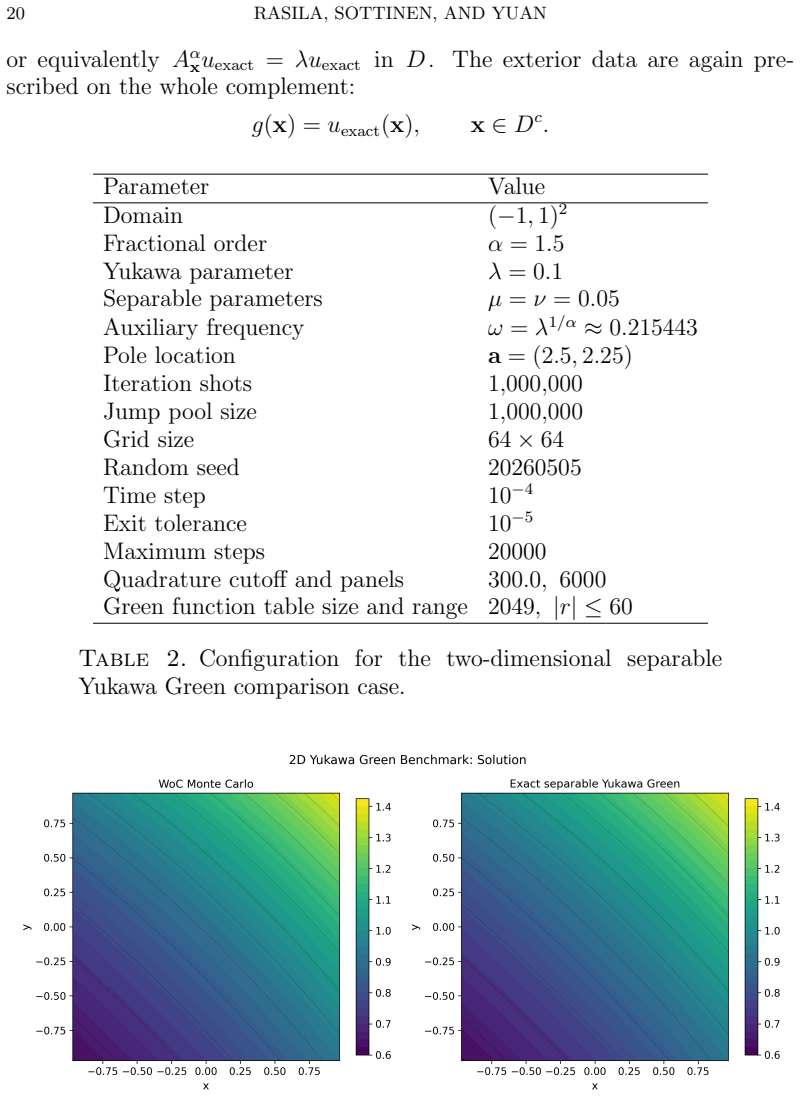
- Figures 1–4 and 9–12 are informative but lack quantitative colour bars or error-scale legends in the text description; adding them (or stating the colour-map ranges) would make the visual claims self-contained.
- The CMS sampling formulae (4.5)–(4.6) are standard; a one-line reference to the original Chambers–Mallows–Stuck paper is already present, but a short remark on numerical stability for α close to 0 or 2 would help practitioners.
- Typographical consistency: “Lévy” appears both with and without the accent; “Walk-on-Cubes” is sometimes abbreviated WoC without prior definition in the abstract.
Circularity Check
No significant circularity: representations follow from the Lévy generator, Fourier symbol, and classical potential theory; self-citations are background only.
full rationale
The core claims are not forced by definition, fitting, or self-citation chains. The nonisotropic operator A^α_x is defined as the sum of independent 1-D fractional Laplacians (Eq. 1.1–1.2), so the associated process is the rectilinear α-stable Lévy process by the Lévy–Khintchine formula; the exit representation u(x)=E_x[g(X_τ)] is the standard Kakutani formula for that generator. The Duffin correspondence (Theorem 2.1) is an elementary product calculation once the 1-D eigenfunction cos(λ^{1/α} y) is obtained from the Fourier symbol |ω|^α=λ (Proposition 2.1, derived directly). For Helmholtz the paper correctly discards spatial lifting (integral divergence for exponential modes) and invokes the classical Feynman–Kac formula under the gauge condition −λ<λ_1(D), whose existence and survival-tail characterization are proved from the killed semigroup (Proposition 3.1, citing external spectral theory). The Walk-on-Cubes rescaling (3.9) is the exact self-similarity of stable processes applied to L^∞ cubes. Manufactured Green-function benchmarks are independent of the Monte-Carlo estimator. Self-citations ([12,17,22,23]) supply only classical Duffin/Walk-on-Spheres background and are not used to justify the fractional nonisotropic constructions or the numerical claims. No parameter is fitted to the target solution and then re-presented as a prediction. Residual soft spots (imported irreducibility from [7], τ_ϵ oτ_D) are openly stated assumptions, not circular reductions. Score 1 reflects only the presence of non-load-bearing self-citations.
Axiom & Free-Parameter Ledger
free parameters (2)
- exit tolerance ϵ
- jump-pool size N_pool and micro-step Δt
axioms (4)
- standard math Fourier symbol of the one-dimensional fractional Laplacian is |ξ|^α (Di Nezza–Palatucci–Valdinoci Prop. 3.3).
- standard math Self-similarity X_{ct} =^d c^{1/α} X_t of symmetric α-stable processes and the strong Markov property.
- domain assumption Killed rectilinear stable process on a bounded domain of the geometric class of Chen–Hu–Zhao [7] admits a strictly positive Dirichlet transition density and a compact positivity-improving semigroup.
- domain assumption Subcritical gauge condition −λ < λ_1(D) guarantees finite exponential moments of the exit time (Chen gaugeability theory).
invented entities (1)
-
Walk-on-Cubes (WoC) algorithm with precomputed unit-cube jump pool
no independent evidence
read the original abstract
We study the nonisotropic fractional analogs of Laplace, Helmholtz and Yukawa equations. We provide a Duffin correspondence for the Yukawa equation and a Feynman--Kac reconstruction for the Helmholtz equation. The foundation of our analysis is the fact that the nonisotropic fractional Laplace equation is related to a symmetric $\alpha$-stable L\'evy process with independent identically distributed components. By using this relation we provide a Walk-on-Cubes algorithm that simulates the solutions of Helmholtz and Yukawa equations.
Figures




Reference graph
Works this paper leans on
-
[1]
Bertoin , L\' e vy processes , vol
J. Bertoin , L\' e vy processes , vol. 121 of Cambridge Tracts in Mathematics, Cambridge University Press, Cambridge, 1996
1996
-
[2]
Bogdan , The boundary H arnack principle for the fractional L aplacian , Studia Mathematica, 123 (1997), pp
K. Bogdan , The boundary H arnack principle for the fractional L aplacian , Studia Mathematica, 123 (1997), pp. 43--80
1997
-
[3]
Bogdan and T
K. Bogdan and T. Byczkowski , Potential theory of S chr \"o dinger operator based on fractional L aplacian , Probability and Mathematical Statistics, 20 (2000), pp. 293--335
2000
-
[4]
Bogdan and P
K. Bogdan and P. Sztonyk , Estimates of the potential kernel and H arnack's inequality for the anisotropic fractional L aplacian , Studia Mathematica, 181 (2007), pp. 101--123
2007
-
[5]
J. M. Chambers, C. L. Mallows, and B. W. Stuck , A method for simulating stable random variables , J. Amer. Statist. Assoc., 71 (1976), pp. 340--344
1976
-
[6]
Chen , Gaugeability and conditional gaugeability , Transactions of the American Mathematical Society, 354 (2002), pp
Z.-Q. Chen , Gaugeability and conditional gaugeability , Transactions of the American Mathematical Society, 354 (2002), pp. 4639--4679
2002
-
[7]
Z.-Q. Chen, E. Hu, and G. Zhao , Dirichlet heat kernel estimates for rectilinear stable processes , Journal of Functional Analysis, 288 (2025), p. 110812
2025
-
[8]
Claus and M
B. Claus and M. Warma , Realization of the fractional L aplacian with nonlocal exterior conditions via forms method , Journal of Evolution Equations, 20 (2020), pp. 1597--1631
2020
-
[9]
Di Nezza, G
E. Di Nezza, G. Palatucci, and E. Valdinoci , Hitchhiker's guide to the fractional S obolev spaces , Bulletin des Sciences Math \'e matiques, 136 (2012), pp. 521--573
2012
-
[10]
R. J. Duffin , Yukawan potential theory , J. Math. Anal. Appl., 35 (1971), pp. 105--130
1971
-
[11]
Dybiec and K
B. Dybiec and K. Szczepaniec , Escape from hypercube driven by multi-variate -stable noises: role of independence , Eur. Phys. J. B, 88 (2015), pp. Art. 184, 8
2015
-
[12]
Q. Han, A. Rasila, and T. Sottinen , Efficient simulation of mixed boundary value problems and conformal mappings , Appl. Math. Comput., 488 (2025), pp. Paper No. 129119, 14
2025
-
[13]
Kwa \'s nicki , Ten equivalent definitions of the fractional L aplace operator , Fractional Calculus and Applied Analysis, 20 (2017), pp
M. Kwa \'s nicki , Ten equivalent definitions of the fractional L aplace operator , Fractional Calculus and Applied Analysis, 20 (2017), pp. 7--51
2017
-
[14]
Kwaśnicki , Eigenvalues of the fractional L aplace operator in the interval , Journal of Functional Analysis, 262 (2012), pp
M. Kwaśnicki , Eigenvalues of the fractional L aplace operator in the interval , Journal of Functional Analysis, 262 (2012), pp. 2379 -- 2402
2012
-
[15]
A. E. Kyprianou, A. Osojnik, and T. Shardlow , Unbiased `walk-on-spheres' M onte C arlo methods for the fractional L aplacian , IMA J. Numer. Anal., 38 (2018), pp. 1550--1578
2018
-
[16]
M. E. Muller , Some continuous M onte carlo methods for the dirichlet problem , Ann. Math. Statist., 27 (1956), pp. 569--589
1956
-
[17]
Rasila and T
A. Rasila and T. Sottinen , Yukawa potential, panharmonic measure and B rownian motion , Axioms, 7 (2018)
2018
-
[18]
Riesz and B
F. Riesz and B. Sz.-Nagy , Functional analysis , Frederick Ungar Publishing Co., New York, 1955. Translated by Leo F. Boron
1955
-
[19]
Ros-Oton and J
X. Ros-Oton and J. Serra , The D irichlet problem for the fractional L aplacian: regularity up to the boundary , Journal de Math \'e matiques Pures et Appliqu \'e es, 101 (2014), pp. 275--302
2014
-
[20]
Sato , L\' e vy processes and infinitely divisible distributions , vol
K.-I. Sato , L\' e vy processes and infinitely divisible distributions , vol. 68 of Cambridge Studies in Advanced Mathematics, Cambridge University Press, Cambridge, 2013. Translated from the 1990 Japanese original, Revised edition of the 1999 English translation
2013
-
[21]
H. H. Schaefer , Banach Lattices and Positive Operators , Springer-Verlag, Berlin, 1974
1974
-
[22]
X. Yang, A. Rasila, and T. Sottinen , Walk on spheres algorithm for H elmholtz and Y ukawa equations via D uffin correspondence , Methodol. Comput. Appl. Probab., 19 (2017), pp. 589--602
2017
-
[23]
height 2pt depth -1.6pt width 23pt, Efficient simulation of the S chr\"odinger equation with a piecewise constant positive potential , Math. Comput. Simulation, 166 (2019), pp. 315--323
2019
-
[24]
, TITLE =
Adler, Robert J. , TITLE =. 1990 , PAGES =
1990
-
[25]
Akhiezer, N. I. and Glazman, I. M. , TITLE =. 1993 , PAGES =
1993
-
[26]
Alili, Larbi , TITLE =. Electron. Comm. Probab. , FJOURNAL =. 2002 , PAGES =. doi:10.1214/ECP.v7-1044 , URL =
-
[27]
Allahviranloo, Tofigh and Esfandiari, Armin , TITLE =. [2022] 2022 , PAGES =. doi:10.1007/978-3-030-85350-1 , URL =
-
[28]
Maleki Almani, H. and Hosseini, S. M. and Tahmasebi, M. , TITLE =. J. Comput. Appl. Math. , FJOURNAL =. 2021 , PAGES =. doi:10.1016/j.cam.2020.113262 , URL =
-
[29]
Multi-Mixed Fractional Brownian Motions and Orstein-Uhlenbeck Processes
Almani, Hamidreza Maleki and Sottinen, Tommi , keywords =. Multi-Mixed Fractional Brownian Motions and Orstein--Uhlenbeck Processes , publisher =. 2021 , copyright =. doi:10.48550/ARXIV.2103.02978 , url =
work page internal anchor Pith review Pith/arXiv arXiv doi:10.48550/arxiv.2103.02978 2021
-
[30]
Stochastic calculus with respect to
Al. Stochastic calculus with respect to. Ann. Probab. , FJOURNAL =. 2001 , NUMBER =. doi:10.1214/aop/1008956692 , URL =
-
[31]
Arcones, Miguel A. , TITLE =. J. Theoret. Probab. , FJOURNAL =. 1995 , NUMBER =. doi:10.1007/BF02410116 , URL =
-
[32]
Aurzada, Frank and Dereich, Steffen , TITLE =. Ann. Probab. , FJOURNAL =. 2009 , NUMBER =. doi:10.1214/09-AOP457 , URL =
-
[33]
Small deviations for a family of smooth
Aurzada, Frank and Gao, Fuchang and K. Small deviations for a family of smooth. J. Theoret. Probab. , FJOURNAL =. 2013 , NUMBER =. doi:10.1007/s10959-011-0380-5 , URL =
-
[34]
Generalized multifractional
Ayache, Antoine and L\'. Generalized multifractional. Fractals: theory and applications in engineering , PAGES =. 1999 , MRCLASS =
1999
-
[35]
Communications in Mathematical Finance , VOLUME =
Azmoodeh, Ehsan , TITLE =. Communications in Mathematical Finance , VOLUME =
-
[36]
Azmoodeh, Ehsan and Campese, Simon and Poly, Guillaume , TITLE =. J. Funct. Anal. , FJOURNAL =. 2014 , NUMBER =. doi:10.1016/j.jfa.2013.10.014 , URL =
-
[37]
Azmoodeh, Ehsan and Malicet, Dominique and Mijoule, Guillaume and Poly, Guillaume , TITLE =. Ann. Probab. , FJOURNAL =. 2016 , NUMBER =. doi:10.1214/14-AOP992 , URL =
-
[38]
Azmoodeh, Ehsan and Mishura, Yuliya and Valkeila, Esko , TITLE =. Statist. Decisions , FJOURNAL =. 2009 , NUMBER =. doi:10.1524/stnd.2009.1021 , URL =
-
[39]
Drift parameter estimation for fractional
Azmoodeh, Ehsan and Morlanes, Jos. Drift parameter estimation for fractional. Statistics , FJOURNAL =. 2015 , NUMBER =. doi:10.1080/02331888.2013.863888 , URL =
-
[40]
Azmoodeh, Ehsan and Sottinen, Tommi and Viitasaari, Lauri , TITLE =. Mod. Stoch. Theory Appl. , FJOURNAL =. 2015 , NUMBER =. doi:10.15559/15-VMSTA24 , URL =
-
[41]
Azmoodeh, Ehsan and Sottinen, Tommi and Viitasaari, Lauri and Yazigi, Adil , TITLE =. Statist. Probab. Lett. , FJOURNAL =. 2014 , PAGES =. doi:10.1016/j.spl.2014.07.030 , URL =
-
[42]
Azmoodeh, Ehsan and Tikanm. When does fractional. Statist. Probab. Lett. , FJOURNAL =. 2010 , NUMBER =. doi:10.1016/j.spl.2010.06.008 , URL =
-
[43]
Azmoodeh, Ehsan and Valkeila, Esko , TITLE =. Stat. Inference Stoch. Process. , FJOURNAL =. 2013 , NUMBER =. doi:10.1007/s11203-013-9079-9 , URL =
-
[44]
Azmoodeh, Ehsan and Viitasaari, Lauri , TITLE =. Stat. Inference Stoch. Process. , FJOURNAL =. 2015 , NUMBER =. doi:10.1007/s11203-014-9111-8 , URL =
-
[45]
Azmoodeh, Ehsan and Viitasaari, Lauri , TITLE =. J. Theoret. Probab. , FJOURNAL =. 2015 , NUMBER =. doi:10.1007/s10959-013-0495-y , URL =
-
[46]
Ba, Demba Bocar , TITLE =. J. Comput. Sci. Appl. Math. , FJOURNAL =. 2021 , NUMBER =. doi:10.37418/jcsam.3.2.2 , URL =
-
[47]
, TITLE =
Balan, Raluca M. , TITLE =. 2001 , PAGES =
2001
-
[48]
Barbour, A. D. , TITLE =. Probab. Theory Related Fields , FJOURNAL =. 1990 , NUMBER =. doi:10.1007/BF01197887 , URL =
-
[49]
2005 , publisher=
An Introduction to Stein's Method , author=. 2005 , publisher=
2005
-
[50]
Barboza, Luis A. and Viens, Frederi G. , TITLE =. Electron. J. Stat. , FJOURNAL =. 2017 , NUMBER =. doi:10.1214/17-EJS1230 , URL =
-
[51]
Bardina, Xavier and Es-Sebaiy, Khalifa , TITLE =. Commun. Stoch. Anal. , FJOURNAL =. 2011 , NUMBER =. doi:10.31390/cosa.5.2.05 , URL =
-
[52]
, title =
Barndorff-Nielsen, Ole E. , title =. Thiele Centre Research Report , number =
-
[53]
and Basse-O'Connor, Andreas , TITLE =
Barndorff-Nielsen, Ole E. and Basse-O'Connor, Andreas , TITLE =. Bernoulli , FJOURNAL =. 2011 , NUMBER =. doi:10.3150/10-BEJ311 , URL =
-
[54]
and Corcuera, J.M
Barndoff-Nielsen, O.E. and Corcuera, J.M. and Podolskij, M. , title =. Stoch. Proc. Appl. , volume =
-
[55]
Barndorff-Nielsen, Ole E. and Pakkanen, Mikko S. and Schmiegel, J. Assessing relative volatility/intermittency/energy dissipation , JOURNAL =. 2014 , NUMBER =. doi:10.1214/14-EJS942 , URL =
-
[56]
Barndorff-Nielsen, Ole E. and Schmiegel, J. Brownian semistationary processes and volatility/intermittency , BOOKTITLE =. 2009 , MRCLASS =. doi:10.1515/9783110213140.1 , URL =
-
[57]
Barndorff-Nielsen, Ole E. and Shephard, Neil , TITLE =. J. R. Stat. Soc. Ser. B Stat. Methodol. , FJOURNAL =. 2001 , NUMBER =. doi:10.1111/1467-9868.00282 , URL =
-
[58]
Bayraktar, Erhan and Pakkanen, Mikko S. and Sayit, Hasanjan , TITLE =. Stoch. Anal. Appl. , FJOURNAL =. 2014 , NUMBER =. doi:10.1080/07362994.2014.858535 , URL =
-
[59]
Beals, Richard and Wong, Roderick , TITLE =. 2010 , PAGES =. doi:10.1017/CBO9780511762543 , URL =
-
[60]
and Es-Sebaiy, K
Belfadli, R. and Es-Sebaiy, K. and Ouknine, Y. , title =. Frontiers in Science and Engineering (An International Journal Edited by Hassan II Academy of Science and Technology) , volume =
-
[61]
1960 , Publisher =
Yu.K. 1960 , Publisher =
1960
-
[62]
Theory Stoch
Bender, Christian and Sottinen, Tommi and Valkeila, Esko , TITLE =. Theory Stoch. Process. , FJOURNAL =. 2007 , NUMBER =
2007
-
[63]
Bender, Christian and Sottinen, Tommi and Valkeila, Esko , TITLE =. Finance Stoch. , FJOURNAL =. 2008 , NUMBER =. doi:10.1007/s00780-008-0074-8 , URL =
-
[64]
Advanced mathematical methods for finance , PAGES =
Bender, Christian and Sottinen, Tommi and Valkeila, Esko , TITLE =. Advanced mathematical methods for finance , PAGES =. 2011 , MRCLASS =. doi:10.1007/978-3-642-18412-3_3 , URL =
-
[65]
, title=
Bertsimas, Dimitris and Kogan, Leonid and Lo, Andrew W. , title=. Journal of Financial Economics , year=2000, volume=
2000
-
[66]
Reproducing kernel
Alain. Reproducing kernel. 2004 , Publisher =
2004
-
[67]
Berman, Simeon M. , TITLE =. Trans. Amer. Math. Soc. , FJOURNAL =. 1969 , PAGES =. doi:10.2307/1995248 , URL =
-
[68]
Berman, Simeon M. , TITLE =. Trans. Amer. Math. Soc. , FJOURNAL =. 1969 , PAGES =. doi:10.2307/1994804 , URL =
-
[69]
Berman, Simeon M. , TITLE =. Ann. Math. Statist. , FJOURNAL =. 1970 , PAGES =. doi:10.1214/aoms/1177696901 , URL =
-
[70]
Berman, Simeon M. , TITLE =. J. Appl. Probability , FJOURNAL =. 1970 , PAGES =. doi:10.1017/s0021900200110666 , URL =
-
[71]
Berman, Simeon M. , TITLE =. Indiana Univ. Math. J. , FJOURNAL =. 1973/74 , PAGES =. doi:10.1512/iumj.1973.23.23006 , URL =
-
[72]
Bertoin, Jean , TITLE =. S\'eminaire de. 1987 , MRCLASS =. doi:10.1007/BFb0077634 , URL =
-
[73]
1996 , PAGES =
Bertoin, Jean , TITLE =. 1996 , PAGES =
1996
-
[74]
Bertsimas, Dimitris and Kogan, Leonid and Lo, Andrew W. , TITLE =. Oper. Res. , FJOURNAL =. 2001 , NUMBER =. doi:10.1287/opre.49.3.372.11218 , URL =
-
[75]
Stochastic calculus for fractional
Biagini, Francesca and Hu, Yaozhong and. Stochastic calculus for fractional. 2008 , PAGES =. doi:10.1007/978-1-84628-797-8 , URL =
-
[76]
Minimal variance hedging for fractional
Biagini, Francesca and. Minimal variance hedging for fractional. Methods Appl. Anal. , FJOURNAL =. 2003 , NUMBER =
2003
-
[77]
Bingham, N. H. and Goldie, C. M. and Teugels, J. L. , TITLE =. 1987 , PAGES =. doi:10.1017/CBO9780511721434 , URL =
-
[78]
Blumenthal, R. M. and Getoor, R. K. and Ray, D. B. , TITLE =. Trans. Amer. Math. Soc. , FJOURNAL =. 1961 , PAGES =. doi:10.2307/1993561 , URL =
-
[79]
Bogachev, Vladimir I. , TITLE =. 1998 , PAGES =. doi:10.1090/surv/062 , URL =
doi:10.1090/surv/062 1998
-
[80]
Studia Mathematica , VOLUME =
Bogdan, Krzysztof , TITLE =. Studia Mathematica , VOLUME =. 1997 , NUMBER =
1997
discussion (0)
Sign in with ORCID, Apple, or X to comment. Anyone can read and Pith papers without signing in.