REVIEW 2 major objections 5 minor 69 references
A hierarchical data structure keeps online proportional sampling efficient even as high-dimensional piecewise partitions explode under smoothed adversaries.
Reviewed by Pith at T0; open to challenge. T0 means a machine referee read the full paper against a public rubric. the ladder, T0–T4 →
T0 review · grok-4.5
2026-07-14 08:00 UTC pith:UZPYIW3Q
load-bearing objection Solid multi-dimensional data structure for smoothed proportional sampling with tight depth bounds and clean no-regret applications; axis-parallel restriction is real but stated clearly. the 2 major comments →
Efficient Online Proportional Sampling with Applications to Smoothed Online Learning
The pith
A machine-rendered reading of the paper's core claim, the machinery that carries it, and where it could break.
Core claim
Under a σ-smoothed adaptive adversary the expected depth of the authors' hierarchical interval-tree data structure is tightly O(sqrt(σ T)); consequently every proportional-sampling operation can be performed in time O(d t^{(d+1)/2}), and the resulting online-learning algorithms achieve sublinear regret for the piecewise-structured rewards that arise in the target applications.
What carries the argument
Lazy Insertion together with scalable cumulative-reward vectors: new hyperplane endpoints are recorded only along the traversal path and deferred contributions are stored as monomial coefficient vectors that can be scaled to any subregion in O(1) time, so the structure never pays the full O(t^d) cascade cost.
Load-bearing premise
All discontinuities must be cut by axis-parallel hyperplanes (or by hyperplanes from a fixed finite set of directions); the full-information analysis further needs new cuts to arrive along only one free direction while the others stay inside a fixed finite menu.
What would settle it
Construct a σ-smooth adaptive sequence of axis-parallel partitions for which the longest increasing subsequence of projected endpoints forces expected tree height ω(sqrt(σ T)); if such a sequence exists the claimed depth bound is false.
Editorial analysis
A structured set of objections, weighed in public.
Referee Report
Summary. The paper studies efficient online proportional sampling over a d-dimensional domain when the weight function is induced by a sequence of piecewise-structured partitions under a σ-smoothed adversary. The central technical contribution is a hierarchical interval-tree data structure with a Lazy Insertion mechanism and parametric (vector-valued) cumulative reward encodings that support insert, update, cumulative-reward, and exact proportional sampling without materializing the naïve O(t^d) atomic regions each round. Under a σ-smoothed adaptive (or oblivious) adversary the authors prove a tight O(√(σT)) bound on tree depth (Theorem 4.2), yielding O(d t^{(d+1)/2}) per-round time (Theorem 4.1); under random-order the depth improves to O(log T). The framework is applied to obtain efficient no-regret implementations of Weighted Majority (full information, piecewise-constant) and EXP3 (bandit, piecewise-linear) with explicit sublinear regret bounds (Theorems 6.1–6.2).
Significance. If the claims hold, the work supplies the first efficient data structure for exact proportional sampling over dynamically refined multi-dimensional piecewise partitions under smoothed adversaries, together with a tight smoothed analysis of hierarchical interval-tree height that is of independent interest (including a tight O(√(σT)) bound for longest increasing subsequence under a smoothed adversary). The resulting efficient WM/EXP3 implementations close a long-standing computational gap left by prior regret analyses of piecewise-structured online learning (Balcan et al., Cohen-Addad–Kanade). The Lazy Insertion + parametric-vector design and the r*-averse reduction are novel technical contributions that should be reusable beyond the present applications.
major comments (2)
- Lemma G.5 states that T requires O(t^d) memory, while the abstract and introduction claim the structure avoids “the cost of explicitly maintaining this exponential growth.” The Lazy Insertion analysis (Section 5, Theorem 4.1) reduces per-round insertion work to a product of heights, but does not appear to reduce asymptotic memory below O(t^d). Please clarify whether memory is truly O(t^d) even with deferred insertions, and if so, discuss the practical implications for moderate-to-large d; otherwise correct the memory bound.
- Theorem 6.1 (full-information) further restricts the adversary so that new endpoints arrive along only one designated direction while the remaining d−1 directions are drawn from a fixed set of size M. This is substantially stronger than the general σ-smooth model of Section 3 and limits applicability to the motivating settings (pricing, contract design, multi-parameter algorithm configuration). The manuscript should state more explicitly how restrictive this is for those applications and whether the restriction is information-theoretic or an artifact of the current exponential-weight scaling argument (Example 3 / Section I.1).
minor comments (5)
- Notation for regular vs. lazy nodes (v-nodes vs. w-nodes) and the multi-index chains ⃗r_{v0,…,wj,…} becomes dense in higher dimensions; a short notation table early in Section 5 would help.
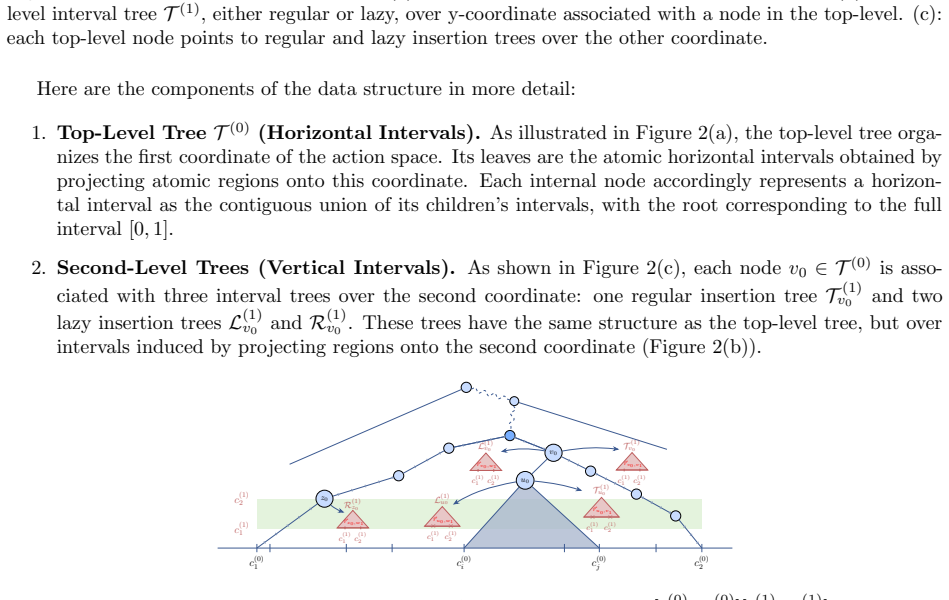
- Figure 3 is helpful for the 2-d lazy/regular insertion idea; a companion schematic for the d-dimensional recursive construction (even a high-level one) would improve readability of Section F.
- The connection to longest increasing subsequence under a smoothed adversary is highlighted as a byproduct of independent interest; a short formal statement of that corollary (with the precise input model) would make the contribution easier to cite.
- In several places “Height(T^{(i)})” is used both for a random variable and for its expectation; making the distinction notationally consistent (e.g., always writing E[Height(·)] when the bound is in expectation) would avoid minor ambiguity.
- Typos / polish: “reward function parameterss” (double s) appears in the update discussion; “action parameter space” is used interchangeably with the domain [0,1]^d—pick one term.
Circularity Check
No circularity: depth, runtime, and regret bounds are derived from first-principles analysis of the r*-averse reduction, Cauchy-Schwarz on record increments, and standard WM/EXP3 under the stated smoothness model.
full rationale
The load-bearing claims (Theorems 4.1–4.2 on O(√(σT)) expected height under adaptive/oblivious σ-smoothed adversaries and the resulting O(d t^{(d+1)/2}) per-round cost; Theorems 6.1–6.2 on sublinear regret for Weighted Majority/EXP3) are obtained by an explicit reduction of tree height to the length of the longest increasing subsequence of endpoints under a monotone r*-averse strategy of shifted uniforms of length 1/σ, followed by a direct application of Cauchy–Schwarz to the sum of record increments whose total length is at most 1, plus a matching lower-bound construction. The same height bound is then multiplied by the number of layers to obtain the runtime of lazy insertion + parametric vector scaling. Regret follows the classical analyses of Weighted Majority and EXP3 once the data structure supplies exact proportional samples. No parameter is fitted to data and then re-used as a “prediction”; no uniqueness theorem or ansatz is imported from the authors’ prior work as a load-bearing premise; the citations to Balcan et al. and Cohen-Addad–Kanade supply only the application setting and the one-dimensional special case, not the multi-dimensional height or runtime proofs. The derivation is therefore self-contained under the explicitly stated axis-parallel (or fixed finite Γ) and one-direction-smoothness assumptions.
Axiom & Free-Parameter Ledger
axioms (4)
- domain assumption A distribution is σ-smooth if its density is pointwise bounded by σ ≥ 1; hyperplanes parallel to each fixed direction are drawn independently from such distributions.
- domain assumption All partition boundaries are axis-parallel hyperplanes (or hyperplanes from a fixed finite set Γ of directions).
- domain assumption Reward functions are piecewise polynomial of fixed degree with a common monomial basis; coefficients may vary by region and round.
- standard math Classical results on binary-search-tree height under random insertion order (Pittel 1984) and Hit-and-Run mixing for log-concave densities (Lovász-Vempala 2007).
invented entities (2)
-
Lazy Insertion mechanism (deferred structural insertion into associated trees)
no independent evidence
-
Parametric / scalable cumulative reward vectors
no independent evidence
read the original abstract
We study the problem of efficient online proportional sampling from a high-dimensional domain under a $\sigma$-smoothed adversary, where the sampling distribution is induced by a dynamically evolving weight function defined over a sequence of piecewise-structured partitions. This setting captures a broad range of applications, including principal-agent games (e.g., pricing and contract design), and algorithm configuration and parameter tuning. The central challenge is maintaining an efficient data structure as the induced partition grows increasingly complex over time -- naively, the number of subregions can grow as $O(t^d)$ by round $t$ in $d$ dimensions. We design a data structure that supports efficient updates and proportional sampling while avoiding the cost of explicitly maintaining this exponential growth, where the discontinuities are structured from axis-parallel hyperplanes. Under a $\sigma$-smoothed adaptive adversary, we prove a tight $O(\sqrt{\sigma T})$ bound on the depth of our data structure, and an $O(\log T)$ bound under a random-order adversary -- to our knowledge, the first such results for this class of problems. We apply this framework to online learning with piecewise-structured rewards, obtaining efficient no-regret algorithms under both full-information and bandit feedback, with provable sublinear regret guarantees.
Figures


Reference graph
Works this paper leans on
-
[3]
New guarantees for learning revenue maximizing menus of lotteries and two-part tariffs
Maria - Florina Balcan and Hedyeh Beyhaghi. New guarantees for learning revenue maximizing menus of lotteries and two-part tariffs. Transactions on Machine Learning Research, 2024. URL https://openreview.net/forum?id=mhawjZcmrJ
2024
-
[4]
Data driven semi-supervised learning
Maria - Florina Balcan and Dravyansh Sharma. Data driven semi-supervised learning. In Marc'Aurelio Ranzato, Alina Beygelzimer, Yann N. Dauphin, Percy Liang, and Jennifer Wortman Vaughan, editors, Advances in Neural Information Processing Systems 34: Annual Conference on Neural Information Processing Systems 2021, NeurIPS 2021, December 6-14, 2021, virtual...
2021
-
[5]
Dispersion for data-driven algorithm design, online learning, and private optimization
Maria-Florina Balcan, Travis Dick, and Ellen Vitercik. Dispersion for data-driven algorithm design, online learning, and private optimization. In 2018 IEEE 59th Annual Symposium on Foundations of Computer Science (FOCS), pages 603--614. IEEE, 2018
2018
-
[6]
Learning to link
Maria - Florina Balcan, Travis Dick, and Manuel Lang. Learning to link. In 8th International Conference on Learning Representations, ICLR 2020, Addis Ababa, Ethiopia, April 26-30, 2020 . OpenReview.net, 2020. URL https://openreview.net/forum?id=S1eRbANtDB
2020
-
[7]
Learning-to-learn non-convex piecewise-lipschitz functions
Maria - Florina Balcan, Mikhail Khodak, Dravyansh Sharma, and Ameet Talwalkar. Learning-to-learn non-convex piecewise-lipschitz functions. In Advances in Neural Information Processing Systems 34: Annual Conference on Neural Information Processing Systems 2021, NeurIPS 2021, December 6-14, 2021, virtual, pages 15056--15069, 2021. URL https://proceedings.ne...
2021
-
[8]
Provably tuning the elasticnet across instances
Maria - Florina Balcan, Misha Khodak, Dravyansh Sharma, and Ameet Talwalkar. Provably tuning the elasticnet across instances. In Sanmi Koyejo, S. Mohamed, A. Agarwal, Danielle Belgrave, K. Cho, and A. Oh, editors, Advances in Neural Information Processing Systems 35: Annual Conference on Neural Information Processing Systems 2022, NeurIPS 2022, New Orlean...
2022
-
[9]
Algorithm configuration for structured pfaffian settings, 2024 a
Maria-Florina Balcan, Anh Tuan Nguyen, and Dravyansh Sharma. Algorithm configuration for structured pfaffian settings, 2024 a . URL https://arxiv.org/abs/2409.04367
Pith/arXiv arXiv 2024
-
[10]
Accelerating ERM for data-driven algorithm design using output-sensitive techniques
Maria - Florina Balcan, Christopher Seiler, and Dravyansh Sharma. Accelerating ERM for data-driven algorithm design using output-sensitive techniques. In Advances in Neural Information Processing Systems 38: Annual Conference on Neural Information Processing Systems 2024, NeurIPS 2024, Vancouver, BC, Canada, December 10 - 15, 2024, 2024 b . URL http://pap...
2024
-
[11]
Avrim Blum and Jason D. Hartline. Near-optimal online auctions. In Proceedings of the Sixteenth Annual ACM-SIAM Symposium on Discrete Algorithms, SODA 2005, Vancouver, British Columbia, Canada, January 23-25, 2005 , pages 1156--1163. SIAM , 2005. URL http://dl.acm.org/citation.cfm?id=1070432.1070597
arXiv 2005
-
[12]
Sampling with unequal probabilities
Ken RW Brewer and Muhammad Hanif. Sampling with unequal probabilities. New York: Springer, 1983
1983
-
[13]
X-armed bandits
S \'e bastien Bubeck, R \'e mi Munos, Gilles Stoltz, and Csaba Szepesv \'a ri. X-armed bandits. Journal of Machine Learning Research, 12 0 (5), 2011
2011
-
[14]
Prediction, Learning, and Games
Nicolo Cesa-Bianchi and Gabor Lugosi. Prediction, Learning, and Games. Cambridge University Press, 2006
2006
-
[15]
Algorithmic chaining and the role of partial feedback in online nonparametric learning
Nicol \`o Cesa-Bianchi, Pierre Gaillard, Claudio Gentile, and S \'e bastien Gerchinovitz. Algorithmic chaining and the role of partial feedback in online nonparametric learning. In Conference on Learning Theory, pages 465--481. PMLR, 2017
2017
-
[16]
Probability Proportional Sampling, pages 5069--5071
Adam Ka Lok Cheung. Probability Proportional Sampling, pages 5069--5071. Springer Netherlands, Dordrecht, 2014. ISBN 978-94-007-0753-5
2014
-
[17]
Sampling techniques
William Gemmell Cochran. Sampling techniques. john wiley & sons, 1977
1977
-
[18]
Online optimization of smoothed piecewise constant functions
Vincent Cohen-Addad and Varun Kanade. Online optimization of smoothed piecewise constant functions. In Artificial Intelligence and Statistics, pages 412--420. PMLR, 2017
2017
-
[19]
Introduction to algorithms
Thomas H Cormen, Charles E Leiserson, Ronald L Rivest, and Clifford Stein. Introduction to algorithms. MIT press, 2022
2022
-
[20]
Haas, and Chris Jermaine
Graham Cormode, Minos Garofalakis, Peter J. Haas, and Chris Jermaine. Synopses for massive data: Samples, histograms, wavelets, sketches. Found. Trends Databases, 4 0 (1--3): 0 1--294, January 2012. ISSN 1931-7883
2012
-
[21]
Computational geometry: algorithms and applications
Mark De Berg. Computational geometry: algorithms and applications. Springer Science & Business Media, 2000
2000
-
[22]
Semi-bandit optimization in the dispersed setting
Travis Dick, Wesley Pegden, and Maria - Florina Balcan. Semi-bandit optimization in the dispersed setting. In Proceedings of the Thirty-Sixth Conference on Uncertainty in Artificial Intelligence, UAI 2020, virtual online, August 3-6, 2020 , volume 124 of Proceedings of Machine Learning Research, pages 909--918. AUAI Press, 2020. URL http://proceedings.mlr...
2020
-
[24]
A pac approach to application-specific algorithm selection
Rishi Gupta and Tim Roughgarden. A pac approach to application-specific algorithm selection. In Proceedings of the 2016 ACM Conference on Innovations in Theoretical Computer Science, pages 123--134, 2016
2016
-
[25]
Smoothed analysis with adaptive adversaries
Nika Haghtalab, Tim Roughgarden, and Abhishek Shetty. Smoothed analysis with adaptive adversaries. Journal of the ACM, 71 0 (3): 0 1--34, 2024
2024
-
[26]
Multidimensional segment trees can do range updates in poly-logarithmic time
Nabil Ibtehaz, M Kaykobad, and M Sohel Rahman. Multidimensional segment trees can do range updates in poly-logarithmic time. Theoretical Computer Science, 854: 0 30--43, 2021
2021
-
[28]
The geometry of logconcave functions and sampling algorithms
L \'a szl \'o Lov \'a sz and Santosh Vempala. The geometry of logconcave functions and sampling algorithms. Random Structures & Algorithms, 30 0 (3): 0 307--358, 2007
2007
-
[29]
Randomized Algorithms
Rajeev Motwani and Prabhakar Raghavan. Randomized Algorithms. Cambridge University Press, 1995
1995
-
[30]
On growing random binary trees
Boris Pittel. On growing random binary trees. Journal of Mathematical Analysis and Applications, 103 0 (2): 0 461--480, 1984
1984
-
[31]
Daniel A. Spielman and Shang - Hua Teng. Smoothed analysis of algorithms: Why the simplex algorithm usually takes polynomial time. CoRR, cs.DS/0111050, 2001. URL https://arxiv.org/abs/cs/0111050
arXiv 2001
-
[32]
Banghua Zhu, Stephen Bates, Zhuoran Yang, Yixin Wang, Jiantao Jiao, and Michael I. Jordan. The sample complexity of online contract design. In Proceedings of the 24th ACM Conference on Economics and Computation, EC 2023, London, United Kingdom, July 9-12, 2023 , page 1188. ACM , 2023
2023
-
[33]
Jordan , title =
Banghua Zhu and Stephen Bates and Zhuoran Yang and Yixin Wang and Jiantao Jiao and Michael I. Jordan , title =. Proceedings of the 24th
-
[34]
Commitment Without Regrets: Online Learning in Stackelberg Security Games , booktitle =
Maria. Commitment Without Regrets: Online Learning in Stackelberg Security Games , booktitle =
-
[35]
1977 , publisher=
Sampling techniques , author=. 1977 , publisher=
1977
-
[36]
1983 , publisher=
Sampling with unequal probabilities , author=. 1983 , publisher=
1983
-
[37]
Probability Proportional Sampling
Cheung, Adam Ka Lok. Probability Proportional Sampling. Encyclopedia of Quality of Life and Well-Being Research. 2014
2014
-
[38]
Randomized Algorithms , publisher=
Motwani, Rajeev and Raghavan, Prabhakar , year=. Randomized Algorithms , publisher=
-
[39]
and Jermaine, Chris , title =
Cormode, Graham and Garofalakis, Minos and Haas, Peter J. and Jermaine, Chris , title =. Found. Trends Databases , month = jan, pages =. 2012 , publisher =
2012
-
[40]
Petros Drineas and Ravi Kannan and Michael W. Mahoney , title =. 2006 , url =. doi:10.1137/S0097539704442696 , timestamp =
-
[41]
Noga Alon and Yossi Matias and Mario Szegedy , title =. J. Comput. Syst. Sci. , volume =. 1999 , url =. doi:10.1006/JCSS.1997.1545 , timestamp =
-
[42]
Prediction, Learning, and Games , publisher=
Cesa-Bianchi, Nicolo and Lugosi, Gabor , year=. Prediction, Learning, and Games , publisher=
-
[43]
Adam Tauman Kalai and Santosh S. Vempala , title =. J. Comput. Syst. Sci. , volume =. 2005 , url =. doi:10.1016/J.JCSS.2004.10.016 , timestamp =
-
[44]
The Nonstochastic Multiarmed Bandit Problem , journal =
Peter Auer and Nicol. The Nonstochastic Multiarmed Bandit Problem , journal =. 2002 , url =. doi:10.1137/S0097539701398375 , timestamp =
-
[45]
Artificial Intelligence and Statistics , pages=
Online optimization of smoothed piecewise constant functions , author=. Artificial Intelligence and Statistics , pages=. 2017 , organization=
2017
-
[46]
Proceedings of the 2016 ACM Conference on Innovations in Theoretical Computer Science , pages=
A PAC approach to application-specific algorithm selection , author=. Proceedings of the 2016 ACM Conference on Innovations in Theoretical Computer Science , pages=
2016
-
[47]
Banghua Zhu and Stephen Bates and Zhuoran Yang and Yixin Wang and Jiantao Jiao and Michael I. Jordan , title =. Proceedings of the 24th. 2023 , url =. doi:10.1145/3580507.3597673 , timestamp =
-
[48]
New Guarantees for Learning Revenue Maximizing Menus of Lotteries and Two-Part Tariffs , journal =
Maria. New Guarantees for Learning Revenue Maximizing Menus of Lotteries and Two-Part Tariffs , journal =. 2024 , url =
2024
-
[49]
Learning to Link , booktitle =
Maria. Learning to Link , booktitle =. 2020 , url =
2020
-
[50]
Hartline , title =
Avrim Blum and Jason D. Hartline , title =. Proceedings of the Sixteenth Annual. 2005 , url =
2005
-
[51]
Commitment Without Regrets: Online Learning in Stackelberg Security Games , booktitle =
Maria. Commitment Without Regrets: Online Learning in Stackelberg Security Games , booktitle =. 2015 , timestamp =
2015
-
[52]
Spielman and Shang
Daniel A. Spielman and Shang. Smoothed Analysis of Algorithms: Why the Simplex Algorithm Usually Takes Polynomial Time , journal =. 2001 , url =
2001
-
[53]
2024 , eprint=
Algorithm Configuration for Structured Pfaffian Settings , author=. 2024 , eprint=
2024
-
[54]
Learning-to-learn non-convex piecewise-Lipschitz functions , booktitle =
Maria. Learning-to-learn non-convex piecewise-Lipschitz functions , booktitle =. 2021 , url =
2021
-
[55]
Accelerating
Maria. Accelerating. Advances in Neural Information Processing Systems 38: Annual Conference on Neural Information Processing Systems 2024, NeurIPS 2024, Vancouver, BC, Canada, December 10 - 15, 2024 , year =
2024
-
[56]
Semi-bandit Optimization in the Dispersed Setting , booktitle =
Travis Dick and Wesley Pegden and Maria. Semi-bandit Optimization in the Dispersed Setting , booktitle =. 2020 , url =
2020
-
[57]
Algorithmic Learning Theory: 20th International Conference, ALT 2009, Porto, Portugal, October 3-5, 2009
Pure exploration in multi-armed bandits problems , author=. Algorithmic Learning Theory: 20th International Conference, ALT 2009, Porto, Portugal, October 3-5, 2009. Proceedings 20 , pages=. 2009 , organization=
2009
-
[58]
2000 , publisher=
Computational geometry: algorithms and applications , author=. 2000 , publisher=
2000
-
[59]
2022 , publisher=
Introduction to algorithms , author=. 2022 , publisher=
2022
-
[60]
2018 IEEE 59th Annual Symposium on Foundations of Computer Science (FOCS) , pages=
Dispersion for data-driven algorithm design, online learning, and private optimization , author=. 2018 IEEE 59th Annual Symposium on Foundations of Computer Science (FOCS) , pages=. 2018 , organization=
2018
-
[61]
2012 , publisher=
Calculus of several variables , author=. 2012 , publisher=
2012
-
[62]
Numerische mathematik , volume=
Gaussian elimination is not optimal , author=. Numerische mathematik , volume=. 1969 , publisher=
1969
-
[63]
Journal of Mathematical Analysis and Applications , volume=
On growing random binary trees , author=. Journal of Mathematical Analysis and Applications , volume=. 1984 , publisher=
1984
-
[64]
Theoretical Computer Science , volume=
Multidimensional segment trees can do range updates in poly-logarithmic time , author=. Theoretical Computer Science , volume=. 2021 , publisher=
2021
-
[65]
Journal of the ACM , volume=
Smoothed analysis with adaptive adversaries , author=. Journal of the ACM , volume=. 2024 , publisher=
2024
-
[66]
arXiv preprint arXiv:2504.03745 , year=
No-Regret Learning in Stackelberg Games with an Application to Electric Ride-Hailing , author=. arXiv preprint arXiv:2504.03745 , year=
-
[67]
arXiv preprint arXiv:2504.15568 , year=
Is Learning Effective in Dynamic Strategic Interactions? Evidence from Stackelberg Games , author=. arXiv preprint arXiv:2504.15568 , year=
-
[68]
Random Structures & Algorithms , volume=
The geometry of logconcave functions and sampling algorithms , author=. Random Structures & Algorithms , volume=. 2007 , publisher=
2007
-
[69]
Wiley statsref: statistics reference online , pages=
Probability proportional to size (PPS) sampling , author=. Wiley statsref: statistics reference online , pages=. 2014 , publisher=
2014
-
[70]
Conference on Learning Theory , pages=
Algorithmic chaining and the role of partial feedback in online nonparametric learning , author=. Conference on Learning Theory , pages=. 2017 , organization=
2017
-
[71]
, author=
X-Armed Bandits. , author=. Journal of Machine Learning Research , volume=
-
[72]
Provably tuning the ElasticNet across instances , booktitle =
Maria. Provably tuning the ElasticNet across instances , booktitle =. 2022 , url =
2022
-
[73]
Data driven semi-supervised learning , booktitle =
Maria. Data driven semi-supervised learning , booktitle =. 2021 , url =
2021
discussion (0)
Sign in with ORCID, Apple, or X to comment. Anyone can read and Pith papers without signing in.