REVIEW 3 major objections 5 minor 92 references
FormalAnalyticGeo: A Neural-Symbolic Based Framework for Multimodal Analytic Geometry Problem Generation
T0 review · 3 major / 5 minor · reviewed 2026-08-02 · deepseek-v4-flash
Pith's one-line read This paper claims a closed-loop pipeline can generate multimodal analytic geometry problems at scale, producing over 7,000 verified problems with a median ground-truth measurement error of 0.70%.
desk verdict A genuinely useful pipeline and honest quality audit, but the 1%-tolerance benchmark is not supported by the paper's own ground-truth error statistics. read the letter →
The pith
A machine-rendered reading of the paper's core claim, the machinery that carries it, and where it could break.
The reading
What carries the argument
The load-bearing object is CDL, a declarative Condition Description Language in which every statement maps either to a visual element or to a differentiable constraint; it is compiled by a Signed Distance Field (SDF) engine into a scalar field whose zero level set is the rendered curve. This unification makes constraint solving and rendering one operation: underdetermined points are resolved by gradient descent, and because the diagram is generated from known geometry, the pixel-to-coordinate map is exact, which the Measurer exploits for visual ground-truth extraction. The closed loop is completed by a Quality Verifier that parses, completes, and cross-checks each stage and issues structured
What would settle it
Recompute exact symbolic answers for all 7,043 problems (or a much larger stratified sample) and diff them against the stored ground truth. If the fraction of stored answers with relative error above 1% is close to the observed 17.7% (the share beyond 5% in the 164-sample evaluation), then the 1%-tolerance benchmark scores are contaminated by ground-truth noise and need re-scoring or filtering.
Extended reading notes
Core claim
The central claim is that conic-section problems can be generated end-to-end with no human annotation by decomposing the work into four LLM components joined by a formal language. The Generator drafts a problem with a clear split between text conditions and visual conditions; the Formalizer translates it into CDL; the SDF engine compiles CDL into diagrams with exact coordinate-to-pixel mappings; and the Measurer extracts the answer purely from the image, without seeing equations, using computer-vision tools. A Quality Verifier checks the output at three gates—symbolic solvability, CDL completeness, and cross-validation of measured against symbolic answers—and feeds structured errors back for
Load-bearing premise
The load-bearing premise is that the stored ground truth—obtained by pixel-level vision measurements on 512×512 rendered diagrams and checked by a verifier that tolerates up to 20% deviation—is accurate enough to score model answers at a 1% tolerance; the paper's own statistics show 17.7% of measured answers exceed 5% error.
Editorial extensions
If this is right
- A 7K-item multimodal analytic-geometry benchmark can be built without human labor, and the same pipeline can be rerun to scale it further.
- The explicit information partition—text conditions and diagram conditions are disjoint—means the dataset tests whether models truly use the image, not just the text.
- The image-versus-text accuracy gap reported for the best model (about 41.6 percentage points) shows current multimodal models rely on diagrams substantially for conic-section problems.
- Because the viewport metadata is known exactly, the same data can evaluate visual measurement tools independently of math reasoning.
- Extending CDL with new primitives would let the framework cover locus problems and parametric equations without a redesign.
Reading between the lines
- A stricter release could filter the 17.7% of ground-truth answers that deviate more than 5% from exact values by recomputing symbolic answers, making the 1%-tolerance benchmark scores cleaner.
- The same CDL/SDF machinery could be extended to locus problems, parametric curves, and region-shaded areas once signed-region SDF composition is added—the paper flags region rendering as future work.
- The dataset's exact viewport metadata makes it a natural testbed for separating visual measurement skill from algebraic reasoning; a model that solves text-only versions may not actually read diagrams.
Editorial analysis
A structured set of objections, weighed in public.
Referee Report
Summary. The paper introduces FormalAnalyticGeo, a fully automatic pipeline that generates multimodal analytic-geometry problems. Natural-language problems are formalized in CDL, rendered through an SDF-based engine, and visually measured to produce ground-truth answers. A Quality Verifier applies three gates with feedback-driven retries, yielding a dataset of 7,043 problems with aligned text, diagram, CDL annotation, and measured answer. On 164 manually solved problems the authors report median ground-truth relative error 0.70% and 82.3% within 5%. They then evaluate eight MLLMs on the dataset at a 1% relative-error tolerance, report ablations showing each framework component contributes, and plan to release the framework and dataset.
Significance. If the framework and dataset are sound, this is a useful contribution: it addresses a genuine gap in multimodal analytic-geometry data, and the combination of a formal intermediate language (CDL), differentiable SDF rendering, and closed-loop verification is a plausible design. The 164-problem manual symbolic evaluation is a real strength, as are the ablations showing that the quality gates and CV tools matter. However, the two central validity claims — that the stored ground truth is accurate enough for a 1%-tolerance benchmark and that Gate 3 provides independent cross-validation — are not established by the reported evidence. The paper should be published only after these are resolved.
major comments (3)
- [§4.3, Table 3, Appendix C.4] The 1% benchmark tolerance is not compatible with the reported ground-truth error distribution. On the 164 sampled problems, the paper reports median relative error 0.70%, mean 2.84%, and 82.3% within 5%; equivalently, at least 17.7% of sampled ground-truth answers are more than 5% from the exact symbolic solution. Since every such item also has error >1%, at least 17.7% of benchmark items can be misclassified at the 1% scoring threshold: a correct model answer can be marked wrong, or a compensating-error answer marked right. The paper never reports the within-1% rate, and the statement that the median GT error being below 1% 'remains reliable' is invalid — a median does not bound the per-item error tail. Further, Gate 3 explicitly retains answers whose error is 5–20% (WARN interval, Appendix C.4). The paper must report the full GT error CDF, the within-1% quantile, and either filter/cor
- [§3.7, Appendix C.4, §3.4] Gate 3's cross-validation is not an independent check for the problems this pipeline is designed to generate. All four components and the Quality Verifier use Gemini-3.1-Pro-Preview. The Generator is explicitly required to place measurable numeric information in the diagram, not the text (I_v ∩ I_t = ∅, §3.4), so a text-only solver such as solve_text_only lacks the quantities needed to compute an exact reference answer for a well-formed diagram-dependent problem. The stored ground truth is the Measurer's own output, filtered by a verifier of the same model family, whose PASS band is 5% and whose WARN band is 5–20%. The manual 164-problem evaluation is a post-hoc accuracy study, not a pipeline gate. Consequently the 'verified' label overstates what Gate 3 guarantees. The authors should either use an independent symbolic solver (not an LLM of the same family) or clearly state the residual
- [§4.3, Figure 4] The quality analysis is based on 164 manually solved problems spread over 20 curve-type × goal-type cells, i.e., roughly 8 per cell. The paper gives aggregate and per-category means but no per-category sample sizes, confidence intervals, or per-category error quantiles (e.g., the within-1% rate for parabola–area, the hardest cell). Given that the benchmark's scoring tolerance is 1%, the paper should report the within-1% rate per cell, not only the mean-based accuracy proxy 1−mean error, which can be misleading when errors are skewed. Please provide the full error distribution and uncertainty quantification for the 164-problem sample.
minor comments (5)
- [Abstract] Minor typo: 'ground truth.Experiments' is missing a space. Also 'AnalyticGeo7k' and 'AnalyticGeo7K' are used inconsistently.
- [Table 3] The table lists a model named 'Qwen-VL-Max', while reference [3] is the Qwen2.5-VL technical report. Please clarify the model naming and ensure the reference matches.
- [Figure 4] The caption describes accuracy as 1−mean relative error. This conflates two different measures; it should be labeled as '1 − mean relative error' and discussed separately from within-5% accuracy.
- [Appendix B.4] The rendering resolution is described as 'typically 512×512'. Since pixel quantization directly affects the measured answers and the 1% benchmark tolerance, the actual resolution and visibility threshold used for the released dataset should be stated exactly.
- [§3.4] The notation I_v ∩ I_t = ∅ is intuitive but not formally defined. A short definition of what counts as text-condition versus visual-condition information would help readers assess the information-partition claim.
Circularity Check
Dataset-wide 'verified' status reduces to same-model text-only self-agreement because Gate 3 cross-checks against a solution that, by the paper's own information-partition design, cannot be computed from text alone.
-
self definitional
[§3.4 (Information partition), §3.7 (Quality Gates), §4.1, Appendix C.1/C.4]
"let 𝐼𝑡 denote the conditions stated in the problem text and 𝐼𝑣 those that must be read from the diagram. The constraint 𝐼𝑣∩𝐼𝑡 =∅ ensures that solving the problem requires both modalities. ... The problemMUSTrequire reading the diagram to solve. ... The problem text says 'As shown in the figure' and the diagram shows the specific numeric configuration. ... Gate 3 (after visual measurement): checks the answer range for plausibility and cross-validates against a text-only symbolic solution. ... All four components (Generator, Formalizer, Measurer, and Quality Verifier) use Gemini-3.1-Pro-Preview."
By the paper's own design, the numeric visual configuration (I_v) is deliberately withheld from the text, so a text-only solver has no basis to compute the exact answer. Gate 3's 'independent analytical answer' is therefore either underdetermined or an ungrounded LLM completion. Comparing the Measurer's answer to that answer—using the same Gemini-3.1-Pro-Preview family for both—certifies only internal agreement, not agreement with the exact symbolic solution. The 'verified' label for all 7,043 problems is thus defined by the framework's own outputs rather than by an external ground truth.
full rationale
The paper does contain one independent anchor: §4.3 manually solves 164 sampled problems and reports median relative error 0.70% and 82.3% within 5%. That external computation prevents the whole derivation from being circular. However, the framework's central claim—that the 7,043 released problems are 'verified' with no human annotation—rests on Gate 3, whose text-only cross-check is impossible under the paper's own I_v∩I_t=∅ rule and whose judge is the same model family that produced the candidate answers. Separately, the benchmark-noise issue (at least 17.7% of sampled GTs deviate by more than 5%, and hence more than the 1% scoring tolerance, while Table 3 scores with a 1% threshold) is a serious validity concern, but it is a statistical flaw rather than a circularity. Score 6 reflects the one load-bearing self-referential verification step; the independent 164-item manual evaluation and the deterministic SDF/CDL pipeline keep the framework from being entirely equivalent to its inputs.
Assumptions & free parameters
free parameters (5)
- Gate 3 verification tolerances =
PASS ≤5%; WARN 5–20%; FAIL >20% relative error
- Benchmark scoring tolerance =
1% relative error
- Rendering resolution and visibility threshold =
512×512 grid; τ_vis = 1.5Δ
- SDF optimization hyperparameters =
λ=0.1; τ=0.2; LR 0.1→1e-6; iters 10,000; batch ≤2048
- Retry budget =
up to 2 retries (3 attempts) per gate
assumptions (7)
- domain assumption Hyperbola SDF may be approximated by |f(x)|/‖∇f(x)‖ (first-order implicit approximation) with 'sub-pixel accuracy near the curve'
- domain assumption AdamW/cosine-annealing optimization over B random initializations finds configurations satisfying all CDL constraints
- domain assumption Threshold rendering at τ_vis = 1.5Δ on a 512×512 grid conveys the visual conditions I_v accurately enough for vision-based measurement
- ad hoc to paper A text-only symbolic solver (solve_text_only) can produce an independent analytical answer for problems designed to be diagram-dependent (I_v ∩ I_t = ∅)
- ad hoc to paper The 1% evaluation threshold is reliable when the median GT relative error is 0.70%
- standard math Standard conic-section geometry and root-finding background
- domain assumption The LLM components (Gemini-3.1-Pro-Preview) follow their ReAct loops and tool-calling protocols faithfully enough that the quality gates are meaningful
invented entities (3)
-
CDL (Condition Description Language)
independent evidence
-
SDF-based rendering engine (constraint solver + renderer)
independent evidence
-
AnalyticGeo7K dataset
Cite this review
Pith. "Pith review of FormalAnalyticGeo: A Neural-Symbolic Based Framework for Multimodal Analytic Geometry Problem Generation." pith.science (2026). https://pith.science/paper/IMJQMJGB
@misc{pith2026260712982,
  author       = {Pith},
  title        = {Pith review of: FormalAnalyticGeo: A Neural-Symbolic Based Framework for Multimodal Analytic Geometry Problem Generation},
  year         = {2026},
  howpublished = {\url{https://pith.science/paper/IMJQMJGB}},
  note         = {Machine review of arXiv:2607.12982}
}
read the original abstract
Math reasoning has achieved significant progress with the rapid advancement of Multimodal Large Language Models (MLLMs), however analytic geometry remains largely underexplored, primarily due to the scarcity of annotated samples. Existing diagram generation approaches struggle with analytic geometry: template methods cannot handle constraint-driven layouts, and generative models lack the geometric precision to render annotated conic curves correctly. We present FormalAnalyticGeo, a scalable framework for fully automatic generation of multimodal analytic geometry problems. Leveraging the rigor of formal languages, we design the framework around CDL (Condition Description Language), a formal intermediate representation that bridges free-form problem text with precise diagram rendering via a Signed Distance Field (SDF) engine. The framework employs four specialized LLM components in sequence: a Generator that produces diverse analytic geometry problems, a Formalizer that converts each problem into CDL for SDF-based rendering, a Measurer that extracts ground-truth answers through vision-based measurement on the rendered diagrams, and a Quality Verifier that checks outputs at three stages. Structured feedback from the Quality Verifier drives automatic retry, forming a closed loop that eliminates any need for human annotation. Applying FormalAnalyticGeo at scale yields AnalyticGeo7K, a dataset of over 7K verified multimodal problems, each with aligned text, diagram, formal annotation, and ground truth.Experiments show that the generated problems achieve a median ground-truth relative error of 0.70\%, with 82.3\% of answers falling within 5\% of the exact symbolic solution. Our framework and dataset will be publicly released.
Figures
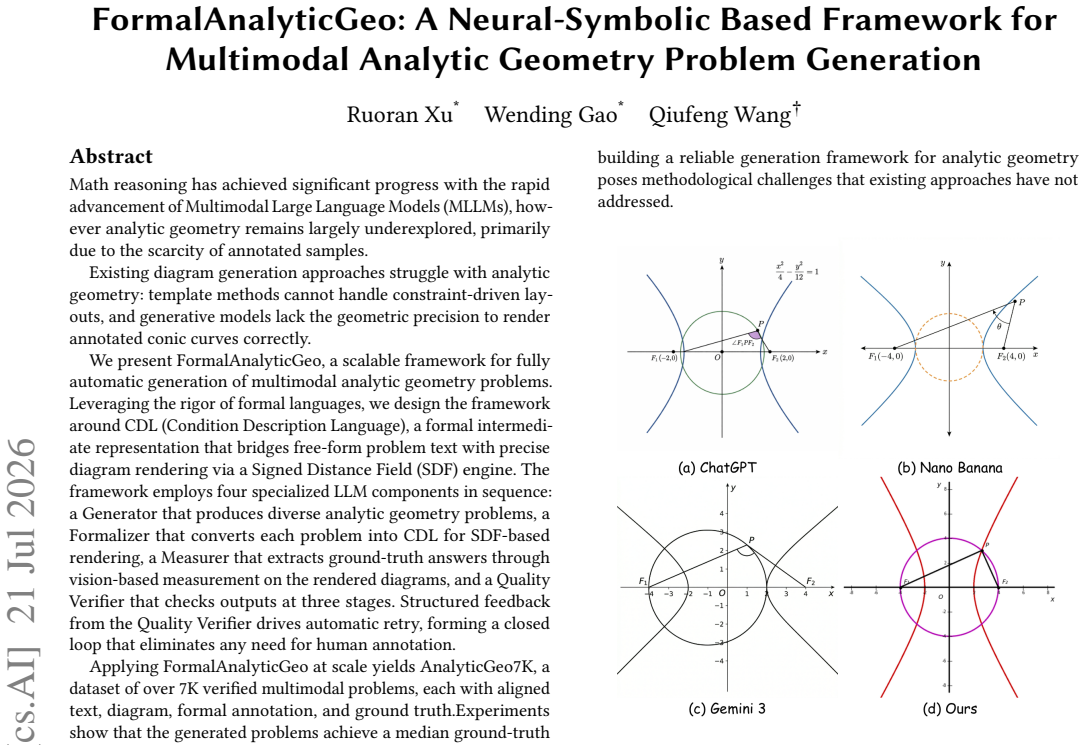


Figures from the paper (5 more)


Reference graph
Works this paper leans on
-
[1]
Anthropic. 2025. Introducing Claude Opus 4.5. https://www.anthropic.com/ news/claude-opus-4-5. Blog post
2025
-
[2]
Anthropic. 2025. System Card: Claude Opus 4 & Claude Sonnet 4. https://www- cdn.anthropic.com/6be99a52cb68eb70eb9572b4cafad13df32ed995.pdf. System card
2025
-
[3]
Shuai Bai, Keqin Chen, Xuejing Liu, Jialin Wang, Wenbin Ge, Sibo Song, Kai Dang, Peng Wang, Shijie Wang, Jun Tang, Humen Zhong, Yuanzhi Zhu, Mingkun Yang, Zhaohai Li, Jianqiang Wan, Pengfei Wang, Wei Ding, Zheren Fu, Yiheng Xu, Jiabo Ye, Xi Zhang, Tianbao Xie, Zesen Cheng, Hang Zhang, Zhibo Yang, Haiyang Xu, and Junyang Lin. 2025. Qwen2.5-VL Technical Rep...
arXiv 2025
-
[4]
Shihao Cai, Keqin Bao, Hangyu Guo, Jizhi Zhang, Jun Song, and Bo Zheng
-
[5]
Jiaqi Chen, Tong Li, Jinghui Qin, Pan Lu, Liang Lin, Chongyu Chen, and Xiaodan Liang. 2022. UniGeo: Unifying Geometry Logical Reasoning via Reformulating Mathematical Expression. arXiv:2212.02746 [cs.AI] https://arxiv.org/abs/2212. 02746
arXiv 2022
-
[6]
Jiaqi Chen, Jianheng Tang, Jinghui Qin, Xiaodan Liang, Lingbo Liu, Eric Xing, and Liang Lin. 2021. GeoQA: A Geometric Question Answering Benchmark Towards Multimodal Numerical Reasoning. InFindings of the Association for Computational Linguistics: ACL-IJCNLP 2021, Chengqing Zong, Fei Xia, Wenjie 8 FormalAnalyticGeo: A Neural-Symbolic Based Framework for M...
2021
-
[7]
DeepSeek-AI. 2025. DeepSeek-V3 Technical Report. arXiv:2412.19437 [cs.CL] https://arxiv.org/abs/2412.19437
arXiv 2025
-
[8]
Daocheng Fu, Jianlong Chen, Renqiu Xia, Zijun Chen, Qi Liu, Yuan Feng, Hongbin Zhou, Renrui Zhang, Shiyang Feng, Peng Gao, Hongyuan Zha, Junchi Yan, Botian Shi, Yu Qiao, and Bo Zhang. 2026. TrustGeoGen: Formal-Verified Data Engine for Trustworthy Multi-modal Geometric Problem Solving. arXiv:2504.15780 [cs.AI] https://arxiv.org/abs/2504.15780
arXiv 2026
Show all 92 references
-
[9]
Jiahui Gao, Renjie Pi, Jipeng Zhang, Jiacheng Ye, Wanjun Zhong, Yufei Wang, Lanqing HONG, Jianhua Han, Hang Xu, Zhenguo Li, and Lingpeng Kong. 2025. G-LLaVA: Solving Geometric Problem with Multi-Modal Large Language Model. InThe Thirteenth International Conference on Learning ...
2025
-
[10]
Google DeepMind. 2025. Gemini 3 Flash. https://deepmind.google/models/ gemini/flash/. Model card available at https://deepmind.google/models/model- cards/gemini-3-flash/
2025
-
[11]
Sirui Hong, Mingchen Zhuge, Jonathan Chen, Xiawu Zheng, Yuheng Cheng, Jinlin Wang, Ceyao Zhang, Zili Wang, Steven Ka Shing Yau, Zijuan Lin, Liyang Zhou, Chenyu Ran, Lingfeng Xiao, Chenglin Wu, and Jürgen Schmidhuber. 2024. MetaGPT: Meta Programming for A Multi-Agent Collaborat...
2024
-
[12]
Zihan Huang, Tao Wu, Wang Lin, Shengyu Zhang, Jingyuan Chen, and Fei Wu
-
[13]
Zhengbo Jiao, Shaobo Wang, Zifan Zhang, Wei Wang, Bing Zhao, Hu Wei, and Linfeng Zhang. 2026. Socratic-Geo: Synthetic Data Generation and Geometric Reasoning via Multi-Agent Interaction. arXiv:2602.03414 [cs.CV] https://arxiv. org/abs/2602.03414
2026
-
[14]
Deng Linger, Linghao Zhu, Yuliang Liu, Yu Wang, Qunyi Xie, Jingjing Wu, Gang Zhang, Yingying Zhu, and Xiang Bai. 2025. Theorem-Validated Reverse Chain-of-Thought Problem Generation for Geometric Reasoning. InProceedings of the 2025 Conference on Empirical Methods in Natural La...
2025 doi
-
[15]
Xianyang Liu, Yilin Liu, Shuai Wang, Hao Cheng, Andrew Estornell, Yuzhi Zhao, Jun Shu, and Jiaheng Wei. 2026. AgenticMath: Enhancing LLM Reasoning via Agentic-based Math Data Generation. arXiv:2510.19361 [cs.CL] https://arxiv. org/abs/2510.19361
2026
-
[16]
Pan Lu, Hritik Bansal, Tony Xia, Jiacheng Liu, Chunyuan Li, Hannaneh Hajishirzi, Hao Cheng, Kai-Wei Chang, Michel Galley, and Jianfeng Gao. 2024. MathVista: Evaluating Mathematical Reasoning of Foundation Models in Visual Contexts. InInternational Conference on Learning Repres...
2024
-
[17]
Pan Lu, Ran Gong, Shibiao Jiang, Liang Qiu, Siyuan Huang, Xiaodan Liang, and Song-Chun Zhu. 2021. Inter-GPS: Interpretable Geometry Problem Solving with Formal Language and Symbolic Reasoning. InThe Joint Conference of the 59th Annual Meeting of the Association for Computation...
2021
-
[18]
Mistral AI. 2024. Mistral Large. https://mistral.ai/news/mistral-large Blog post
2024
-
[19]
OpenAI. 2024. GPT-4 Technical Report. arXiv:2303.08774 [cs.CL] https://arxiv. org/abs/2303.08774
2024 arXiv
-
[20]
OpenAI. 2024. GPT-4o System Card. arXiv:2410.21276 [cs.CL] https://arxiv.org/ abs/2410.21276
2024 arXiv
-
[21]
OpenAI. 2025. Introducing GPT-5.2. https://openai.com/index/introducing-gpt- 5-2/. Blog post. System card available at https://cdn.openai.com/pdf/3a4153c8- c748-4b71-8e31-aecbde944f8d/oai_5_2_system-card.pdf
2025
-
[22]
Bowen Ping, Minnan Luo, Zhuohang Dang, Chenxi Wang, and Chengyou Jia
-
[23]
Timo Schick, Jane Dwivedi-Yu, Roberto Dessi, Roberta Raileanu, Maria Lomeli, Eric Hambro, Luke Zettlemoyer, Nicola Cancedda, and Thomas Scialom. 2023. Toolformer: Language Models Can Teach Themselves to Use Tools. InThirty- seventh Conference on Neural Information Processing S...
2023
-
[24]
Shuo Tang, Xianghe Pang, Zexi Liu, Bohan Tang, Rui Ye, Tian Jin, Xiaowen Dong, Yanfeng Wang, and Siheng Chen. 2025. Synthesizing Post-Training Data for LLMs through Multi-Agent Simulation. InProceedings of the 63rd Annual Meeting of the Association for Computational Linguistic...
2025
-
[25]
Trieu Trinh, Yuhuai Wu, Quoc Le, He He, and Thang Luong. 2024. Solving Olympiad Geometry without Human Demonstrations.Nature(2024). doi:10. 1038/s41586-023-06747-5
2024
-
[26]
Ke Wang, Junting Pan, Weikang Shi, Zimu Lu, Houxing Ren, Aojun Zhou, Mingjie Zhan, and Hongsheng Li. 2024. Measuring Multimodal Mathematical Reasoning with MATH-Vision Dataset. InThe Thirty-eight Conference on Neural Information Processing Systems Datasets and Benchmarks Track...
2024
-
[27]
Haoyi Wu, Wenyang Hui, Yezeng Chen, Weiqi Wu, Kewei Tu, and Yi Zhou
-
[28]
Qingyun Wu, Gagan Bansal, Jieyu Zhang, Yiran Wu, Beibin Li, Erkang Zhu, Li Jiang, Xiaoyun Zhang, Shaokun Zhang, Jiale Liu, Ahmed Hassan Awadallah, Ryen W White, Doug Burger, and Chi Wang. 2024. AutoGen: Enabling Next- Gen LLM Applications via Multi-Agent Conversations. InFirst...
2024
-
[29]
Weiming Wu, Jin Ye, Zi kang Wang, Zhi Zhou, Yu-Feng Li, and Lan-Zhe Guo. 2025. NeSyGeo: A Neuro-Symbolic Framework for Multimodal Geometric Reasoning Data Generation. arXiv:2505.17121 [cs.CL] https://arxiv.org/abs/2505.17121
2025
-
[30]
Ruoran Xu, Haoyu Cheng, Bin Dong, and Qiufeng Wang. 2026. Hilbert-Geo: Solving Solid Geometric Problems by Neural-Symbolic Reasoning. InProceedings of the IEEE/CVF Conference on Computer Vision and Pattern Recognition (CVPR). 9658–9667. https://arxiv.org/abs/2605.16385
2026 arXiv
-
[31]
Shunyu Yao, Jeffrey Zhao, Dian Yu, Nan Du, Izhak Shafran, Karthik Narasimhan, and Yuan Cao. 2023. ReAct: Synergizing Reasoning and Acting in Language Models. InInternational Conference on Learning Representations (ICLR)
2023
-
[32]
Jiaxin Zhang, Zhong-Zhi Li, Ming-Liang Zhang, Fei Yin, Cheng-Lin Liu, and Yashar Moshfeghi. 2024. GeoEval: Benchmark for Evaluating LLMs and Multi- Modal Models on Geometry Problem-Solving. InFindings of the Association for Computational Linguistics: ACL 2024, Lun-Wei Ku, Andr...
2024 doi
-
[33]
Ming-Liang Zhang, Fei Yin, and Cheng-Lin Liu. 2023. A Multi-Modal Neural Geometric Solver with Textual Clauses Parsed from Diagram. InIJCAI
2023
-
[34]
Renrui Zhang, Dongzhi Jiang, Yichi Zhang, Haokun Lin, Ziyu Guo, Pengshuo Qiu, Aojun Zhou, Pan Lu, Kai-Wei Chang, Peng Gao, et al . 2024. MathVerse: Does Your Multi-modal LLM Truly See the Diagrams in Visual Math Problems? arXiv preprint arXiv:2403.14624(2024)
2024 arXiv
-
[35]
Renrui Zhang, Xinyu Wei, Dongzhi Jiang, Yichi Zhang, Ziyu Guo, Chengzhuo Tong, Jiaming Liu, Aojun Zhou, Bin Wei, Shanghang Zhang, Peng Gao, and Hongsheng Li. 2024. MAVIS: Mathematical Visual Instruction Tuning. arXiv:2407.08739 [cs.CV] https://arxiv.org/abs/2407.08739
2024 arXiv
-
[36]
Xiaokai Zhang, Na Zhu, Yiming He, Jia Zou, Qike Huang, Xiaoxiao Jin, Yanjun Guo, Chenyang Mao, Yang Li, Zhe Zhu, Dengfeng Yue, Fangzhen Zhu, Yifan Wang, Yiwen Huang, Runan Wang, Cheng Qin, Zhenbing Zeng, Shaorong Xie, Xiangfeng Luo, and Tuo Leng. 2024. FormalGeo: An Extensible...
2024 arXiv
-
[37]
Chengke Zou, Xingang Guo, Rui Yang, Junyu Zhang, Bin Hu, and Huan Zhang
-
[42]
outside positive, inside negative
DynaMath: A Dynamic Visual Benchmark for Evaluating Mathematical Reasoning Robustness of Vision Language Models. 9 Xu, Gao, and Wang A CDL Specification This appendix provides the complete operator catalog of the Con- dition Description Language (CDL) introduced in Section 3.2...
-
[43]
Decide curve type and equation (or browse seed_pool)
-
[44]
Pick a specific geometric configuration with concrete numeric values
-
[45]
Call rule_check and/or sympy_check to validate
-
[46]
Callsubmit_problemwith all fields. C.2 Formalizer The Formalizer employs a seven-layer system prompt: (1) persona, (2) CDL specification (Appendix A), (3) grounding criteria, (4) step- by-step guidance, (5) few-shot examples, (6) output format, and (7) chain-of-thought trigger...
-
[47]
SYNTAX VALIDITY: Must parse without errors
-
[48]
COMPLETENESS: Every geometric object and relationship mentioned in the problem must appear in CDL
-
[49]
Equation(G) = ... =
CORRECTNESS: Equations, coordinates, and constraints must accurately reflect the problem. Common mistakes to avoid: - Missing declarations (every name must be declared with its type) - Wrong equation format (use "Equation(G) = ... = ...", NOT "Expression(G) = (...)") - Omittin...
-
[50]
pixel_to_coord on the RIGHT endpoint along x-axis -> (a, 0)
-
[51]
pixel_to_coord on the TOP endpoint along y-axis -> (0, b)
-
[52]
Compute: c = sqrt(|a^2 - b^2|), e = c / a
-
[53]
ANSWER: e ### Recipe: Chord Length
-
[54]
intersect_line_curve(x1, y1, x2, y2) -> P1, P2
-
[55]
compute_distance(P1, P2) -> chord length
-
[56]
ANSWER: distance ### Recipe: Area of Triangle
-
[58]
compute_area(x1,y1, x2,y2, x3,y3)
-
[59]
ANSWER: area ### Recipe: Perimeter of Triangle
-
[60]
Measure all 3 vertex coordinates
-
[61]
compute_distance for each of the 3 sides
-
[62]
ANSWER: sum of 3 distances ### Recipe: Slope
-
[63]
Measure 2 points on the line
-
[64]
compute_slope(x1,y1, x2,y2)
-
[65]
ANSWER: slope ### Recipe: Distance Between Two Points
-
[66]
Measure both points with pixel_to_coord
-
[67]
compute_distance(x1,y1, x2,y2)
-
[68]
ANSWER: distance ### Recipe: Radius (circle)
-
[69]
Measure center with pixel_to_coord
-
[70]
Measure any point on the circle
-
[71]
compute_distance(cx,cy, px,py) -> radius
-
[72]
ANSWER: radius ### Recipe: Focus / Focal Length
-
[73]
If foci labeled: measure with pixel_to_coord
-
[74]
If not: measure a, b, compute c = sqrt(|a^2-b^2|)
-
[75]
ANSWER: the requested value ## How to Measure ### Strategy 1: Line-Curve Intersections (PREFERRED)
-
[76]
pixel_to_coord on two points of the line
-
[77]
intersect_line_curve(x1, y1, x2, y2) ### Strategy 2: Visual Point Location
-
[78]
Estimate pixel position from the image
-
[79]
pixel_to_coord(px, py)
-
[80]
find_nearest_curve_point(x, y) to snap if needed 15 Xu, Gao, and Wang ### Strategy 3: Curve Endpoint Measurement
-
[81]
pixel_to_coord on rightmost curve point on x-axis -> a
-
[82]
pixel_to_coord on topmost curve point on y-axis -> b ### Strategy 4: Curve-Curve Intersections
-
[83]
Estimate intersection region visually
-
[84]
Violating any rule below makes the answerINVALID
intersect_curves(x_min, x_max, y_min, y_max) ## RAW VALUE RULE (MANDATORY -- NEVER VIOLATE) YouMUSTreport the EXACT numeric values returned by CV tools. Violating any rule below makes the answerINVALID. 1.NEVER round coordinatesbefore passing to compute_* tools: BAD: intersect...
-
[85]
Table 10: CV tools available to the Visual Measurer
Call verify_solvability to confirm the equation is valid. Table 10: CV tools available to the Visual Measurer. Because the SDF renderer produces the diagram, viewport metadata is known exactly, eliminating axis-reading errors. Tool Description Coordinate Mapping pixel_to_coord...
-
[86]
Assess problem quality: Is the question clear? Is the equation consistent with the stated curve type?
-
[87]
IMPORTANTfor Gate 1: These problems are designed to be DIAGRAM-DEPENDENT
Check for degenerate cases (e.g., eccentricity asked for a circle = always 0). IMPORTANTfor Gate 1: These problems are designed to be DIAGRAM-DEPENDENT. The problem will be accompanied by a rendered diagram, so it is EXPECTED and ACCEPTABLE for some geometric elements to be de...
-
[88]
Call validate_cdl_syntax to verify CDL parses correctly
-
[89]
Call check_cdl_completeness to get NL<->CDL entity comparison
-
[90]
The problem's goal is tracked externally via a goal_type field, NOT inside the CDL annotation
Using the completeness report, judge whether: - All geometric objects have CDL declarations - All relationships have CDL predicates - The equation in CDL matches the problem's equation - No extraneous or contradictory annotations exist IMPORTANTfor Gate 2: CDL does NOT contain...
-
[91]
Call check_answer_range to verify valid bounds
-
[92]
Call solve_text_only to compute an independent analytical answer
-
[93]
gate": 1|2|3,
Compare Agent 3's visual measurement with the analytical solution: - If relative error <= 5%: PASS (answers agree) - If 5% < relative error <= 20%: WARN (flag but pass) - If relative error > 20%: FAIL (significant disagreement) - If analytical solution unavailable: rely on ran...
-
[2023]
InFindings of the Association for Computational Linguistics: EMNLP 2023, Houda Bouamor, Juan Pino, and Kalika Bali (Eds.)
Conic10K: A Challenging Math Problem Understanding and Reasoning Dataset. InFindings of the Association for Computational Linguistics: EMNLP 2023, Houda Bouamor, Juan Pino, and Kalika Bali (Eds.). Association for Computational Linguistics, Singapore, 6444–6458. doi:10.18653/v1...
2023 doi
-
[2024]
InProceedings of the 2024 Conference on Empirical Methods in Natural Language Processing, Yaser Al-Onaizan, Mohit Bansal, and Yun-Nung Chen (Eds.)
GeoGPT4V: Towards Geometric Multi-modal Large Language Models with Geometric Image Generation. InProceedings of the 2024 Conference on Empirical Methods in Natural Language Processing, Yaser Al-Onaizan, Mohit Bansal, and Yun-Nung Chen (Eds.). Association for Computational Ling...
2024 doi
-
[2025]
doi:10.1109/TMM.2025.3557720
AutoGeo: Automating Geometric Image Dataset Creation for Enhanced Geometry Understanding.IEEE Transactions on Multimedia27 (2025), 3105–3116. doi:10.1109/TMM.2025.3557720
2025
-
[2026]
InThe Fourteenth International Conference on Learning Representations
AutoGPS: Automated Geometry Problem Solving via Multimodal Formal- ization and Deductive Reasoning. InThe Fourteenth International Conference on Learning Representations. https://openreview.net/forum?id=PVtZnUh04m
Reviewed August 2, 2026 · model on record in the stance chip above.
Discussion (0). Sign in to comment.