REVIEW 2 major objections 4 minor 80 references
Self-supervision, not clinical labels, is what aligns medical AI encoders.
Reviewed by Pith at T0; open to challenge. T0 means a machine referee read the full paper against a public rubric. the ladder, T0–T4 →
T0 review · deepseek-v4-flash
2026-08-01 10:16 UTC pith:PGALTQUF
load-bearing objection Strong empirical study of medical encoder convergence, but the abstract overstates the causal and scaling claims given one-seed controlled cells and a nonconverged consensus. the 2 major comments →
Self-supervision drives representational convergence in medical foundation models more than clinical supervision
The pith
A machine-rendered reading of the paper's core claim, the machinery that carries it, and where it could break.
Core claim
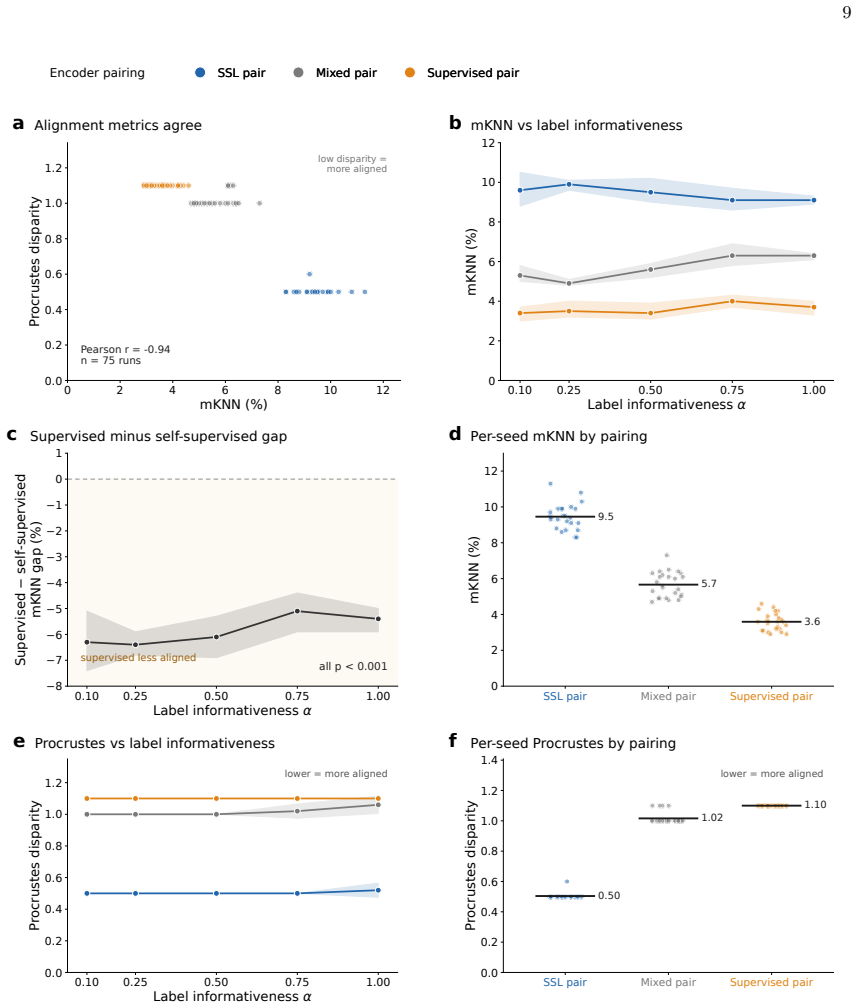
The paper claims that representational convergence among medical foundation models is real but modest, and that it is governed by the shared self-supervised pretraining objective rather than by clinical supervision. Matched self-supervised encoders align far more (40.4% on chest radiography) than label-supervised (21.1%) or image-text (3.3%) pairs, and the same ordering holds in a synthetic generative model and does not close as labels become more informative. Convergence does not grow with model size (Spearman 0.302, p=0.223) and does not extend to image-text alignment. Despite the weak geometry, a linear classifier transfers across encoders and to five held-out hospitals retaining about 85
What carries the argument
The key objects are the alignment metric centered-kernel nearest-neighbor alignment (CKNNA, agreement of k-nearest-neighbor graphs after centering) and the controlled-training design that fixes data, architecture, and scale while varying only the training objective. A consensus geometry built by generalized Procrustes analysis and an anchor-based common coordinate system (relative representations) carry the transfer and stitching analyses.
Load-bearing premise
The causal ordering rests on a controlled training experiment with a single initialization and one seed per cell, so the reported alignment differences could in principle be reversed by training-seed variability, which the bootstrap intervals do not capture.
What would settle it
Re-run the controlled-objective matrix with ten seeds per cell; if the between-seed spread of same-objective alignment overlaps across objectives, the claim that the objective governs convergence collapses. Also, train self-supervised encoders on non-overlapping data from different institutions; if alignment drops to the random floor, shared data rather than the objective may be the driver.
If this is right
- Convergence in medical imaging is set by the pretraining objective; adding clinical-label or report supervision moves an encoder away from its self-supervised peers.
- Bigger and better encoders do not converge more, so interoperability cannot be bought by scaling.
- A modest shared geometry is enough for functional interchangeability: linear classifiers transfer across encoders and to external hospitals, and affine stitching recovers oracle performance.
- Convergence is within-modality: image and text encoders do not align beyond a random floor, so cross-modal convergence should not be assumed.
- The shared representation is uneven across patient subgroups and least reliable for under-represented groups, so subgroup-specific validation is needed before it is trusted.
Where Pith is reading between the lines
- If the objective, not scale, drives convergence, pretraining recipe choices (masked reconstruction versus contrastive) may be a more direct lever for interoperability than data volume; a testable extension is to measure convergence as a function of objective family in the same controlled setup.
- The failure of alignment to match radiologist similarity suggests that case-level clinical similarity may not live in the same subspace as diagnostic co-occurrence; a finding-conditioned triplet task could separate ill-posedness from representational limits.
- The near-chance image-text alignment implies that vision-language medical models may align with language only through fine-tuning on paired data, not from shared pretraining geometry; this could be tested by measuring alignment before and after vision-language instruction tuning.
- The subgroup instability may reflect neighbor-count artifacts in sparsely populated regions; a density-matched evaluation could distinguish representation fracture from estimation noise.
Editorial analysis
A structured set of objections, weighed in public.
Referee Report
Summary. The paper studies representational convergence across 18 open-weight medical image encoders and 7 biomedical text encoders, using pairwise neighbor-based alignment metrics (mKNN, CKNNA) on shared pools spanning five imaging modalities, with chest radiography as the primary substrate (650,982 images). It makes three main claims: (1) convergence is real but modest and is driven by the training objective rather than clinical supervision, scale, or downstream capability; (2) the shared geometry is clinically structured (it tracks disease co-occurrence but not ICD-10 taxonomy) and is uneven across patient subgroups; and (3) despite weak geometric alignment, a linear classifier transferred through relative representations retains about 85% of within-encoder performance across encoders and generalizes across five external sites, while feature stitching recovers oracle performance. The causal claim is supported by a controlled experiment that fixes data, architecture, scale, and initialization while varying only the objective, and by a synthetic generative model with five seeds. The authors report several negative results, including failure of cross-modal image-text convergence, failure of a consensus-deviation drift detector, and chance-level prediction of radiologist similarity triplets.
Significance. If the central claim holds, this is an important and largely novel result for medical foundation models: it inverts the common assumption that clinical-label or report supervision concentrates representations, and it argues that interoperability should be designed through the pretraining objective and validated in a common coordinate system rather than assumed from scale. The study is unusually broad in encoder coverage and evaluation substrates, and it has several methodological strengths: the controlled-objective training matrix, the synthetic generative model with label-informativeness sweep, the use of relative representations for transfer and stitching, the explicit random-initialization floor, and the unusually candid limitation statements. The transfer and stitching results are strong and internally consistent. The main risk is that the central causal ordering rests on a single training seed per controlled cell, and several secondary results rest on a consensus configuration that did not converge; both are acknowledged in the text but are load-bearing for some of the headline claims.
major comments (2)
- [Results, first subsection; Methods 'Controlled-objective training'; Limitation 5] The central causal claim — that the self-supervised objective drives convergence more than clinical supervision — rests on the controlled-objective experiment, where each cell uses one initialization and one seed, and the reported bootstrap intervals resample evaluation cases, not training seeds. The headline chest-radiography gap is 40.4% (SSL) versus 21.1% (supervised), a 19.3-point difference, but each value is a single ViT-S/ViT-B pair. Training a small ViT for 50 epochs from the same initialization can plausibly produce seed-level alignment swings of several points; if that swing is comparable to the gap, the ordering and the 'inverting the expectation' conclusion are not established. The synthetic model uses five seeds, but it is a two-layer MLP on synthetic data and does not quantify real-data seed variance. I would ask the authors to run at least 3–5 seeds for the key chest-radio
- [Methods 'Consensus geometry and residual alignment'; Supplementary Note 1; Fig. 5a–e] The Generalized Procrustes consensus did not reach its convergence tolerance, as stated in the Methods and Supplementary Note 1. Two results that are used to support secondary but still prominent claims depend on this consensus: the clinical-structure recovery (comorbidity correlation 0.615, p<0.001; ICD-10 0.135, p=0.211) and the scaling analysis (residual distance to consensus versus size, AUROC, and release year; Spearman 0.302, p=0.223; 0.131, p=0.604; 0.206, p=0.412). A nonconverged fit can bias a downstream statistic in either direction, so the 'does not grow with size' conclusion and the co-occurrence-versus-taxonomy contrast are sensitivity-limited. The paper says this, but the results are still presented as findings rather than as exploratory. I recommend either running the Procrustes iteration to convergence (e.g., centering/scaling relative representations, increasing iteratio
minor comments (4)
- [Abstract and Results, first subsection] The abstract states 'Convergence is modest but above a random floor' and then gives 40.4% on chest radiography. This floor comparison is formal only for chest radiography; for the other four modalities the floor was not computed on the matched pool, and the text later says the comparison is descriptive. Please state this qualification where the pooled claim is first made.
- [Fig. 2 and Supplementary Table 1] The caption to Fig. 2 says error bars in panels d,e are ±SD, but these SDs come from bootstrapping evaluation cases, not training seeds. To avoid misleading readers, label the error bars as 'case-bootstrap SD' or add a note that no seed variability is included.
- [Methods 'Statistical analysis'; Results 'Uniformity across subgroups'] The demographic omnibus tests treat encoder pairs as independent although pairs sharing an encoder are correlated, and the text correctly flags the p-values as anticonservative. This is an honest caveat, but the Results section still reports p<0.001 for race/ethnicity/insurance without the caveat in the same paragraph. Please move or repeat the caveat at the point of reporting.
- [Fig. 8 and reader study methods] The 'automated diagnostic read' in Fig. 8b is not defined in the main text or caption — which encoder and which classifier produce this read? Please specify, or refer to the Methods/Supplementary table where this is defined.
Circularity Check
No material circularity: the core convergence claim is measured with externally defined metrics and controlled experiments; self-citations are contextual only.
full rationale
The paper's alignment measures (mKNN and CKNNA, Eqs. 1-2), relative representations (Eq. 3), and transfer/stitching protocols are defined from external methodology and are not fitted to the target conclusion. The controlled-objective experiment varies the training objective under fixed data, architecture, and budget, and reports an observed ordering (e.g., chest-radiography matched-objective CKNNA: SSL 40.4 vs supervised 21.1 vs image-text 3.3); this ordering is an outcome, not an input. The synthetic model fixes generative parameters (Eqs. 6-7) and varies label informativeness α as a controlled variable; the SSL-vs-supervised gap is not encoded in the model specification. Self-citations (refs 14-18, 46-47) appear in the introduction and discussion as contextual examples and do not supply the measurement or the causal inference; the independent corroboration in ref. 44 is external. The paper itself honestly flags the single-seed limitation (Discussion, 'Fifth, the controlled encoders use a single seed per cell') and the nonconverged consensus ('First, the consensus configuration did not reach its convergence tolerance'); these are robustness/validity concerns rather than reductions of the result to its inputs. No specific step can be quoted in which a 'prediction' equals a fitted parameter or in which a self-citation chain forces the conclusion, so no circular step is identified.
Axiom & Free-Parameter Ledger
free parameters (5)
- k (neighbor count) =
10
- Anchor count for relative representations =
1024
- Synthetic model dimensions and noise =
D=160, d_s=32, d_n=128, σ=0.1
- Controlled training budget =
50 epochs, lr 1e-4, batch 512, wd 0.05, masking 75%
- Synthetic label informativeness grid =
α ∈ {0.1, 0.25, 0.5, 0.75, 1.0}, C=10
axioms (6)
- domain assumption k-NN graph overlap at k=10 captures the clinically relevant notion of representational convergence
- domain assumption Native preprocessing is part of each encoder and is confounded with encoder identity
- domain assumption The CXR random-initialization floor approximates chance alignment for other pools
- domain assumption Relative representations with 1,024 anchors provide a valid common coordinate system for transfer and stitching
- ad hoc to paper Synthetic generative model's signal/nuisance decomposition and label-generation rule
- domain assumption One training seed per controlled cell is representative of the objective's effect
read the original abstract
Medical image encoders from different groups are increasingly treated as interchangeable, on the assumption that scale and clinical supervision concentrate their representations onto a shared structure. Whether this convergence is real, what produces it, and whether it is clinically usable are untested, and the similarity measures behind such claims are fragile. We present a controlled dissection across 18 image and 7 text encoders, all open-weight and run locally, spanning 7M to 27B parameters and five imaging modalities, including 650,982 chest radiographs from six datasets. To isolate cause, we train encoders that vary only the objective under fixed data, architecture, and scale, and reproduce the effect in a synthetic model. Convergence is modest but above a random floor, driven by the self-supervised objective, not clinical supervision: matched self-supervised encoders aligned most (40.4% on chest radiography), with label-supervised (21.1%) and image-text (3.3%) far lower, and did not grow with size (Spearman 0.302, p=0.223) or capability. It is within-modality, does not reach clinical language, and does not reproduce how radiologists judge case similarity. Yet a linear classifier transfers across encoders and to five held-out hospitals, retaining about 85% of within-encoder performance. Convergence in medical imaging is therefore set by the pretraining objective, not inherited from scale or clinical supervision. Interoperability is accordingly something to design for through that objective, and to validate where the shared geometry is weakest, across patient subgroups and against clinical judgment.
Figures




Reference graph
Works this paper leans on
-
[1]
Nature Machine Intelligence7(1), 119–130 (2025) 33
Pérez-García, F., Sharma, H., Bond-Taylor, S., Bouzid, K., Salvatelli, V., Ilse, M., Bannur, S., Castro, D.C., Schwaighofer, A., Lungren, M.P., et al.: Exploring scalable medical image encoders beyond text supervision. Nature Machine Intelligence7(1), 119–130 (2025) 33
2025
-
[2]
Nature biomedical engineering 6(12), 1399–1406 (2022)
Tiu, E., Talius, E., Patel, P., Langlotz, C.P., Ng, A.Y., Rajpurkar, P.: Expert-level detection of patholo- gies from unannotated chest x-ray images via self-supervised learning. Nature biomedical engineering 6(12), 1399–1406 (2022)
2022
-
[3]
Nejm Ai2(1), AIoa2400640 (2025)
Zhang, S., Xu, Y., Usuyama, N., Xu, H., Bagga, J., Tinn, R., Preston, S., Rao, R., Wei, M., Valluri, N., et al.: A multimodal biomedical foundation model trained from fifteen million image–text pairs. Nejm Ai2(1), AIoa2400640 (2025)
2025
-
[4]
Nature medicine30(3), 850–862 (2024)
Chen, R.J., Ding, T., Lu, M.Y., Williamson, D.F., Jaume, G., Song, A.H., Chen, B., Zhang, A., Shao, D., Shaban, M., et al.: Towards a general-purpose foundation model for computational pathology. Nature medicine30(3), 850–862 (2024)
2024
-
[5]
Nature medicine30(10), 2924–2935 (2024)
Vorontsov, E., Bozkurt, A., Casson, A., Shaikovski, G., Zelechowski, M., Severson, K., Zimmermann, E., Hall, J., Tenenholtz, N., Fusi, N., et al.: A foundation model for clinical-grade computational pathology and rare cancers detection. Nature medicine30(10), 2924–2935 (2024)
2024
-
[6]
Nature 630(8015), 181–188 (2024)
Xu, H., Usuyama, N., Bagga, J., Zhang, S., Rao, R., Naumann, T., Wong, C., Gero, Z., González, J., Gu, Y., et al.: A whole-slide foundation model for digital pathology from real-world data. Nature 630(8015), 181–188 (2024)
2024
-
[7]
Nature medicine 30(3), 863–874 (2024)
Lu, M.Y., Chen, B., Williamson, D.F., Chen, R.J., Liang, I., Ding, T., Jaume, G., Odintsov, I., Le, L.P., Gerber, G., et al.: A visual-language foundation model for computational pathology. Nature medicine 30(3), 863–874 (2024)
2024
-
[8]
Filiot, A., Jacob, P., Kain, A.M., Saillard, C.: Phikon-v2, a large and public feature extractor for biomarker prediction (2024),https://arxiv.org/abs/2409.09173
Pith/arXiv arXiv 2024
-
[9]
Nature622(7981), 156–163 (2023)
Zhou, Y., Chia, M.A., Wagner, S.K., Ayhan, M.S., Williamson, D.J., Struyven, R.R., Liu, T., Xu, M., Lozano, M.G., Woodward-Court, P., et al.: A foundation model for generalizable disease detection from retinal images. Nature622(7981), 156–163 (2023)
2023
-
[10]
Nature machine intelligence6(3), 354–367 (2024)
Pai, S., Bontempi, D., Hadzic, I., Prudente, V., Sokač, M., Chaunzwa, T.L., Bernatz, S., Hosny, A., Mak, R.H., Birkbak, N.J., et al.: Foundation model for cancer imaging biomarkers. Nature machine intelligence6(3), 354–367 (2024)
2024
-
[11]
In: Proceedings of the 37th International Conference on Neural Information Processing Systems (2023)
Li, C., Wong, C., Zhang, S., Usuyama, N., Liu, H., Yang, J., Naumann, T., Poon, H., Gao, J.: Llava- med: training a large language-and-vision assistant for biomedicine in one day. In: Proceedings of the 37th International Conference on Neural Information Processing Systems (2023)
2023
-
[12]
In: Machine learning for healthcare conference
Zhang, Y., Jiang, H., Miura, Y., Manning, C.D., Langlotz, C.P.: Contrastive learning of medical visual representations from paired images and text. In: Machine learning for healthcare conference. pp. 2–25. PMLR (2022)
2022
-
[13]
Nature616(7956), 259–265 (2023)
Moor, M., Banerjee, O., Abad, Z.S.H., Krumholz, H.M., Leskovec, J., Topol, E.J., Rajpurkar, P.: Foundation models for generalist medical artificial intelligence. Nature616(7956), 259–265 (2023)
2023
-
[14]
Radiology: Artificial Intelligence7(4), e240476 (2025)
Tayebi Arasteh, S., Lotfinia, M., Bressem, K., Siepmann, R., Adams, L., Ferber, D., Kuhl, C., Kather, J.N., Nebelung, S., Truhn, D.: Radiorag: online retrieval–augmented generation for radiology question answering. Radiology: Artificial Intelligence7(4), e240476 (2025)
2025
-
[15]
npj Digital Medicine8, 790 (2025)
Wind, S., Sopa, J., Truhn, D., Lotfinia, M., Nguyen, T.T., Bressem, K., Adams, L., Rusu, M., Köstler, H., Wellein, G., et al.: Multi-step retrieval and reasoning improves radiology question answering with large language models. npj Digital Medicine8, 790 (2025)
2025
-
[16]
Arasteh, S.T., Joodaki, M., Lotfinia, M., Nebelung, S., Truhn, D.: Case-grounded evidence verification: A framework for constructing evidence-sensitive supervision (2026),https://arxiv.org/abs/2604.0 9537
2026
-
[17]
Radiology: Artificial Intelligence8(3), e260346 (2026)
Tayebi Arasteh, S., Truhn, D.: When framing shapes the answer: Cognitive bias and large language model reliability in radiology. Radiology: Artificial Intelligence8(3), e260346 (2026)
2026
-
[18]
Nature Communications 15(1), 1603 (2024)
Tayebi Arasteh, S., Han, T., Lotfinia, M., Kuhl, C., Kather, J.N., Truhn, D., Nebelung, S.: Large language models streamline automated machine learning for clinical studies. Nature Communications 15(1), 1603 (2024)
2024
-
[19]
In: ICLR 2021 (2021),https://openreview.net/forum ?id=YicbFdNTTy
Dosovitskiy, A., Beyer, L., Kolesnikov, A., Weissenborn, D., Zhai, X., Unterthiner, T., Dehghani, M., Minderer, M., Heigold, G., Gelly, S., Uszkoreit, J., Houlsby, N.: An image is worth 16x16 words: Transformers for image recognition at scale. In: ICLR 2021 (2021),https://openreview.net/forum ?id=YicbFdNTTy
2021
-
[20]
In: Proceedings of the IEEE/CVF conference on computer vision and pattern recognition
He, K., Chen, X., Xie, S., Li, Y., Dollár, P., Girshick, R.: Masked autoencoders are scalable vision learners. In: Proceedings of the IEEE/CVF conference on computer vision and pattern recognition. pp. 16000–16009 (2022) 34
2022
-
[21]
In: Proceedings of the IEEE/CVF International Conference on Computer Vision (ICCV)
Caron,M.,Touvron,H.,Misra,I.,Jégou,H.,Mairal,J.,Bojanowski,P.,Joulin,A.:Emergingproperties in self-supervised vision transformers. In: Proceedings of the IEEE/CVF International Conference on Computer Vision (ICCV). pp. 9650–9660 (October 2021)
2021
-
[22]
Transactions on Machine Learning Research (2024),https://openreview.net/forum?id=a68SUt6zFt, featured Certification
Oquab, M., Darcet, T., Moutakanni, T., Vo, H.V., Szafraniec, M., Khalidov, V., Fernandez, P., HAZ- IZA, D., Massa, F., El-Nouby, A., Assran, M., Ballas, N., Galuba, W., Howes, R., Huang, P.Y., Li, S.W., Misra, I., Rabbat, M., Sharma, V., Synnaeve, G., Xu, H., Jegou, H., Mairal, J., Labatut, P., Joulin, A., Bojanowski, P.: DINOv2: Learning robust visual fe...
2024
-
[23]
In: Proceedings of the 37th International Conference on Machine Learning (2020)
Chen, T., Kornblith, S., Norouzi, M., Hinton, G.: A simple framework for contrastive learning of visual representations. In: Proceedings of the 37th International Conference on Machine Learning (2020)
2020
-
[24]
In: 2020 IEEE/CVF Conference on Computer Vision and Pattern Recognition (CVPR)
He, K., Fan, H., Wu, Y., Xie, S., Girshick, R.: Momentum contrast for unsupervised visual representa- tion learning. In: 2020 IEEE/CVF Conference on Computer Vision and Pattern Recognition (CVPR). pp. 9726–9735 (2020).https://doi.org/10.1109/CVPR42600.2020.00975
arXiv 2020
-
[25]
In: Proceedings of the 34th International Conference on Neural Information Processing Systems (2020)
Grill, J.B., Strub, F., Altché, F., Tallec, C., Richemond, P.H., Buchatskaya, E., Doersch, C., Pires, B.A., Guo, Z.D., Azar, M.G., Piot, B., Kavukcuoglu, K., Munos, R., Valko, M.: Bootstrap your own latent a new approach to self-supervised learning. In: Proceedings of the 34th International Conference on Neural Information Processing Systems (2020)
2020
-
[26]
In: Inter- national conference on machine learning
Radford, A., Kim, J.W., Hallacy, C., Ramesh, A., Goh, G., Agarwal, S., Sastry, G., Askell, A., Mishkin, P., Clark, J., et al.: Learning transferable visual models from natural language supervision. In: Inter- national conference on machine learning. pp. 8748–8763. PmLR (2021)
2021
-
[27]
Huh, M., Cheung, B., Wang, T., Isola, P.: The platonic representation hypothesis (2024),https: //arxiv.org/abs/2405.07987
Pith/arXiv arXiv 2024
-
[28]
In: Proceedings of the 31st International Conference on Neural Information Processing Systems
Raghu, M., Gilmer, J., Yosinski, J., Sohl-Dickstein, J.: Svcca: singular vector canonical correlation analysis for deep learning dynamics and interpretability. In: Proceedings of the 31st International Conference on Neural Information Processing Systems. p. 6078–6087. NIPS’17, Curran Associates Inc. (2017)
2017
-
[29]
In: Proceedings of the 32nd International Conference on Neural Information Processing Systems
Morcos, A.S., Raghu, M., Bengio, S.: Insights on representational similarity in neural networks with canonical correlation. In: Proceedings of the 32nd International Conference on Neural Information Processing Systems. p. 5732–5741. NIPS’18, Curran Associates Inc. (2018)
2018
-
[30]
In: International conference on machine learning
Kornblith, S., Norouzi, M., Lee, H., Hinton, G.: Similarity of neural network representations revisited. In: International conference on machine learning. pp. 3519–3529. PMlR (2019)
2019
-
[31]
Lenc, K., Vedaldi, A.: Understanding image representations by measuring their equivariance and equiv- alence. Int. J. Comput. Vision127(5), 456–476 (2019).https://doi.org/10.1007/s11263-018-109 8-y
-
[32]
In: Proceedings of the 35th International Conference on Neural Information Processing Systems (2021)
Bansal, Y., Nakkiran, P., Barak, B.: Revisiting model stitching to compare neural representations. In: Proceedings of the 35th International Conference on Neural Information Processing Systems (2021)
2021
-
[33]
In: ICLR 2023 (2023),https://openreview.net/forum ?id=SrC-nwieGJ
Moschella, L., Maiorca, V., Fumero, M., Norelli, A., Locatello, F., Rodolà, E.: Relative representations enable zero-shot latent space communication. In: ICLR 2023 (2023),https://openreview.net/forum ?id=SrC-nwieGJ
2023
-
[34]
Koepke, A.S., Zverev, D., Ginosar, S., Efros, A.A.: Back into plato’s cave: Examining cross-modal representational convergence at scale (2026),https://arxiv.org/abs/2604.18572
Pith/arXiv arXiv 2026
-
[35]
Nature medicine27(12), 2176–2182 (2021)
Seyyed-Kalantari, L., Zhang, H., McDermott, M.B., Chen, I.Y., Ghassemi, M.: Underdiagnosis bias of artificial intelligence algorithms applied to chest radiographs in under-served patient populations. Nature medicine27(12), 2176–2182 (2021)
2021
-
[36]
The Lancet Digital Health4(6), e406–e414 (2022)
Gichoya,J.W.,Banerjee,I.,Bhimireddy,A.R.,Burns,J.L.,Celi,L.A.,Chen,L.C.,Correa,R.,Dullerud, N., Ghassemi, M., Huang, S.C., et al.: Ai recognition of patient race in medical imaging: a modelling study. The Lancet Digital Health4(6), e406–e414 (2022)
2022
-
[37]
Proceedings of the National Academy of Sciences117(23), 12592–12594 (2020)
Larrazabal, A.J., Nieto, N., Peterson, V., Milone, D.H., Ferrante, E.: Gender imbalance in medical imaging datasets produces biased classifiers for computer-aided diagnosis. Proceedings of the National Academy of Sciences117(23), 12592–12594 (2020)
2020
-
[38]
Science366(6464), 447–453 (2019) 35
Obermeyer, Z., Powers, B., Vogeli, C., Mullainathan, S.: Dissecting racial bias in an algorithm used to manage the health of populations. Science366(6464), 447–453 (2019) 35
2019
-
[39]
EBioMedicine89(2023)
Glocker, B., Jones, C., Bernhardt, M., Winzeck, S.: Algorithmic encoding of protected characteristics in chest x-ray disease detection models. EBioMedicine89(2023)
2023
-
[40]
New England Journal of Medicine385(3), 283–286 (2021)
Finlayson, S.G., Subbaswamy, A., Singh, K., Bowers, J., Kupke, A., Zittrain, J., Kohane, I.S., Saria, S.: The clinician and dataset shift in artificial intelligence. New England Journal of Medicine385(3), 283–286 (2021)
2021
-
[41]
In: Breakthroughs in statistics: Method- ology and distribution, pp
Efron, B.: Bootstrap methods: another look at the jackknife. In: Breakthroughs in statistics: Method- ology and distribution, pp. 569–593. Springer (1992)
1992
-
[42]
Journal of the Royal statistical society: series B (Methodological)57(1), 289–300 (1995)
Benjamini, Y., Hochberg, Y.: Controlling the false discovery rate: a practical and powerful approach to multiple testing. Journal of the Royal statistical society: series B (Methodological)57(1), 289–300 (1995)
1995
-
[43]
Cancer Research 27, 209–220 (1967)
Mantel, N.: The detection of disease clustering and a generalized regression approach. Cancer Research 27, 209–220 (1967)
1967
-
[44]
Ciernik, L., Linhardt, L., Morik, M., Dippel, J., Kornblith, S., Muttenthaler, L.: Objective drives the consistency of representational similarity across datasets (2025),https://arxiv.org/abs/2411.05561
Pith/arXiv arXiv 2025
-
[45]
Research Square pp
Aerts, H., Pai, S., Hadzic, I., Fedorov, A., Mak, R.: Foundation model embeddings for quantitative tumor imaging biomarkers. Research Square pp. rs–3 (2025)
2025
-
[46]
Lotfinia, M., Ziegelmayer, S., Adams, L., Truhn, D., Maier, A., Arasteh, S.T.: Vision-language models for chest radiography do not always need the image (2026),https://arxiv.org/abs/2606.17710
Pith/arXiv arXiv 2026
-
[47]
Wind, S., Nguyen, T.T., Sopa, J., Lotfinia, M., Bickelhaup, S., Uder, M., Köstler, H., Wellein, G., Nebelung, S., Truhn, D., Maier, A., Arasteh, S.T.: Safety and accuracy follow different scaling laws in clinical large language models (2026),https://arxiv.org/abs/2605.04039
Pith/arXiv arXiv 2026
-
[48]
Advances in Neural Information Processing Systems38, 45963–45987 (2026)
Jha, R., Zhang, C., Shmatikov, V., Morris, J.: Harnessing the universal geometry of embeddings. Advances in Neural Information Processing Systems38, 45963–45987 (2026)
2026
-
[49]
Advances in Neural Information Processing Systems37, 52545–52567 (2024)
Diao, H., Cui, Y., Li, X., Wang, Y., Lu, H., Wang, X.: Unveiling encoder-free vision-language models. Advances in Neural Information Processing Systems37, 52545–52567 (2024)
2024
-
[50]
In: ProceedingsoftheIEEE/CVFconferenceoncomputervisionandpatternrecognition.pp.24960–24971 (2025)
Luo, G., Yang, X., Dou, W., Wang, Z., Liu, J., Dai, J., Qiao, Y., Zhu, X.: Mono-internvl: Pushing the boundaries of monolithic multimodal large language models with endogenous visual pre-training. In: ProceedingsoftheIEEE/CVFconferenceoncomputervisionandpatternrecognition.pp.24960–24971 (2025)
2025
-
[51]
Team, G., Abd, S.E., Aggarwal, V., Algayres, R., et al.: Gemma 4 technical report (2026),https: //arxiv.org/abs/2607.02770
Pith/arXiv arXiv 2026
-
[52]
Scientific data6(1), 317 (2019)
Johnson, A.E., Pollard, T.J., Berkowitz, S.J., Greenbaum, N.R., Lungren, M.P., Deng, C.y., Mark, R.G., Horng, S.: Mimic-cxr, a de-identified publicly available database of chest radiographs with free- text reports. Scientific data6(1), 317 (2019)
2019
-
[53]
In: Proceedings of the AAAI conference on artificial intelligence
Irvin, J., Rajpurkar, P., Ko, M., Yu, Y., Ciurea-Ilcus, S., Chute, C., Marklund, H., Haghgoo, B., Ball, R., Shpanskaya, K., et al.: Chexpert: A large chest radiograph dataset with uncertainty labels and expert comparison. In: Proceedings of the AAAI conference on artificial intelligence. vol. 33, pp. 590–597 (2019)
2019
-
[54]
In: 2017 IEEE Conference on Computer Vision and Pattern Recognition (CVPR)
Wang, X., Peng, Y., Lu, L., Lu, Z., Bagheri, M., Summers, R.M.: ChestX-Ray8: Hospital-Scale Chest X-Ray Database and Benchmarks on Weakly-Supervised Classification and Localization of Common Thorax Diseases . In: 2017 IEEE Conference on Computer Vision and Pattern Recognition (CVPR). pp. 3462–3471. IEEE Computer Society (Jul 2017).https://doi.org/10.1109/...
-
[55]
Medical image analysis66, 101797 (2020)
Bustos, A., Pertusa, A., Salinas, J.M., De La Iglesia-Vaya, M.: Padchest: A large chest x-ray image dataset with multi-label annotated reports. Medical image analysis66, 101797 (2020)
2020
-
[56]
Scientific Data9(1), 429 (2022)
Nguyen, H.Q., Lam, K., Le, L.T., Pham, H.H., Tran, D.Q., Nguyen, D.B., Le, D.D., Pham, C.M., Tong, H.T., Dinh, D.H., et al.: Vindr-cxr: An open dataset of chest x-rays with radiologist’s annotations. Scientific Data9(1), 429 (2022)
2022
-
[57]
PhysioNet (version 1.0
Pham, H.H., Tran, T.T., Nguyen, H.Q.: Vindr-pcxr: An open, large-scale pediatric chest x-ray dataset for interpretation of common thoracic diseases. PhysioNet (version 1.0. 0)10(2) (2022)
2022
-
[58]
Zenodo (2018)
Kather, J.N., Halama, N., Marx, A.: 100,000 histological images of human colorectal cancer and healthy tissue. Zenodo (2018)
2018
-
[59]
Veeling, B.S., Linmans, J., Winkens, J., Cohen, T., Welling, M.: Rotation equivariant cnns for digital pathology. In: Medical Image Computing and Computer Assisted Intervention – MICCAI 2018: 21st International Conference, Granada, Spain, September 16-20, 2018, Proceedings, Part II. p. 210–218. Springer-Verlag (2018).https://doi.org/10.1007/978-3-030-0093...
-
[60]
Kaggle (2019),https://www.kaggle .com/c/aptos2019-blindness-detection
Karthik, M., Sohier, D.: Aptos 2019 blindness detection dataset. Kaggle (2019),https://www.kaggle .com/c/aptos2019-blindness-detection
2019
-
[61]
Image Analysis & Stereology pp
Decencière, E., Zhang, X., Cazuguel, G., Lay, B., Cochener, B., Trone, C., Gain, P., Ordóñez-Varela, J.R., Massin, P., Erginay, A., et al.: Feedback on a publicly distributed image database: the messidor database. Image Analysis & Stereology pp. 231–234 (2014)
2014
-
[62]
Scientific data5(1), 180161 (2018)
Tschandl, P., Rosendahl, C., Kittler, H.: The ham10000 dataset, a large collection of multi-source dermatoscopic images of common pigmented skin lesions. Scientific data5(1), 180161 (2018)
2018
-
[63]
Hernández-Pérez, C., Combalia, M., Podlipnik, S., Codella, N.C., Rotemberg, V., Halpern, A.C., Re- iter,O.,Carrera,C.,Barreiro,A.,Helba,B.,etal.:Bcn20000:Dermoscopiclesionsinthewild.Scientific data11(1), 641 (2024)
2024
-
[64]
In: 2018 IEEE 15th International Symposium on Biomedical Imaging (ISBI 2018)
Codella, N.C.F., Gutman, D., Celebi, M.E., Helba, B., Marchetti, M.A., Dusza, S.W., Kalloo, A., Liopyris, K., Mishra, N., Kittler, H., Halpern, A.: Skin lesion analysis toward melanoma detection: A challengeatthe2017internationalsymposiumonbiomedicalimaging(isbi),hostedbytheinternational skin imaging collaboration (isic). In: 2018 IEEE 15th International ...
arXiv 2018
-
[65]
Scientific Data10(1), 277 (2023)
Nguyen, H.T., Nguyen, H.Q., Pham, H.H., Lam, K., Le, L.T., Dao, M., Vu, V.: Vindr-mammo: A large- scale benchmark dataset for computer-aided diagnosis in full-field digital mammography. Scientific Data10(1), 277 (2023)
2023
-
[66]
Chambon, P., Delbrouck, J.B., Sounack, T., Huang, S.C., Chen, Z., Varma, M., Truong, S.Q., Chuong, C.T., Langlotz, C.P.: Chexpert plus: Augmenting a large chest x-ray dataset with text radiology reports, patient demographics and additional image formats (2024),https://arxiv.org/abs/2405.1 9538
2024
-
[67]
In: Thirty-seventh Conference on Neural Information Processing Systems Datasets and Benchmarks Track (2023), https://openreview.net/forum?id=OL2JQoO0kq
Ikezogwo, W.O., Seyfioglu, M.S., Ghezloo, F., Geva, D.S.C., Mohammed, F.S., Anand, P.K., Kr- ishna, R., Shapiro, L.: Quilt-1m: One million image-text pairs for histopathology. In: Thirty-seventh Conference on Neural Information Processing Systems Datasets and Benchmarks Track (2023), https://openreview.net/forum?id=OL2JQoO0kq
2023
-
[68]
Siméoni, O., Vo, H.V., Seitzer, M., Baldassarre, F., Oquab, M., Jose, C., Khalidov, V., Szafraniec, M., Yi, S., Ramamonjisoa, M., Massa, F., Haziza, D., Wehrstedt, L., Wang, J., Darcet, T., Moutakanni, T., Sentana, L., Roberts, C., Vedaldi, A., Tolan, J., Brandt, J., Couprie, C., Mairal, J., Jégou, H., Labatut, P., Bojanowski, P.: Dinov3 (2025),https://ar...
Pith/arXiv arXiv 2025
-
[69]
Tschannen, M., Gritsenko, A., Wang, X., Naeem, M.F., Alabdulmohsin, I., Parthasarathy, N., Evans, T., Beyer, L., Xia, Y., Mustafa, B., Hénaff, O., Harmsen, J., Steiner, A., Zhai, X.: Siglip 2: Multilin- gual vision-language encoders with improved semantic understanding, localization, and dense features (2025),https://arxiv.org/abs/2502.14786
Pith/arXiv arXiv 2025
-
[70]
In: International Conference on Medical Imaging with Deep Learning
Cohen, J.P., Viviano, J.D., Bertin, P., Morrison, P., Torabian, P., Guarrera, M., Lungren, M.P., Chaud- hari, A., Brooks, R., Hashir, M., et al.: Torchxrayvision: A library of chest x-ray datasets and models. In: International Conference on Medical Imaging with Deep Learning. pp. 231–249. PMLR (2022)
2022
-
[71]
In: Proceedings of the IEEE conference on computer vision and pattern recognition
Huang, G., Liu, Z., Van Der Maaten, L., Weinberger, K.Q.: Densely connected convolutional networks. In: Proceedings of the IEEE conference on computer vision and pattern recognition. pp. 4700–4708 (2017)
2017
-
[72]
Zimmermann, E., Vorontsov, E., Viret, J., Casson, A., Zelechowski, M., Shaikovski, G., Tenenholtz, N., Hall, J., Klimstra, D., Yousfi, R., Fuchs, T., Fusi, N., Liu, S., Severson, K.: Virchow2: Scaling self- supervised mixed magnification models in pathology (2024),https://arxiv.org/abs/2408.00738
Pith/arXiv arXiv 2024
-
[73]
Sellergren, A., Kazemzadeh, S., Jaroensri, T., et al.: Medgemma technical report (2026),https: //arxiv.org/abs/2507.05201
Pith/arXiv arXiv 2026
-
[74]
Transactions on Machine Learning Research (2025), https://openreview.net/forum?id=zKv8qULV6n
Li, B., Zhang, Y., Guo, D., Zhang, R., Li, F., Zhang, H., Zhang, K., Zhang, P., Li, Y., Liu, Z., Li, C.: LLaVA-onevision: Easy visual task transfer. Transactions on Machine Learning Research (2025), https://openreview.net/forum?id=zKv8qULV6n
2025
-
[75]
Gu, Y., Tinn, R., Cheng, H., Lucas, M., Usuyama, N., Liu, X., Naumann, T., Gao, J., Poon, H.: Domain-specific language model pretraining for biomedical natural language processing. ACM Trans. Comput. Healthcare3(1) (2021).https://doi.org/10.1145/3458754
doi:10.1145/3458754 2021
-
[76]
Bioinformatics39(11), btad651 (2023) 37
Jin, Q., Kim, W., Chen, Q., Comeau, D.C., Yeganova, L., Wilbur, W.J., Lu, Z.: Medcpt: Contrastive pre-trained transformers with large-scale pubmed search logs for zero-shot biomedical information retrieval. Bioinformatics39(11), btad651 (2023) 37
2023
-
[77]
Liu, F., Shareghi, E., Meng, Z., Basaldella, M., Collier, N.: Self-alignment pretraining for biomedical entity representations. In: Proceedings of the 2021 Conference of the North American Chapter of the Association for Computational Linguistics: Human Language Technologies. pp. 4228–4238 (Jun 2021). https://doi.org/10.18653/v1/2021.naacl-main.334
-
[78]
In: International Conference on Learning Representations (2019),https://openreview.net/forum?id=Bkg6RiCqY7
Loshchilov, I., Hutter, F.: Decoupled weight decay regularization. In: International Conference on Learning Representations (2019),https://openreview.net/forum?id=Bkg6RiCqY7
2019
-
[79]
In: ICLR (Poster) (2015),http: //dblp.uni-trier.de/db/conf/iclr/iclr2015.html#KingmaB14
Kingma, D.P., Ba, J.: Adam: A method for stochastic optimization. In: ICLR (Poster) (2015),http: //dblp.uni-trier.de/db/conf/iclr/iclr2015.html#KingmaB14
2015
-
[80]
same” or “diff
Ernst, M.D.: Permutation methods: a basis for exact inference. Statistical Science pp. 676–685 (2004) 38 Supplementary information Supplementary Note 1: Representational alignment metrics and the consensus manifold Pairwise alignment.For two encoders embedding the same set of cases, mutualk-nearest- neighbor alignment (mKNN) is the average overlap of the ...
2004
discussion (0)
Sign in with ORCID, Apple, or X to comment. Anyone can read and Pith papers without signing in.