REVIEW 4 major objections 5 minor
SpecBox: Speculative Sandbox Scheduling for Efficient LLM Agent Serving
T0 review · 4 major / 5 minor · reviewed 2026-07-31 · deepseek-v4-flash
Pith's one-line read SpecBox claims that sandbox preparation for LLM tool calls can be hidden behind token generation and predicted across steps, cutting P99 end-to-end latency by up to 2.9x and peak memory by 45.9% compared with on-demand and permanently reser
desk verdict A well-engineered prewarming system for LLM agents, but the semantic cache can return wrong results and the evaluation is largely in-sample, so the headline numbers should not be taken at face value yet. read the letter →
The pith
A machine-rendered reading of the paper's core claim, the machinery that carries it, and where it could break.
The reading
What carries the argument
The load-bearing mechanism is speculative preallocation, implemented as two coupled predictors: an in-step intent router that unions keyword and semantic triggers on the streaming token output, and a cross-step stochastic prefetcher that runs a first-order Markov model over a sandbox dependency graph (a directed graph of observed tool-to-tool transitions with Laplace-smoothed edge probabilities) and selects the top-B candidates above a cost and probability threshold. Complementing these are a semantic result cache—reuse only when tool identity matches and embedding similarity exceeds a threshold—and an out-of-band shared-memory transport that carries large artifacts by reference rather than
What would settle it
Run a train/test split: build the sandbox dependency graph from half of the 200 traced sessions, replay the other half, and compare cross-step prefetch hit rate and per-turn latency against the in-sample numbers; if the hit rate approaches random or the 6.0x per-turn gain vanishes, the prefetch result was overfit to the traced workload.
Extended reading notes
Core claim
SpecBox's central claim is that the sequential dependency chain of an agent loop—LLM generates tokens, then sandbox starts, then tool runs—is not unavoidable. It begins preparing a sandbox as soon as either a keyword router or a semantic router detects a likely tool intent in the partially generated token stream, overlapping environment setup with the remaining inference time. To cover sandboxes whose cold starts exceed that overlap window, it maintains a sandbox dependency graph with first-order Markov transition probabilities learned from execution traces and prewarms the top candidates within a fixed budget before the next step commits. Once execution is ready, a semantic result cache and
Load-bearing premise
The central premise—that the next sandbox an agent needs is predictable from a first-order Markov model over historical tool transitions, and that the 200 replayed sessions fairly represent that history—is what the prefetch gains rest on; if those transition patterns are unrepresentative or change over time, the reported speedups shrink.
Editorial extensions
If this is right
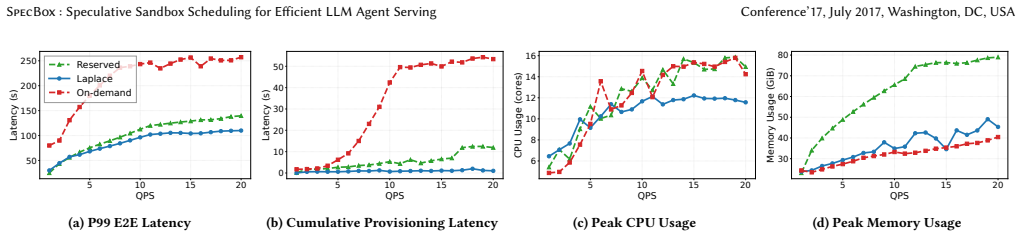
- Tool sandbox provisioning can be moved out of the agent's critical path in most steps: cumulative provisioning latency drops 4.53x and comes within 10.6% of a permanently reserved deployment.
- Cross-step prefetching is where most of the multi-turn gain lives: by turn 10 the proactive variant cuts per-turn wait from about 540 ms to about 97 ms relative to the reactive-only variant, keeping cold starts below one per turn.
- Semantically equivalent but differently worded tool calls can be served from cache: average wait drops 2.91x over no cache, with a 37.4% hit rate on the repeated-request workload.
- Delivering large tool artifacts over a shared-memory reference keeps data-transfer latency nearly flat as payloads grow, reaching about 6 ms at 1 GB versus about 1.87 s for inline JSON-RPC.
- These mechanisms sit in a middleware layer and preserve the tool-facing interface, so existing agent frameworks can adopt the runtime without changing how tools are invoked.
Reading between the lines
- The first-order Markov assumption is the point most likely to limit generalization: if a deployment's tool transitions drift over time or depend on long-horizon plans, the SDG probabilities could go stale; testing on a disjoint train/test split of traces would show how much of the 6.0x cross-step gain is real.
- The same overlap principle transfers to agentic reinforcement learning, where per-rollout environment resets resemble sandbox cold starts; the paper notes this direction but does not evaluate it.
- Semantic caching is only safe for deterministic tools; a production extension would attach per-tool determinism and side-effect annotations and route non-deterministic tools around the cache automatically.
- The prefetch budget B=1 is conservative; if memory pressure allows, dynamically adjusting B with current cold-start cost and cache state could hide more cold starts without reverting to fully reserved deployments.
Editorial analysis
A structured set of objections, weighed in public.
Referee Report
Summary. The paper presents SpecBox, a runtime middleware for LLM agent serving that overlays speculative scheduling on top of sandboxed MCP-style tool execution. It contributes three mechanisms: (i) intent-aware sandbox prewarming that uses keyword and semantic routers on streaming token output to overlap sandbox initialization with LLM decoding; (ii) stochastic sandbox prefetching based on a first-order Markov model over a sandbox dependency graph (SDG); and (iii) reuse-aware data transmission consisting of a semantic result cache and an out-of-band shared-memory data plane. The prototype is integrated with AgentScope and evaluated on 200 MCPBench-derived multi-turn traces using Qwen3.5-Max. The paper reports a 2.9× P99 end-to-end latency improvement over an on-demand baseline and a 45.9% peak-memory reduction versus a reserved-sandbox baseline, with microbenchmarks attributing the gains to each mechanism. The central idea is plausible and the system decomposition is clear, but the evaluation currently does not support the generality of the reported numbers and the semantic cache's correctness guarantee is not demonstrated.
Significance. If the claims hold, SpecBox would be a useful contribution: it identifies a concrete opportunity to hide sandbox cold starts inside LLM token generation, extends prewarming across steps with a lightweight stochastic model, and separates large artifact transfer from the control plane. The authors also provide mechanism-level microbenchmarks, which is a strength. However, the headline latency and memory results are obtained under a single-seed, same-benchmark evaluation with no visible train/test split for the predictive components, and the semantic-result-cache mechanism raises an unverified correctness risk. The contribution is significant but the evidence is currently insufficient as presented.
major comments (4)
- [§5.1, §3.2 (Eq. 4), Fig. 11] The stochastic prefetcher estimates transition probabilities from historical traces and updates them online, but the evaluation replays the same 200 generated sessions with a fixed seed (seed = 0). No train/test split is described for the SDG counts. The reported 6.0× cross-step latency reduction and the E2E speedups are therefore in-sample estimates: the predictor may be memorizing the replayed transitions rather than generalizing. Please add a held-out or leave-one-session-out evaluation, state how many sessions populate the SDG before measurement, and report prediction accuracy on unseen traces.
- [§5.3, §5.1] All decisive operating points (γ=2, τ=0.6, B=1, λ=5, τ_c=0.8) are either explicitly selected from the §5.3 sensitivity experiments or reported only for the same workload, and the E2E evaluation uses one fixed seed. This means the headline numbers are tuned on the test set. Please provide a clear separation of tuning/validation/test traces, or otherwise demonstrate that the thresholds are not selected using the same sessions that produce the reported P99 and memory results. Reporting variance over multiple seeds is also needed.
- [§3.3, Eq. (8); §4; §5.3.3] The semantic cache's reuse condition is only tool(x)=tool(x_i) and sim(φ(x),φ(x_i))≥τ_c. This does not establish functional equivalence: for a deterministic tool, invocations with different arguments, query filters, or file paths can have high embedding similarity yet produce different outputs and side effects. The paper calls this a 'conservative extension of exact reuse' and mentions a validation fallback, but no concrete validation mechanism or formal equivalence condition is given, and the trace replay does not compare cached results against freshly computed outputs. Challenge #3 is therefore not demonstrated, and part of the reported speedup may come from skipped executions that should have run. Please add an explicit correctness check, describe the fallback path, and report output-equality verification on the evaluation traces.
- [Table 4 vs. §4] Table 4 labels the semantic cache experiments as 'Semantic Cache (τ=0.6)', while §4 states that τ_c=0.8 was used in the reported experiments. The 2.91× cache speedup and the 84.8% bypass ratio are thus not tied to the stated production configuration, and the discrepancy is load-bearing for the claimed benefit of semantic caching. Please clarify which threshold was actually used and present results for the relevant threshold range, including the relationship between τ_c, hit rate, and correctness.
minor comments (5)
- [Figures 9 and 10, §5.2] The system is named SpecBox, but several figures and the text in §5.2.2 refer to 'Laplace' or 'Laplace'. This naming inconsistency should be fixed throughout.
- [Table 4] The column 'Bypass Ratio' is ambiguous: it could mean the fraction of cache hits that skip execution, or the fraction that are bypassed for validation. Its meaning should be defined, especially because Exact-Match Cache has a 100.0% value.
- [§5.3.3] Typo: 'sematic caching' should be 'semantic caching'.
- [§8 / Abstract] The conclusion mentions a '97.9% prewarming hit rate' that is not defined or measured in the evaluation section. Please either report the corresponding measurement and definition or remove the claim.
- [§5.1] The workload generation uses an LLM planner and external APIs, but no artifact or code release is mentioned. For reproducibility, specify the exact planner prompts, model version, date of access, and dataset release plan.
Circularity Check
Stochastic sandbox prefetching is fitted to the same 200 traces that are replayed in evaluation, making its 6.0x/97.9% predictive gains in-sample; the rest of SpecBox is empirical rather than circular.
-
fitted input called prediction
[§3.2 (Eqs. 3-4, Online Update) with §5.1 Methodology and §5.3.2 / §8]
"For each ordered pair (v_i,v_j), we maintain transition counts: C_{i,j}←C_{i,j}+1 ... (3). The next-state probability is estimated by a first-order Markov model with Laplace Smoothing: P_{i,j}=... (4). ... After each completed sandbox invocation, SpecBox appends one transition edge to SDG and updates C_{i,j} and P_{i,j} asynchronously ... Unless otherwise specified, we evaluate all systems by replaying full traces as session-level workloads with a fixed random seed (seed = 0)."
The Markov transition probabilities are empirical counts over the very workload used for evaluation. Since §5.1 replays the same 200 trajectories and the online-update paragraph updates C and P during execution, the SDG encodes the test set's own transition frequencies before and while it is being measured. The 'prediction' of the next sandbox is therefore an in-sample majority/empirical-frequency estimate, not an independent forecast. The 6.0x cross-step latency reduction (Fig. 11) and the 97.9% prewarming hit rate (Conclusion) then measure how repetitive the test traces are, not generalization to unseen agent workflows. Routing thresholds (gamma, tau, tau_c) are also chosen on this same benchmark (§5.3), compounding the in-sample selection.
full rationale
SpecBox is an empirical serving system, not a formal derivation, so most of its reported speedups are measurements rather than first-principles predictions. I found no load-bearing self-citation chain: the cited prior work (AgentScope, MCPBench, Cauchy) is used as a framework/benchmark and is not invoked to forbid alternatives or justify the core mechanism. The semantic cache (Eq. 8) is a correctness risk because embedding similarity is asserted, not proven, to imply functional equivalence; that is an omitted proof, not a circular reduction, and I did not score it here. The one structural circularity is the stochastic prefetcher: its probability model is trained on the identical traces that are replayed as the test workload, with no described train/test split, and the headline prefetching gains are in-sample fits. Because this affects one of the three central mechanisms and the main E2E result aggregates that mechanism, the score is 6 rather than 0-2. The paper's own limitation (first-order Markov may be inaccurate in open-ended workflows) acknowledges predictive weakness but does not repair the in-sample evaluation.
Assumptions & free parameters
free parameters (6)
- γ (keyword trigger threshold) =
2
- τ (prefetch probability threshold) =
0.6
- B (prefetch budget) =
1
- λ (cold-start cost threshold) =
5
- τ_c (semantic cache similarity threshold) =
0.8
- Semantic router model =
Retrieval (TF-IDF)
assumptions (5)
- ad hoc to paper Agent tool transitions are well-modeled by a first-order Markov chain over sandbox states
- domain assumption Tool invocations can be classified as deterministic for safe semantic caching
- domain assumption LLM serving frameworks expose streaming token outputs at runtime
- ad hoc to paper Semantically similar normalized invocations imply functionally equivalent results
- domain assumption Sandbox cold-start latency is dominated by application-layer handshakes rather than OS boot, making prewarm effective
Cite this review
Pith. "Pith review of SpecBox: Speculative Sandbox Scheduling for Efficient LLM Agent Serving." pith.science (2026). https://pith.science/paper/DLT44XMK
@misc{pith2026260723933,
  author       = {Pith},
  title        = {Pith review of: SpecBox: Speculative Sandbox Scheduling for Efficient LLM Agent Serving},
  year         = {2026},
  howpublished = {\url{https://pith.science/paper/DLT44XMK}},
  note         = {Machine review of arXiv:2607.23933}
}
abstract
As LLM agents increasingly rely on the Model Context Protocol (MCP) to invoke isolated external sandboxes, disaggregated sandbox deployment introduces a fundamental tension between resource utilization and interactive tail latency. Persistent long-lived sandbox reservations incur excessive memory overhead at scale, while lazy on-demand instantiation generates severe cold-start penalties that degrade response performance under multi-tenant, multi-turn agent workloads. To resolve this dilemma, we present SpecBox, a runtime built around speculative sandbox preallocation tailored for dynamic LLM agent execution pipelines. At its core, SpecBox implements keyword matching and streaming semantic embedding to enable intent-driven sandbox prewarming, which identifies pending tool execution demands mid-LLM token generation and fully overlaps sandbox bootstrapping with model inference. To extend prewarming windows across sequential agent steps, the framework leverages context-aware stochastic prefetching atop a sandbox dependency graph to probabilistically forecast future sandbox switches ahead of execution. We complement these speculative mechanisms with two orthogonal optimizations: a semantic result cache that prunes redundant repeated sandbox invocations, and a dedicated out-of-band shared-memory transport plane that bypasses conventional network serialization to deliver zero-copy artifact transfers. Evaluated on high-concurrency multi-turn agent traces, our prototype demonstrates that SpecBox cuts P99 end-to-end latency by up to $2.9\times$ relative to the on-demand sandbox baseline, while slashing peak memory consumption by $45.9\%$ compared to permanently reserved sandbox deployments.
Figures


Figures from the paper (9 more)




Reviewed July 31, 2026 · model on record in the stance chip above.
Discussion (0). Sign in to comment.