REVIEW 3 major objections 6 minor 120 references
Strong play on interactive abstraction games depends on deciding when to build and use a model, not only on how accurately that model replays the past.
Reviewed by Pith at T0; open to challenge. T0 means a machine referee read the full paper against a public rubric. the ladder, T0–T4 →
T0 review · grok-4.5
2026-07-31 12:13 UTC pith:N6TRYE45
load-bearing objection Strong systems paper with a real negative result: transition-perfect repair loses to selective model use, but the policy ranking sits on n=1 public runs that include development games. the 3 major comments →
Tycho: Active Abstraction with Programmatic World Models for ARC-AGI-3
The pith
A machine-rendered reading of the paper's core claim, the machinery that carries it, and where it could break.
Core claim
The paper establishes that strong ARC-AGI-3 play requires active abstraction, not transition accuracy alone. Under matched public-set runs, actor-requested delegation to a model builder reached the highest mean Relative Human Action Efficiency among four policies (88.49). Automatic verification-triggered repair produced far higher accepted transition match but only 83.07. With the selected policy, two frontier models both reached 100.00 RHAE and finished all 183 levels, one using 61% fewer scored actions than the aggregate official human baselines.
What carries the argument
Active abstraction, implemented by Tycho’s optional programmatic world models over rendered deterministic Moore machines. A free-form executable hypothesis exposes initialization, transition, partial rendering, and outcome classification; verification and planning thread state from typed history; four policies vary who builds or repairs the model and when, while only the actor may commit environment actions.
Load-bearing premise
The policy ranking and perfect scores rest on one run of each setup on the same 25 public games, several of which helped shape the system during development.
What would settle it
Freeze the harness, then run repeated independent evaluations on newly released games never used in development; if actor-requested delegation no longer beats automatic repair, or perfect public-set scores collapse off that set, the central system claim fails.
If this is right
- Transition match is an incomplete success metric when goals are hidden and every exploratory action is scored.
- Making model construction optional and actor-gated can outperform always-on repair under the same inference budget.
- Free-form executable hypotheses can support planning without a fixed object schema if history, verification, and partial rendering are explicit.
- Action-efficiency headlines can hide large unscored inference costs that still dominate total resource use.
- The same limited-feedback loop can be aimed one level up: from task models to revisions of the agent harness itself.
Where Pith is reading between the lines
- Metareasoning over whether to invoke a simulator may matter as much as simulator fidelity in other scarce-interaction settings such as UI automation or lab protocols.
- Renderers that abstain on unknown pixels offer a practical middle path between full observation models and pure latent planners.
- If repair overfits dynamics while missing objectives, agents may need a separate budget for goal hypotheses rather than one world-model loop.
- Public-set saturation at 100 RHAE will force evaluation toward held-out games and multi-run statistics sooner than architecture claims alone would.
Editorial analysis
A structured set of objections, weighed in public.
Referee Report
Summary. The paper formalizes ARC-AGI-3 games as parameterized rendered deterministic Moore machines with typed interaction history, and presents Tycho, a coding-agent harness that can construct, verify, plan with, repair, or bypass free-form Python world models during scored interaction. In a matched four-policy comparison on all 25 public games with Claude Opus 4.8, actor-requested builder delegation (Orchestrator) achieves the highest observed mean RHAE (88.49), while automatic verification-triggered repair (Trigger) yields much higher accepted transition match but only 83.07 RHAE. With Orchestrator fixed, GPT-5.6 Sol and Opus 5 both reach 100.00 RHAE and complete all 183 levels; Opus 5 uses substantially fewer scored actions than official human baselines. The authors frame the joint problem as active abstraction: building a testable model from costly interaction and deciding when modeling is worth its cost.
Significance. If the results hold, this is a substantial contribution to interactive abstraction and agent world-model research. Strengths include a clean formal setting that separates hidden state, transient emissions, and terminal outcomes; an explicit, auditable comparison of model-allocation policies rather than only model synthesis; careful separation of transition match from gameplay; public competition-replay scorecards; rich pre-action and end-of-run diagnostics; human-replay midranks; cost normalization against contemporaneous systems; and strong qualitative case studies (cd82, tu93, sk48, tr87, ka59, ls20) that make the active-abstraction thesis concrete. The dissociation between high transition fidelity and weaker play is an important, falsifiable systems finding for the world-model agenda. Open-source release and protocol transparency further raise the work’s value as a reference point for ARC-AGI-3 agent evaluation.
major comments (3)
- [§5.1, Table 3, Figure 8] §5.1 and Table 3: The load-bearing scientific claim is not only that frontier Orchestrator runs hit 100 RHAE, but that actor-requested delegation is the best of four matched policies and that this gap, against Trigger’s much higher transition match, supports active abstraction over transition accuracy alone. That ranking rests on one stochastic trajectory per policy on the same 25 public games. The Orchestrator−Trigger paired delta is +5.43 with a game-bootstrap interval that includes zero ([−6.73, 16.44]), many games tie at saturation, and some reverse the ranking (e.g., sk48 in Fig. 8, where Trigger completes the game and Orchestrator does not). The observed ordering is still informative, but the manuscript should not treat policy selection as settled without either (i) repeated runs on at least a substantial subset under the same budgets, or (ii) a clearly demoted claim language plus
- [§5, Limitations] §5 opening and Limitations: Five games (tr87, vc33, r11l, bp35, ft09) informed harness development and remain inside the 25-game scorecards used both to select Orchestrator and to headline 100 RHAE. The paper correctly flags that results characterize a fixed public testbed, not unseen-game generalization. For the central policy-comparison claim this is load-bearing: please report full matched-policy and selected-policy aggregates with the five development games excluded (and, if sample size allows, with the three early-preview games excluded as a contamination sensitivity). Without those numbers in the main results, it is hard to judge how much of the Orchestrator advantage and ceiling performance is carried by games that shaped the harness.
- [§4.4, Appendix C.2, Table 7] §4.4 / Appendix C.2 and Table 7: Trigger’s verifier gates (accepted match < 0.999, coverage < 0.75, lifecycle builder calls) are free parameters fixed during development and not ablated. Because Trigger is the foil that supplies high transition match with lower RHAE, the active-abstraction argument depends on Trigger being a reasonable automatic-repair policy rather than an over-calling straw man. A minimal sensitivity—e.g., fewer lifecycle invocations or a looser match threshold on a subset—or an explicit argument that the chosen gates match the intended ‘repair when unusable’ semantics would make the Orchestrator vs Trigger contrast more convincing.
minor comments (6)
- [Abstract, Table 4] Abstract and §5.1: ‘midranks of 98.5 and 100.0’ vs Table 4’s 98.47 and 100.00—harmonize rounding and state once that midrank is game-balanced over uneven per-game human sample sizes (10–54).
- [§2] Related Work cost comparisons are useful but dense; a short table of protocol tags (single-pass vs conditional rerun, action limit, model) next to RHAE/midrank/cost would reduce the risk of readers equating headline numbers across incompatible protocols.
- [§3.1–3.2] Definition 1 / Figure 2: The non-Markov scrolling example is excellent; consider explicitly cross-referencing Proposition 1 there so the formal insufficiency claim is tied to the figure on first reading.
- [Table 2, Table 10] Table 2: Clarify that the $750 / $1,500 inference ceilings and 3500 LM-call budgets are harness stops, and that several matched-study failures are budget-censored (already partly in Table 10)—a one-sentence pointer in the main text would help.
- [§5.2] §5.2 sk48 case: Strong counterexample to ‘accurate dynamics ⇒ good play’; add the Trigger action count on sk48 beside Orchestrator’s 314 failed actions for a sharper paired contrast.
- [Abstract / front matter] Minor polish: spacing in ‘at88.49’, ‘reaches100.00RHAE’, and similar run-on number/unit strings in the front matter; fix for camera-ready.
Circularity Check
No derivation circularity: RHAE, completion, and policy ranking are external empirical outcomes, not quantities forced by Tycho’s definitions or self-citation.
full rationale
Tycho is an empirical systems paper. Its load-bearing claims are (i) a matched four-policy comparison on the 25 public ARC-AGI-3 games and (ii) the observation that higher accepted transition match (Trigger) does not yield higher RHAE than actor-requested delegation (Orchestrator). Official RHAE, level completion, scored actions, and human-replay midranks are defined by the ARC Prize protocol and external human baselines, not by Tycho’s world-model loss, verifier thresholds, or fitted objectives. The rendered Moore-machine formalization is a modeling contract for evidence and verification; it does not algebraically entail any policy’s score. “Active abstraction” names the empirical allocation problem (when to build/use/bypass), not a self-definitional identity between transition match and play quality—the paper’s point is precisely that those come apart. Related-work self-citations (WorldCoder, TheoryCoder, etc.) are background, not uniqueness theorems that force the Orchestrator ranking. Development on five public games and n=1 runs are generalization/reliability threats, not circular reductions of prediction to fitted input. No step reduces Eq./metric Y to input X by construction.
Axiom & Free-Parameter Ledger
free parameters (4)
- Trigger verifier gates (accepted match < 0.999; coverage < 0.75) =
0.999 match; 0.75 coverage
- LM-call budget per game and inference dollar ceilings =
3500 calls; $750 / $1500
- Policy-selection backbone (single Opus 4.8 run per policy) =
n=1 per policy
- Development-game subset inside public eval =
5/25 games
axioms (5)
- domain assumption ARC-AGI-3 levels behave as deterministic rendered environments for fixed version and initial configuration; legal action + full latent state yields one successor.
- domain assumption Official RHAE (human upper-median baselines, per-level cap 115, later-level weights) is the primary measure of skill-acquisition efficiency.
- ad hoc to paper A free-form Python program with init/transition/render/outcome is an adequate executable hypothesis language for these games.
- ad hoc to paper Only the actor may commit environment actions; builders only edit models and advise.
- standard math Standard deterministic automata / Moore-machine semantics and ordinary planning search are valid background math for the formalization.
invented entities (3)
-
Active abstraction
no independent evidence
-
Parameterized rendered deterministic Moore machine with transition emissions (game formalization)
independent evidence
-
Tycho four model-maintenance policies (No-WM, Single, Orchestrator, Trigger)
independent evidence
read the original abstract
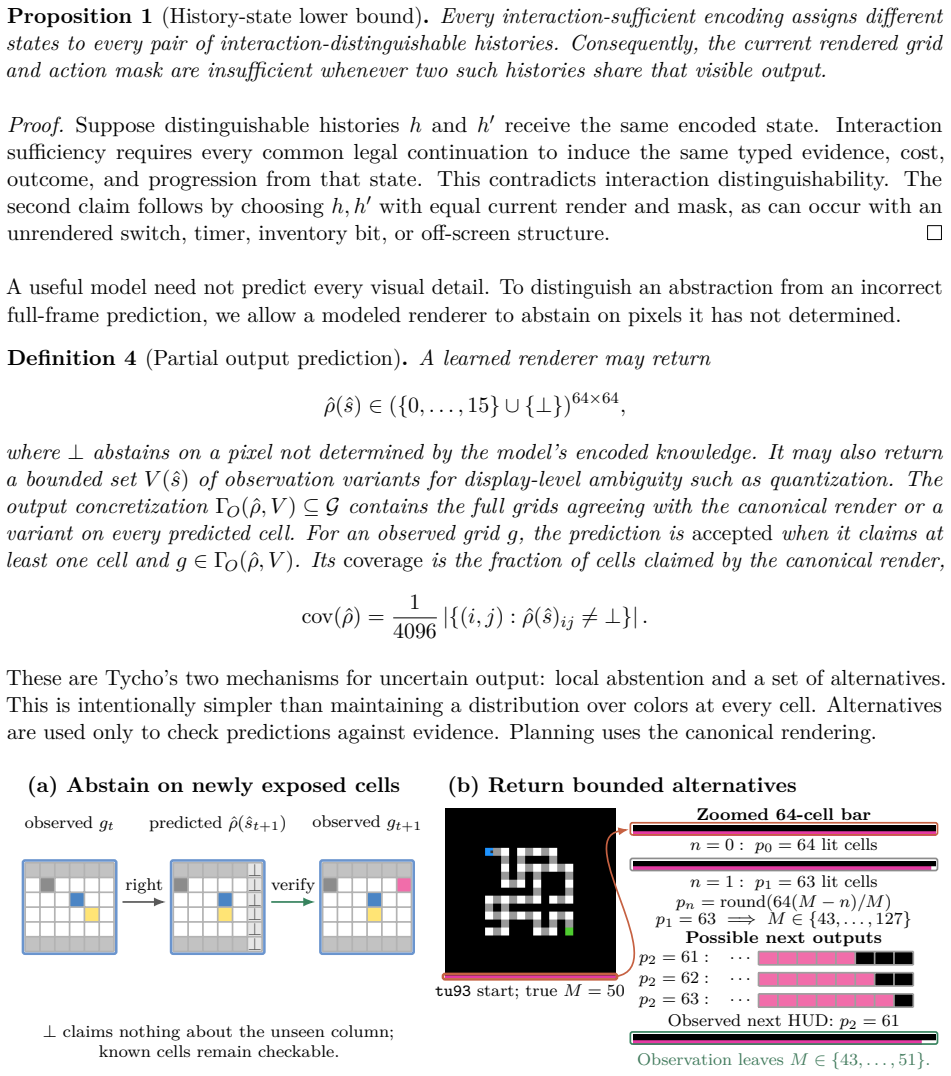
ARC-AGI-3 turns abstraction into an interactive problem of skill acquisition. A player must infer an unfamiliar game's rules, hidden state, and goal while maintaining action efficiency because every move counts. We formalize these environments as parameterized rendered deterministic Moore machines and introduce Tycho, a coding-agent system that constructs and uses game-specific models during interaction. Tycho separates actionable observations from intermediate animation, level-completion, and game-over frames. From this structured history, an agent can model, test, plan with, repair, or bypass a free-form executable hypothesis. In one matched public-set run per policy, we compare four orchestration policies on all 25 public games using Claude Opus 4.8 under matched inference budgets. Actor-requested delegation to a model builder obtains the highest observed mean Relative Human Action Efficiency (RHAE), 88.49. With this selected policy, GPT-5.6 Sol and Opus 5 both reach 100.00 RHAE and complete all 183 levels. Their game-balanced first-run human-replay midranks are 98.5 and 100.0. Opus 5 uses 61% fewer scored actions than the aggregate official human baselines. Automatic repair after verification failures produces models that reproduce observed transitions much more accurately, yet reaches only 83.07 RHAE. Transition match indicates whether a simulator reproduces observed dynamics, not whether it has identified the objective or improves the next action. Strong play also requires deciding when to construct, repair, use, or bypass a model. We call this joint problem active abstraction: generating a testable model from costly interaction and deciding when acquiring or using it is worth its cost.
Figures




Reference graph
Works this paper leans on
-
[1]
L. A. Agrawal, S. Tan, D. Soylu, N. Ziems, R. Khare, K. Opsahl-Ong, A. Singhvi, H. Shandilya, M. J. Ryan, M. Jiang, C. Potts, K. Sen, A. G. Dimakis, I. Stoica, D. Klein, M. Zaharia, and O. Khattab. GEPA : Reflective prompt evolution can outperform reinforcement learning. In International Conference on Learning Representations, 2026. URL https://openreview...
2026
-
[2]
Ahmed, J
Z. Ahmed, J. B. Tenenbaum, C. Bates, and S. J. Gershman. Synthesizing world models for bilevel planning. Transactions on Machine Learning Research, 2025. URL https://openreview.net/forum?id=m9V4JHLJrD
2025
-
[4]
D. Angluin. Learning regular sets from queries and counterexamples. Information and Computation, 75 0 (2): 0 87--106, 1987. doi:10.1016/0890-5401(87)90052-6
-
[5]
Models overview
Anthropic . Models overview. https://platform.claude.com/docs/en/about-claude/models/overview, 2026 a . Accessed 2026-07-29
2026
-
[6]
Claude pricing
Anthropic . Claude pricing. https://platform.claude.com/docs/en/about-claude/pricing, 2026 b . Accessed 2026-07-22
2026
-
[7]
ARC-AGI-3 scoring methodology
ARC Prize Foundation . ARC-AGI-3 scoring methodology. https://docs.arcprize.org/methodology, 2026 a . Accessed 2026-07-09
2026
-
[9]
ARC-AGI community leaderboard
ARC Prize Foundation . ARC-AGI community leaderboard. https://arcprize.org/leaderboard/community, 2026 c . Accessed 2026-07-22
2026
-
[11]
Bessis, J
H. Bessis, J. Cottaar, I. Pressman, A. Smit, M. Te s nar, and S. Viel. Duck harness: Winning solution for ARC-AGI-3 milestone 1. https://tufalabs.ai/research/duck-harness/, 2026. Published 2026-07-01; accessed 2026-07-22
2026
-
[12]
Bonet and H
B. Bonet and H. Geffner. Planning with incomplete information as heuristic search in belief space. In Proceedings of the Fifth International Conference on Artificial Intelligence Planning and Scheduling (AIPS), pages 52--61. AAAI Press, 2000
2000
-
[13]
M. Chen, J. Wang, Z. Liu, Y. Wang, H. Zheng, and Q. Wang. From failed trajectories to reliable LLM agents: Diagnosing and repairing harness flaws. arXiv preprint arXiv:2606.06324, 2026
Pith/arXiv arXiv 2026
-
[15]
D. Courtis, W. Li, and S. Sanner. OPINE-World : Programmatic world modeling with ontology-error-prioritized interactive exploration for ARC-AGI-3 . arXiv preprint arXiv:2607.01531, 2026
Pith/arXiv arXiv 2026
-
[16]
N. Dainese, M. Merler, M. Alakuijala, and P. Marttinen. Generating code world models with large language models guided by monte carlo tree search. In Advances in Neural Information Processing Systems, volume 37, pages 60429--60474, 2024. doi:10.52202/079017-1933
-
[17]
C. Elsworth, K. Huang, D. Patterson, I. Schneider, R. Sedivy, S. Goodman, B. Townsend, P. Ranganathan, J. Dean, A. Vahdat, B. Gomes, and J. Manyika. Measuring the environmental impact of delivering AI at Google scale. arXiv preprint arXiv:2508.15734, 2025
Pith/arXiv arXiv 2025
-
[18]
A. Fox, J. Wang, P. Rosu, and B. Dhingra. PRO-LONG : Programmatic memory enables long-horizon reasoning. arXiv preprint arXiv:2607.20064, 2026 a
Pith/arXiv arXiv 2026
-
[19]
A. Fox, J. Wang, P. Rosu, and B. Dhingra. PRO-LONG source code, scorecards, and run logs. https://github.com/alexisfox7/PRO-LONG, 2026 b . Repository revision 7268de0 ; accessed 2026-07-28
2026
-
[21]
G. Giantamidis, S. Tripakis, and S. Basagiannis. Learning Moore machines from input-output traces. International Journal on Software Tools for Technology Transfer, 23 0 (1): 0 1--29, 2021. doi:10.1007/s10009-019-00544-0
-
[22]
Grimm, A
C. Grimm, A. Barreto, S. P. Singh, and D. Silver. The value equivalence principle for model-based reinforcement learning. In Advances in Neural Information Processing Systems, volume 33, pages 5541--5552, 2020. URL https://proceedings.neurips.cc/paper_files/paper/2020/hash/3bb585ea00014b0e3ebe4c6dd165a358-Abstract.html
2020
-
[23]
Ha and J
D. Ha and J. Schmidhuber. Recurrent world models facilitate policy evolution. In Advances in Neural Information Processing Systems, volume 31, pages 2450--2462, 2018
2018
-
[24]
Hafner, T
D. Hafner, T. Lillicrap, J. Ba, and M. Norouzi. Dream to control: Learning behaviors by latent imagination. In International Conference on Learning Representations (ICLR), 2020. URL https://openreview.net/forum?id=S1lOTC4tDS
2020
-
[25]
L. K. Han. AERA ARC-AGI-3 evaluation code. GitHub, https://github.com/farmountain/aera-arc3-paper, 2026 a . Repository revision https://github.com/farmountain/aera-arc3-paper/tree/53ba4db1d715cd75c28640ca1a2ddd444cd02e89 53ba4db . Accessed 2026-07-30
2026
-
[26]
L. K. Han. Explore before you solve: The speed--depth trade-off in epistemic agents for ARC-AGI-3 . arXiv preprint arXiv:2605.25931, 2026 b
Pith/arXiv arXiv 2026
-
[27]
R. A. Howard. Information value theory. IEEE Transactions on Systems Science and Cybernetics, 2 0 (1): 0 22--26, 1966. doi:10.1109/TSSC.1966.300074
arXiv 1966
-
[28]
S. Hu, C. Lu, and J. Clune. Automated design of agentic systems. In International Conference on Learning Representations, 2025. URL https://proceedings.iclr.cc/paper_files/paper/2025/hash/36b7acf6f6010652b3f2a433774a66fe-Abstract-Conference.html
2025
-
[29]
L. P. Kaelbling, M. L. Littman, and A. R. Cassandra. Planning and acting in partially observable stochastic domains. Artificial Intelligence, 101 0 (1--2): 0 99--134, 1998. doi:10.1016/S0004-3702(98)00023-X
-
[30]
G. Kamradt. Analyzing GPT-5.5 & Opus 4.7 with ARC-AGI-3 . ARC Prize Foundation, https://arcprize.org/blog/arc-agi-3-gpt-5-5-opus-4-7-analysis, 2026 a . Published 2026-05-01; accessed 2026-07-22
2026
-
[31]
G. Kamradt. Measuring human performance on ARC-AGI-3 . https://arcprize.org/blog/arc-agi-3-human-dataset, 2026 b . Published 2026-04-14; accessed 2026-07-22
2026
-
[32]
Kapoor, B
S. Kapoor, B. Stroebl, Z. S. Siegel, N. Nadgir, and A. Narayanan. AI agents that matter. Transactions on Machine Learning Research, 2025. URL https://openreview.net/forum?id=Zy4uFzMviZ
2025
-
[34]
E. D. Klenske and P. Hennig. Dual control for approximate bayesian reinforcement learning. Journal of Machine Learning Research, 17 0 (127): 0 1--30, 2016
2016
-
[35]
Lambert, B
N. Lambert, B. Amos, O. Yadan, and R. Calandra. Objective mismatch in model-based reinforcement learning. In Proceedings of the 2nd Conference on Learning for Dynamics and Control, volume 120 of Proceedings of Machine Learning Research, pages 761--770, 2020
2020
-
[36]
W.-D. Li, K. Hu, C. Larsen, Y. Wu, S. Alford, C. Woo, S. M. Dunn, H. Tang, W.-L. Zheng, Y. Pu, and K. Ellis. Combining induction and transduction for abstract reasoning. In The Thirteenth International Conference on Learning Representations, 2025. URL https://openreview.net/forum?id=UmdotAAVDe
2025
-
[37]
Locatello, D
F. Locatello, D. Weissenborn, T. Unterthiner, A. Mahendran, G. Heigold, J. Uszkoreit, A. Dosovitskiy, and T. Kipf. Object-centric learning with slot attention. In Advances in Neural Information Processing Systems, volume 33, pages 11594--11604, 2020
2020
-
[38]
D. J. C. MacKay. Information-based objective functions for active data selection. Neural Computation, 4 0 (4): 0 590--604, 1992. doi:10.1162/neco.1992.4.4.590
-
[39]
R. Menaged, G. Lior, S. Ravfogel, R. Aharoni, and G. Stanovsky. Can LLM agents infer world models? evidence from agentic automata learning. arXiv preprint arXiv:2606.16576, 2026
arXiv 2026
-
[40]
GPT-5.6 Sol Model
OpenAI . GPT-5.6 Sol Model . OpenAI API documentation, 2026. URL https://developers.openai.com/api/docs/models/gpt-5.6-sol. Accessed 2026-07-22
2026
- [41]
-
[43]
W. T. Piriyakulkij, Y. Liang, H. Tang, A. Weller, M. Kryven, and K. Ellis. PoE-World : Compositional world modeling with products of programmatic experts. In Advances in Neural Information Processing Systems, volume 38, 2025. URL https://proceedings.neurips.cc/paper_files/paper/2025/hash/262dd62fd1bbb30d6a6b4d578f5e65ff-Abstract-Conference.html
2025
-
[45]
R. L. Rivest and R. E. Schapire. Inference of finite automata using homing sequences. Information and Computation, 103 0 (2): 0 299--347, 1993. doi:10.1006/inco.1993.1021
arXiv 1993
-
[47]
S. Rodionov. Do coding agents need executable world models, simplification, and verification to solve ARC-AGI-3 ? arXiv preprint arXiv:2607.15439, 2026 b
Pith/arXiv arXiv 2026
-
[48]
S. Rodionov. Executable world models for ARC-AGI-3 in the era of coding agents. arXiv preprint arXiv:2605.05138, 2026 c . Accepted at AGI-2026
Pith/arXiv arXiv 2026
-
[49]
E. Rudakov, J. Shock, and B. U. Cowley. Graph-based exploration for ARC-AGI-3 interactive reasoning tasks. arXiv preprint arXiv:2512.24156, 2025
arXiv 2025
-
[50]
S. Russell and E. Wefald. Principles of metareasoning. Artificial Intelligence, 49 0 (1--3): 0 361--395, 1991. doi:10.1016/0004-3702(91)90015-C
-
[52]
B. Sch \"o lkopf, F. Locatello, S. Bauer, N. R. Ke, N. Kalchbrenner, A. Goyal, and Y. Bengio. Toward causal representation learning. Proceedings of the IEEE, 109 0 (5): 0 612--634, 2021. doi:10.1109/JPROC.2021.3058954
arXiv 2021
-
[53]
J. Schrittwieser, I. Antonoglou, T. Hubert, K. Simonyan, L. Sifre, S. Schmitt, A. Guez, E. Lockhart, D. Hassabis, T. Graepel, T. Lillicrap, and D. Silver. Mastering Atari , Go , chess and shogi by planning with a learned model. Nature, 588: 0 604--609, 2020. doi:10.1038/s41586-020-03051-4
-
[54]
N. Shinn, F. Cassano, A. Gopinath, K. Narasimhan, and S. Yao. Reflexion: Language agents with verbal reinforcement learning. In Advances in Neural Information Processing Systems, volume 36, pages 8634--8652, 2023. doi:10.52202/075280-0377
-
[55]
H. Tang, D. Key, and K. Ellis. WorldCoder , a model-based LLM agent: Building world models by writing code and interacting with the environment. In Advances in Neural Information Processing Systems, volume 37, pages 70148--70212, 2024. doi:10.52202/079017-2243
-
[56]
P. Tsividis, J. Loula, J. Burga, J. P. Rodriguez, S. Arnaud, N. Foss, A. Campero, A. Subramanian, T. Pouncy, S. J. Gershman, and J. B. Tenenbaum. Human-level learning of complex novel tasks as theory-based modelling, exploration and planning. Philosophical Transactions of the Royal Society A, 384 0 (2320): 0 20240529, 2026. doi:10.1098/rsta.2024.0529
arXiv 2026
-
[57]
F. Vaandrager, B. Garhewal, J. Rot, and T. Wi mann. A new approach for active automata learning based on apartness. In Tools and Algorithms for the Construction and Analysis of Systems, volume 13243 of Lecture Notes in Computer Science, pages 223--243. Springer, 2022. doi:10.1007/978-3-030-99524-9_12
-
[58]
S. Vahdati, A. Aioanei, H. Suresh, and J. Lehmann. The ARC of progress towards AGI : A living survey of abstraction and reasoning. arXiv preprint arXiv:2603.13372, 2026
arXiv 2026
-
[59]
G. Wang, Y. Xie, Y. Jiang, A. Mandlekar, C. Xiao, Y. Zhu, L. Fan, and A. Anandkumar. Voyager: An open-ended embodied agent with large language models. Transactions on Machine Learning Research, 2024. URL https://openreview.net/forum?id=ehfRiF0R3a
2024
-
[60]
Warrier, T
A. Warrier, T. D. Nguyen, M. Naim, M. Jain, Y. Liang, K. Schroeder, C. Yang, J. B. Tenenbaum, S. Vollmer, K. Ellis, and Z. Tavares. Benchmarking world-model learning with environment-level queries. In Proceedings of the Forty-third International Conference on Machine Learning, volume 306 of Proceedings of Machine Learning Research, 2026. URL https://openr...
2026
-
[61]
J. Yang, C. E. Jimenez, A. Wettig, K. Lieret, S. Yao, K. Narasimhan, and O. Press. SWE-agent : Agent-computer interfaces enable automated software engineering. In Advances in Neural Information Processing Systems, volume 37, pages 50528--50652, 2024. doi:10.52202/079017-1601
-
[62]
S. Yao, J. Zhao, D. Yu, N. Du, I. Shafran, K. Narasimhan, and Y. Cao. React: Synergizing reasoning and acting in language models. In International Conference on Learning Representations (ICLR), 2023. URL https://openreview.net/forum?id=WE_vluYUL-X
2023
-
[64]
Y. Yu, P. Herman, D. L. Rothman, D. Agarwal, and F. Hyder. Evaluating the gray and white matter energy budgets of human brain function. Journal of Cerebral Blood Flow & Metabolism, 38 0 (8): 0 1339--1353, 2018. doi:10.1177/0271678X17708691
-
[65]
G. Zeng, J. Wang, W. Ma, S. Yin, C. Wang, S. Liu, A. Kanazawa, W. Ni, X. Li, A. Zanette, and H. Feng. Frontier models with our harness achieve 99\ public--- Schema . Impossible Research, https://schema-harness.github.io/, 2026. Project report; retained traces at https://huggingface.co/datasets/schema-harness/arc-agi-3-schema-traces; accessed 2026-07-22
2026
- [66]
-
[67]
arXiv preprint arXiv:1911.01547 , year=
On the Measure of Intelligence , author=. arXiv preprint arXiv:1911.01547 , year=
Pith/arXiv arXiv 1911
-
[68]
The Thirteenth International Conference on Learning Representations , year=
Combining Induction and Transduction for Abstract Reasoning , author=. The Thirteenth International Conference on Learning Representations , year=
-
[69]
Artificial Intelligence , volume=
Planning and acting in partially observable stochastic domains , author=. Artificial Intelligence , volume=. 1998 , publisher=
1998
-
[70]
Information and Computation , volume=
Learning regular sets from queries and counterexamples , author=. Information and Computation , volume=. 1987 , publisher=
1987
-
[71]
Information and Computation , volume=
Inference of finite automata using homing sequences , author=. Information and Computation , volume=. 1993 , publisher=
1993
-
[72]
arXiv preprint arXiv:2603.24621 , year=
-
[73]
Vahdati, Sahar and Aioanei, Andrei and Suresh, Haridhra and Lehmann, Jens , journal=. The
-
[74]
2026 , howpublished=
2026
-
[75]
Measuring Human Performance on
Kamradt, Greg , year=. Measuring Human Performance on
-
[76]
Journal of Cerebral Blood Flow & Metabolism , volume=
Evaluating the Gray and White Matter Energy Budgets of Human Brain Function , author=. Journal of Cerebral Blood Flow & Metabolism , volume=. 2018 , doi=
2018
-
[77]
Measuring the Environmental Impact of Delivering
Elsworth, Cooper and Huang, Keguo and Patterson, David and Schneider, Ian and Sedivy, Robert and Goodman, Savannah and Townsend, Ben and Ranganathan, Parthasarathy and Dean, Jeff and Vahdat, Amin and Gomes, Ben and Manyika, James , journal=. Measuring the Environmental Impact of Delivering
-
[78]
, journal=
Oviedo, Felipe and Kazhamiaka, Fiodar and Choukse, Esha and Kim, Allen and Luers, Amy and Nakagawa, Melanie and Bianchini, Ricardo and Lavista Ferres, Juan M. , journal=. Energy Use of. 2026 , doi=
2026
-
[79]
2026 , howpublished=
Claude Pricing , author=. 2026 , howpublished=
2026
-
[80]
2026 , howpublished=
Models Overview , author=. 2026 , howpublished=
2026
-
[81]
Executable World Models for
Rodionov, Sergey , journal=. Executable World Models for
-
[82]
Do Coding Agents Need Executable World Models, Simplification, and Verification to Solve
Rodionov, Sergey , journal=. Do Coding Agents Need Executable World Models, Simplification, and Verification to Solve
-
[83]
Rodionov, Sergey , year=. Supporting Data and Full Run Artifacts for ``Do Coding Agents Need Executable World Models, Simplification, and Verification to Solve. doi:10.5281/zenodo.21412274 , howpublished=
-
[84]
arXiv preprint arXiv:2507.12821 , year=
Assessing Adaptive World Models in Machines with Novel Games , author=. arXiv preprint arXiv:2507.12821 , year=
-
[85]
arXiv preprint arXiv:2605.09650 , year=
Workspace Optimization: How to Train Your Agent , author=. arXiv preprint arXiv:2605.09650 , year=
-
[86]
arXiv preprint arXiv:2605.09998 , year=
Continual Harness: Online Adaptation for Self-Improving Foundation Agents , author=. arXiv preprint arXiv:2605.09998 , year=
-
[87]
arXiv preprint arXiv:2607.20709 , year=
Furgale, Paul and Klingler, Severin and Nolan, James and Staats, Matt and Di Lorenzo, Gaia and Martinez Abad, Elisa and Sch. arXiv preprint arXiv:2607.20709 , year=
-
[88]
Duck Harness: Winning Solution for
Bessis, Harold and Cottaar, Jeroen and Pressman, Isaiah and Smit, Andries and Te. Duck Harness: Winning Solution for. 2026 , howpublished=
2026
-
[89]
Frontier Models with Our Harness Achieve
Zeng, Guanning and Wang, Jiani and Ma, Wenjie and Yin, Shaofeng and Wang, Chenyang and Liu, Shichen and Kanazawa, Angjoo and Ni, Wode and Li, Xiuyu and Zanette, Andrea and Feng, Haiwen , year=. Frontier Models with Our Harness Achieve
-
[90]
Fox, Alexis and Wang, Junlin and Rosu, Paul and Dhingra, Bhuwan , journal=
-
[91]
Fox, Alexis and Wang, Junlin and Rosu, Paul and Dhingra, Bhuwan , year=
discussion (0)
Sign in with ORCID, Apple, or X to comment. Anyone can read and Pith papers without signing in.