REVIEW 4 major objections 5 minor 110 references
Recursive Gaussian Processes and the Bayesian Brain
T0 review · 4 major / 5 minor · reviewed 2026-08-05 · deepseek-v4-flash
Pith's one-line read Recursive Gaussian processes, a single GP indexed by layer and input, are claimed to implement predictive coding and minimize variational free energy, mapping onto the cortical microcircuit component by component.
desk verdict A useful conceptual mapping of RGPs onto predictive coding, but the formal universal-approximation claim is unproved and unlikely to hold as stated. read the letter →
The pith
A machine-rendered reading of the paper's core claim, the machinery that carries it, and where it could break.
The reading
What carries the argument
The load-bearing object is the single recursive Gaussian process g(t,·), a GP indexed jointly by layer index t and input value z, with a structured covariance that separates cross-layer correlation (r1g) from input-space correlation (r2g). Because every layer is an evaluation of one shared function, layers can neither collapse into the degenerate constant or white-noise limits that afflict stacked independent GPs nor be forced into independence; the data learns the degree of sharing through r1g. Around this object are two supporting mechanisms: spike-and-slab priors on connection weights, which implement variable selection and act as the paper's analog of precision-weighted gain control, and
What would settle it
Compute the RGP KL-divergence floor h(Θ) for a target function outside the RGP class—say a discontinuous or highly oscillatory regression function—and record whether the precision-weighted prediction-error term falls below epsilon as recursion depth T grows; if the floor stays bounded away from zero, the free-energy-minimization claim as stated is false. A second, experimental falsifier: measure task-dependent changes in cross-area functional connectivity; if r1g never tracks task demands in the predicted direction, the laminar-specific mapping loses its empirical anchor.
Extended reading notes
Core claim
The central claim is that RGP inference is Bayesian brain inference in a formal, not merely metaphorical, sense. The RGP defines a single GP g(t, z) over layer index and input, with covariance exp(−r1g(t1−t2)²/T² − r2g(z1−z2)²/ρ²), so layer functions g(t)(·)=g(t,·) share statistical strength to a degree learned from data via r1g. Recursively composing these layer functions and inferring weights, biases, and precision parameters by MCMC yields a posterior whose large-sample behavior is governed by the KL divergence rate h(θ) = log(σϵ/σ0) − 1/2 + σ0²/(2σϵ²) + 1/(2σϵ²) Σ E[(ηT − η0)²]. The normalized variational free energy equals E_q[h(θ)] + (1/n)D_KL[q‖p] plus a constant, so minimizing free e
Load-bearing premise
The argument leans on an unproved universal-approximation assertion: for any epsilon, some sufficiently deep RGP function comes within epsilon of the true regression function; if that fails for a target function, the claimed zero floor on prediction error and the misspecification bound collapse, though the predictive-coding interpretation could still stand.
Editorial extensions
If this is right
- If RGP inference minimizes variational free energy, predictive coding can be realized by a fully Bayesian nonparametric model rather than only by gradient-based or linear-dynamics approximations.
- The learnable correlation r1g predicts that functional similarity between cortical areas is task-modulated: tasks requiring independent processing should lower r1g, coupled tasks should raise it, a measurable fMRI or electrophysiology prediction.
- Repetition suppression and mismatch negativity emerge as consequences of MCMC posterior refinement: repeated stimuli shrink prediction errors as the posterior converges, while deviants generate large prediction errors under the converged posterior.
- The depth-performance curve (best at T=4, deteriorating for T≥6) suggests cortical hierarchies have an optimal depth beyond which additional levels add error, a systems-level claim that can be probed empirically.
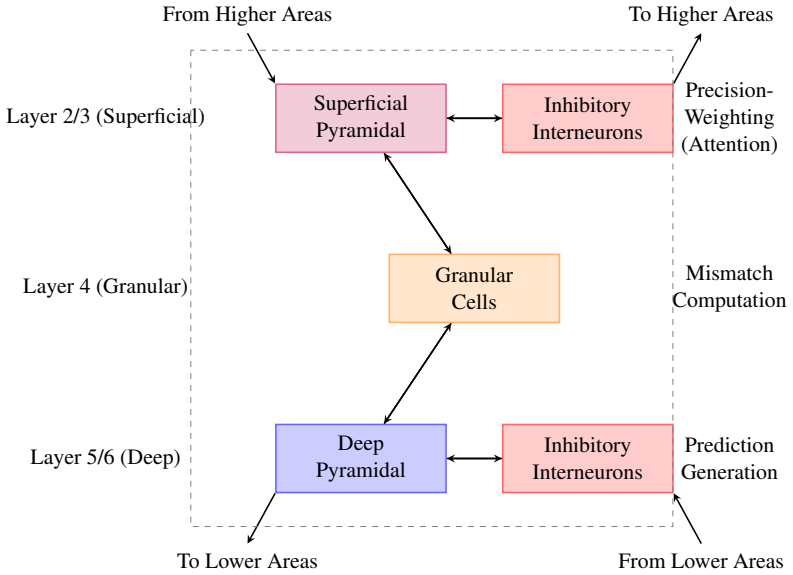
- Mapping superficial pyramidal cells to prediction errors and deep pyramidal cells to predictions entails laminar-specific spectral asymmetries—gamma versus alpha/beta—matching the canonical microcircuit literature.
Reading between the lines
- The paper's component mapping suggests a stronger test than it states: if spike-and-slab priors really implement precision-weighting, the posterior concentration of slab probabilities should track cell-type-specific attentional gain modulation, not just population-level effects.
- A proof of the asserted universal-approximation property would imply a more general theorem the paper leaves implicit: any sufficiently smooth generative process can be tracked asymptotically by a single shared GP whenever the layer-indexed covariance family is dense in the space of continuous functions.
- The MCMC-as-neural-dynamics analogy invites a concrete computational experiment: simulate warm-started, parallelized, continuous-time Langevin inference on natural image streams and measure the settling steps needed to match roughly 150 ms recognition latencies; the paper only argues the timescale gap is not fatal, not that it closes.
- Because the misspecification bound depends on driving h(Θ) to zero, a negative result for discontinuous or highly oscillatory targets would refute the sufficiency of this function class without refuting predictive coding itself; the two claims should be tested separately.
Editorial analysis
A structured set of objections, weighed in public.
Referee Report
Summary. The paper argues that Recursive Gaussian Processes (RGPs) provide a computational substrate for predictive coding and the canonical microcircuit. After reviewing the RGP architecture (Section 3), the authors map RGP components to neuronal populations (Section 4), develop a variational-free-energy analysis via the KL divergence rate (Section 5), discuss the epistemological status of Bayesian models (Section 6), reinterpret earlier simulations (Section 7), and compare RGPs with deep learning and Bayesian neural networks (Sections 8–9). The central formal claims are: (i) RGPs implement hierarchical Bayesian inference with uncertainty propagation and precision-weighted prediction error; (ii) RGP inference minimizes variational free energy; and (iii) under a universal approximation property, the posterior predictive distribution tracks the true generative process arbitrarily closely, even under misspecification.
Significance. If the formal claims were fully established, this would be a valuable interdisciplinary synthesis: it would connect a specific Bayesian nonparametric architecture to predictive coding, offer a concrete mapping to laminar microcircuitry, and generate falsifiable predictions about laminar dynamics and task-dependent functional coupling. The authors deserve credit for explicitly flagging several limitations, including the open question of whether RGP variance spectra match empirical 1/n scaling (Section 4.7.1), the caveats about continuous cortical gradients (Section 4.7.2), and the MCMC-timescale objection (Section 4.3). However, the mathematical core is not self-contained: the load-bearing results are imported from a non-public preprint, and the universal approximation assertion in Section 5.5 is under-specified and unproved. The paper's own equations show that the free-energy result is largely a restatement of variational inference, which weakens the advertised novelty of the formal bridge.
major comments (4)
- [Section 5.5, Eq. (19)] The statement that for any epsilon there exist RGP functions f and g(t,·) such that the composed function η_T approximates η_0 is asserted without proof and without conditions on the hidden-layer widths k_t. In the architecture defined by Eqs. (1)–(2), each layer applies the univariate function g(t,·) to a linear pre-activation. If k_t=1, the whole composition reduces to a univariate function of the input and cannot approximate general multivariate regression functions such as x1*x2. If the intended theorem allows widths to grow with T, that is a different and much weaker statement, and it must be stated explicitly and proved. Because Eq. (19) is used to conclude h(Θ)<ε and hence to derive the misspecification bound (23), this gap directly undermines the formal claim that RGP inference 'tracks' arbitrary true generative processes.
- [Section 5.5, Eq. (23)] The Hellinger and total-variation bounds in (23) are stated under assumptions (A1)–(A5), but these assumptions are not listed anywhere in the manuscript; they are said to be established in a separately cited non-public preprint (Bhattacharya et al., 2025). Likewise, the posterior concentration result (18) is imported from that same source. These results are load-bearing for the central free-energy and misspecification claims. The paper should either state and verify the assumptions in this manuscript or explicitly present those claims as conditional on a source that the reader cannot currently check.
- [Sections 5.2–5.3, Eq. (16)] The claim that 'RGP inference minimizes variational free energy' is, as shown by the paper's own equations, a restatement of the definition of variational inference. MCMC targets the posterior, and the posterior is the minimizer of F(q) over all distributions. Equation (16) is a useful asymptotic decomposition of F into expected KL divergence rate and complexity, but it does not provide an independent derivation that RGP dynamics constitute free-energy minimization. This is acceptable as a consistency result, but the manuscript should not present it as a new formal link between Bayesian mechanics and neuronal dynamics; the biological mapping remains analogical.
- [Section 3.4 and Table 1] The mapping of spike-and-slab priors to precision-weighted prediction error is not made rigorous. In the model, spike-and-slab priors on w^(t) induce sparsity and variable selection. In the KL formula (14), precision-weighting arises from the factor 1/(2σ_ε^2) multiplying the squared prediction error. No mechanism connects the spike-and-slab posterior to this precision factor. If the intended claim is an analogy rather than a mathematical equivalence, it should be explicitly labeled as such, especially because the abstract and Table 1 present it as part of the core implementation claim.
minor comments (5)
- [Section 5.5] The phrase 'The universal approximation theorem' should cite a specific theorem and state the relevant norm (L2, sup, etc.) and domain assumptions. Currently it is a bare assertion and cannot be checked.
- [Section 5.1] Using Q for the output dimension is confusingly close to the variational density q(θ). The parenthetical warning helps, but the notation P_nQ, F_nQ, y_nQ is still easy to misread; consider renaming the output dimension to, e.g., D.
- [Section 4.3] The discussion of MCMC timescales is honest and appropriately hedged, but it is longer than needed. A shorter version with a clear pointer to the open question in Section 11.3 would improve readability.
- [Section 7.4] The prediction that r_1g 'should decrease' or 'should increase' with task demands is presented as a consequence of the model, but it is not derived from the RGP posterior or its dynamics. Please state explicitly that this is a conjecture about how the learned hyperparameter would behave.
- [Section 2] The sentence beginning 'Mumford [1992] anticipated...' has a grammatical error: 'proposing' should be 'proposes' or the sentence should be restructured. This is a small presentation issue.
Circularity Check
Free-energy claim is partly definitional and leans on co-authored preprint; biological mappings are heuristic rather than derived, so partial circularity but not fully forced.
-
self definitional
[Section 4.2, Eq. (10); cf. Section 5.2, Eq. (12)]
"MCMC inference targets the posterior p(θ|D), equivalent to minimizing variational free energy: F(q) = E_q[−log p(D|θ)] + D_KL[q(θ)||p(θ)] (10)"
This equivalence is the definition of variational inference: F(q) equals D_KL[q(θ)||p(θ|D)] plus a constant independent of q, so the posterior is its minimizer by construction. Since RGP inference is defined to be MCMC targeting the posterior, the headline 'RGP inference minimizes variational free energy' (Abstract, Section 5) restates the setup rather than deriving a new consequence. The later asymptotic decomposition (16) re-expresses the same F in terms of h(θ) but does not remove the definitional equivalence.
-
self citation load bearing
[Section 5.2, Eq. (14); Section 5.5, Eq. (23)]
"For the RGP model, this rate can be computed explicitly [Bhattacharya et al., 2025, Equation (90)]"
The RGP-specific KL rate (14), the almost-sure convergence (15), posterior concentration (18), and misspecification bound (23) are all imported from a preprint whose author list includes co-author Sourabh Bhattacharya. The present paper supplies no proof or independent check, so the 'rigorous foundation' for the paper's quantitative claims reduces to a self-citation chain. This is load-bearing because if Eq. (90) or Theorem 4 of that preprint were absent or invalid, the free-energy and misspecification conclusions would have no support in this paper; the cited work is not machine-checked or otherwise independently verified in the text.
full rationale
Most of the paper is a synthesis: the RGP architecture and its asymptotics are taken from the authors' earlier preprint, and the predictive-coding mapping is explicitly heuristic (e.g., 'we make explicit which parts ... are established results and which are heuristic correspondences'; 'alternative architectures could in principle also be reconciled'). The free-energy derivation is a standard variational identity: Eq. (16) follows from the definition of F(q) and the a.s. limit of the log-likelihood ratio, so that part is not by itself circular. However, the paper presents two reductions as results: (i) 'RGP inference minimizes variational free energy' is true by the definition of F and of posterior-sampling MCMC (Eq. 10); and (ii) the RGP-specific formula for h(θ) and the misspecification theorem are self-citations to a co-authored preprint. The universal-approximation assertion (Eq. 19) is an unproved premise rather than a circular step; if it fails, the h(Θ)→0 and misspecification conclusions fail, but that is a correctness gap, not equivalence-to-input. The biological 'predictions' are mostly qualitative correspondences to already-reported phenomena (repetition suppression, spectral asymmetries, task-modulated connectivity), and the paper itself labels many as plausibility arguments. Overall, the central claim retains independent mathematical content, but the headline free-energy result and the most quantitative bounds are partly definitional and partly self-citation-dependent, so I score 4.
Assumptions & free parameters
free parameters (7)
- r1g =
learned from data
- r2g =
learned from data
- rho =
learned from data
- sigma_g^2 =
learned from data
- T (depth) =
selected via model comparison; T=4 optimal in cited simulations
- L (number of KL basis functions) =
posterior concentrated at L=8,10 for T=1,4
- Spike-and-slab hyperparameters (p_tilde=0.5, sigma_1^2=0.1, sigma_2^2=1) =
set as typical values
assumptions (5)
- domain assumption Assumptions A1-A5 from Bhattacharya et al. 2025
- ad hoc to paper Universal approximation property for RGP composition (Eq 19)
- standard math Shalizi (2009) convergence of log likelihood ratio (Eq 15)
- domain assumption Laplace approximation reduction of free energy to precision-weighted prediction error (Friston and Kiebel 2009)
- standard math MCMC converges to the posterior
invented entities (1)
-
Shared GP g(t,.) as genetic/developmental constraints across cortical areas
Cite this review
Pith. "Pith review of Recursive Gaussian Processes and the Bayesian Brain." pith.science (2026). https://pith.science/paper/GNA3DCCD
@misc{pith2026260800503,
  author       = {Pith},
  title        = {Pith review of: Recursive Gaussian Processes and the Bayesian Brain},
  year         = {2026},
  howpublished = {\url{https://pith.science/paper/GNA3DCCD}},
  note         = {Machine review of arXiv:2608.00503}
}
abstract
Predictive coding offers a powerful framework for cortical computation, yet scalable implementations that respect both Bayesian exactness and neurobiological constraints remain scarce. We bridge this gap by formally connecting predictive coding to Recursive Gaussian Processes (RGPs). RGPs employ a single Gaussian process \( g(t, \cdot) \) indexed by layer index and input value, preventing the representational collapse of standard deep Gaussian processes while allowing learnable cross-layer dependence via \( r_{1g} \). We demonstrate that RGPs intrinsically implement hierarchical Bayesian inference, uncertainty propagation, and precision-weighted prediction error. Critically, we map RGP components---the shared GP, spike-and-slab variable selection, and MCMC dynamics---onto the canonical cortical microcircuit, providing a neurobiological substrate for these computations. Drawing on the free energy principle, we show that RGP inference minimizes variational free energy, formally linking Bayesian mechanics to neuronal dynamics. Our synthesis positions RGPs as both a principled computational tool and a candidate model for the brain's predictive machinery, generating testable predictions for laminar-specific dynamics and spectral asymmetries between feedforward and feedback processing.
Figures


Figures from the paper (4 more)


Reference graph
Works this paper leans on
-
[1]
Kok, Peter and Jehee, Janneke F. M. and de Lange, Floris P. , journal =. 2012 , publisher =
2012
-
[2]
Rangarajan, Prashant and Rao, Rajesh P. N. , title =. Neural Computation , publisher =. 2026 , volume =. doi:10.1162/NECO.a.1545 , archivePrefix =. 2604.15679 , primaryClass =
work page Pith review arXiv 2026
-
[3]
Advances in Neural Information Processing Systems , year =
Salvatori, Tommaso and Pinchetti, Luca and Millidge, Beren and Song, Yuhang and Bao, Tianyi and Bogacz, Rafal and Lukasiewicz, Thomas , title =. Advances in Neural Information Processing Systems , year =
-
[4]
Nature Communications , year =
Ororbia, Alexander and Kifer, Daniel , title =. Nature Communications , year =
-
[5]
Millidge, Beren and Salvatori, Tommaso and Song, Yuhang and Bogacz, Rafal and Lukasiewicz, Thomas , year =. 2202.09467 , archivePrefix =
-
[6]
PLoS Computational Biology , volume =
Buesing, Lars and Bill, Johannes and Nessler, Bernhard and Maass, Wolfgang , title =. PLoS Computational Biology , volume =. 2011 , month =. doi:10.1371/journal.pcbi.1002211 , url =
-
[7]
arXiv preprint arXiv:2407.01163 , year =
Pinchetti, Luca and Qi, Chen and Lokshyn, Oleksandr and Olivers, Gaspard and Emde, C. arXiv preprint arXiv:2407.01163 , year =
-
[8]
Whittington, James C. R. and Bogacz, Rafal , journal =. 2017 , publisher =
2017
Show all 110 references
-
[9]
Statistical Methodology , volume =
Dutta, Somak and Bhattacharya, Sourabh , title =. Statistical Methodology , volume =
-
[10]
Brazilian Journal of Probability and Statistics , volume =
Das, Moumita and Bhattacharya, Sourabh , title =. Brazilian Journal of Probability and Statistics , volume =
-
[11]
and Lukasiewicz, Thomas and Rao, Rajesh P
Salvatori, Tommaso and Mali, Ankur and Buckley, Christopher L. and Lukasiewicz, Thomas and Rao, Rajesh P. N. and Friston, Karl and Ororbia, Alexander , journal =
-
[12]
and Friston, Karl J
Buechel, Christian and Coull, Jennifer T. and Friston, Karl J. , journal =. 1999 , publisher =
1999
-
[13]
and Buechel, Christian and Fink, Gereon R
Friston, Karl J. and Buechel, Christian and Fink, Gereon R. and Morris, James and Rolls, Edmund T. and Dolan, Raymond J. , journal =. 1997 , publisher =
1997
-
[14]
, year =
Hebb, Donald O. , year =
-
[15]
and Usrey, W
Bastos, Andre M. and Usrey, W. Martin and Adams, Rick A. and Mangun, George R. and Fries, Pascal and Friston, Karl J. , journal =. 2012 , publisher =
2012
-
[16]
Bhattacharya, Durba and Maitra, Trisha and Roy, Sucharita and Bhattacharya, Sourabh , journal =
-
[17]
Blundell, Charles and Cornebise, Julien and Kavukcuoglu, Koray and Wierstra, Daan , booktitle =
-
[18]
and Fries, Pascal and Landman, Rogier and Buschman, Timothy J
Buffalo, Elizabeth A. and Fries, Pascal and Landman, Rogier and Buschman, Timothy J. and Desimone, Robert , journal =. 2011 , publisher =
2011
-
[19]
and Maass, Wolfgang , journal =
Buonomano, Dean V. and Maass, Wolfgang , journal =. 2009 , publisher =
2009
-
[20]
2008 , publisher =
Caporale, Natalia and Dan, Yang , journal =. 2008 , publisher =
2008
-
[21]
Clark, Andy , year =
-
[22]
The British Journal for the Philosophy of Science , volume =
Colombo, Matteo and Seri. The British Journal for the Philosophy of Science , volume =. 2012 , publisher =
2012
-
[23]
1989 , publisher =
Crick, Francis , journal =. 1989 , publisher =
1989
-
[24]
, year =
Dayan, Peter and Abbott, Laurence F. , year =
-
[25]
2013 , organization =
Damianou, Andreas and Lawrence, Neil , booktitle =. 2013 , organization =
2013
-
[26]
and Zoccolan, Davide and Rust, Nicole C
DiCarlo, James J. and Zoccolan, Davide and Rust, Nicole C. , journal =. 2012 , publisher =
2012
-
[27]
and Martin, Kevan A
Douglas, Rodney J. and Martin, Kevan A. C. and Whitteridge, David , journal =. 1991 , publisher =
1991
-
[28]
and Girolami, Mark A
Dunlop, Matthew M. and Girolami, Mark A. and Stuart, Andrew M. and Teckentrup, Aretha L. , journal =. 2018 , publisher =
2018
-
[29]
and Ghahramani, Zoubin , booktitle =
Duvenaud, David and Rippel, Oren and Adams, Ryan P. and Ghahramani, Zoubin , booktitle =. 2014 , organization =
2014
-
[30]
and Banks, Martin S
Ernst, Marc O. and Banks, Martin S. , journal =. 2002 , publisher =
2002
-
[31]
2010 , publisher =
Feldman, Harriet and Friston, Karl , journal =. 2010 , publisher =
2010
-
[32]
and Van Essen, David C
Felleman, Daniel J. and Van Essen, David C. , journal =. 1991 , publisher =
1991
-
[33]
Trends in Cognitive Sciences , volume =
Fiser, Jozsef and Berkes, Pietro and Orb. Trends in Cognitive Sciences , volume =. 2010 , publisher =
2010
-
[34]
2005 , publisher =
Friston, Karl , journal =. 2005 , publisher =
2005
-
[35]
2008 , publisher =
Friston, Karl , journal =. 2008 , publisher =
2008
-
[36]
2009 , publisher =
Friston, Karl and Kiebel, Stefan , journal =. 2009 , publisher =
2009
-
[37]
2010 , publisher =
Friston, Karl , journal =. 2010 , publisher =
2010
-
[38]
2017 , publisher =
Friston, Karl and FitzGerald, Thomas and Rigoli, Francesco and Schwartenbeck, Philipp and Pezzulo, Giovanni , journal =. 2017 , publisher =
2017
-
[39]
2016 , organization =
Gal, Yarin and Ghahramani, Zoubin , booktitle =. 2016 , organization =
2016
-
[40]
and Kilner, James M
Garrido, Marta I. and Kilner, James M. and Stephan, Klaas E. and Friston, Karl J. , journal =. 2009 , publisher =
2009
-
[41]
and Milner, David A
Goodale, Melvyn A. and Milner, David A. , journal =. 1992 , publisher =
1992
-
[42]
Graves, Alex , booktitle =
-
[43]
2017 , publisher =
Hassabis, Demis and Kumaran, Dharshan and Summerfield, Christopher and Botvinick, Matthew , journal =. 2017 , publisher =
2017
-
[44]
and Rubin, Nava , journal =
Hasson, Uri and Yang, Eunice and Vallines, Ignacio and Heeger, David J. and Rubin, Nava , journal =. 2008 , publisher =
2008
-
[45]
Advances in Neural Information Processing Systems , volume =
Hennequin, Guillaume and Aitchison, Laurence and Lengyel, M. Advances in Neural Information Processing Systems , volume =
-
[46]
and Daunizeau, Jean and Friston, Karl J
Kiebel, Stefan J. and Daunizeau, Jean and Friston, Karl J. , journal =. 2008 , publisher =
2008
-
[47]
, journal =
Knill, David C. , journal =. 2003 , publisher =
2003
-
[48]
and Pouget, Alexandre , journal =
Knill, David C. and Pouget, Alexandre , journal =. 2004 , publisher =
2004
-
[49]
Lakshminarayanan, Balaji and Pritzel, Alexander and Blundell, Charles , booktitle =
-
[50]
1988 , publisher =
Livingstone, Margaret and Hubel, David , journal =. 1988 , publisher =
1988
-
[51]
MacKay, David J. C. , journal =. 1992 , publisher =
1992
-
[52]
and Aura, Christopher and Leopold, David A
Maier, Alexander and Adams, Geoffrey K. and Aura, Christopher and Leopold, David A. , journal =. 2010 , publisher =
2010
-
[53]
and Mamassian, Pascal , journal =
Maloney, Laurence T. and Mamassian, Pascal , journal =. 2009 , publisher =
2009
-
[54]
and Maunsell, John H
McAdams, Carrie J. and Maunsell, John H. R. , journal =. 1999 , publisher =
1999
-
[55]
and Cohen, Jonathan D
Miller, Earl K. and Cohen, Jonathan D. , journal =. 2000 , publisher =
2000
-
[56]
, journal =
Millidge, Beren and Seth, Anil and Buckley, Christopher L. , journal =
-
[57]
, journal =
Mountcastle, Vernon B. , journal =. 1997 , publisher =
1997
-
[58]
1992 , publisher =
Mumford, David , journal =. 1992 , publisher =
1992
-
[59]
, series =
Neal, Radford M. , series =. 1996 , publisher =
1996
-
[60]
and Hugdahl, Kenneth , journal =
Nordby, Helge and Hammerborg, Dag and Roth, Walton T. and Hugdahl, Kenneth , journal =. 1994 , publisher =
1994
-
[61]
Neuron , volume =
Orb. Neuron , volume =. 2016 , publisher =
2016
-
[62]
, journal =
Parr, Thomas and Friston, Karl J. , journal =. 2017 , publisher =
2017
-
[63]
Rao, Rajesh P. N. and Ballard, Dana H. , journal =. 1999 , publisher =
1999
-
[64]
and Middleton, Steven J
Roopun, Anita K. and Middleton, Steven J. and Cunningham, Mark O. and LeBeau, Fiona E. N. and Bibbig, Andrea and Whittington, Miles A. and Traub, Roger D. , journal =. 2006 , publisher =
2006
-
[65]
and McClelland, James L
Rumelhart, David E. and McClelland, James L. , volume =. 1986 , publisher =
1986
-
[66]
and Keller, Georg B
Rutar, Darko and Vogels, Tim P. and Keller, Georg B. , journal =. 2022 , publisher =
2022
-
[67]
Salimbeni, Hugh and Deisenroth, Marc , booktitle =
-
[68]
2009 , publisher =
Shalizi, Cosma Rohilla , journal =. 2009 , publisher =
2009
-
[69]
2023 , publisher =
Sprevak, Mark , journal =. 2023 , publisher =
2023
-
[70]
and Monti, Jim M
Summerfield, Christopher and Trittschuh, Emily H. and Monti, Jim M. and Mesulam, M.-Marsel and Egner, Tobias , journal =. 2008 , publisher =
2008
-
[71]
and Bannister, Peter A
Thomson, Alex M. and Bannister, Peter A. , journal =. 2002 , publisher =
2002
-
[72]
and Bannister, Peter A
Thomson, Alex M. and Bannister, Peter A. , journal =. 2003 , publisher =
2003
-
[73]
, journal =
Todorovic, Ana and de Lange, Floris P. , journal =. 2011 , publisher =
2011
-
[74]
and Movshon, Anthony J
Tolhurst, David J. and Movshon, Anthony J. and Dean, Andrew F. , journal =. 1983 , publisher =
1983
-
[75]
2011 , publisher =
Wacongne, Catherine and Labyt, Etienne and van Wassenhove, Virginie and Bekinschtein, Tristan and Naccache, Lionel and Dehaene, Stanislas , journal =. 2011 , publisher =
2011
-
[76]
and Adelson, Edward H
Weiss, Yair and Simoncelli, Eero P. and Adelson, Edward H. , journal =. 2002 , publisher =
2002
-
[77]
NeuroReport , volume =
Yabe, Hirooki and Tervaniemi, Mari and Reinikainen, Kalevi and N. NeuroReport , volume =. 1997 , publisher =
1997
-
[78]
Yamins, Daniel L. K. and Hong, Ha and Cadieu, Charles F. and Solomon, Ethan A. and Seibert, Darren and DiCarlo, James J. , journal =. 2014 , publisher =
2014
-
[79]
2024 , publisher =
Zunger, Andrew , journal =. 2024 , publisher =
2024
-
[80]
and others , journal =
Margulies, Daniel S. and others , journal =
-
[81]
and others , journal =
Burt, Joshua B. and others , journal =
-
[82]
, journal =
Johnson, Mark H. , journal =
-
[83]
Kriegeskorte, Nikolaus and others , journal =
-
[84]
and Bazin, Pierre-Louis and Margulies, Daniel S
Huntenburg, Julia M. and Bazin, Pierre-Louis and Margulies, Daniel S. , journal =. 2018 , publisher =
2018
-
[85]
Brain and Language , volume =
Dopiera. Brain and Language , volume =. 2023 , publisher =
2023
-
[86]
Kakaei, Ehsan and Braun, Jochen , journal =
-
[87]
and Vul, Edward and Tenenbaum, Joshua B
Gershman, Samuel J. and Vul, Edward and Tenenbaum, Joshua B. , journal =. 2012 , publisher =
2012
-
[88]
2017 , publisher =
Weilnhammer, Veith and Stuke, Heiner and Hesselmann, Guido and Sterzer, Philipp and Schmack, Katharina , journal =. 2017 , publisher =
2017
-
[89]
and others , journal =
Murray, John D. and others , journal =
-
[90]
and Kohn, Adam , journal =
Cohen, Marlene R. and Kohn, Adam , journal =. 2011 , publisher =
2011
-
[91]
and others , journal =
Averbeck, Bruno B. and others , journal =
-
[92]
, journal =
Carandini, Matteo and Heeger, David J. , journal =
-
[93]
and Ma, Wei Ji and Kiani, Roozbeh and others , journal =
Beck, Jeffrey M. and Ma, Wei Ji and Kiani, Roozbeh and others , journal =
-
[94]
and Latham, Peter E
Beck, Jeffrey M. and Latham, Peter E. and Pouget, Alexandre , journal =. 2011 , publisher =
2011
-
[95]
and Cadena, Santiago A
Burg, Max F. and Cadena, Santiago A. and Denfield, George H. and Walker, Edgar Y. and Tolias, Andreas S. and Bethge, Matthias and Ecker, Alexander S. , journal =. 2021 , publisher =
2021
-
[96]
2015 , publisher =
Fries, Pascal , journal =. 2015 , publisher =
2015
-
[97]
and Harris, Kenneth D
Luczak, Artur and McNaughton, Bruce L. and Harris, Kenneth D. , journal =. 2015 , publisher =
2015
-
[98]
2024 , publisher =
Gallina, Jessica and Ronconi, Luca and Marsicano, Gianluca and Bertini, Caterina , journal =. 2024 , publisher =
2024
-
[99]
, journal =
Stringer, Carsen and Pachitariu, Marius and Steinmetz, Nicholas and Carandini, Matteo and Harris, Kenneth D. , journal =. 2019 , publisher =
2019
-
[100]
, journal =
Spratling, Michael W. , journal =. 2008 , publisher =
2008
-
[101]
and Uchida, Naoshige , journal =
Lowet, Adam S. and Uchida, Naoshige , journal =. 2024 , publisher =
2024
-
[102]
1996 , publisher =
Thorpe, Simon and Fize, Denis and Marlot, Catherine , journal =. 1996 , publisher =
1996
-
[103]
Aldo and Selen, Luc P
Faisal, A. Aldo and Selen, Luc P. J. and Wolpert, Daniel M. , journal =. 2008 , publisher =
2008
-
[104]
2009 , publisher =
Branco, Tiago and Staras, Kevin , journal =. 2009 , publisher =
2009
-
[105]
and Latham, Peter E
Ma, Wei Ji and Beck, Jeffrey M. and Latham, Peter E. and Pouget, Alexandre , journal =. 2006 , publisher =
2006
-
[106]
Pezzulo, Giovanni and Parr, Thomas and Friston, Karl , journal =
-
[107]
, journal =
Huang, Yanping and Rao, Rajesh P. , journal =
-
[108]
Advances in Neural Information Processing Systems , volume =
Savin, Cristina and Den. Advances in Neural Information Processing Systems , volume =
-
[109]
and Field, David J
Olshausen, Bruno A. and Field, David J. , journal =
-
[110]
and Sejnowski, Terrence J
Bell, Anthony J. and Sejnowski, Terrence J. , journal =
Reviewed August 5, 2026 · model on record in the stance chip above.
Discussion (0). Continue with ORCID to comment.