REVIEW 3 major objections 6 minor 16 references
Visualizing Graph-to-Answer Mechanism Recovery in Materials-Science Hypothesis Generation
T0 review · 3 major / 6 minor · reviewed 2026-08-08 · deepseek-v4-flash
Pith's one-line read Graph-structured mechanism content in Graph-PRefLexOR-8B becomes recoverable only in late transformer layers, not in the early transition region; graph reasoning is transformed into answer-ready content late in the network.
desk verdict A careful, honest case study of graph-to-answer mechanism tracing; the late-layer recovery claim is plausible and the controls are good, but the lexical extractor and token alignment deserve scrutiny. read the letter →
The pith
A machine-rendered reading of the paper's core claim, the machinery that carries it, and where it could break.
The reading
What carries the argument
The argument is carried by two paired tools. Mechanism-F1 is an automatic edge extractor that maps free-text answers back onto a reference directed path (problem, failure mode, intervention, mechanism, target, outcome) and scores edge-level agreement, so recovery is measured as restoration of directed causal relations rather than surface similarity. Activation patching writes clean residual-stream states into a corrupted run at one layer and token region; the paper sweeps all 37 checkpoints (embedding output plus 36 transformer blocks) over graph, patterns, synthesis, and answer-start regions. The full layer-by-token-region recovery grid is the central object, and identity-patch and random-region controls are used to show that the patching hook is neutral and that recovery is localized rather than a generic clean-activation effect.
What would settle it
Run the identical corruption and patching sweep using a paraphrase-invariant relation extractor on a fresh set of 100 questions; if layers 7–10 then show recovery at or above the late-layer band, the paper's localization claim fails. Equally decisive would be a randomization test showing late-layer patching recovers no more mechanism-F1 than random-region patching once token alignment is fixed.
Extended reading notes
Core claim
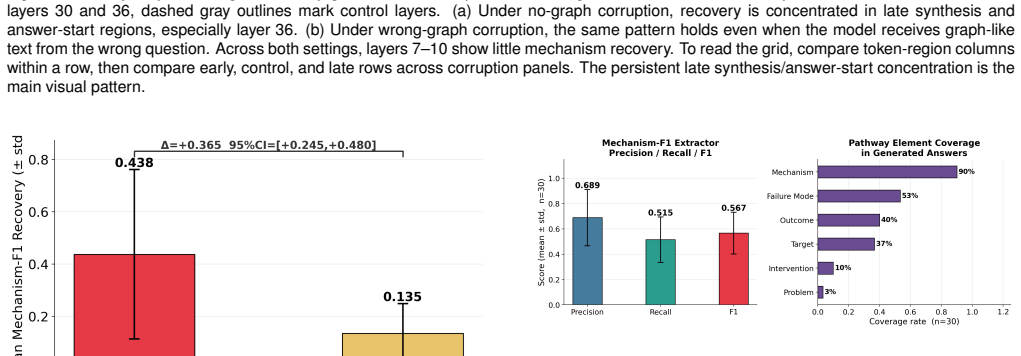
The paper's central discovery is a spatial separation between representational transition and mechanism recovery in a graph-native reasoning model. Layers 7–10, previously suggested as a transition point where reasoning and answer representations separate, show essentially no recovery of mechanism content when clean activations are patched into corrupted runs. Recovery appears in late layers, especially layer 36, and is strongest for synthesis-stage and answer-start tokens; the late-layer advantage over control layers is +0.237 to +0.262 in mechanism-F1 recovery depending on corruption, all with p<0.001. The authors interpret this as evidence that graph reasoning is transformed into answer-ready mechanism content late in the network, and they are careful to frame the result as localized recoverability under a specified intervention and metric, not a complete circuit-level mechanism.
Load-bearing premise
The late-layer localization result depends on the assumption that mechanism-F1, an automatic edge extractor with precision 0.689, recall 0.515, and F1 0.567, captures enough of the true directed mechanism to make relative layer differences trustworthy, and that patching the same token region remains meaningful even when graph corruption shifts token positions or sequence length.
Editorial extensions
If this is right
- Answer-level similarity is not a safe proxy for mechanism preservation: graph corruption leaves final answers close to clean answers in embedding space while mechanism-F1 drops.
- Monitoring a few selected layers can mislead; the full sweep shows the negative result at layers 7–10 and the repeated positive result at late layers.
- Machine-generated hypotheses can be cheaply screened by graph corruption followed by mechanism scoring before being sent to simulation or experiment.
- Interventions aimed at restoring or improving mechanism support may need to target late synthesis representations rather than the graph stage itself.
- The late synthesis/answer-start locus gives model developers a concrete place to inspect or probe when a generated hypothesis loses causal support.
Reading between the lines
- The late-layer concentration could be a general signature of transformer graph-to-text generation, not a quirk of this model; running the same sweep on other graph-native models would test that.
- Because mechanism-F1 uses lexical edge matching, paraphrase-expressed mechanisms are likely under-counted; a semantic or entailment-based relation scorer might reveal earlier recovery and should be checked.
- Corruption-induced token shifts (the paper's own limitation) could inflate late-layer recovery if patching restores lexical flow rather than content; alignment-free attribution methods would separate these.
- The workflow's practical target is a human gate: a hypothesis whose mechanism collapses under graph perturbation could be flagged for regeneration, which is a policy choice the paper leaves implicit.
Editorial analysis
A structured set of objections, weighed in public.
Referee Report
Summary. The paper reports a case study of mechanism tracing in Graph-PRefLexOR-8B, a Qwen3-8B-derived model that emits sentinel-delimited reasoning stages (brainstorm, graph, patterns, synthesis, answer). Across 100 open-ended materials-science questions, the authors (i) measure semantic backtracking of final answers to the model's own visible stages, (ii) corrupt the graph stage in three ways (no-graph, wrong-graph, shuffled-graph), (iii) score mechanism preservation with an automatic directed-edge extractor (mechanism-F1), and (iv) perform activation patching over 37 residual-stream checkpoints and four token regions to produce full layer-by-region recovery grids. The central empirical claim is that layers 7-10, previously highlighted as a reasoning-to-answer transition region, show little mechanism recovery under patching, whereas recovery concentrates in late synthesis and answer-start regions around layers 30 and 36. The paper explicitly positions this as a static visual diagnostic workflow rather than an interactive system, and it includes matched controls, a strict identity check, and manual audits of the extractor.
Significance. If the localization result holds, the paper provides a useful and credible negative result: graph-structured mechanism information is not copied directly into the answer but is transformed into answer-ready content late in the network. The main strengths are the full checkpoint sweep rather than selected-layer analysis, three corruption conditions, the random-region negative control, the strict identity patch that verifies the patching hook is neutral, and the manual extractor audit. The model weights are released and the evaluation set is public, which supports reproducibility. The main limitations are the single-model, single-domain, 100-question scope and the reliance on a lexical extractor with modest recall; these are acknowledged by the authors. The contribution is incremental but methodologically appropriate for a diagnostic case-study paper.
major comments (3)
- [§5.3, §8]
- [§5.2, Figure 5]
- [Table 1, §6.3]
minor comments (6)
- [§5.2]
- [Figure 3]
- [Table 1]
- [§1]
- [§4]
- [Figure 4]
Circularity Check
No circular derivation: the recovery claim is a new intervention-based measurement; self-citations supply model and benchmark provenance but are not load-bearing.
full rationale
The paper's derivation chain is: corrupt the graph stage, patch clean residual-stream activations at each layer and token region, and measure mechanism recovery with mechanism-F1 relative to a question-level mechanism reference. None of these steps defines the claimed late-layer recovery pattern in terms of the thing it purports to predict. The reference mechanism paths are presented as intended answer structures for the curated questions (Section 3), and mechanism-F1 is computed as edge-level agreement with those paths, not as agreement with the clean run's output. The strict identity patch (Table 2) and the random-region negative control (Section 6.4) provide matched checks that the intervention does not trivially reproduce the clean answer. The self-citations to the authors' prior Graph-PRefLexOR work supply the model, the reused 100-question evaluation set, and the earlier annotation of layers 7-10 as a transition region; these are provenance inputs and prior hypotheses, not fitted parameters, and the full recovery sweep is a new empirical measurement that does not reduce to them. The token-alignment limitation acknowledged in Section 8 is a validity threat to the localization claim, but it is not a circularity: it concerns whether patching across corrupted trajectories is positionally meaningful, not whether the recovery formula is equivalent to its input by construction. The only reason the score is not zero is the minor self-citation/benchmark provenance; no load-bearing circular step was identified.
Assumptions & free parameters
free parameters (3)
- Late-layer and control-layer groupings =
Late: {30,36}; controls: {3,15,25,33}
- Token region definitions =
<graph>, <patterns>, <synthesis>, answer-start
- Mechanism-F1 extraction preprocessing =
lower-casing, punctuation removal, stage-tag stripping, lexical canonicalization
assumptions (3)
- domain assumption Mechanism reference paths E_ref_i (p, f, u, m, t, o) are the correct target structure for each question.
- domain assumption Activation patching in the residual stream is a valid localized causal intervention for this model.
- domain assumption Graph corruptions isolate the contribution of the graph stage to the final mechanism.
Cite this review
Pith. "Pith review of Visualizing Graph-to-Answer Mechanism Recovery in Materials-Science Hypothesis Generation." pith.science (2026). https://pith.science/paper/CSA5G3NL
@misc{pith2026260804170,
  author       = {Pith},
  title        = {Pith review of: Visualizing Graph-to-Answer Mechanism Recovery in Materials-Science Hypothesis Generation},
  year         = {2026},
  howpublished = {\url{https://pith.science/paper/CSA5G3NL}},
  note         = {Machine review of arXiv:2608.04170}
}
read the original abstract
AI co-scientists can generate fluent materials-science hypotheses, but fluency does not show that an answer preserves a scientifically meaningful mechanism. We present a graph-to-answer mechanism-tracing case study for Graph-PRefLexOR-8B, a Qwen3-8B model adapted to expose distinct stages for brainstorming, graph construction, pattern extraction, and synthesis. We organize semantic backtracking, graph corruption, activation-based recovery measurements, and layer-by-token-region grids into a visual diagnostic workflow for inspecting this pathway. Across 100 open-ended materials-science questions, final answers remain closest to the model's own structured stages, especially synthesis. Under graph corruption, a full sweep over 37 residual-stream checkpoints, the embedding output and 36 transformer blocks, shows little mechanism recovery in the earlier transition region at layers 7--10, recovery instead concentrates in late synthesis and answer-start regions around layers 30 and 36. The workflow is intended to help scientists and model developers identify where a generated hypothesis loses or regains mechanism support before it is passed to downstream experimental planning.
Figures


Figures from the paper (1 more)
Reference graph
Works this paper leans on
-
[1]
A. Agrawal and A. Choudhary. Perspective: Materials informatics and big data: Realization of the fourth paradigm of science in materials science.APL Materials, 4(5):053208, 2016. doi: 10.1063/1.4946894 1
-
[2]
O. Bentham, N. Stringham, and A. Marasovi ´c. Chain-of- Thought Unfaithfulness as Disguised Accuracy.arXiv e-prints, p. arXiv:2402.14897, Feb. 2024. doi: 10.48550/arXiv.2402.14897 1, 3
-
[3]
S. Kumbhar, V . Mishra, K. Coutinho, D. Handa, A. Iquebal, and C. Baral. Hypothesis Generation for Materials Discovery and De- sign Using Goal-Driven and Constraint-Guided LLM Agents.arXiv e-prints, p. arXiv:2501.13299, Jan. 2025. doi: 10.48550/arXiv.2501. 13299 1
-
[4]
T. Lanham, A. Chen, A. Radhakrishnan, B. Steiner, C. Deni- son, D. Hernandez, D. Li, E. Durmus, E. Hubinger, J. Kernion, K. Luko ˇsi¯ut˙e, K. Nguyen, N. Cheng, N. Joseph, N. Schiefer, O. Rausch, R. Larson, S. McCandlish, S. Kundu, S. Kadavath, S. Yang, T. Henighan, T. Maxwell, T. Telleen-Lawton, T. Hume, Z. Hatfield-Dodds, J. Kaplan, J. Brauner, S. R. Bow...
-
[5]
Q. Liu, M. P. Polak, S. Y . Kim, M. A. A. Shuvo, H. S. Deodhar, J. Han, D. Morgan, and H. Oh. Beyond designer’s knowledge: Generating materials design hypotheses via a large language model.Acta Mate- rialia, 297:121307, Sept. 2025. doi: 10.1016/j.actamat.2025.121307 1
arXiv 2025
-
[6]
D. L. McDowell and R. A. LeSar. The need for microstructure informatics in process-structure-property relations.MRS Bulletin, 41(8):587–593, Aug. 2016. doi: 10.1557/mrs.2016.163 1
-
[7]
K. Meng, D. Bau, A. Andonian, and Y . Belinkov. Locating and Edit- ing Factual Associations in GPT.arXiv e-prints, p. arXiv:2202.05262, Feb. 2022. doi: 10.48550/arXiv.2202.05262 1, 3
-
[8]
S. Pal, S. Sourav, T. Ghosal, and M. J. Buehler. Graph-Native Reinforcement Learning Enables Traceable Scientific Hypothesis Generation through Conceptual Recombination.arXiv e-prints, p. arXiv:2607.00924, July 2026. doi: 10.48550/arXiv.2607.00924 1, 3
work page Pith review arXiv doi:10.48550/arxiv.2607.00924 2026
Show all 16 references
- [9]
- [10]
- [11]
- [12]
-
[13]
K. Wang, A. Variengien, A. Conmy, B. Shlegeris, and J. Steinhardt. Interpretability in the wild: A circuit for indirect object identification in gpt-2 small.arXiv preprint arXiv:2211.00593, 2022. 1, 3
2022 arXiv
-
[14]
L. Wang, C. Ma, X. Feng, Z. Zhang, H. Yang, J. Zhang, Z. Chen, J. Tang, X. Chen, Y . Lin, et al. A survey on large language models with some insights on their capabilities and limitations.arXiv preprint arXiv:2305.10601, 2023. 1, 3
2023 arXiv
-
[15]
J. Wei, X. Wang, D. Schuurmans, M. Bosma, B. Ichter, F. Xia, E. Chi, Q. Le, and D. Zhou. Chain-of-thought prompting elicits reasoning in large language models.Advances in Neural Information Processing Systems, 35:24824–24837, 2022. 1, 3
2022
-
[16]
Zhang, N
F. Zhang, N. Nanda, et al. Towards best practices of activation patching in language models: Metrics and methods.arXiv preprint arXiv:2309.16042, 2023. 1, 3
2023 arXiv
Reviewed August 8, 2026 · model on record in the stance chip above.
Discussion (0). Continue with ORCID to comment.