REVIEW 2 major objections 3 minor 32 references
Optimize Cheap, Deploy Strong: Cost-Aware Cross-Tier Transfer for Evolutionary Optimization
T0 review · 2 major / 3 minor · reviewed 2026-08-15 · deepseek-v4-flash
Pith's one-line read Decoupling search tier from deployment tier makes prompt optimization 5.6–14× cheaper without losing quality.
desk verdict Well-controlled empirical study showing cheap-tier search with a strong reflector is not worse than same-tier optimization at 5-54x lower cost; the 'beats' half is overstated because the positive transfer claim flips under variance weighting. read the letter →
The pith
A machine-rendered reading of the paper's core claim, the machinery that carries it, and where it could break.
The reading
What carries the argument
The central object is the decoupling of three LLM roles that standard practice fuses: the answering model that scores candidates during search (the fitness evaluator), the variation operator that reads traces and proposes edits (the reflector), and the deployment model that serves the final prompt. The paper assigns the cheap answerer to fitness evaluation, the strong reflector to variation, and any target tier to deployment, with zero mapping or recalibration. The formal identity is the decomposition of the deployment objective into the cheap surrogate objective plus a cross-tier transfer residual, with the target regret as the key measured quantity contrasting cheap-tier search with same-tier search. The load-bearing mechanism is the volume asymmetry: fitness evaluation dominates token spend, so cheapening that role moves most of the cost, while the reflector's rarity makes its strength affordable.
What would settle it
Run the same protocol on a task where the cheap tier scores near zero on the seed prompt and on all random variations (e.g., a specialized reasoning task far from the cheap model's competence). If the cheap search then fails to beat the untrained seed on the strong deployment tier, while same-tier full-cost optimization succeeds, the central claim fails.
Extended reading notes
Core claim
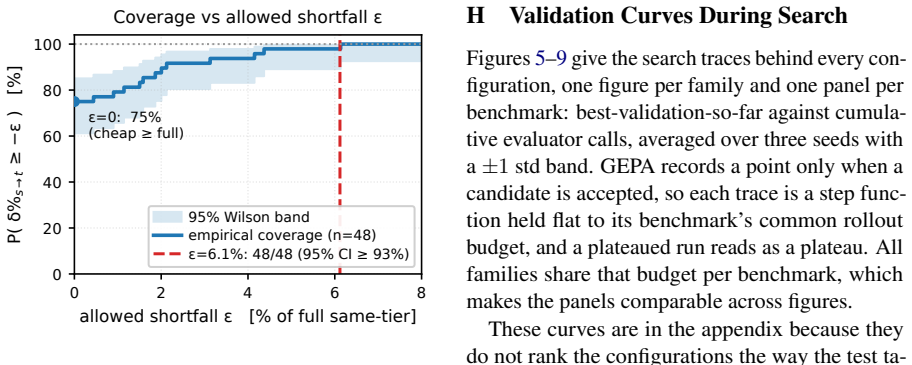
The central claim is that a prompt searched on a cheap model with a strong reflector, then deployed zero-shot on a stronger tier, matches or exceeds the prompt that same tier optimized for itself at full price. The paper formalizes the trade-off with target regret: the difference between the deployment-tier quality of the prompt optimized on the target and the prompt optimized cheaply and transferred upward. Across 48 (task, search arm, deploy tier) deployments, the mean transfer residual is +2.8% in favor of the cheap search, with 36 of 48 at or above parity and no scenario worse than 6.12% short. The cost reduction is 5.6–14× on the Mixed Claude and GPT ladders and 25–54× on Gemini, rising to 63–114× when the answerer is a self-hosted local model. The saving comes from the volume asymmetry: over 96% of search tokens are fitness-evaluation tokens, so moving that role to the cheapest tier moves almost the whole bill, while the strong reflector, though expensive per token, is rare. Upward transfer is positive because the variation operator is strong: a role ablation shows the reflector, not the evaluator, produces the transferable prompt. The cheap search also writes more explicit prompts, implying the mechanism that a weak evaluator rewards spelled-out structure that a stronger model can exploit.
Load-bearing premise
The cheap evaluator must be able to rank candidate prompts at least marginally well on the task; if it scores near zero everywhere, the fitness landscape is flat and search stagnates.
Editorial extensions
If this is right
- If the central claim is correct, practitioners can run one cheap search and deploy the resulting prompt on any stronger tier in the same family, with no per-tier re-optimization.
- Search cost becomes a one-time tuning expense rather than a per-query cost, so prompt optimization becomes viable for tasks and teams where full same-tier search was previously unaffordable.
- The saving is robust to price changes: in 15 of 24 cells the cheap composition stays cheaper even at price parity, because it emits fewer output tokens overall.
- The effect is not tied to a specific optimizer: repeating the construction with MIPROv2 instead of GEPA keeps the results, indicating the decoupling is the operative ingredient rather than one mutation operator.
- The direction of transfer matters: upward transfer is reliable, whereas lateral transfer between similar-capability models degrades, so prompts should be evolved on a weak model and deployed on a strong one.
Reading between the lines
- The explicitness account suggests a testable prediction: if a cheap answerer is made artificially weaker or more literal, the evolved prompts should become even more explicit and transfer even better, while a cheap answerer that is already strong may yield less transferable prompts.
- The method's scope likely extends beyond prompt text to agentic program modules, demonstrations, and tool-use policies, since the decoupling applies to any artifact whose fitness is evaluated by an LLM and whose variation is proposed by an LLM.
- The measured break-even volume implies a practical decision rule for practitioners: the cheap-search strategy is best for one-time or moderate-volume deployments, while for extremely high-volume serving, a longer prompt's per-query cost can erode the one-time saving.
- The finding that a cheap evaluator need only rank, not estimate, suggests that noisy or quantized evaluation metrics, or sub-sampled validation sets, might preserve much of the transfer benefit while further cutting cost.
Signed reviews
Editorial analysis
A structured set of objections, weighed in public.
Referee Report
Summary. The paper proposes a cost-aware reformulation of evolutionary LLM prompt optimization (instantiated on GEPA, with a MIPROv2 ablation) in which the fitness-evaluation role, the reflective variation role, and the deployment role are assigned to different model tiers. A cheap answerer scores candidates, a strong reflector proposes edits, and the evolved prompt is deployed zero-shot on stronger tiers. Across four tasks and eleven models in four families, the paper reports that this configuration matches or beats full same-tier optimization in 36 of 48 deployment cells, at 5.6–14× (25–54× on Gemini) lower search cost, with over 96% of search tokens on the cheapest tier. The paper also presents role ablations locating the gain in the reflector, an explicitness analysis of the evolved prompts, break-even volume analysis, and a pooled transfer-residual analysis.
Significance. If the central claim held, the paper would be a practically valuable result: it would decouple search cost from deployment-tier capability and supply a characterization of when cheap-tier search substitutes for target-tier search. The experimental design is a strength: shared per-task metric-call budgets, n=3 seeds, zero-cost seed baselines on every tier, a 2×2 role ablation, an optimizer ablation with MIPROv2, a neutral cross-family deploy target, and honest reporting of search traces that rank the cheap arms below the full-cost ones. The cost accounting is unusually careful (per-call token logs at published prices, break-even price ratios, deployment break-even volumes). The main weakness is that the 'beats' half of the claim rests on an unweighted pooled residual whose robustness is explicitly conceded in Appendix G; the data robustly support 'not worse,' and the positive-transfer contribution needs either stronger evidence or re-scoping.
major comments (2)
- [§6, Appendix G, Fig. 3] The claim in the abstract and Section 5 that cheap search 'exceeds' or 'beats' same-tier optimization is not statistically robust. The evidence is the pooled mean δ̄=+2.8% with 95% CI [+1.3%, +4.4%] over 48 residuals, but those residuals are clustered by 12 setups and 4 datasets with heterogeneous variances, and Appendix G concedes that 'a variance-weighted mean, which downweights the noisier large-margin points, sits slightly below zero.' Only the Mixed Qwen family (24 of 48 points) has a family-level CI excluding zero; GPT (+1.0%), Gemini (+1.5%), and Mixed Claude (+3.0%) intervals overlap zero. The data therefore establish 'matches' (36/48 non-negative; worst shortfall 6.12%) but not 'exceeds.' Please either provide a robustness analysis (hierarchical model, family-level inference, or pre-specified weighting) that supports positive transfer, or rephrase the central claim and conclusion as 'at least matches' and characterize the positive tail as suggestive.
- [Section 9, Section 5] The method's boundary condition is stated but not operationalized: Section 9 says that if the cheap score is approximately 0, the fitness landscape is flat and search stagnates, so the cheap evaluator 'must achieve at least marginal success.' This is structurally distinct from the transfer claim, and the abstract's unconditional phrasing ('the resulting prompt matches or exceeds') and Section 5 headline do not carry this scope condition. Over the tested tasks the cheap answerers are all clearly above floor, but the paper does not report how close to zero a cheap tier can be before the method degrades, nor provide a diagnostic (e.g., seed-prompt score on the cheap tier) that practitioners could use to decide whether the method applies. Please either add such an analysis or explicitly qualify the headline claim as applying only when the cheap tier achieves non-trivial baseline competence.
minor comments (3)
- [Section 5, first paragraph] The phrase 'matches or beats ... at every deploy tier we tested' is stronger than the cell-by-cell data; the paper's own count is 36 of 48 at or above parity, and some cells (e.g., LiveBench-Math at luna, 75.2 vs 76.4; IFBench@3.5-flash, 69.7 vs 71.2) are below parity. Please qualify the headline with the 36/48 count and the worst observed shortfall.
- [Appendix C, Table 2] The cost normalization used in the pts/$ comparisons (dividing raw totals by measured token-log coverage) is essential to the headline '236× difference in return per search dollar' but only appears in the appendix. Consider stating in the main text that the cost figures in Table 2 are normalized so readers do not misread them as raw measured spend.
- [Figure 1 caption] The caption 'never worse than 3.8 points' could be misread as an absolute score; it means 3.8 points below the full same-tier baseline on the quality-gap axis. Please make explicit that the bound is relative to the baseline.
Circularity Check
No circularity: the central claims are direct measurements of transfer residuals and search cost, with no fitted-input predictions or load-bearing self-citations.
full rationale
The paper's central empirical claims are direct measurements, not quantities derived from fitted parameters or from the authors' own prior results. The headline comparison (cheap-tier search 'matches or beats' same-tier optimization) is operationalized by Eq. (3), δ_s→t = -R_s→t normalized by J_t(π*_t), and the reported +2.8% pooled mean residual (Figure 3, Appendix G) is a direct measurement over 48 deployments. The cost reduction is computed from Eq. (4) using measured per-call token counts and published prices (Table 3), explicitly stated as 'derived' in Section 9: 'we measure per-call token counts per model and apply Table 3 as a lookup.' Nothing is fit to the target quantity and then renamed as a prediction. The Section 6 'structural explicitness' account is presented as a hypothesis, not as evidence: the paper states 'This is a correlation, not an ablation' and 'we offer structural explicitness as a hypothesis,' with Appendix E explicitly labeling its lexicon counts as 'descriptive rather than as a test of the mechanism.' No load-bearing self-citations appear: the reference list contains no work by the present authors, and the cited GEPA, MIPROv2, and prior weak-to-strong transfer results are external baselines or related work, not uniqueness theorems or premises smuggled in via citation. The stated limitation that the cheap evaluator must achieve marginal competence is an acknowledged boundary condition ('If the cheap model scores approximately 0 on the task, the fitness landscape is flat... search stagnates'), not a circular restatement of the empirical claim. The skeptic's concern that the positive-transfer conclusion may not be robust under variance-weighted pooling is a statistical-robustness caveat about the measured data, not a circularity; the paper itself discloses that 'a variance-weighted mean... sits slightly below zero' in Appendix G. Accordingly, no circular step can be exhibited with a specific reduction, and the correct finding is no significant circularity.
Assumptions & free parameters
free parameters (3)
- per-task metric-call budget =
HotpotQA 6871; IFBench 3593; LiveBench-Math 1839; HoVer 7051
- output token caps per benchmark =
3000 (HotpotQA), 4000 (IFBench), 16384 (LiveBench-Math, HoVer)
- MIPROv2 auto=heavy configuration =
auto=heavy, 4 bootstrapped + 4 labeled demonstrations, minibatch_size=35
assumptions (5)
- domain assumption The fitness evaluator need only rank candidates well enough to steer selection, not estimate deployed quality precisely.
- domain assumption The deployment tier has prompt-optimization headroom; where the seed prompt is already near the ceiling, no optimizer gains.
- domain assumption Price tier (Table 3) defines the direction of transfer and the cost comparisons; conclusions are contingent on tiered price schedules existing.
- domain assumption The four task setups are faithful ports of the GEPA artifacts, so only the models differ.
- domain assumption The cited systems (GEPA, DSPy, MIPROv2, vLLM) behave as published.
Cite this review
Pith. "Pith review of Optimize Cheap, Deploy Strong: Cost-Aware Cross-Tier Transfer for Evolutionary Optimization." pith.science (2026). https://pith.science/paper/Q7VDP2MP
@misc{pith2026260810694,
  author       = {Pith},
  title        = {Pith review of: Optimize Cheap, Deploy Strong: Cost-Aware Cross-Tier Transfer for Evolutionary Optimization},
  year         = {2026},
  howpublished = {\url{https://pith.science/paper/Q7VDP2MP}},
  note         = {Machine review of arXiv:2608.10694}
}
read the original abstract
Evolutionary optimization of LLM prompts and agentic programs (e.g., GEPA) is dominated by fitness evaluation: scoring each candidate runs an answering LLM over a validation set, so the evaluator's price tier dictates total search cost. We restructure that search by decoupling the three roles an LLM plays, running the high-volume answering role on the cheapest tier, reserving a strong model for the rare reflection/variation operator, then exploiting upward cross-tier transfer to deploy the cheaply evolved prompt on a stronger target. We contribute a cost-controlled characterization of when cheap-tier search substitutes for target-tier search, and where it fails. Across four tasks (HotpotQA, IFBench, LiveBench-Math, HoVer) and eleven models in four model families, the resulting prompt matches or exceeds same-tier optimization while placing over 96% of search tokens on the cheapest tier, at 5.6-14x lower search cost, rising to 25-54x where reasoning tiers emit long chains of thought on every fitness call.
Figures


Figures from the paper (6 more)


Reference graph
Works this paper leans on
-
[1]
, title =
Holland, John H. , title =
-
[2]
, title =
Koza, John R. , title =
-
[3]
and Miikkulainen, Risto , title =
Stanley, Kenneth O. and Miikkulainen, Risto , title =. Evolutionary Computation , volume =
-
[4]
Swarm and Evolutionary Computation , volume =
Jin, Yaochu , title =. Swarm and Evolutionary Computation , volume =
-
[5]
Agrawal, Lakshya A and Tan, Shangyin and Soylu, Dilara and Ziems, Noah and Khare, Rishi and Opsahl-Ong, Krista and Singhvi, Arnav and Shandilya, Herumb and Ryan, Michael J and Jiang, Meng and others , booktitle=
-
[6]
International Conference on Learning Representations (ICLR) , year =
Guo, Qingyan and Wang, Rui and Guo, Junliang and Li, Bei and Song, Kaitao and Tan, Xu and Liu, Guoqing and Bian, Jiang and Yang, Yujiu , title =. International Conference on Learning Representations (ICLR) , year =
-
[7]
Promptbreeder: Self-Referential Self-Improvement via Prompt Evolution , booktitle =
Fernando, Chrisantha and Banarse, Dylan and Michalewski, Henryk and Osindero, Simon and Rockt. Promptbreeder: Self-Referential Self-Improvement via Prompt Evolution , booktitle =
-
[8]
and Zhou, Denny and Chen, Xinyun , title =
Yang, Chengrun and Wang, Xuezhi and Lu, Yifeng and Liu, Hanxiao and Le, Quoc V. and Zhou, Denny and Chen, Xinyun , title =. International Conference on Learning Representations (ICLR) , year =
Show all 32 references
-
[9]
arXiv preprint arXiv:2607.11944 , year =
Singh, Prateek , title =. arXiv preprint arXiv:2607.11944 , year =
-
[10]
arXiv preprint arXiv:2608.05651 , year =
Luo, Sichun and Huang, Yi and Deng, Guanzhi and Wang, Haibo and Luo, Haochen and Li, Lei and Hu, Zefa and Feng, Junlan and Liu, Qi , title =. arXiv preprint arXiv:2608.05651 , year =
-
[11]
Tanveer, Temoor , journal=
-
[12]
Zhao, Chenzhuo and Liu, Ziqian and Wang, Xinda and Lu, Junting and Ruan, Chaoyi , booktitle =
-
[13]
Transactions on Machine Learning Research , year =
Chen, Lingjiao and Zaharia, Matei and Zou, James , title =. Transactions on Machine Learning Research , year =
-
[14]
and Kadous, M
Ong, Isaac and Almahairi, Amjad and Wu, Vincent and Chiang, Wei-Lin and Wu, Tianhao and Gonzalez, Joseph E. and Kadous, M. Waleed and Stoica, Ion , title =. International Conference on Learning Representations (ICLR) , year =
-
[15]
International Conference on Learning Representations (ICLR) , year =
Lange, Robert Tjarko and Imajuku, Yuki and Cetin, Edoardo , title =. International Conference on Learning Representations (ICLR) , year =
-
[16]
Findings of the Association for Computational Linguistics: ACL 2026 , pages =
Ray, Pretam and Brahma, Pratik Prabhanjan and Liu, Zicheng and Barsoum, Emad , title =. Findings of the Association for Computational Linguistics: ACL 2026 , pages =
2026
-
[17]
Journal of Machine Learning Research , volume =
Li, Lisha and Jamieson, Kevin and DeSalvo, Giulia and Rostamizadeh, Afshin and Talwalkar, Ameet , title =. Journal of Machine Learning Research , volume =
-
[18]
Efficient Hyperparameter Optimization for
Chen, Minping and Xiao, Bowen and Liang, Du and Zeng, Chuxuan and Wen, Zeyi , booktitle=. Efficient Hyperparameter Optimization for
-
[19]
International Conference on Machine Learning (ICML) , year =
Chen, Zhuo and Yuan, Xinzhe and Zhang, Jianshu and Dong, Jinzong and Zhou, Ruichen and Niu, Yingchun and Zhou, Tianhang and Liu, Yu Yang Fredrik and Li, Yuqiang and Ye, Nanyang and Gu, Qinying , title =. International Conference on Machine Learning (ICML) , year =
-
[20]
arXiv preprint arXiv:2512.01420 , year=
PromptBridge: Cross-Model Prompt Transfer for Large Language Models , author=. arXiv preprint arXiv:2512.01420 , year=
-
[21]
Efficient and Privacy-Preserving Soft Prompt Transfer for
Wang, Xun and Xu, Jing and Boenisch, Franziska and Backes, Michael and Choquette-Choo, Christopher A and Dziedzic, Adam , booktitle =. Efficient and Privacy-Preserving Soft Prompt Transfer for
-
[22]
IEEE Transactions on Knowledge and Data Engineering , volume =
Pan, Sinno Jialin and Yang, Qiang , title =. IEEE Transactions on Knowledge and Data Engineering , volume =
-
[23]
Advances in Neural Information Processing Systems (NeurIPS) , year =
Yosinski, Jason and Clune, Jeff and Bengio, Yoshua and Lipson, Hod , title =. Advances in Neural Information Processing Systems (NeurIPS) , year =
-
[24]
Proceedings of NAACL-HLT , year =
Devlin, Jacob and Chang, Ming-Wei and Lee, Kenton and Toutanova, Kristina , title =. Proceedings of NAACL-HLT , year =
-
[25]
arXiv preprint arXiv:2604.08801 , year=
p1 : Better Prompt Optimization with Fewer Prompts , author=. arXiv preprint arXiv:2604.08801 , year=
-
[26]
International Conference on Learning Representations (ICLR) , year =
Large Language Models Are Human-Level Prompt Engineers , author =. International Conference on Learning Representations (ICLR) , year =
-
[27]
and Moazam, Hanna and Miller, Heather and Zaharia, Matei and Potts, Christopher , booktitle =
Khattab, Omar and Singhvi, Arnav and Maheshwari, Paridhi and Zhang, Zhiyuan and Santhanam, Keshav and Vardhamanan, Sri and Haq, Saiful and Sharma, Ashutosh and Joshi, Thomas T. and Moazam, Hanna and Miller, Heather and Zaharia, Matei and Potts, Christopher , booktitle =
-
[28]
Proceedings of the 2024 Conference on Empirical Methods in Natural Language Processing (EMNLP) , year =
Optimizing Instructions and Demonstrations for Multi-Stage Language Model Programs , author =. Proceedings of the 2024 Conference on Empirical Methods in Natural Language Processing (EMNLP) , year =
2024
-
[29]
Yuksekgonul, Mert and Bianchi, Federico and Boen, Joseph and Liu, Sheng and Huang, Zhi and Guestrin, Carlos and Zou, James , journal =
-
[30]
International Conference on Automated Machine Learning (AutoML) , year =
Zehle, Tom and Schlager, Moritz and Hei. International Conference on Automated Machine Learning (AutoML) , year =
-
[31]
arXiv preprint arXiv:2408.11198 , year =
Automated Prompt Engineering for Cost-Effective Code Generation Using Evolutionary Algorithm , author =. arXiv preprint arXiv:2408.11198 , year =
-
[32]
and Zhang, Hao and Stoica, Ion , title =
Kwon, Woosuk and Li, Zhuohan and Zhuang, Siyuan and Sheng, Ying and Zheng, Lianmin and Yu, Cody Hao and Gonzalez, Joseph E. and Zhang, Hao and Stoica, Ion , title =. Proceedings of the 29th ACM Symposium on Operating Systems Principles (SOSP) , year =
Reviewed August 15, 2026 · model on record in the stance chip above.
Discussion (0). Continue with ORCID to comment.