Differentiable design of the PIAA-ZWFS: a flexible wavefront sensor that approaches the fundamental limit
Pith reviewed 2026-06-29 02:14 UTC · model grok-4.3
The pith
The PIAA-ZWFS approaches the fundamental limit of wavefront sensing by a factor of ten over conventional designs.
A machine-rendered reading of the paper's core claim, the machinery that carries it, and where it could break.
Core claim
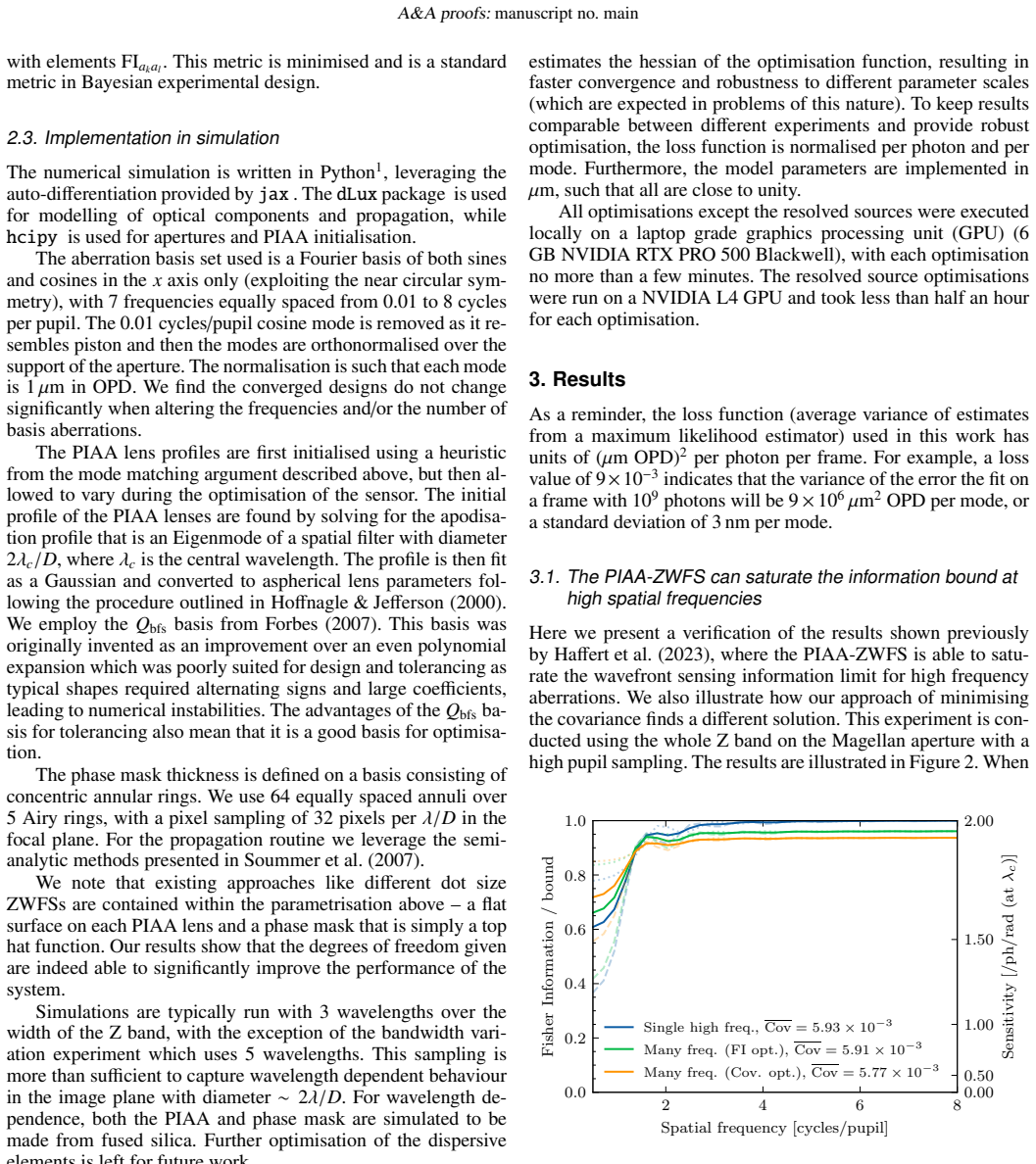
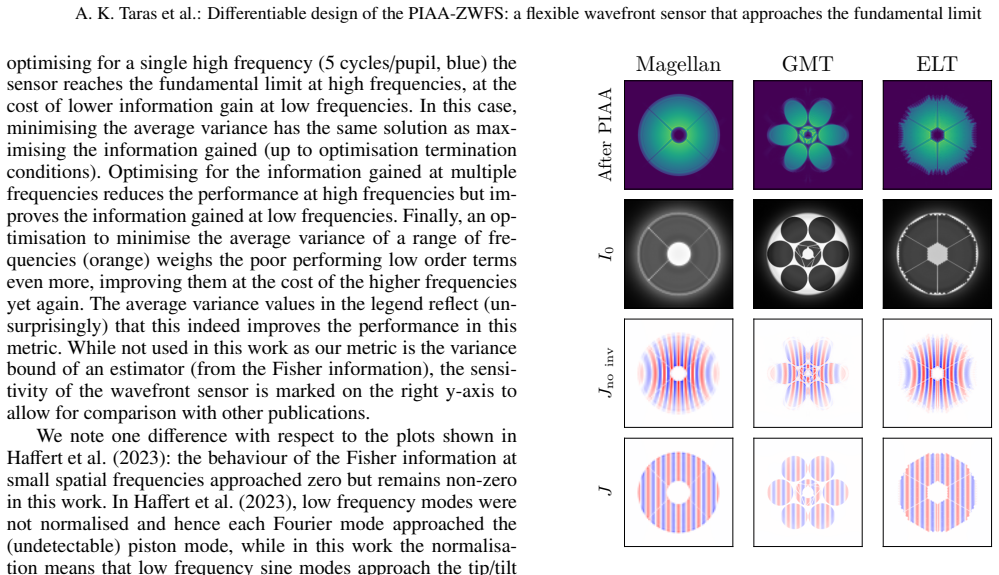
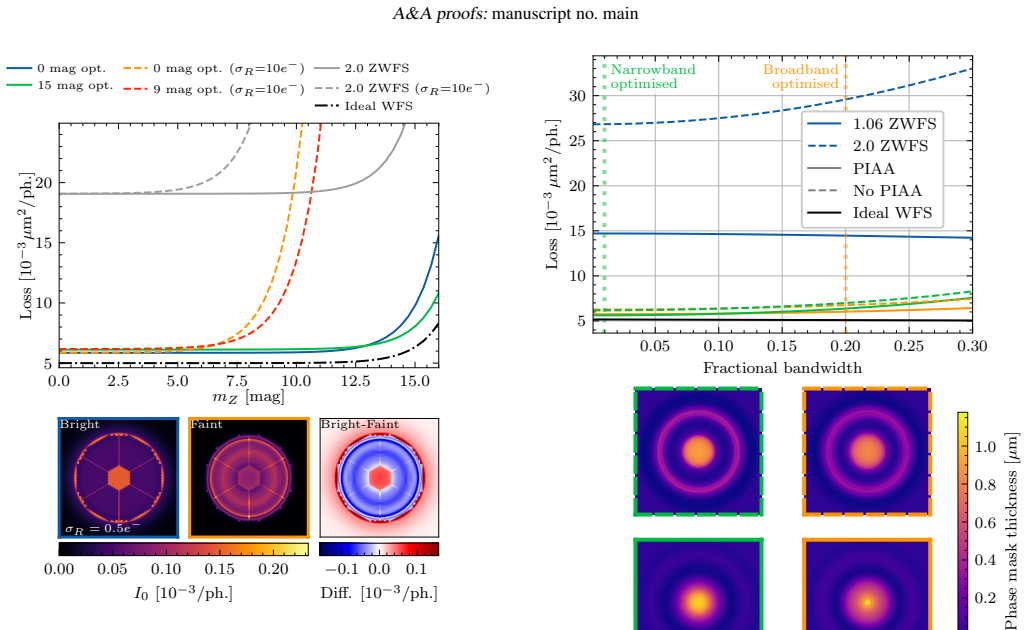
The PIAA-ZWFS is an adaptation of the Zernike wavefront sensor that uses phase-induced amplitude apodisation of the pupil to concentrate starlight. Optimized with a differentiable framework to minimize the variance of a maximum likelihood estimator in the high Strehl regime, it closes the gap to the fundamental limit by a factor of 10 compared to the conventional ZWFS in photon-limited cases and by 2.5 compared to an optimized ZWFS. It also outperforms point source sensors for stellar diameters larger than 0.8 λ/D and maintains dynamic range with linear and non-linear reconstructors.
What carries the argument
The PIAA-ZWFS architecture, which combines phase-induced amplitude apodisation with the Zernike wavefront sensor and is optimized through differentiable modeling to minimize estimator variance.
If this is right
- Closes the gap to the fundamental limit by a factor of 10 compared to conventional ZWFS in typical photon-limited cases.
- Outperforms the optimised ZWFS by a factor of 2.5 in the same scenario.
- Outperforms ideal point source sensors for source sizes larger than 0.8 λ/D.
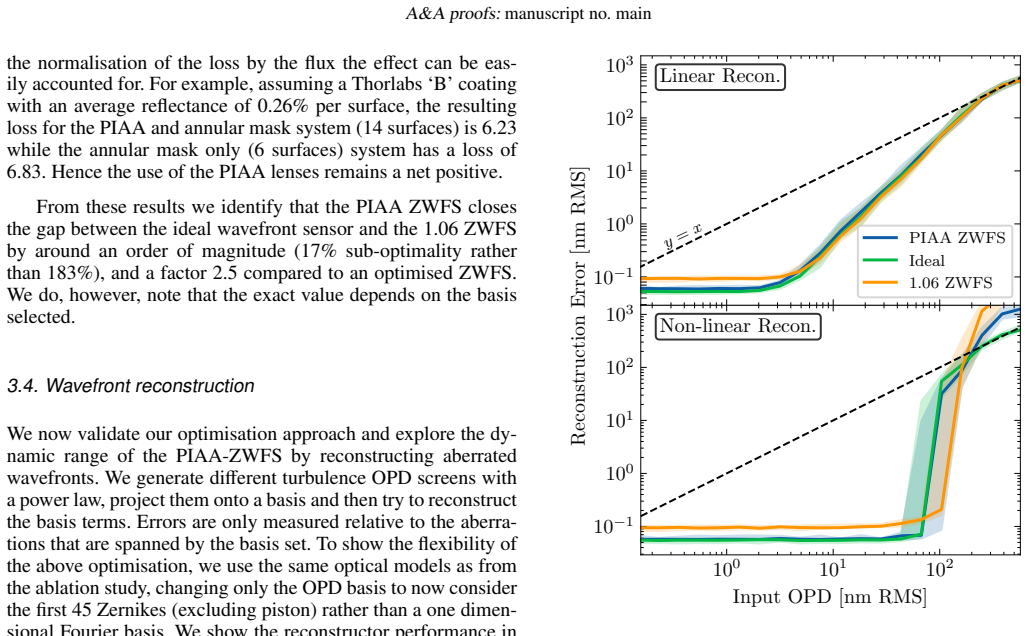
- Maintains performance with linear or non-linear reconstructors without loss of dynamic range.
- There is a necessary trade-off between amplitude and phase error information for any wavefront sensor.
Where Pith is reading between the lines
- The sensor could allow adaptive optics systems to run on fainter targets or at higher frame rates for exoplanet detection.
- Optimization methods using differentiable models may apply to other types of wavefront sensors.
- Implementation on real telescopes would test if the simulated gains hold under actual atmospheric and instrumental conditions.
Load-bearing premise
The maximum likelihood estimator operates in the high Strehl regime and the differentiable model accurately captures the physical behavior of the PIAA-ZWFS.
What would settle it
An experiment measuring the estimation variance for the PIAA-ZWFS in a photon-limited, high Strehl setup and checking if it matches the predicted improvement over standard ZWFS.
Figures


read the original abstract
Extreme adaptive optics (AO) is necessary for high contrast astronomy at scales of the habitable zone of nearby systems. We seek to evaluate wavefront sensors that approach fundamental limits of wavefront sensing, enabling adaptive optics systems to run faster or on fainter targets. We present the phase-induced amplitude apodisation Zernike wavefront sensor (PIAA-ZWFS): an adaptation of the conventional Zernike wavefront sensor (ZWFS) that leverages lossless apodisation of the pupil to concentrate the starlight in the focal plane. We optimise and evaluate the sensor with a differentiable modelling framework, drawing on concepts from Bayesian experimental design to minimise the variance of a maximum likelihood estimator that uses the system in the high Strehl regime. Our architecture shows state-of-the-art performance in simulation for different apertures, bandwidths, photon fluxes and source sizes, closing the gap to the fundamental limit by a factor 10 (2.5) compared to the conventional ZWFS (optimised ZWFS) in a typical photon-limited case. For extended sources, we show that even an ideal point source sensor rapidly becomes sub-optimal, and our system outperforms it for stellar diameters larger than 0.8{\lambda}/D. We verify that these gains do not come at the cost of dynamic range with either linear or non-linear reconstructors. Finally, we present a proof that there must be a trade-off between the information gained about amplitude and phase errors for any wavefront sensor. The PIAA-ZWFS is a viable wavefront sensor operating near the fundamental sensitivity limits.
Editorial analysis
A structured set of objections, weighed in public.
Referee Report
Summary. The manuscript introduces the phase-induced amplitude apodisation Zernike wavefront sensor (PIAA-ZWFS), an adaptation of the conventional Zernike wavefront sensor (ZWFS) that uses lossless pupil apodisation to concentrate starlight. A differentiable physical model is employed to optimise the design by minimising the variance of a maximum likelihood estimator (MLE) in the high Strehl regime, drawing on Bayesian experimental design concepts. Simulations across apertures, bandwidths, photon fluxes and source sizes demonstrate state-of-the-art performance, closing the gap to the fundamental limit by a factor of 10 (2.5) relative to the conventional ZWFS (optimised ZWFS) in a typical photon-limited case. Additional results address extended sources (outperforming point-source sensors for diameters >0.8 λ/D), dynamic range with linear/non-linear reconstructors, and a proof of the necessary amplitude-phase information trade-off for any wavefront sensor.
Significance. If the simulation results hold under the stated modeling assumptions, the PIAA-ZWFS represents a meaningful advance for extreme adaptive optics in high-contrast astronomy, potentially enabling faster correction or fainter targets. The differentiable optimisation framework is a methodological strength that could generalise to other sensor designs, and the theoretical proof on information trade-offs adds lasting value. The work is entirely simulation-based with no experimental validation or independent model benchmarking reported.
major comments (2)
- [Results / optimisation section] The central performance claims (factor-of-10 and factor-of-2.5 gap closures) rest on MLE variance comparisons to a fundamental limit; the manuscript must provide explicit equations or tables (e.g., in the results section) showing how the limit is computed, how the MLE variance is evaluated, and the precise Strehl ratios at which the high-Strehl assumption is applied, as these quantities are load-bearing for the quantitative claims.
- [Methods / simulation framework] The differentiable model is used both to optimise the PIAA-ZWFS and to evaluate its performance; an independent cross-check (e.g., against a non-differentiable physical optics code or analytic ZWFS expressions) is required to confirm that optimisation gains are not artefacts of the shared model, particularly for the extended-source and dynamic-range cases.
minor comments (3)
- Clarify the exact definition and derivation of the 'fundamental limit' used for benchmarking (abstract and § on information limits).
- The dynamic-range verification with linear and non-linear reconstructors is mentioned but lacks specifics on the reconstructors or the quantitative metric; add a short table or figure caption with these details.
- Notation for the PIAA apodisation parameters and the MLE covariance should be defined consistently in the first methods subsection where they appear.
Simulated Author's Rebuttal
We thank the referee for their positive assessment and constructive comments, which will strengthen the manuscript. We address each major comment below and will revise accordingly.
read point-by-point responses
-
Referee: [Results / optimisation section] The central performance claims (factor-of-10 and factor-of-2.5 gap closures) rest on MLE variance comparisons to a fundamental limit; the manuscript must provide explicit equations or tables (e.g., in the results section) showing how the limit is computed, how the MLE variance is evaluated, and the precise Strehl ratios at which the high-Strehl assumption is applied, as these quantities are load-bearing for the quantitative claims.
Authors: We agree that explicit documentation of these quantities is necessary to support the quantitative claims. In the revised manuscript we will add, in the results section, the explicit equations for the fundamental limit (Cramér-Rao bound under the high-Strehl approximation), the procedure used to evaluate MLE variance (via the inverse Fisher information matrix), and a table listing the precise Strehl ratios (all simulations use Strehl > 0.9) at which the high-Strehl assumption is invoked. revision: yes
-
Referee: [Methods / simulation framework] The differentiable model is used both to optimise the PIAA-ZWFS and to evaluate its performance; an independent cross-check (e.g., against a non-differentiable physical optics code or analytic ZWFS expressions) is required to confirm that optimisation gains are not artefacts of the shared model, particularly for the extended-source and dynamic-range cases.
Authors: We acknowledge the value of independent validation. In revision we will add, in the methods section, direct comparisons of the differentiable model against analytic ZWFS expressions for the conventional (non-PIAA) case across the reported photon fluxes and bandwidths. For the PIAA-ZWFS itself, where no closed-form solution exists, we will include additional notes on the physical-optics derivation of the model and a limited cross-check against a non-differentiable Fourier-propagation implementation for the extended-source and dynamic-range results. Full benchmarking of every optimized configuration against an independent code base is not feasible within the current scope but the requested analytic checks will be provided. revision: partial
Circularity Check
No significant circularity in derivation chain
full rationale
The paper optimizes the PIAA-ZWFS via a differentiable physical model to minimize MLE variance (high-Strehl regime) using Bayesian experimental design concepts, then evaluates simulated performance against an independent fundamental limit (Cramér-Rao type) across apertures, bandwidths, fluxes and source sizes. A separate proof addresses amplitude-phase information trade-off. No quoted equations or steps reduce by construction to fitted inputs, self-citations, or renamed known results; the modeling accuracy is an explicit assumption rather than a derived claim. Central results remain externally falsifiable via simulation benchmarks and the stated limit, qualifying as self-contained.
Axiom & Free-Parameter Ledger
axioms (1)
- domain assumption The maximum likelihood estimator uses the system in the high Strehl regime
invented entities (1)
-
PIAA-ZWFS
no independent evidence
Reference graph
Works this paper leans on
-
[1]
& Kahn, P
Bracewell, R. & Kahn, P. B. 1966, American Journal of Physics, 34, 712
1966
-
[2]
2022, in Adaptive Optics Systems VIII, V ol
Chambouleyron, V ., Fauvarque, O., Plantet, C., et al. 2022, in Adaptive Optics Systems VIII, V ol. 12185, SPIE, 932–944
2022
-
[3]
2023, Astronomy & Astro- physics, 670, A153
Chambouleyron, V ., Fauvarque, O., Plantet, C., et al. 2023, Astronomy & Astro- physics, 670, A153
2023
-
[4]
K., Jensen-Clem, R., & Macintosh, B
Chambouleyron, V ., Wallace, J. K., Jensen-Clem, R., & Macintosh, B. 2024, Optics Express, 32, 47706
2024
-
[5]
2018, Annual Review of Materials Research, 48, 279
Chang, S., Guo, X., & Ni, X. 2018, Annual Review of Materials Research, 48, 279
2018
-
[6]
2025, Astronomy & Astro- physics, 701, A157
Darcis, M., Haffert, S., Chambouleyron, V ., et al. 2025, Astronomy & Astro- physics, 701, A157
2025
-
[7]
S., Fagginger Auer, F., Escuti, M
Doelman, D. S., Fagginger Auer, F., Escuti, M. J., & Snik, F. 2018, Optics letters, 44, 17
2018
-
[8]
S., Snik, F., Warriner, N
Doelman, D. S., Snik, F., Warriner, N. Z., & Escuti, M. J. 2017, in Techniques and Instrumentation for Detection of Exoplanets VIII, V ol. 10400, SPIE, 224–235
2017
-
[9]
2019, Journal of the Optical Society of America A, 36, 1241
Fauvarque, O., Janin-Potiron, P., Correia, C., et al. 2019, Journal of the Optical Society of America A, 36, 1241
2019
-
[10]
2013, Practical methods of optimization (John Wiley & Sons)
Fletcher, R. 2013, Practical methods of optimization (John Wiley & Sons)
2013
-
[11]
Forbes, G. W. 2007, Optics express, 15, 5218
2007
-
[12]
2019, Advanced Optical Technologies, 8, 163
Grushina, A. 2019, Advanced Optical Technologies, 8, 163
2019
-
[13]
2003, Astronomy & Astrophysics, 404, 379
Guyon, O. 2003, Astronomy & Astrophysics, 404, 379
2003
-
[14]
2005, The Astrophysical Journal, 629, 592
Guyon, O. 2005, The Astrophysical Journal, 629, 592
2005
-
[15]
2018, Annual Review of Astronomy and Astrophysics, 56, 315
Guyon, O. 2018, Annual Review of Astronomy and Astrophysics, 56, 315
2018
-
[16]
Haffert, S. Y ., Males, J. R., & Guyon, O. 2023, arXiv preprint arXiv:2310.10889
-
[17]
Hoffnagle, J. A. & Jefferson, C. M. 2000, Applied optics, 39, 5488
2000
-
[18]
Kasper, M., Urra, N. C., Pathak, P., et al. 2021, arXiv preprint arXiv:2103.11196
-
[19]
Y ., Long, J., et al
Landman, R., Haffert, S. Y ., Long, J., et al. 2025, Astronomy & Astrophysics, 696, L1
2025
-
[20]
H., et al
Landman, R., Keller, C., Por, E. H., et al. 2022, in Adaptive Optics Systems VIII, V ol. 12185, SPIE, 2582–2593
2022
-
[21]
R., Close, L
Males, J. R., Close, L. M., Haffert, S. Y ., et al. 2024, in Ground-based and Air- borne Instrumentation for Astronomy X, ed. J. R. Vernet, J. J. Bryant, & K. Motohara (Yokohama, Japan: SPIE), 34
2024
-
[22]
R., Fitzgerald, M
Males, J. R., Fitzgerald, M. P., Belikov, R., & Guyon, O. 2021, Publications of the Astronomical Society of the Pacific, 133, 104504
2021
-
[23]
A., Bailey, J., Bartlett, J., et al
Mazin, B. A., Bailey, J., Bartlett, J., et al. 2019, arXiv preprint arXiv:1908.02775 N’Diaye, M., Dohlen, K., Fusco, T., & Paul, B. 2013, Astronomy & Astro- physics, 555, A94
-
[24]
2008, 139, 012021
Paterson, C. 2008, 139, 012021
2008
- [25]
-
[26]
& Farinato, J
Ragazzoni, R. & Farinato, J. 1999, Astronomy and Astrophysics, v. 350, p. L23- L26 (1999), 350, L23
1999
-
[27]
1965, Journal of the Optical Society of America, 55, 1110
Slepian, D. 1965, Journal of the Optical Society of America, 55, 1110
1965
-
[28]
Soummer, R., Pueyo, L., Sivaramakrishnan, A., & Vanderbei, R. J. 2007, Optics Express, 15, 15935
2007
-
[29]
K., Kettenbeil, C., & Jewell, J
Steeves, J., Wallace, J. K., Kettenbeil, C., & Jewell, J. 2020, Optica, 7, 1267
2020
- [30]
-
[31]
& Wallace, J
Wenger, T. & Wallace, J. K. 2025, Optics Letters, 50, 726
2025
-
[32]
1979, Optics Communications, 28, 21
Wyne, C. 1979, Optics Communications, 28, 21
1979
-
[33]
|C {WkEi}|2 dudv − ⟨C {iWkEi} ,C {Ei}⟩ ⟨C {Ei} ,C {iWkEi}⟩ .(A.35) Similarly for the amplitude-amplitude term FIQ bkbk =4ℜ
Zernike, F. 1934, Monthly Notices of the Royal Astronomical Society, V ol. 94, p. 377-384, 94, 377 Article number, page 10 A. K. Taras et al.: Differentiable design of the PIAA-ZWFS: a flexible wavefront sensor that approaches the fundamental limit Appendix A: Derivation of Fisher information bounds A general result for the derivative of the intensity wit...
1934
discussion (0)
Sign in with ORCID, Apple, or X to comment. Anyone can read and Pith papers without signing in.