Evolution of compressed clouds formed by filament coalescence. I. Oblique collisions
Pith reviewed 2026-05-21 03:52 UTC · model grok-4.3
The pith
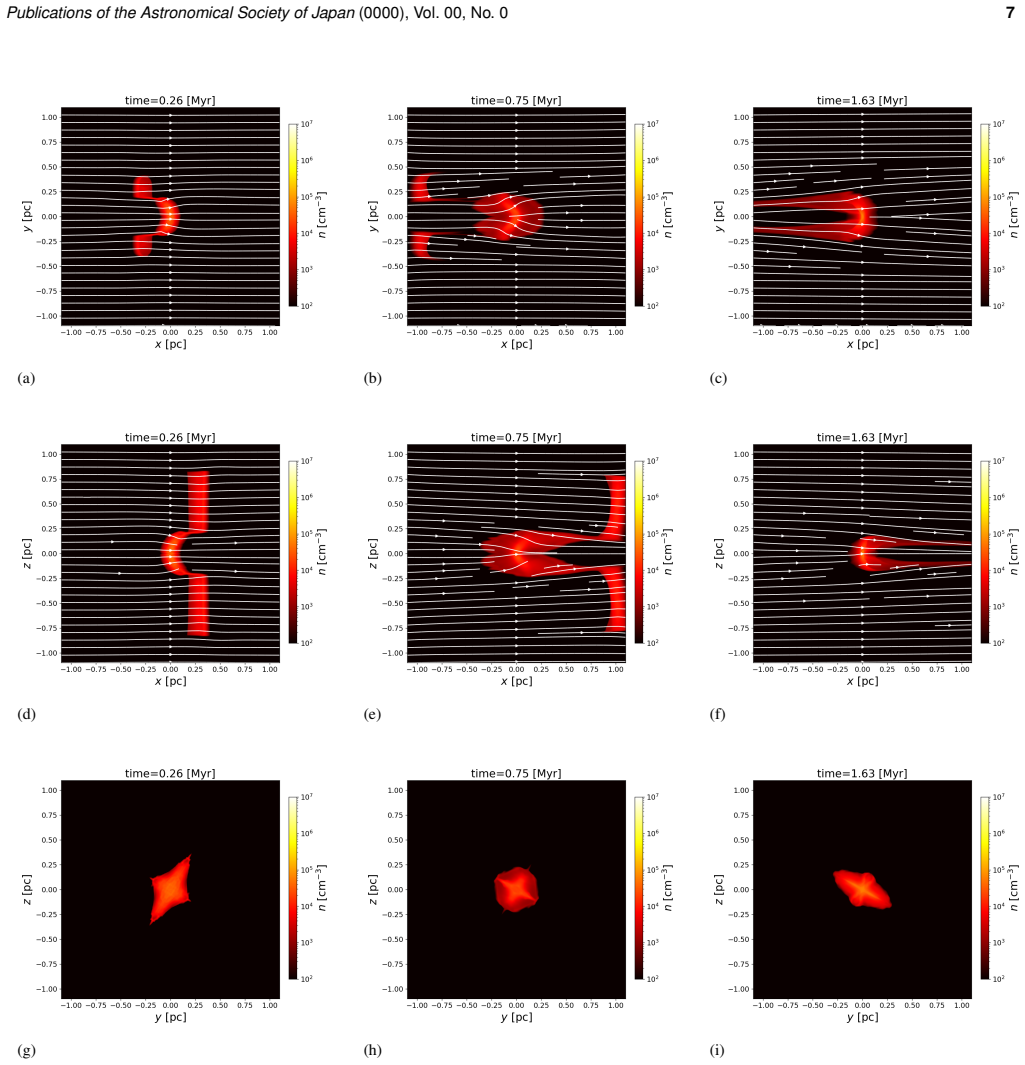
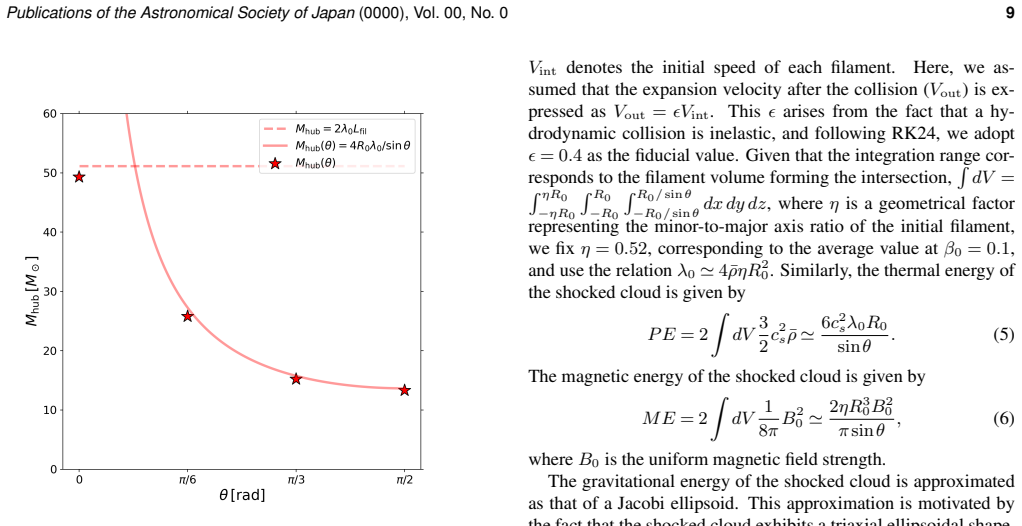
Oblique collisions between magnetized filaments form compressed clouds whose collapse or expansion is set by the angle and an immediate energy balance check.
A machine-rendered reading of the paper's core claim, the machinery that carries it, and where it could break.
Core claim
The gravitational stability of the post-collision compressed cloud is determined by its energy balance immediately after the collision. When the absolute value of the gravitational energy exceeds the sum of the kinetic, thermal, and magnetic energies, the cloud undergoes gravitational collapse; when the gravitational energy is smaller, the cloud expands.
What carries the argument
The instantaneous energy balance: absolute gravitational energy compared against the sum of kinetic, thermal, and magnetic energies, evaluated right after the oblique collision.
If this is right
- Smaller collision angles make the compressed cloud more likely to collapse gravitationally.
- An upper limit exists on collision velocity beyond which hub-filament systems do not form.
- The identified conditions point to collision geometries favorable for massive star formation.
- The energy criterion offers a direct test for whether observed filament intersections will form dense hubs.
Where Pith is reading between the lines
- Observed alignments of filaments in molecular clouds could be used to forecast which junctions will form stars.
- Adding radiative cooling or ongoing accretion in future runs would test how durable the single-moment energy test remains.
- The same balance idea might extend to mergers among three or more filaments inside larger hub systems.
Load-bearing premise
The long-term gravitational stability of the compressed cloud is fully determined by comparing energies at one instant immediately after the collision, without needing to track continued accretion, magnetic field evolution, or radiative cooling over longer times.
What would settle it
A simulation or observation showing a post-collision cloud where the absolute gravitational energy exceeds the sum of the other energies yet the cloud expands, or where the energies suggest expansion yet collapse occurs.
Figures





read the original abstract
Stars are thought to form predominantly within filamentary molecular clouds. Recent studies have suggested that active star formation, including the formation of stellar clusters and massive stars, occurs within so-called "hub" structures, where multiple filaments converge. Understanding the formation and evolution of such hub-filament systems is therefore essential for unveiling the physical processes responsible for cluster and massive star formation, although the full picture remains incomplete. To address this, we have focused on filament-filament collisions as a potential formation mechanism of the hubs. In this study, we investigate the fundamental evolutionary processes of oblique collisions between two magnetized filaments using three-dimensional ideal magnetohydrodynamical simulations. As a model of initial filaments, we consider two identical finite-length magnetized filaments, varying the collision angle between their long axes, the collision velocity, which is set perpendicular to the long axes, and the initial line mass. We find that as the collision angle decreases from orthogonal to parallel, the compressed cloud becomes more prone to gravitational collapse. In addition, the instability of the post-collision compressed cloud can be explained by its energy balance. Specifically, if the absolute value of the gravitational energy exceeds the sum of the kinetic, thermal, and magnetic energies immediately after the collision, the cloud undergoes gravitational collapse. Conversely, if the gravitational energy is smaller, the cloud expands. In addition, we estimate the upper limit of the collision velocity that enables hub-filament formation and identify the collision conditions favorable for massive star formation.
Editorial analysis
A structured set of objections, weighed in public.
Referee Report
Summary. The manuscript uses 3D ideal MHD simulations of oblique collisions between two identical finite-length magnetized filaments, varying collision angle, velocity (perpendicular to the axes), and initial line mass. It reports that smaller collision angles increase the likelihood of gravitational collapse in the compressed cloud. The central result is an energy-balance criterion: the cloud collapses if |E_grav| exceeds the sum of kinetic, thermal, and magnetic energies evaluated immediately after the collision, and expands otherwise. The work also derives an upper limit on collision velocity for hub-filament formation and identifies parameter regimes favorable for massive star formation.
Significance. If the instantaneous energy criterion is robust, the paper supplies a simple, falsifiable diagnostic for predicting collapse versus expansion in filament-coalescence events, directly relevant to hub-filament systems and clustered star formation. The systematic exploration of angle, velocity, and line mass in MHD runs is a clear strength, as is the explicit linkage between simulation outcomes and an energy-based explanation.
major comments (2)
- [§4] §4 (energy-balance analysis): The central claim that the sign of |E_grav| − (E_kin + E_therm + E_mag) evaluated immediately after collision determines long-term collapse or expansion is load-bearing, yet the manuscript does not report time series of the four energy terms beyond that single snapshot. Because the filaments are finite, post-collision accretion continues to alter the mass distribution and E_grav on comparable timescales; without showing that the initial inequality remains decisive, the criterion’s predictive power is not fully demonstrated.
- [§2–3] Methods (§2–3): The simulations employ ideal MHD and therefore omit radiative cooling. The paper should quantify how the absence of cooling affects the thermal-energy term in the balance and whether the reported threshold would shift under more realistic thermodynamics, since cooling directly reduces pressure support on the same timescales as the reported collapse.
minor comments (2)
- Define the precise instant used for the post-collision energy evaluation (e.g., time when the filament axes have fully overlapped or a fixed multiple of the crossing time).
- Add panel labels or a table summarizing the exact (angle, velocity, line-mass) values for each run shown in the figures.
Simulated Author's Rebuttal
We thank the referee for their constructive comments and positive evaluation of our study on oblique filament collisions. We address each major point below and have revised the manuscript to improve the presentation of our results.
read point-by-point responses
-
Referee: [§4] §4 (energy-balance analysis): The central claim that the sign of |E_grav| − (E_kin + E_therm + E_mag) evaluated immediately after collision determines long-term collapse or expansion is load-bearing, yet the manuscript does not report time series of the four energy terms beyond that single snapshot. Because the filaments are finite, post-collision accretion continues to alter the mass distribution and E_grav on comparable timescales; without showing that the initial inequality remains decisive, the criterion’s predictive power is not fully demonstrated.
Authors: We agree that time series would strengthen the demonstration. Our existing simulations already evolve the systems for multiple free-fall times post-collision, with outcomes matching the immediate post-collision energy balance. To directly address ongoing accretion in finite filaments, the revised manuscript now includes time-evolution plots of all four energy components for representative runs. These confirm that the sign of the difference at the post-collision snapshot remains predictive and is not reversed by later mass accretion on the relevant timescales. revision: yes
-
Referee: [§2–3] Methods (§2–3): The simulations employ ideal MHD and therefore omit radiative cooling. The paper should quantify how the absence of cooling affects the thermal-energy term in the balance and whether the reported threshold would shift under more realistic thermodynamics, since cooling directly reduces pressure support on the same timescales as the reported collapse.
Authors: We acknowledge that omitting radiative cooling overestimates thermal support in our ideal MHD runs. Cooling would lower the thermal energy term, making gravitational collapse more likely and potentially shifting the velocity or angle thresholds. A quantitative assessment would require new simulations incorporating a cooling function, which lies outside the scope of this work focused on magnetic and geometric effects. The revised manuscript adds a dedicated paragraph in the discussion noting this limitation and stating that our reported criterion is therefore conservative. revision: partial
Circularity Check
No circularity: energy criterion is empirical observation from simulations
full rationale
The paper runs 3D ideal MHD simulations of oblique filament collisions across a parameter space of angles, velocities, and line masses. The central claim—that collapse occurs precisely when |E_grav| exceeds the sum of kinetic + thermal + magnetic energies evaluated immediately after collision—is presented as a finding extracted from inspecting the simulated states and their subsequent evolution. No parameter is fitted to the outcomes and then relabeled as a prediction; the energies are computed directly from the post-collision snapshot and checked against the long-term behavior within the same runs. No self-citation chain, uniqueness theorem, or ansatz smuggling is used to justify the criterion. The result is therefore self-contained as a numerical correlation rather than a tautological reduction of the output to the input.
Axiom & Free-Parameter Ledger
free parameters (3)
- collision angle
- collision velocity
- initial line mass
axioms (2)
- domain assumption Ideal magnetohydrodynamics applies with no resistivity or non-ideal effects.
- domain assumption Two filaments are identical and finite-length with uniform properties along their axes.
Lean theorems connected to this paper
-
IndisputableMonolith/Cost/FunctionalEquation.leanwashburn_uniqueness_aczel unclear?
unclearRelation between the paper passage and the cited Recognition theorem.
if the absolute value of the gravitational energy exceeds the sum of the kinetic, thermal, and magnetic energies immediately after the collision, the cloud undergoes gravitational collapse
-
IndisputableMonolith/Foundation/RealityFromDistinction.leanreality_from_one_distinction unclear?
unclearRelation between the paper passage and the cited Recognition theorem.
Etot = KE_after + PE + ME + GE
What do these tags mean?
- matches
- The paper's claim is directly supported by a theorem in the formal canon.
- supports
- The theorem supports part of the paper's argument, but the paper may add assumptions or extra steps.
- extends
- The paper goes beyond the formal theorem; the theorem is a base layer rather than the whole result.
- uses
- The paper appears to rely on the theorem as machinery.
- contradicts
- The paper's claim conflicts with a theorem or certificate in the canon.
- unclear
- Pith found a possible connection, but the passage is too broad, indirect, or ambiguous to say the theorem truly supports the claim.
Reference graph
Works this paper leans on
-
[1]
The Astropy Project: Building an inclusive, open-science project and status of the v2.0 core package
The Astropy Project: Building an Open-science Project and Status of the v2.0 Core Package. , keywords =. doi:10.3847/1538-3881/aabc4f , archivePrefix =. 1801.02634 , primaryClass =
work page internal anchor Pith review Pith/arXiv arXiv doi:10.3847/1538-3881/aabc4f
-
[2]
Astropy: A Community Python Package for Astronomy
Astropy: A community Python package for astronomy. , keywords =. 2013. doi:10.1051/0004-6361/201322068 , archivePrefix =. 1307.6212 , primaryClass =
work page internal anchor Pith review Pith/arXiv arXiv doi:10.1051/0004-6361/201322068 2013
-
[3]
SExtractor: Software for source extraction. , keywords =. 1996. doi:10.1051/aas:1996164 , adsurl =
-
[4]
Quantifying the Observational Effort Required for the Radial Velocity Characterization of TESS Planets. , keywords =. 2018. doi:10.3847/1538-3881/aacea9 , archivePrefix =. 1807.01263 , primaryClass =
work page internal anchor Pith review Pith/arXiv arXiv doi:10.3847/1538-3881/aacea9 2018
-
[5]
X-Ray Scattering Echoes and Ghost Halos from the Intergalactic Medium: Relation to the Nature of AGN Variability. , keywords =. 2015. doi:10.1088/0004-637X/805/1/23 , archivePrefix =. 1503.01475 , primaryClass =
work page internal anchor Pith review Pith/arXiv arXiv doi:10.1088/0004-637x/805/1/23 2015
- [6]
-
[7]
T _ E X and LAT _ E X Macro Definition Files for Astronomical Publications. , year = "1989", month = "Mar", pages =
work page 1989
-
[8]
LaTeX: A Document Preparation System. 1994
work page 1994
-
[9]
Quasi-periodic Fast Propagating Magnetoacoustic Waves during the Magnetic Reconnection Between Solar Coronal Loops. , keywords =. 2018. doi:10.3847/2041-8213/aaf167 , archivePrefix =. 1811.08553 , primaryClass =
work page internal anchor Pith review Pith/arXiv arXiv doi:10.3847/2041-8213/aaf167 2018
-
[10]
Nominal values for selected solar and planetary quantities: IAU 2015 Resolution B3
Nominal Values for Selected Solar and Planetary Quantities: IAU 2015 Resolution B3. , keywords =. 2016. doi:10.3847/0004-6256/152/2/41 , archivePrefix =. 1605.09788 , primaryClass =
work page internal anchor Pith review Pith/arXiv arXiv doi:10.3847/0004-6256/152/2/41 2015
-
[11]
Swift X-Ray Observations of Classical Novae. II. The Super Soft Source Sample. , keywords =. 2011. doi:10.1088/0067-0049/197/2/31 , archivePrefix =. 1110.6224 , primaryClass =
work page internal anchor Pith review Pith/arXiv arXiv doi:10.1088/0067-0049/197/2/31 2011
-
[12]
Galaxy emission line classification using 3D line ratio diagrams
Galaxy Emission Line Classification Using Three-dimensional Line Ratio Diagrams. , keywords =. 2014. doi:10.1088/0004-637X/793/2/127 , archivePrefix =. 1406.5186 , primaryClass =
work page internal anchor Pith review Pith/arXiv arXiv doi:10.1088/0004-637x/793/2/127 2014
-
[13]
Behrens, Ken and Barnes, Keith , month = dec, year =. Lemuridae , abstract =. Wildlife of. doi:10.1515/9781400880676-008 , pages =
- [14]
-
[15]
Science Fiction Studies , author =
The. Science Fiction Studies , author =. 1979 , pages =
work page 1979
- [16]
- [17]
-
[18]
McGoogan, Keriann , year =. Chasing
-
[19]
Magnetohydrostatic Equilibrium Structure and Mass of Filamentary Isothermal Cloud Threaded by Lateral Magnetic Field. , keywords =. doi:10.1088/0004-637X/785/1/24 , archivePrefix =. 1402.3033 , primaryClass =
work page internal anchor Pith review Pith/arXiv arXiv doi:10.1088/0004-637x/785/1/24
- [20]
-
[21]
SCUBA and Spitzer observations of the Taurus molecular cloud - pulling the bull's tail. , keywords =. doi:10.1111/j.1365-2966.2007.12750.x , archivePrefix =. 0711.3565 , primaryClass =
-
[22]
Polytropic models of filamentary interstellar clouds - I. Structure and stability
Polytropic models of filamentary interstellar clouds - I. Structure and stability. , keywords =. doi:10.1093/mnras/stu2168 , archivePrefix =. 1410.6091 , primaryClass =
work page internal anchor Pith review Pith/arXiv arXiv doi:10.1093/mnras/stu2168
-
[23]
Characterizing interstellar filaments with Herschel in IC5146
Characterizing interstellar filaments with Herschel in IC 5146. , keywords =. doi:10.1051/0004-6361/201116596 , archivePrefix =. 1103.0201 , primaryClass =
work page internal anchor Pith review Pith/arXiv arXiv doi:10.1051/0004-6361/201116596
-
[24]
Gravitational Collapse of Filamentary Clouds. , keywords =. doi:10.1093/pasj/50.6.577 , adsurl =
-
[25]
Characterizing the properties of nearby molecular filaments observed with Herschel
Characterizing the properties of nearby molecular filaments observed with Herschel. , keywords =. doi:10.1051/0004-6361/201832725 , archivePrefix =. 1810.00721 , primaryClass =
work page internal anchor Pith review Pith/arXiv arXiv doi:10.1051/0004-6361/201832725
-
[26]
Herschel view of the Taurus B211/3 filament and striations: Evidence of filamentary growth?
Herschel view of the Taurus B211/3 filament and striations: evidence of filamentary growth?. , keywords =. doi:10.1051/0004-6361/201220500 , archivePrefix =. 1211.6360 , primaryClass =
work page internal anchor Pith review Pith/arXiv arXiv doi:10.1051/0004-6361/201220500
-
[27]
, year = 1964, month = oct, volume =
The Equilibrium of Polytropic and Isothermal Cylinders. , year = 1964, month = oct, volume =. doi:10.1086/148005 , adsurl =
-
[28]
Near-infrared-imaging Polarimetry Toward Serpens South: Revealing the Importance of the Magnetic Field. , keywords =. doi:10.1088/0004-637X/734/1/63 , archivePrefix =. 1104.2977 , primaryClass =
work page internal anchor Pith review Pith/arXiv arXiv doi:10.1088/0004-637x/734/1/63
-
[29]
The Magnetic Field in Taurus Probed by Infrared Polarization
The Magnetic Field in Taurus Probed by Infrared Polarization. , keywords =. doi:10.1088/0004-637X/741/1/21 , archivePrefix =. 1108.0410 , primaryClass =
work page internal anchor Pith review Pith/arXiv arXiv doi:10.1088/0004-637x/741/1/21
-
[30]
Polarization Structure of Filamentary Clouds
Polarization Structure of Filamentary Clouds. , keywords =. doi:10.1088/0004-637X/807/1/47 , archivePrefix =. 1505.02895 , primaryClass =
work page internal anchor Pith review Pith/arXiv arXiv doi:10.1088/0004-637x/807/1/47
-
[31]
Planck intermediate results. XXXV. Probing the role of the magnetic field in the formation of structure in molecular clouds. , keywords =. doi:10.1051/0004-6361/201525896 , archivePrefix =. 1502.04123 , primaryClass =
work page internal anchor Pith review Pith/arXiv arXiv doi:10.1051/0004-6361/201525896
-
[32]
The JCMT BISTRO Survey: Magnetic Fields Associated with a Network of Filaments in NGC 1333. , keywords =. doi:10.3847/1538-4357/aba1e2 , archivePrefix =. 2007.00176 , primaryClass =
-
[33]
From filamentary clouds to prestellar cores to the stellar IMF: Initial highlights from the Herschel Gould Belt Survey. , keywords =. doi:10.1051/0004-6361/201014666 , archivePrefix =. 1005.2618 , primaryClass =
work page internal anchor Pith review Pith/arXiv arXiv doi:10.1051/0004-6361/201014666
-
[34]
Herschel Space Observatory - An ESA facility for far-infrared and submillimetre astronomy
Herschel Space Observatory. An ESA facility for far-infrared and submillimetre astronomy. , keywords =. doi:10.1051/0004-6361/201014759 , archivePrefix =. 1005.5331 , primaryClass =
work page internal anchor Pith review Pith/arXiv arXiv doi:10.1051/0004-6361/201014759
-
[35]
Filamentary structures and compact objects in the Aquila and Polaris clouds observed by Herschel
Filamentary structures and compact objects in the Aquila and Polaris clouds observed by Herschel. , keywords =. doi:10.1051/0004-6361/201014668 , archivePrefix =. 1005.3115 , primaryClass =
work page internal anchor Pith review Pith/arXiv arXiv doi:10.1051/0004-6361/201014668
-
[36]
A Herschel study of the properties of starless cores in the Polaris Flare dark cloud region using PACS and SPIRE. , keywords =. doi:10.1051/0004-6361/201014618 , archivePrefix =. 1005.2519 , primaryClass =
work page internal anchor Pith review Pith/arXiv arXiv doi:10.1051/0004-6361/201014618
-
[37]
Magnetic field structure in the Taurus dark cloud. , keywords =. doi:10.1086/162228 , adsurl =
-
[38]
EVLA Observations of the Barnard 5 Star-Forming Core: Embedded Filaments Revealed
Expanded Very Large Array Observations of the Barnard 5 Star-forming Core: Embedded Filaments Revealed. , keywords =. doi:10.1088/2041-8205/739/1/L2 , archivePrefix =. 1106.5474 , primaryClass =
work page internal anchor Pith review Pith/arXiv arXiv doi:10.1088/2041-8205/739/1/l2 2041
-
[39]
Initial Conditions for Star Formation in Clusters: Physical and Kinematical Structure of the Starless Core Oph A-N6. , keywords =. doi:10.1088/0004-637X/745/2/117 , archivePrefix =. 1111.4424 , primaryClass =
work page internal anchor Pith review Pith/arXiv arXiv doi:10.1088/0004-637x/745/2/117
-
[40]
L1495 revisited: a PPMAP view of a star-forming filament. , keywords =. doi:10.1093/mnras/stz2234 , archivePrefix =. 1908.02295 , primaryClass =
-
[41]
Dense core formation by fragmentation of velocity-coherent filaments in L1517
Dense core formation by fragmentation of velocity-coherent filaments in L1517. , keywords =. doi:10.1051/0004-6361/201117039 , archivePrefix =. 1107.0971 , primaryClass =
work page internal anchor Pith review Pith/arXiv arXiv doi:10.1051/0004-6361/201117039
-
[42]
Planck intermediate results. XXXIII. Signature of the magnetic field geometry of interstellar filaments in dust polarization maps. , keywords =. doi:10.1051/0004-6361/201425305 , archivePrefix =. 1411.2271 , primaryClass =
work page internal anchor Pith review Pith/arXiv arXiv doi:10.1051/0004-6361/201425305
-
[43]
Magnetic fields in star-forming systems (II): examining dust polarization, the Zeeman effect, and the Faraday rotation measure as magnetic field tracers. , keywords =. doi:10.1093/mnras/staa3148 , archivePrefix =. 2009.04201 , primaryClass =
-
[44]
Magnetic Field of the Vela C Molecular Cloud. , keywords =. doi:10.3847/2041-8205/830/2/L23 , adsurl =
-
[45]
Relative Alignment between the Magnetic Field and Molecular Gas Structure in the Vela C Giant Molecular Cloud Using Low- and High-density Tracers. , keywords =. doi:10.3847/1538-4357/ab1eb0 , archivePrefix =. 1804.08979 , primaryClass =
work page internal anchor Pith review Pith/arXiv arXiv doi:10.3847/1538-4357/ab1eb0
-
[46]
The relation between the column density structures and the magnetic field orientation in the Vela C molecular complex. , keywords =. doi:10.1051/0004-6361/201730608 , archivePrefix =. 1702.03853 , primaryClass =
work page internal anchor Pith review Pith/arXiv arXiv doi:10.1051/0004-6361/201730608
-
[47]
, year = 1974, month = jul, volume =
Polytropic Sheets, Cylinders and Spheres with Negative Index. , year = 1974, month = jul, volume =
work page 1974
-
[48]
, year = 1969, month = jan, volume =
Numerical calculations of the dynamics of collapsing proto-star. , year = 1969, month = jan, volume =. doi:10.1093/mnras/145.3.271 , adsurl =
-
[49]
An introduction to the study of stellar structure
-
[50]
Polytropic models of filamentary interstellar clouds -II. Helical magnetic fields
Polytropic models of filamentary interstellar clouds - II. Helical magnetic fields. , keywords =. doi:10.1093/mnras/stu2194 , archivePrefix =. 1410.6092 , primaryClass =
work page internal anchor Pith review Pith/arXiv arXiv doi:10.1093/mnras/stu2194
-
[51]
From Filamentary Networks to Dense Cores in Molecular Clouds: Toward a New Paradigm for Star Formation. Protostars and Planets VI , year = 2014, editor =. doi:10.2458/azu_uapress_9780816531240-ch002 , archivePrefix =. 1312.6232 , primaryClass =
work page internal anchor Pith review Pith/arXiv arXiv doi:10.2458/azu_uapress_9780816531240-ch002 2014
-
[52]
Frontiers in Astronomy and Space Sciences , keywords =
The role of magnetic field in molecular cloud formation and evolution. Frontiers in Astronomy and Space Sciences , keywords =. doi:10.3389/fspas.2019.00005 , archivePrefix =. 1902.00798 , primaryClass =
-
[53]
, year = 1958, month = jan, volume =
Stability of polytropic gas spheres. , year = 1958, month = jan, volume =. doi:10.1093/mnras/118.5.523 , adsurl =
-
[54]
Progress of Theoretical Physics , year = 1987, month = mar, volume =
Gravitational Instability of the Isothermal Gas Cylinder with an Axial magnetic Field. Progress of Theoretical Physics , year = 1987, month = mar, volume =. doi:10.1143/PTP.77.635 , adsurl =
-
[55]
Self-similar Solutions and the Stability of Collapsing Isothermal Filaments. , keywords =. doi:10.1086/171162 , adsurl =
-
[56]
Helical fields and filamentary molecular clouds - I. , keywords =. doi:10.1046/j.1365-8711.2000.03066.x , archivePrefix =. astro-ph/9901096 , primaryClass =
-
[57]
The Athena++ Adaptive Mesh Refinement Framework: Design and Magnetohydrodynamic Solvers. , keywords =. doi:10.3847/1538-4365/ab929b , archivePrefix =. 2005.06651 , primaryClass =
-
[58]
The Jeans Condition: A New Constraint on Spatial Resolution in Simulations of Isothermal Self-gravitational Hydrodynamics. , keywords =. doi:10.1086/310975 , adsurl =
-
[59]
Journal of Computational Physics , year = 2005, month = sep, volume =
A multi-state HLL approximate Riemann solver for ideal magnetohydrodynamics. Journal of Computational Physics , year = 2005, month = sep, volume =. doi:10.1016/j.jcp.2005.02.017 , adsurl =
-
[60]
Journal of Scientific Computing , year = 2009, month = mar, volume =
High Order Strong Stability Preserving Time Discretizations. Journal of Scientific Computing , year = 2009, month = mar, volume =. doi:10.1007/s10915-008-9239-z , adsurl =
-
[61]
Athena: A New Code for Astrophysical MHD
Athena: A New Code for Astrophysical MHD. , keywords =. doi:10.1086/588755 , archivePrefix =. 0804.0402 , primaryClass =
work page internal anchor Pith review Pith/arXiv arXiv doi:10.1086/588755
-
[62]
An Origin of Filamentary Structure in Molecular Clouds. , keywords =. doi:10.1086/306249 , adsurl =
-
[63]
Cluster Formation Triggered by Filament Collisions in Serpens South
Cluster Formation Triggered by Filament Collisions in Serpens South. , keywords =. doi:10.1088/2041-8205/791/2/L23 , archivePrefix =. 1407.1235 , primaryClass =
work page internal anchor Pith review Pith/arXiv arXiv doi:10.1088/2041-8205/791/2/l23 2041
-
[64]
The highest mass stars (>100 M _ ) form only in hubs
Unifying low- and high-mass star formation through density-amplified hubs of filaments. The highest mass stars (>100 M _ ) form only in hubs. , keywords =. doi:10.1051/0004-6361/202038232 , archivePrefix =. 2008.00295 , primaryClass =
-
[65]
Was a cloud-cloud collision the trigger of the recent star formation in Serpens?
Was a cloud-cloud collision the trigger of the recent star formation in Serpens?. , keywords =. doi:10.1051/0004-6361/201015477 , archivePrefix =. 1101.2412 , primaryClass =
work page internal anchor Pith review Pith/arXiv arXiv doi:10.1051/0004-6361/201015477
-
[66]
Merging filaments I: a race against collapse. , keywords =. doi:10.1093/mnras/stab1698 , archivePrefix =. 2104.04541 , primaryClass =
-
[67]
A census of dense cores in the Aquila cloud complex: SPIRE/PACS observations from the Herschel Gould Belt survey. , keywords =. doi:10.1051/0004-6361/201525861 , archivePrefix =. 1507.05926 , primaryClass =
work page internal anchor Pith review Pith/arXiv arXiv doi:10.1051/0004-6361/201525861
-
[68]
Properties of the dense core population in Orion B as seen by the Herschel Gould Belt survey. , keywords =. doi:10.1051/0004-6361/201834753 , archivePrefix =. 1910.04053 , primaryClass =
-
[69]
Near-infrared imaging polarimetry toward M 17 SWex. , keywords =. doi:10.1093/pasj/psz072 , archivePrefix =. 1906.12138 , primaryClass =
-
[70]
Dust polarized emission observations of NGC 6334. BISTRO reveals the details of the complex but organized magnetic field structure of the high-mass star-forming hub-filament network. , keywords =. doi:10.1051/0004-6361/202038624 , archivePrefix =. 2012.13060 , primaryClass =
-
[71]
Simulation of Magnetohydrodynamic Flows: A Constrained Transport Model. , keywords =. doi:10.1086/166684 , adsurl =
-
[72]
II ---Full Nonlinear Numerical Simulations---
Fragmentation of Isothermal Sheet-Like Clouds. II ---Full Nonlinear Numerical Simulations---. Progress of Theoretical Physics , year = 1987, month = dec, volume =. doi:10.1143/PTP.78.1273 , adsurl =
-
[73]
, year = 1978, month = jan, volume =
Gravitational Instability of Magnetized Gaseous Disks 6. , year = 1978, month = jan, volume =
work page 1978
-
[74]
The Cluster-forming Site AFGL 5157: Colliding Filamentary Clouds and Star Formation. , keywords =. doi:10.3847/1538-4357/ab4189 , archivePrefix =. 1909.01298 , primaryClass =
-
[75]
Formation of dense structures induced by filament collisions. Correlation of density, kinematics, and magnetic field in the Pipe nebula. , keywords =. doi:10.1051/0004-6361/201425234 , archivePrefix =. 1412.4778 , primaryClass =
work page internal anchor Pith review Pith/arXiv arXiv doi:10.1051/0004-6361/201425234
-
[76]
Filamentary structure of star-forming complexes
Filamentary Structure of Star-forming Complexes. , keywords =. doi:10.1088/0004-637X/700/2/1609 , archivePrefix =. 0906.2005 , primaryClass =
work page internal anchor Pith review Pith/arXiv arXiv doi:10.1088/0004-637x/700/2/1609 2005
-
[77]
The physical and dynamical structure of Serpens: Two very different sub-(proto)clusters
The physical and dynamical structure of Serpens. Two very different sub-(proto)clusters. , keywords =. doi:10.1051/0004-6361/200913919 , archivePrefix =. 1006.0879 , primaryClass =
work page internal anchor Pith review Pith/arXiv arXiv doi:10.1051/0004-6361/200913919
-
[78]
Magnetic braking of an aligned rotator during star formation - an exact, time-dependent solution. , keywords =. doi:10.1086/157936 , adsurl =
-
[79]
Evolution of Angular Momentum Distribution during Star Formation
The Evolution of the Angular Momentum Distribution during Star Formation. , keywords =. doi:10.1086/312417 , archivePrefix =. astro-ph/9911166 , primaryClass =
work page internal anchor Pith review Pith/arXiv arXiv doi:10.1086/312417
-
[80]
Simulations of MHD Turbulence in a Strongly Magnetized Medium
Simulations of Magnetohydrodynamic Turbulence in a Strongly Magnetized Medium. , keywords =. doi:10.1086/324186 , archivePrefix =. astro-ph/0105235 , primaryClass =
work page internal anchor Pith review Pith/arXiv arXiv doi:10.1086/324186
discussion (0)
Sign in with ORCID, Apple, or X to comment. Anyone can read and Pith papers without signing in.