One-Step Flow Matching for Generative Modeling of Path-Dependent Physical Fields
Pith reviewed 2026-06-26 09:37 UTC · model grok-4.3
The pith
A transformer-based flow matching model generates accurate high-resolution path-dependent stress fields in one step from limited data.
A machine-rendered reading of the paper's core claim, the machinery that carries it, and where it could break.
Core claim
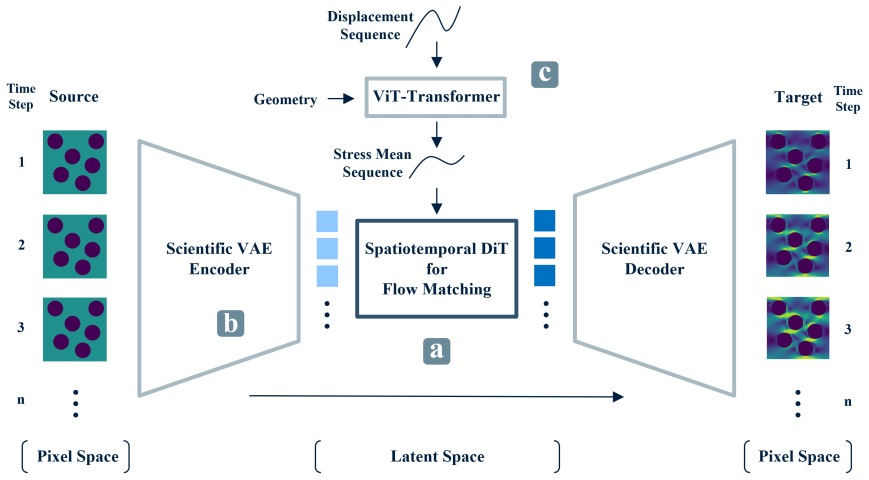
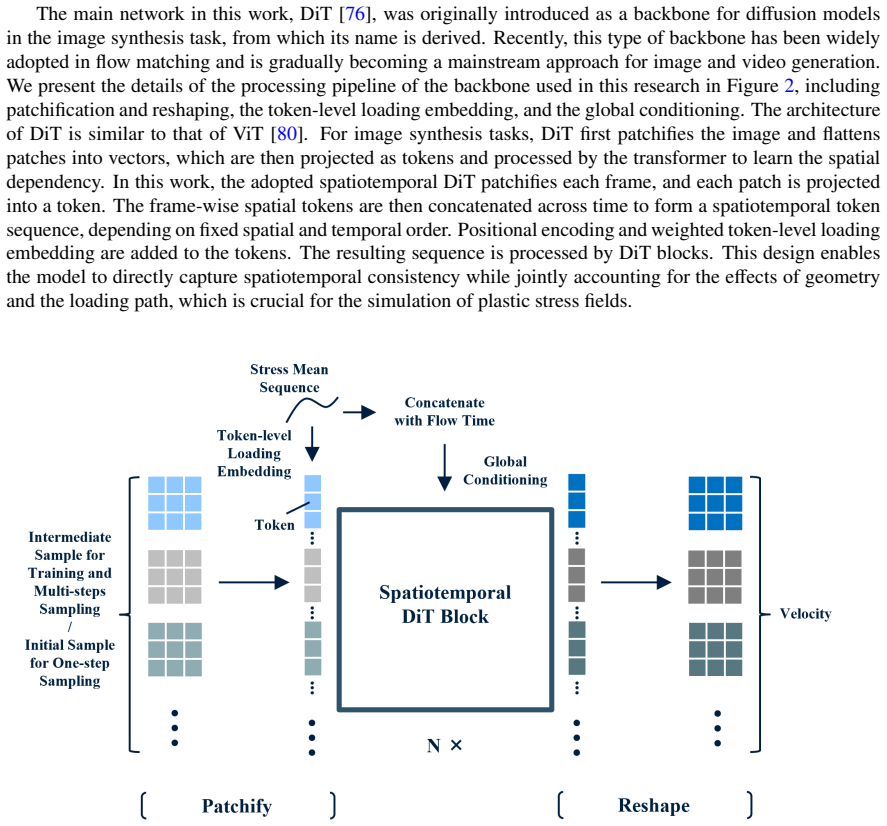
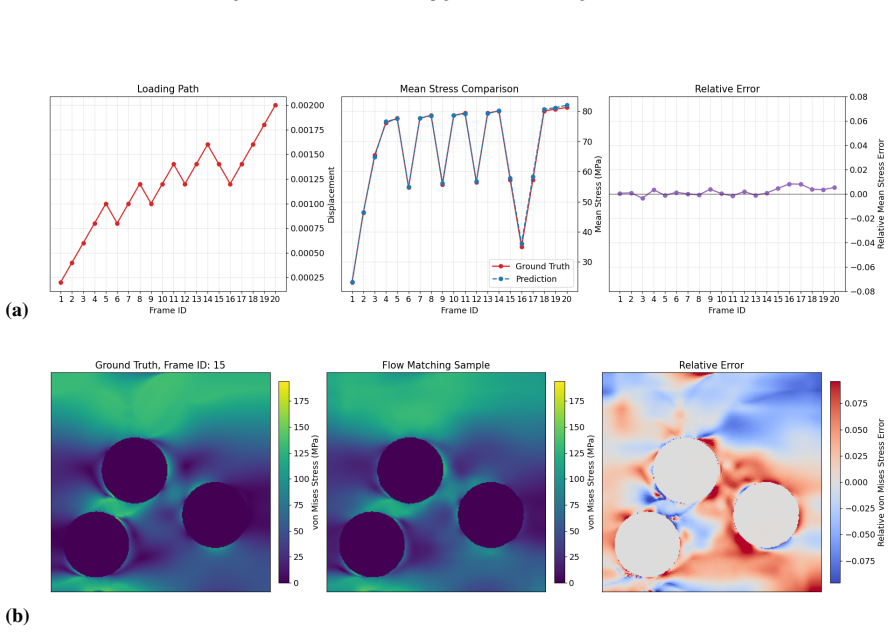
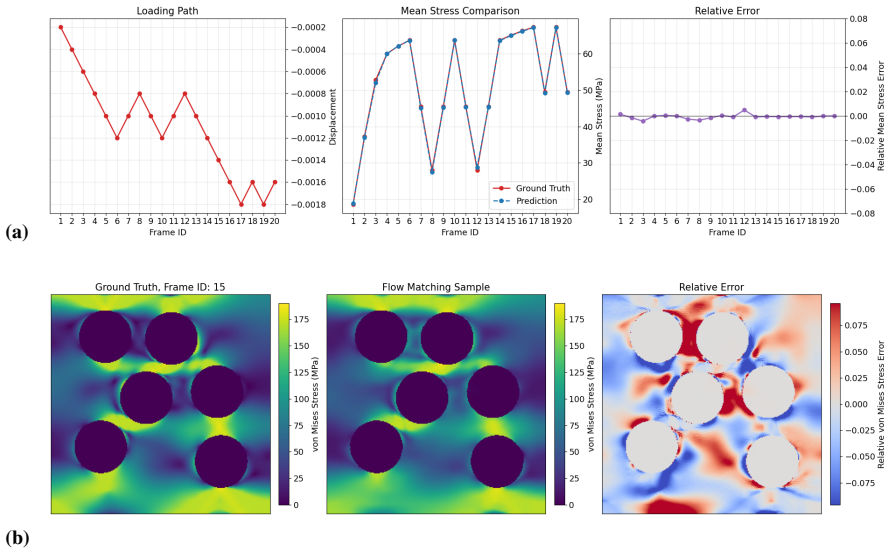
The authors develop a flow matching model based on a transformer backbone that operates in the latent space of a variational autoencoder, formulating plastic field simulation as a video synthesis task. By designing a non-Gaussian source distribution, the model reduces crossings among conditional transport paths, enabling satisfactory one-step samples. Token-level loading embeddings and two auxiliary networks enhance performance for path-dependent constitutive behavior with stochastic paths and geometry.
What carries the argument
Flow matching with non-Gaussian source distribution inside VAE latent space, using a transformer backbone plus token-level loading embeddings and auxiliary networks
If this is right
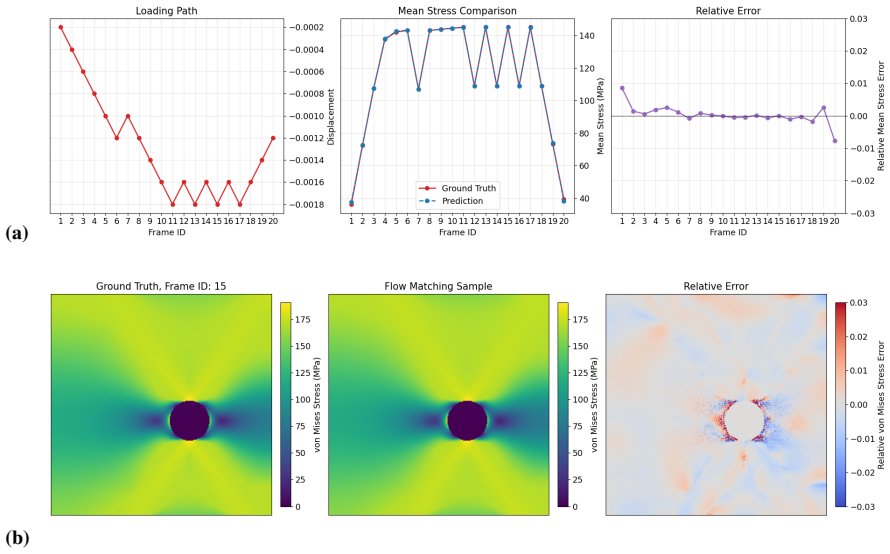
- Accurate generation of high-resolution path-dependent stress fields is possible even with a limited training dataset.
- The model produces full time sequences of stress fields directly, without requiring hundreds of sampling steps.
- Computational cost is reduced by a factor of 6 to 7 relative to finite-element analysis on CPUs.
- Speedup reaches approximately two orders of magnitude on consumer-grade GPUs while preserving accuracy for path-dependent behavior.
Where Pith is reading between the lines
- The one-step property could enable interactive design loops where engineers query stress fields for many candidate geometries in real time.
- The same latent-space video formulation might transfer to other history-dependent physical quantities such as damage evolution or thermal history.
- Because the method avoids iterative sampling, it could be paired with uncertainty quantification techniques that require many independent realizations.
Load-bearing premise
The non-Gaussian source distribution combined with token-level loading embeddings and auxiliary networks is sufficient to produce accurate one-step samples for path-dependent constitutive behavior without post-hoc tuning or multiple sampling steps.
What would settle it
Quantitative comparison of one-step generated stress fields against independent finite-element solutions on a held-out collection of unseen stochastic loading paths and geometries, using field-wise error norms such as mean absolute stress deviation.
Figures
read the original abstract
Physical simulations for intricate geometries with path-dependent constitutive models face difficulties due to the enormous computational cost they require. Recently, the emergence of generative AI models, which succeed in image and video synthesis tasks, has provided a promise to further improve simulations. Although U-Net-based denoising diffusion probabilistic models (DDPMs) have been adopted for elastic stress field generation, they typically require hundreds of sampling steps, and applications of generative models to path-dependent, e.g. plastic, stress fields remain very limited. In this work, we propose a novel flow matching (FM) model based on a transformer backbone for high-resolution path-dependent stress field generation with stochastic loading-unloading paths and geometry. The proposed model operates within the latent space of a variational autoencoder (VAE) and formulates the simulation of plastic fields as a video synthesis task, directly generating the stress fields across all time steps. Meanwhile, we design a non-Gaussian source distribution for flow matching, such that crossings among conditional transport paths are reduced during training. This enables our model to generate satisfactory samples in one step without relying on distillation. In addition, we introduce token-level loading embeddings and two auxiliary networks to further enhance the model performance in path-dependent simulation. The results demonstrate that, even with a limited training dataset, our model can accurately generate high-resolution path-dependent fields. It is much more computationally efficient than finite element analysis, providing a speedup of 6 to 7 times over FEM on CPUs and approximately two orders of magnitude speedup on consumer-grade GPUs.
Editorial analysis
A structured set of objections, weighed in public.
Referee Report
Summary. The manuscript proposes a flow matching model with a transformer backbone operating in the latent space of a variational autoencoder (VAE) to generate high-resolution path-dependent (e.g., plastic) stress fields under stochastic loading-unloading paths and varying geometries. It formulates the task as video synthesis across time steps, introduces a non-Gaussian source distribution to reduce crossings in conditional transport paths for one-step sampling without distillation, and adds token-level loading embeddings plus two auxiliary networks. The work claims that the resulting model produces accurate outputs even with limited training data and delivers speedups of 6-7x over FEM on CPUs and roughly two orders of magnitude on consumer GPUs.
Significance. If the central claims are substantiated, the approach could meaningfully accelerate high-fidelity simulations of path-dependent constitutive behavior, offering a practical alternative to expensive finite-element computations for engineering geometries. The framing of time-dependent plastic fields as a generative video task and the attempt at one-step flow matching without post-training distillation represent technically interesting directions at the intersection of generative modeling and computational mechanics.
major comments (2)
- [Abstract (model design paragraph)] Abstract (paragraph on model design): The claim that the non-Gaussian source distribution reduces crossings among conditional transport paths sufficiently to enable accurate one-step samples rests on an unverified mechanism; no quantitative measure of crossing reduction, no ablation against a Gaussian baseline, and no comparison of one-step versus multi-step sampling error on the trained model are supplied to support that this design choice is load-bearing for the reported fidelity.
- [Abstract (results paragraph)] Abstract (results paragraph): The assertions of accurate high-resolution generation with a limited dataset and concrete speedups (6-7x on CPUs, ~100x on GPUs) versus FEM are presented without accompanying error metrics (e.g., relative L2 norms, plastic strain error), dataset cardinality, geometry resolution, hardware specifications, or timing breakdowns that would allow independent verification of the performance claims.
Simulated Author's Rebuttal
We thank the referee for the constructive and detailed comments. We address each major comment point by point below and indicate where revisions to the manuscript will be made.
read point-by-point responses
-
Referee: [Abstract (model design paragraph)] Abstract (paragraph on model design): The claim that the non-Gaussian source distribution reduces crossings among conditional transport paths sufficiently to enable accurate one-step samples rests on an unverified mechanism; no quantitative measure of crossing reduction, no ablation against a Gaussian baseline, and no comparison of one-step versus multi-step sampling error on the trained model are supplied to support that this design choice is load-bearing for the reported fidelity.
Authors: We agree that the abstract presents the non-Gaussian source as enabling one-step sampling without providing quantitative support for the claimed reduction in path crossings. The manuscript motivates the choice in the methods and shows qualitative path visualizations, but does not include the requested ablations or metrics. In the revised manuscript we will add an ablation study (Gaussian vs. non-Gaussian source) with quantitative measures of crossings and one-step versus multi-step error, and we will update the abstract to reference these results. revision: yes
-
Referee: [Abstract (results paragraph)] Abstract (results paragraph): The assertions of accurate high-resolution generation with a limited dataset and concrete speedups (6-7x on CPUs, ~100x on GPUs) versus FEM are presented without accompanying error metrics (e.g., relative L2 norms, plastic strain error), dataset cardinality, geometry resolution, hardware specifications, or timing breakdowns that would allow independent verification of the performance claims.
Authors: We acknowledge that the abstract states the accuracy and speedup claims without the supporting numerical details requested. The experimental section of the manuscript reports relative L2 errors, dataset sizes, resolutions, and timing results, but these are not summarized in the abstract. We will revise the abstract to include the key quantitative values (error norms, dataset cardinality, resolution, and hardware/timing specifications) so that the performance claims can be verified directly from the abstract. revision: yes
Circularity Check
No significant circularity; design choices and empirical results are independent
full rationale
The paper introduces a flow-matching model with a transformer backbone, VAE latent space, non-Gaussian source, token-level embeddings, and auxiliary networks as explicit design decisions to enable one-step generation of path-dependent fields. These choices are motivated by reducing path crossings during training but are not shown to be equivalent to the target performance metrics by construction; results are reported from training on a limited dataset and direct comparison to FEM runtimes. No equations, self-citations, or fitted parameters are described that rename or force the claimed accuracy or speedups. The derivation chain remains self-contained against external benchmarks.
Axiom & Free-Parameter Ledger
Reference graph
Works this paper leans on
-
[1]
D. Bishara, Y . Xie, W. K. Liu, S. Li, A state-of-the-art review on machine learning-based multiscale modeling, simulation, homogenization and design of materials, Archives of computational methods in engineering 30 (1) (2023) 191–222.doi:https://doi.org/10.1007/s11831-022-09795-8
-
[2]
F. E. Bock, R. C. Aydin, C. J. Cyron, N. Huber, S. R. Kalidindi, B. Klusemann, A review of the application of machine learning and data mining approaches in continuum materials mechanics, Frontiers in Materials 6 (2019) 110.doi:https://doi.org/10.3389/fmats.2019.00110
-
[3]
X. Liu, S. Tian, F. Tao, W. Yu, A review of artificial neural networks in the constitutive modeling of composite ma- terials, Composites Part B: Engineering 224 (2021) 109152.doi:https://doi.org/10.1016/j.compositesb. 2021.109152
-
[4]
J. Fish, G. J. Wagner, S. Keten, Mesoscopic and multiscale modelling in materials, Nature materials 20 (6) (2021) 774–786.doi:https://doi.org/10.1038/s41563-020-00913-0
-
[5]
W. K. Liu, S. Li, H. S. Park, Eighty years of the finite element method: Birth, evolution, and future, Archives of Computational Methods in Engineering 29 (6) (2022) 4431–4453.doi:https://doi.org/10.1007/ s11831-022-09740-9
2022
-
[6]
Mozaffar, R
M. Mozaffar, R. Bostanabad, W. Chen, K. Ehmann, J. Cao, M. Bessa, Deep learning predicts path-dependent plastic- ity, Proceedings of the National Academy of Sciences 116 (52) (2019) 26414–26420.doi:https://doi.org/10. 1073/pnas.1911815116
2019
-
[7]
C. Bonatti, D. Mohr, On the importance of self-consistency in recurrent neural network models representing elasto- plastic solids, Journal of the Mechanics and Physics of Solids 158 (2022) 104697.doi:https://doi.org/10. 1016/j.jmps.2021.104697
arXiv 2022
-
[8]
N. Zhang, S.-L. Shen, A. Zhou, Y .-F. Jin, Application of lstm approach for modelling stress–strain behaviour of soil, Applied Soft Computing 100 (2021) 106959.doi:https://doi.org/10.1016/j.asoc.2020.106959
-
[9]
S. Im, J. Lee, M. Cho, Surrogate modeling of elasto-plastic problems via long short-term memory neural networks and proper orthogonal decomposition, Computer Methods in Applied Mechanics and Engineering 385 (2021) 114030. doi:https://doi.org/10.1016/j.cma.2021.114030
-
[10]
J. N. Heidenreich, D. Mohr, Recurrent neural network plasticity models: Unveiling their common core through multi-task learning, Computer Methods in Applied Mechanics and Engineering 426 (2024) 116991.doi:https: //doi.org/10.1016/j.cma.2024.116991
-
[11]
S. Guan, X. Zhang, S. Ranftl, T. Qu, A neural network-based material cell for elastoplasticity and its performance in fe analyses of boundary value problems, International Journal of Plasticity 171 (2023) 103811.doi:https: //doi.org/10.1016/j.ijplas.2023.103811
-
[12]
T. Tancogne-Dejean, M. B. Gorji, J. Zhu, D. Mohr, Recurrent neural network modeling of the large deformation of lithium-ion battery cells, International Journal of Plasticity 146 (2021) 103072.doi:https://doi.org/10.1016/ j.ijplas.2021.103072
arXiv 2021
-
[13]
W. G. Dettmer, E. J. Muttio, R. Alhayki, D. Peri ´c, A framework for neural network based constitutive modelling of inelastic materials, Computer Methods in Applied Mechanics and Engineering 420 (2024) 116672.doi:https: //doi.org/10.1016/j.cma.2023.116672
-
[14]
G. Chen, Recurrent neural networks (rnns) learn the constitutive law of viscoelasticity, Computational Mechanics 67 (3) (2021) 1009–1019.doi:https://doi.org/10.1007/s00466-021-01981-y
-
[15]
Y . Zhou, S. J. Semnani, A machine learning based multi-scale finite element framework for nonlinear com- posite materials, Engineering with Computers 41 (5) (2025) 2795–2831.doi:https://doi.org/10.1007/ s00366-025-02121-3
2025
-
[16]
L. Wu, V . D. Nguyen, N. G. Kilingar, L. Noels, A recurrent neural network-accelerated multi-scale model for elasto- plastic heterogeneous materials subjected to random cyclic and non-proportional loading paths, Computer Meth- ods in Applied Mechanics and Engineering 369 (2020) 113234.doi:https://doi.org/10.1016/j.cma.2020. 113234
-
[17]
F. Ghavamian, A. Simone, Accelerating multiscale finite element simulations of history-dependent materials using a recurrent neural network, Computer Methods in Applied Mechanics and Engineering 357 (2019) 112594.doi: https://doi.org/10.1016/j.cma.2019.112594
-
[18]
H. J. Logarzo, G. Capuano, J. J. Rimoli, Smart constitutive laws: Inelastic homogenization through machine learning, Computer methods in applied mechanics and engineering 373 (2021) 113482.doi:https://doi.org/10.1016/ j.cma.2020.113482
arXiv 2021
-
[19]
K. Wang, W. Sun, A multiscale multi-permeability poroplasticity model linked by recursive homogenizations and deep learning, Computer Methods in Applied Mechanics and Engineering 334 (2018) 337–380.doi:https:// doi.org/10.1016/j.cma.2018.01.036
-
[20]
E. M. Haghighi, S. Na, A single long short-term memory network for enhancing the prediction of path-dependent plasticity with material heterogeneity and anisotropy, arXiv preprint arXiv:2204.01466 (2022).doi:https://doi. org/10.48550/arXiv.2204.01466
-
[21]
J. M. Calleja Vazquez, V . D. Nguyen, L. Wu, S. M. Mustafa, L. Noels, Development of history-dependent surro- gate models in the context of stochastic multi-scale simulations for elasto-plastic composites, in: 5th International 22 Conference on Uncertainty Quantification in Computational Science and Engineering (UNCECOMP2023), 2023. doi:https://doi.org/10...
-
[22]
L. Wu, L. Noels, Self-consistency reinforced minimal gated recurrent unit for surrogate modeling of history- dependent non-linear problems: Application to history-dependent homogenized response of heterogeneous materials, Computer Methods in Applied Mechanics and Engineering 424 (2024) 116881.doi:https://doi.org/10.1016/ j.cma.2024.116881
arXiv 2024
-
[23]
H. Kim, I. Jeong, H. Cho, M. Cho, Surrogate model based on data-driven model reduction for inelastic behavior of composite microstructure, International Journal of Aeronautical and Space Sciences 24 (3) (2023) 732–752.doi: https://doi.org/10.1007/s42405-022-00547-3
-
[24]
S. Vijayaraghavan, L. Wu, L. Noels, S. Bordas, S. Natarajan, L. A. Beex, A data-driven reduced-order surrogate model for entire elastoplastic simulations applied to representative volume elements, Scientific Reports 13 (1) (2023) 12781.doi:https://doi.org/10.1038/s41598-023-38104-x
-
[25]
M. B. Gorji, M. Mozaffar, J. N. Heidenreich, J. Cao, D. Mohr, On the potential of recurrent neural networks for modeling path dependent plasticity, Journal of the Mechanics and Physics of Solids 143 (2020) 103972.doi: https://doi.org/10.1016/j.jmps.2020.103972
-
[26]
J. Friemann, B. Dashtbozorg, M. Fagerström, S. Mirkhalaf, A micromechanics-based recurrent neural networks model for path-dependent cyclic deformation of short fiber composites, International Journal for Numerical Methods in Engineering 124 (10) (2023) 2292–2314.doi:https://doi.org/10.1002/nme.7211
-
[27]
S. B. Tandale, F. Bamer, B. Markert, M. Stoffel, Physics-based self-learning recurrent neural network enhanced time integration scheme for computing viscoplastic structural finite element response, Computer Methods in Applied Mechanics and Engineering 401 (2022) 115668.doi:https://doi.org/10.1016/j.cma.2022.115668
-
[28]
M. Maia, I. Rocha, P. Kerfriden, F. van der Meer, Physically recurrent neural networks for path-dependent het- erogeneous materials: Embedding constitutive models in a data-driven surrogate, Computer Methods in Applied Mechanics and Engineering 407 (2023) 115934.doi:https://doi.org/10.1016/j.cma.2023.115934
-
[29]
S. Deng, S. Hosseinmardi, L. Wang, D. Apelian, R. Bostanabad, Data-driven physics-constrained recurrent neural networks for multiscale damage modeling of metallic alloys with process-induced porosity, Computational Mechan- ics (2024) 1–31doi:https://doi.org/10.1007/s00466-023-02429-1
-
[30]
L. Borkowski, C. Sorini, A. Chattopadhyay, Recurrent neural network-based multiaxial plasticity model with regu- larization for physics-informed constraints, Computers & Structures 258 (2022) 106678.doi:https://doi.org/ 10.1016/j.compstruc.2021.106678
-
[31]
T. Qu, S. Di, Y . Feng, M. Wang, T. Zhao, Towards data-driven constitutive modelling for granular materials via micromechanics-informed deep learning, International Journal of Plasticity 144 (2021) 103046.doi:https:// doi.org/10.1016/j.ijplas.2021.103046
-
[32]
M. Maia, I. B. Rocha, D. Kovaˇcevi´c, F. van der Meer, Physically recurrent neural network for rate and path-dependent heterogeneous materials in a finite strain framework, arXiv preprint arXiv:2404.17583 (2024).doi:https://doi. org/10.48550/arXiv.2404.17583
-
[33]
J. Fish, Y . Yu, Data-physics driven reduced order homogenization, International Journal for Numerical Methods in Engineering 124 (7) (2023) 1620–1645.doi:https://doi.org/10.1002/nme.7178
-
[34]
J. N. Heidenreich, C. Bonatti, D. Mohr, Transfer learning of recurrent neural network-based plasticity models, Inter- national Journal for Numerical Methods in Engineering 125 (1) (2024) e7357.doi:https://doi.org/10.1002/ nme.7357
2024
-
[35]
T. Qu, J. Zhao, S. Guan, Y . Feng, Data-driven multiscale modelling of granular materials via knowledge transfer and sharing, International Journal of Plasticity 171 (2023) 103786.doi:https://doi.org/10.1016/j.ijplas. 2023.103786
-
[36]
S. B. Tandale, M. Stoffel, Recurrent and convolutional neural networks in structural dynamics: a modified atten- tion steered encoder–decoder architecture versus lstm versus gru versus tcn topologies to predict the response of shock wave-loaded plates, Computational Mechanics 72 (4) (2023) 765–786.doi:https://doi.org/10.1007/ s00466-023-02317-8
2023
-
[37]
Vaswani, N
A. Vaswani, N. Shazeer, N. Parmar, J. Uszkoreit, L. Jones, A. N. Gomez, Ł. Kaiser, I. Polosukhin, Attention is all you need, Advances in neural information processing systems 30 (2017). URLhttps://proceedings.neurips.cc/paper_files/paper/2017/file/ 3f5ee243547dee91fbd053c1c4a845aa-Paper.pdf
2017
-
[38]
Y . Zhou, S. J. Semnani, Vit-transformer: Self-attention mechanism based constitutive modeling for nonlinear het- erogeneous materials, arXiv preprint arXiv:2510.16575 (2025).doi:https://doi.org/10.48550/arXiv.2510. 16575
-
[39]
Y . Zhongbo, P. L. Hien, Pre-trained transformer model as a surrogate in multiscale computational homogenization framework for elastoplastic composite materials subjected to generic loading paths, Computer Methods in Applied Mechanics and Engineering 421 (2024) 116745.doi:https://doi.org/10.1016/j.cma.2024.116745
-
[41]
E. L. Buehler, M. J. Buehler, End-to-end prediction of multimaterial stress fields and fracture patterns using cycle- 23 consistent adversarial and transformer neural networks, Biomedical Engineering Advances 4 (2022) 100038.doi: https://doi.org/10.1016/j.bea.2022.100038
-
[42]
Z. Yang, M. J. Buehler, Words to matter: De novo architected materials design using transformer neural networks, Frontiers in Materials 8 (2021) 740754.doi:https://doi.org/10.3389/fmats.2021.740754
-
[44]
A. Gupta, A. Bhaduri, L. Graham-Brady, Accelerated multiscale mechanics modeling in a deep learning framework, Mechanics of Materials (2023) 104709doi:https://doi.org/10.1016/j.mechmat.2023.104709
-
[45]
I. Saha, A. Gupta, L. Graham-Brady, Prediction of local elasto-plastic stress and strain fields in a two-phase composite microstructure using a deep convolutional neural network, Computer Methods in Applied Mechanics and Engineering 421 (2024) 116816.doi:https://doi.org/10.1016/j.cma.2024.116816
-
[46]
M. S. Khorrami, J. R. Mianroodi, N. H. Siboni, P. Goyal, B. Svendsen, P. Benner, D. Raabe, An artificial neural network for surrogate modeling of stress fields in viscoplastic polycrystalline materials, npj Computational Materials 9 (1) (2023) 37.doi:https://doi.org/10.1038/s41524-023-00991-z
-
[47]
C. Yang, Y . Kim, S. Ryu, G. X. Gu, Using convolutional neural networks to predict composite properties beyond the elastic limit, MRS Communications 9 (2) (2019) 609–617.doi:https://doi.org/10.1557/mrc.2019.49
-
[48]
H. Su, T. Guan, Y . Liu, A three-dimensional prediction method of stiffness properties of composites based on deep learning, Computational Mechanics 71 (3) (2023) 583–597.doi:https://doi.org/10.1007/ s00466-022-02253-z
2023
-
[49]
Chang, J.-H
H.-S. Chang, J.-H. Huang, J.-L. Tsai, Predicting mechanical properties of unidirectional composites using ma- chine learning, Multiscale Science and Engineering 4 (4) (2022) 202–210.doi:https://doi.org/10.1007/ s42493-022-00087-8
2022
-
[50]
M. A. Mahdi, C. Crick, W. Zhao, Lattice structure design using machine learning and homogenization approach, in: ASME Aerospace Structures, Structural Dynamics, and Materials Conference, V ol. 87745, American Society of Mechanical Engineers, 2024, p. V001T01A015.doi:https://doi.org/10.1115/SSDM2024-121612
-
[51]
J. R. Mianroodi, S. Rezaei, N. H. Siboni, B.-X. Xu, D. Raabe, Lossless multi-scale constitutive elastic relations with artificial intelligence, npj Computational Materials 8 (1) (2022) 67.doi:https://doi.org/10.1038/ s41524-022-00753-3
2022
-
[52]
C. Yang, Y . Kim, S. Ryu, G. X. Gu, Prediction of composite microstructure stress-strain curves using convolutional neural networks, Materials & Design 189 (2020) 108509.doi:https://doi.org/10.1016/j.matdes.2020. 108509
-
[53]
C. Rao, Y . Liu, Three-dimensional convolutional neural network (3d-cnn) for heterogeneous material homogeniza- tion, Computational Materials Science 184 (2020) 109850.doi:https://doi.org/10.1016/j.commatsci. 2020.109850
-
[54]
H. Peng, A. Liu, J. Huang, L. Cao, J. Liu, L. Lu, Ph-net: Parallelepiped microstructure homogenization via 3d convolutional neural networks, Additive Manufacturing 60 (2022) 103237.doi:https://doi.org/10.1016/j. addma.2022.103237
work page doi:10.1016/j 2022
-
[55]
S. Yan, J. Jelovica, Kato: Neural-reparameterized topology optimization using convolutional kolmogorov-arnold network for stress minimization, International Journal for Numerical Methods in Engineering 126 (8) (2025) e70034. doi:https://doi.org/10.1002/nme.70034
-
[56]
S. Yan, J. Jelovica, Katosuper: Surrogate-accelerated neural topology optimization with sensitivity-consistent fourier neural operators, Available at SSRN 6184689 (2026)
2026
-
[57]
R. Gulakala, B. Markert, M. Stoffel, Graph neural network enhanced finite element modelling, PAMM 22 (1) (2023) e202200306.doi:https://doi.org/10.1002/pamm.202200306
-
[58]
C. Jiang, N.-Z. Chen, Graph neural networks (gnns) based accelerated numerical simulation, Engineering Applica- tions of Artificial Intelligence 123 (2023) 106370.doi:https://doi.org/10.1016/j.engappai.2023.106370
-
[59]
Maurizi, C
M. Maurizi, C. Gao, F. Berto, Predicting stress, strain and deformation fields in materials and structures with graph neural networks, Scientific reports 12 (1) (2022) 21834.doi:https://doi.org/10.1038/ s41598-022-26424-3
2022
-
[60]
Y . Cai, J. Jelovica, Efficient graph representation in graph neural networks for stress predictions in stiffened panels, Thin-Walled Structures 203 (2024) 112157.doi:https://doi.org/10.1016/j.tws.2024.112157
-
[61]
Y . Cai, J. Jelovica, Heterogeneous graph representation of stiffened panels with non-uniform boundary conditions and loads, Engineering with Computers 42 (1) (2026) 5.doi:https://doi.org/10.1007/s00366-025-02261-6
-
[62]
Y . Cai, J. Jelovica, A hybrid global–local computational framework for ship hull structural analysis using homoge- nized model and graph neural network, Marine Structures 109 (2026) 104077.doi:https://doi.org/10.1016/ j.marstruc.2026.104077
arXiv 2026
-
[63]
M. Dai, M. F. Demirel, Y . Liang, J.-M. Hu, Graph neural networks for an accurate and interpretable prediction of the properties of polycrystalline materials, npj Computational Materials 7 (1) (2021) 103.doi:https://doi.org/10. 1038/s41524-021-00574-w
2021
-
[64]
R. Perera, D. Guzzetti, V . Agrawal, Graph neural networks for simulating crack coalescence and propagation in brittle materials, Computer Methods in Applied Mechanics and Engineering 395 (2022) 115021.doi:https://doi.org/ 24 10.1016/j.cma.2022.115021
-
[65]
Karapiperis, D
K. Karapiperis, D. M. Kochmann, Prediction and control of fracture paths in disordered architected materials us- ing graph neural networks, Communications Engineering 2 (1) (2023) 32.doi:https://doi.org/10.1038/ s44172-023-00085-0
2023
-
[66]
Thomas, A
A. Thomas, A. R. Durmaz, M. Alam, P. Gumbsch, H. Sack, C. Eberl, Materials fatigue prediction using graph neural networks on microstructure representations, Scientific Reports 13 (1) (2023) 12562.doi:https://doi.org/10. 1038/s41598-023-39400-2
2023
-
[67]
J. Ho, A. Jain, P. Abbeel, Denoising diffusion probabilistic models, in: H. Larochelle, M. Ranzato, R. Hadsell, M. Balcan, H. Lin (Eds.), Advances in Neural Information Processing Systems, V ol. 33, Curran Associates, Inc., 2020, pp. 6840–6851. URLhttps://proceedings.neurips.cc/paper_files/paper/2020/file/ 4c5bcfec8584af0d967f1ab10179ca4b-Paper.pdf
2020
-
[68]
Y . Song, J. Sohl-Dickstein, D. P. Kingma, A. Kumar, S. Ermon, B. Poole, Score-based generative modeling through stochastic differential equations, in: International Conference on Learning Representations, 2021. URLhttps://openreview.net/forum?id=PxTIG12RRHS
2021
-
[69]
Lipman, R
Y . Lipman, R. T. Q. Chen, H. Ben-Hamu, M. Nickel, M. Le, Flow matching for generative modeling, in: The Eleventh International Conference on Learning Representations, 2023. URLhttps://openreview.net/forum?id=PqvMRDCJT9t
2023
-
[70]
Y . Lipman, M. Havasi, P. Holderrieth, N. Shaul, M. Le, B. Karrer, R. T. Chen, D. Lopez-Paz, H. Ben-Hamu, I. Gat, Flow matching guide and code, arXiv preprint arXiv:2412.06264 (2024).doi:https://doi.org/10.48550/ arXiv.2412.06264
Pith/arXiv arXiv 2024
-
[71]
Albergo, N
M. Albergo, N. M. Boffi, E. Vanden-Eijnden, Stochastic interpolants: A unifying framework for flows and diffusions, Journal of Machine Learning Research 26 (209) (2025) 1–80. URLhttp://jmlr.org/papers/v26/23-1605.html
2025
-
[72]
Y . Jadhav, J. Berthel, C. Hu, R. Panat, J. Beuth, A. B. Farimani, Stressd: 2d stress estimation using denoising diffusion model, Computer Methods in Applied Mechanics and Engineering 416 (2023) 116343.doi:https://doi.org/ 10.1016/j.cma.2023.116343
-
[73]
P. V . Kota, M. M. Rashid, S. Goswami, L. Graham-Brady, A hybrid conditional diffusion-deeponet framework for high-fidelity stress prediction in hyperelastic materials, arXiv preprint arXiv:2603.18225 (2026).doi:https:// doi.org/10.48550/arXiv.2603.18225
-
[74]
D. Shu, Z. Li, A. B. Farimani, A physics-informed diffusion model for high-fidelity flow field reconstruction, Journal of Computational Physics 478 (2023) 111972.doi:https://doi.org/10.1016/j.jcp.2023.111972
-
[75]
A. Kashefi, Flow matching and diffusion models via pointnet for generating fluid fields on irregular geometries, Computer Methods in Applied Mechanics and Engineering 458 (2026) 119037.doi:https://doi.org/10.1016/ j.cma.2026.119037
arXiv 2026
-
[76]
Scalable Diffusion Models with Transformers
W. Peebles, S. Xie, Scalable diffusion models with transformers, in: Proceedings of the IEEE/CVF international conference on computer vision, 2023, pp. 4195–4205.doi:https://doi.org/10.48550/arXiv.2212.09748
work page internal anchor Pith review Pith/arXiv arXiv doi:10.48550/arxiv.2212.09748 2023
-
[77]
A. Tong, K. FATRAS, N. Malkin, G. Huguet, Y . Zhang, J. Rector-Brooks, G. Wolf, Y . Bengio, Improving and generalizing flow-based generative models with minibatch optimal transport, Transactions on Machine Learning ResearchExpert Certification (2024). URLhttps://openreview.net/forum?id=CD9Snc73AW
2024
-
[78]
X. Liu, C. Gong, qiang liu, Flow straight and fast: Learning to generate and transfer data with rectified flow, in: The Eleventh International Conference on Learning Representations, 2023. URLhttps://openreview.net/forum?id=XVjTT1nw5z
2023
-
[79]
Z. Geng, M. Deng, X. Bai, J. Z. Kolter, K. He, Mean flows for one-step generative modeling, in: The Thirty-ninth Annual Conference on Neural Information Processing Systems, 2026. URLhttps://openreview.net/forum?id=uWj4s7rMnR
2026
-
[80]
Dosovitskiy, L
A. Dosovitskiy, L. Beyer, A. Kolesnikov, D. Weissenborn, X. Zhai, T. Unterthiner, M. Dehghani, M. Minderer, G. Heigold, S. Gelly, et al., An image is worth 16x16 words: Transformers for image recognition at scale, Interna- tional Conference on Learning Representations (2020). URLhttps://openreview.net/forum?id=YicbFdNTTy
2020
-
[81]
High-Resolution Image Synthesis with Latent Diffusion Models
R. Rombach, A. Blattmann, D. Lorenz, P. Esser, B. Ommer, High-resolution image synthesis with latent diffusion models, in: Proceedings of the IEEE/CVF Conference on Computer Vision and Pattern Recognition (CVPR), 2022, pp. 10684–10695.doi:https://doi.org/10.48550/arXiv.2112.10752. 25
work page internal anchor Pith review Pith/arXiv arXiv doi:10.48550/arxiv.2112.10752 2022
discussion (0)
Sign in with ORCID, Apple, or X to comment. Anyone can read and Pith papers without signing in.