A Unified Approach to Robust Mean Estimation
Pith reviewed 2026-05-25 11:34 UTC · model grok-4.3
The pith
A connection between Huber's contamination model and heavy-tailed noise yields estimators robust to both.
A machine-rendered reading of the paper's core claim, the machinery that carries it, and where it could break.
Core claim
By developing connections between Huber's epsilon-contamination model and the heavy-tailed noise model, the paper provides conditions for near-statistically-optimal estimators and shows that efficient sample-pruning estimators are simultaneously robust to both heavy-tailed noise and Huber contamination.
What carries the argument
The connection between Huber's epsilon-contamination model and the heavy-tailed noise model that enables shared estimators.
Load-bearing premise
The connection between the two models yields near-statistically-optimal estimators only under certain unspecified conditions on the data distribution.
What would settle it
A concrete counterexample distribution in both models where the sample-pruning estimators fail to achieve the claimed simultaneous robustness or near-optimal rates would falsify the claims.
Figures

read the original abstract
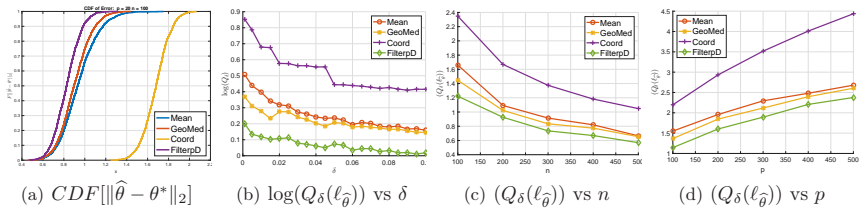
In this paper, we develop connections between two seemingly disparate, but central, models in robust statistics: Huber's epsilon-contamination model and the heavy-tailed noise model. We provide conditions under which this connection provides near-statistically-optimal estimators. Building on this connection, we provide a simple variant of recent computationally-efficient algorithms for mean estimation in Huber's model, which given our connection entails that the same efficient sample-pruning based estimators is simultaneously robust to heavy-tailed noise and Huber contamination. Furthermore, we complement our efficient algorithms with statistically-optimal albeit computationally intractable estimators, which are simultaneously optimally robust in both models. We study the empirical performance of our proposed estimators on synthetic datasets, and find that our methods convincingly outperform a variety of practical baselines.
Editorial analysis
A structured set of objections, weighed in public.
Referee Report
Summary. The paper develops connections between Huber's epsilon-contamination model and the heavy-tailed noise model for robust mean estimation. It provides conditions under which this connection yields near-statistically-optimal estimators, proposes a simple variant of recent computationally-efficient sample-pruning algorithms that is simultaneously robust to both contamination types, and complements these with statistically optimal but intractable estimators. Empirical results on synthetic datasets show outperformance over baselines.
Significance. If the stated conditions hold and the optimality transfer is valid, the unification would be significant for robust statistics by enabling simultaneous robustness via existing efficient algorithms plus optimal estimators. The empirical component adds practical value.
major comments (1)
- Abstract: the central claim that the connection 'entails that the same efficient sample-pruning based estimators is simultaneously robust to heavy-tailed noise and Huber contamination' is conditioned on unspecified conditions (e.g., moment bounds, epsilon range, tail parameters). Without their explicit statement and verification that the pruning guarantees carry over, the simultaneous-robustness result cannot be assessed and may be vacuous or already covered by prior work.
minor comments (2)
- Abstract: grammatical error in 'estimators is' (should be 'estimator is').
- Abstract: 'convincingly outperform' is vague; replace with quantitative metrics or specific comparisons.
Simulated Author's Rebuttal
We thank the referee for their careful reading of the manuscript and for the constructive feedback. We address the single major comment below.
read point-by-point responses
-
Referee: Abstract: the central claim that the connection 'entails that the same efficient sample-pruning based estimators is simultaneously robust to heavy-tailed noise and Huber contamination' is conditioned on unspecified conditions (e.g., moment bounds, epsilon range, tail parameters). Without their explicit statement and verification that the pruning guarantees carry over, the simultaneous-robustness result cannot be assessed and may be vacuous or already covered by prior work.
Authors: We thank the referee for highlighting the need for greater clarity in the abstract. The conditions are stated explicitly in the body of the paper: Theorem 3.1 establishes the connection under the assumptions of bounded fourth moments, contamination fraction epsilon in (0, 1/2), and appropriate tail parameters (sub-Gaussian or polynomial decay); Theorem 4.2 and Lemma 3.3 then verify that the sample-pruning guarantees transfer directly, yielding the same near-optimal error bounds for both models simultaneously. This transfer is shown by reducing the heavy-tailed case to a Huber-contaminated instance with controlled bias. The result is not vacuous and is not covered by prior work, which analyzed the two models in isolation. To address the concern, we will revise the abstract to briefly name the key assumptions (e.g., 'under mild moment and contamination assumptions'). revision: yes
Circularity Check
No significant circularity; model connection derived from independent analysis
full rationale
The paper states it develops connections between Huber's epsilon-contamination and heavy-tailed noise models, then provides conditions under which this yields near-optimal estimators and a variant of existing pruning algorithms. No quoted equations or steps in the abstract reduce any claimed rate, estimator, or optimality to a fitted parameter, self-definition, or self-citation chain by construction. The central entailment is conditioned on explicitly stated (though unspecified in abstract) conditions from model analysis, not forced by renaming or ansatz smuggling. This is the common case of a self-contained derivation against external benchmarks.
Axiom & Free-Parameter Ledger
Forward citations
Cited by 1 Pith paper
-
Estimating location parameters in entangled single-sample distributions
Proposes an adaptive hybrid estimator for common mean estimation under independent but non-identical symmetric unimodal distributions, with near-optimality guarantees even when only log n / n samples are low-noise.
Reference graph
Works this paper leans on
-
[1]
Challenging the empirical mean and empi rical variance: a deviation study
Olivier Catoni. Challenging the empirical mean and empi rical variance: a deviation study. In Annales de l’Institut Henri Poincaré, Probabilités et Statist iques, volume 48, pages 1148–1185. Institut Henri Poincaré, 2012
work page 2012
-
[2]
Geometric median and robust estimat ion in banach spaces
Stanislav Minsker. Geometric median and robust estimat ion in banach spaces. Bernoulli, 21(4): 2308–2335, 2015
work page 2015
-
[3]
Sub-Gaussian estimators of the mean of a random vector
Gábor Lugosi and Shahar Mendelson. Sub-gaussian estima tors of the mean of a random vector. arXiv preprint arXiv:1702.00482 , 2017
work page internal anchor Pith review Pith/arXiv arXiv 2017
-
[4]
Dimension-free PAC-Bayesian bounds for matrices, vectors, and linear least squares regression
Olivier Catoni and Ilaria Giulini. Dimension-free pac- bayesian bounds for matrices, vectors, and linear least squares regression. arXiv preprint arXiv:1712.02747 , 2017
work page internal anchor Pith review Pith/arXiv arXiv 2017
-
[5]
A bound on tail pr obabilities for quadratic forms in independent random variables
David Lee Hanson and Farroll Tim Wright. A bound on tail pr obabilities for quadratic forms in independent random variables. The Annals of Mathematical Statistics , 42(3):1079–1083, 1971
work page 1971
-
[6]
The space com plexity of approximating the fre- quency moments
Noga Alon, Yossi Matias, and Mario Szegedy. The space com plexity of approximating the fre- quency moments. In Proceedings of the Twenty-eighth Annual ACM Symposium on Th eory of Computing, STOC ’96, pages 20–29, New York, NY, USA, 1996. ACM
work page 1996
-
[7]
A.S. Nemirovski and D.B. Yudin. Problem Complexity and Method Efficiency in Optimization . A Wiley-Interscience publication. Wiley, 1983
work page 1983
-
[8]
Mark R. Jerrum, Leslie G. Valiant, and Vijay V. Vazirani. Random generation of combinatorial structures from a uniform distribution. Theoretical Computer Science , 43:169 – 188, 1986
work page 1986
-
[9]
Mean Estimation with Sub-Gaussian Rates in Polynomial Time
Samuel B Hopkins. Sub-gaussian mean estimation in polyn omial time. arXiv preprint arXiv:1809.07425, 2018
work page internal anchor Pith review Pith/arXiv arXiv 2018
-
[10]
Fast Mean Estimation with Sub-Gaussian Rates
Yeshwanth Cherapanamjeri, Nicolas Flammarion, and Pe ter L Bartlett. Fast mean estimation with sub-gaussian rates. arXiv preprint arXiv:1902.01998 , 2019
work page internal anchor Pith review Pith/arXiv arXiv 1902
-
[11]
Frank R Hampel, Elvezio M Ronchetti, Peter J Rousseeuw, and Werner A Stahel. Robust statistics. Wiley Online Library, 1986
work page 1986
-
[12]
Mathematics and the picturing of data
John W Tukey. Mathematics and the picturing of data. In Proceedings of the International Congress of Mathematicians, Vancouver, 1975 , volume 2, pages 523–531, 1975
work page 1975
-
[13]
Low moments for small samples: a comparative study of order statistics
Cecil Hastings, Frederick Mosteller, John W Tukey, Cha rles P Winsor, et al. Low moments for small samples: a comparative study of order statistics. The Annals of Mathematical Statistics , 18 (3):413–426, 1947
work page 1947
-
[14]
Robust estimators in high dimensions without the compu tational intractability
Ilias Diakonikolas, Gautam Kamath, Daniel M Kane, Jerr y Li, Ankur Moitra, and Alistair Stew- art. Robust estimators in high dimensions without the compu tational intractability. In Foun- dations of Computer Science (FOCS), 2016 IEEE 57th Annual Sym posium on , pages 655–664. IEEE, 2016
work page 2016
-
[15]
Agnostic es timation of mean and covariance
Kevin A Lai, Anup B Rao, and Santosh Vempala. Agnostic es timation of mean and covariance. In Foundations of Computer Science (FOCS), 2016 IEEE 57th Annua l Symposium on , pages 665–674. IEEE, 2016
work page 2016
-
[16]
Robust moment estimation and im- proved clustering via sum of squares
Pravesh K Kothari, Jacob Steinhardt, and David Steurer . Robust moment estimation and im- proved clustering via sum of squares. In Proceedings of the 50th Annual ACM SIGACT Symposium on Theory of Computing , pages 1035–1046. ACM, 2018. 16
work page 2018
-
[17]
Moses Charikar, Jacob Steinhardt, and Gregory Valiant . Learning from untrusted data. In Proceedings of the 49th Annual ACM SIGACT Symposium on Theory o f Computing , pages 47–
-
[18]
Being robust (in high dimensions) can be practical
Ilias Diakonikolas, Gautam Kamath, Daniel M Kane, Jerr y Li, Ankur Moitra, and Alistair Stew- art. Being robust (in high dimensions) can be practical. In International Conference on Machine Learning, pages 999–1008, 2017
work page 2017
-
[19]
Computationally efficient robust sparse estimation in high dimensions
Sivaraman Balakrishnan, Simon S Du, Jerry Li, and Aarti Singh. Computationally efficient robust sparse estimation in high dimensions. In Conference on Learning Theory , pages 169–212, 2017
work page 2017
-
[20]
A general decisi on theory for huberâĂŹs epsilon- contamination model
Mengjie Chen, Chao Gao, Zhao Ren, et al. A general decisi on theory for huberâĂŹs epsilon- contamination model. Electronic Journal of Statistics , 10(2):3752–3774, 2016
work page 2016
-
[21]
Mixture models, robustne ss, and sum of squares proofs
Samuel B Hopkins and Jerry Li. Mixture models, robustne ss, and sum of squares proofs. In Proceedings of the 50th Annual ACM SIGACT Symposium on Theory o f Computing , pages 1021–
-
[22]
Resilience: A Criterion for Learning in the Presence of Arbitrary Outliers
Jacob Steinhardt, Moses Charikar, and Gregory Valiant . Resilience: A criterion for learning in the presence of arbitrary outliers. arXiv preprint arXiv:1703.04940 , 2017
work page internal anchor Pith review Pith/arXiv arXiv 2017
-
[23]
Robust subgaussian estimation of a mean vector in nearly linear time
Guillaume Lecué and Jules Depersin. Robust subgaussia n estimation of a mean vector in nearly linear time. arXiv preprint arXiv:1906.03058 , 2019
work page internal anchor Pith review Pith/arXiv arXiv 1906
-
[24]
Quantum Entropy Scoring for Fast Robust Mean Estimation and Improved Outlier Detection
Yihe Dong, Samuel B Hopkins, and Jerry Li. Quantum entro py scoring for fast robust mean estimation and improved outlier detection dong. arXiv preprint arXiv:1906.11366 , 2019
work page internal anchor Pith review Pith/arXiv arXiv 1906
-
[25]
Lear ning halfspaces with malicious noise
Adam R Klivans, Philip M Long, and Rocco A Servedio. Lear ning halfspaces with malicious noise. Journal of Machine Learning Research , 10(Dec):2715–2740, 2009
work page 2009
-
[26]
The power of localization for efficiently learning linear separators with noise
Pranjal Awasthi, Maria Florina Balcan, and Philip M Lon g. The power of localization for efficiently learning linear separators with noise. In Proceedings of the forty-sixth annual ACM symposium on Theory of computing , pages 449–458. ACM, 2014
work page 2014
-
[27]
Outli er-robust pca: the high-dimensional case
Huan Xu, Constantine Caramanis, and Shie Mannor. Outli er-robust pca: the high-dimensional case. IEEE transactions on information theory , 59(1):546–572, 2013
work page 2013
-
[28]
High Dimensional Robust Sparse Regression
Liu Liu, Yanyao Shen, Tianyang Li, and Constantine Cara manis. High dimensional robust sparse regression. arXiv preprint arXiv:1805.11643 , 2018
work page internal anchor Pith review Pith/arXiv arXiv 2018
-
[29]
A robust version of the probability ratio test
Peter J Huber. A robust version of the probability ratio test. The Annals of Mathematical Statistics, 36(6):1753–1758, 1965
work page 1965
-
[30]
Robust m-estimators of multi variate location and scatter
Ricardo Antonio Maronna. Robust m-estimators of multi variate location and scatter. The annals of statistics , pages 51–67, 1976
work page 1976
-
[31]
Breakdown properti es of location estimates based on halfspace depth and projected outlyingness
David L Donoho, Miriam Gasko, et al. Breakdown properti es of location estimates based on halfspace depth and projected outlyingness. The Annals of Statistics , 20(4):1803–1827, 1992
work page 1992
-
[32]
On the estimation of the mean of a random vector
Emilien Joly, Gábor Lugosi, Roberto Imbuzeiro Oliveir a, et al. On the estimation of the mean of a random vector. Electronic Journal of Statistics , 11(1):440–451, 2017
work page 2017
-
[33]
Robust Estimation via Robust Gradient Estimation
Adarsh Prasad, Arun Sai Suggala, Sivaraman Balakrishn an, and Pradeep Ravikumar. Robust estimation via robust gradient estimation. arXiv preprint arXiv:1802.06485 , 2018
work page internal anchor Pith review Pith/arXiv arXiv 2018
-
[34]
Sever: A Robust Meta-Algorithm for Stochastic Optimization
Ilias Diakonikolas, Gautam Kamath, Daniel M Kane, Jerr y Li, Jacob Steinhardt, and Alis- tair Stewart. Sever: A robust meta-algorithm for stochasti c optimization. arXiv preprint arXiv:1803.02815, 2018. 17
work page internal anchor Pith review Pith/arXiv arXiv 2018
-
[35]
Practical appli- cations of sparse modeling
Irina Rish, Guillermo A Cecchi, Aurelie Lozano, and Ale xandru Niculescu-Mizil. Practical appli- cations of sparse modeling . MIT Press, 2014
work page 2014
-
[36]
Robust Learning: Information Theory and Algorithms
Jacob Steinhardt. Robust Learning: Information Theory and Algorithms . PhD thesis, Stanford University, 2018
work page 2018
-
[37]
A mathematical introduction to compressive sensing, volume 1
Simon Foucart and Holger Rauhut. A mathematical introduction to compressive sensing, volume 1. Birkhäuser Basel, 2013
work page 2013
-
[38]
Introduction to the non-asymptotic analysis of random matrices
Roman Vershynin. Introduction to the non-asymptotic a nalysis of random matrices. arXiv preprint arXiv:1011.3027, 2010
work page internal anchor Pith review Pith/arXiv arXiv 2010
-
[39]
José M Bernardo and Adrian FM Smith. Bayesian theory, volume 405. John Wiley & Sons, 2009
work page 2009
-
[40]
On the uniform c onvergence of relative frequencies of events to their probabilities
Vladimir N Vapnik and A Ya Chervonenkis. On the uniform c onvergence of relative frequencies of events to their probabilities. In Measures of complexity , pages 11–30. Springer, 2015
work page 2015
-
[41]
High-dimensional statistics: A non-asymptotic viewpoint , volume 48
Martin J Wainwright. High-dimensional statistics: A non-asymptotic viewpoint , volume 48. Cam- bridge University Press, 2019
work page 2019
-
[42]
On the role of sparsity in compressed s ensing and random matrix theory
Roman Vershynin. On the role of sparsity in compressed s ensing and random matrix theory. In 2009 3rd IEEE International Workshop on Computational Advances in Multi-Sensor Adaptive Processing (CAMSAP), pages 189–192. IEEE, 2009. 18 A Proofs A.1 Proof of Theorem 1 Proof. Using Chebyshev’s inequality, we have that, Pr(∥x − µ ∥2 ≥ R) ≤ E[∥x − µ ∥2k 2 ] R2k N...
work page 2009
-
[43]
Controlling ∥µ − E[ˆθG0]∥2 . This is a deterministic statement and essentially quantifi es the amount the mean can shift, when the random variable is con ditioned on an event. We show this in Claim 1 which was shown in [ 15, 36]. We also provide a proof of the statement for completeness in Section B.1. 19 Claim 1. [General Mean shift,[ 15, 36]] Suppose tha...
-
[44]
This term measures how quickly the samples within G0 converge to their true mean
Controlling ∥ˆθG0 − E[ˆθG0]∥2. This term measures how quickly the samples within G0 converge to their true mean. To show this we use vector versio n of Bernstein’s inequality. Let zi def= xi − E[ˆθG0] be the centered random variables. Then, we have that ∥zi∥2 ≤ ∥ θ∗ − E[ˆθG0]∥2 + ∥xi − θ∗∥2 ≤ 2∥Σ∥ 1 2 2α 1− 1/ (2k) +R ≤ 2R Similarly, E[∥zi∥2 2] = E[∥x − E...
-
[45]
Note that E[A] = E[(x − θ∗)(x − θ∗)T |x ∈ G]
Controlling T2. Note that E[A] = E[(x − θ∗)(x − θ∗)T |x ∈ G]. E[A] = E[(x − θ∗)(x − θ∗)T I { x ∈ G0} ] P (x ∈ G0) (67) Let Pr(x ∈ G0) ≥ 1 − α . Hence, for any v ∈ S p− 1, vT E[A]v = E[(vT (x − θ∗))2I { x ∈ G0} ] P (x ∈ G0) ≤ ∥Σ∥2 1 − α Under the assumption that α< 1 2 , we get that, ∥E[A]∥2 ≤ 2∥Σ∥2
-
[46]
Controlling T1. Note that T1 can be controlled using a concentration of measu re argument, and in particular exploits concentration of cova riance for bounded random vectors. Lemma 10. [Theorem 5.44 [ 38]] Let {yi}n i=1 samples such that yi ∈ Rp and ∥yi∥2 ≤ √ m and E[yyT ] = Σ . Then, with probability at least 1 − δ, ∥ 1 n n∑ i=1 yiyT i − Σ∥2 ≤ max(∥Σ∥ 1 ...
discussion (0)
Sign in with ORCID, Apple, or X to comment. Anyone can read and Pith papers without signing in.