Strong X-ray Variability of I Zwicky 1: Obscuration from Clumpy Accretion-Disk Winds
Pith reviewed 2026-05-25 05:32 UTC · model grok-4.3
The pith
Clumpy accretion-disk winds produce the strong X-ray variability in super-Eddington AGN I Zwicky 1.
A machine-rendered reading of the paper's core claim, the machinery that carries it, and where it could break.
Core claim
Through spectral and temporal analyses of 2020 XMM-Newton and NuSTAR observations plus 2022 NICER monitoring, a partial-covering absorption model with a stable corona and varying ionized absorbers accounts for all observed X-ray changes. Three distinct absorbers with varying column density and covering factor reproduce the short-term flares and longer-term spectral shifts while the accretion flow remains stable, supporting a unified scenario in which obscuration from clumpy accretion-disk winds produces the strong X-ray variability observed in super-Eddington accreting AGNs.
What carries the argument
partial-covering absorption model with stable corona and three varying ionized absorbers whose column density and covering factor changes explain the X-ray flares and spectral evolution
If this is right
- X-ray variability in I Zw 1 arises from changes in absorber column density and covering factor rather than intrinsic coronal emission changes.
- Similar strong X-ray variability in other narrow-line Seyfert 1 galaxies can be explained by the same clumpy disk-wind obscuration.
- The unified scenario applies to super-Eddington accreting AGNs that exhibit extreme X-ray weakness and variability.
- Disk winds driven by super-Eddington accretion can be characterized through time-resolved X-ray spectroscopy of absorber properties.
Where Pith is reading between the lines
- Multi-epoch monitoring could map the spatial structure and velocity of the clumpy winds.
- The same absorption mechanism may account for X-ray weakness seen in a broader population of quasars.
- The model predicts testable spectral signatures in other NLS1s with strong X-ray variability.
Load-bearing premise
The accretion process in I Zw 1 is stable, as inferred from the lack of significant contemporaneous UV variability and only mild long-term optical/infrared variability, implying that the X-ray variability arises from variable absorption rather than changes in the coronal emission.
What would settle it
Detection of significant UV variability contemporaneous with the X-ray changes would indicate intrinsic coronal variability rather than variable absorption.
Figures






read the original abstract
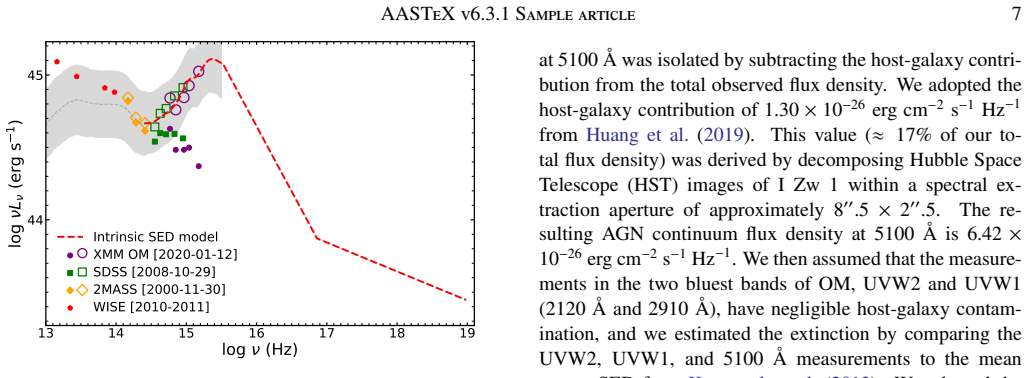
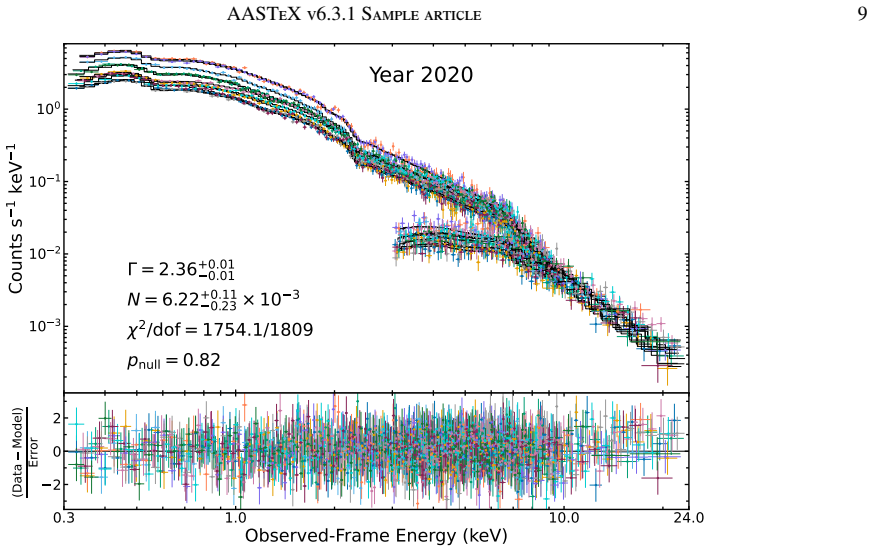
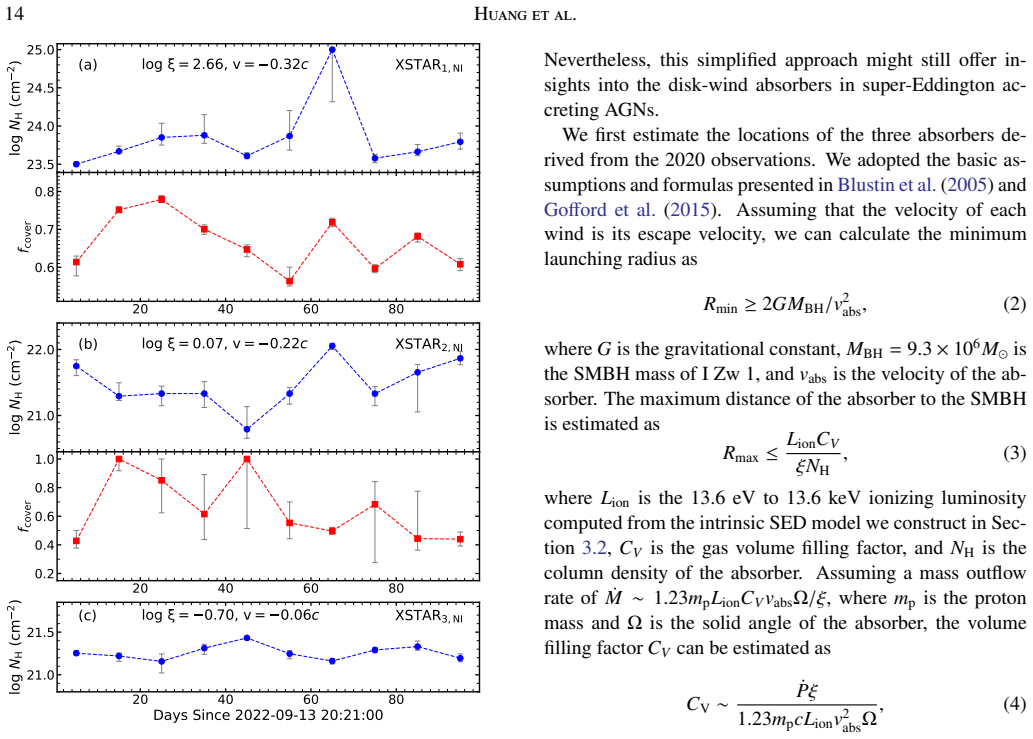
Obscuration from clumpy accretion-disk winds has been invoked to explain the extreme X-ray weakness and X-ray variability observed in a substantial fraction of super-Eddington accreting quasars. We present a comprehensive study of the strong X-ray variability of the super-Eddington accreting active galactic nucleus (AGN) I Zwicky 1 (I Zw 1), a prototypical narrow-line} Seyfert 1 galaxy (NLS1), to test the disk-wind obscuration scenario as the underlying mechanism and characterizing the disk-wind absorber properties. We focus on spectral and temporal analyses of simultaneous XMM-Newton and NuSTAR observations in 2020, and a 100-day NICER monitoring campaign in 2022. Despite strong X-ray variability by factors of $\approx3$ and $\approx6$ on short-term and long-term timescales, respectively, the XMM-Newton Optical Monitor observations do not show contemporaneous significant UV variability, and archival data reveal only mild long-term optical/infrared variability ($\approx30\%$), indicating a stable accretion process in I Zw 1. The strong X-ray variability thus likely arises from variable absorption of relatively stable coronal emission. We perform time-resolved X-ray spectroscopy utilizing a partial-covering absorption model with a stable corona and varying ionized absorbers. We identify three distinct absorbers whose variations in the column density and covering factor successfully explain the observed X-ray ``flares'' in 2020 and the longer-term spectral evolution in 2022. Our results support a unified scenario in which obscuration from clumpy disk winds produces the strong X-ray variability observed in super-Eddington accreting AGNs. This scenario may be applicable to other NLS1s exhibiting strong X-ray variability to better characterize the disk winds driven by super-Eddington accretion.
Editorial analysis
A structured set of objections, weighed in public.
Referee Report
Summary. The paper analyzes strong X-ray variability (factors of ~3 short-term, ~6 long-term) in the super-Eddington NLS1 I Zw 1 using simultaneous XMM-Newton/NuSTAR (2020) and NICER (2022) data. It attributes the variability to changes in column density and covering factor of three ionized absorbers in a partial-covering model, while the corona remains stable (inferred from absent significant UV variability in XMM OM data and only ~30% long-term optical/IR changes). This supports a unified clumpy disk-wind obscuration scenario for X-ray variability in super-Eddington AGNs.
Significance. If the central claim holds, the work provides concrete multi-epoch spectroscopic evidence linking clumpy disk winds to X-ray variability in a prototypical super-Eddington AGN, with the identification of three distinct absorbers and their time-dependent parameters offering a testable framework applicable to other NLS1s. The combination of short-term flare analysis and long-term monitoring is a methodological strength.
major comments (1)
- [Abstract and §4] Abstract and §4 (time-resolved spectroscopy): The inference that lack of significant UV variability (XMM OM UVW1/UVW2) and mild optical/IR changes imply a stable corona (and thus that X-ray changes must arise from variable absorption) is load-bearing for the central claim. In super-Eddington flows the UV-emitting disk region can be spatially decoupled from the corona; the OM bands do not directly constrain coronal power or seed-photon supply. No explicit test of an intrinsic coronal-variability model (e.g., varying power-law normalization with fixed absorbers) is reported, leaving open whether the three-absorber partial-covering solution is required or merely sufficient.
minor comments (2)
- [Table 2] Table 2 (or equivalent fit table): report the full set of fit statistics (χ²/dof, null-hypothesis probability) for the time-resolved spectra and for the null model with fixed absorbers; this is needed to quantify whether the variable-absorber model is statistically required.
- [Figure 3] Figure 3 (or light-curve panel): clarify the exact energy bands used for the hardness-ratio curves and whether they are corrected for the partial-covering absorption; this affects interpretation of the flares.
Simulated Author's Rebuttal
We thank the referee for their constructive and detailed review. We address the single major comment below and agree that an explicit test of the alternative model will strengthen the manuscript.
read point-by-point responses
-
Referee: [Abstract and §4] Abstract and §4 (time-resolved spectroscopy): The inference that lack of significant UV variability (XMM OM UVW1/UVW2) and mild optical/IR changes imply a stable corona (and thus that X-ray changes must arise from variable absorption) is load-bearing for the central claim. In super-Eddington flows the UV-emitting disk region can be spatially decoupled from the corona; the OM bands do not directly constrain coronal power or seed-photon supply. No explicit test of an intrinsic coronal-variability model (e.g., varying power-law normalization with fixed absorbers) is reported, leaving open whether the three-absorber partial-covering solution is required or merely sufficient.
Authors: We agree that the OM UV bands do not directly constrain coronal power or seed-photon supply, particularly in super-Eddington flows where the UV-emitting disk region can be spatially decoupled from the corona. While the absence of significant UV variability combined with only mild (~30%) long-term optical/IR changes provides supporting (if indirect) evidence for a stable accretion flow, we acknowledge that this inference is not definitive on its own. To address the concern directly, we will add in the revised manuscript an explicit comparison by fitting an alternative model in which the power-law normalization is allowed to vary while the absorber parameters are held fixed. We will report the fit statistics, residuals, and parameter constraints for both models and discuss whether the three-absorber partial-covering solution is statistically preferred. This addition will clarify whether variable absorption is required rather than merely sufficient. revision: yes
Circularity Check
No significant circularity; analysis grounded in new multi-epoch observations and standard spectral modeling.
full rationale
The paper reports new XMM-Newton/NuSTAR (2020) and NICER (2022) data on I Zw 1, measures X-ray variability factors of ~3 (short-term) and ~6 (long-term), and notes the absence of significant contemporaneous UV variability plus only mild (~30%) long-term optical/IR changes. It adopts a partial-covering ionized absorber model with fixed coronal emission and lets absorber column density and covering factor vary to fit the spectra. This is ordinary model fitting to independent data; the conclusion that variable absorption explains the X-ray changes follows directly from the fit success and the UV stability constraint, without any self-definitional loop, fitted parameter renamed as prediction, or load-bearing self-citation. No enumerated circularity pattern is present.
Axiom & Free-Parameter Ledger
free parameters (2)
- column density of the three ionized absorbers
- covering factor of the three ionized absorbers
axioms (2)
- domain assumption The X-ray corona emission is stable over the observed timescales
- domain assumption The partial-covering absorption model accurately describes the spectral features
Lean theorems connected to this paper
-
IndisputableMonolith/Foundation/RealityFromDistinction.leanreality_from_one_distinction unclear?
unclearRelation between the paper passage and the cited Recognition theorem.
We perform time-resolved X-ray spectroscopy utilizing a partial-covering absorption model with a stable corona and varying ionized absorbers. We identify three distinct absorbers whose variations in the column density and covering factor successfully explain the observed X-ray flares
What do these tags mean?
- matches
- The paper's claim is directly supported by a theorem in the formal canon.
- supports
- The theorem supports part of the paper's argument, but the paper may add assumptions or extra steps.
- extends
- The paper goes beyond the formal theorem; the theorem is a base layer rather than the whole result.
- uses
- The paper appears to rely on the theorem as machinery.
- contradicts
- The paper's claim conflicts with a theorem or certificate in the canon.
- unclear
- Pith found a possible connection, but the passage is too broad, indirect, or ambiguous to say the theorem truly supports the claim.
Reference graph
Works this paper leans on
-
[1]
HI4PI: A full-sky HI survey based on EBHIS and GASS
HI4PI: A full-sky H I survey based on EBHIS and GASS. , keywords =. doi:10.1051/0004-6361/201629178 , archivePrefix =. 1610.06175 , primaryClass =
work page internal anchor Pith review Pith/arXiv arXiv doi:10.1051/0004-6361/201629178
-
[2]
Black holes in binary systems. Observational appearance. , year = 1973, month = jan, volume =
work page 1973
-
[3]
Comptonization of X-rays in plasma clouds. Typical radiation spectra. , keywords =
-
[4]
X-Ray Spectra from Two-Phase Accretion Disks. , keywords =. doi:10.1086/173020 , adsurl =
-
[5]
The X-Ray-to-Optical Properties of Optically Selected Active Galaxies over Wide Luminosity and Redshift Ranges. , keywords =. doi:10.1086/503627 , archivePrefix =. astro-ph/0602407 , primaryClass =
work page internal anchor Pith review Pith/arXiv arXiv doi:10.1086/503627
-
[6]
The X-ray Properties of the Most-Luminous Quasars from the Sloan Digital Sky Survey
The X-Ray Properties of the Most Luminous Quasars from the Sloan Digital Sky Survey. , keywords =. doi:10.1086/519990 , archivePrefix =. 0705.3059 , primaryClass =
work page internal anchor Pith review Pith/arXiv arXiv doi:10.1086/519990
-
[7]
On the Fraction of X-Ray-weak Quasars from the Sloan Digital Sky Survey. , keywords =. doi:10.3847/1538-4357/abacc5 , archivePrefix =. 2008.02277 , primaryClass =
-
[8]
Cosmological constraints from the Hubble diagram of quasars at high redshifts
Cosmological Constraints from the Hubble Diagram of Quasars at High Redshifts. Nature Astronomy , keywords =. doi:10.1038/s41550-018-0657-z , archivePrefix =. 1811.02590 , primaryClass =
work page internal anchor Pith review Pith/arXiv arXiv doi:10.1038/s41550-018-0657-z
-
[9]
X-ray Insights into the Nature of PHL 1811 Analogs and Weak Emission-line Quasars: Unification with a Geometrically Thick Accretion Disk?. , keywords =. doi:10.1088/0004-637X/805/2/122 , archivePrefix =. 1503.02085 , primaryClass =
work page internal anchor Pith review Pith/arXiv arXiv doi:10.1088/0004-637x/805/2/122
-
[10]
The most luminous blue quasars at 3.0 < z < 3.3. I. A tale of two X-ray populations. , keywords =. doi:10.1051/0004-6361/201936911 , archivePrefix =. 1910.04604 , primaryClass =
-
[11]
The frequency of extreme X-ray variability for radio-quiet quasars. , keywords =. doi:10.1093/mnras/staa2661 , archivePrefix =. 2008.12778 , primaryClass =
-
[12]
X-ray spectroscopic survey of highly accreting AGN. , keywords =. doi:10.1051/0004-6361/202141829 , archivePrefix =. 2110.06939 , primaryClass =
-
[13]
Sensitive Chandra coverage of a representative sample of weak-line quasars: revealing the full range of X-ray properties. , keywords =. doi:10.1093/mnras/stac394 , archivePrefix =. 2202.05279 , primaryClass =
-
[14]
The Nature of Luminous Quasars with Very Large C IV Equivalent Widths. , keywords =. doi:10.3847/1538-4357/ac7a36 , archivePrefix =. 2206.11631 , primaryClass =
-
[15]
The Intrinsically X-Ray-weak Quasar PHL 1811. II. Optical and UV Spectra and Analysis. , keywords =. doi:10.1086/519768 , archivePrefix =. 0705.0940 , primaryClass =
-
[16]
The Intrinsically X-Ray Weak Quasar PHL 1811. I. X-Ray Observations and Spectral Energy Distribution. , keywords =. doi:10.1086/518017 , archivePrefix =. astro-ph/0611349 , primaryClass =
work page internal anchor Pith review Pith/arXiv arXiv doi:10.1086/518017
-
[17]
Weak Hard X-ray Emission from Broad Absorption Line Quasars: Evidence for Intrinsic X-ray Weakness
Weak Hard X-Ray Emission from Broad Absorption Line Quasars: Evidence for Intrinsic X-Ray Weakness. , keywords =. doi:10.1088/0004-637X/794/1/70 , archivePrefix =. 1408.3633 , primaryClass =
work page internal anchor Pith review Pith/arXiv arXiv doi:10.1088/0004-637x/794/1/70
-
[18]
NuSTAR Observations of Intrinsically X-Ray Weak Quasar Candidates: An Obscuration-only Scenario. , keywords =. doi:10.3847/1538-4357/ac886e , archivePrefix =. 2208.04961 , primaryClass =
-
[19]
Active Galactic Nuclei as scaled-up Galactic black holes
Active galactic nuclei as scaled-up Galactic black holes. , keywords =. doi:10.1038/nature05389 , archivePrefix =. astro-ph/0612273 , primaryClass =
work page internal anchor Pith review Pith/arXiv arXiv doi:10.1038/nature05389
-
[20]
Modeling the Time Variability of SDSS Stripe 82 Quasars as a Damped Random Walk
Modeling the Time Variability of SDSS Stripe 82 Quasars as a Damped Random Walk. , keywords =. doi:10.1088/0004-637X/721/2/1014 , archivePrefix =. 1004.0276 , primaryClass =
work page internal anchor Pith review Pith/arXiv arXiv doi:10.1088/0004-637x/721/2/1014
-
[21]
Long-Term X-ray Variability of Typical Active Galactic Nuclei in the Distant Universe
Long-term X-Ray Variability of Typical Active Galactic Nuclei in the Distant Universe. , keywords =. doi:10.3847/0004-637X/831/2/145 , archivePrefix =. 1608.08224 , primaryClass =
work page internal anchor Pith review Pith/arXiv arXiv doi:10.3847/0004-637x/831/2/145
-
[22]
Deepest view of AGN X-ray variability with the 7 Ms Chandra Deep Field-South survey
Deepest View of AGN X-Ray Variability with the 7 Ms Chandra Deep Field-South Survey. , keywords =. doi:10.3847/1538-4357/aa9378 , archivePrefix =. 1710.04358 , primaryClass =
work page internal anchor Pith review Pith/arXiv arXiv doi:10.3847/1538-4357/aa9378
-
[23]
X-ray spectra and time variability of active galactic nuclei. , keywords =. doi:10.1146/annurev.aa.31.090193.003441 , adsurl =
-
[24]
The X-Ray Variability of a Large, Serendipitous Sample of Spectroscopic Quasars
The X-Ray Variability of a Large, Serendipitous Sample of Spectroscopic Quasars. , keywords =. doi:10.1088/0004-637X/746/1/54 , archivePrefix =. 1110.5341 , primaryClass =
work page internal anchor Pith review Pith/arXiv arXiv doi:10.1088/0004-637x/746/1/54
-
[25]
A long term study of AGN X-ray variability. Structure function analysis on a ROSAT-XMM quasar sample
A long-term study of AGN X-ray variability . Structure function analysis on a ROSAT-XMM quasar sample. , keywords =. doi:10.1051/0004-6361/201629940 , archivePrefix =. 1612.08547 , primaryClass =
work page internal anchor Pith review Pith/arXiv arXiv doi:10.1051/0004-6361/201629940
-
[26]
The Discovery of the First Changing Look Quasar: New Insights Into the Physics and Phenomenology of Active Galactic Nucleus. , keywords =. doi:10.1088/0004-637X/800/2/144 , archivePrefix =. 1412.2136 , primaryClass =
work page internal anchor Pith review Pith/arXiv arXiv doi:10.1088/0004-637x/800/2/144
-
[27]
The detection and X-ray view of the changing look AGN HE 1136-2304
The detection and X-ray view of the changing look AGN HE 1136-2304. , keywords =. doi:10.1093/mnras/stw1449 , archivePrefix =. 1606.04955 , primaryClass =
work page internal anchor Pith review Pith/arXiv arXiv doi:10.1093/mnras/stw1449
-
[28]
The Changing-Look Quasar Mrk 590 is Awakening
The Changing-look Quasar Mrk 590 Is Awakening. , keywords =. doi:10.3847/1538-4357/aadd91 , archivePrefix =. 1810.06616 , primaryClass =
work page internal anchor Pith review Pith/arXiv arXiv doi:10.3847/1538-4357/aadd91
-
[29]
New changing look case in NGC 1566
New changing look case in NGC 1566. , keywords =. doi:10.1093/mnras/sty3133 , archivePrefix =. 1811.06926 , primaryClass =
work page internal anchor Pith review Pith/arXiv arXiv doi:10.1093/mnras/sty3133
-
[30]
XMM-Newton Observations of Two Archival X-Ray Weak Type 1 Quasars: Obscuration Induced X-Ray Weakness and Variability. , keywords =. doi:10.3847/1538-4357/ace7c2 , archivePrefix =. 2307.07554 , primaryClass =
-
[31]
On the Extremely X-Ray Variable Active Galactic Nuclei in the XMM-LSS Field. , keywords =. doi:10.3847/1538-4357/adbb6b , archivePrefix =. 2502.20556 , primaryClass =
-
[32]
Insights on the X-ray weak quasar phenomenon from XMM-Newton monitoring of PHL 1092. , keywords =. doi:10.1111/j.1365-2966.2012.21648.x , archivePrefix =. 1207.0694 , primaryClass =
-
[33]
SDSS J075101.42+291419.1: A Super-Eddington Accreting Quasar with Extreme X-ray Variability
SDSS J075101.42+291419.1: A Super-Eddington Accreting Quasar with Extreme X-Ray Variability. , keywords =. doi:10.3847/1538-4357/ab1d5b , archivePrefix =. 1904.12876 , primaryClass =
work page internal anchor Pith review Pith/arXiv arXiv doi:10.3847/1538-4357/ab1d5b 1904
-
[34]
An Extreme X-Ray Variability Event of a Weak-line Quasar. , keywords =. doi:10.3847/2041-8213/ab6d78 , archivePrefix =. 2001.08216 , primaryClass =
-
[35]
A Rapid and Large-amplitude X-Ray Dimming Event in a z 2.6 Radio-quiet Quasar. , keywords =. doi:10.3847/1538-4357/ac6265 , archivePrefix =. 2203.15824 , primaryClass =
-
[36]
Strong and Rapid X-Ray Variability of the Super-Eddington Accreting Quasar SDSS J081456.10+532533.5. , keywords =. doi:10.3847/1538-4357/accd64 , archivePrefix =. 2304.07323 , primaryClass =
-
[37]
Radiation Magneto-hydrodynamic Simulations of the Formation of Hot Accretion Disk Coronae
Radiation Magnetohydrodynamic Simulations of the Formation of Hot Accretion Disk Coronae. , keywords =. doi:10.1088/0004-637X/784/2/169 , archivePrefix =. 1402.2979 , primaryClass =
work page internal anchor Pith review Pith/arXiv arXiv doi:10.1088/0004-637x/784/2/169
-
[38]
Numerical simulations of super-critical black hole accretion flows in general relativity
Numerical simulations of super-critical black hole accretion flows in general relativity. , keywords =. doi:10.1093/mnras/stt2479 , archivePrefix =. 1311.5900 , primaryClass =
work page internal anchor Pith review Pith/arXiv arXiv doi:10.1093/mnras/stt2479
-
[39]
Super-Eddington Accretion Disks around Supermassive Black Holes. , keywords =. doi:10.3847/1538-4357/ab29ff , archivePrefix =. 1709.02845 , primaryClass =
-
[40]
A Momentum-conserving Accretion Disk Wind in the Narrow-line Seyfert 1 I Zwicky 1. , keywords =. doi:10.3847/1538-4357/ab41f9 , archivePrefix =. 1909.05039 , primaryClass =
-
[41]
Extreme ultra-soft X-ray variability in an eROSITA observation of the narrow-line Seyfert 1 galaxy 1H 0707-495. , keywords =. doi:10.1051/0004-6361/202039316 , archivePrefix =. 2011.03307 , primaryClass =
-
[42]
The nature of the extreme X-ray variability in the NLS1 1H 0707-495. , keywords =. doi:10.1093/mnras/stab2434 , archivePrefix =. 2108.10167 , primaryClass =
-
[43]
Peculiar X-ray spectra and variability
Multiwavelength campaign on the Super-Eddington NLS1 RX J0134.2-4258 - I. Peculiar X-ray spectra and variability. , keywords =. doi:10.1093/mnras/stac827 , archivePrefix =. 2203.13419 , primaryClass =
-
[44]
The Emission-Line Properties of Low-Redshift Quasi-stellar Objects. , keywords =. doi:10.1086/191661 , adsurl =
-
[45]
Composite Quasar Spectra From the Sloan Digital Sky Survey
Composite Quasar Spectra from the Sloan Digital Sky Survey. , keywords =. doi:10.1086/321167 , archivePrefix =. astro-ph/0105231 , primaryClass =
work page internal anchor Pith review Pith/arXiv arXiv doi:10.1086/321167
-
[46]
Reverberation mapping of narrow-line Seyfert 1 galaxy I Zwicky 1: black hole mass
Reverberation Mapping of the Narrow-line Seyfert 1 Galaxy I Zwicky 1: Black Hole Mass. , keywords =. doi:10.3847/1538-4357/ab16ef , archivePrefix =. 1904.06146 , primaryClass =
work page internal anchor Pith review Pith/arXiv arXiv doi:10.3847/1538-4357/ab16ef 1904
-
[47]
Optimal binning of X-ray spectra and response matrix design
Optimal binning of X-ray spectra and response matrix design. , keywords =. doi:10.1051/0004-6361/201527395 , archivePrefix =. 1601.05309 , primaryClass =
work page internal anchor Pith review Pith/arXiv arXiv doi:10.1051/0004-6361/201527395
-
[48]
A Population of X-ray Weak Quasars: PHL 1811 Analogs at High Redshift
A Population of X-Ray Weak Quasars: PHL 1811 Analogs at High Redshift. , keywords =. doi:10.1088/0004-637X/736/1/28 , archivePrefix =. 1104.3861 , primaryClass =
work page internal anchor Pith review Pith/arXiv arXiv doi:10.1088/0004-637x/736/1/28
-
[49]
XMM-Newton observatory. I. The spacecraft and operations. , keywords =. doi:10.1051/0004-6361:20000036 , adsurl =
-
[50]
The Nuclear Spectroscopic Telescope Array (NuSTAR) Mission
The Nuclear Spectroscopic Telescope Array (NuSTAR) High-energy X-Ray Mission. , keywords =. doi:10.1088/0004-637X/770/2/103 , archivePrefix =. 1301.7307 , primaryClass =
work page internal anchor Pith review Pith/arXiv arXiv doi:10.1088/0004-637x/770/2/103
-
[51]
Accretion Disk Outflow during the X-Ray Flare of the Super-Eddington Active Nucleus of I Zwicky 1. , keywords =. doi:10.3847/1538-4357/ac6955 , adsurl =
-
[52]
The multi-epoch X-ray tale of I Zwicky 1 outflows. , keywords =. doi:10.1093/mnras/stac2552 , archivePrefix =. 2209.02747 , primaryClass =
-
[53]
C., et al., 2016, in Space Telescopes and Instrumentation 2016: Ultraviolet to Gamma Ray
The Neutron star Interior Composition Explorer (NICER): design and development. Space Telescopes and Instrumentation 2016: Ultraviolet to Gamma Ray , year = 2016, editor =. doi:10.1117/12.2231304 , adsurl =
-
[54]
Astronomical Data Analysis Software and Systems V , year = 1996, editor =
XSPEC: The First Ten Years. Astronomical Data Analysis Software and Systems V , year = 1996, editor =
work page 1996
-
[55]
Light bending and X-ray echoes from behind a supermassive black hole. , keywords =. doi:10.1038/s41586-021-03667-0 , archivePrefix =. 2107.13555 , primaryClass =
-
[56]
Acceleration and cooling of the corona during X-ray flares from the Seyfert galaxy I Zw 1. , keywords =. doi:10.1093/mnras/stac416 , archivePrefix =. 2202.06958 , primaryClass =
-
[57]
Planck 2018 results. VI. Cosmological parameters. , keywords =. doi:10.1051/0004-6361/201833910 , archivePrefix =. 1807.06209 , primaryClass =
work page internal anchor Pith review Pith/arXiv arXiv doi:10.1051/0004-6361/201833910 2018
-
[58]
The European Photon Imaging Camera on XMM-Newton: The pn-CCD camera. , keywords =. doi:10.1051/0004-6361:20000066 , adsurl =
-
[59]
The XMM-Newton Optical/UV Monitor Telescope
The XMM-Newton optical/UV monitor telescope. , keywords =. doi:10.1051/0004-6361:20000044 , archivePrefix =. astro-ph/0011216 , primaryClass =
work page internal anchor Pith review Pith/arXiv arXiv doi:10.1051/0004-6361:20000044
-
[60]
An Analysis of the Shapes of Interstellar Extinction Curves. VII. Milky Way Spectrophotometric Optical-through-ultraviolet Extinction and Its R-dependence. , keywords =. doi:10.3847/1538-4357/ab4c3a , archivePrefix =. 1910.08852 , primaryClass =
-
[61]
Maps of Dust IR Emission for Use in Estimation of Reddening and CMBR Foregrounds
Maps of Dust Infrared Emission for Use in Estimation of Reddening and Cosmic Microwave Background Radiation Foregrounds. , keywords =. doi:10.1086/305772 , archivePrefix =. astro-ph/9710327 , primaryClass =
work page internal anchor Pith review Pith/arXiv arXiv doi:10.1086/305772
-
[62]
Astronomical Data Analysis Software and Systems IV , year = 1995, editor =
FTOOLS: A FITS Data Processing and Analysis Software Package. Astronomical Data Analysis Software and Systems IV , year = 1995, editor =
work page 1995
-
[63]
A Wavelet-Based Algorithm for the Spatial Analysis of Poisson Data
A Wavelet-Based Algorithm for the Spatial Analysis of Poisson Data. , keywords =. doi:10.1086/324017 , archivePrefix =. astro-ph/0108429 , primaryClass =
work page internal anchor Pith review Pith/arXiv arXiv doi:10.1086/324017
-
[64]
Preliminary Results from NEOWISE: An Enhancement to the Wide-field Infrared Survey Explorer for Solar System Science. , keywords =. doi:10.1088/0004-637X/731/1/53 , archivePrefix =. 1102.1996 , primaryClass =
work page internal anchor Pith review Pith/arXiv arXiv doi:10.1088/0004-637x/731/1/53 1996
-
[65]
The Zwicky Transient Facility: Data Processing, Products, and Archive
The Zwicky Transient Facility: Data Processing, Products, and Archive. , keywords =. doi:10.1088/1538-3873/aae8ac , archivePrefix =. 1902.01872 , primaryClass =
work page internal anchor Pith review Pith/arXiv arXiv doi:10.1088/1538-3873/aae8ac 1902
-
[66]
The Wide-field Infrared Survey Explorer (WISE): Mission Description and Initial On-orbit Performance. , keywords =. doi:10.1088/0004-6256/140/6/1868 , archivePrefix =. 1008.0031 , primaryClass =
work page internal anchor Pith review Pith/arXiv arXiv doi:10.1088/0004-6256/140/6/1868
-
[67]
The Two Micron All Sky Survey (2MASS). , keywords =. doi:10.1086/498708 , adsurl =
-
[68]
Line Variations in Quasars and Seyfert Galaxies. , keywords =. doi:10.1086/164238 , adsurl =
-
[69]
Central Masses and Broad-Line Region Sizes of Active Galactic Nuclei. II. A Homogeneous Analysis of a Large Reverberation-Mapping Database. , keywords =. doi:10.1086/423269 , archivePrefix =. astro-ph/0407299 , primaryClass =
work page internal anchor Pith review Pith/arXiv arXiv doi:10.1086/423269
-
[70]
Mean Spectral Energy Distributions and Bolometric Corrections for Luminous Quasars
Mean Spectral Energy Distributions and Bolometric Corrections for Luminous Quasars. , keywords =. doi:10.1088/0067-0049/206/1/4 , archivePrefix =. 1304.5573 , primaryClass =
work page internal anchor Pith review Pith/arXiv arXiv doi:10.1088/0067-0049/206/1/4
-
[71]
A Quantitative Comparison of SMC, LMC, and Milky Way UV to NIR Extinction Curves
A Quantitative Comparison of the Small Magellanic Cloud, Large Magellanic Cloud, and Milky Way Ultraviolet to Near-Infrared Extinction Curves. , keywords =. doi:10.1086/376774 , archivePrefix =. astro-ph/0305257 , primaryClass =
work page internal anchor Pith review Pith/arXiv arXiv doi:10.1086/376774
-
[72]
FIRST-2MASS Red Quasars: Transitional Objects Emerging from the Dust
FIRST-2MASS Red Quasars: Transitional Objects Emerging from the Dust. , keywords =. doi:10.1088/0004-637X/757/1/51 , archivePrefix =. 1207.2175 , primaryClass =
work page internal anchor Pith review Pith/arXiv arXiv doi:10.1088/0004-637x/757/1/51
-
[73]
Dust Reddening in SDSS Quasars
Dust Reddening in Sloan Digital Sky Survey Quasars. , keywords =. doi:10.1086/423291 , archivePrefix =. astro-ph/0406293 , primaryClass =
work page internal anchor Pith review Pith/arXiv arXiv doi:10.1086/423291
-
[74]
The 1 Micron Fe II Lines of the Seyfert Galaxy I Zw 1. , keywords =. doi:10.1086/309222 , adsurl =
-
[75]
Photoionization Modeling and the K Lines of Iron
Photoionization Modeling and the K Lines of Iron. , keywords =. doi:10.1086/424039 , archivePrefix =. astro-ph/0405210 , primaryClass =
work page internal anchor Pith review Pith/arXiv arXiv doi:10.1086/424039
-
[76]
On why the iron K-shell absorption in AGN is not a signature of the local warm/hot intergalactic medium. , keywords =. doi:10.1111/j.1745-3933.2008.00443.x , archivePrefix =. 0801.1587 , primaryClass =
-
[77]
J., 1998, @doi [ ] 10.1023/A:1005161325181 , http://esoads.eso.org/abs/1998SSRv...85..161G 85, 161
Standard Solar Composition. , keywords =. doi:10.1023/A:1005161325181 , adsurl =
-
[78]
Hidden Little Monsters: Spectroscopic Identification of Low-mass, Broad-line AGNs at z > 5 with CEERS. , keywords =. doi:10.3847/2041-8213/ace5a0 , archivePrefix =. 2302.00012 , primaryClass =
-
[79]
UNCOVER Spectroscopy Confirms the Surprising Ubiquity of Active Galactic Nuclei in Red Sources at z > 5. , keywords =. doi:10.3847/1538-4357/ad1e5f , archivePrefix =. 2309.05714 , primaryClass =
-
[80]
BlackTHUNDER ─ A non-stellar Balmer break in a black hole-dominated little red dot at z = 7.04. , keywords =. doi:10.1093/mnras/staf1867 , archivePrefix =. 2501.13082 , primaryClass =
discussion (0)
Sign in with ORCID, Apple, or X to comment. Anyone can read and Pith papers without signing in.