TABX: A High-Throughput Sandbox Battle Simulator for Multi-Agent Reinforcement Learning
Pith reviewed 2026-05-25 07:40 UTC · model grok-4.3
The pith
TABX is a modular JAX simulator that gives researchers granular control over multi-agent battle environments for faster exploration of cooperative strategies.
A machine-rendered reading of the paper's core claim, the machinery that carries it, and where it could break.
Core claim
TABX provides granular control over environmental parameters, permitting a systematic investigation into emergent agent behaviors and algorithmic trade-offs across a diverse spectrum of task complexities while leveraging JAX for hardware-accelerated execution on GPUs enabling massive parallelization and significantly reduced computational overhead.
What carries the argument
TABX, the Totally Accelerated Battle Simulator in JAX, a reconfigurable high-throughput sandbox whose modularity and GPU parallelization carry the argument for enabling new MARL studies.
If this is right
- Users can design and run custom evaluation scenarios instead of relying on fixed benchmarks.
- Massive parallel runs become feasible, allowing tests across many different task complexities in the same wall-clock time.
- Emergent behaviors in cooperative settings can be examined at larger scales and with finer parameter adjustments.
- The framework serves as a starting point for extending MARL research into more structured or complex domains.
Where Pith is reading between the lines
- The speed gains could let researchers run more ablation studies or hyperparameter sweeps within the same compute budget.
- Modular parameters might support automated curriculum generation by gradually increasing task complexity across parallel environments.
- Because the simulator is built in JAX, it could integrate with differentiable optimization pipelines for end-to-end training of both agents and environment dynamics.
Load-bearing premise
That supplying modular control and faster execution will produce meaningful new insights into agent behaviors and algorithm trade-offs.
What would settle it
A direct comparison experiment that measures insight generation or experiment throughput and finds no measurable advantage over prior MARL simulators would falsify the claimed utility.
Figures






read the original abstract
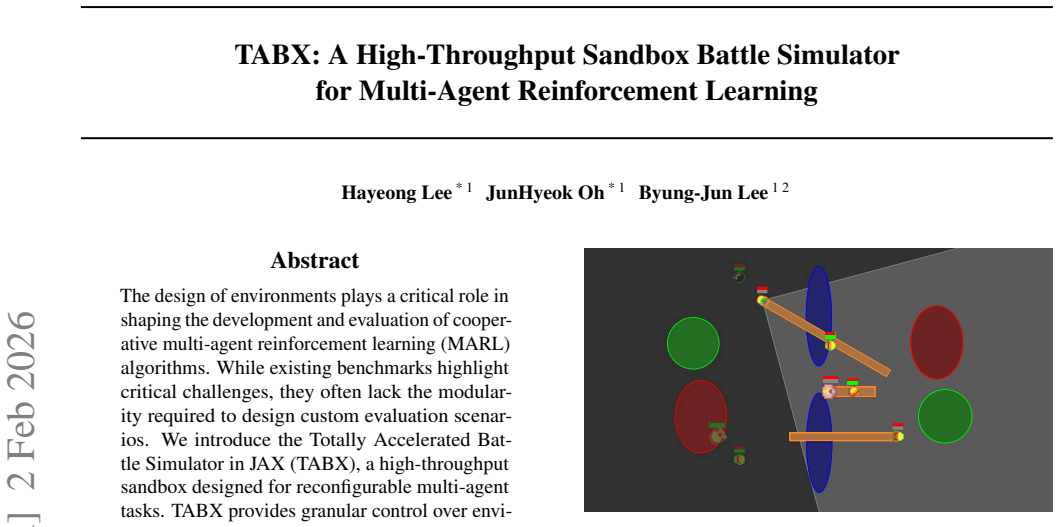
The design of environments plays a critical role in shaping the development and evaluation of cooperative multi-agent reinforcement learning (MARL) algorithms. While existing benchmarks highlight critical challenges, they often lack the modularity required to design custom evaluation scenarios. We introduce the Totally Accelerated Battle Simulator in JAX (TABX), a high-throughput sandbox designed for reconfigurable multi-agent tasks. TABX provides granular control over environmental parameters, permitting a systematic investigation into emergent agent behaviors and algorithmic trade-offs across a diverse spectrum of task complexities. Leveraging JAX for hardware-accelerated execution on GPUs, TABX enables massive parallelization and significantly reduces computational overhead. By providing a fast, extensible, and easily customized framework, TABX facilitates the study of MARL agents in complex structured domains and serves as a scalable foundation for future research. Our code is available at: https://github.com/ku-dmlab/TABX.
Editorial analysis
A structured set of objections, weighed in public.
Referee Report
Summary. The manuscript introduces TABX, a high-throughput sandbox battle simulator implemented in JAX for multi-agent reinforcement learning. It emphasizes granular control over environmental parameters for custom scenarios, hardware-accelerated execution on GPUs for massive parallelization, and reduced computational overhead to enable systematic investigation of emergent agent behaviors and algorithmic trade-offs in MARL.
Significance. If the described features are realized in the implementation, TABX could provide a useful, extensible platform for MARL research by allowing rapid, parallelized experimentation across diverse task complexities; the open-source code release at the provided GitHub link is a positive aspect that supports reproducibility and further development.
major comments (1)
- [Abstract] Abstract: The central claims that TABX 'enables massive parallelization and significantly reduces computational overhead' and 'facilitates the study of MARL agents in complex structured domains' are not supported by any empirical evidence, such as throughput measurements, comparisons to existing simulators like PettingZoo or SMAC, or example MARL training experiments. This absence makes it impossible to verify whether the design choices deliver the promised benefits for systematic investigation.
Simulated Author's Rebuttal
We thank the referee for their constructive comments. We address the major concern point-by-point below and commit to revisions that directly strengthen the empirical grounding of the claims.
read point-by-point responses
-
Referee: [Abstract] Abstract: The central claims that TABX 'enables massive parallelization and significantly reduces computational overhead' and 'facilitates the study of MARL agents in complex structured domains' are not supported by any empirical evidence, such as throughput measurements, comparisons to existing simulators like PettingZoo or SMAC, or example MARL training experiments. This absence makes it impossible to verify whether the design choices deliver the promised benefits for systematic investigation.
Authors: We agree that the abstract currently states performance and utility claims without direct empirical support in the manuscript. The paper emphasizes the JAX-based design for parallelization and modularity but does not include the requested benchmarks or training experiments. In the revised manuscript we will add (1) throughput measurements (steps/second across batch sizes on GPU), (2) direct comparisons to PettingZoo and SMAC under equivalent task settings, and (3) example cooperative MARL training curves that demonstrate the practical benefits of the high-throughput regime. The abstract will be updated to reference these new results or to qualify the claims accordingly. revision: yes
Circularity Check
No circularity: software framework paper with no derivations or predictions
full rationale
The manuscript introduces TABX as a JAX-based simulator and describes its features (granular parameter control, hardware acceleration, modularity). No equations, fitted parameters, predictions, or derivation chains appear in the provided text. Claims about facilitating MARL research are descriptive assertions about the tool's design rather than results reduced to inputs by construction. No self-citations, ansatzes, or uniqueness theorems are invoked as load-bearing steps. This is a standard self-contained tool paper; the absence of empirical benchmarks is a separate correctness concern, not circularity.
discussion (0)
Sign in with ORCID, Apple, or X to comment. Anyone can read and Pith papers without signing in.