Toward Trustworthy AI: Multi-Target Adversarial Attacks and Robust Defenses for Continuous Data Summarization
Pith reviewed 2026-06-27 09:55 UTC · model grok-4.3
The pith
Multi-resolution image summarization objectives satisfy DR-submodularity with m-weak monotonicity, enabling min-max formulations for multi-target adversarial attacks and regularized max-min defenses with approximation algorithms.
A machine-rendered reading of the paper's core claim, the machinery that carries it, and where it could break.
Core claim
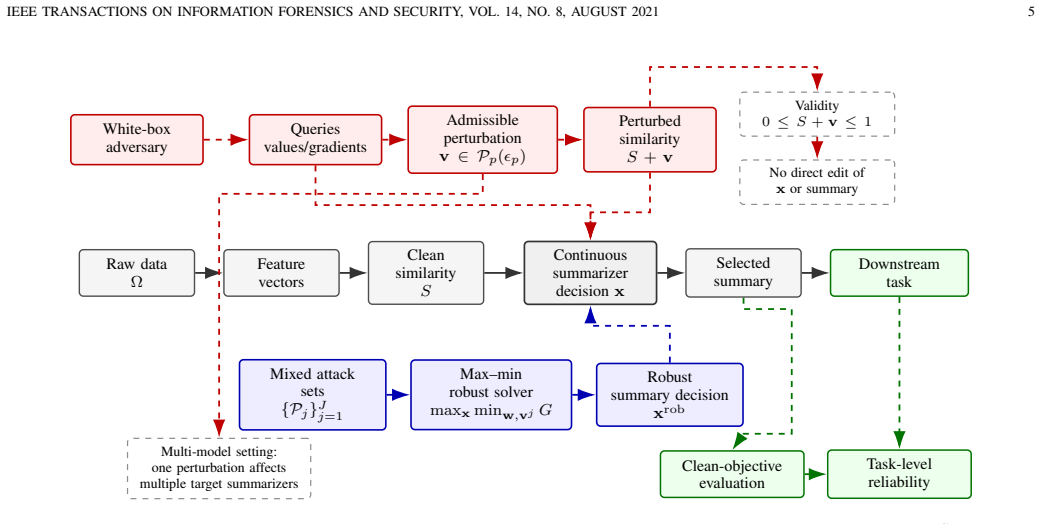
A class of multi-resolution image summarization objectives can be formulated as multilinear extensions of non-negative submodular set functions and satisfy DR-submodularity with m-weak monotonicity. Multi-target attack generation is then cast as a min-max problem over admissible perturbations of the similarity structure, and robust defense against mixed attacks is cast as a regularized max-min problem; approximation algorithms with theoretical guarantees are developed for both.
What carries the argument
DR-submodularity with m-weak monotonicity of multilinear extensions of non-negative submodular set functions, which permits the min-max attack and regularized max-min defense formulations.
If this is right
- The attack is effective in representative low-to-moderate budget regimes.
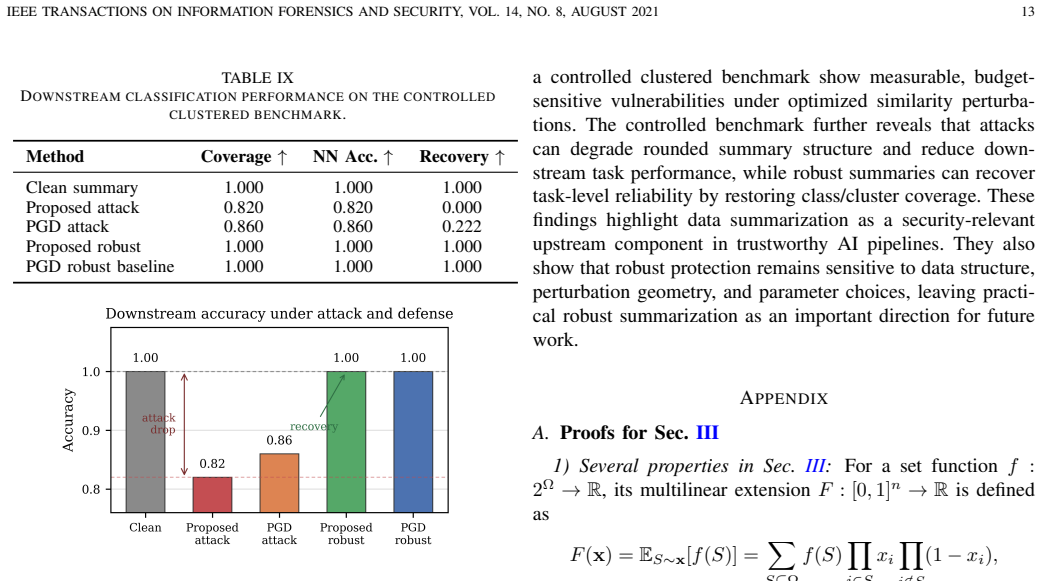
- The attack can induce downstream task-performance loss.
- The defense improves the robustness-mitigation trade-off in structured settings.
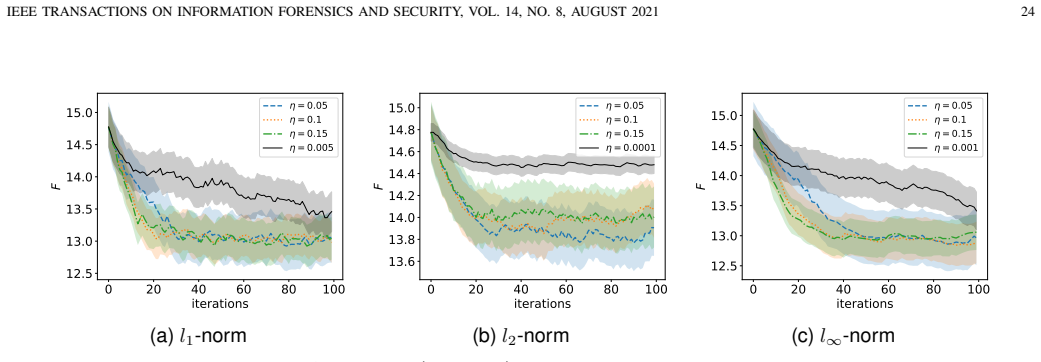
- The defense reveals parameter sensitivity of robust protection on real data.
Where Pith is reading between the lines
- Securing upstream summarization steps may be required to achieve end-to-end trustworthy AI pipelines.
- The same DR-submodular attack formulation could be tested on summarization tasks outside images.
- The min-max approach might apply to other continuous optimization problems that rely on submodular objectives.
Load-bearing premise
The multi-resolution image summarization objectives satisfy DR-submodularity with m-weak monotonicity.
What would settle it
An experiment in which the proposed min-max attack produces no greater degradation in summarization quality or downstream task performance than random perturbations of comparable budget.
Figures



read the original abstract
Trustworthy AI requires reliable data-processing pipelines, not only robust downstream predictive models. As an upstream component, data summarization determines which information is retained and passed to subsequent learning or decision modules. Therefore, adversarial perturbations to the summarization process can compromise trustworthy AI in an upstream manner: they may alter the selected summary, reduce its representativeness, and further degrade the utility of subsequent learning tasks. In this paper, we study adversarial attacks on continuous data summarization under similarity-level perturbations through DR-submodular optimization. We show that a class of multi-resolution image summarization objectives can be formulated as multilinear extensions of non-negative submodular set functions and satisfy DR-submodularity with $m$-weak monotonicity. We then formulate multi-target attack generation as a min-max problem, where one admissible perturbation of the similarity structure is optimized to degrade multiple target summarization models. To mitigate such perturbations, we formulate robust defense against mixed attack types as a regularized max-min problem. For both problems, we develop approximation algorithms with theoretical guarantees. Experiments on real-data and controlled clustered benchmarks show that the proposed attack is effective in representative low-to-moderate budget regimes and can induce downstream task-performance loss. The proposed defense improves the robustness--mitigation trade-off in structured settings, while also revealing the parameter sensitivity of robust protection on real data.
Editorial analysis
A structured set of objections, weighed in public.
Referee Report
Summary. The paper claims that a class of multi-resolution image summarization objectives can be formulated as multilinear extensions of non-negative submodular set functions and satisfy DR-submodularity with m-weak monotonicity. This property underpins the formulation of multi-target attack generation as a min-max problem (optimizing admissible perturbations to degrade multiple target models) and robust defense as a regularized max-min problem, for both of which approximation algorithms with theoretical guarantees are developed. Experiments on real-data and controlled clustered benchmarks indicate that the attack is effective in low-to-moderate budget regimes and induces downstream task-performance loss, while the defense improves the robustness-mitigation trade-off (with noted parameter sensitivity on real data).
Significance. If the DR-submodularity claim holds, the work addresses an upstream vulnerability in trustworthy AI pipelines by providing a submodular-optimization-based framework for attacking and defending continuous data summarization, which can propagate to downstream learning tasks. The explicit use of multilinear extensions and approximation algorithms with guarantees would be a constructive contribution if the foundational property is rigorously established.
major comments (2)
- [Abstract] Abstract: The assertion that the multi-resolution image summarization objectives satisfy DR-submodularity with m-weak monotonicity is the load-bearing step for reducing the attack to a min-max problem and inheriting approximation guarantees. No proof sketch, conditions on the similarity matrix, or verification under the considered perturbations is provided in the abstract, leaving open whether the property holds generally or only under unstated restrictions.
- [Experiments] Experiments section (as described in abstract): The reported effectiveness of the attack and defense lacks any mention of error bars, baseline comparisons, exact data exclusion rules, or statistical verification, which undermines assessment of whether the results support the cross-benchmark claims in representative budget regimes.
minor comments (1)
- [Abstract] The abstract notes parameter sensitivity of the defense on real data but does not indicate where or how this is quantified in the main text.
Simulated Author's Rebuttal
We thank the referee for the review and the opportunity to address these points. We respond to each major comment below.
read point-by-point responses
-
Referee: [Abstract] Abstract: The assertion that the multi-resolution image summarization objectives satisfy DR-submodularity with m-weak monotonicity is the load-bearing step for reducing the attack to a min-max problem and inheriting approximation guarantees. No proof sketch, conditions on the similarity matrix, or verification under the considered perturbations is provided in the abstract, leaving open whether the property holds generally or only under unstated restrictions.
Authors: The DR-submodularity property with m-weak monotonicity, including the full proof, conditions on the similarity matrix, and verification for the considered perturbations, is established rigorously in Section 3 of the manuscript. The abstract states the claim at a high level, as is conventional due to length constraints. We can add a reference to Section 3 in a revised abstract if helpful. revision: partial
-
Referee: [Experiments] Experiments section (as described in abstract): The reported effectiveness of the attack and defense lacks any mention of error bars, baseline comparisons, exact data exclusion rules, or statistical verification, which undermines assessment of whether the results support the cross-benchmark claims in representative budget regimes.
Authors: The full experiments section provides baseline comparisons, error bars from repeated runs, statistical verification, and explicit data exclusion rules. The abstract summarizes outcomes at a high level only. We will revise to ensure these details are stated with greater prominence. revision: yes
Circularity Check
No significant circularity detected
full rationale
The paper's core derivation begins by formulating multi-resolution summarization objectives as multilinear extensions of non-negative submodular functions and then proving they satisfy DR-submodularity with m-weak monotonicity. This is presented as a direct mathematical result from the objective definitions, not a fit or self-referential loop. The min-max attack and max-min defense are then constructed on top of that property, with approximation algorithms and external experiments on real and synthetic data providing independent validation. No equation reduces to its input by construction, no fitted parameter is relabeled as a prediction, and no load-bearing step relies on an unverified self-citation chain. The derivation chain is self-contained against the stated assumptions.
Axiom & Free-Parameter Ledger
axioms (1)
- domain assumption Multi-resolution image summarization objectives can be formulated as multilinear extensions of non-negative submodular set functions satisfying DR-submodularity with m-weak monotonicity
Reference graph
Works this paper leans on
-
[1]
Submodular functions and convexity,
L. Lov ´asz, “Submodular functions and convexity,”Mathematical Pro- gramming The State of the Art: Bonn 1982, pp. 235–257, 1983
1982
-
[2]
Submodular function maximization via the multilinear relaxation and contention resolution schemes,
C. Chekuri, J. V ondr ´ak, and R. Zenklusen, “Submodular function maximization via the multilinear relaxation and contention resolution schemes,” inProceedings of the forty-third annual ACM symposium on Theory of computing, 2011, pp. 783–792
2011
-
[3]
Optimal budget allocation: Theoretical guarantee and efficient algorithm,
T. Soma, N. Kakimura, K. Inaba, and K.-i. Kawarabayashi, “Optimal budget allocation: Theoretical guarantee and efficient algorithm,” in International Conference on Machine Learning. PMLR, 2014, pp. 351–359
2014
-
[4]
apricot: Submodular selec- tion for data summarization in python,
J. Schreiber, J. Bilmes, and W. S. Noble, “apricot: Submodular selec- tion for data summarization in python,”Journal of Machine Learning Research, vol. 21, no. 161, pp. 1–6, 2020
2020
-
[5]
Submodlib: A submodular optimization library,
V . Kaushal, G. Ramakrishnan, and R. Iyer, “Submodlib: A submodular optimization library,”arXiv preprint arXiv:2202.10680, 2022
-
[6]
Security defense of large-scale networks under false data injection attacks: An at- tack detection scheduling approach,
Y . Suo, S. Chai, R. Chai, Z.-H. Pang, Y . Xia, and G.-P. Liu, “Security defense of large-scale networks under false data injection attacks: An at- tack detection scheduling approach,”IEEE Transactions on Information Forensics and Security, vol. 19, pp. 1908–1921, 2024
1908
-
[7]
Targeted mismatch adversarial attack: Query with a flower to retrieve the tower,
G. Tolias, F. Radenovic, and O. Chum, “Targeted mismatch adversarial attack: Query with a flower to retrieve the tower,” inProceedings of the IEEE/CVF international conference on computer vision, 2019, pp. 5037–5046
2019
-
[8]
Data poisoning attacks on neighborhood-based recommender systems,
L. Chen, Y . Xu, F. Xie, M. Huang, and Z. Zheng, “Data poisoning attacks on neighborhood-based recommender systems,”Transactions on Emerging Telecommunications Technologies, vol. 32, no. 6, p. e3872, 2021
2021
-
[9]
Minimax optimization: The case of convex-submodular,
A. Adibi, A. Mokhtari, and H. Hassani, “Minimax optimization: The case of convex-submodular,” inInternational Conference on Artificial Intelligence and Statistics. PMLR, 2022, pp. 3556–3580
2022
-
[10]
Discrete adversarial attacks and submodular optimization with applications to text classification,
Q. Lei, L. Wu, P.-Y . Chen, A. Dimakis, I. S. Dhillon, and M. J. Wit- brock, “Discrete adversarial attacks and submodular optimization with applications to text classification,”Proceedings of Machine Learning and Systems, vol. 1, pp. 146–165, 2019
2019
-
[11]
Adversarial attack generation empowered by min-max optimization,
J. Wang, T. Zhang, S. Liu, P.-Y . Chen, J. Xu, M. Fardad, and B. Li, “Adversarial attack generation empowered by min-max optimization,” Advances in Neural Information Processing Systems, vol. 34, pp. 16 020–16 033, 2021
2021
-
[12]
Robust budget allocation via continuous sub- modular functions,
M. Staib and S. Jegelka, “Robust budget allocation via continuous sub- modular functions,” inInternational Conference on Machine Learning. PMLR, 2017, pp. 3230–3240
2017
-
[13]
Non-smooth and holder-smooth submodular maximization,
D. Lee, N. Ho-Nguyen, and D. Lee, “Non-smooth and holder-smooth submodular maximization,”arXiv preprint arXiv:2210.06061, 2022
-
[14]
Zeroth-order stochastic approximation algorithms for dr-submodular optimization,
Y . Lian, X. Wang, D. Xu, and Z. Zhao, “Zeroth-order stochastic approximation algorithms for dr-submodular optimization,”Journal of Machine Learning Research, vol. 25, no. 391, pp. 1–55, 2024
2024
-
[15]
Submodularity-based false data injection attack strategy in dc microgrids,
Q. Liu, C. Zhao, M. Liu, R. Deng, and P. Cheng, “Submodularity-based false data injection attack strategy in dc microgrids,”IEEE Transactions on Information Forensics and Security, vol. 20, pp. 2342–2356, 2025
2025
-
[16]
Measures and optimization for robust- ness and vulnerability in disconnected networks,
L. Zhu, Q. Bao, and Z. Zhang, “Measures and optimization for robust- ness and vulnerability in disconnected networks,”IEEE Transactions on Information Forensics and Security, vol. 18, pp. 3350–3362, 2023
2023
-
[17]
Robust sub- modular observation selection,
A. Krause, H. B. McMahan, C. Guestrin, and A. Gupta, “Robust sub- modular observation selection,”Journal of Machine Learning Research, vol. 9, no. 12, 2008
2008
-
[18]
Robust influence maximization,
W. Chen, T. Lin, Z. Tan, M. Zhao, and X. Zhou, “Robust influence maximization,” inProceedings of the 22nd ACM SIGKDD international conference on Knowledge discovery and data mining, 2016, pp. 795– 804
2016
-
[19]
Stability and robustness in influence maximiza- tion,
X. He and D. Kempe, “Stability and robustness in influence maximiza- tion,”ACM Transactions on Knowledge Discovery from Data (TKDD), vol. 12, no. 6, pp. 1–34, 2018
2018
-
[20]
Equilibrium computation and robust optimization in zero sum games with submodular structure,
B. Wilder, “Equilibrium computation and robust optimization in zero sum games with submodular structure,”Proceedings of the AAAI Con- ference on Artificial Intelligence, vol. 32, no. 1, 2018
2018
-
[21]
Distributionally robust submodular maximization,
M. Staib, B. Wilder, and S. Jegelka, “Distributionally robust submodular maximization,” inThe 22nd International Conference on Artificial Intelligence and Statistics. PMLR, 2019, pp. 506–516
2019
-
[22]
Guaranteed non-convex optimization: Submodular maximization over continuous domains,
A. A. Bian, B. Mirzasoleiman, J. Buhmann, and A. Krause, “Guaranteed non-convex optimization: Submodular maximization over continuous domains,” inArtificial Intelligence and Statistics. PMLR, 2017, pp. 111–120
2017
-
[23]
Using partial monotonicity in submodular maximization,
L. Mualem and M. Feldman, “Using partial monotonicity in submodular maximization,”Advances in Neural Information Processing Systems, vol. 35, pp. 2723–2736, 2022
2022
-
[24]
Learning multiple layers of features from tiny images,
K. Alex, “Learning multiple layers of features from tiny images,” https://www. cs. toronto. edu/kriz/learning-features-2009-TR. pdf, 2009
2009
-
[25]
MNIST handwritten digit database,
Y . LeCun and C. Cortes, “MNIST handwritten digit database,” http://yann.lecun.com/exdb/mnist/, 2010. [Online]. Available: http: //yann.lecun.com/exdb/mnist/
2010
-
[26]
Fashion-mnist: a novel image dataset for benchmarking machine learning algorithms,
H. Xiao, K. Rasul, and R. V ollgraf, “Fashion-mnist: a novel image dataset for benchmarking machine learning algorithms,” 2017
2017
-
[27]
Efficient algorithms for smooth minimax optimization,
K. K. Thekumparampil, P. Jain, P. Netrapalli, and S. Oh, “Efficient algorithms for smooth minimax optimization,”Advances in Neural Information Processing Systems, vol. 32, 2019
2019
-
[28]
A unified single-loop alternat- ing gradient projection algorithm for nonconvex–concave and convex– nonconcave minimax problems,
Z. Xu, H. Zhang, Y . Xu, and G. Lan, “A unified single-loop alternat- ing gradient projection algorithm for nonconvex–concave and convex– nonconcave minimax problems,”Mathematical Programming, vol. 201, no. 1, pp. 635–706, 2023
2023
-
[29]
On gradient descent ascent for nonconvex-concave minimax problems,
T. Lin, C. Jin, and M. Jordan, “On gradient descent ascent for nonconvex-concave minimax problems,” inInternational Conference on Machine Learning. PMLR, 2020, pp. 6083–6093
2020
discussion (0)
Sign in with ORCID, Apple, or X to comment. Anyone can read and Pith papers without signing in.