REVIEW 4 major objections 6 minor 75 references
Long-tailed Medical Diagnosis with Relation-aware Representation Learning and Iterative Classifier Calibration
T0 review · 4 major / 6 minor · reviewed 2026-08-09 · deepseek-v4-flash
Pith's one-line read Long-tailed medical image classification improves when representation learning and classifier calibration are attacked together: LMD's two-stage scheme reports the best balanced accuracy on ISIC-2019-LT, ISIC-Archive-LT, and Hyper-Kvasir…
desk verdict Plausible extension of the authors' MICCAI 2023 method, but the load-bearing singular-covariance assumption is unaddressed and the 'significant' gains lack statistical support. read the letter →
The pith
A machine-rendered reading of the paper's core claim, the machinery that carries it, and where it could break.
The reading
What carries the argument
The load-bearing mechanism is a two-stage training loop. Stage one's Relation-aware Representation Learning forces the encoder to be invariant to image perturbations by matching a student network on strong augmentations to an EMA-updated teacher on weak augmentations, through a probability KL term plus sample-wise and channel-wise Gram-matrix consistency losses. Stage two's Iterative Classifier Calibration alternates between two steps: the M-step estimates class-wise multivariate Gaussians $N(\hat{\mu}_k,\hat{\Sigma}_k)$ of encoded features using class-balanced sampling, samples an equal number $R$ of virtual features for every class, and trains the classifier on this balanced set; the E-step freezes the classifier and fine-tunes the encoder with the Feature Distribution Consistency loss, which minimizes the Mahalanobis distance of each sample to its own class mean and maximizes its Mahalanobis distance to other class means. The identity doing the work is the Gaussian feature model: it converts scarce tail-class samples into an arbitrarily large balanced training set, and the FDC loss then shapes the true features to fit that model.
What would settle it
In the M-step, replace the virtual Gaussian features with an equal number of resampled real features from the same classes, keeping everything else fixed; if tail-class balanced accuracy does not drop substantially, the central claim about synthetic features is not doing the work. Alternatively, compute the empirical tail-class feature covariance on the classes with only 26 to 243 images in ISIC-2019-LT and check whether it is singular or ill-conditioned, which would indicate that the virtual feature sampling uses an unreliable distribution.
Extended reading notes
Core claim
The central discovery is that the bottleneck in decoupled long-tailed medical classification is not only the biased classifier but also the biased representation learned in stage one, and that both can be corrected jointly. The paper's two inventions are Relation-aware Representation Learning (RRL), which uses a teacher-student pair with weak and strong augmentations and a multi-view consistency loss, and Iterative Classifier Calibration (ICC), an Expectation-Maximization procedure. The Maximization step estimates each class's feature mean and covariance under class-balanced sampling, generates 50,000 balanced virtual features per class from these Gaussians, and retrains the classifier on them; the Expectation step freezes the classifier and fine-tunes the encoder with the Feature Distribution Consistency loss, pulling features toward their class mean and pushing them away from other class means in Mahalanobis distance. Iterating this loop refines the feature distribution toward a balanced, class-discriminative geometry, and the experiments report that this yields the best balanced accuracy on all three datasets tested.
Load-bearing premise
The whole second stage rests on the assumption that each class's encoded features follow a multivariate Gaussian and that the mean and covariance estimated from a few dozen tail samples are accurate enough to sample synthetic features from, with no shrinkage or regularization of the covariance stated.
Editorial extensions
If this is right
- On ISIC-2019-LT, LMD improves balanced accuracy from 65.36% for CC-SAM to 70.75% at imbalance factor 100, and still leads at imbalance factors 300 and 500.
- On ISIC-Archive-LT, tail-class balanced accuracy reaches 60.59% versus 52.60% for CC-SAM, shrinking the head-to-tail accuracy gap to about three points.
- On Hyper-Kvasir, LMD raises balanced accuracy to 67.27% with AUC 98.96%, outperforming all compared reweighting, resampling, and decoupling methods.
- Ablation studies attribute the gains to both modules: removing virtual feature compensation lowers tail-class balanced accuracy by 22.14 points on ISIC-Archive-LT, and removing the iterative calibration lowers balanced accuracy by up to 10.47 points on ISIC-2019-LT.
Reading between the lines
- The Gaussian-feature assumption is the likeliest stress point; a natural extension is to test shrinkage or diagonal-covariance estimates for tail classes with fewer than roughly 50 samples, where the empirical covariance is singular or ill-conditioned.
- Because the second stage operates only on encoded feature vectors, the same calibration loop could transfer to other imaging modalities or to long-tailed backbones that emit per-image features.
- The paper leaves open whether the EM iterations converge to a stable optimum; a simple test would be to plot balanced accuracy versus iteration count across multiple random seeds and check monotonic improvement.
Editorial analysis
A structured set of objections, weighed in public.
Referee Report
Summary. The paper proposes a two-stage framework, LMD, for long-tailed medical image classification. In stage one, Relation-aware Representation Learning (RRL) trains a student encoder with a teacher model via an EMA, enforcing prediction, sample-wise, and channel-wise consistency under different augmentations. In stage two, Iterative Classifier Calibration (ICC) alternately calibrates the classifier and fine-tunes the encoder: the M-step generates R virtual features per class from class-wise multivariate Gaussian estimates (VFC) and trains the classifier on these balanced features, while the E-step fine-tunes the encoder with a Feature Distribution Consistency (FDC) loss that combines cross-entropy with Mahalanobis-distance attraction/repulsion terms. Experiments on Hyper-Kvasir, ISIC-Archive-LT, and ISIC-2019-LT report substantial gains over prior long-tailed methods, especially on tail classes, with ablations for RRL, ICC, VFC, FDC, and key hyperparameters.
Significance. If validated, the proposed framework would be practically valuable for rare-disease classification, where the reported tail-class gains are large (e.g., +7.99 tail BACC over CC-SAM on ISIC-Archive-LT and +25.58 over CICL). The paper ships source code, isolates the contribution of each module in ablations, and analyzes the main hyperparameters, which are strengths. However, the central ICC mechanism rests on a Gaussian covariance estimate that is singular for tail classes, and the paper does not specify a regularization strategy; this must be resolved before the mechanism can be considered well defined. In addition, the claimed statistical significance is not supported by the reported experimental protocol for two of the three main tables.
major comments (4)
- [§3.4.1–3.4.2, Eqs. (6)–(7)] The class-wise covariance Σ_k is estimated from at most N_k samples in a 512-dimensional ResNet-18 feature space; for tail classes with N_k=26 (Fig. 3a), the empirical covariance has rank at most 25 and is therefore singular. The paper never states a regularization or shrinkage strategy before sampling R=50,000 virtual features in VFC or before using Σ_k in the Mahalanobis terms of Eqs. (10)–(11). This leaves the central ICC mechanism undefined for tail classes. Please add a regularized covariance estimator (e.g., diagonal loading, shrinkage, or PCA truncation) and rerun the ablations that depend on VFC/FDC, or explicitly justify the use of a singular Gaussian.
- [§3.4.2, Eq. (7)] The statement that class-balanced resampling makes the estimated mean and covariance 'irrelevant to the number of samples for class k' is not established. Class-balanced sampling gives unbiased estimates, but the variance and the rank of the covariance matrix still depend on N_k; for a tail class the empirical covariance after resampling remains singular. Please replace this claim with a precise unbiasedness statement and discuss the remaining dependence on N_k.
- [§3.4.3, Eqs. (10)–(11)] The text calls Ψ and Φ average Mahalanobis distances, but the formulas do not contain Σ^{-1}; as written they are quadratic forms with the covariance itself. If an inverse is intended, define it and its regularization; if not, the FDC loss is not a Mahalanobis-distance regularizer. This affects the interpretation of the E-step and must be clarified.
- [Tables 1, 3 and §4.3–4.5] Tables 1 and 3 report a single run without error bars or significance tests, while the abstract and text claim that LMD 'significantly surpasses' state-of-the-art approaches. Table 2 includes standard deviations, but no paired tests are reported anywhere. Please provide multiple-seed results with standard deviations (and, where feasible, statistical tests) for all main tables, or soften the significance claims.
minor comments (6)
- [Algorithm 1, line 12] The pseudocode states 'Estimate class-wise μ and Σ using Eq. (6)', but the text's unbiased variant is described by Eq. (7); please clarify which estimator is actually used in the implementation.
- [§3.1, Eq. (1)] There are notation inconsistencies: θ*_g and θ_f appear with swapped subscripts in the optimization objective, and 'encoder θ_f' should read 'encoder θ_g'. Please correct these typos.
- [Table 1 and §4.3] The column labeled 'Recall' is referred to as 'balanced accuracy' in the text. Since balanced accuracy is macro recall, please either rename the column to BACC or define the equivalence explicitly.
- [§4.2] The strong and weak augmentation lists are given in prose; a precise list or small table would improve reproducibility, especially because the RRL loss depends on the exact augmentation split.
- [Fig. 3b] The class-wise recall plot for different R values is hard to read because head/medium/tail groupings are not marked; adding group boundaries would make the ablation much clearer.
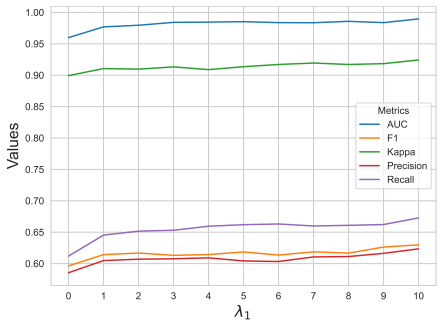
- [Fig. 7] The λ1 ablation shows performance still increasing at λ1=10, the largest value tested; please state whether larger values were considered or explain why λ1=10 was chosen as the endpoint.
Circularity Check
No significant circularity: the LMD training objectives are self-contained and test predictions are not used as inputs.
full rationale
The paper's derivation chain does not reduce any predicted result to a fitted input. Stage one (RRL) trains the encoder with cross-entropy plus consistency losses between strong and weak augmentations; stage two (ICC) estimates class-wise Gaussian parameters from the frozen encoder's features (Eq. 6), samples balanced virtual features, trains the classifier on them (Eq. 8), and fine-tunes the encoder with the FDC loss (Eqs. 10-12). The claimed contributions—balanced accuracy on ISIC-Archive-LT, ISIC-2019-LT, and Hyper-Kvasir—are measured on held-out test splits against external baselines, and none of the reported accuracies appears as a term in any loss or parameter update. Hyperparameters (lambda1=10, lambda_e=1e-4, R=50000, J) are selected on validation, which is standard tuning rather than hidden fitting. The self-citation to the authors' MICCAI 2023 paper (Pan et al., 2023) is used only to state provenance of the preliminary version and is not load-bearing. The skeptic's concern about Eq. (7)—that the balanced covariance estimate may be ill-conditioned or singular for tail classes with 26-243 samples in a 512-dimensional feature space—is a correctness and robustness concern about whether the Gaussian assumption holds and how the inverse covariance is computed in Eqs. (10)-(11); it is not circularity, because the estimate is not defined in terms of the target result and no predicted outcome equals an input by construction. Therefore no circular step is identified.
Assumptions & free parameters
free parameters (5)
- lambda_1 (stage-1 loss weight) =
10
- lambda_e (FDC loss weight) =
1e-4
- R (virtual features per class) =
50,000
- J (number of ICC iterations) =
not stated as a single number
- Stage-2 learning rates =
1e-5 (classifier), 1e-6 (encoder)
assumptions (4)
- domain assumption Each class's feature vectors follow a multivariate Gaussian distribution
- domain assumption EMA teacher provides stable, useful targets for consistency learning
- domain assumption ImageNet-pretrained ResNet-18 is an adequate feature extractor for medical images
- standard math Class-balanced sampling yields unbiased mean and covariance estimates
Cite this review
Pith. "Pith review of Long-tailed Medical Diagnosis with Relation-aware Representation Learning and Iterative Classifier Calibration." pith.science (2026). https://pith.science/paper/3RJ4AXOT
@misc{pith2026250203238,
  author       = {Pith},
  title        = {Pith review of: Long-tailed Medical Diagnosis with Relation-aware Representation Learning and Iterative Classifier Calibration},
  year         = {2026},
  howpublished = {\url{https://pith.science/paper/3RJ4AXOT}},
  note         = {Machine review of arXiv:2502.03238}
}
read the original abstract
Recently computer-aided diagnosis has demonstrated promising performance, effectively alleviating the workload of clinicians. However, the inherent sample imbalance among different diseases leads algorithms biased to the majority categories, leading to poor performance for rare categories. Existing works formulated this challenge as a long-tailed problem and attempted to tackle it by decoupling the feature representation and classification. Yet, due to the imbalanced distribution and limited samples from tail classes, these works are prone to biased representation learning and insufficient classifier calibration. To tackle these problems, we propose a new Long-tailed Medical Diagnosis (LMD) framework for balanced medical image classification on long-tailed datasets. In the initial stage, we develop a Relation-aware Representation Learning (RRL) scheme to boost the representation ability by encouraging the encoder to capture intrinsic semantic features through different data augmentations. In the subsequent stage, we propose an Iterative Classifier Calibration (ICC) scheme to calibrate the classifier iteratively. This is achieved by generating a large number of balanced virtual features and fine-tuning the encoder using an Expectation-Maximization manner. The proposed ICC compensates for minority categories to facilitate unbiased classifier optimization while maintaining the diagnostic knowledge in majority classes. Comprehensive experiments on three public long-tailed medical datasets demonstrate that our LMD framework significantly surpasses state-of-the-art approaches. The source code can be accessed at https://github.com/peterlipan/LMD.
Figures


Figures from the paper (4 more)


Reference graph
Works this paper leans on
-
[1]
+ is cited as + ESG96 +. In connection with cross-referencing and possible future hyperlinking it is not a good idea to collect more that one literature item in one + +. The so-called Harvard or author-year style of referencing is enabled by the package natbib . With this package the literature can be cited as follows: enumerate [ ] Parenthetical: + WB96 ...
work page 1996
-
[2]
write newline
" write newline "" before.all 'output.state := FUNCTION n.dashify 't := "" t empty not t #1 #1 substring "-" = t #1 #2 substring "--" = not "--" * t #2 global.max substring 't := t #1 #1 substring "-" = "-" * t #2 global.max substring 't := while if t #1 #1 substring * t #2 global.max substring 't := if while FUNCTION word.in bbl.in ":" * " " * FUNCTION f...
-
[3]
write newline
" write newline "" before.all 'output.state := FUNCTION n.dashify 't := "" t empty not t #1 #1 substring "-" = t #1 #2 substring "--" = not "--" * t #2 global.max substring 't := t #1 #1 substring "-" = "-" * t #2 global.max substring 't := while if t #1 #1 substring * t #2 global.max substring 't := if while FUNCTION word.in bbl.in ":" * " " * FUNCTION f...
-
[4]
write newline
" write newline "" before.all 'output.state := FUNCTION n.dashify 't := "" t empty not t #1 #1 substring "-" = t #1 #2 substring "--" = not "--" * t #2 global.max substring 't := t #1 #1 substring "-" = "-" * t #2 global.max substring 't := while if t #1 #1 substring * t #2 global.max substring 't := if while FUNCTION word.in bbl.in ":" * " " * FUNCTION f...
-
[5]
author Almalik, F. , author Yaqub, M. , author Nandakumar, K. , year 2022 . title Self-ensembling vision transformer (sevit) for robust medical image classification , in: booktitle International Conference on Medical Image Computing and Computer-Assisted Intervention , organization Springer . pp. pages 376--386
work page 2022
-
[6]
author Alshammari, S. , author Wang, Y.X. , author Ramanan, D. , author Kong, S. , year 2022 . title Long-tailed recognition via weight balancing , in: booktitle CVPR , pp. pages 6897--6907
work page 2022
-
[7]
author Borgli, H. , author Thambawita, V. , author Smedsrud, P.H. , author Hicks, S. , author Jha, D. , author Eskeland, S.L. , author Randel, K.R. , author Pogorelov, K. , author Lux, M. , author Nguyen, D.T.D. , author Johansen, D. , author Griwodz, C. , author Stensland, H.K. , author Garcia-Ceja, E. , author Schmidt, P.T. , author Hammer, H.L. , autho...
work page 2020
-
[8]
author Buda, M. , author Maki, A. , author Mazurowski, M.A. , year 2018 . title A systematic study of the class imbalance problem in convolutional neural networks . journal Neural networks volume 106 , pages 249--259
work page 2018
Show all 75 references
-
[9]
, author Iglovikov, V.I
author Buslaev, A. , author Iglovikov, V.I. , author Khvedchenya, E. , author Parinov, A. , author Druzhinin, M. , author Kalinin, A.A. , year 2020 . title Albumentations: Fast and flexible image augmentations . journal Information volume 11
2020
-
[10]
, author Wei, C
author Cao, K. , author Wei, C. , author Gaidon, A. , author Arechiga, N. , author Ma, T. , year 2019 . title Learning imbalanced datasets with label-distribution-aware margin loss . journal NeurIPS volume 32
2019
-
[11]
, author Lei, W
author Chen, K. , author Lei, W. , author Zhao, S. , author Zheng, W.S. , author Wang, R. , year 2023 a. title Pcct: Progressive class-center triplet loss for imbalanced medical image classification . journal IEEE Journal of Biomedical and Health Informatics volume 27 , pages ...
2023
-
[12]
, author Li, K
author Chen, W. , author Li, K. , year 2021 . title Self-supervised learning for medical image classification using imbalanced training data , in: booktitle International Symposium on Intelligence Computation and Applications , organization Springer . pp. pages 242--252
2021
-
[13]
, author Guo, Q
author Chen, Z. , author Guo, Q. , author Yeung, L.K. , author Chan, D.T. , author Lei, Z. , author Liu, H. , author Wang, J. , year 2023 b. title Surgical video captioning with mutual-modal concept alignment , in: booktitle MICCAI , organization Springer . pp. pages 24--34
2023
-
[14]
, author Guo, X
author Chen, Z. , author Guo, X. , author Woo, P.Y. , author Yuan, Y. , year 2021 a. title Super-resolution enhanced medical image diagnosis with sample affinity interaction . journal IEEE Transactions on Medical Imaging volume 40 , pages 1377--1389
2021
-
[15]
, author Guo, X
author Chen, Z. , author Guo, X. , author Yang, C. , author Ibragimov, B. , author Yuan, Y. , year 2020 . title Joint spatial-wavelet dual-stream network for super-resolution , in: booktitle MICCAI , organization Springer . pp. pages 184--193
2020
-
[16]
, author Li, W
author Chen, Z. , author Li, W. , author Xing, X. , author Yuan, Y. , year 2023 c. title Medical federated learning with joint graph purification for noisy label learning . journal Medical Image Analysis volume 90 , pages 102976
2023
-
[17]
, author Liu, J
author Chen, Z. , author Liu, J. , author Zhu, M. , author Woo, P.Y. , author Yuan, Y. , year 2022 a. title Instance importance-aware graph convolutional network for 3d medical diagnosis . journal Medical Image Analysis volume 78 , pages 102421
2022
-
[18]
, author Xu, Q
author Chen, Z. , author Xu, Q. , author Liu, X. , author Yuan, Y. , year 2024 . title Un-sam: Universal prompt-free segmentation for generalized nuclei images . journal arXiv preprint arXiv:2402.16663
2024 arXiv
-
[19]
, author Yang, C
author Chen, Z. , author Yang, C. , author Zhu, M. , author Peng, Z. , author Yuan, Y. , year 2022 b. title Personalized retrogress-resilient federated learning toward imbalanced medical data . journal IEEE Transactions on Medical Imaging volume 41 , pages 3663--3674
2022
-
[20]
, author Zhai, Y
author Chen, Z. , author Zhai, Y. , author Zhang, J. , author Wang, J. , year 2023 d. title Surgical temporal action-aware network with sequence regularization for phase recognition , in: booktitle BIBM , organization IEEE
2023
-
[21]
, author Zhang, J
author Chen, Z. , author Zhang, J. , author Che, S. , author Huang, J. , author Han, X. , author Yuan, Y. , year 2021 b. title Diagnose like a pathologist: Weakly-supervised pathologist-tree network for slide-level immunohistochemical scoring , in: booktitle Proceedings of the...
2021
-
[22]
, author Gutman, D
author Codella, N.C. , author Gutman, D. , author Celebi, M.E. , author Helba, B. , author Marchetti, M.A. , author Dusza, S.W. , author Kalloo, A. , author Liopyris, K. , author Mishra, N. , author Kittler, H. , et al., year 2018 . title Skin lesion analysis toward melanoma d...
2018
-
[23]
, author Codella, N.C
author Combalia, M. , author Codella, N.C. , author Rotemberg, V. , author Helba, B. , author Vilaplana, V. , author Reiter, O. , author Carrera, C. , author Barreiro, A. , author Halpern, A.C. , author Puig, S. , et al., year 2019 . title Bcn20000: Dermoscopic lesions in the ...
2019 arXiv
-
[24]
, author Jia, M
author Cui, Y. , author Jia, M. , author Lin, T.Y. , author Song, Y. , author Belongie, S. , year 2019 . title Class-balanced loss based on effective number of samples , in: booktitle CVPR , pp. pages 9268--9277
2019
-
[25]
, author Jouan-Rimbaud, D
author De Maesschalck, R. , author Jouan-Rimbaud, D. , author Massart, D.L. , year 2000 . title The mahalanobis distance . journal Chemometrics and intelligent laboratory systems volume 50 , pages 1--18
2000
-
[26]
, author Dong, W
author Deng, J. , author Dong, W. , author Socher, R. , author Li, L.J. , author Li, K. , author Fei-Fei, L. , year 2009 . title Imagenet: A large-scale hierarchical image database , in: booktitle CVPR , organization Ieee . pp. pages 248--255
2009
-
[27]
, author Ozkut, M
author Eryilmaz, S. , author Ozkut, M. , year 2020 . title Optimization problems for a parallel system with multiple types of dependent components . journal Reliability Engineering & System Safety volume 199 , pages 106911
2020
-
[28]
, author Kuprel, B
author Esteva, A. , author Kuprel, B. , author Novoa, R.A. , author Ko, J. , author Swetter, S.M. , author Blau, H.M. , author Thrun, S. , year 2017 . title Dermatologist-level classification of skin cancer with deep neural networks . journal Nature volume 542 , pages 115--118
2017
-
[29]
, author Zhang, D
author Fang, C. , author Zhang, D. , author Zheng, W. , author Li, X. , author Yang, L. , author Cheng, L. , author Han, J. , year 2023 . title Revisiting long-tailed image classification: Survey and benchmarks with new evaluation metrics . journal arXiv preprint arXiv:2302.01507
2023 arXiv
-
[30]
, author Carneiro, G
author Galdran, A. , author Carneiro, G. , author Gonz \'a lez Ballester, M.A. , year 2021 . title Balanced-mixup for highly imbalanced medical image classification , in: booktitle MICCAI , organization Springer . pp. pages 323--333
2021
-
[31]
, author Zhang, X
author He, K. , author Zhang, X. , author Ren, S. , author Sun, J. , year 2016 . title Deep residual learning for image recognition , in: booktitle CVPR , pp. pages 770--778
2016
-
[32]
, author Karray, F
author Islam, M.M. , author Karray, F. , author Alhajj, R. , author Zeng, J. , year 2021 . title A review on deep learning techniques for the diagnosis of novel coronavirus (covid-19) . journal Ieee Access volume 9 , pages 30551--30572
2021
-
[33]
, author Li, M
author Jin, Y. , author Li, M. , author Lu, Y. , author Cheung, Y.m. , author Wang, H. , year 2023 . title Long-tailed visual recognition via self-heterogeneous integration with knowledge excavation , in: booktitle Proceedings of the IEEE/CVF conference on computer vision and ...
2023
-
[34]
, author Wu, Y
author Ju, L. , author Wu, Y. , author Wang, L. , author Yu, Z. , author Zhao, X. , author Wang, X. , author Bonnington, P. , author Ge, Z. , year 2022 . title Flexible sampling for long-tailed skin lesion classification , in: booktitle MICCAI , organization Springer . pp. pag...
2022
-
[35]
, author Xie, S
author Kang, B. , author Xie, S. , author Rohrbach, M. , author Yan, Z. , author Gordo, A. , author Feng, J. , author Kalantidis, Y. , year 2020 . title Decoupling representation and classifier for long-tailed recognition . journal ICLR
2020
-
[36]
, author Shaukat, K
author Khushi, M. , author Shaukat, K. , author Alam, T.M. , author Hameed, I.A. , author Uddin, S. , author Luo, S. , author Yang, X. , author Reyes, M.C. , year 2021 . title A comparative performance analysis of data resampling methods on imbalance medical data . journal IEE...
2021
-
[37]
, author Chen, G
author Li, J. , author Chen, G. , author Mao, H. , author Deng, D. , author Li, D. , author Hao, J. , author Dou, Q. , author Heng, P.A. , year 2022 a. title Flat-aware cross-stage distilled framework for imbalanced medical image classification , in: booktitle MICCAI , organiz...
2022
-
[38]
, author Cheung, Y.m
author Li, M. , author Cheung, Y.m. , author Lu, Y. , year 2022 b. title Long-tailed visual recognition via gaussian clouded logit adjustment , in: booktitle Proceedings of the IEEE/CVF Conference on Computer Vision and Pattern Recognition , pp. pages 6929--6938
2022
-
[39]
, author Cheung, Y.m
author Li, M. , author Cheung, Y.m. , author Lu, Y. , author Hu, Z. , author Lan, W. , author Huang, H. , year 2024 a. title Adjusting logit in gaussian form for long-tailed visual recognition . journal IEEE Transactions on Artificial Intelligence
2024
-
[40]
, author Zhikai, H
author Li, M. , author Zhikai, H. , author Lu, Y. , author Lan, W. , author Cheung, Y.m. , author Huang, H. , year 2024 b. title Feature fusion from head to tail for long-tailed visual recognition , in: booktitle Proceedings of the AAAI Conference on Artificial Intelligence , ...
2024
-
[41]
, author Goyal, P
author Lin, T.Y. , author Goyal, P. , author Girshick, R. , author He, K. , author Doll \'a r, P. , year 2017 . title Focal loss for dense object detection , in: booktitle ICCV , pp. pages 2980--2988
2017
-
[42]
, author Sun, Y
author Liu, J. , author Sun, Y. , author Han, C. , author Dou, Z. , author Li, W. , year 2020 . title Deep representation learning on long-tailed data: A learnable embedding augmentation perspective , in: booktitle CVPR , pp. pages 2970--2979
2020
-
[43]
, author He, J
author Liu, X. , author He, J. , author Song, L. , author Liu, S. , author Srivastava, G. , year 2021 . title Medical image classification based on an adaptive size deep learning model . journal ACM Transactions on Multimedia Computing, Communications, and Applications (TOMM) ...
2021
-
[44]
, author Zhang, Y
author Lu, Y. , author Zhang, Y. , author Han, B. , author Cheung, Y.m. , author Wang, H. , year 2023 . title Label-noise learning with intrinsically long-tailed data , in: booktitle Proceedings of the IEEE/CVF International Conference on Computer Vision , pp. pages 1369--1378
2023
-
[45]
, author Pang, Y
author Luo, X. , author Pang, Y. , author Chen, Z. , author Wu, J. , author Zhang, Z. , author Lei, Z. , author Liu, H. , year 2024 . title Surgplan: Surgical phase localization network for phase recognition , in: booktitle ISBI , organization IEEE . pp. pages 1--5
2024
-
[46]
, author Hinton, G
author Van der Maaten, L. , author Hinton, G. , year 2008 . title Visualizing data using t-sne. journal Journal of machine learning research volume 9
2008
-
[47]
, author Makansi, O
author Marrakchi, Y. , author Makansi, O. , author Brox, T. , year 2021 . title Fighting class imbalance with contrastive learning , in: booktitle MICCAI , organization Springer . pp. pages 466--476
2021
-
[48]
, year 2016
author More, A. , year 2016 . title Survey of resampling techniques for improving classification performance in unbalanced datasets . journal arXiv:1608.06048
2016 arXiv
-
[49]
, author Jang, S
author Nam, G. , author Jang, S. , author Lee, J. , year 2023 . title Decoupled training for long-tailed classification with stochastic representations . journal arXiv:2304.09426
2023 arXiv
-
[50]
, author Zhang, Y
author Pan, L. , author Zhang, Y. , author Yang, Q. , author Li, T. , author Chen, Z. , year 2023 . title Combat long-tails in medical classification with relation-aware consistency and virtual features compensation , in: booktitle International Conference on Medical Image Com...
2023
-
[51]
, author Zhang, Y
author Pan, L. , author Zhang, Y. , author Yang, Q. , author Li, T. , author Xing, X. , author Yeung, M.C. , author Chen, Z. , year 2024 . title Focus on focus: Focus-oriented representation learning and multi-view cross-modal alignment for glioma grading , in: booktitle BIBM ...
2024
-
[52]
, author Gross, S
author Paszke, A. , author Gross, S. , author Massa, F. , author Lerer, A. , author Bradbury, J. , author Chanan, G. , author Killeen, T. , author Lin, Z. , author Gimelshein, N. , author Antiga, L. , et al., year 2019 . title Pytorch: An imperative style, high-performance dee...
2019
-
[53]
, author Mijani, A
author Rezaei-Dastjerdehei, M.R. , author Mijani, A. , author Fatemizadeh, E. , year 2020 . title Addressing imbalance in multi-label classification using weighted cross entropy loss function , in: booktitle ICBME , organization IEEE . pp. pages 333--338
2020
-
[54]
, author Ciga, O
author Srinidhi, C.L. , author Ciga, O. , author Martel, A.L. , year 2021 . title Deep neural network models for computational histopathology: A survey . journal Med. Image Anal. volume 67 , pages 101813
2021
-
[55]
, author Huang, J
author Tang, K. , author Huang, J. , author Zhang, H. , year 2020 . title Long-tailed classification by keeping the good and removing the bad momentum causal effect . journal NeurIPS volume 33 , pages 1513--1524
2020
-
[56]
, author Valpola, H
author Tarvainen, A. , author Valpola, H. , year 2017 . title Mean teachers are better role models: Weight-averaged consistency targets improve semi-supervised deep learning results . journal NeurIPS volume 30
2017
-
[57]
, author Rosendahl, C
author Tschandl, P. , author Rosendahl, C. , author Kittler, H. , year 2018 . title The ham10000 dataset, a large collection of multi-source dermatoscopic images of common pigmented skin lesions . journal Scientific data volume 5 , pages 1--9
2018
-
[58]
, author Langelaar, M
author Ur Rehman, S. , author Langelaar, M. , year 2017 . title Adaptive efficient global optimization of systems with independent components . journal Structural and Multidisciplinary Optimization volume 55 , pages 1143--1157
2017
-
[59]
, author Liu, Y
author Wang, D. , author Liu, Y. , author Fang, L. , author Shang, F. , author Liu, Y. , author Liu, H. , year 2022 . title Balanced gradient penalty improves deep long-tailed learning , in: booktitle ACM MM , pp. pages 5093--5101
2022
-
[60]
, author Zhang, W
author Wang, J. , author Zhang, W. , author Zang, Y. , author Cao, Y. , author Pang, J. , author Gong, T. , author Chen, K. , author Liu, Z. , author Loy, C.C. , author Lin, D. , year 2021 . title Seesaw loss for long-tailed instance segmentation , in: booktitle CVPR , pp. pag...
2021
-
[61]
, author Chen, Z
author Yang, Q. , author Chen, Z. , author Yuan, Y. , year 2023 . title Hierarchical bias mitigation for semi-supervised medical image classification . journal IEEE Transactions on Medical Imaging volume 42 , pages 2200--2210
2023
-
[62]
, author Guo, X
author Yang, Q. , author Guo, X. , author Chen, Z. , author Woo, P.Y. , author Yuan, Y. , year 2022 a. title D2-net: Dual disentanglement network for brain tumor segmentation with missing modalities . journal IEEE Transactions on Medical Imaging volume 41 , pages 2953--2964
2022
-
[63]
, author Liu, X
author Yang, Q. , author Liu, X. , author Chen, Z. , author Ibragimov, B. , author Yuan, Y. , year 2022 b. title Semi-supervised medical image classification with temporal knowledge-aware regularization , in: booktitle MICCAI , organization Springer . pp. pages 119--129
2022
-
[64]
, author Xu, Z
author Yang, Y. , author Xu, Z. , year 2020 . title Rethinking the value of labels for improving class-imbalanced learning . journal NeurIPS volume 33 , pages 19290--19301
2020
-
[65]
, author Wei, P
author Yue, G. , author Wei, P. , author Zhou, T. , author Jiang, Q. , author Yan, W. , author Wang, T. , year 2022 . title Toward multicenter skin lesion classification using deep neural network with adaptively weighted balance loss . journal IEEE Trans. Med. Imaging volume 4...
2022
-
[66]
, author Li, M
author Zhang, H. , author Li, M. , year 2014 . title Rwo-sampling: A random walk over-sampling approach to imbalanced data classification . journal Information Fusion volume 20 , pages 99--116
2014
-
[67]
, author Kang, B
author Zhang, Y. , author Kang, B. , author Hooi, B. , author Yan, S. , author Feng, J. , year 2021 a. title Deep long-tailed learning: A survey . journal arXiv preprint arXiv:2110.04596
2021 arXiv
-
[68]
, author Pan, L
author Zhang, Y. , author Pan, L. , author Yang, Q. , author Li, T. , author Chen, Z. , year 2024 . title Unified multi-modal diagnostic framework with reconstruction pre-training and heterogeneity-combat tuning . journal IEEE Journal of Biomedical and Health Informatics
2024
-
[69]
, author Tokmakov, P
author Zhang, Y. , author Tokmakov, P. , author Hebert, M. , author Schmid, C. , year 2019 . title A study on action detection in the wild . journal arXiv preprint arXiv:1904.12993
2019 arXiv
-
[70]
, author Wei, X.S
author Zhang, Y. , author Wei, X.S. , author Zhou, B. , author Wu, J. , year 2021 b. title Bag of tricks for long-tailed visual recognition with deep convolutional neural networks , in: booktitle AAAI , pp. pages 3447--3455
2021
-
[71]
, author Chen, B
author Zhao, S. , author Chen, B. , author Chang, H. , author Chen, B. , author Li, S. , year 2022 . title Reasoning discriminative dictionary-embedded network for fully automatic vertebrae tumor diagnosis . journal Medical Image Analysis volume 79 , pages 102456
2022
-
[72]
, author Cui, Q
author Zhou, B. , author Cui, Q. , author Wei, X.S. , author Chen, Z.M. , year 2020 . title Bbn: Bilateral-branch network with cumulative learning for long-tailed visual recognition , in: booktitle CVPR , pp. pages 9719--9728
2020
-
[73]
, author Li, L
author Zhou, Z. , author Li, L. , author Zhao, P. , author Heng, P.A. , author Gong, W. , year 2023 . title Class-conditional sharpness-aware minimization for deep long-tailed recognition , in: booktitle CVPR , pp. pages 3499--3509
2023
-
[74]
, author Chen, Z
author Zhu, M. , author Chen, Z. , author Yuan, Y. , year 2023 . title Feddm: Federated weakly supervised segmentation via annotation calibration and gradient de-conflicting . journal IEEE Transactions on Medical Imaging volume 42 , pages 1632--1643
2023
-
[75]
write newline
" write newline "" before.all 'output.state := FUNCTION n.dashify 't := "" t empty not t #1 #1 substring "-" = t #1 #2 substring "--" = not "--" * t #2 global.max substring 't := t #1 #1 substring "-" = "-" * t #2 global.max substring 't := while if t #1 #1 substring * t #2 gl...
Reviewed August 9, 2026 · model on record in the stance chip above.
Discussion (0). Continue with ORCID to comment.