REVIEW 4 major objections 6 minor 26 references
Reviewed by Pith at T0; open to challenge.
T0 means a machine referee read the full paper against a public rubric. The mark states how deep the mechanical check went, never who wrote it. the ladder, T0–T4 →
T0 review · glm-5.2
Tree-of-Thoughts reasoning fixes image prompt ambiguity
2026-07-09 19:46 UTC pith:3RPEWRNQ
load-bearing objection ToT applied to T2I-ICL: real gains over CoT, but ablation raises questions about what drives them the 4 major comments →
Tree-of-Thoughts Reasoning for Text-to-Image In-Context Learning
The pith
A machine-rendered reading of the paper's core claim, the machinery that carries it, and where it could break.
Core claim
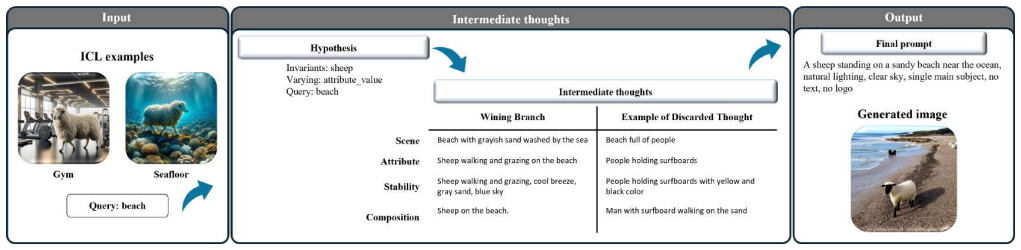
The paper demonstrates that applying Tree-of-Thoughts reasoning to text-to-image in-context learning improves compositional generalization and image-text alignment compared to baseline and Chain-of-Thought methods, without requiring any model fine-tuning. The improvement comes from a multi-stage, multi-branch reasoning process that generates, scores, and selects among candidate prompt interpretations before passing the final prompt to a frozen image generator.
What carries the argument
The central mechanism is a four-stage Tree-of-Thoughts reasoning pipeline: (1) Input Representation and Pattern Analysis, which extracts invariant elements, varying components, and the query entity from demonstrations; (2) Tree-of-Thoughts Reasoning, which decomposes reasoning into Scene, Attribute, Stability, and Composition stages, generates multiple candidate thoughts per stage, scores them using a weighted function with six criteria and two penalties, and prunes branches via beam search with a threshold; (3) Image Generation, which constructs a final prompt from the winning reasoning path and passes it to a frozen text-to-image diffusion model. The scoring function (Eq. 3) combines six手工
Load-bearing premise
The hand-crafted scoring function with six manually weighted criteria and two penalties accurately reflects prompt quality for image generation, and the fixed weights and pruning threshold generalize across all task types without per-task tuning.
What would settle it
If the scoring function used to evaluate and prune reasoning branches does not correlate with actual image quality, the branch-selection process could systematically favor incorrect reasoning paths, negating any benefit from multi-branch exploration.
If this is right
- Multi-branch reasoning could be applied to other multimodal generation tasks where prompt ambiguity causes compositional failures, such as video generation or 3D scene synthesis.
- The separation of reasoning from image generation suggests that improvements in language model reasoning can directly benefit image generation quality without retraining the image model.
- The Constraint Satisfaction Rate metric, which tests whether generated images satisfy task-specific structural constraints, could become a standard evaluation tool for compositional correctness in text-to-image systems.
- Adaptive branching strategies that dynamically adjust the number of reasoning branches based on task complexity could reduce the computational overhead identified as a limitation.
Where Pith is reading between the lines
- The hand-crafted scoring function with manually tuned weights is a potential bottleneck; a learned or adaptive scoring mechanism might yield further improvements, though the authors show the function is robust to moderate weight changes.
- The non-monotonic relationship between internal reasoning scores and image-level metrics suggests that the frozen image generator's limited controllability caps the benefits of improved reasoning, implying that co-designing the reasoning pipeline with the image generator could unlock additional gains.
- The approach is evaluated on a controlled benchmark with ten tasks; extending to open-domain scenarios with greater task diversity would test whether the structured reasoning stages generalize or require task-specific adaptation.
Editorial analysis
A structured set of objections, weighed in public.
Referee Report
Summary. The paper proposes a Tree-of-Thoughts (ToT) reasoning framework for text-to-image in-context learning (T2I-ICL). The method decomposes prompt construction into four stages (Scene, Attribute, Stability, Composition), generates multiple candidate thoughts per stage, scores them with a heuristic function, and prunes branches via beam search. The final selected reasoning path is converted into a text prompt and passed to a frozen Stable Diffusion model. The approach is evaluated on the CoBSAT benchmark (10 tasks, 300 samples) using CLIP similarity and a new Constraint Satisfaction Rate (CSR), showing improvements over Baseline and Chain-of-Thought (CoT) strategies. Human evaluation (21 participants, 20 samples) also favors ToT. The method requires no fine-tuning and operates entirely at inference time. Code is publicly available.
Significance. The paper addresses a genuine gap: applying structured multi-branch reasoning to T2I-ICL, where current MLLMs struggle with compositional generalization. The complete inference pipeline with publicly available code is a strength for reproducibility. The introduction of CSR as a task-specific metric that probes structural fidelity beyond CLIP similarity is a useful methodological contribution. The human evaluation, while limited in scale, provides complementary evidence. The work is a reasonable proof-of-concept that structured reasoning can improve prompt construction for T2I-ICL without training.
major comments (4)
- Table III (ablation on branch width B) directly tests the central claim that multi-branch reasoning improves image generation. On the 5-task ablation subset, B=1 (single-chain, no branching) achieves CLIP 0.3206 and CSR 0.8833, while B=3 (the reported setting) achieves CLIP 0.3064 and CSR 0.9000. The CLIP score decreases with branching, and the CSR difference is within one standard deviation (±0.2034 for B=3). Crucially, B=1 is not equivalent to the CoT baseline in Table I; B=1 still uses the full 4-stage decomposition, hypothesis generation, constraint enforcement, and rule-based filtering. If B=1 performs comparably to B=3 on image-level metrics, the active ingredient may be the structured decomposition rather than the multi-branch ToT exploration that defines the paper's central contribution. The paper acknowledges this disconnect but attributes it to 'branch-selection noise' and 'fro
- There is an unexplained discrepancy between the CSR values in Table I and Table III. Table I reports ToT CSR as 0.775±0.252 across all 10 tasks (300 samples). Table III reports CSR values of 0.8833–0.9000 on the 5-task ablation subset (30 samples per task, 150 total). While some difference is expected from the different task subsets, the ablation subset CSR being substantially higher than the full-benchmark CSR raises questions about whether the ablation subset is representative. The paper should clarify whether the ablation subset was selected and whether the full-benchmark tasks that are excluded show lower performance, as this affects the generalizability of the ablation conclusions. The ablation should ideally be extended to all 10 tasks, or the selection criteria for the subset should be justified.
- The scoring function (Eq. 3) uses six manually weighted criteria with weights w_k = {0.24, 0.22, 0.18, 0.14, 0.12, 0.10} and two penalty terms (p_leap, p_red), all relying on lexical matching and keyword detection. Table IV tests robustness to weight changes but only on the 5-task subset, and the CSR range (0.9167–0.9333) is narrow and high, making it difficult to distinguish settings. The paper states weights are 'fixed and manually set based on preliminary experiments' (§III-B) but does not describe these experiments. Given that the scoring function drives branch selection and is central to the method, the sensitivity analysis should be expanded to the full benchmark, and the preliminary experiments used to select the weights should be described or at least summarized. Without this, it is unclear whether the reported main results depend on weight tuning that may not generalize.
- The relationship between the internal reasoning score (column 'Reasoning Score (s)' in Table III) and downstream image metrics (CLIP, CSR) is presented as potentially disconnected. The reasoning score increases monotonically with B (0.489 → 0.723), but image metrics do not. The paper notes this in the text but does not analyze which branches are selected at higher B or whether the scoring function is systematically selecting branches that score well internally but produce worse images. A brief analysis of selected branches at B=2 vs. B=3, or a comparison of the prompts produced, would help clarify whether the scoring function is the bottleneck and whether the claim of 'selecting a coherent interpretation' is empirically supported at the image level. This is important because the paper's framing emphasizes the selection mechanism as a key contribution.
minor comments (6)
- §III-B, Eq. (3): The weights w_k are listed as a set {0.24, 0.22, 0.18, 0.14, 0.12, 0.10} but the six criteria are listed in a bulleted list without explicit mapping between each weight and the corresponding criterion. This mapping should be made explicit.
- §IV-B: The specific version of SEED-LLaMA used as the reasoning backbone and the Stable Diffusion version/model checkpoint used for image generation are not specified. These should be stated for reproducibility.
- Table II: The human evaluation reports 21 participants and 20 samples. The criteria (Example, Query, Joint) are described but the exact instructions given to participants are not included. A brief description of the evaluation protocol or an appendix with the instructions would strengthen the statistical claim.
- The arXiv stamp reads '8 Jul 2026' which appears to be a future date; this is likely a formatting artifact but should be corrected.
- §III-B: The penalty bounds p_leap ∈ [0, 0.5] and p_red ∈ [0, 0.5] are specified, but the exact computation of these penalties (how lexical matching determines the penalty value within the range) is not described in detail. A brief specification would improve reproducibility.
- Fig. 1 is referenced as illustrating the pipeline but the figure caption mentions 'adaptive branch selection based on score differences' which is not clearly distinguished from the threshold τ rule described in the text. Clarifying whether 'adaptive' refers to the τ-based pruning or an additional mechanism would help.
Circularity Check
No circularity found: the derivation chain is self-contained with independent content at each stage
full rationale
The paper's pipeline flows: (1) input demonstrations → heuristic pattern analysis extracting invariants/variables, (2) multi-branch ToT reasoning with a hand-crafted scoring function (Eq. 3) that selects among candidate thoughts, (3) prompt construction from the winning branch, (4) image generation by a frozen Stable Diffusion model. No step reduces to its inputs by construction. The scoring function (Eq. 3) is a heuristic composed of lexical-matching criteria and penalties — it is not defined in terms of the output metric (CLIP/CSR), so there is no self-definitional loop. The manually set weights (w_k) and pruning threshold (τ=0.08) are tuned on preliminary experiments, but the main results are evaluated on the full CoBSAT benchmark with external metrics (CLIP, CSR, human eval), so this is parameter tuning, not fitted-input-called-prediction. The ablation (Table IV) confirms robustness to weight perturbations, further arguing against overfitting. Self-citations ([7], [8], [12]–[15], [19]–[22]) are on unrelated topics (face recognition, few-shot learning, action recognition, diffusion interpretability) and are not load-bearing for the central claim. The core premise rests on external work: CoBSAT [6] by Zeng et al. and ToT [24] by Yao et al. The skeptic's concern that B=1 performs comparably to B=3 on image metrics is an empirical/correctness issue about which component drives improvement, not a circularity problem — the paper does not claim branching improves metrics by definition; it reports measured results and acknowledges the disconnect. No step in the derivation chain is equivalent to its inputs by construction.
Axiom & Free-Parameter Ledger
free parameters (4)
- Scoring weights w_k =
{0.24, 0.22, 0.18, 0.14, 0.12, 0.10}
- Pruning threshold τ =
0.08
- Branching width B =
3 (early stages: 3 candidates, later stages: 2)
- Penalty bounds p_leap, p_red =
[0, 0.5]
axioms (3)
- ad hoc to paper The four-stage decomposition (Scene, Attribute, Stability, Composition) captures the relevant dimensions of prompt construction for T2I-ICL.
- domain assumption Lexical matching and keyword detection are sufficient to evaluate the quality of candidate reasoning thoughts.
- domain assumption CLIP similarity and the custom Constraint Satisfaction Rate (CSR) are adequate proxies for image-text alignment and compositional correctness.
read the original abstract
In text-to-image in-context learning (T2I-ICL), a model has to infer a latent compositional pattern from fewshot demonstrations for generating a query image. Recent studies show that state-of-the-art multimodal large language models struggle with this setting, particularly due to limited compositional reasoning and sensitivity to prompt construction. In this work, we propose a Tree-of-Thoughts (ToT) reasoning framework for T2I-ICL that introduces a multi-stage reasoning and selection layer that generates, evaluates, and selects among multiple candidate hypotheses before constructing the final prompt for image synthesis. By exploring alternative reasoning branches and selecting a coherent interpretation, the proposed approach mitigates prompt ambiguity and compositional errors. We implement the proposed approach in a complete ToT-T2IICL inference pipeline and evaluate it on the CoBSAT benchmark. Both qualitative and quantitative results show that structured multi-branch reasoning leads to more consistent and semantically aligned image generation compared to baseline and Chain-of-Thought prompting strategies, without any additional training or fine-tuning.
Figures


Reference graph
Works this paper leans on
-
[1]
High-resolution image synthesis with latent diffusion models,
R. Rombach, A. Blattmann, D. Lorenz, P. Esser, and B. Ommer, “High-resolution image synthesis with latent diffusion models,” in Proc. IEEE/CVF Conf. Comput. Vis. Pattern Recognit. (CVPR), 2022, pp. 10 684–10 695
work page 2022
-
[2]
Zero-shot text-to-image generation,
A. Rameshet al., “Zero-shot text-to-image generation,” inInt. Conf. Mach. Learn. (ICML), 2021, pp. 8821–8831
work page 2021
-
[3]
Composi- tional visual generation with composable diffusion models,
N. Liu, S. Li, Y . Du, A. Torralba, and J. B. Tenenbaum, “Composi- tional visual generation with composable diffusion models,” inEur. Conf. Comput. Vis. (ECCV), 2022, pp. 423–439
work page 2022
-
[4]
Flamingo: A visual language model for few- shot learning,
J.-B. Alayracet al., “Flamingo: A visual language model for few- shot learning,”Adv. Neural Inf. Process. Syst. (NeurIPS), vol. 35, pp. 23 716–23 736, 2022
work page 2022
-
[5]
Context diffusion: In-context aware image generation,
I. Najdenkoska, A. Sinha, A. Dubey, D. Mahajan, V . Ramanathan, and F. Radenovic, “Context diffusion: In-context aware image generation,” inEur. Conf. Comput. Vis. (ECCV), 2024, pp. 375–391
work page 2024
-
[6]
Can mllms perform text-to-image in-context learning?
Y . Zeng, W. Kang, Y . Chen, H. I. Koo, and K. Lee, “Can mllms perform text-to-image in-context learning?” inConf. Lang. Model. (COLM), 2024
work page 2024
-
[7]
J.-H. Park, Y .-J. Ju, and S.-W. Lee, “Explaining generative diffusion models via visual analysis for interpretable decision-making process,” Expert Syst. Appl., vol. 248, p. 123231, 2024
work page 2024
-
[8]
Flipconcept: Tuning-free multi- concept personalization for text-to-image generation,
Y .-B. Woo, S.-E. Kim, and S.-W. Lee, “Flipconcept: Tuning-free multi- concept personalization for text-to-image generation,” inProc. IEEE Int. Conf. Syst. Man Cybern. (SMC), 2025, pp. 4390–4395
work page 2025
-
[9]
Ranni: Taming text-to-image diffusion for accurate instruction following,
Y . Feng, B. Gong, D. Chen, Y . Shen, Y . Liu, and J. Zhou, “Ranni: Taming text-to-image diffusion for accurate instruction following,” in Proc. IEEE/CVF Conf. Comput. Vis. Pattern Recognit. (CVPR), 2024, pp. 4744–4753
work page 2024
-
[10]
Versagen: Unleashing versatile visual control for text- to-image synthesis,
Z. Chenet al., “Versagen: Unleashing versatile visual control for text- to-image synthesis,” inProc. AAAI Conf. Artif. Intell. (AAAI), vol. 39, no. 3, 2025, pp. 2394–2402
work page 2025
-
[11]
A survey on in-context learning,
Q. Donget al., “A survey on in-context learning,” inProc. Conf. Empirical Methods Natural Lang. Process. (EMNLP), 2024, pp. 1107– 1128
work page 2024
-
[12]
Few-shot learning with geometric con- straints,
H.-G. Jung and S.-W. Lee, “Few-shot learning with geometric con- straints,”IEEE Trans. Neural Netw. Learn. Syst., vol. 31, no. 11, pp. 4660–4672, 2020
work page 2020
-
[13]
Self-augmentation: General- izing deep networks to unseen classes for few-shot learning,
J.-W. Seo, H.-G. Jung, and S.-W. Lee, “Self-augmentation: General- izing deep networks to unseen classes for few-shot learning,”Neural Netw., vol. 138, pp. 140–149, 2021
work page 2021
-
[14]
Spatial reasoning for few-shot object detection,
G. Kim, H.-G. Jung, and S.-W. Lee, “Spatial reasoning for few-shot object detection,”Pattern Recognit., vol. 120, p. 108118, 2021
work page 2021
-
[15]
Discriminative context learning with gated recurrent unit for group activity recognition,
P.-S. Kim, D.-G. Lee, and S.-W. Lee, “Discriminative context learning with gated recurrent unit for group activity recognition,”Pattern Recognit., vol. 76, pp. 149–161, 2018
work page 2018
-
[16]
Imagegen-cot: Enhancing text-to-image in-context learning with chain-of-thought reasoning,
J. Liaoet al., “Imagegen-cot: Enhancing text-to-image in-context learning with chain-of-thought reasoning,” inProc. IEEE/CVF Int. Conf. Comput. Vis. (ICCV), 2025, pp. 17 214–17 223
work page 2025
-
[17]
In-context learning unlocked for diffusion models,
Z. Wanget al., “In-context learning unlocked for diffusion models,” Adv. Neural Inf. Process. Syst. (NeurIPS), vol. 36, pp. 8542–8562, 2023
work page 2023
-
[18]
Analogist: Out-of-the-box visual in-context learning with image diffusion model,
Z. Gu, S. Yang, J. Liao, J. Huo, and Y . Gao, “Analogist: Out-of-the-box visual in-context learning with image diffusion model,”ACM Trans. Graph., vol. 43, no. 4, pp. 1–15, 2024
work page 2024
-
[19]
Pill-id: Matching and retrieval of drug pill images,
Y .-B. Lee, U. Park, A. K. Jain, and S.-W. Lee, “Pill-id: Matching and retrieval of drug pill images,”Pattern Recognit. Lett., vol. 33, no. 7, pp. 904–910, 2012
work page 2012
-
[20]
Nighttime face recog- nition at large standoff: Cross-distance and cross-spectral matching,
D. Kang, H. Han, A. K. Jain, and S.-W. Lee, “Nighttime face recog- nition at large standoff: Cross-distance and cross-spectral matching,” Pattern Recognit., vol. 47, no. 12, pp. 3750–3766, 2014
work page 2014
-
[21]
View-independent human action recognition with volume motion template on single stereo camera,
M.-C. Roh, H.-K. Shin, and S.-W. Lee, “View-independent human action recognition with volume motion template on single stereo camera,”Pattern Recognit. Lett., vol. 31, no. 7, pp. 639–647, 2010
work page 2010
-
[22]
Text extraction in mpeg compressed video for content-based indexing,
Y .-K. Lim, S.-H. Choi, and S.-W. Lee, “Text extraction in mpeg compressed video for content-based indexing,” inProc. Int. Conf. Pattern Recognit. (ICPR), vol. 4, 2000, pp. 409–412
work page 2000
-
[23]
Chain-of-thought prompting elicits reasoning in large language models,
J. Weiet al., “Chain-of-thought prompting elicits reasoning in large language models,”Adv. Neural Inf. Process. Syst. (NeurIPS), vol. 35, pp. 24 824–24 837, 2022
work page 2022
-
[24]
Tree of thoughts: Deliberate problem solving with large language models,
S. Yaoet al., “Tree of thoughts: Deliberate problem solving with large language models,”Adv. Neural Inf. Process. Syst. (NeurIPS), vol. 36, pp. 11 809–11 822, 2023
work page 2023
-
[25]
Making LLaMA SEE and Draw with SEED Tokenizer
Y . Geet al., “Making llama see and draw with seed tokenizer,”arXiv preprint arXiv:2310.01218, 2023
work page internal anchor Pith review Pith/arXiv arXiv 2023
-
[26]
Learning transferable visual models from natural language supervision,
A. Radfordet al., “Learning transferable visual models from natural language supervision,” inInt. Conf. Mach. Learn. (ICML), 2021, pp. 8748–8763
work page 2021
discussion (0)
Sign in with ORCID, Apple, or X to comment. Anyone can read and Pith papers without signing in.